Verbs 2: Phrases and
Auxiliaries
Materials by Liz Siler
Review Point
• In our first slides we looked at a FORMbased way to consider verbs.
• We will now look at a different way to
consider verbs --- a functional, rolebased way.
Lexical and Auxiliary Verbs
• Verbs can be divided into two subcategories: lexical verbs and auxiliary
verbs.
• Together these form verb phrases.
Definition: Verb Phrase
• A verb phrase is a group of words that
consists of a lexical verb and all its
auxiliaries if there are any.
• If there are any adverbs between the
lexical verb and the auxiliaries, they are
part of the verb phrase.
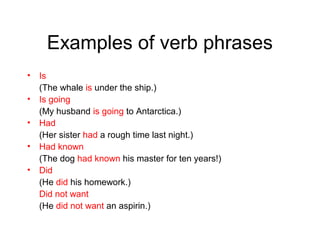
Examples of verb phrases
•
•
•
•
•

Is
(The whale is under the ship.)
Is going
(My husband is going to Antarctica.)
Had
(Her sister had a rough time last night.)
Had known
(The dog had known his master for ten years!)
Did
(He did his homework.)
Did not want
(He did not want an aspirin.)
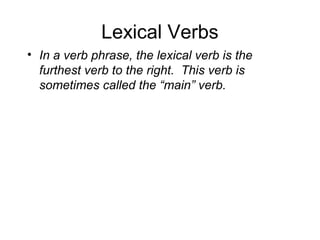
Lexical Verbs
• In a verb phrase, the lexical verb is the
furthest verb to the right. This verb is
sometimes called the “main” verb.
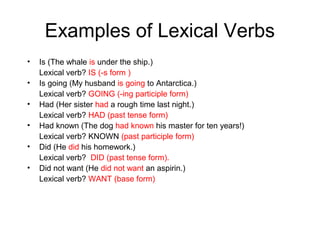
Examples of Lexical Verbs
•
•
•
•
•
•

Is (The whale is under the ship.)
Lexical verb? IS (-s form )
Is going (My husband is going to Antarctica.)
Lexical verb? GOING (-ing participle form)
Had (Her sister had a rough time last night.)
Lexical verb? HAD (past tense form)
Had known (The dog had known his master for ten years!)
Lexical verb? KNOWN (past participle form)
Did (He did his homework.)
Lexical verb? DID (past tense form).
Did not want (He did not want an aspirin.)
Lexical verb? WANT (base form)
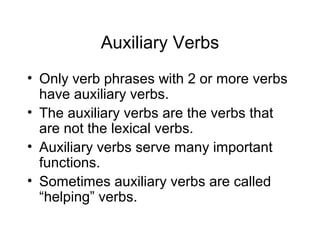
Auxiliary Verbs
• Only verb phrases with 2 or more verbs
have auxiliary verbs.
• The auxiliary verbs are the verbs that
are not the lexical verbs.
• Auxiliary verbs serve many important
functions.
• Sometimes auxiliary verbs are called
“helping” verbs.
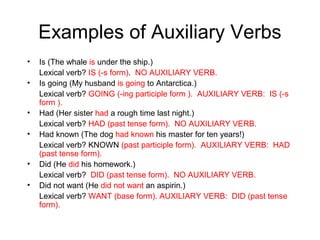
Examples of Auxiliary Verbs
•
•

•
•

•
•

Is (The whale is under the ship.)
Lexical verb? IS (-s form). NO AUXILIARY VERB.
Is going (My husband is going to Antarctica.)
Lexical verb? GOING (-ing participle form ). AUXILIARY VERB: IS (-s
form ).
Had (Her sister had a rough time last night.)
Lexical verb? HAD (past tense form). NO AUXILIARY VERB.
Had known (The dog had known his master for ten years!)
Lexical verb? KNOWN (past participle form). AUXILIARY VERB: HAD
(past tense form).
Did (He did his homework.)
Lexical verb? DID (past tense form). NO AUXILIARY VERB.
Did not want (He did not want an aspirin.)
Lexical verb? WANT (base form). AUXILIARY VERB: DID (past tense
form).
Types of Auxiliaries
• There are basically two kinds of
auxiliaries: primary and modal.
Primary Auxiliaries
• Primary auxiliaries are formed with
forms of the verbs to have, do, and be.
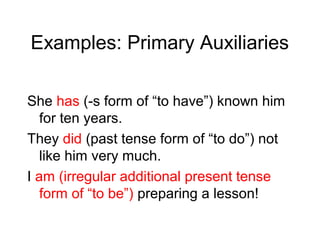
Examples: Primary Auxiliaries
She has (-s form of “to have”) known him
for ten years.
They did (past tense form of “to do”) not
like him very much.
I am (irregular additional present tense
form of “to be”) preparing a lesson!
The Verb To Do
• “Do” can be a primary auxiliary or a
lexical verb.
• It’s an important verb --- so learn it in all
its forms.
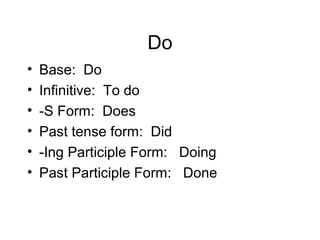
Do
•
•
•
•
•
•

Base: Do
Infinitive: To do
-S Form: Does
Past tense form: Did
-Ing Participle Form: Doing
Past Participle Form: Done
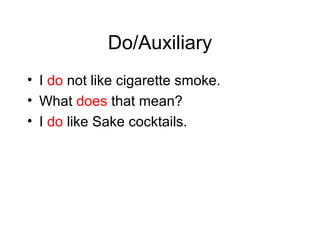
Do/Auxiliary
• I do not like cigarette smoke.
• What does that mean?
• I do like Sake cocktails.
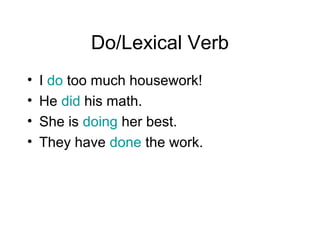
Do/Lexical Verb
•
•
•
•

I do too much housework!
He did his math.
She is doing her best.
They have done the work.
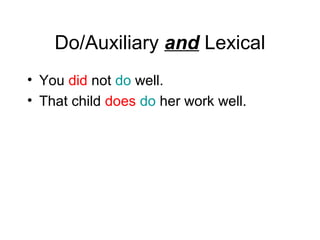
Do/Auxiliary and Lexical
• You did not do well.
• That child does do her work well.
The Verb To Be
• “Be” can be a primary auxiliary or a
lexical verb.
• It’s a very important verb --- learn it!
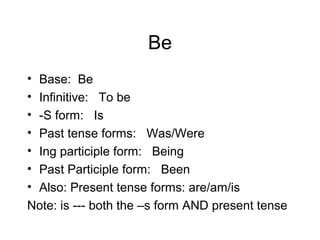
Be
•
•
•
•
•
•
•

Base: Be
Infinitive: To be
-S form: Is
Past tense forms: Was/Were
Ing participle form: Being
Past Participle form: Been
Also: Present tense forms: are/am/is
Note: is --- both the –s form AND present tense
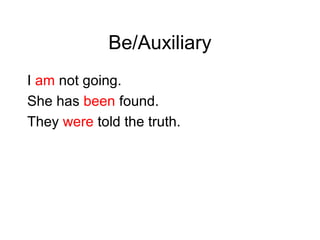
Be/Auxiliary
I am not going.
She has been found.
They were told the truth.
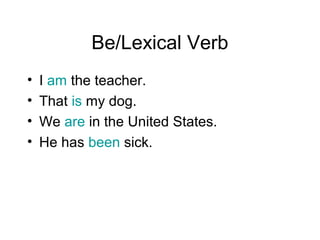
Be/Lexical Verb
•
•
•
•

I am the teacher.
That is my dog.
We are in the United States.
He has been sick.
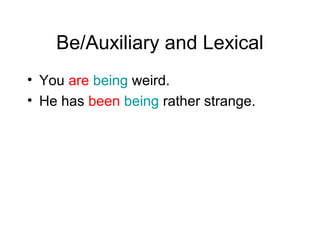
Be/Auxiliary and Lexical
• You are being weird.
• He has been being rather strange.
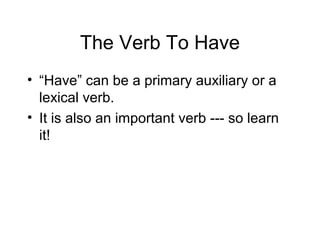
The Verb To Have
• “Have” can be a primary auxiliary or a
lexical verb.
• It is also an important verb --- so learn
it!
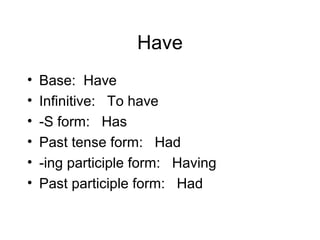
Have
•
•
•
•
•
•

Base: Have
Infinitive: To have
-S form: Has
Past tense form: Had
-ing participle form: Having
Past participle form: Had
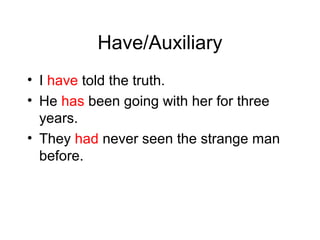
Have/Auxiliary
• I have told the truth.
• He has been going with her for three
years.
• They had never seen the strange man
before.
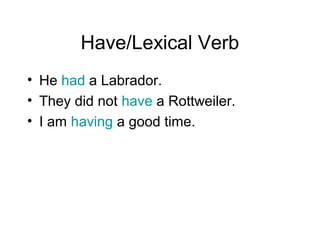
Have/Lexical Verb
• He had a Labrador.
• They did not have a Rottweiler.
• I am having a good time.
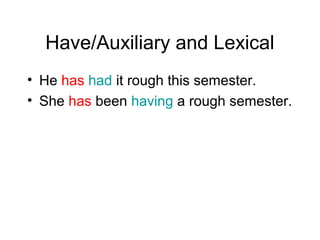
Have/Auxiliary and Lexical
• He has had it rough this semester.
• She has been having a rough semester.

Verbs2

  • 1.
    Verbs 2: Phrasesand Auxiliaries Materials by Liz Siler
  • 2.
    Review Point • Inour first slides we looked at a FORMbased way to consider verbs. • We will now look at a different way to consider verbs --- a functional, rolebased way.
  • 3.
    Lexical and AuxiliaryVerbs • Verbs can be divided into two subcategories: lexical verbs and auxiliary verbs. • Together these form verb phrases.
  • 4.
    Definition: Verb Phrase •A verb phrase is a group of words that consists of a lexical verb and all its auxiliaries if there are any. • If there are any adverbs between the lexical verb and the auxiliaries, they are part of the verb phrase.
  • 5.
    Examples of verbphrases • • • • • Is (The whale is under the ship.) Is going (My husband is going to Antarctica.) Had (Her sister had a rough time last night.) Had known (The dog had known his master for ten years!) Did (He did his homework.) Did not want (He did not want an aspirin.)
  • 6.
    Lexical Verbs • Ina verb phrase, the lexical verb is the furthest verb to the right. This verb is sometimes called the “main” verb.
  • 7.
    Examples of LexicalVerbs • • • • • • Is (The whale is under the ship.) Lexical verb? IS (-s form ) Is going (My husband is going to Antarctica.) Lexical verb? GOING (-ing participle form) Had (Her sister had a rough time last night.) Lexical verb? HAD (past tense form) Had known (The dog had known his master for ten years!) Lexical verb? KNOWN (past participle form) Did (He did his homework.) Lexical verb? DID (past tense form). Did not want (He did not want an aspirin.) Lexical verb? WANT (base form)
  • 8.
    Auxiliary Verbs • Onlyverb phrases with 2 or more verbs have auxiliary verbs. • The auxiliary verbs are the verbs that are not the lexical verbs. • Auxiliary verbs serve many important functions. • Sometimes auxiliary verbs are called “helping” verbs.
  • 9.
    Examples of AuxiliaryVerbs • • • • • • Is (The whale is under the ship.) Lexical verb? IS (-s form). NO AUXILIARY VERB. Is going (My husband is going to Antarctica.) Lexical verb? GOING (-ing participle form ). AUXILIARY VERB: IS (-s form ). Had (Her sister had a rough time last night.) Lexical verb? HAD (past tense form). NO AUXILIARY VERB. Had known (The dog had known his master for ten years!) Lexical verb? KNOWN (past participle form). AUXILIARY VERB: HAD (past tense form). Did (He did his homework.) Lexical verb? DID (past tense form). NO AUXILIARY VERB. Did not want (He did not want an aspirin.) Lexical verb? WANT (base form). AUXILIARY VERB: DID (past tense form).
  • 10.
    Types of Auxiliaries •There are basically two kinds of auxiliaries: primary and modal.
  • 11.
    Primary Auxiliaries • Primaryauxiliaries are formed with forms of the verbs to have, do, and be.
  • 12.
    Examples: Primary Auxiliaries Shehas (-s form of “to have”) known him for ten years. They did (past tense form of “to do”) not like him very much. I am (irregular additional present tense form of “to be”) preparing a lesson!
  • 13.
    The Verb ToDo • “Do” can be a primary auxiliary or a lexical verb. • It’s an important verb --- so learn it in all its forms.
  • 14.
    Do • • • • • • Base: Do Infinitive: Todo -S Form: Does Past tense form: Did -Ing Participle Form: Doing Past Participle Form: Done
  • 15.
    Do/Auxiliary • I donot like cigarette smoke. • What does that mean? • I do like Sake cocktails.
  • 16.
    Do/Lexical Verb • • • • I dotoo much housework! He did his math. She is doing her best. They have done the work.
  • 17.
    Do/Auxiliary and Lexical •You did not do well. • That child does do her work well.
  • 18.
    The Verb ToBe • “Be” can be a primary auxiliary or a lexical verb. • It’s a very important verb --- learn it!
  • 19.
    Be • • • • • • • Base: Be Infinitive: Tobe -S form: Is Past tense forms: Was/Were Ing participle form: Being Past Participle form: Been Also: Present tense forms: are/am/is Note: is --- both the –s form AND present tense
  • 20.
    Be/Auxiliary I am notgoing. She has been found. They were told the truth.
  • 21.
    Be/Lexical Verb • • • • I amthe teacher. That is my dog. We are in the United States. He has been sick.
  • 22.
    Be/Auxiliary and Lexical •You are being weird. • He has been being rather strange.
  • 23.
    The Verb ToHave • “Have” can be a primary auxiliary or a lexical verb. • It is also an important verb --- so learn it!
  • 24.
    Have • • • • • • Base: Have Infinitive: Tohave -S form: Has Past tense form: Had -ing participle form: Having Past participle form: Had
  • 25.
    Have/Auxiliary • I havetold the truth. • He has been going with her for three years. • They had never seen the strange man before.
  • 26.
    Have/Lexical Verb • Hehad a Labrador. • They did not have a Rottweiler. • I am having a good time.
  • 27.
    Have/Auxiliary and Lexical •He has had it rough this semester. • She has been having a rough semester.