The Past Tenses of Spanish

          E. Siler
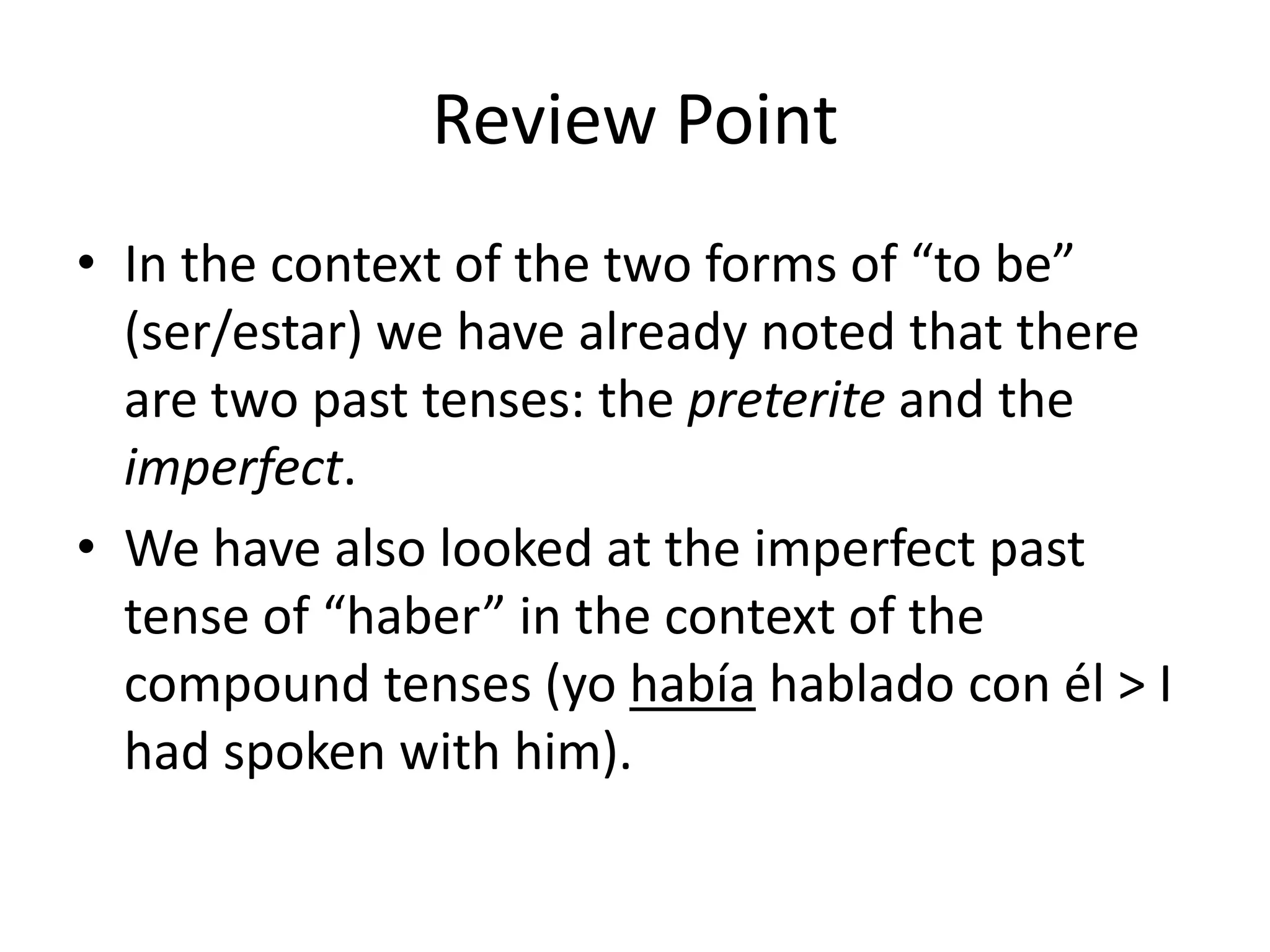
Review Point
• In the context of the two forms of “to be”
  (ser/estar) we have already noted that there
  are two past tenses: the preterite and the
  imperfect.
• We have also looked at the imperfect past
  tense of “haber” in the context of the
  compound tenses (yo había hablado con él > I
  had spoken with him).
Focus
• The expression of the past in Spanish routinely
  includes use of the preterite and the
  imperfect.
The Preterite

  A Past Tense
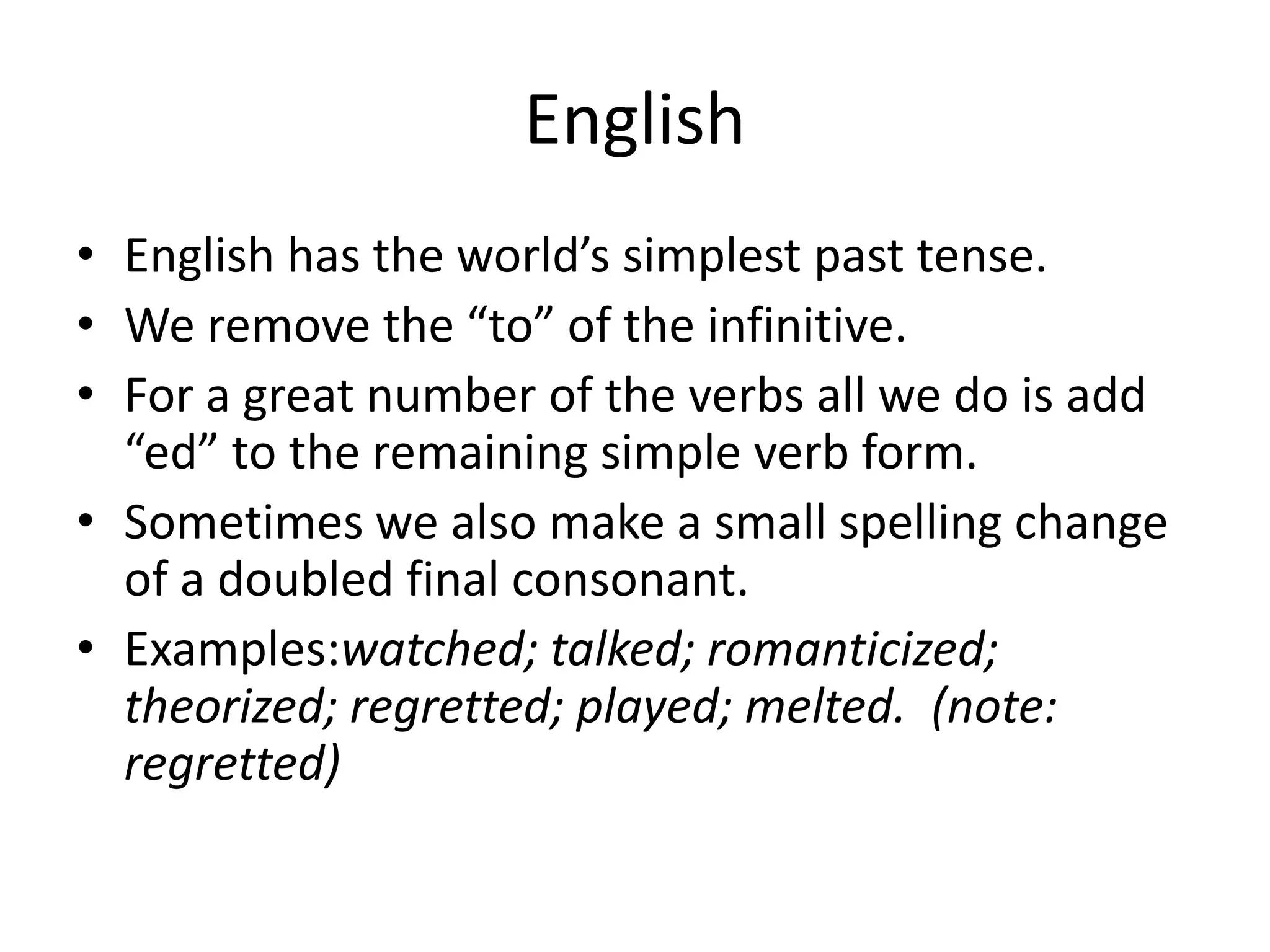
English
• English has the world’s simplest past tense.
• We remove the “to” of the infinitive.
• For a great number of the verbs all we do is add
  “ed” to the remaining simple verb form.
• Sometimes we also make a small spelling change
  of a doubled final consonant.
• Examples:watched; talked; romanticized;
  theorized; regretted; played; melted. (note:
  regretted)
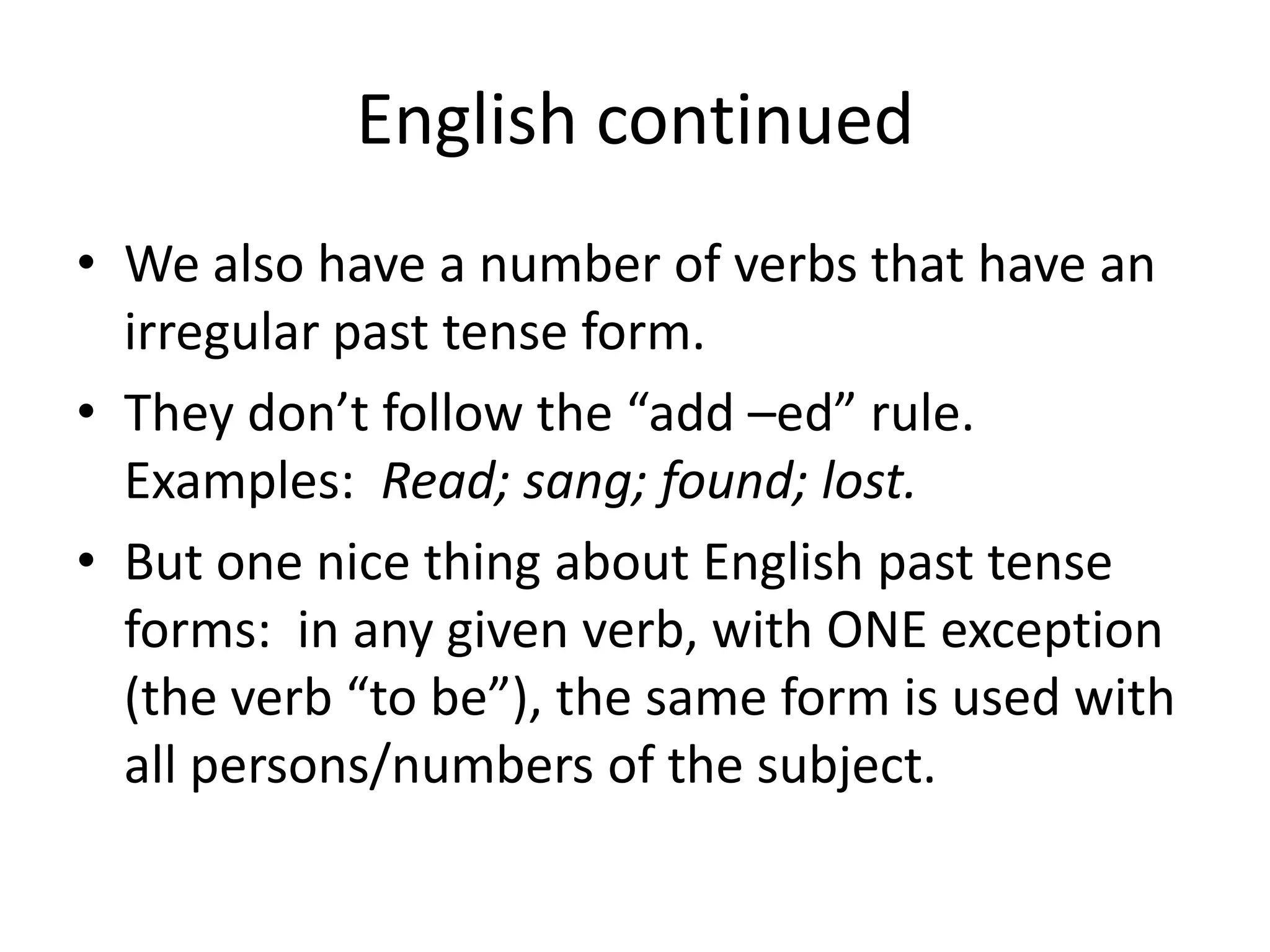
English continued
• We also have a number of verbs that have an
  irregular past tense form.
• They don’t follow the “add –ed” rule.
  Examples: Read; sang; found; lost.
• But one nice thing about English past tense
  forms: in any given verb, with ONE exception
  (the verb “to be”), the same form is used with
  all persons/numbers of the subject.
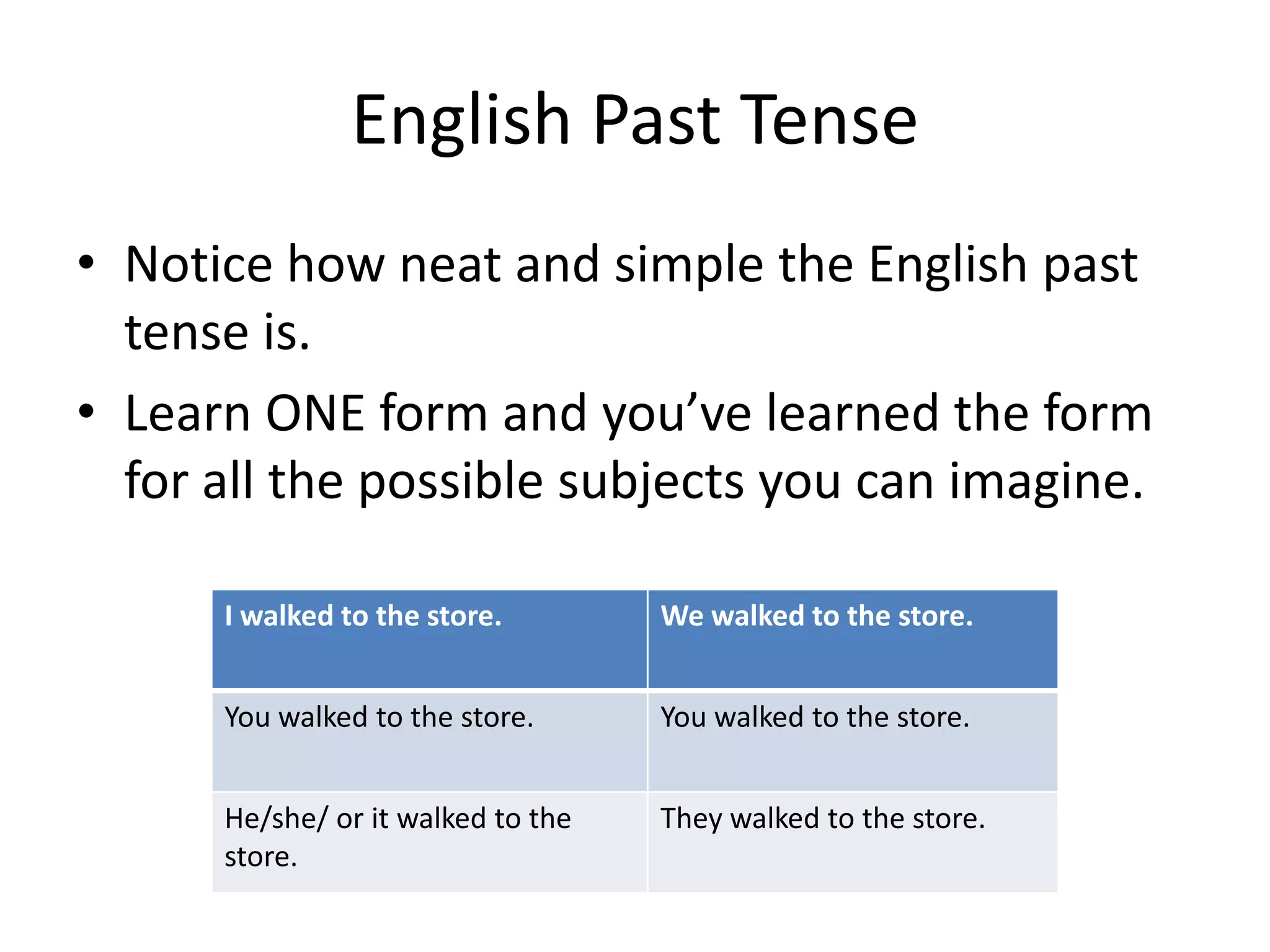
English Past Tense
• Notice how neat and simple the English past
  tense is.
• Learn ONE form and you’ve learned the form
  for all the possible subjects you can imagine.

      I walked to the store.        We walked to the store.


      You walked to the store.      You walked to the store.


      He/she/ or it walked to the   They walked to the store.
      store.
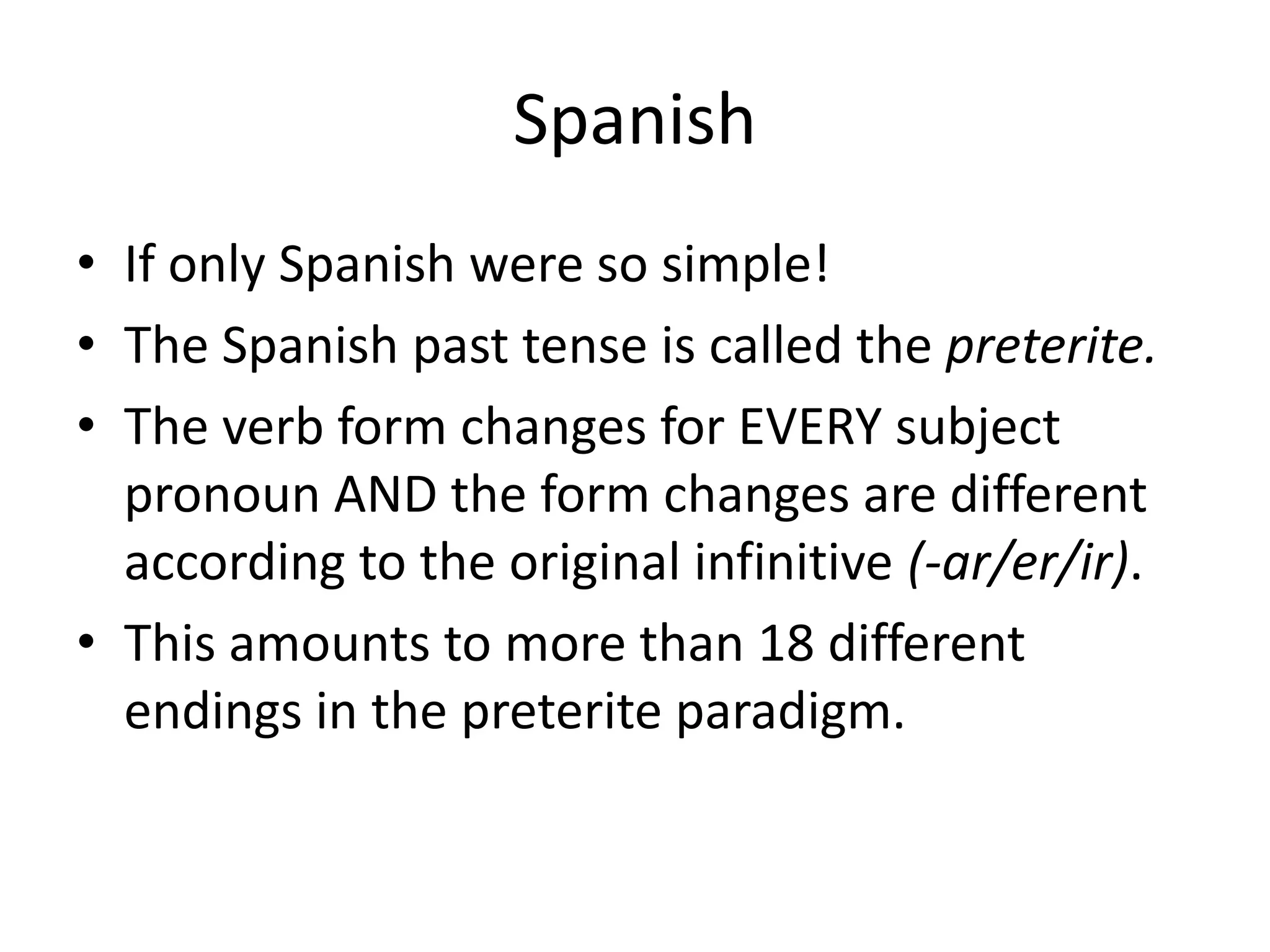
Spanish
• If only Spanish were so simple!
• The Spanish past tense is called the preterite.
• The verb form changes for EVERY subject
  pronoun AND the form changes are different
  according to the original infinitive (-ar/er/ir).
• This amounts to more than 18 different
  endings in the preterite paradigm.
Spanish Preterite – AR verbs
• Hablar (to speak): Remove the –ar and add
  these endings. Note the accents. These are
  important!
      Person     Singular          Plural
      First      Yo habl[é]        Nosotros/nosotras
                                   habl[amos]
      Second     Tú habl[aste]     Ustedes habl[aron]
                 Usted habl[ó]
      Third      Él/ella habl[ó]   Ellos/Ellas
                                   habl[aron]
Spanish Preterite – ER Verbs
• Comer (to eat). Remove the – er and add
  these endings. Note the accents. They are
  important.
      Person     Singular          Plural
      First      Yo com[í]         Nosotros/nosotras
                                   com[imos]
      Second     Tú com[iste]      Ustedes com[ieron]
                 Usted com[ió]
      Third      Él/Ella com[ió]   Ellos/Ellas
                                   com[ieron]
Spanish Preterite – IR Verbs
• Vivir (to live). Remove the –ir and add these
  endings, which are the same as those for –er
  verbs. Note the accents.
      Person      Singular          Plural
      First       Yo viv[í]         Nosotros/Nosotras
                                    viv[imos]
      Second      Tú viv[iste]      Ustedes viv[ieron]
                  Usted viv[ió]
      Third       Él/Ella viv[ió]   Ellos/Ellas
                                    viv[ieron]
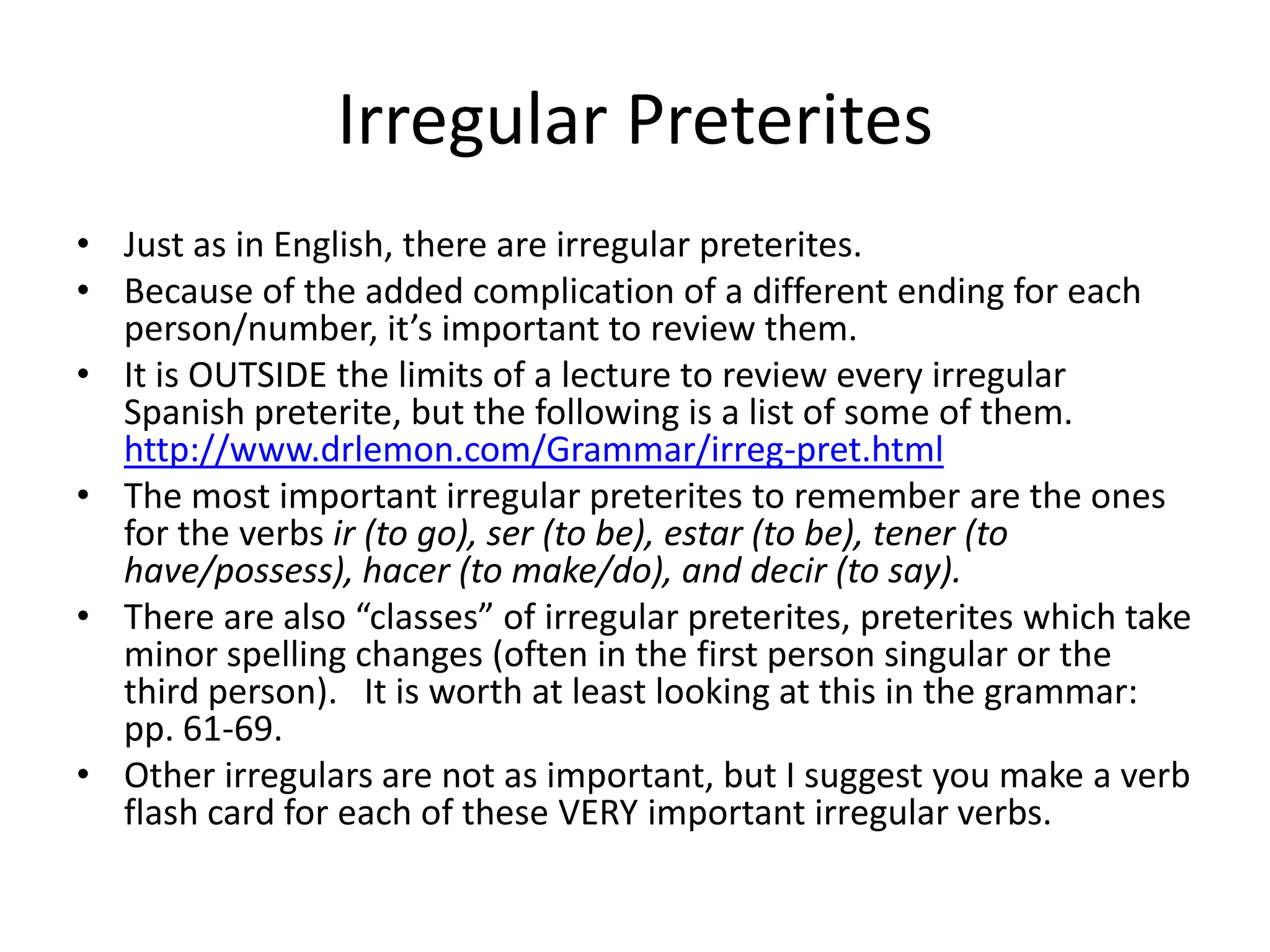
Irregular Preterites
• Just as in English, there are irregular preterites.
• Because of the added complication of a different ending for each
  person/number, it’s important to review them.
• It is OUTSIDE the limits of a lecture to review every irregular
  Spanish preterite, but the following is a list of some of them.
  http://www.drlemon.com/Grammar/irreg-pret.html
• The most important irregular preterites to remember are the ones
  for the verbs ir (to go), ser (to be), estar (to be), tener (to
  have/possess), hacer (to make/do), and decir (to say).
• There are also “classes” of irregular preterites, preterites which take
  minor spelling changes (often in the first person singular or the
  third person). It is worth at least looking at this in the grammar:
  pp. 61-69.
• Other irregulars are not as important, but I suggest you make a verb
  flash card for each of these VERY important irregular verbs.
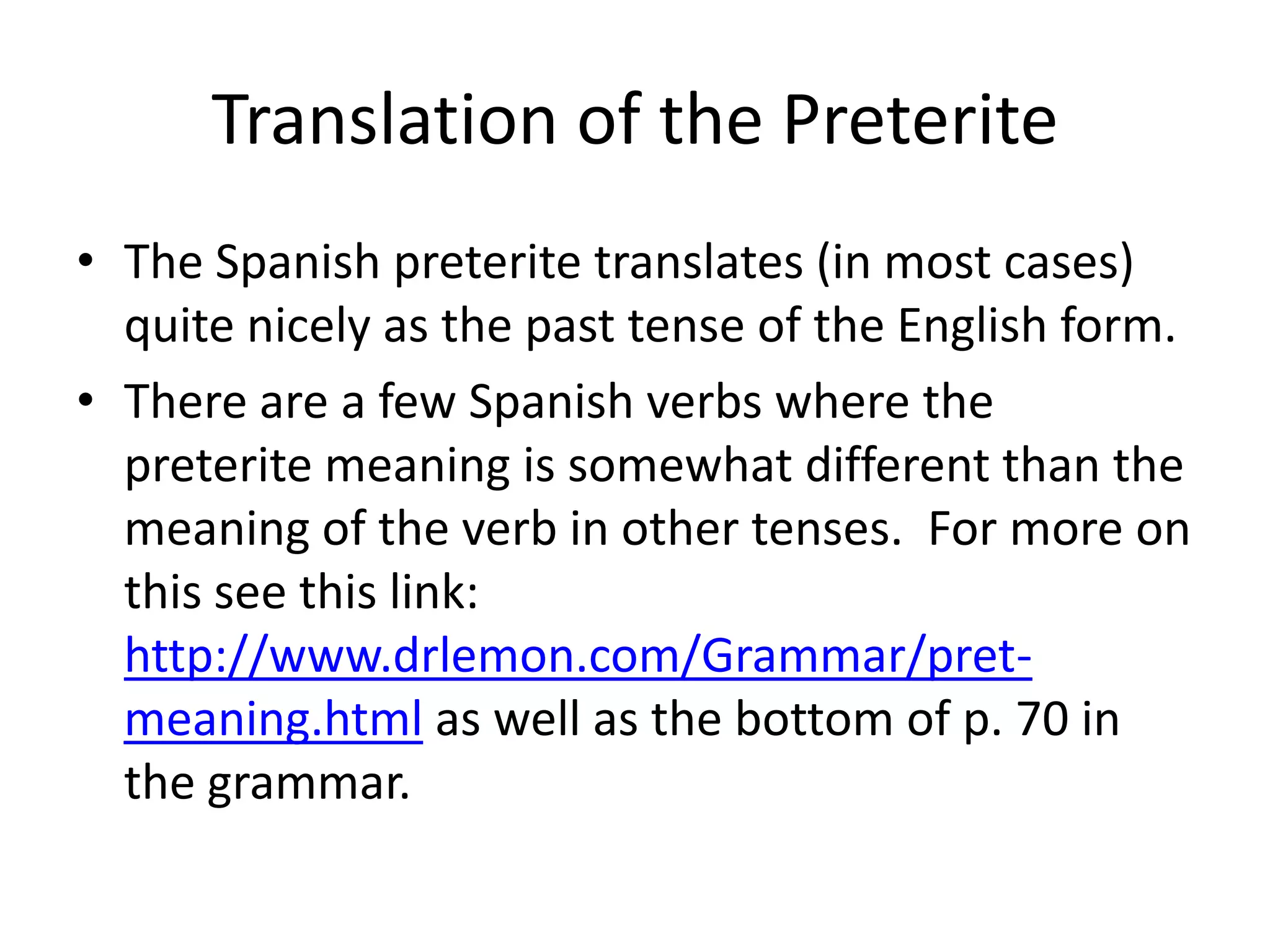
Translation of the Preterite
• The Spanish preterite translates (in most cases)
  quite nicely as the past tense of the English form.
• There are a few Spanish verbs where the
  preterite meaning is somewhat different than the
  meaning of the verb in other tenses. For more on
  this see this link:
  http://www.drlemon.com/Grammar/pret-
  meaning.html as well as the bottom of p. 70 in
  the grammar.
The Imperfect

Another Type of Past Tense
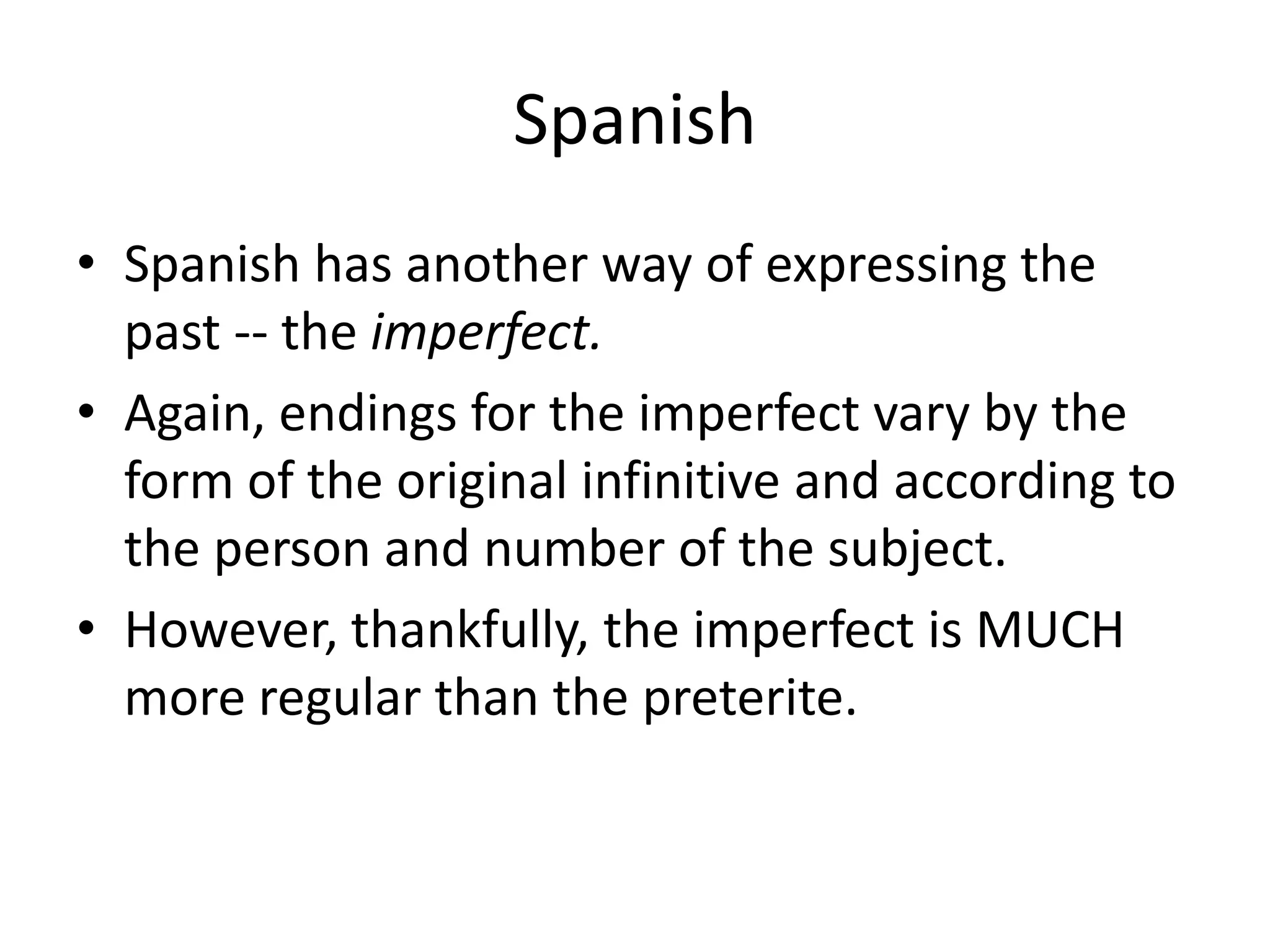
Spanish
• Spanish has another way of expressing the
  past -- the imperfect.
• Again, endings for the imperfect vary by the
  form of the original infinitive and according to
  the person and number of the subject.
• However, thankfully, the imperfect is MUCH
  more regular than the preterite.
Spanish Imperfect – ar Verbs
• Hablar. Remove the –ar and add the endings.
  Note the accents!
      Person     Singular            Plural

      First      Yo habl[aba]        Nosotros/nosotras
                                     habl[ábamos]
      Second     Tú habl[abas]       Ustedes habl[aban]
                 Usted habl[aba]
      Third      Él/Ella habl[aba]   Ellos/Ellas
                                     Habl[aban]
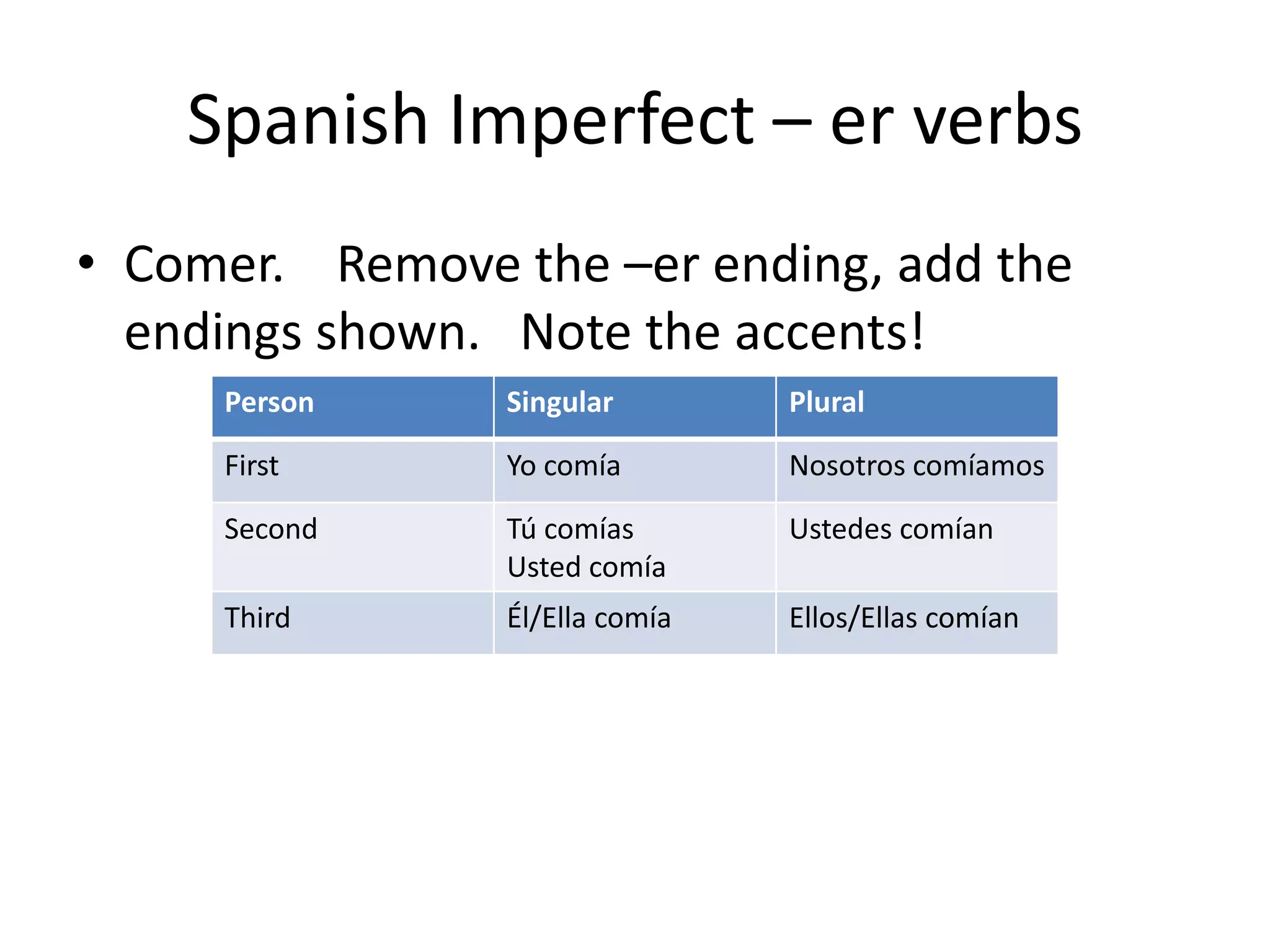
Spanish Imperfect – er verbs
• Comer. Remove the –er ending, add the
  endings shown. Note the accents!
     Person     Singular        Plural
     First      Yo comía        Nosotros comíamos
     Second     Tú comías       Ustedes comían
                Usted comía
     Third      Él/Ella comía   Ellos/Ellas comían
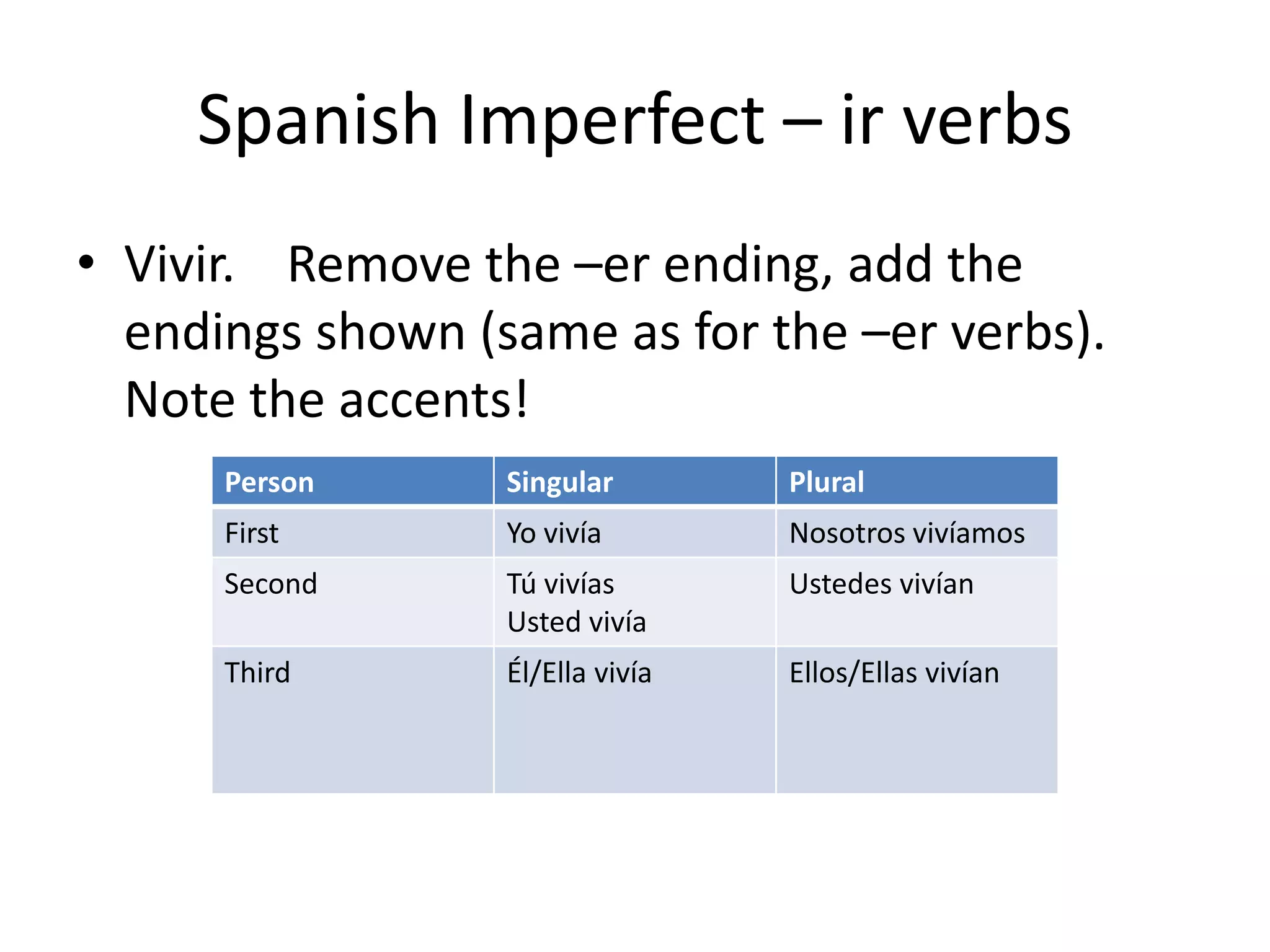
Spanish Imperfect – ir verbs
• Vivir. Remove the –er ending, add the
  endings shown (same as for the –er verbs).
  Note the accents!
      Person      Singular        Plural
      First       Yo vivía        Nosotros vivíamos
      Second      Tú vivías       Ustedes vivían
                  Usted vivía
      Third       Él/Ella vivía   Ellos/Ellas vivían
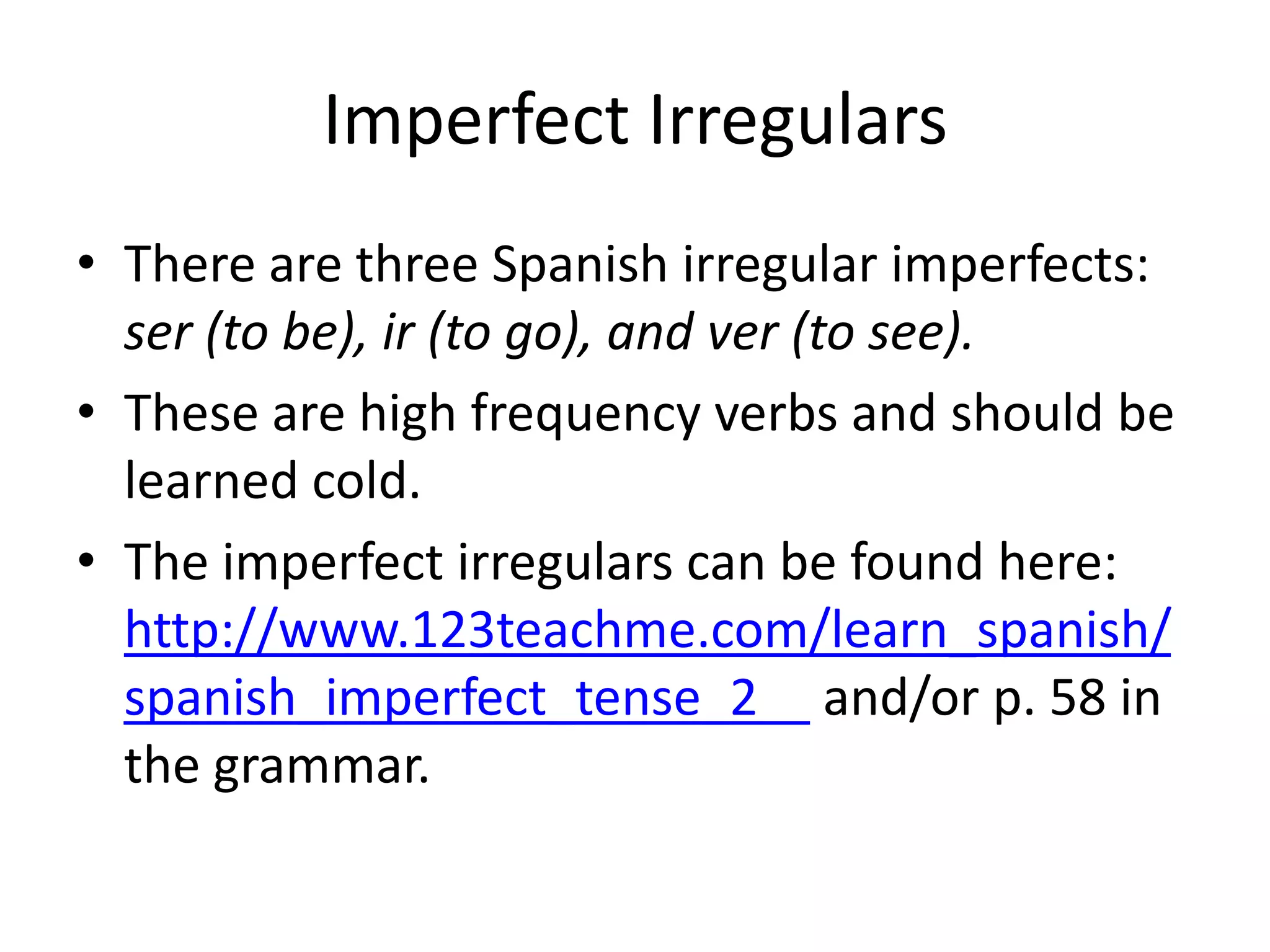
Imperfect Irregulars
• There are three Spanish irregular imperfects:
  ser (to be), ir (to go), and ver (to see).
• These are high frequency verbs and should be
  learned cold.
• The imperfect irregulars can be found here:
  http://www.123teachme.com/learn_spanish/
  spanish_imperfect_tense_2 and/or p. 58 in
  the grammar.
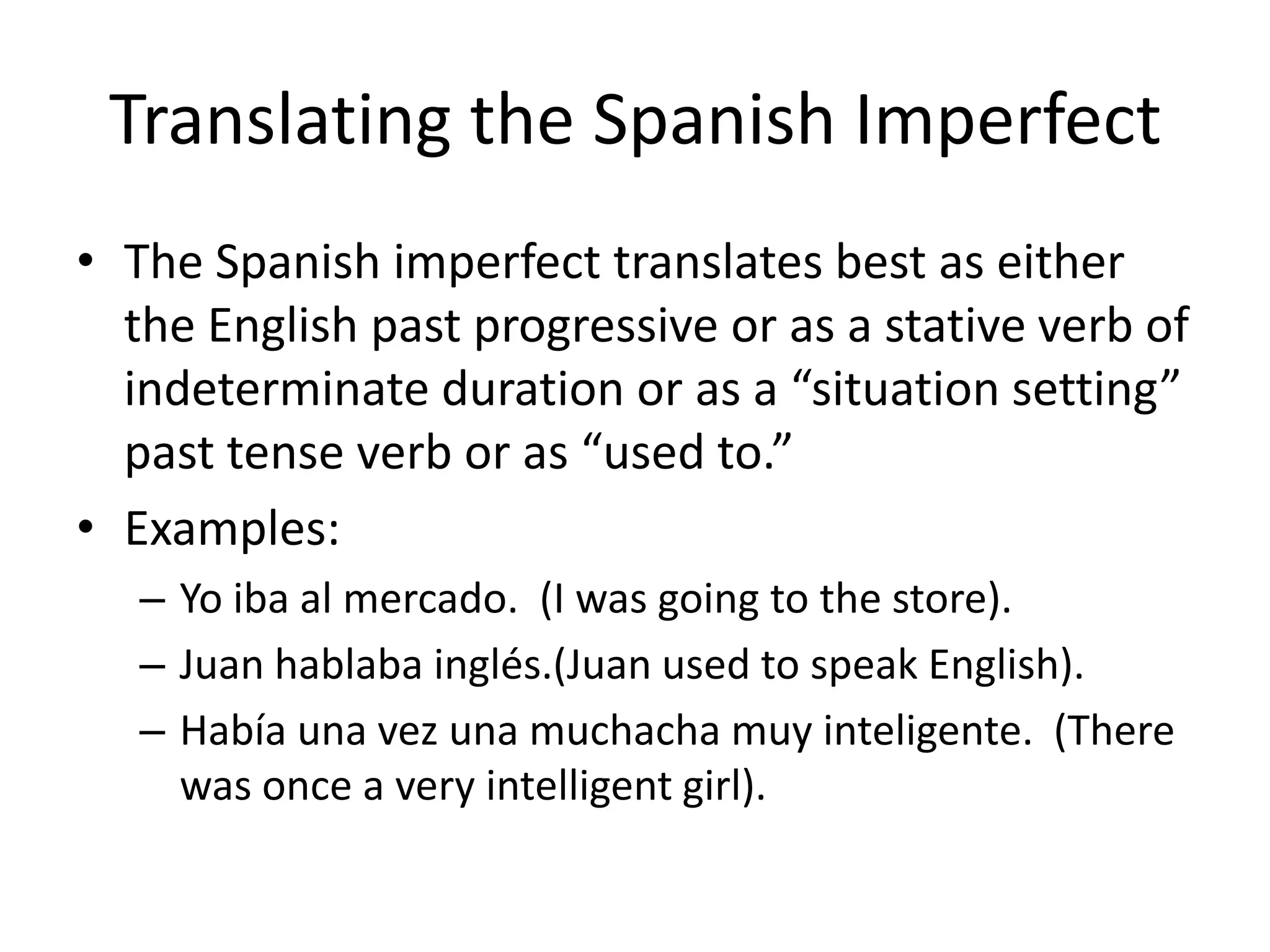
Translating the Spanish Imperfect
• The Spanish imperfect translates best as either
  the English past progressive or as a stative verb of
  indeterminate duration or as a “situation setting”
  past tense verb or as “used to.”
• Examples:
   – Yo iba al mercado. (I was going to the store).
   – Juan hablaba inglés.(Juan used to speak English).
   – Había una vez una muchacha muy inteligente. (There
     was once a very intelligent girl).

Sp600 l4

  • 1.
    The Past Tensesof Spanish E. Siler
  • 2.
    Review Point • Inthe context of the two forms of “to be” (ser/estar) we have already noted that there are two past tenses: the preterite and the imperfect. • We have also looked at the imperfect past tense of “haber” in the context of the compound tenses (yo había hablado con él > I had spoken with him).
  • 3.
    Focus • The expressionof the past in Spanish routinely includes use of the preterite and the imperfect.
  • 4.
    The Preterite A Past Tense
  • 5.
    English • English hasthe world’s simplest past tense. • We remove the “to” of the infinitive. • For a great number of the verbs all we do is add “ed” to the remaining simple verb form. • Sometimes we also make a small spelling change of a doubled final consonant. • Examples:watched; talked; romanticized; theorized; regretted; played; melted. (note: regretted)
  • 6.
    English continued • Wealso have a number of verbs that have an irregular past tense form. • They don’t follow the “add –ed” rule. Examples: Read; sang; found; lost. • But one nice thing about English past tense forms: in any given verb, with ONE exception (the verb “to be”), the same form is used with all persons/numbers of the subject.
  • 7.
    English Past Tense •Notice how neat and simple the English past tense is. • Learn ONE form and you’ve learned the form for all the possible subjects you can imagine. I walked to the store. We walked to the store. You walked to the store. You walked to the store. He/she/ or it walked to the They walked to the store. store.
  • 8.
    Spanish • If onlySpanish were so simple! • The Spanish past tense is called the preterite. • The verb form changes for EVERY subject pronoun AND the form changes are different according to the original infinitive (-ar/er/ir). • This amounts to more than 18 different endings in the preterite paradigm.
  • 9.
    Spanish Preterite –AR verbs • Hablar (to speak): Remove the –ar and add these endings. Note the accents. These are important! Person Singular Plural First Yo habl[é] Nosotros/nosotras habl[amos] Second Tú habl[aste] Ustedes habl[aron] Usted habl[ó] Third Él/ella habl[ó] Ellos/Ellas habl[aron]
  • 10.
    Spanish Preterite –ER Verbs • Comer (to eat). Remove the – er and add these endings. Note the accents. They are important. Person Singular Plural First Yo com[í] Nosotros/nosotras com[imos] Second Tú com[iste] Ustedes com[ieron] Usted com[ió] Third Él/Ella com[ió] Ellos/Ellas com[ieron]
  • 11.
    Spanish Preterite –IR Verbs • Vivir (to live). Remove the –ir and add these endings, which are the same as those for –er verbs. Note the accents. Person Singular Plural First Yo viv[í] Nosotros/Nosotras viv[imos] Second Tú viv[iste] Ustedes viv[ieron] Usted viv[ió] Third Él/Ella viv[ió] Ellos/Ellas viv[ieron]
  • 12.
    Irregular Preterites • Justas in English, there are irregular preterites. • Because of the added complication of a different ending for each person/number, it’s important to review them. • It is OUTSIDE the limits of a lecture to review every irregular Spanish preterite, but the following is a list of some of them. http://www.drlemon.com/Grammar/irreg-pret.html • The most important irregular preterites to remember are the ones for the verbs ir (to go), ser (to be), estar (to be), tener (to have/possess), hacer (to make/do), and decir (to say). • There are also “classes” of irregular preterites, preterites which take minor spelling changes (often in the first person singular or the third person). It is worth at least looking at this in the grammar: pp. 61-69. • Other irregulars are not as important, but I suggest you make a verb flash card for each of these VERY important irregular verbs.
  • 13.
    Translation of thePreterite • The Spanish preterite translates (in most cases) quite nicely as the past tense of the English form. • There are a few Spanish verbs where the preterite meaning is somewhat different than the meaning of the verb in other tenses. For more on this see this link: http://www.drlemon.com/Grammar/pret- meaning.html as well as the bottom of p. 70 in the grammar.
  • 14.
  • 15.
    Spanish • Spanish hasanother way of expressing the past -- the imperfect. • Again, endings for the imperfect vary by the form of the original infinitive and according to the person and number of the subject. • However, thankfully, the imperfect is MUCH more regular than the preterite.
  • 16.
    Spanish Imperfect –ar Verbs • Hablar. Remove the –ar and add the endings. Note the accents! Person Singular Plural First Yo habl[aba] Nosotros/nosotras habl[ábamos] Second Tú habl[abas] Ustedes habl[aban] Usted habl[aba] Third Él/Ella habl[aba] Ellos/Ellas Habl[aban]
  • 17.
    Spanish Imperfect –er verbs • Comer. Remove the –er ending, add the endings shown. Note the accents! Person Singular Plural First Yo comía Nosotros comíamos Second Tú comías Ustedes comían Usted comía Third Él/Ella comía Ellos/Ellas comían
  • 18.
    Spanish Imperfect –ir verbs • Vivir. Remove the –er ending, add the endings shown (same as for the –er verbs). Note the accents! Person Singular Plural First Yo vivía Nosotros vivíamos Second Tú vivías Ustedes vivían Usted vivía Third Él/Ella vivía Ellos/Ellas vivían
  • 19.
    Imperfect Irregulars • Thereare three Spanish irregular imperfects: ser (to be), ir (to go), and ver (to see). • These are high frequency verbs and should be learned cold. • The imperfect irregulars can be found here: http://www.123teachme.com/learn_spanish/ spanish_imperfect_tense_2 and/or p. 58 in the grammar.
  • 20.
    Translating the SpanishImperfect • The Spanish imperfect translates best as either the English past progressive or as a stative verb of indeterminate duration or as a “situation setting” past tense verb or as “used to.” • Examples: – Yo iba al mercado. (I was going to the store). – Juan hablaba inglés.(Juan used to speak English). – Había una vez una muchacha muy inteligente. (There was once a very intelligent girl).