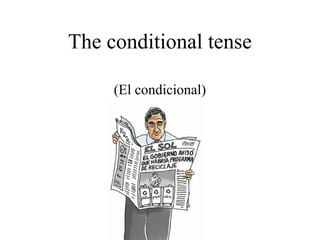
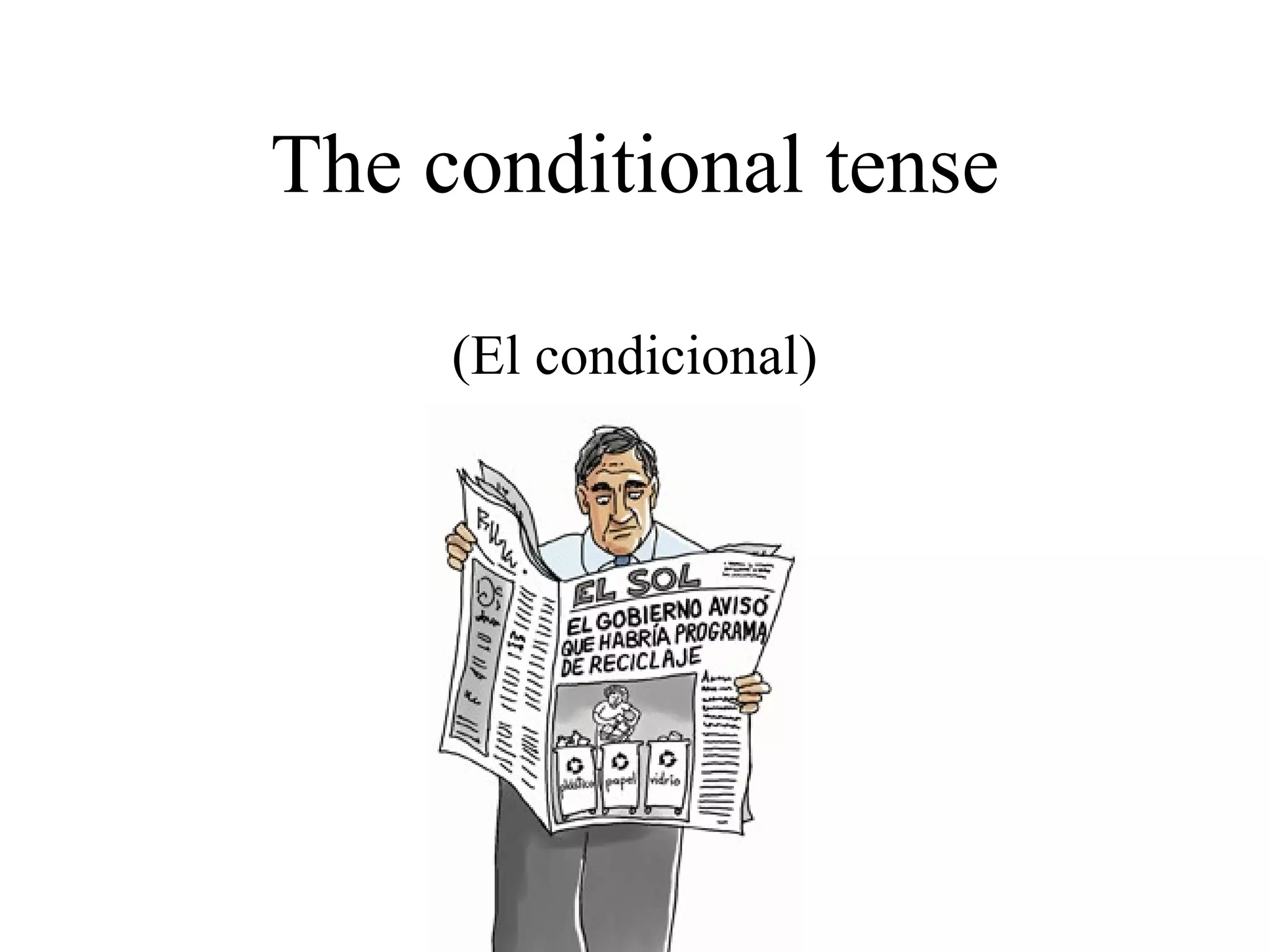
The conditional tense
(El condicional)
hablar
hablar hablar
hablar
hablar
hablar
ías
ía
íais
ían
íamos
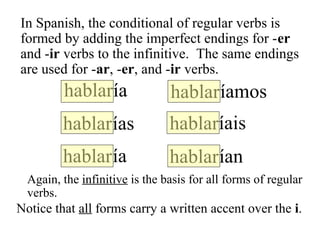
In Spanish, the conditional of regular verbs is
formed by adding the imperfect endings for -er
and -ir verbs to the infinitive. The same endings
are used for -ar, -er, and -ir verbs.
ía
Again, the infinitive is the basis for all forms of regular
verbs.
Notice that all forms carry a written accent over the i.
hablar
hablar
hablar
hablar
hablar
hablar
ías
ía
íais
ían
íamos
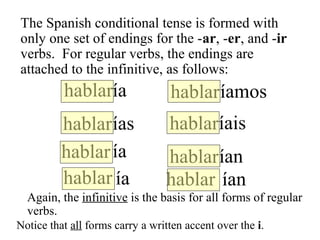
The Spanish conditional tense is formed with
only one set of endings for the -ar, -er, and -ir
verbs. For regular verbs, the endings are
attached to the infinitive, as follows:
ía
Again, the infinitive is the basis for all forms of regular
verbs.
Notice that all forms carry a written accent over the i.
hablar hablaría ían
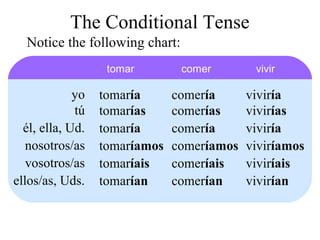
Notice the following chart:
The Conditional Tense
tomar comer
yo
tú
él, ella, Ud.
nosotros/as
vosotros/as
ellos/as, Uds.
tomaría
tomarías
tomaría
tomaríamos
tomaríais
tomarían
comería
comerías
comería
comeríamos
comeríais
comerían
viviría
vivirías
viviría
viviríamos
viviríais
vivirían
vivir
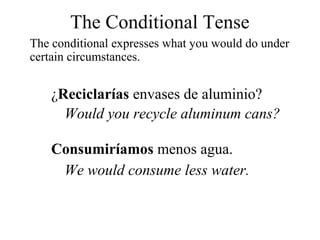
The conditional expresses what you would do under
certain circumstances.
¿Reciclarías envases de aluminio?
Would you recycle aluminum cans?
Consumiríamos menos agua.
We would consume less water.
The Conditional Tense
leer
escribir
hablar
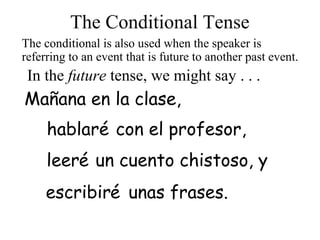
In the future tense, we might say . . .
con el profesor,
Mañana en la clase,
é
é un cuento chistoso, y
é unas frases.
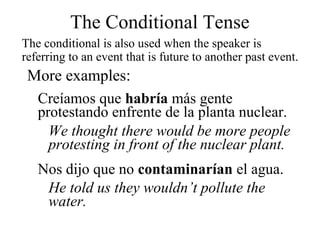
The conditional is also used when the speaker is
referring to an event that is future to another past event.
The Conditional Tense
unas frases.
un cuento chistoso, y
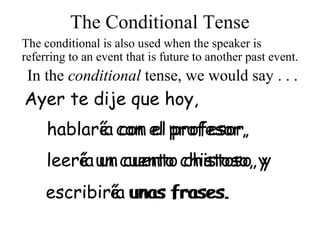
In the conditional tense, we would say . . .
Ayer te dije que hoy,
ía con el profesor,
ía un cuento chistoso, y
ía unas frases.
leer
escribir
hablar con el profesor,é
é
é
The conditional is also used when the speaker is
referring to an event that is future to another past event.
The Conditional Tense
The conditional is also used when the speaker is
referring to an event that is future to another past event.
Creíamos que habría más gente
protestando enfrente de la planta nuclear.
We thought there would be more people
protesting in front of the nuclear plant.
Nos dijo que no contaminarían el agua.
He told us they wouldn’t pollute the
water.
The Conditional Tense
More examples:
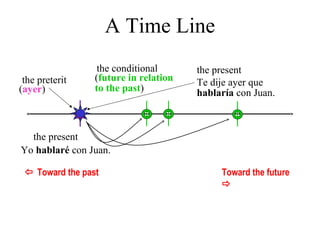
the presentthe conditional
the preterit
A Time Line
(future in relation
to the past)(ayer)
Te dije ayer que
hablaría con Juan.
Yo hablaré con Juan.
 Toward the past Toward the future

the present
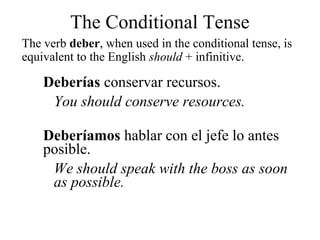
The verb deber, when used in the conditional tense, is
equivalent to the English should + infinitive.
Deberías conservar recursos.
You should conserve resources.
Deberíamos hablar con el jefe lo antes
posible.
We should speak with the boss as soon
as possible.
The Conditional Tense
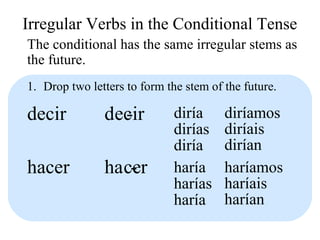
Irregular Verbs in the Conditional Tense
The conditional has the same irregular stems as
the future.
1. Drop two letters to form the stem of the future.
decir
hacer
d
ha
ecir
cer
- diría
dirías
diría
diríamos
diríais
dirían
- haría
harías
haría
haríamos
haríais
harían
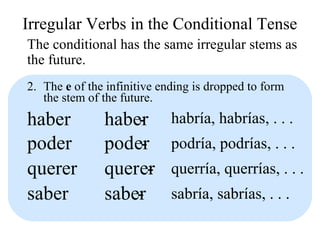
2. The e of the infinitive ending is dropped to form
the stem of the future.
haber
poder
hab
pod
er
er
- habría, habrías, . . .
- podría, podrías, . . .
querer querer- querría, querrías, . . .
saber saber- sabría, sabrías, . . .
Irregular Verbs in the Conditional Tense
The conditional has the same irregular stems as
the future.
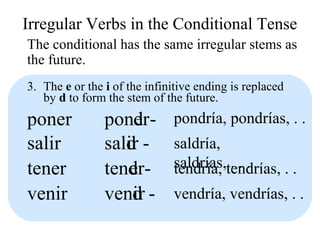
id
ten
3. The e or the i of the infinitive ending is replaced
by d to form the stem of the future.
poner
salir
pon
sal
er
ir
- pondría, pondrías, . .
- saldría,
saldrías, . . .tener er- tendría, tendrías, . .
.venir ven r - vendría, vendrías, . .
d
d
d
Irregular Verbs in the Conditional Tense
The conditional has the same irregular stems as
the future.
A Special Use of the Conditional Tense
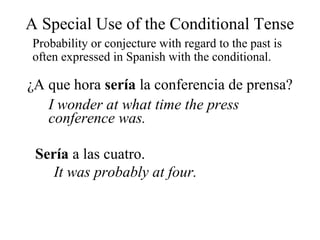
Probability or conjecture with regard to the past is
often expressed in Spanish with the conditional.
¿A que hora sería la conferencia de prensa?
I wonder at what time the press
conference was.
Sería a las cuatro.
It was probably at four.
FIN

Conditional tense

  • 1.
  • 2.
    hablar hablar hablar hablar hablar hablar ías ía íais ían íamos In Spanish,the conditional of regular verbs is formed by adding the imperfect endings for -er and -ir verbs to the infinitive. The same endings are used for -ar, -er, and -ir verbs. ía Again, the infinitive is the basis for all forms of regular verbs. Notice that all forms carry a written accent over the i.
  • 3.
    hablar hablar hablar hablar hablar hablar ías ía íais ían íamos The Spanish conditionaltense is formed with only one set of endings for the -ar, -er, and -ir verbs. For regular verbs, the endings are attached to the infinitive, as follows: ía Again, the infinitive is the basis for all forms of regular verbs. Notice that all forms carry a written accent over the i. hablar hablaría ían
  • 4.
    Notice the followingchart: The Conditional Tense tomar comer yo tú él, ella, Ud. nosotros/as vosotros/as ellos/as, Uds. tomaría tomarías tomaría tomaríamos tomaríais tomarían comería comerías comería comeríamos comeríais comerían viviría vivirías viviría viviríamos viviríais vivirían vivir
  • 5.
    The conditional expresseswhat you would do under certain circumstances. ¿Reciclarías envases de aluminio? Would you recycle aluminum cans? Consumiríamos menos agua. We would consume less water. The Conditional Tense
  • 6.
    leer escribir hablar In the futuretense, we might say . . . con el profesor, Mañana en la clase, é é un cuento chistoso, y é unas frases. The conditional is also used when the speaker is referring to an event that is future to another past event. The Conditional Tense
  • 7.
    unas frases. un cuentochistoso, y In the conditional tense, we would say . . . Ayer te dije que hoy, ía con el profesor, ía un cuento chistoso, y ía unas frases. leer escribir hablar con el profesor,é é é The conditional is also used when the speaker is referring to an event that is future to another past event. The Conditional Tense
  • 8.
    The conditional isalso used when the speaker is referring to an event that is future to another past event. Creíamos que habría más gente protestando enfrente de la planta nuclear. We thought there would be more people protesting in front of the nuclear plant. Nos dijo que no contaminarían el agua. He told us they wouldn’t pollute the water. The Conditional Tense More examples:
  • 9.
    the presentthe conditional thepreterit A Time Line (future in relation to the past)(ayer) Te dije ayer que hablaría con Juan. Yo hablaré con Juan.  Toward the past Toward the future  the present
  • 10.
    The verb deber,when used in the conditional tense, is equivalent to the English should + infinitive. Deberías conservar recursos. You should conserve resources. Deberíamos hablar con el jefe lo antes posible. We should speak with the boss as soon as possible. The Conditional Tense
  • 11.
    Irregular Verbs inthe Conditional Tense The conditional has the same irregular stems as the future. 1. Drop two letters to form the stem of the future. decir hacer d ha ecir cer - diría dirías diría diríamos diríais dirían - haría harías haría haríamos haríais harían
  • 12.
    2. The eof the infinitive ending is dropped to form the stem of the future. haber poder hab pod er er - habría, habrías, . . . - podría, podrías, . . . querer querer- querría, querrías, . . . saber saber- sabría, sabrías, . . . Irregular Verbs in the Conditional Tense The conditional has the same irregular stems as the future.
  • 13.
    id ten 3. The eor the i of the infinitive ending is replaced by d to form the stem of the future. poner salir pon sal er ir - pondría, pondrías, . . - saldría, saldrías, . . .tener er- tendría, tendrías, . . .venir ven r - vendría, vendrías, . . d d d Irregular Verbs in the Conditional Tense The conditional has the same irregular stems as the future.
  • 14.
    A Special Useof the Conditional Tense Probability or conjecture with regard to the past is often expressed in Spanish with the conditional. ¿A que hora sería la conferencia de prensa? I wonder at what time the press conference was. Sería a las cuatro. It was probably at four.
  • 15.