The Present Tense and The Expletive
    Some Uses of Por and Para
              E. Siler
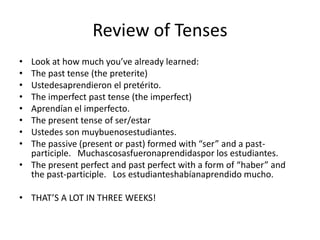
Review of Tenses
• Look at how much you’ve already learned:
• The past tense (the preterite)
• Ustedesaprendieron el pretérito.
• The imperfect past tense (the imperfect)
• Aprendían el imperfecto.
• The present tense of ser/estar
• Ustedes son muybuenosestudiantes.
• The passive (present or past) formed with “ser” and a past-
  participle. Muchascosasfueronaprendidaspor los estudiantes.
• The present perfect and past perfect with a form of “haber” and
  the past-participle. Los estudianteshabíanaprendido mucho.

• THAT’S A LOT IN THREE WEEKS!
Present Tense
• The present tense is one of the most useful
  tenses to know for academic Spanish.
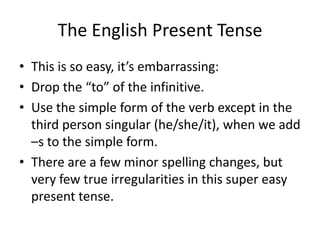
The English Present Tense
• This is so easy, it’s embarrassing:
• Drop the “to” of the infinitive.
• Use the simple form of the verb except in the
  third person singular (he/she/it), when we add
  –s to the simple form.
• There are a few minor spelling changes, but
  very few true irregularities in this super easy
  present tense.
Examples
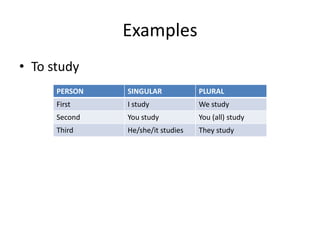
• To study
      PERSON   SINGULAR            PLURAL
      First    I study             We study
      Second   You study           You (all) study
      Third    He/she/it studies   They study
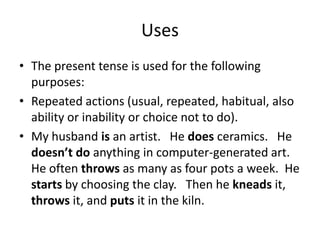
Uses
• The present tense is used for the following
  purposes:
• Repeated actions (usual, repeated, habitual, also
  ability or inability or choice not to do).
• My husband is an artist. He does ceramics. He
  doesn’t do anything in computer-generated art.
  He often throws as many as four pots a week. He
  starts by choosing the clay. Then he kneads it,
  throws it, and puts it in the kiln.
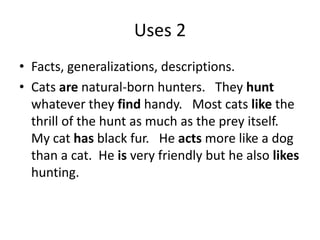
Uses 2
• Facts, generalizations, descriptions.
• Cats are natural-born hunters. They hunt
  whatever they find handy. Most cats like the
  thrill of the hunt as much as the prey itself.
  My cat has black fur. He acts more like a dog
  than a cat. He is very friendly but he also likes
  hunting.
Uses 3
• Scheduled events in the future.
• My plane leaves tomorrow at 9.
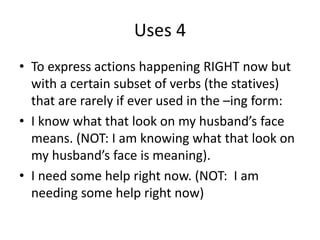
Uses 4
• To express actions happening RIGHT now but
  with a certain subset of verbs (the statives)
  that are rarely if ever used in the –ing form:
• I know what that look on my husband’s face
  means. (NOT: I am knowing what that look on
  my husband’s face is meaning).
• I need some help right now. (NOT: I am
  needing some help right now)
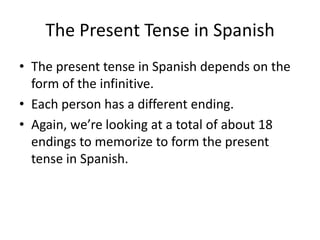
The Present Tense in Spanish
• The present tense in Spanish depends on the
  form of the infinitive.
• Each person has a different ending.
• Again, we’re looking at a total of about 18
  endings to memorize to form the present
  tense in Spanish.
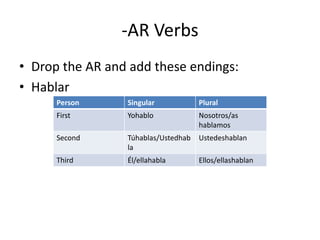
-AR Verbs
• Drop the AR and add these endings:
• Hablar
      Person     Singular            Plural
      First      Yohablo             Nosotros/as
                                     hablamos
      Second     Túhablas/Ustedhab   Ustedeshablan
                 la
      Third      Él/ellahabla        Ellos/ellashablan
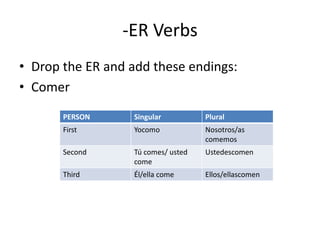
-ER Verbs
• Drop the ER and add these endings:
• Comer
       PERSON     Singular          Plural
       First      Yocomo            Nosotros/as
                                    comemos
       Second     Tú comes/ usted   Ustedescomen
                  come
       Third      Él/ella come      Ellos/ellascomen
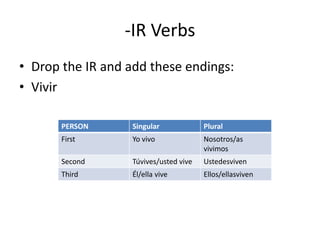
-IR Verbs
• Drop the IR and add these endings:
• Vivir

       PERSON     Singular             Plural
       First      Yo vivo              Nosotros/as
                                       vivimos
       Second     Túvives/usted vive   Ustedesviven
       Third      Él/ella vive         Ellos/ellasviven
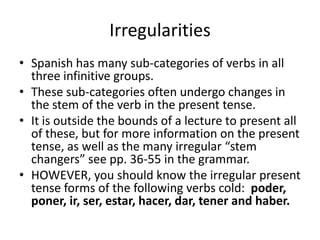
Irregularities
• Spanish has many sub-categories of verbs in all
  three infinitive groups.
• These sub-categories often undergo changes in
  the stem of the verb in the present tense.
• It is outside the bounds of a lecture to present all
  of these, but for more information on the present
  tense, as well as the many irregular “stem
  changers” see pp. 36-55 in the grammar.
• HOWEVER, you should know the irregular present
  tense forms of the following verbs cold: poder,
  poner, ir, ser, estar, hacer, dar, tener and haber.
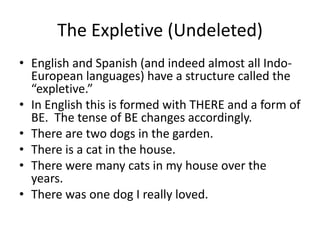
The Expletive (Undeleted)
• English and Spanish (and indeed almost all Indo-
  European languages) have a structure called the
  “expletive.”
• In English this is formed with THERE and a form of
  BE. The tense of BE changes accordingly.
• There are two dogs in the garden.
• There is a cat in the house.
• There were many cats in my house over the
  years.
• There was one dog I really loved.
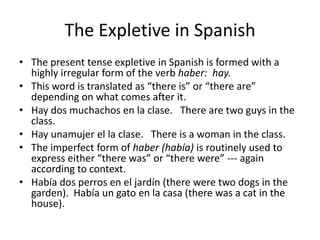
The Expletive in Spanish
• The present tense expletive in Spanish is formed with a
  highly irregular form of the verb haber: hay.
• This word is translated as “there is” or “there are”
  depending on what comes after it.
• Hay dos muchachos en la clase. There are two guys in the
  class.
• Hay unamujer el la clase. There is a woman in the class.
• The imperfect form of haber (había) is routinely used to
  express either “there was” or “there were” --- again
  according to context.
• Había dos perros en el jardín (there were two dogs in the
  garden). Había un gato en la casa (there was a cat in the
  house).
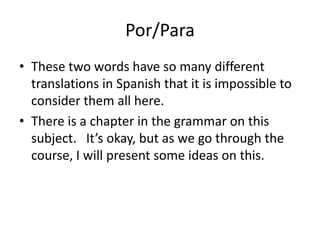
Por/Para
• These two words have so many different
  translations in Spanish that it is impossible to
  consider them all here.
• There is a chapter in the grammar on this
  subject. It’s okay, but as we go through the
  course, I will present some ideas on this.
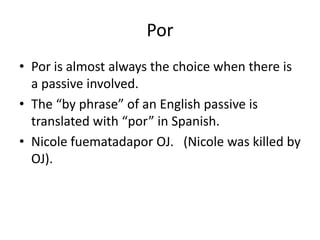
Por
• Por is almost always the choice when there is
  a passive involved.
• The “by phrase” of an English passive is
  translated with “por” in Spanish.
• Nicole fuematadapor OJ. (Nicole was killed by
  OJ).
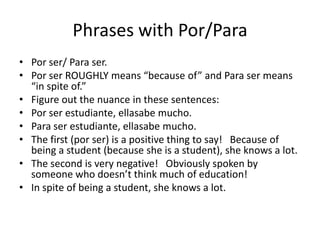
Phrases with Por/Para
• Por ser/ Para ser.
• Por ser ROUGHLY means “because of” and Para ser means
  “in spite of.”
• Figure out the nuance in these sentences:
• Por ser estudiante, ellasabe mucho.
• Para ser estudiante, ellasabe mucho.
• The first (por ser) is a positive thing to say! Because of
  being a student (because she is a student), she knows a lot.
• The second is very negative! Obviously spoken by
  someone who doesn’t think much of education!
• In spite of being a student, she knows a lot.

Spanish600 l6

  • 1.
    The Present Tenseand The Expletive Some Uses of Por and Para E. Siler
  • 2.
    Review of Tenses •Look at how much you’ve already learned: • The past tense (the preterite) • Ustedesaprendieron el pretérito. • The imperfect past tense (the imperfect) • Aprendían el imperfecto. • The present tense of ser/estar • Ustedes son muybuenosestudiantes. • The passive (present or past) formed with “ser” and a past- participle. Muchascosasfueronaprendidaspor los estudiantes. • The present perfect and past perfect with a form of “haber” and the past-participle. Los estudianteshabíanaprendido mucho. • THAT’S A LOT IN THREE WEEKS!
  • 3.
    Present Tense • Thepresent tense is one of the most useful tenses to know for academic Spanish.
  • 4.
    The English PresentTense • This is so easy, it’s embarrassing: • Drop the “to” of the infinitive. • Use the simple form of the verb except in the third person singular (he/she/it), when we add –s to the simple form. • There are a few minor spelling changes, but very few true irregularities in this super easy present tense.
  • 5.
    Examples • To study PERSON SINGULAR PLURAL First I study We study Second You study You (all) study Third He/she/it studies They study
  • 6.
    Uses • The presenttense is used for the following purposes: • Repeated actions (usual, repeated, habitual, also ability or inability or choice not to do). • My husband is an artist. He does ceramics. He doesn’t do anything in computer-generated art. He often throws as many as four pots a week. He starts by choosing the clay. Then he kneads it, throws it, and puts it in the kiln.
  • 7.
    Uses 2 • Facts,generalizations, descriptions. • Cats are natural-born hunters. They hunt whatever they find handy. Most cats like the thrill of the hunt as much as the prey itself. My cat has black fur. He acts more like a dog than a cat. He is very friendly but he also likes hunting.
  • 8.
    Uses 3 • Scheduledevents in the future. • My plane leaves tomorrow at 9.
  • 9.
    Uses 4 • Toexpress actions happening RIGHT now but with a certain subset of verbs (the statives) that are rarely if ever used in the –ing form: • I know what that look on my husband’s face means. (NOT: I am knowing what that look on my husband’s face is meaning). • I need some help right now. (NOT: I am needing some help right now)
  • 10.
    The Present Tensein Spanish • The present tense in Spanish depends on the form of the infinitive. • Each person has a different ending. • Again, we’re looking at a total of about 18 endings to memorize to form the present tense in Spanish.
  • 11.
    -AR Verbs • Dropthe AR and add these endings: • Hablar Person Singular Plural First Yohablo Nosotros/as hablamos Second Túhablas/Ustedhab Ustedeshablan la Third Él/ellahabla Ellos/ellashablan
  • 12.
    -ER Verbs • Dropthe ER and add these endings: • Comer PERSON Singular Plural First Yocomo Nosotros/as comemos Second Tú comes/ usted Ustedescomen come Third Él/ella come Ellos/ellascomen
  • 13.
    -IR Verbs • Dropthe IR and add these endings: • Vivir PERSON Singular Plural First Yo vivo Nosotros/as vivimos Second Túvives/usted vive Ustedesviven Third Él/ella vive Ellos/ellasviven
  • 14.
    Irregularities • Spanish hasmany sub-categories of verbs in all three infinitive groups. • These sub-categories often undergo changes in the stem of the verb in the present tense. • It is outside the bounds of a lecture to present all of these, but for more information on the present tense, as well as the many irregular “stem changers” see pp. 36-55 in the grammar. • HOWEVER, you should know the irregular present tense forms of the following verbs cold: poder, poner, ir, ser, estar, hacer, dar, tener and haber.
  • 15.
    The Expletive (Undeleted) •English and Spanish (and indeed almost all Indo- European languages) have a structure called the “expletive.” • In English this is formed with THERE and a form of BE. The tense of BE changes accordingly. • There are two dogs in the garden. • There is a cat in the house. • There were many cats in my house over the years. • There was one dog I really loved.
  • 16.
    The Expletive inSpanish • The present tense expletive in Spanish is formed with a highly irregular form of the verb haber: hay. • This word is translated as “there is” or “there are” depending on what comes after it. • Hay dos muchachos en la clase. There are two guys in the class. • Hay unamujer el la clase. There is a woman in the class. • The imperfect form of haber (había) is routinely used to express either “there was” or “there were” --- again according to context. • Había dos perros en el jardín (there were two dogs in the garden). Había un gato en la casa (there was a cat in the house).
  • 17.
    Por/Para • These twowords have so many different translations in Spanish that it is impossible to consider them all here. • There is a chapter in the grammar on this subject. It’s okay, but as we go through the course, I will present some ideas on this.
  • 18.
    Por • Por isalmost always the choice when there is a passive involved. • The “by phrase” of an English passive is translated with “por” in Spanish. • Nicole fuematadapor OJ. (Nicole was killed by OJ).
  • 19.
    Phrases with Por/Para •Por ser/ Para ser. • Por ser ROUGHLY means “because of” and Para ser means “in spite of.” • Figure out the nuance in these sentences: • Por ser estudiante, ellasabe mucho. • Para ser estudiante, ellasabe mucho. • The first (por ser) is a positive thing to say! Because of being a student (because she is a student), she knows a lot. • The second is very negative! Obviously spoken by someone who doesn’t think much of education! • In spite of being a student, she knows a lot.