VERBS 10: Adverbs and
Adverbials
Materials by Liz Siler
Adverbials

• Adverbials are structures that modify
verb phrases (and sometimes other
structures). An adverbial can be:
– An adverb phrase
– A prepositional phrase
– A noun phrase
– A clause

• We will discuss the first three in this
lesson.
Adverbials 1: Adverb Phrases
• An adverb phrase (one type of adverbial) is centered
around an adverb.
Adverbs
• Typical adverbs are single words that
end in -ly and answer questions loosely
formed with “how” and “when.”
– Usually: When does this happen? This
usually happens.
– Thoroughly: How did he do it? He did it
thoroughly.
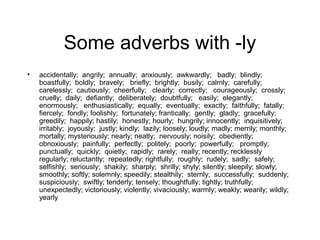
Some adverbs with -ly
•

accidentally; angrily; annually; anxiously; awkwardly; badly; blindly;
boastfully; boldly; bravely; briefly; brightly; busily; calmly; carefully;
carelessly; cautiously; cheerfully; clearly; correctly; courageously; crossly;
cruelly; daily; defiantly; deliberately; doubtfully; easily; elegantly;
enormously; enthusiastically; equally; eventually; exactly; faithfully; fatally;
fiercely; fondly; foolishly; fortunately; frantically; gently; gladly; gracefully;
greedily; happily; hastily; honestly; hourly; hungrily; innocently; inquisitively;
irritably; joyously; justly; kindly; lazily; loosely; loudly; madly; merrily; monthly;
mortally; mysteriously; nearly; neatly; nervously; noisily; obediently;
obnoxiously; painfully; perfectly; politely; poorly; powerfully; promptly;
punctually; quickly; quietly; rapidly; rarely; really; recently; recklessly
regularly; reluctantly; repeatedly; rightfully; roughly; rudely; sadly; safely;
selfishly; seriously; shakily; sharply; shrilly; shyly; silently; sleepily; slowly;
smoothly; softly; solemnly; speedily; stealthily; sternly; successfully; suddenly;
suspiciously; swiftly; tenderly; tensely; thoughtfully; tightly; truthfully;
unexpectedly; victoriously; violently; vivaciously; warmly; weakly; wearily; wildly;
yearly
Other adverbs
• Other adverbs don’t end in -ly but do
answer the “how” and “when” questions.
• Examples: soon, now, often, then, still,
yet, always, never , well.
Examples: Sentences with Adverb Phrases

• The students angrily planned a walkout.
• Administrative salaries can not be
easily explained.
• Tuition always increases.
• Administrative salaries often increase!
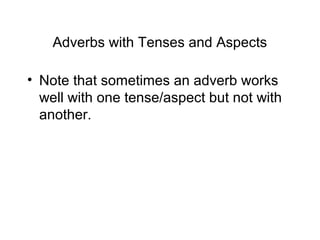
Adverbs with Tenses and Aspects
• Note that sometimes an adverb works
well with one tense/aspect but not with
another.
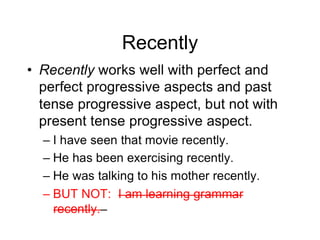
Recently
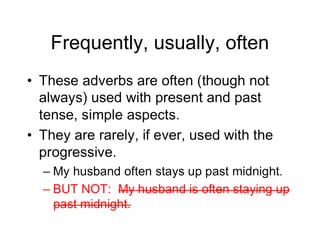
Frequently, usually, often
Adverbials 2: Prepositional
Phrase Adverbials
• Prepositional phrase adverbials are
formed with prepositional phrases
(preposition + noun phrase)
Examples
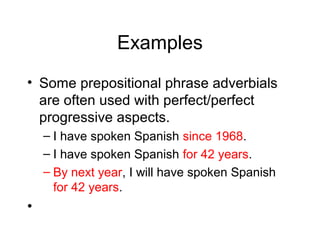
• Some prepositional phrase adverbials
are often used with perfect/perfect
progressive aspects.
– I have spoken Spanish since 1968.
– I have spoken Spanish for 42 years.
– By next year, I will have spoken Spanish
for 42 years.

•
Adverbials 3: Noun Phrase
Adverbials
• Noun phrase adverbials are adverbials
formed from a noun phrase.
• These often answer the “when”
question.
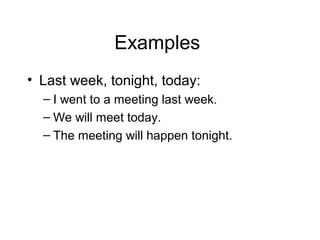
Examples
• Last week, tonight, today:
– I went to a meeting last week.
– We will meet today.
– The meeting will happen tonight.
Modals and the Future
• Since we only have two tenses in English
(past and present), modals are commonly
used to help us talk about the future.
• But modals are tricky (ask any ESL learner).
They aren’t “clean.”
• A person can use some present tense and
past tense modals to talk about the future.
• So in clauses with modals in the verb
phrases, adverbials take on special
importance. Adverbials help clarify the
time frame.
Examples
• He should go tomorrow. (Past tense
modal “should” but the time frame is
clearly the future because of the
adverbial “tomorrow.”)
• He would often go there. (Past tense
modal “would” and the time frame is
clearly the past because of the
adverbial “often.”)

Verbs10

  • 1.
    VERBS 10: Adverbsand Adverbials Materials by Liz Siler
  • 2.
    Adverbials • Adverbials arestructures that modify verb phrases (and sometimes other structures). An adverbial can be: – An adverb phrase – A prepositional phrase – A noun phrase – A clause • We will discuss the first three in this lesson.
  • 3.
    Adverbials 1: AdverbPhrases • An adverb phrase (one type of adverbial) is centered around an adverb.
  • 4.
    Adverbs • Typical adverbsare single words that end in -ly and answer questions loosely formed with “how” and “when.” – Usually: When does this happen? This usually happens. – Thoroughly: How did he do it? He did it thoroughly.
  • 5.
    Some adverbs with-ly • accidentally; angrily; annually; anxiously; awkwardly; badly; blindly; boastfully; boldly; bravely; briefly; brightly; busily; calmly; carefully; carelessly; cautiously; cheerfully; clearly; correctly; courageously; crossly; cruelly; daily; defiantly; deliberately; doubtfully; easily; elegantly; enormously; enthusiastically; equally; eventually; exactly; faithfully; fatally; fiercely; fondly; foolishly; fortunately; frantically; gently; gladly; gracefully; greedily; happily; hastily; honestly; hourly; hungrily; innocently; inquisitively; irritably; joyously; justly; kindly; lazily; loosely; loudly; madly; merrily; monthly; mortally; mysteriously; nearly; neatly; nervously; noisily; obediently; obnoxiously; painfully; perfectly; politely; poorly; powerfully; promptly; punctually; quickly; quietly; rapidly; rarely; really; recently; recklessly regularly; reluctantly; repeatedly; rightfully; roughly; rudely; sadly; safely; selfishly; seriously; shakily; sharply; shrilly; shyly; silently; sleepily; slowly; smoothly; softly; solemnly; speedily; stealthily; sternly; successfully; suddenly; suspiciously; swiftly; tenderly; tensely; thoughtfully; tightly; truthfully; unexpectedly; victoriously; violently; vivaciously; warmly; weakly; wearily; wildly; yearly
  • 6.
    Other adverbs • Otheradverbs don’t end in -ly but do answer the “how” and “when” questions. • Examples: soon, now, often, then, still, yet, always, never , well.
  • 7.
    Examples: Sentences withAdverb Phrases • The students angrily planned a walkout. • Administrative salaries can not be easily explained. • Tuition always increases. • Administrative salaries often increase!
  • 8.
    Adverbs with Tensesand Aspects • Note that sometimes an adverb works well with one tense/aspect but not with another.
  • 9.
  • 10.
  • 11.
    Adverbials 2: Prepositional PhraseAdverbials • Prepositional phrase adverbials are formed with prepositional phrases (preposition + noun phrase)
  • 12.
    Examples • Some prepositionalphrase adverbials are often used with perfect/perfect progressive aspects. – I have spoken Spanish since 1968. – I have spoken Spanish for 42 years. – By next year, I will have spoken Spanish for 42 years. •
  • 13.
    Adverbials 3: NounPhrase Adverbials • Noun phrase adverbials are adverbials formed from a noun phrase. • These often answer the “when” question.
  • 14.
    Examples • Last week,tonight, today: – I went to a meeting last week. – We will meet today. – The meeting will happen tonight.
  • 15.
    Modals and theFuture • Since we only have two tenses in English (past and present), modals are commonly used to help us talk about the future. • But modals are tricky (ask any ESL learner). They aren’t “clean.” • A person can use some present tense and past tense modals to talk about the future. • So in clauses with modals in the verb phrases, adverbials take on special importance. Adverbials help clarify the time frame.
  • 16.
    Examples • He shouldgo tomorrow. (Past tense modal “should” but the time frame is clearly the future because of the adverbial “tomorrow.”) • He would often go there. (Past tense modal “would” and the time frame is clearly the past because of the adverbial “often.”)