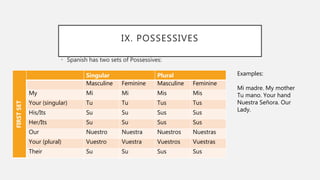
SPANISH GRAMMAR
Made by Marlon Ramos
Based from Modern Spanish Grammar: A Practical Guide
by Juan Kattán-Ibarra and Christopher J. Pountain
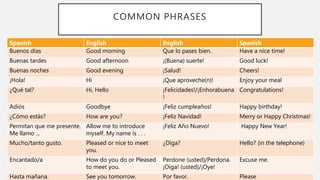
COMMON PHRASES
Spanish English English Spanish
Buenos días Good morning Que lo pases bien. Have a nice time!
Buenas tardes Good afternoon ¡(Buena) suerte! Good luck!
Buenas noches Good evening ¡Salud! Cheers!
¡Hola! Hi ¡Que aproveche(n)! Enjoy your meal
¿Qué tal? Hi, Hello ¡Felicidades!/¡Enhorabuena
!
Congratulations!
Adiós Goodbye ¡Feliz cumpleaños! Happy birthday!
¿Cómo estás? How are you? ¡Feliz Navidad! Merry or Happy Christmas!
Permitan que me presente.
Me llamo ...
Allow me to introduce
myself. My name is . . .
¡Feliz Año Nuevo! Happy New Year!
Mucho/tanto gusto. Pleased or nice to meet
you.
¿Diga? Hello? (in the telephone)
Encantado/a How do you do or Pleased
to meet you.
Perdone (usted)/Perdona.
¡Oiga! (usted)/¡Oye!
Excuse me.
Hasta mañana. See you tomorrow. Por favor. Please
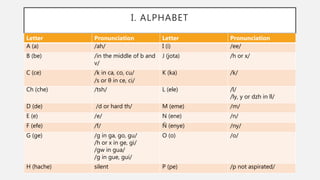
I. ALPHABET
Letter Pronunciation Letter Pronunciation
A (a) /ah/ I (i) /ee/
B (be) /in the middle of b and
v/
J (jota) /h or x/
C (ce) /k in ca, co, cu/
/s or θ in ce, ci/
K (ka) /k/
Ch (che) /tsh/ L (ele) /l/
/ly, y or dzh in ll/
D (de) /d or hard th/ M (eme) /m/
E (e) /e/ N (ene) /n/
F (efe) /f/ Ñ (enye) /ny/
G (ge) /g in ga, go, gu/
/h or x in ge, gi/
/gw in gua/
/g in gue, gui/
O (o) /o/
H (hache) silent P (pe) /p not aspirated/
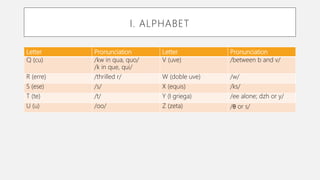
Letter Pronunciation Letter Pronunciation
Q (cu) /kw in qua, quo/
/k in que, qui/
V (uve) /between b and v/
R (erre) /thrilled r/ W (doble uve) /w/
S (ese) /s/ X (equis) /ks/
T (te) /t/ Y (I griega) /ee alone; dzh or y/
U (u) /oo/ Z (zeta) /θ or s/
I. ALPHABET
DIPHTHONG
• a + i aire [ajre]
• a + u áureo [awreo]
• e + y ley [lej]
• e + u Europa [ewropa]
• o + y hoy [oj]
• o + u not very common, mainly in abbreviations, e.g. COU, or proper names, of Galician origin, e.g.
Couceiro [ow]
• i + a enviar [embjar]
• i + e bien [bjen]
• i + o serio [serjo]
• u + a Guatemala [watemala]
• u + e bueno [bweno]
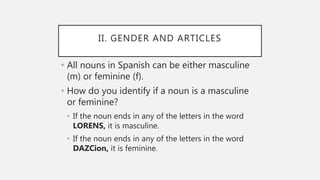
II. GENDER AND ARTICLES
• All nouns in Spanish can be either masculine
(m) or feminine (f).
• How do you identify if a noun is a masculine
or feminine?
• If the noun ends in any of the letters in the word
LORENS, it is masculine.
• If the noun ends in any of the letters in the word
DAZCion, it is feminine.
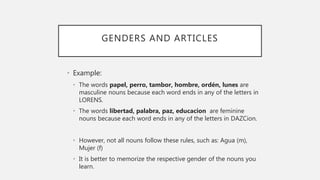
GENDERS AND ARTICLES
• Example:
• The words papel, perro, tambor, hombre, ordén, lunes are
masculine nouns because each word ends in any of the letters in
LORENS.
• The words libertad, palabra, paz, educacion are feminine
nouns because each word ends in any of the letters in DAZCion.
• However, not all nouns follow these rules, such as: Agua (m),
Mujer (f)
• It is better to memorize the respective gender of the nouns you
learn.
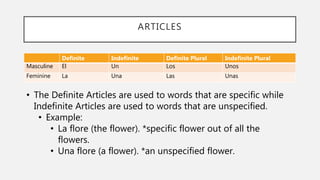
ARTICLES
Definite Indefinite Definite Plural Indefinite Plural
Masculine El Un Los Unos
Feminine La Una Las Unas
• The Definite Articles are used to words that are specific while
Indefinite Articles are used to words that are unspecified.
• Example:
• La flore (the flower). *specific flower out of all the
flowers.
• Una flore (a flower). *an unspecified flower.
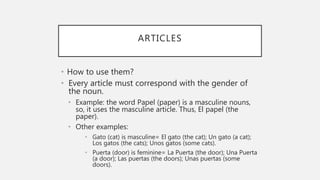
ARTICLES
• How to use them?
• Every article must correspond with the gender of
the noun.
• Example: the word Papel (paper) is a masculine nouns,
so, it uses the masculine article. Thus, El papel (the
paper).
• Other examples:
• Gato (cat) is masculine= El gato (the cat); Un gato (a cat);
Los gatos (the cats); Unos gatos (some cats).
• Puerta (door) is feminine= La Puerta (the door); Una Puerta
(a door); Las puertas (the doors); Unas puertas (some
doors).
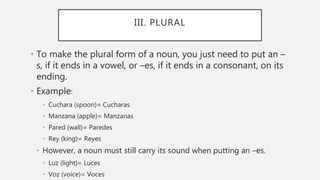
III. PLURAL
• To make the plural form of a noun, you just need to put an –
s, if it ends in a vowel, or –es, if it ends in a consonant, on its
ending.
• Example:
• Cuchara (spoon)= Cucharas
• Manzana (apple)= Manzanas
• Pared (wall)= Paredes
• Rey (king)= Reyes
• However, a noun must still carry its sound when putting an –es.
• Luz (light)= Luces
• Voz (voice)= Voces
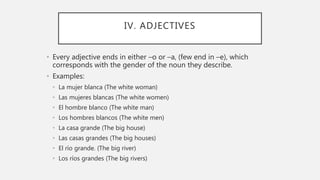
IV. ADJECTIVES
• Every adjective ends in either –o or –a, (few end in –e), which
corresponds with the gender of the noun they describe.
• Examples:
• La mujer blanca (The white woman)
• Las mujeres blancas (The white women)
• El hombre blanco (The white man)
• Los hombres blancos (The white men)
• La casa grande (The big house)
• Las casas grandes (The big houses)
• El río grande. (The big river)
• Los ríos grandes (The big rivers)
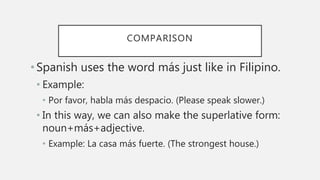
COMPARISON
•Spanish uses the word más just like in Filipino.
• Example:
• Por favor, habla más despacio. (Please speak slower.)
• In this way, we can also make the superlative form:
noun+más+adjective.
• Example: La casa más fuerte. (The strongest house.)
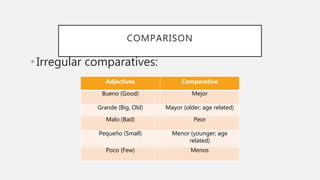
•Irregular comparatives:
Adjectives Comparative
Bueno (Good) Mejor
Grande (Big, Old) Mayor (older; age related)
Malo (Bad) Peor
Pequeño (Small) Menor (younger; age
related)
Poco (Few) Menos
COMPARISON
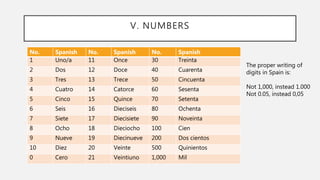
V. NUMBERS
No. Spanish No. Spanish No. Spanish
1 Uno/a 11 Once 30 Treinta
2 Dos 12 Doce 40 Cuarenta
3 Tres 13 Trece 50 Cincuenta
4 Cuatro 14 Catorce 60 Sesenta
5 Cinco 15 Quince 70 Setenta
6 Seis 16 Dieciseis 80 Ochenta
7 Siete 17 Diecisiete 90 Noveinta
8 Ocho 18 Dieciocho 100 Cien
9 Nueve 19 Diecinueve 200 Dos cientos
10 Diez 20 Veinte 500 Quinientos
0 Cero 21 Veintiuno 1,000 Mil
The proper writing of
digits in Spain is:
Not 1,000, instead 1.000
Not 0.05, instead 0,05
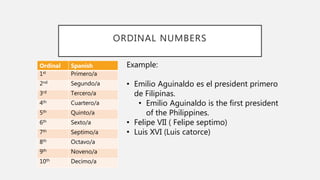
ORDINAL NUMBERS
Ordinal Spanish
1st Primero/a
2nd Segundo/a
3rd Tercero/a
4th Cuartero/a
5th Quinto/a
6th Sexto/a
7th Septimo/a
8th Octavo/a
9th Noveno/a
10th Decimo/a
Example:
• Emilio Aguinaldo es el president primero
de Filipinas.
• Emilio Aguinaldo is the first president
of the Philippines.
• Felipe VII ( Felipe septimo)
• Luis XVI (Luis catorce)
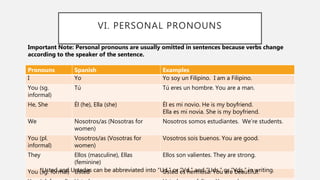
VI. PERSONAL PRONOUNS
Pronouns Spanish Examples
I Yo Yo soy un Filipino. I am a Filipino.
You (sg.
informal)
Tú Tú eres un hombre. You are a man.
He, She Él (he), Ella (she) Él es mi novio. He is my boyfriend.
Ella es mi novia. She is my boyfriend.
We Nosotros/as (Nosotras for
women)
Nosotros somos estudiantes. We’re students.
You (pl.
informal)
Vosotros/as (Vosotras for
women)
Vosotros sois buenos. You are good.
They Ellos (masculine), Ellas
(feminine)
Ellos son valientes. They are strong.
You (sg. formal) Usted Usted es hermosa. You are beautiful.
*Usted and Ustedes can be abbreviated into “Ud.” or “Vd.” and “Uds.” or “Vds.” in writing.
Important Note: Personal pronouns are usually omitted in sentences because verbs change
according to the speaker of the sentence.
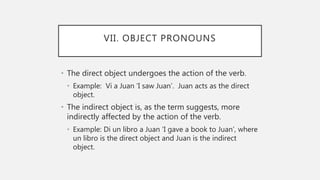
VII. OBJECT PRONOUNS
• The direct object undergoes the action of the verb.
• Example: Vi a Juan ‘I saw Juan’. Juan acts as the direct
object.
• The indirect object is, as the term suggests, more
indirectly affected by the action of the verb.
• Example: Di un libro a Juan ‘I gave a book to Juan’, where
un libro is the direct object and Juan is the indirect
object.
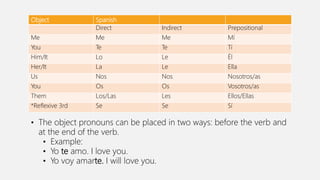
Object Spanish
Direct Indirect Prepositional
Me Me Me Mí
You Te Te Tí
Him/It Lo Le Él
Her/It La Le Ella
Us Nos Nos Nosotros/as
You Os Os Vosotros/as
Them Los/Las Les Ellos/Ellas
*Reflexive 3rd Se Se Sí
• The object pronouns can be placed in two ways: before the verb and
at the end of the verb.
• Example:
• Yo te amo. I love you.
• Yo voy amarte. I will love you.
OBJECT PRONOUNS
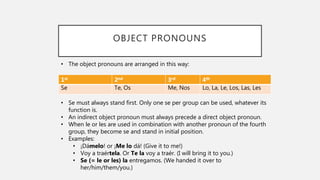
1st 2nd 3rd 4th
Se Te, Os Me, Nos Lo, La, Le, Los, Las, Les
• The object pronouns are arranged in this way:
• Se must always stand first. Only one se per group can be used, whatever its
function is.
• An indirect object pronoun must always precede a direct object pronoun.
• When le or les are used in combination with another pronoun of the fourth
group, they become se and stand in initial position.
• Examples:
• ¡Dámelo! or ¡Me lo dá! (Give it to me!)
• Voy a traértela. Or Te la voy a traér. (I will bring it to you.)
• Se (= le or les) la entregamos. (We handed it over to
her/him/them/you.)
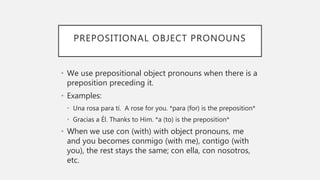
PREPOSITIONAL OBJECT PRONOUNS
• We use prepositional object pronouns when there is a
preposition preceding it.
• Examples:
• Una rosa para tí. A rose for you. *para (for) is the preposition*
• Gracias a Él. Thanks to Him. *a (to) is the preposition*
• When we use con (with) with object pronouns, me
and you becomes conmigo (with me), contigo (with
you), the rest stays the same; con ella, con nosotros,
etc.
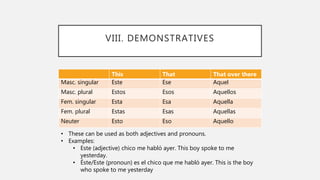
VIII. DEMONSTRATIVES
This That That over there
Masc. singular Este Ese Aquel
Masc. plural Estos Esos Aquellos
Fem. singular Esta Esa Aquella
Fem. plural Estas Esas Aquellas
Neuter Esto Eso Aquello
• These can be used as both adjectives and pronouns.
• Examples:
• Este (adjective) chico me habló ayer. This boy spoke to me
yesterday.
• Éste/Este (pronoun) es el chico que me habló ayer. This is the boy
who spoke to me yesterday
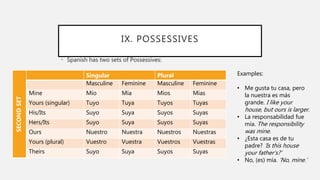
IX. POSSESSIVES
• Spanish has two sets of Possessives:
FIRST
SET
Singular Plural
Masculine Feminine Masculine Feminine
My Mi Mi Mis Mis
Your (singular) Tu Tu Tus Tus
His/Its Su Su Sus Sus
Her/Its Su Su Sus Sus
Our Nuestro Nuestra Nuestros Nuestras
Your (plural) Vuestro Vuestra Vuestros Vuestras
Their Su Su Sus Sus
Examples:
Mi madre. My mother
Tu mano. Your hand
Nuestra Señora. Our
Lady.
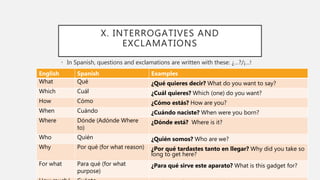
IX. POSSESSIVES
• Spanish has two sets of Possessives:
SECOND
SET
Singular Plural
Masculine Feminine Masculine Feminine
Mine Mío Mía Míos Mías
Yours (singular) Tuyo Tuya Tuyos Tuyas
His/Its Suyo Suya Suyos Suyas
Hers/Its Suyo Suya Suyos Suyas
Ours Nuestro Nuestra Nuestros Nuestras
Yours (plural) Vuestro Vuestra Vuestros Vuestras
Theirs Suyo Suya Suyos Suyas
Examples:
• Me gusta tu casa, pero
la nuestra es más
grande. I like your
house, but ours is larger.
• La responsabilidad fue
mía. The responsibility
was mine.
• ¿Esta casa es de tu
padre? ‘Is this house
your father’s?’
• No, (es) mía. ‘No, mine.’
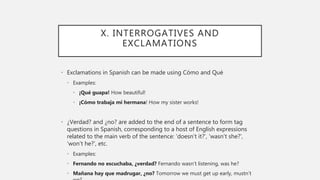
X. INTERROGATIVES AND
EXCLAMATIONS
• In Spanish, questions and exclamations are written with these: ¿…?/¡…!
English Spanish Examples
What Qué ¿Qué quieres decir? What do you want to say?
Which Cuál ¿Cuál quieres? Which (one) do you want?
How Cómo ¿Cómo estás? How are you?
When Cuándo ¿Cuándo naciste? When were you born?
Where Dónde (Adónde Where
to)
¿Dónde está? Where is it?
Who Quién ¿Quién somos? Who are we?
Why Por qué (for what reason) ¿Por qué tardastes tanto en llegar? Why did you take so
long to get here?
For what Para qué (for what
purpose)
¿Para qué sirve este aparato? What is this gadget for?
X. INTERROGATIVES AND
EXCLAMATIONS
• Exclamations in Spanish can be made using Cómo and Qué
• Examples:
• ¡Qué guapa! How beautiful!
• ¡Cómo trabaja mi hermana! How my sister works!
• ¿Verdad? and ¿no? are added to the end of a sentence to form tag
questions in Spanish, corresponding to a host of English expressions
related to the main verb of the sentence: ‘doesn’t it?’, ‘wasn’t she?’,
‘won’t he?’, etc.
• Examples:
• Fernando no escuchaba, ¿verdad? Fernando wasn’t listening, was he?
• Mañana hay que madrugar, ¿no? Tomorrow we must get up early, mustn’t
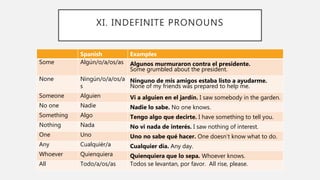
XI. INDEFINITE PRONOUNS
Spanish Examples
Some Algún/o/a/os/as Algunos murmuraron contra el presidente.
Some grumbled about the president.
None Ningún/o/a/os/a
s
Ninguno de mis amigos estaba listo a ayudarme.
None of my friends was prepared to help me.
Someone Alguien Vi a alguien en el jardín. I saw somebody in the garden.
No one Nadie Nadie lo sabe. No one knows.
Something Algo Tengo algo que decirte. I have something to tell you.
Nothing Nada No vi nada de interés. I saw nothing of interest.
One Uno Uno no sabe qué hacer. One doesn’t know what to do.
Any Cualquiér/a Cualquier día. Any day.
Whoever Quienquiera Quienquiera que lo sepa. Whoever knows.
All Todo/a/os/as Todos se levantan, por favor. All rise, please.
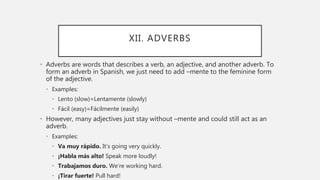
XII. ADVERBS
• Adverbs are words that describes a verb, an adjective, and another adverb. To
form an adverb in Spanish, we just need to add –mente to the feminine form
of the adjective.
• Examples:
• Lento (slow)=Lentamente (slowly)
• Fácil (easy)=Fácilmente (easily)
• However, many adjectives just stay without –mente and could still act as an
adverb.
• Examples:
• Va muy rápido. It’s going very quickly.
• ¡Habla más alto! Speak more loudly!
• Trabajamos duro. We’re working hard.
• ¡Tirar fuerte! Pull hard!
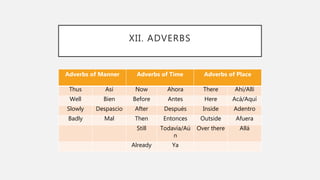
XII. ADVERBS
Adverbs of Manner Adverbs of Time Adverbs of Place
Thus Así Now Ahora There Ahí/Allí
Well Bien Before Antes Here Acá/Aquí
Slowly Despascio After Después Inside Adentro
Badly Mal Then Entonces Outside Afuera
Still Todavía/Aú
n
Over there Allá
Already Ya
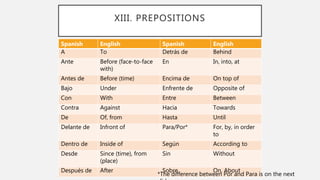
XIII. PREPOSITIONS
Spanish English Spanish English
A To Detrás de Behind
Ante Before (face-to-face
with)
En In, into, at
Antes de Before (time) Encima de On top of
Bajo Under Enfrente de Opposite of
Con With Entre Between
Contra Against Hacia Towards
De Of, from Hasta Until
Delante de Infront of Para/Por* For, by, in order
to
Dentro de Inside of Según According to
Desde Since (time), from
(place)
Sin Without
Después de After Sobre On, About
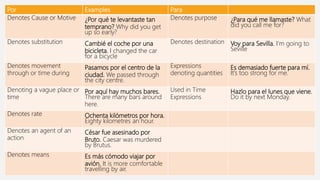
*The difference between Por and Para is on the next
Por Examples Para
Denotes Cause or Motive ¿Por qué te levantaste tan
temprano? Why did you get
up so early?
Denotes purpose ¿Para qué me llamaste? What
did you call me for?
Denotes substitution Cambié el coche por una
bicicleta. I changed the car
for a bicycle
Denotes destination Voy para Sevilla. I’m going to
Seville
Denotes movement
through or time during
Pasamos por el centro de la
ciudad. We passed through
the city centre.
Expressions
denoting quantities
Es demasiado fuerte para mí.
It’s too strong for me.
Denoting a vague place or
time
Por aquí hay muchos bares.
There are many bars around
here.
Used in Time
Expressions
Hazlo para el lunes que viene.
Do it by next Monday.
Denotes rate Ochenta kilómetros por hora.
Eighty kilometres an hour.
Denotes an agent of an
action
César fue asesinado por
Bruto. Caesar was murdered
by Brutus.
Denotes means Es más cómodo viajar por
avión. It is more comfortable
travelling by air.
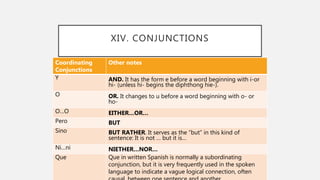
XIV. CONJUNCTIONS
Coordinating
Conjunctions
Other notes
Y AND. It has the form e before a word beginning with i-or
hi- (unless hi- begins the diphthong hie-).
O OR. It changes to u before a word beginning with o- or
ho-
O…O EITHER…OR…
Pero BUT
Sino BUT RATHER. It serves as the “but” in this kind of
sentence: It is not … but it is…
Ni…ni NIETHER…NOR…
Que Que in written Spanish is normally a subordinating
conjunction, but it is very frequently used in the spoken
language to indicate a vague logical connection, often
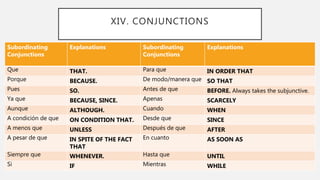
XIV. CONJUNCTIONS
Subordinating
Conjunctions
Explanations Subordinating
Conjunctions
Explanations
Que THAT. Para que IN ORDER THAT
Porque BECAUSE. De modo/manera que SO THAT
Pues SO. Antes de que BEFORE. Always takes the subjunctive.
Ya que BECAUSE, SINCE. Apenas SCARCELY
Aunque ALTHOUGH. Cuando WHEN
A condición de que ON CONDITION THAT. Desde que SINCE
A menos que UNLESS Después de que AFTER
A pesar de que IN SPITE OF THE FACT
THAT
En cuanto AS SOON AS
Siempre que WHENEVER. Hasta que UNTIL
Si IF Mientras WHILE
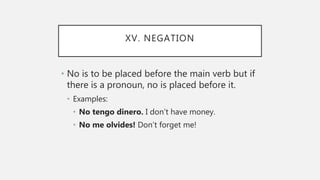
XV. NEGATION
• No is to be placed before the main verb but if
there is a pronoun, no is placed before it.
• Examples:
• No tengo dinero. I don’t have money.
• No me olvides! Don’t forget me!
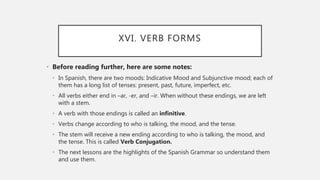
XVI. VERB FORMS
• Before reading further, here are some notes:
• In Spanish, there are two moods: Indicative Mood and Subjunctive mood; each of
them has a long list of tenses: present, past, future, imperfect, etc.
• All verbs either end in –ar, -er, and –ir. When without these endings, we are left
with a stem.
• A verb with those endings is called an infinitive.
• Verbs change according to who is talking, the mood, and the tense.
• The stem will receive a new ending according to who is talking, the mood, and
the tense. This is called Verb Conjugation.
• The next lessons are the highlights of the Spanish Grammar so understand them
and use them.
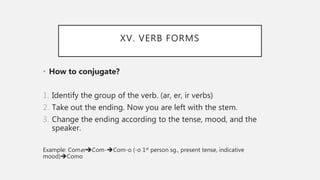
XV. VERB FORMS
• How to conjugate?
1. Identify the group of the verb. (ar, er, ir verbs)
2. Take out the ending. Now you are left with the stem.
3. Change the ending according to the tense, mood, and the
speaker.
Example: ComerCom-Com-o (-o 1st person sg., present tense, indicative
mood)Como
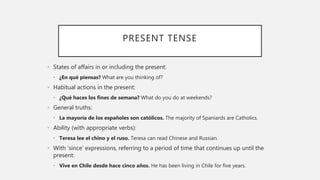
PRESENT TENSE
• States of affairs in or including the present:
• ¿En qué piensas? What are you thinking of?
• Habitual actions in the present:
• ¿Qué haces los fines de semana? What do you do at weekends?
• General truths:
• La mayoría de los españoles son católicos. The majority of Spaniards are Catholics.
• Ability (with appropriate verbs):
• Teresa lee el chino y el ruso. Teresa can read Chinese and Russian.
• With ‘since’ expressions, referring to a period of time that continues up until the
present:
• Vive en Chile desde hace cinco años. He has been living in Chile for five years.
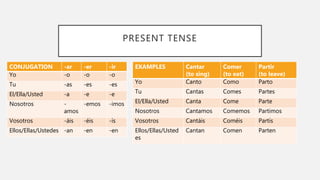
PRESENT TENSE
CONJUGATION -ar -er -ir
Yo -o -o -o
Tu -as -es -es
El/Ella/Usted -a -e -e
Nosotros -
amos
-emos -imos
Vosotros -áis -éis -ís
Ellos/Ellas/Ustedes -an -en -en
EXAMPLES Cantar
(to sing)
Comer
(to eat)

Partir
(to leave)
Yo Canto Como Parto
Tu Cantas Comes Partes
El/Ella/Usted Canta Come Parte
Nosotros Cantamos Comemos Partimos
Vosotros Cantáis Coméis Partís
Ellos/Ellas/Usted
es
Cantan Comen Parten
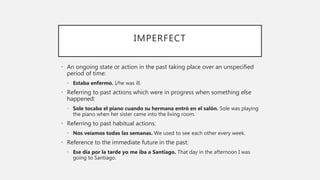
IMPERFECT
• An ongoing state or action in the past taking place over an unspecified
period of time:
• Estaba enfermo. I/he was ill.
• Referring to past actions which were in progress when something else
happened:
• Sole tocaba el piano cuando su hermana entró en el salón. Sole was playing
the piano when her sister came into the living room.
• Referring to past habitual actions:
• Nos veíamos todas las semanas. We used to see each other every week.
• Reference to the immediate future in the past:
• Ese día por la tarde yo me iba a Santiago. That day in the afternoon I was
going to Santiago.
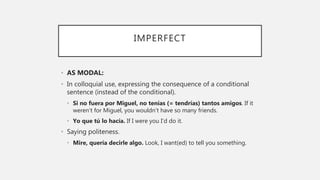
IMPERFECT
• AS MODAL:
• In colloquial use, expressing the consequence of a conditional
sentence (instead of the conditional).
• Si no fuera por Miguel, no tenías (= tendrías) tantos amigos. If it
weren’t for Miguel, you wouldn’t have so many friends.
• Yo que tú lo hacía. If I were you I’d do it.
• Saying politeness.
• Mire, quería decirle algo. Look, I want(ed) to tell you something.
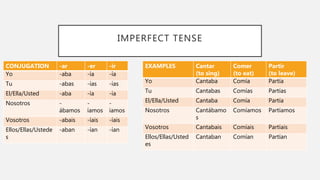
IMPERFECT TENSE
CONJUGATION -ar -er -ir
Yo -aba -ía -ía
Tu -abas -ías -ías
El/Ella/Usted -aba -ía -ía
Nosotros -
ábamos
-
íamos
-
íamos
Vosotros -abais -íais -íais
Ellos/Ellas/Ustede
s
-aban -ían -ían
EXAMPLES Cantar
(to sing)
Comer
(to eat)
Partir
(to leave)
Yo Cantaba Comía Partía
Tu Cantabas Comías Partías
El/Ella/Usted Cantaba Comía Partía
Nosotros Cantábamo
s
Comíamos Partíamos
Vosotros Cantabais Comíais Partíais
Ellos/Ellas/Usted
es
Cantaban Comían Partían
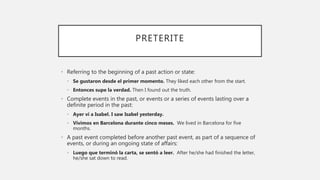
PRETERITE
• Referring to the beginning of a past action or state:
• Se gustaron desde el primer momento. They liked each other from the start.
• Entonces supe la verdad. Then I found out the truth.
• Complete events in the past, or events or a series of events lasting over a
definite period in the past:
• Ayer vi a Isabel. I saw Isabel yesterday.
• Vivimos en Barcelona durante cinco meses. We lived in Barcelona for five
months.
• A past event completed before another past event, as part of a sequence of
events, or during an ongoing state of affairs:
• Luego que terminó la carta, se sentó a leer. After he/she had finished the letter,
he/she sat down to read.
PRETERITE
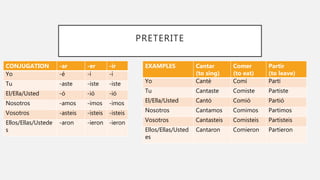
CONJUGATION -ar -er -ir
Yo -é -í -í
Tu -aste -iste -iste
El/Ella/Usted -ó -ió -ió
Nosotros -amos -imos -imos
Vosotros -asteis -isteis -isteis
Ellos/Ellas/Ustede
s
-aron -ieron -ieron
EXAMPLES Cantar
(to sing)
Comer
(to eat)
Partir
(to leave)
Yo Canté Comí Partí
Tu Cantaste Comiste Partiste
El/Ella/Usted Cantó Comió Partió
Nosotros Cantamos Comimos Partimos
Vosotros Cantasteis Comisteis Partisteis
Ellos/Ellas/Usted
es
Cantaron Comieron Partieron
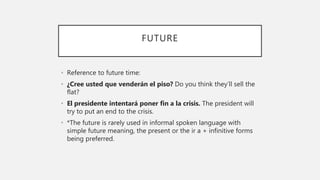
FUTURE
• Reference to future time:
• ¿Cree usted que venderán el piso? Do you think they’ll sell the
flat?
• El presidente intentará poner fin a la crisis. The president will
try to put an end to the crisis.
• *The future is rarely used in informal spoken language with
simple future meaning, the present or the ir a + infinitive forms
being preferred.
FUTURE
• AS MODALS
• Saying uncertainty with regard to future plans:
• Supongo que el jefe vendrá a la reunión. I suppose the boss will come to the
meeting.
• Saying intention:
• ¿Vendrás conmigo? Will you (would you like to) come with me?
• Saying promises:
• Se lo traeré mañana sin falta. I’ll bring it for you tomorrow without fail.
• Expressing probability with regard to something in the present:
• Estará con alguien. He/she must be with someone.
FUTURE
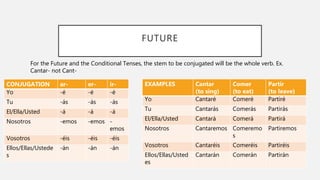
CONJUGATION ar- er- ir-
Yo -é -é -é
Tu -ás -ás -ás
El/Ella/Usted -á -á -á
Nosotros -emos -emos -
emos
Vosotros -éis -éis -éis
Ellos/Ellas/Ustede
s
-án -án -án
EXAMPLES Cantar
(to sing)
Comer
(to eat)
Partir
(to leave)
Yo Cantaré Comeré Partiré
Tu Cantarás Comerás Partirás
El/Ella/Usted Cantará Comerá Partirá
Nosotros Cantaremos Comeremo
s
Partiremos
Vosotros Cantaréis Comeréis Partiréis
Ellos/Ellas/Usted
es
Cantarán Comerán Partirán
For the Future and the Conditional Tenses, the stem to be conjugated will be the whole verb. Ex.
Cantar- not Cant-
CONDITIONAL
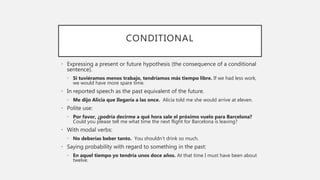
• Expressing a present or future hypothesis (the consequence of a conditional
sentence).
• Si tuviéramos menos trabajo, tendríamos más tiempo libre. If we had less work,
we would have more spare time.
• In reported speech as the past equivalent of the future.
• Me dijo Alicia que Ilegaría a las once. Alicia told me she would arrive at eleven.
• Polite use:
• Por favor, ¿podría decirme a qué hora sale el próximo vuelo para Barcelona?
Could you please tell me what time the next flight for Barcelona is leaving?
• With modal verbs:
• No deberías beber tanto. You shouldn’t drink so much.
• Saying probability with regard to something in the past:
• En aquel tiempo yo tendría unos doce años. At that time I must have been about
twelve.
CONDITIONAL
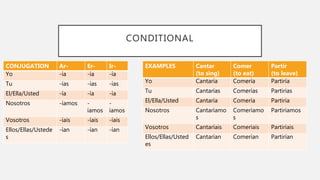
CONJUGATION Ar- Er- Ir-
Yo -ía -ía -ía
Tu -ías -ías -ías
El/Ella/Usted -ía -ía -ía
Nosotros -íamos -
íamos
-
íamos
Vosotros -íais -íais -íais
Ellos/Ellas/Ustede
s
-ían -ían -ían
EXAMPLES Cantar
(to sing)
Comer
(to eat)
Partir
(to leave)
Yo Cantaría Comería Partiría
Tu Cantarías Comerías Partirías
El/Ella/Usted Cantaría Comería Partiría
Nosotros Cantaríamo
s
Comeríamo
s
Partiríamos
Vosotros Cantaríais Comeríais Partiríais
Ellos/Ellas/Usted
es
Cantarían Comerían Partirían
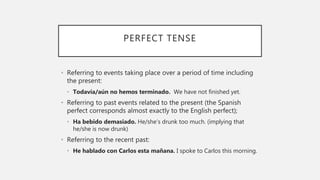
PERFECT TENSE
• Referring to events taking place over a period of time including
the present:
• Todavía/aún no hemos terminado. We have not finished yet.
• Referring to past events related to the present (the Spanish
perfect corresponds almost exactly to the English perfect);
• Ha bebido demasiado. He/she’s drunk too much. (implying that
he/she is now drunk)
• Referring to the recent past:
• He hablado con Carlos esta mañana. I spoke to Carlos this morning.
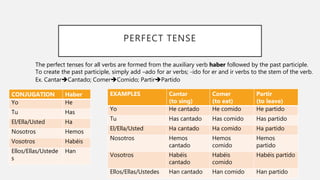
PERFECT TENSE
CONJUGATION Haber
Yo He
Tu Has
El/Ella/Usted Ha
Nosotros Hemos
Vosotros Habéis
Ellos/Ellas/Ustede
s
Han
EXAMPLES Cantar
(to sing)
Comer
(to eat)
Partir
(to leave)
Yo He cantado He comido He partido
Tu Has cantado Has comido Has partido
El/Ella/Usted Ha cantado Ha comido Ha partido
Nosotros Hemos
cantado
Hemos
comido
Hemos
partido
Vosotros Habéis
cantado
Habéis
comido
Habéis partido
Ellos/Ellas/Ustedes Han cantado Han comido Han partido
The perfect tenses for all verbs are formed from the auxiliary verb haber followed by the past participle.
To create the past participle, simply add –ado for ar verbs; -ido for er and ir verbs to the stem of the verb.
Ex. CantarCantado; ComerComido; PartirPartido
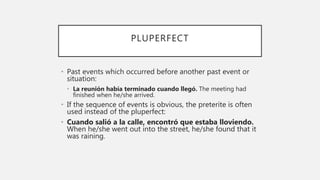
PLUPERFECT
• Past events which occurred before another past event or
situation:
• La reunión había terminado cuando llegó. The meeting had
finished when he/she arrived.
• If the sequence of events is obvious, the preterite is often
used instead of the pluperfect:
• Cuando salió a la calle, encontró que estaba lloviendo.
When he/she went out into the street, he/she found that it
was raining.
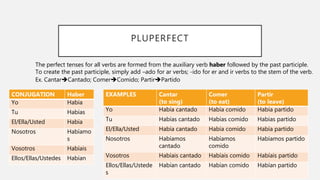
PLUPERFECT
CONJUGATION Haber
Yo Había
Tu Habías
El/Ella/Usted Había
Nosotros Habíamo
s
Vosotros Habíais
Ellos/Ellas/Ustedes Habían
EXAMPLES Cantar
(to sing)
Comer
(to eat)
Partir
(to leave)
Yo Había cantado Había comido Había partido
Tu Habías cantado Habías comido Habías partido
El/Ella/Usted Había cantado Había comido Había partido
Nosotros Habíamos
cantado
Habíamos
comido
Habíamos partido
Vosotros Habíais cantado Habíais comido Habíais partido
Ellos/Ellas/Ustede
s
Habían cantado Habían comido Habían partido
The perfect tenses for all verbs are formed from the auxiliary verb haber followed by the past participle.
To create the past participle, simply add –ado for ar verbs; -ido for er and ir verbs to the stem of the verb.
Ex. CantarCantado; ComerComido; PartirPartido
FUTURE PERFECT
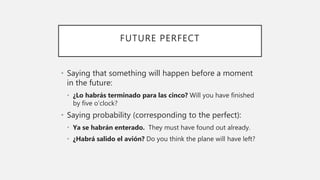
• Saying that something will happen before a moment
in the future:
• ¿Lo habrás terminado para las cinco? Will you have finished
by five o’clock?
• Saying probability (corresponding to the perfect):
• Ya se habrán enterado. They must have found out already.
• ¿Habrá salido el avión? Do you think the plane will have left?
FUTURE PERFECT
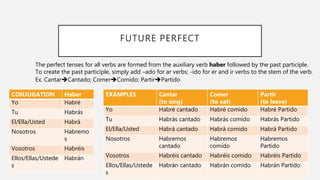
CONJUGATION Haber
Yo Habré
Tu Habrás
El/Ella/Usted Habrá
Nosotros Habremo
s
Vosotros Habréis
Ellos/Ellas/Ustede
s
Habrán
EXAMPLES Cantar
(to sing)
Comer
(to eat)
Partir
(to leave)
Yo Habré cantado Habré comido Habré Partido
Tu Habrás cantado Habrás comido Habrás Partido
El/Ella/Usted Habrá cantado Habrá comido Habrá Partido
Nosotros Habremos
cantado
Habremos
comido
Habremos
Partido
Vosotros Habréis cantado Habréis comido Habréis Partido
Ellos/Ellas/Ustede
s
Habrán cantado Habrán comido Habrán Partido
The perfect tenses for all verbs are formed from the auxiliary verb haber followed by the past participle.
To create the past participle, simply add –ado for ar verbs; -ido for er and ir verbs to the stem of the verb.
Ex. CantarCantado; ComerComido; PartirPartido
CONDITIONAL PERFECT
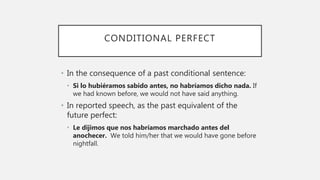
• In the consequence of a past conditional sentence:
• Si lo hubiéramos sabido antes, no habríamos dicho nada. If
we had known before, we would not have said anything.
• In reported speech, as the past equivalent of the
future perfect:
• Le dijimos que nos habríamos marchado antes del
anochecer. We told him/her that we would have gone before
nightfall.
CONDITIONAL PERFECT
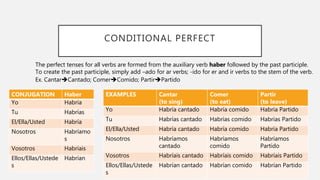
CONJUGATION Haber
Yo Habría
Tu Habrías
El/Ella/Usted Habría
Nosotros Habríamo
s
Vosotros Habríais
Ellos/Ellas/Ustede
s
Habrían
EXAMPLES Cantar
(to sing)
Comer
(to eat)
Partir
(to leave)
Yo Habría cantado Habría comido Habría Partido
Tu Habrías cantado Habrías comido Habrías Partido
El/Ella/Usted Habría cantado Habría comido Habría Partido
Nosotros Habríamos
cantado
Habríamos
comido
Habríamos
Partido
Vosotros Habríais cantado Habríais comido Habríais Partido
Ellos/Ellas/Ustede
s
Habrían cantado Habrían comido Habrían Partido
The perfect tenses for all verbs are formed from the auxiliary verb haber followed by the past participle.
To create the past participle, simply add –ado for ar verbs; -ido for er and ir verbs to the stem of the verb.
Ex. CantarCantado; ComerComido; PartirPartido
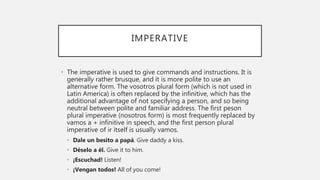
IMPERATIVE
• The imperative is used to give commands and instructions. It is
generally rather brusque, and it is more polite to use an
alternative form. The vosotros plural form (which is not used in
Latin America) is often replaced by the infinitive, which has the
additional advantage of not specifying a person, and so being
neutral between polite and familiar address. The first peson
plural imperative (nosotros form) is most frequently replaced by
vamos a + infinitive in speech, and the first person plural
imperative of ir itself is usually vamos.
• Dale un besito a papá. Give daddy a kiss.
• Déselo a él. Give it to him.
• ¡Escuchad! Listen!
• ¡Vengan todos! All of you come!
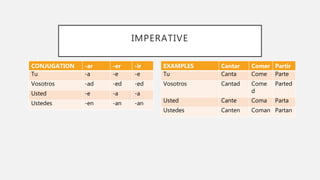
IMPERATIVE
CONJUGATION -ar -er -ir
Tu -a -e -e
Vosotros -ad -ed -ed
Usted -e -a -a
Ustedes -en -an -an
EXAMPLES Cantar Comer Partir
Tu Canta Come Parte
Vosotros Cantad Come
d
Parted
Usted Cante Coma Parta
Ustedes Canten Coman Partan
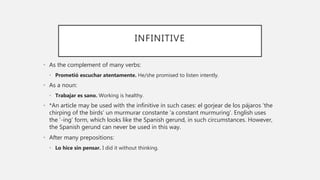
INFINITIVE
• As the complement of many verbs:
• Prometió escuchar atentamente. He/she promised to listen intently.
• As a noun:
• Trabajar es sano. Working is healthy.
• *An article may be used with the infinitive in such cases: el gorjear de los pájaros ‘the
chirping of the birds’ un murmurar constante ‘a constant murmuring’. English uses
the ‘-ing’ form, which looks like the Spanish gerund, in such circumstances. However,
the Spanish gerund can never be used in this way.
• After many prepositions:
• Lo hice sin pensar. I did it without thinking.
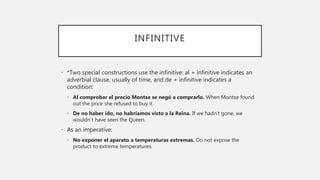
INFINITIVE
• *Two special constructions use the infinitive: al + infinitive indicates an
adverbial clause, usually of time, and de + infinitive indicates a
condition:
• Al comprobar el precio Montse se negó a comprarlo. When Montse found
out the price she refused to buy it.
• De no haber ido, no habríamos visto a la Reina. If we hadn’t gone, we
wouldn’t have seen the Queen.
• As an imperative:
• No exponer el aparato a temperaturas extremas. Do not expose the
product to extreme temperatures.
GERUND
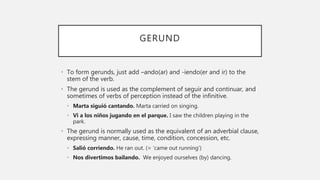
• To form gerunds, just add –ando(ar) and -iendo(er and ir) to the
stem of the verb.
• The gerund is used as the complement of seguir and continuar, and
sometimes of verbs of perception instead of the infinitive.
• Marta siguió cantando. Marta carried on singing.
• Vi a los niños jugando en el parque. I saw the children playing in the
park.
• The gerund is normally used as the equivalent of an adverbial clause,
expressing manner, cause, time, condition, concession, etc.
• Salió corriendo. He ran out. (= ‘came out running’)
• Nos divertimos bailando. We enjoyed ourselves (by) dancing.
SUBJUNCTIVE
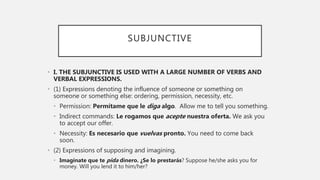
• I. THE SUBJUNCTIVE IS USED WITH A LARGE NUMBER OF VERBS AND
VERBAL EXPRESSIONS.
• (1) Expressions denoting the influence of someone or something on
someone or something else: ordering, permission, necessity, etc.
• Permission: Permítame que le diga algo. Allow me to tell you something.
• Indirect commands: Le rogamos que acepte nuestra oferta. We ask you
to accept our offer.
• Necessity: Es necesario que vuelvas pronto. You need to come back
soon.
• (2) Expressions of supposing and imagining.
• Imagínate que te pida dinero. ¿Se lo prestarás? Suppose he/she asks you for
money. Will you lend it to him/her?
SUBJUNCTIVE
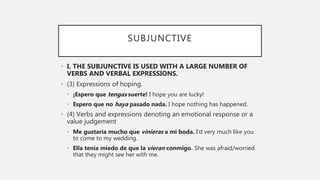
• I. THE SUBJUNCTIVE IS USED WITH A LARGE NUMBER OF
VERBS AND VERBAL EXPRESSIONS.
• (3) Expressions of hoping.
• ¡Espero que tengas suerte! I hope you are lucky!
• Espero que no haya pasado nada. I hope nothing has happened.
• (4) Verbs and expressions denoting an emotional response or a
value judgement
• Me gustaría mucho que vinieras a mi boda. I’d very much like you
to come to my wedding.
• Ella tenía miedo de que la vieran conmigo. She was afraid/worried
that they might see her with me.
SUBJUNCTIVE
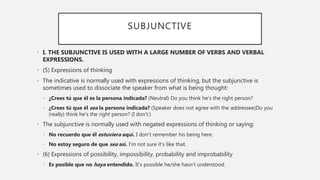
• I. THE SUBJUNCTIVE IS USED WITH A LARGE NUMBER OF VERBS AND VERBAL
EXPRESSIONS.
• (5) Expressions of thinking
• The indicative is normally used with expressions of thinking, but the subjunctive is
sometimes used to dissociate the speaker from what is being thought:
• ¿Crees tú que él es la persona indicada? (Neutral) Do you think he’s the right person?
• ¿Crees tú que él sea la persona indicada? (Speaker does not agree with the addressee)Do you
(really) think he’s the right person? (I don’t.)
• The subjunctive is normally used with negated expressions of thinking or saying:
• No recuerdo que él estuviera aquí. I don’t remember his being here.
• No estoy seguro de que sea así. I’m not sure it’s like that.
• (6) Expressions of possibility, impossibility, probability and improbability
• Es posible que no haya entendido. It’s possible he/she hasn’t understood.
SUBJUNCTIVE
• II. THE SUBJUNCTIVE AFTER CONJUNCTIONS
• (1) Expressing purpose
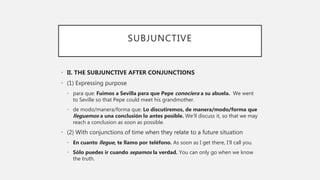
• para que: Fuimos a Sevilla para que Pepe conociera a su abuela. We went
to Seville so that Pepe could meet his grandmother.
• de modo/manera/forma que: Lo discutiremos, de manera/modo/forma que
lleguemos a una conclusión lo antes posible. We’ll discuss it, so that we may
reach a conclusion as soon as possible.
• (2) With conjunctions of time when they relate to a future situation
• En cuanto llegue, te llamo por teléfono. As soon as I get there, I’ll call you.
• Sólo puedes ir cuando sepamos la verdad. You can only go when we know
the truth.
SUBJUNCTIVE
• II. THE SUBJUNCTIVE AFTER CONJUNCTIONS
• (3) Conjunctions expressing a hypothesis
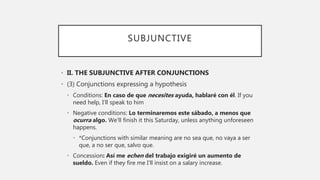
• Conditions: En caso de que necesites ayuda, hablaré con él. If you
need help, I’ll speak to him
• Negative conditions: Lo terminaremos este sábado, a menos que
ocurra algo. We’ll finish it this Saturday, unless anything unforeseen
happens.
• *Conjunctions with similar meaning are no sea que, no vaya a ser
que, a no ser que, salvo que.
• Concession: Así me echen del trabajo exigiré un aumento de
sueldo. Even if they fire me I’ll insist on a salary increase.
SUBJUNCTIVE
• II. THE SUBJUNCTIVE AFTER CONJUNCTIONS
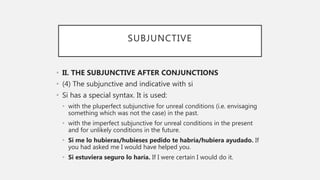
• (4) The subjunctive and indicative with si
• Si has a special syntax. It is used:
• with the pluperfect subjunctive for unreal conditions (i.e. envisaging
something which was not the case) in the past.
• with the imperfect subjunctive for unreal conditions in the present
and for unlikely conditions in the future.
• Si me lo hubieras/hubieses pedido te habría/hubiera ayudado. If
you had asked me I would have helped you.
• Si estuviera seguro lo haría. If I were certain I would do it.
SUBJUNCTIVE
• II. THE SUBJUNCTIVE AFTER CONJUNCTIONS
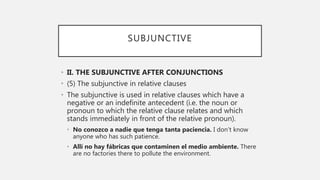
• (5) The subjunctive in relative clauses
• The subjunctive is used in relative clauses which have a
negative or an indefinite antecedent (i.e. the noun or
pronoun to which the relative clause relates and which
stands immediately in front of the relative pronoun).
• No conozco a nadie que tenga tanta paciencia. I don’t know
anyone who has such patience.
• Allí no hay fábricas que contaminen el medio ambiente. There
are no factories there to pollute the environment.
SUBJUNCTIVE
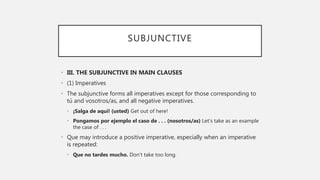
• III. THE SUBJUNCTIVE IN MAIN CLAUSES
• (1) Imperatives
• The subjunctive forms all imperatives except for those corresponding to
tú and vosotros/as, and all negative imperatives.
• ¡Salga de aquí! (usted) Get out of here!
• Pongamos por ejemplo el caso de . . . (nosotros/as) Let’s take as an example
the case of . . .
• Que may introduce a positive imperative, especially when an imperative
is repeated:
• Que no tardes mucho. Don’t take too long.
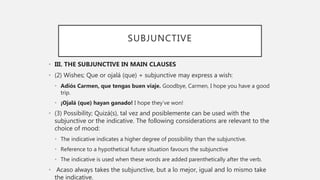
SUBJUNCTIVE
• III. THE SUBJUNCTIVE IN MAIN CLAUSES
• (2) Wishes; Que or ojalá (que) + subjunctive may express a wish:
• Adiós Carmen, que tengas buen viaje. Goodbye, Carmen, I hope you have a good
trip.
• ¡Ojalá (que) hayan ganado! I hope they’ve won!
• (3) Possibility; Quizá(s), tal vez and posiblemente can be used with the
subjunctive or the indicative. The following considerations are relevant to the
choice of mood:
• The indicative indicates a higher degree of possibility than the subjunctive.
• Reference to a hypothetical future situation favours the subjunctive
• The indicative is used when these words are added parenthetically after the verb.
• Acaso always takes the subjunctive, but a lo mejor, igual and lo mismo take
the indicative.
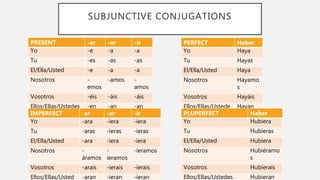
SUBJUNCTIVE CONJUGATIONS
PRESENT -ar -er -ir
Yo -e -a -a
Tu -es -as -as
El/Ella/Usted -e -a -a
Nosotros -
emos
-amos -
amos
Vosotros -éis -áis -áis
Ellos/Ellas/Ustedes -en -an -an
IMPERFECT -ar -er -ir
Yo -ara -iera -iera
Tu -aras -ieras -ieras
El/Ella/Usted -ara -iera -iera
Nosotros -
áramos
-
ieramos
-ieramos
Vosotros -arais -ierais -ierais
Ellos/Ellas/Usted -aran -ieran -ieran
PERFECT Haber
Yo Haya
Tu Hayas
El/Ella/Usted Haya
Nosotros Hayamo
s
Vosotros Hayáis
Ellos/Ellas/Ustede
s
Hayan
PLUPERFECT Haber
Yo Hubiera
Tu Hubieras
El/Ella/Usted Hubiera
Nosotros Hubiéramo
s
Vosotros Hubierais
Ellos/Ellas/Ustedes Hubieran
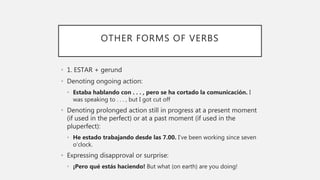
OTHER FORMS OF VERBS
• 1. ESTAR + gerund
• Denoting ongoing action:
• Estaba hablando con . . . , pero se ha cortado la comunicación. I
was speaking to . . . , but I got cut off
• Denoting prolonged action still in progress at a present moment
(if used in the perfect) or at a past moment (if used in the
pluperfect):
• He estado trabajando desde las 7.00. I’ve been working since seven
o’clock.
• Expressing disapproval or surprise:
• ¡Pero qué estás haciendo! But what (on earth) are you doing!
OTHER FORMS OF VERBS
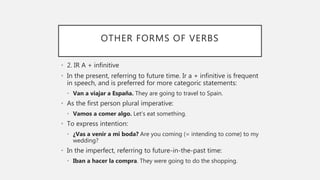
• 2. IR A + infinitive
• In the present, referring to future time. Ir a + infinitive is frequent
in speech, and is preferred for more categoric statements:
• Van a viajar a España. They are going to travel to Spain.
• As the first person plural imperative:
• Vamos a comer algo. Let’s eat something.
• To express intention:
• ¿Vas a venir a mi boda? Are you coming (= intending to come) to my
wedding?
• In the imperfect, referring to future-in-the-past time:
• Iban a hacer la compra. They were going to do the shopping.
OTHER FORMS OF VERBS
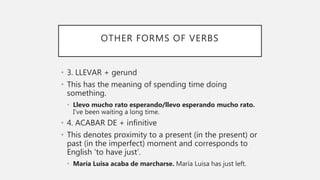
• 3. LLEVAR + gerund
• This has the meaning of spending time doing
something.
• Llevo mucho rato esperando/llevo esperando mucho rato.
I’ve been waiting a long time.
• 4. ACABAR DE + infinitive
• This denotes proximity to a present (in the present) or
past (in the imperfect) moment and corresponds to
English ‘to have just’.
• María Luisa acaba de marcharse. María Luisa has just left.
OTHER FORMS OF VERBS
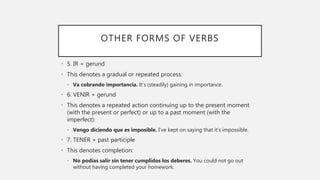
• 5. IR + gerund
• This denotes a gradual or repeated process:
• Va cobrando importancia. It’s (steadily) gaining in importance.
• 6. VENIR + gerund
• This denotes a repeated action continuing up to the present moment
(with the present or perfect) or up to a past moment (with the
imperfect):
• Vengo diciendo que es imposible. I’ve kept on saying that it’s impossible.
• 7. TENER + past participle
• This denotes completion:
• No podías salir sin tener cumplidos los deberes. You could not go out
without having completed your homework.
MODAL VERBS
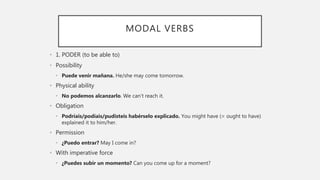
• 1. PODER (to be able to)
• Possibility
• Puede venir mañana. He/she may come tomorrow.
• Physical ability
• No podemos alcanzarlo. We can’t reach it.
• Obligation
• Podríais/podíais/pudisteis habérselo explicado. You might have (= ought to have)
explained it to him/her.
• Permission
• ¿Puedo entrar? May I come in?
• With imperative force
• ¿Puedes subir un momento? Can you come up for a moment?
MODAL VERBS
• 2. DEBER DE (must)
• Supposition
• Deben (de) ser más de las seis. It must be past six o’clock.
• Deben (de) haber regresado ya. They must have returned
already
• Obligation: English ‘ought’ is often rendered in Spanish by
the conditional (or colloquially the imperfect) form of
deber.
• Debo ir. I must go.
• Debería usted hacerlo de nuevo. You should do it again.
MODAL VERBS
• 3. SABER (to know how)
• Learned ability:
• ¿Sabes tocar el piano? Can you (= do you know how to) play the
piano?
• 4. QUERER (to want)
• Wishes. A greater degree of politeness is achieved by using
the imperfect or the quisiera form.
• Queremos viajar a Madrid. We want to travel to Madrid.
• Invitation
• ¿Quieres venir a nuestra fiesta? Do you want to come to our
party?
MODAL VERBS
• 5. TENER QUE (to have to)
• Obligation
• Tendrás que contestar. You will have to reply.
• Imperative
• Tienes que subir por esa escalera mecánica. You have to go up that
escalator.
• 6. HABER DE (to have to)
• Obligation
• Hemos de separarnos. We’ll have to separate.
• Imperative
• Has de decírmelo todo. You’ll have to tell me everything.
MODAL VERBS
• 7. HAY QUE
• This is an impersonal expression, used only in the 3rd
person singular
• Obligation
• Hay que callarlo. This must be kept quiet.
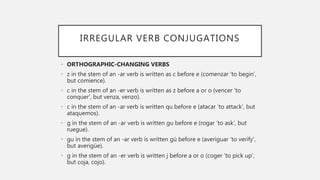
IRREGULAR VERB CONJUGATIONS
• ORTHOGRAPHIC-CHANGING VERBS
• z in the stem of an -ar verb is written as c before e (comenzar ‘to begin’,
but comience).
• c in the stem of an -er verb is written as z before a or o (vencer ‘to
conquer’, but venza, venzo).
• c in the stem of an -ar verb is written qu before e (atacar ‘to attack’, but
ataquemos).
• g in the stem of an -ar verb is written gu before e (rogar ‘to ask’, but
ruegue).
• gu in the stem of an -ar verb is written gü before e (averiguar ‘to verify’,
but averigüe).
• g in the stem of an -er verb is written j before a or o (coger ‘to pick up’,
but coja, cojo).
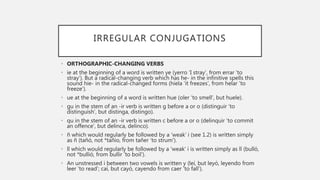
IRREGULAR CONJUGATIONS
• ORTHOGRAPHIC-CHANGING VERBS
• ie at the beginning of a word is written ye (yerro ‘I stray’, from errar ‘to
stray’). But a radical-changing verb which has he- in the infinitive spells this
sound hie- in the radical-changed forms (hiela ‘it freezes’, from helar ‘to
freeze’).
• ue at the beginning of a word is written hue (oler ‘to smell’, but huele).
• gu in the stem of an -ir verb is written g before a or o (distinguir ‘to
distinguish’, but distinga, distingo).
• qu in the stem of an -ir verb is written c before a or o (delinquir ‘to commit
an offence’, but delinca, delinco).
• ñ which would regularly be followed by a ‘weak’ i (see 1.2) is written simply
as ñ (tañó, not *tañio, from tañer ‘to strum’).
• ll which would regularly be followed by a ‘weak’ i is written simply as ll (bulló,
not *bullió, from bullir ‘to boil’).
• An unstressed i between two vowels is written y (leí, but leyó, leyendo from
leer ‘to read’; caí, but cayó, cayendo from caer ‘to fall’).
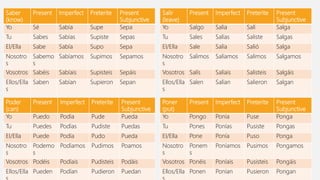
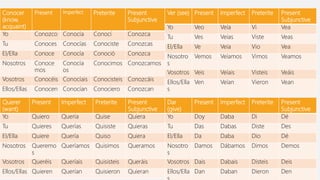
IRREGULAR VERBS (SAMPLE
CONJUGATIONS)
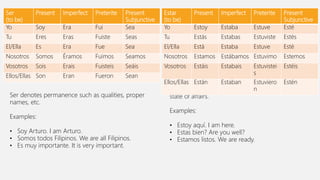
Ser
(to be)
Present Imperfect Preterite Present
Subjunctive
Yo Soy Era Fui Sea
Tu Eres Eras Fuiste Seas
El/Ella Es Era Fue Sea
Nosotros Somos Éramos Fuimos Seamos
Vosotros Sois Erais Fuisteis Seáis
Ellos/Ellas Son Eran Fueron Sean
Ser denotes permanence such as qualities, proper
names, etc.
Examples:
• Soy Arturo. I am Arturo.
• Somos todos Filipinos. We are all Filipinos.
• Es muy importante. It is very important.
Estar denotes temporary situations such as location,
state of affairs.
Examples:
• Estoy aquí. I am here.
• Estas bien? Are you well?
• Estamos listos. We are ready.
Estar
(to be)
Present Imperfect Preterite Present
Subjunctive
Yo Estoy Estaba Estuve Esté
Tu Estás Estabas Estuviste Estés
El/Ella Está Estaba Estuve Esté
Nosotros Estamos Estábamos Estuvimo Estemos
Vosotros Estáis Estabais Estuvistei
s
Estéis
Ellos/Ellas Están Estaban Estuviero
n
Estén
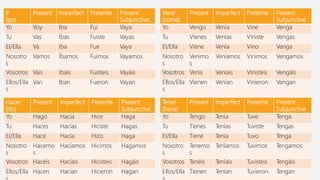
Ir
(go)
Present Imperfect Preterite Present
Subjunctive
Yo Voy Iba Fui Vaya
Tu Vas Ibas Fuiste Vayas
El/Ella Va Iba Fue Vaya
Nosotro
s
Vamos Íbamos Fuimos Vayamos
Vosotros Vais Ibais Fuisteis Vayáis
Ellos/Ella
s
Van Iban Fueron Vayan
Venir
(come)
Present Imperfect Preterite Present
Subjunctive
Yo Vengo Venía Vine Venga
Tu Vienes Venías Viniste Vengas
El/Ella Viene Venía Vino Venga
Nosotro
s
Venimo
s
Veníamos Vinimos Vengamos
Vosotros Venís Veníais Vinisteis Vengáis
Ellos/Ella
s
Vienen Venían Vinieron Vengan
Tener
(have)
Present Imperfect Preterite Present
Subjunctive
Yo Tengo Tenía Tuve Tenga
Tu Tienes Tenías Tuviste Tengas
El/Ella Tiene Tenía Tuvo Tenga
Nosotro
s
Tenemo
s
Teníamos Tuvimos Tengamos
Vosotros Tenéis Teníais Tuvisteis Tengáis
Ellos/Ella Tienen Tenían Tuvieron Tengan
Hacer
(do)
Present Imperfect Preterite Present
Subjunctive
Yo Hago Hacía Hice Haga
Tu Haces Hacías Hiciste Hagas
El/Ella Hace Hacía Hizo Haga
Nosotro
s
Hacemo
s
Hacíamos Hicimos Hagamos
Vosotros Hacéis Hacíais Hicisteis Hagáis
Ellos/Ella Hacen Hacían Hicieron Hagan
Saber
(know)
Present Imperfect Preterite Present
Subjunctive
Yo Sé Sabía Supe Sepa
Tu Sabes Sabías Supiste Sepas
El/Ella Sabe Sabía Supo Sepa
Nosotro
s
Sabemo
s
Sabíamos Supimos Sepamos
Vosotros Sabéis Sabíais Supisteis Sepáis
Ellos/Ella
s
Saben Sabían Supieron Sepan
Salir
(leave)
Present Imperfect Preterite Present
Subjunctive
Yo Salgo Salía Salí Salga
Tu Sales Salías Saliste Salgas
El/Ella Sale Salía Salió Salga
Nosotro
s
Salimos Salíamos Salimos Salgamos
Vosotros Salís Salíais Salisteis Salgáis
Ellos/Ella
s
Salen Salían Salieron Salgan
Poner
(put)
Present Imperfect Preterite Present
Subjunctive
Yo Pongo Ponía Puse Ponga
Tu Pones Ponías Pusiste Pongas
El/Ella Pone Ponía Puso Ponga
Nosotro
s
Ponem
s
Poníamos Pusimos Pongamos
Vosotros Ponéis Poníais Pusisteis Pongáis
Ellos/Ella Ponen Ponían Pusieron Pongan
Poder
(can)
Present Imperfect Preterite Present
Subjunctive
Yo Puedo Podía Pude Pueda
Tu Puedes Podías Pudiste Puedas
El/Ella Puede Podía Pudo Pueda
Nosotro
s
Podemo
s
Podíamos Pudimos Poamos
Vosotros Podéis Podíais Pudisteis Podáis
Ellos/Ella Pueden Podían Pudieron Puedan
Conocer
(know,
acquaint)
Present Imperfect Preterite Present
Subjunctive
Yo Conozco Conocía Conocí Conozca
Tu Conoces Conocías Conociste Conozcas
El/Ella Conoce Conocía Conoció Conozca
Nosotros Conoce
mos
Conocía
os
Conocimos Conozcamos
Vosotros Conocéis Conocíais Conocisteis Conozcáis
Ellos/Ellas Conocen Conocían Conociero Conozcan
Ver (see) Present Imperfect Preterite Present
Subjunctive
Yo Veo Veía Vi Vea
Tu Ves Veías Viste Veas
El/Ella Ve Veía Vio Vea
Nosotro
s
Vemos Veíamos Vimos Veamos
Vosotros Veis Veíais Visteis Veáis
Ellos/Ella
s
Ven Veían Vieron Vean
Dar
(give)
Present Imperfect Preterite Present
Subjunctive
Yo Doy Daba Di Dé
Tu Das Dabas Diste Des
El/Ella Da Daba Dio Dé
Nosotro
s
Damos Dábamos Dimos Demos
Vosotros Dais Dabais Disteis Deis
Ellos/Ella Dan Daban Dieron Den
Querer
(want)
Present Imperfect Preterite Present
Subjunctive
Yo Quiero Quería Quise Quiera
Tu Quieres Querías Quisiste Quieras
El/Ella Quiere Quería Quiso Quiera
Nosotros Queremo
s
Queríamos Quisimos Queramos
Vosotros Queréis Queríais Quisisteis Queráis
Ellos/Ellas Quieren Querían Quisieron Quieran

Spanish grammar

  • 1.
    SPANISH GRAMMAR Made byMarlon Ramos Based from Modern Spanish Grammar: A Practical Guide by Juan Kattán-Ibarra and Christopher J. Pountain
  • 2.
    COMMON PHRASES Spanish EnglishEnglish Spanish Buenos días Good morning Que lo pases bien. Have a nice time! Buenas tardes Good afternoon ¡(Buena) suerte! Good luck! Buenas noches Good evening ¡Salud! Cheers! ¡Hola! Hi ¡Que aproveche(n)! Enjoy your meal ¿Qué tal? Hi, Hello ¡Felicidades!/¡Enhorabuena ! Congratulations! Adiós Goodbye ¡Feliz cumpleaños! Happy birthday! ¿Cómo estás? How are you? ¡Feliz Navidad! Merry or Happy Christmas! Permitan que me presente. Me llamo ... Allow me to introduce myself. My name is . . . ¡Feliz Año Nuevo! Happy New Year! Mucho/tanto gusto. Pleased or nice to meet you. ¿Diga? Hello? (in the telephone) Encantado/a How do you do or Pleased to meet you. Perdone (usted)/Perdona. ¡Oiga! (usted)/¡Oye! Excuse me. Hasta mañana. See you tomorrow. Por favor. Please
  • 3.
    I. ALPHABET Letter PronunciationLetter Pronunciation A (a) /ah/ I (i) /ee/ B (be) /in the middle of b and v/ J (jota) /h or x/ C (ce) /k in ca, co, cu/ /s or θ in ce, ci/ K (ka) /k/ Ch (che) /tsh/ L (ele) /l/ /ly, y or dzh in ll/ D (de) /d or hard th/ M (eme) /m/ E (e) /e/ N (ene) /n/ F (efe) /f/ Ñ (enye) /ny/ G (ge) /g in ga, go, gu/ /h or x in ge, gi/ /gw in gua/ /g in gue, gui/ O (o) /o/ H (hache) silent P (pe) /p not aspirated/
  • 4.
    Letter Pronunciation LetterPronunciation Q (cu) /kw in qua, quo/ /k in que, qui/ V (uve) /between b and v/ R (erre) /thrilled r/ W (doble uve) /w/ S (ese) /s/ X (equis) /ks/ T (te) /t/ Y (I griega) /ee alone; dzh or y/ U (u) /oo/ Z (zeta) /θ or s/ I. ALPHABET
  • 5.
    DIPHTHONG • a +i aire [ajre] • a + u áureo [awreo] • e + y ley [lej] • e + u Europa [ewropa] • o + y hoy [oj] • o + u not very common, mainly in abbreviations, e.g. COU, or proper names, of Galician origin, e.g. Couceiro [ow] • i + a enviar [embjar] • i + e bien [bjen] • i + o serio [serjo] • u + a Guatemala [watemala] • u + e bueno [bweno]
  • 6.
    II. GENDER ANDARTICLES • All nouns in Spanish can be either masculine (m) or feminine (f). • How do you identify if a noun is a masculine or feminine? • If the noun ends in any of the letters in the word LORENS, it is masculine. • If the noun ends in any of the letters in the word DAZCion, it is feminine.
  • 7.
    GENDERS AND ARTICLES •Example: • The words papel, perro, tambor, hombre, ordén, lunes are masculine nouns because each word ends in any of the letters in LORENS. • The words libertad, palabra, paz, educacion are feminine nouns because each word ends in any of the letters in DAZCion. • However, not all nouns follow these rules, such as: Agua (m), Mujer (f) • It is better to memorize the respective gender of the nouns you learn.
  • 8.
    ARTICLES Definite Indefinite DefinitePlural Indefinite Plural Masculine El Un Los Unos Feminine La Una Las Unas • The Definite Articles are used to words that are specific while Indefinite Articles are used to words that are unspecified. • Example: • La flore (the flower). *specific flower out of all the flowers. • Una flore (a flower). *an unspecified flower.
  • 9.
    ARTICLES • How touse them? • Every article must correspond with the gender of the noun. • Example: the word Papel (paper) is a masculine nouns, so, it uses the masculine article. Thus, El papel (the paper). • Other examples: • Gato (cat) is masculine= El gato (the cat); Un gato (a cat); Los gatos (the cats); Unos gatos (some cats). • Puerta (door) is feminine= La Puerta (the door); Una Puerta (a door); Las puertas (the doors); Unas puertas (some doors).
  • 10.
    III. PLURAL • Tomake the plural form of a noun, you just need to put an – s, if it ends in a vowel, or –es, if it ends in a consonant, on its ending. • Example: • Cuchara (spoon)= Cucharas • Manzana (apple)= Manzanas • Pared (wall)= Paredes • Rey (king)= Reyes • However, a noun must still carry its sound when putting an –es. • Luz (light)= Luces • Voz (voice)= Voces
  • 11.
    IV. ADJECTIVES • Everyadjective ends in either –o or –a, (few end in –e), which corresponds with the gender of the noun they describe. • Examples: • La mujer blanca (The white woman) • Las mujeres blancas (The white women) • El hombre blanco (The white man) • Los hombres blancos (The white men) • La casa grande (The big house) • Las casas grandes (The big houses) • El río grande. (The big river) • Los ríos grandes (The big rivers)
  • 12.
    COMPARISON •Spanish uses theword más just like in Filipino. • Example: • Por favor, habla más despacio. (Please speak slower.) • In this way, we can also make the superlative form: noun+más+adjective. • Example: La casa más fuerte. (The strongest house.)
  • 13.
    •Irregular comparatives: Adjectives Comparative Bueno(Good) Mejor Grande (Big, Old) Mayor (older; age related) Malo (Bad) Peor Pequeño (Small) Menor (younger; age related) Poco (Few) Menos COMPARISON
  • 14.
    V. NUMBERS No. SpanishNo. Spanish No. Spanish 1 Uno/a 11 Once 30 Treinta 2 Dos 12 Doce 40 Cuarenta 3 Tres 13 Trece 50 Cincuenta 4 Cuatro 14 Catorce 60 Sesenta 5 Cinco 15 Quince 70 Setenta 6 Seis 16 Dieciseis 80 Ochenta 7 Siete 17 Diecisiete 90 Noveinta 8 Ocho 18 Dieciocho 100 Cien 9 Nueve 19 Diecinueve 200 Dos cientos 10 Diez 20 Veinte 500 Quinientos 0 Cero 21 Veintiuno 1,000 Mil The proper writing of digits in Spain is: Not 1,000, instead 1.000 Not 0.05, instead 0,05
  • 15.
    ORDINAL NUMBERS Ordinal Spanish 1stPrimero/a 2nd Segundo/a 3rd Tercero/a 4th Cuartero/a 5th Quinto/a 6th Sexto/a 7th Septimo/a 8th Octavo/a 9th Noveno/a 10th Decimo/a Example: • Emilio Aguinaldo es el president primero de Filipinas. • Emilio Aguinaldo is the first president of the Philippines. • Felipe VII ( Felipe septimo) • Luis XVI (Luis catorce)
  • 16.
    VI. PERSONAL PRONOUNS PronounsSpanish Examples I Yo Yo soy un Filipino. I am a Filipino. You (sg. informal) Tú Tú eres un hombre. You are a man. He, She Él (he), Ella (she) Él es mi novio. He is my boyfriend. Ella es mi novia. She is my boyfriend. We Nosotros/as (Nosotras for women) Nosotros somos estudiantes. We’re students. You (pl. informal) Vosotros/as (Vosotras for women) Vosotros sois buenos. You are good. They Ellos (masculine), Ellas (feminine) Ellos son valientes. They are strong. You (sg. formal) Usted Usted es hermosa. You are beautiful. *Usted and Ustedes can be abbreviated into “Ud.” or “Vd.” and “Uds.” or “Vds.” in writing. Important Note: Personal pronouns are usually omitted in sentences because verbs change according to the speaker of the sentence.
  • 17.
    VII. OBJECT PRONOUNS •The direct object undergoes the action of the verb. • Example: Vi a Juan ‘I saw Juan’. Juan acts as the direct object. • The indirect object is, as the term suggests, more indirectly affected by the action of the verb. • Example: Di un libro a Juan ‘I gave a book to Juan’, where un libro is the direct object and Juan is the indirect object.
  • 18.
    Object Spanish Direct IndirectPrepositional Me Me Me Mí You Te Te Tí Him/It Lo Le Él Her/It La Le Ella Us Nos Nos Nosotros/as You Os Os Vosotros/as Them Los/Las Les Ellos/Ellas *Reflexive 3rd Se Se Sí • The object pronouns can be placed in two ways: before the verb and at the end of the verb. • Example: • Yo te amo. I love you. • Yo voy amarte. I will love you.
  • 19.
    OBJECT PRONOUNS 1st 2nd3rd 4th Se Te, Os Me, Nos Lo, La, Le, Los, Las, Les • The object pronouns are arranged in this way: • Se must always stand first. Only one se per group can be used, whatever its function is. • An indirect object pronoun must always precede a direct object pronoun. • When le or les are used in combination with another pronoun of the fourth group, they become se and stand in initial position. • Examples: • ¡Dámelo! or ¡Me lo dá! (Give it to me!) • Voy a traértela. Or Te la voy a traér. (I will bring it to you.) • Se (= le or les) la entregamos. (We handed it over to her/him/them/you.)
  • 20.
    PREPOSITIONAL OBJECT PRONOUNS •We use prepositional object pronouns when there is a preposition preceding it. • Examples: • Una rosa para tí. A rose for you. *para (for) is the preposition* • Gracias a Él. Thanks to Him. *a (to) is the preposition* • When we use con (with) with object pronouns, me and you becomes conmigo (with me), contigo (with you), the rest stays the same; con ella, con nosotros, etc.
  • 21.
    VIII. DEMONSTRATIVES This ThatThat over there Masc. singular Este Ese Aquel Masc. plural Estos Esos Aquellos Fem. singular Esta Esa Aquella Fem. plural Estas Esas Aquellas Neuter Esto Eso Aquello • These can be used as both adjectives and pronouns. • Examples: • Este (adjective) chico me habló ayer. This boy spoke to me yesterday. • Éste/Este (pronoun) es el chico que me habló ayer. This is the boy who spoke to me yesterday
  • 22.
    IX. POSSESSIVES • Spanishhas two sets of Possessives: FIRST SET Singular Plural Masculine Feminine Masculine Feminine My Mi Mi Mis Mis Your (singular) Tu Tu Tus Tus His/Its Su Su Sus Sus Her/Its Su Su Sus Sus Our Nuestro Nuestra Nuestros Nuestras Your (plural) Vuestro Vuestra Vuestros Vuestras Their Su Su Sus Sus Examples: Mi madre. My mother Tu mano. Your hand Nuestra Señora. Our Lady.
  • 23.
    IX. POSSESSIVES • Spanishhas two sets of Possessives: SECOND SET Singular Plural Masculine Feminine Masculine Feminine Mine Mío Mía Míos Mías Yours (singular) Tuyo Tuya Tuyos Tuyas His/Its Suyo Suya Suyos Suyas Hers/Its Suyo Suya Suyos Suyas Ours Nuestro Nuestra Nuestros Nuestras Yours (plural) Vuestro Vuestra Vuestros Vuestras Theirs Suyo Suya Suyos Suyas Examples: • Me gusta tu casa, pero la nuestra es más grande. I like your house, but ours is larger. • La responsabilidad fue mía. The responsibility was mine. • ¿Esta casa es de tu padre? ‘Is this house your father’s?’ • No, (es) mía. ‘No, mine.’
  • 24.
    X. INTERROGATIVES AND EXCLAMATIONS •In Spanish, questions and exclamations are written with these: ¿…?/¡…! English Spanish Examples What Qué ¿Qué quieres decir? What do you want to say? Which Cuál ¿Cuál quieres? Which (one) do you want? How Cómo ¿Cómo estás? How are you? When Cuándo ¿Cuándo naciste? When were you born? Where Dónde (Adónde Where to) ¿Dónde está? Where is it? Who Quién ¿Quién somos? Who are we? Why Por qué (for what reason) ¿Por qué tardastes tanto en llegar? Why did you take so long to get here? For what Para qué (for what purpose) ¿Para qué sirve este aparato? What is this gadget for?
  • 25.
    X. INTERROGATIVES AND EXCLAMATIONS •Exclamations in Spanish can be made using Cómo and Qué • Examples: • ¡Qué guapa! How beautiful! • ¡Cómo trabaja mi hermana! How my sister works! • ¿Verdad? and ¿no? are added to the end of a sentence to form tag questions in Spanish, corresponding to a host of English expressions related to the main verb of the sentence: ‘doesn’t it?’, ‘wasn’t she?’, ‘won’t he?’, etc. • Examples: • Fernando no escuchaba, ¿verdad? Fernando wasn’t listening, was he? • Mañana hay que madrugar, ¿no? Tomorrow we must get up early, mustn’t
  • 26.
    XI. INDEFINITE PRONOUNS SpanishExamples Some Algún/o/a/os/as Algunos murmuraron contra el presidente. Some grumbled about the president. None Ningún/o/a/os/a s Ninguno de mis amigos estaba listo a ayudarme. None of my friends was prepared to help me. Someone Alguien Vi a alguien en el jardín. I saw somebody in the garden. No one Nadie Nadie lo sabe. No one knows. Something Algo Tengo algo que decirte. I have something to tell you. Nothing Nada No vi nada de interés. I saw nothing of interest. One Uno Uno no sabe qué hacer. One doesn’t know what to do. Any Cualquiér/a Cualquier día. Any day. Whoever Quienquiera Quienquiera que lo sepa. Whoever knows. All Todo/a/os/as Todos se levantan, por favor. All rise, please.
  • 27.
    XII. ADVERBS • Adverbsare words that describes a verb, an adjective, and another adverb. To form an adverb in Spanish, we just need to add –mente to the feminine form of the adjective. • Examples: • Lento (slow)=Lentamente (slowly) • Fácil (easy)=Fácilmente (easily) • However, many adjectives just stay without –mente and could still act as an adverb. • Examples: • Va muy rápido. It’s going very quickly. • ¡Habla más alto! Speak more loudly! • Trabajamos duro. We’re working hard. • ¡Tirar fuerte! Pull hard!
  • 28.
    XII. ADVERBS Adverbs ofManner Adverbs of Time Adverbs of Place Thus Así Now Ahora There Ahí/Allí Well Bien Before Antes Here Acá/Aquí Slowly Despascio After Después Inside Adentro Badly Mal Then Entonces Outside Afuera Still Todavía/Aú n Over there Allá Already Ya
  • 29.
    XIII. PREPOSITIONS Spanish EnglishSpanish English A To Detrás de Behind Ante Before (face-to-face with) En In, into, at Antes de Before (time) Encima de On top of Bajo Under Enfrente de Opposite of Con With Entre Between Contra Against Hacia Towards De Of, from Hasta Until Delante de Infront of Para/Por* For, by, in order to Dentro de Inside of Según According to Desde Since (time), from (place) Sin Without Después de After Sobre On, About *The difference between Por and Para is on the next
  • 30.
    Por Examples Para DenotesCause or Motive ¿Por qué te levantaste tan temprano? Why did you get up so early? Denotes purpose ¿Para qué me llamaste? What did you call me for? Denotes substitution Cambié el coche por una bicicleta. I changed the car for a bicycle Denotes destination Voy para Sevilla. I’m going to Seville Denotes movement through or time during Pasamos por el centro de la ciudad. We passed through the city centre. Expressions denoting quantities Es demasiado fuerte para mí. It’s too strong for me. Denoting a vague place or time Por aquí hay muchos bares. There are many bars around here. Used in Time Expressions Hazlo para el lunes que viene. Do it by next Monday. Denotes rate Ochenta kilómetros por hora. Eighty kilometres an hour. Denotes an agent of an action César fue asesinado por Bruto. Caesar was murdered by Brutus. Denotes means Es más cómodo viajar por avión. It is more comfortable travelling by air.
  • 31.
    XIV. CONJUNCTIONS Coordinating Conjunctions Other notes YAND. It has the form e before a word beginning with i-or hi- (unless hi- begins the diphthong hie-). O OR. It changes to u before a word beginning with o- or ho- O…O EITHER…OR… Pero BUT Sino BUT RATHER. It serves as the “but” in this kind of sentence: It is not … but it is… Ni…ni NIETHER…NOR… Que Que in written Spanish is normally a subordinating conjunction, but it is very frequently used in the spoken language to indicate a vague logical connection, often
  • 32.
    XIV. CONJUNCTIONS Subordinating Conjunctions Explanations Subordinating Conjunctions Explanations QueTHAT. Para que IN ORDER THAT Porque BECAUSE. De modo/manera que SO THAT Pues SO. Antes de que BEFORE. Always takes the subjunctive. Ya que BECAUSE, SINCE. Apenas SCARCELY Aunque ALTHOUGH. Cuando WHEN A condición de que ON CONDITION THAT. Desde que SINCE A menos que UNLESS Después de que AFTER A pesar de que IN SPITE OF THE FACT THAT En cuanto AS SOON AS Siempre que WHENEVER. Hasta que UNTIL Si IF Mientras WHILE
  • 33.
    XV. NEGATION • Nois to be placed before the main verb but if there is a pronoun, no is placed before it. • Examples: • No tengo dinero. I don’t have money. • No me olvides! Don’t forget me!
  • 34.
    XVI. VERB FORMS •Before reading further, here are some notes: • In Spanish, there are two moods: Indicative Mood and Subjunctive mood; each of them has a long list of tenses: present, past, future, imperfect, etc. • All verbs either end in –ar, -er, and –ir. When without these endings, we are left with a stem. • A verb with those endings is called an infinitive. • Verbs change according to who is talking, the mood, and the tense. • The stem will receive a new ending according to who is talking, the mood, and the tense. This is called Verb Conjugation. • The next lessons are the highlights of the Spanish Grammar so understand them and use them.
  • 35.
    XV. VERB FORMS •How to conjugate? 1. Identify the group of the verb. (ar, er, ir verbs) 2. Take out the ending. Now you are left with the stem. 3. Change the ending according to the tense, mood, and the speaker. Example: ComerCom-Com-o (-o 1st person sg., present tense, indicative mood)Como
  • 36.
    PRESENT TENSE • Statesof affairs in or including the present: • ¿En qué piensas? What are you thinking of? • Habitual actions in the present: • ¿Qué haces los fines de semana? What do you do at weekends? • General truths: • La mayoría de los españoles son católicos. The majority of Spaniards are Catholics. • Ability (with appropriate verbs): • Teresa lee el chino y el ruso. Teresa can read Chinese and Russian. • With ‘since’ expressions, referring to a period of time that continues up until the present: • Vive en Chile desde hace cinco años. He has been living in Chile for five years.
  • 37.
    PRESENT TENSE CONJUGATION -ar-er -ir Yo -o -o -o Tu -as -es -es El/Ella/Usted -a -e -e Nosotros - amos -emos -imos Vosotros -áis -éis -ís Ellos/Ellas/Ustedes -an -en -en EXAMPLES Cantar (to sing) Comer (to eat) Partir (to leave) Yo Canto Como Parto Tu Cantas Comes Partes El/Ella/Usted Canta Come Parte Nosotros Cantamos Comemos Partimos Vosotros Cantáis Coméis Partís Ellos/Ellas/Usted es Cantan Comen Parten
  • 38.
    IMPERFECT • An ongoingstate or action in the past taking place over an unspecified period of time: • Estaba enfermo. I/he was ill. • Referring to past actions which were in progress when something else happened: • Sole tocaba el piano cuando su hermana entró en el salón. Sole was playing the piano when her sister came into the living room. • Referring to past habitual actions: • Nos veíamos todas las semanas. We used to see each other every week. • Reference to the immediate future in the past: • Ese día por la tarde yo me iba a Santiago. That day in the afternoon I was going to Santiago.
  • 39.
    IMPERFECT • AS MODAL: •In colloquial use, expressing the consequence of a conditional sentence (instead of the conditional). • Si no fuera por Miguel, no tenías (= tendrías) tantos amigos. If it weren’t for Miguel, you wouldn’t have so many friends. • Yo que tú lo hacía. If I were you I’d do it. • Saying politeness. • Mire, quería decirle algo. Look, I want(ed) to tell you something.
  • 40.
    IMPERFECT TENSE CONJUGATION -ar-er -ir Yo -aba -ía -ía Tu -abas -ías -ías El/Ella/Usted -aba -ía -ía Nosotros - ábamos - íamos - íamos Vosotros -abais -íais -íais Ellos/Ellas/Ustede s -aban -ían -ían EXAMPLES Cantar (to sing) Comer (to eat) Partir (to leave) Yo Cantaba Comía Partía Tu Cantabas Comías Partías El/Ella/Usted Cantaba Comía Partía Nosotros Cantábamo s Comíamos Partíamos Vosotros Cantabais Comíais Partíais Ellos/Ellas/Usted es Cantaban Comían Partían
  • 41.
    PRETERITE • Referring tothe beginning of a past action or state: • Se gustaron desde el primer momento. They liked each other from the start. • Entonces supe la verdad. Then I found out the truth. • Complete events in the past, or events or a series of events lasting over a definite period in the past: • Ayer vi a Isabel. I saw Isabel yesterday. • Vivimos en Barcelona durante cinco meses. We lived in Barcelona for five months. • A past event completed before another past event, as part of a sequence of events, or during an ongoing state of affairs: • Luego que terminó la carta, se sentó a leer. After he/she had finished the letter, he/she sat down to read.
  • 42.
    PRETERITE CONJUGATION -ar -er-ir Yo -é -í -í Tu -aste -iste -iste El/Ella/Usted -ó -ió -ió Nosotros -amos -imos -imos Vosotros -asteis -isteis -isteis Ellos/Ellas/Ustede s -aron -ieron -ieron EXAMPLES Cantar (to sing) Comer (to eat) Partir (to leave) Yo Canté Comí Partí Tu Cantaste Comiste Partiste El/Ella/Usted Cantó Comió Partió Nosotros Cantamos Comimos Partimos Vosotros Cantasteis Comisteis Partisteis Ellos/Ellas/Usted es Cantaron Comieron Partieron
  • 43.
    FUTURE • Reference tofuture time: • ¿Cree usted que venderán el piso? Do you think they’ll sell the flat? • El presidente intentará poner fin a la crisis. The president will try to put an end to the crisis. • *The future is rarely used in informal spoken language with simple future meaning, the present or the ir a + infinitive forms being preferred.
  • 44.
    FUTURE • AS MODALS •Saying uncertainty with regard to future plans: • Supongo que el jefe vendrá a la reunión. I suppose the boss will come to the meeting. • Saying intention: • ¿Vendrás conmigo? Will you (would you like to) come with me? • Saying promises: • Se lo traeré mañana sin falta. I’ll bring it for you tomorrow without fail. • Expressing probability with regard to something in the present: • Estará con alguien. He/she must be with someone.
  • 45.
    FUTURE CONJUGATION ar- er-ir- Yo -é -é -é Tu -ás -ás -ás El/Ella/Usted -á -á -á Nosotros -emos -emos - emos Vosotros -éis -éis -éis Ellos/Ellas/Ustede s -án -án -án EXAMPLES Cantar (to sing) Comer (to eat) Partir (to leave) Yo Cantaré Comeré Partiré Tu Cantarás Comerás Partirás El/Ella/Usted Cantará Comerá Partirá Nosotros Cantaremos Comeremo s Partiremos Vosotros Cantaréis Comeréis Partiréis Ellos/Ellas/Usted es Cantarán Comerán Partirán For the Future and the Conditional Tenses, the stem to be conjugated will be the whole verb. Ex. Cantar- not Cant-
  • 46.
    CONDITIONAL • Expressing apresent or future hypothesis (the consequence of a conditional sentence). • Si tuviéramos menos trabajo, tendríamos más tiempo libre. If we had less work, we would have more spare time. • In reported speech as the past equivalent of the future. • Me dijo Alicia que Ilegaría a las once. Alicia told me she would arrive at eleven. • Polite use: • Por favor, ¿podría decirme a qué hora sale el próximo vuelo para Barcelona? Could you please tell me what time the next flight for Barcelona is leaving? • With modal verbs: • No deberías beber tanto. You shouldn’t drink so much. • Saying probability with regard to something in the past: • En aquel tiempo yo tendría unos doce años. At that time I must have been about twelve.
  • 47.
    CONDITIONAL CONJUGATION Ar- Er-Ir- Yo -ía -ía -ía Tu -ías -ías -ías El/Ella/Usted -ía -ía -ía Nosotros -íamos - íamos - íamos Vosotros -íais -íais -íais Ellos/Ellas/Ustede s -ían -ían -ían EXAMPLES Cantar (to sing) Comer (to eat) Partir (to leave) Yo Cantaría Comería Partiría Tu Cantarías Comerías Partirías El/Ella/Usted Cantaría Comería Partiría Nosotros Cantaríamo s Comeríamo s Partiríamos Vosotros Cantaríais Comeríais Partiríais Ellos/Ellas/Usted es Cantarían Comerían Partirían
  • 48.
    PERFECT TENSE • Referringto events taking place over a period of time including the present: • Todavía/aún no hemos terminado. We have not finished yet. • Referring to past events related to the present (the Spanish perfect corresponds almost exactly to the English perfect); • Ha bebido demasiado. He/she’s drunk too much. (implying that he/she is now drunk) • Referring to the recent past: • He hablado con Carlos esta mañana. I spoke to Carlos this morning.
  • 49.
    PERFECT TENSE CONJUGATION Haber YoHe Tu Has El/Ella/Usted Ha Nosotros Hemos Vosotros Habéis Ellos/Ellas/Ustede s Han EXAMPLES Cantar (to sing) Comer (to eat) Partir (to leave) Yo He cantado He comido He partido Tu Has cantado Has comido Has partido El/Ella/Usted Ha cantado Ha comido Ha partido Nosotros Hemos cantado Hemos comido Hemos partido Vosotros Habéis cantado Habéis comido Habéis partido Ellos/Ellas/Ustedes Han cantado Han comido Han partido The perfect tenses for all verbs are formed from the auxiliary verb haber followed by the past participle. To create the past participle, simply add –ado for ar verbs; -ido for er and ir verbs to the stem of the verb. Ex. CantarCantado; ComerComido; PartirPartido
  • 50.
    PLUPERFECT • Past eventswhich occurred before another past event or situation: • La reunión había terminado cuando llegó. The meeting had finished when he/she arrived. • If the sequence of events is obvious, the preterite is often used instead of the pluperfect: • Cuando salió a la calle, encontró que estaba lloviendo. When he/she went out into the street, he/she found that it was raining.
  • 51.
    PLUPERFECT CONJUGATION Haber Yo Había TuHabías El/Ella/Usted Había Nosotros Habíamo s Vosotros Habíais Ellos/Ellas/Ustedes Habían EXAMPLES Cantar (to sing) Comer (to eat) Partir (to leave) Yo Había cantado Había comido Había partido Tu Habías cantado Habías comido Habías partido El/Ella/Usted Había cantado Había comido Había partido Nosotros Habíamos cantado Habíamos comido Habíamos partido Vosotros Habíais cantado Habíais comido Habíais partido Ellos/Ellas/Ustede s Habían cantado Habían comido Habían partido The perfect tenses for all verbs are formed from the auxiliary verb haber followed by the past participle. To create the past participle, simply add –ado for ar verbs; -ido for er and ir verbs to the stem of the verb. Ex. CantarCantado; ComerComido; PartirPartido
  • 52.
    FUTURE PERFECT • Sayingthat something will happen before a moment in the future: • ¿Lo habrás terminado para las cinco? Will you have finished by five o’clock? • Saying probability (corresponding to the perfect): • Ya se habrán enterado. They must have found out already. • ¿Habrá salido el avión? Do you think the plane will have left?
  • 53.
    FUTURE PERFECT CONJUGATION Haber YoHabré Tu Habrás El/Ella/Usted Habrá Nosotros Habremo s Vosotros Habréis Ellos/Ellas/Ustede s Habrán EXAMPLES Cantar (to sing) Comer (to eat) Partir (to leave) Yo Habré cantado Habré comido Habré Partido Tu Habrás cantado Habrás comido Habrás Partido El/Ella/Usted Habrá cantado Habrá comido Habrá Partido Nosotros Habremos cantado Habremos comido Habremos Partido Vosotros Habréis cantado Habréis comido Habréis Partido Ellos/Ellas/Ustede s Habrán cantado Habrán comido Habrán Partido The perfect tenses for all verbs are formed from the auxiliary verb haber followed by the past participle. To create the past participle, simply add –ado for ar verbs; -ido for er and ir verbs to the stem of the verb. Ex. CantarCantado; ComerComido; PartirPartido
  • 54.
    CONDITIONAL PERFECT • Inthe consequence of a past conditional sentence: • Si lo hubiéramos sabido antes, no habríamos dicho nada. If we had known before, we would not have said anything. • In reported speech, as the past equivalent of the future perfect: • Le dijimos que nos habríamos marchado antes del anochecer. We told him/her that we would have gone before nightfall.
  • 55.
    CONDITIONAL PERFECT CONJUGATION Haber YoHabría Tu Habrías El/Ella/Usted Habría Nosotros Habríamo s Vosotros Habríais Ellos/Ellas/Ustede s Habrían EXAMPLES Cantar (to sing) Comer (to eat) Partir (to leave) Yo Habría cantado Habría comido Habría Partido Tu Habrías cantado Habrías comido Habrías Partido El/Ella/Usted Habría cantado Habría comido Habría Partido Nosotros Habríamos cantado Habríamos comido Habríamos Partido Vosotros Habríais cantado Habríais comido Habríais Partido Ellos/Ellas/Ustede s Habrían cantado Habrían comido Habrían Partido The perfect tenses for all verbs are formed from the auxiliary verb haber followed by the past participle. To create the past participle, simply add –ado for ar verbs; -ido for er and ir verbs to the stem of the verb. Ex. CantarCantado; ComerComido; PartirPartido
  • 56.
    IMPERATIVE • The imperativeis used to give commands and instructions. It is generally rather brusque, and it is more polite to use an alternative form. The vosotros plural form (which is not used in Latin America) is often replaced by the infinitive, which has the additional advantage of not specifying a person, and so being neutral between polite and familiar address. The first peson plural imperative (nosotros form) is most frequently replaced by vamos a + infinitive in speech, and the first person plural imperative of ir itself is usually vamos. • Dale un besito a papá. Give daddy a kiss. • Déselo a él. Give it to him. • ¡Escuchad! Listen! • ¡Vengan todos! All of you come!
  • 57.
    IMPERATIVE CONJUGATION -ar -er-ir Tu -a -e -e Vosotros -ad -ed -ed Usted -e -a -a Ustedes -en -an -an EXAMPLES Cantar Comer Partir Tu Canta Come Parte Vosotros Cantad Come d Parted Usted Cante Coma Parta Ustedes Canten Coman Partan
  • 58.
    INFINITIVE • As thecomplement of many verbs: • Prometió escuchar atentamente. He/she promised to listen intently. • As a noun: • Trabajar es sano. Working is healthy. • *An article may be used with the infinitive in such cases: el gorjear de los pájaros ‘the chirping of the birds’ un murmurar constante ‘a constant murmuring’. English uses the ‘-ing’ form, which looks like the Spanish gerund, in such circumstances. However, the Spanish gerund can never be used in this way. • After many prepositions: • Lo hice sin pensar. I did it without thinking.
  • 59.
    INFINITIVE • *Two specialconstructions use the infinitive: al + infinitive indicates an adverbial clause, usually of time, and de + infinitive indicates a condition: • Al comprobar el precio Montse se negó a comprarlo. When Montse found out the price she refused to buy it. • De no haber ido, no habríamos visto a la Reina. If we hadn’t gone, we wouldn’t have seen the Queen. • As an imperative: • No exponer el aparato a temperaturas extremas. Do not expose the product to extreme temperatures.
  • 60.
    GERUND • To formgerunds, just add –ando(ar) and -iendo(er and ir) to the stem of the verb. • The gerund is used as the complement of seguir and continuar, and sometimes of verbs of perception instead of the infinitive. • Marta siguió cantando. Marta carried on singing. • Vi a los niños jugando en el parque. I saw the children playing in the park. • The gerund is normally used as the equivalent of an adverbial clause, expressing manner, cause, time, condition, concession, etc. • Salió corriendo. He ran out. (= ‘came out running’) • Nos divertimos bailando. We enjoyed ourselves (by) dancing.
  • 61.
    SUBJUNCTIVE • I. THESUBJUNCTIVE IS USED WITH A LARGE NUMBER OF VERBS AND VERBAL EXPRESSIONS. • (1) Expressions denoting the influence of someone or something on someone or something else: ordering, permission, necessity, etc. • Permission: Permítame que le diga algo. Allow me to tell you something. • Indirect commands: Le rogamos que acepte nuestra oferta. We ask you to accept our offer. • Necessity: Es necesario que vuelvas pronto. You need to come back soon. • (2) Expressions of supposing and imagining. • Imagínate que te pida dinero. ¿Se lo prestarás? Suppose he/she asks you for money. Will you lend it to him/her?
  • 62.
    SUBJUNCTIVE • I. THESUBJUNCTIVE IS USED WITH A LARGE NUMBER OF VERBS AND VERBAL EXPRESSIONS. • (3) Expressions of hoping. • ¡Espero que tengas suerte! I hope you are lucky! • Espero que no haya pasado nada. I hope nothing has happened. • (4) Verbs and expressions denoting an emotional response or a value judgement • Me gustaría mucho que vinieras a mi boda. I’d very much like you to come to my wedding. • Ella tenía miedo de que la vieran conmigo. She was afraid/worried that they might see her with me.
  • 63.
    SUBJUNCTIVE • I. THESUBJUNCTIVE IS USED WITH A LARGE NUMBER OF VERBS AND VERBAL EXPRESSIONS. • (5) Expressions of thinking • The indicative is normally used with expressions of thinking, but the subjunctive is sometimes used to dissociate the speaker from what is being thought: • ¿Crees tú que él es la persona indicada? (Neutral) Do you think he’s the right person? • ¿Crees tú que él sea la persona indicada? (Speaker does not agree with the addressee)Do you (really) think he’s the right person? (I don’t.) • The subjunctive is normally used with negated expressions of thinking or saying: • No recuerdo que él estuviera aquí. I don’t remember his being here. • No estoy seguro de que sea así. I’m not sure it’s like that. • (6) Expressions of possibility, impossibility, probability and improbability • Es posible que no haya entendido. It’s possible he/she hasn’t understood.
  • 64.
    SUBJUNCTIVE • II. THESUBJUNCTIVE AFTER CONJUNCTIONS • (1) Expressing purpose • para que: Fuimos a Sevilla para que Pepe conociera a su abuela. We went to Seville so that Pepe could meet his grandmother. • de modo/manera/forma que: Lo discutiremos, de manera/modo/forma que lleguemos a una conclusión lo antes posible. We’ll discuss it, so that we may reach a conclusion as soon as possible. • (2) With conjunctions of time when they relate to a future situation • En cuanto llegue, te llamo por teléfono. As soon as I get there, I’ll call you. • Sólo puedes ir cuando sepamos la verdad. You can only go when we know the truth.
  • 65.
    SUBJUNCTIVE • II. THESUBJUNCTIVE AFTER CONJUNCTIONS • (3) Conjunctions expressing a hypothesis • Conditions: En caso de que necesites ayuda, hablaré con él. If you need help, I’ll speak to him • Negative conditions: Lo terminaremos este sábado, a menos que ocurra algo. We’ll finish it this Saturday, unless anything unforeseen happens. • *Conjunctions with similar meaning are no sea que, no vaya a ser que, a no ser que, salvo que. • Concession: Así me echen del trabajo exigiré un aumento de sueldo. Even if they fire me I’ll insist on a salary increase.
  • 66.
    SUBJUNCTIVE • II. THESUBJUNCTIVE AFTER CONJUNCTIONS • (4) The subjunctive and indicative with si • Si has a special syntax. It is used: • with the pluperfect subjunctive for unreal conditions (i.e. envisaging something which was not the case) in the past. • with the imperfect subjunctive for unreal conditions in the present and for unlikely conditions in the future. • Si me lo hubieras/hubieses pedido te habría/hubiera ayudado. If you had asked me I would have helped you. • Si estuviera seguro lo haría. If I were certain I would do it.
  • 67.
    SUBJUNCTIVE • II. THESUBJUNCTIVE AFTER CONJUNCTIONS • (5) The subjunctive in relative clauses • The subjunctive is used in relative clauses which have a negative or an indefinite antecedent (i.e. the noun or pronoun to which the relative clause relates and which stands immediately in front of the relative pronoun). • No conozco a nadie que tenga tanta paciencia. I don’t know anyone who has such patience. • Allí no hay fábricas que contaminen el medio ambiente. There are no factories there to pollute the environment.
  • 68.
    SUBJUNCTIVE • III. THESUBJUNCTIVE IN MAIN CLAUSES • (1) Imperatives • The subjunctive forms all imperatives except for those corresponding to tú and vosotros/as, and all negative imperatives. • ¡Salga de aquí! (usted) Get out of here! • Pongamos por ejemplo el caso de . . . (nosotros/as) Let’s take as an example the case of . . . • Que may introduce a positive imperative, especially when an imperative is repeated: • Que no tardes mucho. Don’t take too long.
  • 69.
    SUBJUNCTIVE • III. THESUBJUNCTIVE IN MAIN CLAUSES • (2) Wishes; Que or ojalá (que) + subjunctive may express a wish: • Adiós Carmen, que tengas buen viaje. Goodbye, Carmen, I hope you have a good trip. • ¡Ojalá (que) hayan ganado! I hope they’ve won! • (3) Possibility; Quizá(s), tal vez and posiblemente can be used with the subjunctive or the indicative. The following considerations are relevant to the choice of mood: • The indicative indicates a higher degree of possibility than the subjunctive. • Reference to a hypothetical future situation favours the subjunctive • The indicative is used when these words are added parenthetically after the verb. • Acaso always takes the subjunctive, but a lo mejor, igual and lo mismo take the indicative.
  • 70.
    SUBJUNCTIVE CONJUGATIONS PRESENT -ar-er -ir Yo -e -a -a Tu -es -as -as El/Ella/Usted -e -a -a Nosotros - emos -amos - amos Vosotros -éis -áis -áis Ellos/Ellas/Ustedes -en -an -an IMPERFECT -ar -er -ir Yo -ara -iera -iera Tu -aras -ieras -ieras El/Ella/Usted -ara -iera -iera Nosotros - áramos - ieramos -ieramos Vosotros -arais -ierais -ierais Ellos/Ellas/Usted -aran -ieran -ieran PERFECT Haber Yo Haya Tu Hayas El/Ella/Usted Haya Nosotros Hayamo s Vosotros Hayáis Ellos/Ellas/Ustede s Hayan PLUPERFECT Haber Yo Hubiera Tu Hubieras El/Ella/Usted Hubiera Nosotros Hubiéramo s Vosotros Hubierais Ellos/Ellas/Ustedes Hubieran
  • 71.
    OTHER FORMS OFVERBS • 1. ESTAR + gerund • Denoting ongoing action: • Estaba hablando con . . . , pero se ha cortado la comunicación. I was speaking to . . . , but I got cut off • Denoting prolonged action still in progress at a present moment (if used in the perfect) or at a past moment (if used in the pluperfect): • He estado trabajando desde las 7.00. I’ve been working since seven o’clock. • Expressing disapproval or surprise: • ¡Pero qué estás haciendo! But what (on earth) are you doing!
  • 72.
    OTHER FORMS OFVERBS • 2. IR A + infinitive • In the present, referring to future time. Ir a + infinitive is frequent in speech, and is preferred for more categoric statements: • Van a viajar a España. They are going to travel to Spain. • As the first person plural imperative: • Vamos a comer algo. Let’s eat something. • To express intention: • ¿Vas a venir a mi boda? Are you coming (= intending to come) to my wedding? • In the imperfect, referring to future-in-the-past time: • Iban a hacer la compra. They were going to do the shopping.
  • 73.
    OTHER FORMS OFVERBS • 3. LLEVAR + gerund • This has the meaning of spending time doing something. • Llevo mucho rato esperando/llevo esperando mucho rato. I’ve been waiting a long time. • 4. ACABAR DE + infinitive • This denotes proximity to a present (in the present) or past (in the imperfect) moment and corresponds to English ‘to have just’. • María Luisa acaba de marcharse. María Luisa has just left.
  • 74.
    OTHER FORMS OFVERBS • 5. IR + gerund • This denotes a gradual or repeated process: • Va cobrando importancia. It’s (steadily) gaining in importance. • 6. VENIR + gerund • This denotes a repeated action continuing up to the present moment (with the present or perfect) or up to a past moment (with the imperfect): • Vengo diciendo que es imposible. I’ve kept on saying that it’s impossible. • 7. TENER + past participle • This denotes completion: • No podías salir sin tener cumplidos los deberes. You could not go out without having completed your homework.
  • 75.
    MODAL VERBS • 1.PODER (to be able to) • Possibility • Puede venir mañana. He/she may come tomorrow. • Physical ability • No podemos alcanzarlo. We can’t reach it. • Obligation • Podríais/podíais/pudisteis habérselo explicado. You might have (= ought to have) explained it to him/her. • Permission • ¿Puedo entrar? May I come in? • With imperative force • ¿Puedes subir un momento? Can you come up for a moment?
  • 76.
    MODAL VERBS • 2.DEBER DE (must) • Supposition • Deben (de) ser más de las seis. It must be past six o’clock. • Deben (de) haber regresado ya. They must have returned already • Obligation: English ‘ought’ is often rendered in Spanish by the conditional (or colloquially the imperfect) form of deber. • Debo ir. I must go. • Debería usted hacerlo de nuevo. You should do it again.
  • 77.
    MODAL VERBS • 3.SABER (to know how) • Learned ability: • ¿Sabes tocar el piano? Can you (= do you know how to) play the piano? • 4. QUERER (to want) • Wishes. A greater degree of politeness is achieved by using the imperfect or the quisiera form. • Queremos viajar a Madrid. We want to travel to Madrid. • Invitation • ¿Quieres venir a nuestra fiesta? Do you want to come to our party?
  • 78.
    MODAL VERBS • 5.TENER QUE (to have to) • Obligation • Tendrás que contestar. You will have to reply. • Imperative • Tienes que subir por esa escalera mecánica. You have to go up that escalator. • 6. HABER DE (to have to) • Obligation • Hemos de separarnos. We’ll have to separate. • Imperative • Has de decírmelo todo. You’ll have to tell me everything.
  • 79.
    MODAL VERBS • 7.HAY QUE • This is an impersonal expression, used only in the 3rd person singular • Obligation • Hay que callarlo. This must be kept quiet.
  • 80.
    IRREGULAR VERB CONJUGATIONS •ORTHOGRAPHIC-CHANGING VERBS • z in the stem of an -ar verb is written as c before e (comenzar ‘to begin’, but comience). • c in the stem of an -er verb is written as z before a or o (vencer ‘to conquer’, but venza, venzo). • c in the stem of an -ar verb is written qu before e (atacar ‘to attack’, but ataquemos). • g in the stem of an -ar verb is written gu before e (rogar ‘to ask’, but ruegue). • gu in the stem of an -ar verb is written gü before e (averiguar ‘to verify’, but averigüe). • g in the stem of an -er verb is written j before a or o (coger ‘to pick up’, but coja, cojo).
  • 81.
    IRREGULAR CONJUGATIONS • ORTHOGRAPHIC-CHANGINGVERBS • ie at the beginning of a word is written ye (yerro ‘I stray’, from errar ‘to stray’). But a radical-changing verb which has he- in the infinitive spells this sound hie- in the radical-changed forms (hiela ‘it freezes’, from helar ‘to freeze’). • ue at the beginning of a word is written hue (oler ‘to smell’, but huele). • gu in the stem of an -ir verb is written g before a or o (distinguir ‘to distinguish’, but distinga, distingo). • qu in the stem of an -ir verb is written c before a or o (delinquir ‘to commit an offence’, but delinca, delinco). • ñ which would regularly be followed by a ‘weak’ i (see 1.2) is written simply as ñ (tañó, not *tañio, from tañer ‘to strum’). • ll which would regularly be followed by a ‘weak’ i is written simply as ll (bulló, not *bullió, from bullir ‘to boil’). • An unstressed i between two vowels is written y (leí, but leyó, leyendo from leer ‘to read’; caí, but cayó, cayendo from caer ‘to fall’).
  • 82.
  • 83.
    Ser (to be) Present ImperfectPreterite Present Subjunctive Yo Soy Era Fui Sea Tu Eres Eras Fuiste Seas El/Ella Es Era Fue Sea Nosotros Somos Éramos Fuimos Seamos Vosotros Sois Erais Fuisteis Seáis Ellos/Ellas Son Eran Fueron Sean Ser denotes permanence such as qualities, proper names, etc. Examples: • Soy Arturo. I am Arturo. • Somos todos Filipinos. We are all Filipinos. • Es muy importante. It is very important. Estar denotes temporary situations such as location, state of affairs. Examples: • Estoy aquí. I am here. • Estas bien? Are you well? • Estamos listos. We are ready. Estar (to be) Present Imperfect Preterite Present Subjunctive Yo Estoy Estaba Estuve Esté Tu Estás Estabas Estuviste Estés El/Ella Está Estaba Estuve Esté Nosotros Estamos Estábamos Estuvimo Estemos Vosotros Estáis Estabais Estuvistei s Estéis Ellos/Ellas Están Estaban Estuviero n Estén
  • 84.
    Ir (go) Present Imperfect PreteritePresent Subjunctive Yo Voy Iba Fui Vaya Tu Vas Ibas Fuiste Vayas El/Ella Va Iba Fue Vaya Nosotro s Vamos Íbamos Fuimos Vayamos Vosotros Vais Ibais Fuisteis Vayáis Ellos/Ella s Van Iban Fueron Vayan Venir (come) Present Imperfect Preterite Present Subjunctive Yo Vengo Venía Vine Venga Tu Vienes Venías Viniste Vengas El/Ella Viene Venía Vino Venga Nosotro s Venimo s Veníamos Vinimos Vengamos Vosotros Venís Veníais Vinisteis Vengáis Ellos/Ella s Vienen Venían Vinieron Vengan Tener (have) Present Imperfect Preterite Present Subjunctive Yo Tengo Tenía Tuve Tenga Tu Tienes Tenías Tuviste Tengas El/Ella Tiene Tenía Tuvo Tenga Nosotro s Tenemo s Teníamos Tuvimos Tengamos Vosotros Tenéis Teníais Tuvisteis Tengáis Ellos/Ella Tienen Tenían Tuvieron Tengan Hacer (do) Present Imperfect Preterite Present Subjunctive Yo Hago Hacía Hice Haga Tu Haces Hacías Hiciste Hagas El/Ella Hace Hacía Hizo Haga Nosotro s Hacemo s Hacíamos Hicimos Hagamos Vosotros Hacéis Hacíais Hicisteis Hagáis Ellos/Ella Hacen Hacían Hicieron Hagan
  • 85.
    Saber (know) Present Imperfect PreteritePresent Subjunctive Yo Sé Sabía Supe Sepa Tu Sabes Sabías Supiste Sepas El/Ella Sabe Sabía Supo Sepa Nosotro s Sabemo s Sabíamos Supimos Sepamos Vosotros Sabéis Sabíais Supisteis Sepáis Ellos/Ella s Saben Sabían Supieron Sepan Salir (leave) Present Imperfect Preterite Present Subjunctive Yo Salgo Salía Salí Salga Tu Sales Salías Saliste Salgas El/Ella Sale Salía Salió Salga Nosotro s Salimos Salíamos Salimos Salgamos Vosotros Salís Salíais Salisteis Salgáis Ellos/Ella s Salen Salían Salieron Salgan Poner (put) Present Imperfect Preterite Present Subjunctive Yo Pongo Ponía Puse Ponga Tu Pones Ponías Pusiste Pongas El/Ella Pone Ponía Puso Ponga Nosotro s Ponem s Poníamos Pusimos Pongamos Vosotros Ponéis Poníais Pusisteis Pongáis Ellos/Ella Ponen Ponían Pusieron Pongan Poder (can) Present Imperfect Preterite Present Subjunctive Yo Puedo Podía Pude Pueda Tu Puedes Podías Pudiste Puedas El/Ella Puede Podía Pudo Pueda Nosotro s Podemo s Podíamos Pudimos Poamos Vosotros Podéis Podíais Pudisteis Podáis Ellos/Ella Pueden Podían Pudieron Puedan
  • 86.
    Conocer (know, acquaint) Present Imperfect PreteritePresent Subjunctive Yo Conozco Conocía Conocí Conozca Tu Conoces Conocías Conociste Conozcas El/Ella Conoce Conocía Conoció Conozca Nosotros Conoce mos Conocía os Conocimos Conozcamos Vosotros Conocéis Conocíais Conocisteis Conozcáis Ellos/Ellas Conocen Conocían Conociero Conozcan Ver (see) Present Imperfect Preterite Present Subjunctive Yo Veo Veía Vi Vea Tu Ves Veías Viste Veas El/Ella Ve Veía Vio Vea Nosotro s Vemos Veíamos Vimos Veamos Vosotros Veis Veíais Visteis Veáis Ellos/Ella s Ven Veían Vieron Vean Dar (give) Present Imperfect Preterite Present Subjunctive Yo Doy Daba Di Dé Tu Das Dabas Diste Des El/Ella Da Daba Dio Dé Nosotro s Damos Dábamos Dimos Demos Vosotros Dais Dabais Disteis Deis Ellos/Ella Dan Daban Dieron Den Querer (want) Present Imperfect Preterite Present Subjunctive Yo Quiero Quería Quise Quiera Tu Quieres Querías Quisiste Quieras El/Ella Quiere Quería Quiso Quiera Nosotros Queremo s Queríamos Quisimos Queramos Vosotros Queréis Queríais Quisisteis Queráis Ellos/Ellas Quieren Querían Quisieron Quieran