Spanish Cognates
Spanish words that
look or sound similar to
English words and mean the
same thing in both languages.
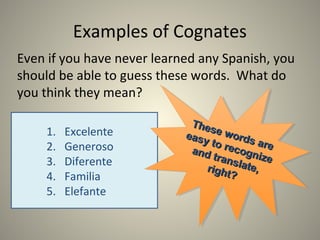
1. Excelente
2. Generoso
3. Diferente
4. Familia
5. Elefante
Examples of Cognates
Even if you have never learned any Spanish, you
should be able to guess these words. What do
you think they mean?
These words are
These words are
easy to recognize
easy to recognize
and translate,
and translate,right?
right?
Beware “False” Cognates!
False Cognates are words that look similar in
both languages but mean something different.
Examples:
•pan = bread (not “pan”)
•vaso = cup, glass (not “vase”)
•éxito = success (not “exit”)
•pie = foot (not “pie”)
•embarazada = pregnant (not “embarassed”)
Let’s try some out........
Spanish words that end in -a, -o or -e very often
have an equivalent in English. Simply drop or change
the last vowel (usually to an –e).
mapa
aire
caso
causa
costo
creativo
credito dieta
drama
favorito
figura
forma guitarra
líquido
lista
lista
medicinapersona
florista
English words that end in -or often have a Spanish
cognate that is identical.
actor
English words that end in -ist often have a Spanish
cognate that ends with –ista
artista
profesor
error
motor
humor
doctor
director
color
autor (author)
recepcionista
turista
pianista
moralista
Words that end in -ary in English very
often have a Spanish cognate that ends in
-ario
vocabulario
aniversario
diccionario disciplinario
itinerario
literario
necesario
ordinario
salario
English words that end in -ic usually have a
Spanish cognate that simply ends with -ico.
sarcástico
romántico
patriótico
Atlántico
automático
democrático didáctico
escolástico
fanático gimnástico
linguístico
lunático
optimístico
fantástico
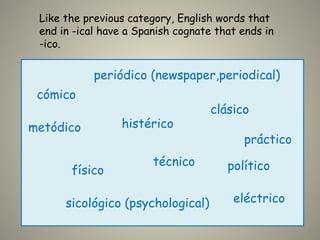
Like the previous category, English words that
end in -ical have a Spanish cognate that ends in
-ico.
cómico
clásico
técnico
sicológico (psychological)
práctico
político
periódico (newspaper,periodical)
metódico histérico
físico
eléctrico
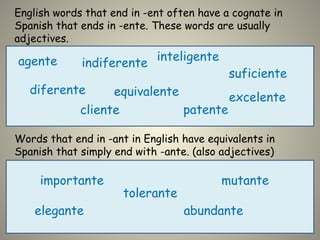
English words that end in -ent often have a cognate in
Spanish that ends in -ente. These words are usually
adjectives.
agente
Words that end in -ant in English have equivalents in
Spanish that simply end with -ante. (also adjectives)
elegante
suficiente
excelente
patente
inteligente
indiferente
equivalentediferente
cliente
tolerante
mutante
abundante
importante
English words that end in –ly often have a cognate in
Spanish that ends in -mente. These words are usually
adverbs.
Words that end in -ment in English have equivalents in
Spanish that simply end in -mento. These words are nouns.
momento
elemento suplemento argumento
documentoelemento
frecuentemente generalmente
usualmente
rápidamente
perfectamente
Words that end in -tion in English have equivalents in
Spanish that simply end with -ción. These words are also
feminine .
presentación
sociedad
curiosidadvariedad
abilidadcapacidad
electricidadnecesidad
eternidad
populación generación
educaciónrepetición
invitación
Words that in in -dad are quite common in Spanish. They
usually correspond to an English word that ends in -ty. All
of these words are feminine in gender.
adopción
ambición
Some English words that end in -ous have a Spanish
cognate that ends in -oso.
English words that end in -ence or -ance often have a
Spanish cognate that ends in -encia or -ancia
ambicioso
delicioso
misterioso religioso
generoso
diferencia
excelencia
eleganciadistancia
violencia
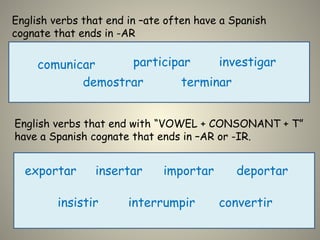
English verbs that end with “VOWEL + CONSONANT + T”
have a Spanish cognate that ends in –AR or -IR.
English verbs that end in –ate often have a Spanish
cognate that ends in -AR
participar investigar
terminardemostrar
comunicar
exportar insertar
convertir
importar
insistir
deportar
interrumpir
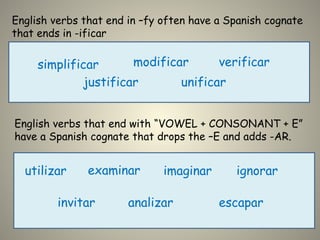
English verbs that end with “VOWEL + CONSONANT + E”
have a Spanish cognate that drops the –E and adds -AR.
English verbs that end in –fy often have a Spanish cognate
that ends in -ificar
modificar verificar
unificarjustificar
simplificar
utilizar examinar
escapar
imaginar
invitar
ignorar
analizar
There are many moreThere are many more
cognates to learn, but cancognates to learn, but can
you believe how manyyou believe how many
words you can alreadywords you can already
recognize in Spanish?recognize in Spanish?

1.1.8 cognados

  • 1.
    Spanish Cognates Spanish wordsthat look or sound similar to English words and mean the same thing in both languages.
  • 2.
    1. Excelente 2. Generoso 3.Diferente 4. Familia 5. Elefante Examples of Cognates Even if you have never learned any Spanish, you should be able to guess these words. What do you think they mean? These words are These words are easy to recognize easy to recognize and translate, and translate,right? right?
  • 3.
    Beware “False” Cognates! FalseCognates are words that look similar in both languages but mean something different. Examples: •pan = bread (not “pan”) •vaso = cup, glass (not “vase”) •éxito = success (not “exit”) •pie = foot (not “pie”) •embarazada = pregnant (not “embarassed”)
  • 4.
    Let’s try someout........ Spanish words that end in -a, -o or -e very often have an equivalent in English. Simply drop or change the last vowel (usually to an –e). mapa aire caso causa costo creativo credito dieta drama favorito figura forma guitarra líquido lista lista medicinapersona
  • 5.
    florista English words thatend in -or often have a Spanish cognate that is identical. actor English words that end in -ist often have a Spanish cognate that ends with –ista artista profesor error motor humor doctor director color autor (author) recepcionista turista pianista moralista
  • 6.
    Words that endin -ary in English very often have a Spanish cognate that ends in -ario vocabulario aniversario diccionario disciplinario itinerario literario necesario ordinario salario
  • 7.
    English words thatend in -ic usually have a Spanish cognate that simply ends with -ico. sarcástico romántico patriótico Atlántico automático democrático didáctico escolástico fanático gimnástico linguístico lunático optimístico fantástico
  • 8.
    Like the previouscategory, English words that end in -ical have a Spanish cognate that ends in -ico. cómico clásico técnico sicológico (psychological) práctico político periódico (newspaper,periodical) metódico histérico físico eléctrico
  • 9.
    English words thatend in -ent often have a cognate in Spanish that ends in -ente. These words are usually adjectives. agente Words that end in -ant in English have equivalents in Spanish that simply end with -ante. (also adjectives) elegante suficiente excelente patente inteligente indiferente equivalentediferente cliente tolerante mutante abundante importante
  • 10.
    English words thatend in –ly often have a cognate in Spanish that ends in -mente. These words are usually adverbs. Words that end in -ment in English have equivalents in Spanish that simply end in -mento. These words are nouns. momento elemento suplemento argumento documentoelemento frecuentemente generalmente usualmente rápidamente perfectamente
  • 11.
    Words that endin -tion in English have equivalents in Spanish that simply end with -ción. These words are also feminine . presentación sociedad curiosidadvariedad abilidadcapacidad electricidadnecesidad eternidad populación generación educaciónrepetición invitación Words that in in -dad are quite common in Spanish. They usually correspond to an English word that ends in -ty. All of these words are feminine in gender. adopción ambición
  • 12.
    Some English wordsthat end in -ous have a Spanish cognate that ends in -oso. English words that end in -ence or -ance often have a Spanish cognate that ends in -encia or -ancia ambicioso delicioso misterioso religioso generoso diferencia excelencia eleganciadistancia violencia
  • 13.
    English verbs thatend with “VOWEL + CONSONANT + T” have a Spanish cognate that ends in –AR or -IR. English verbs that end in –ate often have a Spanish cognate that ends in -AR participar investigar terminardemostrar comunicar exportar insertar convertir importar insistir deportar interrumpir
  • 14.
    English verbs thatend with “VOWEL + CONSONANT + E” have a Spanish cognate that drops the –E and adds -AR. English verbs that end in –fy often have a Spanish cognate that ends in -ificar modificar verificar unificarjustificar simplificar utilizar examinar escapar imaginar invitar ignorar analizar
  • 15.
    There are manymoreThere are many more cognates to learn, but cancognates to learn, but can you believe how manyyou believe how many words you can alreadywords you can already recognize in Spanish?recognize in Spanish?