ESL FOR THE NATIVE ITALIAN
         SPEAKER


DATA ANALYSIS AND LANGUAGE COMPARISON
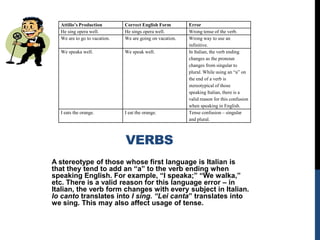
Attilio’s Production        Correct English Form        Error
  He sing opera well.         He sings opera well.        Wrong tense of the verb.
  We are to go to vacation.   We are going on vacation.   Wrong way to use an
                                                          infinitive.
  We speaka well.             We speak well.              In Italian, the verb ending
                                                          changes as the pronoun
                                                          changes from singular to
                                                          plural. While using an “a” on
                                                          the end of a verb is
                                                          stereotypical of those
                                                          speaking Italian, there is a
                                                          valid reason for this confusion
                                                          when speaking in English.
  I eats the orange.          I eat the orange.           Tense confusion – singular
                                                          and plural.


                              VERBS
A stereotype of those whose first language is Italian is
that they tend to add an “a” to the verb ending when
speaking English. For example, “I speaka;” “We walka,”
etc. There is a valid reason for this language error – in
Italian, the verb form changes with every subject in Italian.
Io canto translates into I sing. “Lei canta” translates into
we sing. This may also affect usage of tense.
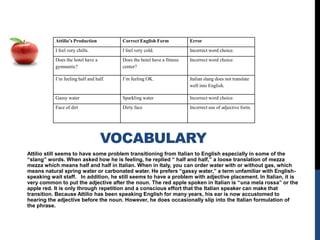
Attilio’s Production         Correct English Form            Error
           I feel very chills.          I feel very cold.               Incorrect word choice.
           Does the hotel have a        Does the hotel have a fitness   Incorrect word choice.
           gymnastic?                   center?

           I’m feeling half and half.   I’m feeling OK.                 Italian slang does not translate
                                                                        well into English.

           Gassy water                  Sparkling water                 Incorrect word choice.
           Face of dirt                 Dirty face                      Incorrect use of adjective form.


                                   VOCABULARY
Attilio still seems to have some problem transitioning from Italian to English especially in some of the
“slang” words. When asked how he is feeling, he replied “ half and half,” a loose translation of mezza
mezza which means half and half in Italian. When in Italy, you can order water with or without gas, which
means natural spring water or carbonated water. He prefers “gassy water,” a term unfamiliar with English-
speaking wait staff. In addition, he still seems to have a problem with adjective placement. In Italian, it is
very common to put the adjective after the noun. The red apple spoken in Italian is “una mela rossa” or the
apple red. It is only through repetition and a conscious effort that the Italian speaker can make that
transition. Because Attilio has been speaking English for many years, his ear is now accustomed to
hearing the adjective before the noun. However, he does occasionally slip into the Italian formulation of
the phrase.
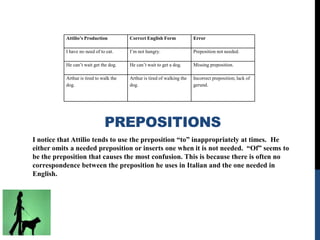
Attilio’s Production          Correct English Form             Error

           I have no need of to eat.     I’m not hungry.                  Preposition not needed.

           He can’t wait get the dog.    He can’t wait to get a dog.      Missing preposition.

           Arthur is tired to walk the   Arthur is tired of walking the   Incorrect preposition; lack of
           dog.                          dog.                             gerund.


                               PREPOSITIONS
I notice that Attilio tends to use the preposition “to” inappropriately at times. He
either omits a needed preposition or inserts one when it is not needed. “Of” seems to
be the preposition that causes the most confusion. This is because there is often no
correspondence between the preposition he uses in Italian and the one needed in
English.
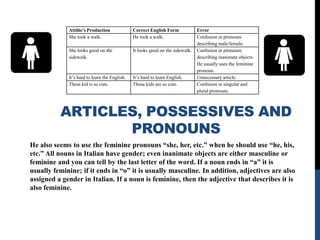
Attilio’s Production              Correct English Form             Error
             She took a walk.                  He took a walk.                  Confusion in pronouns
                                                                                describing male/female.
             She looks good on the             It looks good on the sidewalk.   Confusion in pronouns
             sidewalk.                                                          describing inanimate objects.
                                                                                He usually uses the feminine
                                                                                pronoun.
             It’s hard to learn the English.   It’s hard to learn English.      Unnecessary article.
             These kid is so cute.             Those kids are so cute.          Confusion in singular and
                                                                                plural pronouns.


          ARTICLES, POSSESSIVES AND
                 PRONOUNS
He also seems to use the feminine pronouns “she, her, etc.” when he should use “he, his,
etc.” All nouns in Italian have gender; even inanimate objects are either masculine or
feminine and you can tell by the last letter of the word. If a noun ends in “a” it is
usually feminine; if it ends in “o” it is usually masculine. In addition, adjectives are also
assigned a gender in Italian. If a noun is feminine, then the adjective that describes it is
also feminine.
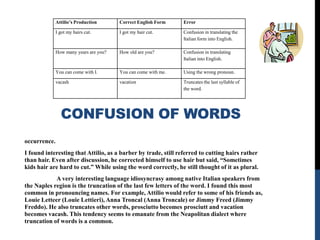
Attilio’s Production      Correct English Form    Error

              I got my hairs cut.       I got my hair cut.      Confusion in translating the
                                                                Italian form into English.

              How many years are you?   How old are you?        Confusion in translating
                                                                Italian into English.

              You can come with I.      You can come with me.   Using the wrong pronoun.

              vacash                    vacation                Truncates the last syllable of
                                                                the word.


                CONFUSION OF WORDS
occurrence.
I found interesting that Attilio, as a barber by trade, still referred to cutting hairs rather
than hair. Even after discussion, he corrected himself to use hair but said, “Sometimes
kids hair are hard to cut.” While using the word correctly, he still thought of it as plural.
            A very interesting language idiosyncrasy among native Italian speakers from
the Naples region is the truncation of the last few letters of the word. I found this most
common in pronouncing names. For example, Attilio would refer to some of his friends as,
Louie Letteer (Louie Lettieri), Anna Troncal (Anna Troncale) or Jimmy Freed (Jimmy
Freddo). He also truncates other words, prosciutto becomes prosciutt and vacation
becomes vacash. This tendency seems to emanate from the Neapolitan dialect where
truncation of words is a common.

Esl for the_native_italian_speaker

  • 1.
    ESL FOR THENATIVE ITALIAN SPEAKER DATA ANALYSIS AND LANGUAGE COMPARISON
  • 2.
    Attilio’s Production Correct English Form Error He sing opera well. He sings opera well. Wrong tense of the verb. We are to go to vacation. We are going on vacation. Wrong way to use an infinitive. We speaka well. We speak well. In Italian, the verb ending changes as the pronoun changes from singular to plural. While using an “a” on the end of a verb is stereotypical of those speaking Italian, there is a valid reason for this confusion when speaking in English. I eats the orange. I eat the orange. Tense confusion – singular and plural. VERBS A stereotype of those whose first language is Italian is that they tend to add an “a” to the verb ending when speaking English. For example, “I speaka;” “We walka,” etc. There is a valid reason for this language error – in Italian, the verb form changes with every subject in Italian. Io canto translates into I sing. “Lei canta” translates into we sing. This may also affect usage of tense.
  • 3.
    Attilio’s Production Correct English Form Error I feel very chills. I feel very cold. Incorrect word choice. Does the hotel have a Does the hotel have a fitness Incorrect word choice. gymnastic? center? I’m feeling half and half. I’m feeling OK. Italian slang does not translate well into English. Gassy water Sparkling water Incorrect word choice. Face of dirt Dirty face Incorrect use of adjective form. VOCABULARY Attilio still seems to have some problem transitioning from Italian to English especially in some of the “slang” words. When asked how he is feeling, he replied “ half and half,” a loose translation of mezza mezza which means half and half in Italian. When in Italy, you can order water with or without gas, which means natural spring water or carbonated water. He prefers “gassy water,” a term unfamiliar with English- speaking wait staff. In addition, he still seems to have a problem with adjective placement. In Italian, it is very common to put the adjective after the noun. The red apple spoken in Italian is “una mela rossa” or the apple red. It is only through repetition and a conscious effort that the Italian speaker can make that transition. Because Attilio has been speaking English for many years, his ear is now accustomed to hearing the adjective before the noun. However, he does occasionally slip into the Italian formulation of the phrase.
  • 4.
    Attilio’s Production Correct English Form Error I have no need of to eat. I’m not hungry. Preposition not needed. He can’t wait get the dog. He can’t wait to get a dog. Missing preposition. Arthur is tired to walk the Arthur is tired of walking the Incorrect preposition; lack of dog. dog. gerund. PREPOSITIONS I notice that Attilio tends to use the preposition “to” inappropriately at times. He either omits a needed preposition or inserts one when it is not needed. “Of” seems to be the preposition that causes the most confusion. This is because there is often no correspondence between the preposition he uses in Italian and the one needed in English.
  • 5.
    Attilio’s Production Correct English Form Error She took a walk. He took a walk. Confusion in pronouns describing male/female. She looks good on the It looks good on the sidewalk. Confusion in pronouns sidewalk. describing inanimate objects. He usually uses the feminine pronoun. It’s hard to learn the English. It’s hard to learn English. Unnecessary article. These kid is so cute. Those kids are so cute. Confusion in singular and plural pronouns. ARTICLES, POSSESSIVES AND PRONOUNS He also seems to use the feminine pronouns “she, her, etc.” when he should use “he, his, etc.” All nouns in Italian have gender; even inanimate objects are either masculine or feminine and you can tell by the last letter of the word. If a noun ends in “a” it is usually feminine; if it ends in “o” it is usually masculine. In addition, adjectives are also assigned a gender in Italian. If a noun is feminine, then the adjective that describes it is also feminine.
  • 6.
    Attilio’s Production Correct English Form Error I got my hairs cut. I got my hair cut. Confusion in translating the Italian form into English. How many years are you? How old are you? Confusion in translating Italian into English. You can come with I. You can come with me. Using the wrong pronoun. vacash vacation Truncates the last syllable of the word. CONFUSION OF WORDS occurrence. I found interesting that Attilio, as a barber by trade, still referred to cutting hairs rather than hair. Even after discussion, he corrected himself to use hair but said, “Sometimes kids hair are hard to cut.” While using the word correctly, he still thought of it as plural. A very interesting language idiosyncrasy among native Italian speakers from the Naples region is the truncation of the last few letters of the word. I found this most common in pronouncing names. For example, Attilio would refer to some of his friends as, Louie Letteer (Louie Lettieri), Anna Troncal (Anna Troncale) or Jimmy Freed (Jimmy Freddo). He also truncates other words, prosciutto becomes prosciutt and vacation becomes vacash. This tendency seems to emanate from the Neapolitan dialect where truncation of words is a common.