Simple Present Tense 
English Grammar Rules 
The simple present tense in English is used to describe an action that is 
regular, true or normal. 
We use the present tense: 
1. For repeated or regular actions in the present time period. 
 I take the train to the office. 
 The train to Berlin leaves every hour. 
 John sleeps eight hours every night during the week. 
2. For facts. 
 The President of The USA lives in The White House. 
 A dog has four legs. 
 We come from Switzerland. 
3. For habits. 
 I get up early every day. 
 Carol brushes her teeth twice a day. 
 They travel to their country house every weekend. 
4. For things that are always / generally true. 
 It rains a lot in winter. 
 The Queen of England lives in Buckingham Palace. 
 They speak English at work. 
Verb Conjugation & Spelling 
We form the present tense using the base form of the infinitive (without the 
TO).
In general, in the third person we add 'S' in the third person. 
Subject Verb The Rest of the sentence 
I / you / we / they speak / learn English at home 
he / she / it speaks / learns English at home 
The spelling for the verb in the third person differs depending on the ending of 
that verb: 
1. For verbs that end in -O, -CH, -SH, -SS, -X, or -Z we add -ES in the third 
person. 
 go – goes 
 catch – catches 
 wash – washes 
 kiss – kisses 
 fix – fixes 
 buzz – buzzes 
2. For verbs that end in a consonant + Y, we remove the Y and add -IES. 
 marry – marries 
 study – studies 
 carry – carries 
 worry – worries 
NOTE: For verbs that end in a vowel + Y, we just add -S. 
 play – plays 
 enjoy – enjoys 
 say – says 
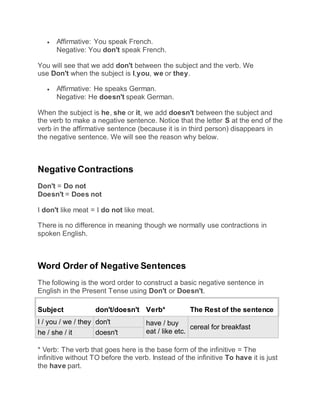
Negative Sentences in the Simple Present Tense 
To make a negative sentence in English we normally use Don't or 
Doesn't with all verbs EXCEPT To Be and Modal verbs (can, might, should 
etc.).
 Affirmative: You speak French. 
Negative: You don't speak French. 
You will see that we add don't between the subject and the verb. We 
use Don't when the subject is I,you, we or they. 
 Affirmative: He speaks German. 
Negative: He doesn't speak German. 
When the subject is he, she or it, we add doesn't between the subject and 
the verb to make a negative sentence. Notice that the letter S at the end of the 
verb in the affirmative sentence (because it is in third person) disappears in 
the negative sentence. We will see the reason why below. 
Negative Contractions 
Don't = Do not 
Doesn't = Does not 
I don't like meat = I do not like meat. 
There is no difference in meaning though we normally use contractions in 
spoken English. 
Word Order of Negative Sentences 
The following is the word order to construct a basic negative sentence in 
English in the Present Tense using Don't or Doesn't. 
Subject don't/doesn't Verb* The Rest of the sentence 
I / you / we / they don't have / buy 
eat / like etc. 
cereal for breakfast 
he / she / it doesn't 
* Verb: The verb that goes here is the base form of the infinitive = The 
infinitive without TO before the verb. Instead of the infinitive To have it is just 
the have part.
Remember that the infinitive is the verb before it is conjugated (changed) and 
it begins with TO. For example: to have, to eat, to go, to live, to speak etc. 
Examples of Negative Sentences with Don't and Doesn't: 
 You don't speak Arabic. 
 John doesn't speak Italian. 
 We don't have time for a rest. 
 It doesn't move. 
 They don't want to go to the party. 
 She doesn't like fish. 
Questions in the Simple Present Tense 
To make a question in English we normally use Do or Does. It has no 
translation in Spanish though it is essential to show we are making a question. 
It is normally put at the beginning of the question. 
 Affirmative: You speak English. 
Question: Do you speak English? 
You will see that we add DO at the beginning of the affirmative sentence to 
make it a question. We useDo when the subject is I, you, we or they. 
 Affirmative: He speaks French. 
Question: Does he speak French? 
When the subject is he, she or it, we add DOES at the beginning to make the 
affirmative sentence a question. Notice that the letter S at the end of the verb 
in the affirmative sentence (because it is in third person) disappears in the 
question. We will see the reason why below. 
We DON'T use Do or Does in questions that have the verb To Be or Modal 
Verbs (can, must, might, should etc.) 
Word Order of Questions with Do and Does
The following is the word order to construct a basic question in English 
using Do or Does. 
Do/Does Subject Verb* The Rest of the sentence 
Do I / you / we / they have / need 
want etc. 
a new bike? 
Does he / she / it 
*Verb: The verb that goes here is the base form of the infinitive = The infinitive 
without TO before the verb. Instead of the infinitive To have it is just 
the have part. 
Remember that the infinitive is the verb before it is conjugated (changed) and 
it begins with TO. For example: to have, to eat, to go, to live, to speak etc. 
Examples of Questions with Do and Does: 
 Do you need a dictionary? 
 Does Mary need a dictionary? 
 Do we have a meeting now? 
 Does it rain a lot in winter? 
 Do they want to go to the party? 
 Does he like pizza? 
Short Answers with Do and Does 
In questions that use do/does it is possible to give short answers to direct 
questions as follows: 
Sample Questions 
Short Answer 
(Affirmative) 
Short Answer 
(Negative) 
Do you like chocolate? Yes, I do. No, I don't. 
Do I need a pencil? Yes, you do. No, you don't. 
Do you both like chocolate? Yes, we do. No, we don't. 
Do they like chocolate? Yes, they do. No, they don't. 
Does he like chocolate? Yes, he does. No, he doesn't.
Does she like chocolate? Yes, she does. No, she doesn't. 
Does it have four wheels? Yes, it does. No, it doesn't. 
However, if a question word such 
as who, when, where, why, which or how is used in the question, you can 
not use the short answers above to respond to the question.

Simple present tense

  • 1.
    Simple Present Tense English Grammar Rules The simple present tense in English is used to describe an action that is regular, true or normal. We use the present tense: 1. For repeated or regular actions in the present time period.  I take the train to the office.  The train to Berlin leaves every hour.  John sleeps eight hours every night during the week. 2. For facts.  The President of The USA lives in The White House.  A dog has four legs.  We come from Switzerland. 3. For habits.  I get up early every day.  Carol brushes her teeth twice a day.  They travel to their country house every weekend. 4. For things that are always / generally true.  It rains a lot in winter.  The Queen of England lives in Buckingham Palace.  They speak English at work. Verb Conjugation & Spelling We form the present tense using the base form of the infinitive (without the TO).
  • 2.
    In general, inthe third person we add 'S' in the third person. Subject Verb The Rest of the sentence I / you / we / they speak / learn English at home he / she / it speaks / learns English at home The spelling for the verb in the third person differs depending on the ending of that verb: 1. For verbs that end in -O, -CH, -SH, -SS, -X, or -Z we add -ES in the third person.  go – goes  catch – catches  wash – washes  kiss – kisses  fix – fixes  buzz – buzzes 2. For verbs that end in a consonant + Y, we remove the Y and add -IES.  marry – marries  study – studies  carry – carries  worry – worries NOTE: For verbs that end in a vowel + Y, we just add -S.  play – plays  enjoy – enjoys  say – says Negative Sentences in the Simple Present Tense To make a negative sentence in English we normally use Don't or Doesn't with all verbs EXCEPT To Be and Modal verbs (can, might, should etc.).
  • 3.
     Affirmative: Youspeak French. Negative: You don't speak French. You will see that we add don't between the subject and the verb. We use Don't when the subject is I,you, we or they.  Affirmative: He speaks German. Negative: He doesn't speak German. When the subject is he, she or it, we add doesn't between the subject and the verb to make a negative sentence. Notice that the letter S at the end of the verb in the affirmative sentence (because it is in third person) disappears in the negative sentence. We will see the reason why below. Negative Contractions Don't = Do not Doesn't = Does not I don't like meat = I do not like meat. There is no difference in meaning though we normally use contractions in spoken English. Word Order of Negative Sentences The following is the word order to construct a basic negative sentence in English in the Present Tense using Don't or Doesn't. Subject don't/doesn't Verb* The Rest of the sentence I / you / we / they don't have / buy eat / like etc. cereal for breakfast he / she / it doesn't * Verb: The verb that goes here is the base form of the infinitive = The infinitive without TO before the verb. Instead of the infinitive To have it is just the have part.
  • 4.
    Remember that theinfinitive is the verb before it is conjugated (changed) and it begins with TO. For example: to have, to eat, to go, to live, to speak etc. Examples of Negative Sentences with Don't and Doesn't:  You don't speak Arabic.  John doesn't speak Italian.  We don't have time for a rest.  It doesn't move.  They don't want to go to the party.  She doesn't like fish. Questions in the Simple Present Tense To make a question in English we normally use Do or Does. It has no translation in Spanish though it is essential to show we are making a question. It is normally put at the beginning of the question.  Affirmative: You speak English. Question: Do you speak English? You will see that we add DO at the beginning of the affirmative sentence to make it a question. We useDo when the subject is I, you, we or they.  Affirmative: He speaks French. Question: Does he speak French? When the subject is he, she or it, we add DOES at the beginning to make the affirmative sentence a question. Notice that the letter S at the end of the verb in the affirmative sentence (because it is in third person) disappears in the question. We will see the reason why below. We DON'T use Do or Does in questions that have the verb To Be or Modal Verbs (can, must, might, should etc.) Word Order of Questions with Do and Does
  • 5.
    The following isthe word order to construct a basic question in English using Do or Does. Do/Does Subject Verb* The Rest of the sentence Do I / you / we / they have / need want etc. a new bike? Does he / she / it *Verb: The verb that goes here is the base form of the infinitive = The infinitive without TO before the verb. Instead of the infinitive To have it is just the have part. Remember that the infinitive is the verb before it is conjugated (changed) and it begins with TO. For example: to have, to eat, to go, to live, to speak etc. Examples of Questions with Do and Does:  Do you need a dictionary?  Does Mary need a dictionary?  Do we have a meeting now?  Does it rain a lot in winter?  Do they want to go to the party?  Does he like pizza? Short Answers with Do and Does In questions that use do/does it is possible to give short answers to direct questions as follows: Sample Questions Short Answer (Affirmative) Short Answer (Negative) Do you like chocolate? Yes, I do. No, I don't. Do I need a pencil? Yes, you do. No, you don't. Do you both like chocolate? Yes, we do. No, we don't. Do they like chocolate? Yes, they do. No, they don't. Does he like chocolate? Yes, he does. No, he doesn't.
  • 6.
    Does she likechocolate? Yes, she does. No, she doesn't. Does it have four wheels? Yes, it does. No, it doesn't. However, if a question word such as who, when, where, why, which or how is used in the question, you can not use the short answers above to respond to the question.