Connected Speech
From Ch 5 Teaching Pronunciation, 2nd Edition
What you know from
consonants & vowels
In Chapters 3 & 4, you went beyond the
citation forms of the vowel and consonant
inventory in American English and considered
the effects of positional variation and
processes.
These include...
the effects of positional
variation on consonants
what happens to
consonants in (consonant)
clusters - devoicing, cluster
reductions, unreleased
stops
vowel lengthening in
relation to tense/lax vowels
and the effects of stops
and fricatives
the effects on vowels as a
result of /r/ /l/ and nasal
coloring
So quite a lot that can
enable you to do a narrow
transcription, but...
Almost all of this has been at the single word
level, and we rarely say words in isolation.
Instead we need to look at connected speech,
and that entails learning about a few more
processes.
Contractions, Blends, &
Reductions
Blending refers to “...any two word sequence in which the word boundary is
blurred”. It includes contractions and blends. What’s the difference?
Contractions are blends, but they have a conventionalized WRITTEN form, for
example, we’ve or he’s (letters are removed)
Blends are contracted SPOKEN forms that do NOT have a conventionalized
written form, such as who’ll (from who will) or there’re (from there are). It’s quite
common to say these, but you are very unlikely to see them in written form. Here,
there are reductions and/or deletions.
Spoken English has many more phrase reductions, like
wanna (want to), and kinda (kind of), typical of informal
speech.
However, reduced forms affect all areas and all types of
spoken English. Contrary to what may believe, connected
speech is not “slang”. It is important and even necessary to
maintain the natural rhythmic patterns of English
Linking
Linking (or liaison) is “the ability to
speak English smoothly…the
(appropriate) connecting of the final
sound of one word or syllable to the
initial sound of the next”. This is
often something that is lacking in the
speech of NNS.
Just how much linking you’d
find in native-speaker speech
depends on various factors:
● level of formality of the
situation
● rate of speaking
● individual features of the
speaker
There are several types of linking:
Insertion of glides with V +
V sequences
Intervocalic consonant
sharing in VC + V
sequences
Resyllabification in CC + V
sequences
Lengthened articulation of
consonants w/germinate
consonants
Unreleased consonants in
stop + stop or stop +
affricate sequences
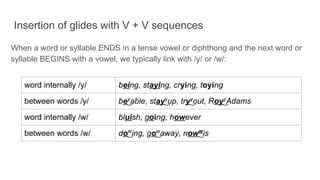
Insertion of glides with V + V sequences
When a word or syllable ENDS in a tense vowel or diphthong and the next word or
syllable BEGINS with a vowel, we typically link with /y/ or /w/:
word internally /y/ being, staying, crying, toying
between words /y/ be͜y
able, stay͜y
up, try͜y
out, Roy͜y
Adams
word internally /w/ bluish, going, however
between words /w/ do͜w
ing, go͜w
away, now͜w
is
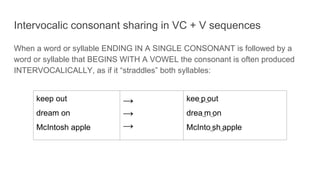
Intervocalic consonant sharing in VC + V sequences
When a word or syllable ENDING IN A SINGLE CONSONANT is followed by a
word or syllable that BEGINS WITH A VOWEL the consonant is often produced
INTERVOCALICALLY, as if it “straddles” both syllables:
keep out
dream on
McIntosh apple
→
→
→
kee͜ p͜ out
drea͜ m͜ on
McInto͜ sh͜ apple
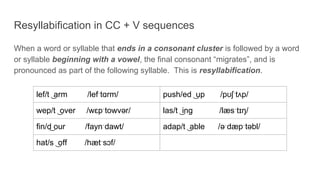
Resyllabification in CC + V sequences
When a word or syllable that ends in a consonant cluster is followed by a word
or syllable beginning with a vowel, the final consonant “migrates”, and is
pronounced as part of the following syllable. This is resyllabification.
lef/t ͜ arm /lefˑtɑrm/ push/ed ͜ up /pʊʃˑtʌp/
wep/t ͜ over /wɛpˑtowvər/ las/t ͜ ing /læsˑtɪŋ/
fin/d͜ our /faynˑdawt/ adap/t ͜ able /əˑdæpˑtəbl/
hat/s ͜ off /hætˑsɔf/
Lengthened articulation of consonants w/germinate
consonants
Geminates are two identical consonants - when they come together due to
juxtaposition of two words, there is one single elongated articulation of the
consonant:
stop͜ pushing [pː] Rob͜ Bill [bː]
short͜ time [sː] bad͜ dog [dː]
quick͜ cure [kː] big͜ gap [gː]
classroom͜ management [mː] less͜ serious [sː]
Unreleased consonants in stop + stop or stop + affricate
sequences
Whenever a stop is followed by another stop or by an affricate, the first stop is
unreleased in order to make a smooth transition between the two. Use the
“degree” diacritic [̊] to show this process.
pet cat [t ̊k] big dipper [g ̊d]
soap dish [p ̊d] good jury [d ̊dʒ]
black board [k ̊b] big church [g ̊tʃ]
Assimilation
Assimilation
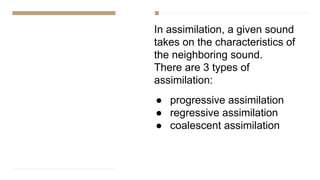
In assimilation, a given sound
takes on the characteristics of
the neighboring sound.
There are 3 types of
assimilation:
● progressive assimilation
● regressive assimilation
● coalescent assimilation
Progressive assimilation
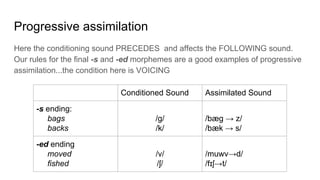
Here the conditioning sound PRECEDES and affects the FOLLOWING sound.
Our rules for the final -s and -ed morphemes are a good examples of progressive
assimilation...the condition here is VOICING
Conditioned Sound Assimilated Sound
-s ending:
bags
backs
/g/
/k/
/bæg → z/
/bæk → s/
-ed ending
moved
fished
/v/
/ʃ/
/muwv→d/
/fɪʃ→t/
Regressive assimilation
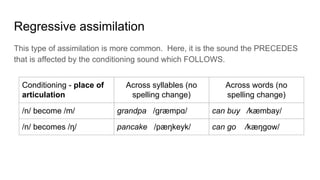
This type of assimilation is more common. Here, it is the sound the PRECEDES
that is affected by the conditioning sound which FOLLOWS.
Conditioning - place of
articulation
Across syllables (no
spelling change)
Across words (no
spelling change)
/n/ become /m/ grandpa /græmpɑ/ can buy /kæmbay/
/n/ becomes /ŋ/ pancake /pæŋkeyk/ can go /kæŋgow/
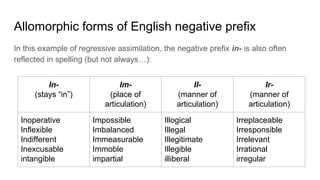
Allomorphic forms of English negative prefix
In this example of regressive assimilation, the negative prefix in- is also often
reflected in spelling (but not always…):
In-
(stays “in”)
Im-
(place of
articulation)
Il-
(manner of
articulation)
Ir-
(manner of
articulation)
Inoperative
Inflexible
Indifferent
Inexcusable
intangible
Impossible
Imbalanced
Immeasurable
Immoble
impartial
Illogical
Illegal
Illegitimate
Illegible
illiberal
Irreplaceable
Irresponsible
Irrelevant
Irrational
irregular
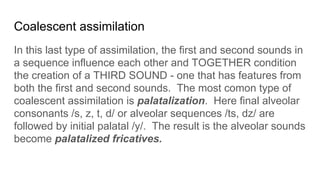
Coalescent assimilation
In this last type of assimilation, the first and second sounds in
a sequence influence each other and TOGETHER condition
the creation of a THIRD SOUND - one that has features from
both the first and second sounds. The most comon type of
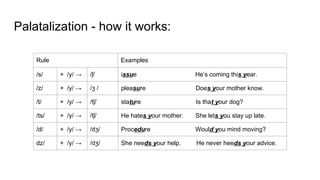
coalescent assimilation is palatalization. Here final alveolar
consonants /s, z, t, d/ or alveolar sequences /ts, dz/ are
followed by initial palatal /y/. The result is the alveolar sounds
become palatalized fricatives.
Palatalization - how it works:
Rule Examples
/s/ + /y/ → /ʃ/ issue He’s coming this year.
/z/ + /y/ → /ʒ / pleasure Does your mother know.
/t/ + /y/ → /tʃ/ stature Is that your dog?
/ts/ + /y/ → /tʃ/ He hates your mother. She lets you stay up late.
/d/ + /y/ → /dʒ/ Procedure Would you mind moving?
dz/ + /y/ → /dʒ/ She needs your help. He never heeds your advice.
Deletion
Deletion is another common
process in connected speech.
Here, sound disappear or are
not clearly articulated in
certain contexts. Sometimes,
this is reflected in spelling as
in deletion in contracted
forms of auxiliary verbs like .
Some examples of deletion NOT reflected in spelling
● Loss of /t/ when /nt/ is between two vowels or before a syllabic [l]. Note the
strike though for the /t/ in each word below:
● Loss of /t/ or /d/ when the occur SECOND in sequence or cluster of 3
cosonants:
winter Toronto enter mantle
/t/ restless listless exactly
/d/ windmill kindness hands
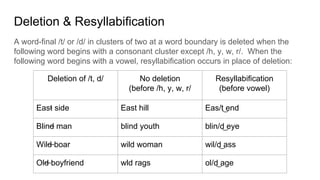
Deletion & Resyllabification
A word-final /t/ or /d/ in clusters of two at a word boundary is deleted when the
following word begins with a consonant cluster except /h, y, w, r/. When the
following word begins with a vowel, resyllabification occurs in place of deletion:
Deletion of /t, d/ No deletion
(before /h, y, w, r/
Resyllabification
(before vowel)
East side East hill Eas/t͜ end
Blind man blind youth blin/d͜ eye
Wild boar wild woman wil/d͜ ass
Old boyfriend wld rags ol/d͜ age
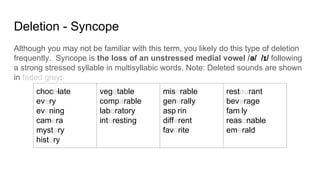
Deletion - Syncope
Although you may not be familiar with this term, you likely do this type of deletion
frequently. Syncope is the loss of an unstressed medial vowel /ə/ /ɪ/ following
a strong stressed syllable in multisyllabic words. Note: Deleted sounds are shown
in faded grey:
chocolate
every
evening
camera
mystery
history
vegetable
comparable
laboratory
interesting
miserable
generally
aspirin
different
favorite
restaurant
beverage
family
reasonable
emerald
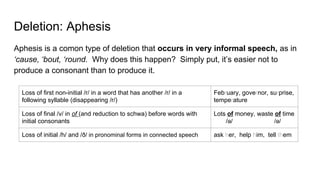
Deletion: Aphesis
Aphesis is a comon type of deletion that occurs in very informal speech, as in
‘cause, ‘bout, ‘round. Why does this happen? Simply put, it’s easier not to
produce a consonant than to produce it.
Loss of first non-initial /r/ in a word that has another /r/ in a
following syllable (disappearing /r/)
February, governor, surprise,
temperature
Loss of final /v/ in of (and reduction to schwa) before words with
initial consonants
Lots of money, waste of time
/ə/ /ə/
Loss of initial /h/ and /ð/ in pronominal forms in connected speech ask her, help him, tell them
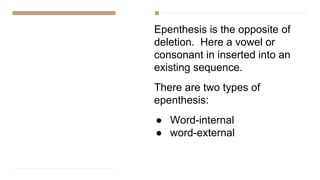
Epenthesis
Epenthesis is the opposite of
deletion. Here a vowel or
consonant in inserted into an
existing sequence.
There are two types of
epenthesis:
● Word-internal
● word-external
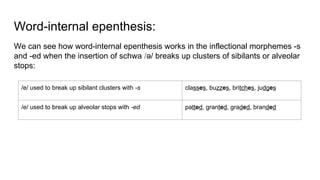
Word-internal epenthesis:
We can see how word-internal epenthesis works in the inflectional morphemes -s
and -ed when the insertion of schwa /ə/ breaks up clusters of sibilants or alveolar
stops:
/e/ used to break up sibilant clusters with -s classes, buzzes, britches, judges
/e/ used to break up alveolar stops with -ed patted, granted, graded, branded
Word-internal epenthesis (cont)
We also see epenthesis used to facilitate the pronunciation of consonant clusters
in connected speech.
Note: NNS sometimes erroneously use epenthesis to simplify clusters:
In a voiced nasal + voiceless fricative sequence
● Insert voiceless stop [t] to facilitate cluster /ns/
● Insert voiceless stop [p] to facilitate cluster /mf/
prince → /prɪnts/
comfort → /kʌmpfərt/
Misuse of word-internal epenthesis film → /fɪləm/
please → /pəliyz/
judgment → /dʒʌdʒəmənt/
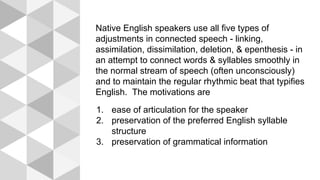
Native English speakers use all five types of
adjustments in connected speech - linking,
assimilation, dissimilation, deletion, & epenthesis - in
an attempt to connect words & syllables smoothly in
the normal stream of speech (often unconsciously)
and to maintain the regular rhythmic beat that typifies
English. The motivations are
1. ease of articulation for the speaker
2. preservation of the preferred English syllable
structure
3. preservation of grammatical information
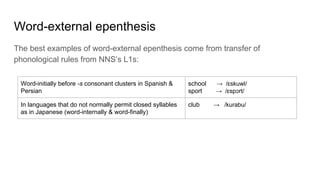
Word-external epenthesis
The best examples of word-external epenthesis come from transfer of
phonological rules from NNS’s L1s:
Word-initially before -s consonant clusters in Spanish &
Persian
school → /ɛskuwl/
sport → /ɛspɔrt/
In languages that do not normally permit closed syllables
as in Japanese (word-internally & word-finally)
club → /kurabu/

Connected speech

  • 1.
    Connected Speech From Ch5 Teaching Pronunciation, 2nd Edition
  • 2.
    What you knowfrom consonants & vowels In Chapters 3 & 4, you went beyond the citation forms of the vowel and consonant inventory in American English and considered the effects of positional variation and processes.
  • 3.
    These include... the effectsof positional variation on consonants what happens to consonants in (consonant) clusters - devoicing, cluster reductions, unreleased stops vowel lengthening in relation to tense/lax vowels and the effects of stops and fricatives the effects on vowels as a result of /r/ /l/ and nasal coloring
  • 4.
    So quite alot that can enable you to do a narrow transcription, but... Almost all of this has been at the single word level, and we rarely say words in isolation. Instead we need to look at connected speech, and that entails learning about a few more processes.
  • 5.
  • 6.
    Blending refers to“...any two word sequence in which the word boundary is blurred”. It includes contractions and blends. What’s the difference? Contractions are blends, but they have a conventionalized WRITTEN form, for example, we’ve or he’s (letters are removed) Blends are contracted SPOKEN forms that do NOT have a conventionalized written form, such as who’ll (from who will) or there’re (from there are). It’s quite common to say these, but you are very unlikely to see them in written form. Here, there are reductions and/or deletions.
  • 7.
    Spoken English hasmany more phrase reductions, like wanna (want to), and kinda (kind of), typical of informal speech. However, reduced forms affect all areas and all types of spoken English. Contrary to what may believe, connected speech is not “slang”. It is important and even necessary to maintain the natural rhythmic patterns of English
  • 8.
  • 9.
    Linking (or liaison)is “the ability to speak English smoothly…the (appropriate) connecting of the final sound of one word or syllable to the initial sound of the next”. This is often something that is lacking in the speech of NNS.
  • 10.
    Just how muchlinking you’d find in native-speaker speech depends on various factors: ● level of formality of the situation ● rate of speaking ● individual features of the speaker
  • 11.
    There are severaltypes of linking: Insertion of glides with V + V sequences Intervocalic consonant sharing in VC + V sequences Resyllabification in CC + V sequences Lengthened articulation of consonants w/germinate consonants Unreleased consonants in stop + stop or stop + affricate sequences
  • 12.
    Insertion of glideswith V + V sequences When a word or syllable ENDS in a tense vowel or diphthong and the next word or syllable BEGINS with a vowel, we typically link with /y/ or /w/: word internally /y/ being, staying, crying, toying between words /y/ be͜y able, stay͜y up, try͜y out, Roy͜y Adams word internally /w/ bluish, going, however between words /w/ do͜w ing, go͜w away, now͜w is
  • 13.
    Intervocalic consonant sharingin VC + V sequences When a word or syllable ENDING IN A SINGLE CONSONANT is followed by a word or syllable that BEGINS WITH A VOWEL the consonant is often produced INTERVOCALICALLY, as if it “straddles” both syllables: keep out dream on McIntosh apple → → → kee͜ p͜ out drea͜ m͜ on McInto͜ sh͜ apple
  • 14.
    Resyllabification in CC+ V sequences When a word or syllable that ends in a consonant cluster is followed by a word or syllable beginning with a vowel, the final consonant “migrates”, and is pronounced as part of the following syllable. This is resyllabification. lef/t ͜ arm /lefˑtɑrm/ push/ed ͜ up /pʊʃˑtʌp/ wep/t ͜ over /wɛpˑtowvər/ las/t ͜ ing /læsˑtɪŋ/ fin/d͜ our /faynˑdawt/ adap/t ͜ able /əˑdæpˑtəbl/ hat/s ͜ off /hætˑsɔf/
  • 15.
    Lengthened articulation ofconsonants w/germinate consonants Geminates are two identical consonants - when they come together due to juxtaposition of two words, there is one single elongated articulation of the consonant: stop͜ pushing [pː] Rob͜ Bill [bː] short͜ time [sː] bad͜ dog [dː] quick͜ cure [kː] big͜ gap [gː] classroom͜ management [mː] less͜ serious [sː]
  • 16.
    Unreleased consonants instop + stop or stop + affricate sequences Whenever a stop is followed by another stop or by an affricate, the first stop is unreleased in order to make a smooth transition between the two. Use the “degree” diacritic [̊] to show this process. pet cat [t ̊k] big dipper [g ̊d] soap dish [p ̊d] good jury [d ̊dʒ] black board [k ̊b] big church [g ̊tʃ]
  • 17.
  • 18.
  • 19.
    In assimilation, agiven sound takes on the characteristics of the neighboring sound. There are 3 types of assimilation: ● progressive assimilation ● regressive assimilation ● coalescent assimilation
  • 20.
    Progressive assimilation Here theconditioning sound PRECEDES and affects the FOLLOWING sound. Our rules for the final -s and -ed morphemes are a good examples of progressive assimilation...the condition here is VOICING Conditioned Sound Assimilated Sound -s ending: bags backs /g/ /k/ /bæg → z/ /bæk → s/ -ed ending moved fished /v/ /ʃ/ /muwv→d/ /fɪʃ→t/
  • 21.
    Regressive assimilation This typeof assimilation is more common. Here, it is the sound the PRECEDES that is affected by the conditioning sound which FOLLOWS. Conditioning - place of articulation Across syllables (no spelling change) Across words (no spelling change) /n/ become /m/ grandpa /græmpɑ/ can buy /kæmbay/ /n/ becomes /ŋ/ pancake /pæŋkeyk/ can go /kæŋgow/
  • 22.
    Allomorphic forms ofEnglish negative prefix In this example of regressive assimilation, the negative prefix in- is also often reflected in spelling (but not always…): In- (stays “in”) Im- (place of articulation) Il- (manner of articulation) Ir- (manner of articulation) Inoperative Inflexible Indifferent Inexcusable intangible Impossible Imbalanced Immeasurable Immoble impartial Illogical Illegal Illegitimate Illegible illiberal Irreplaceable Irresponsible Irrelevant Irrational irregular
  • 23.
    Coalescent assimilation In thislast type of assimilation, the first and second sounds in a sequence influence each other and TOGETHER condition the creation of a THIRD SOUND - one that has features from both the first and second sounds. The most comon type of coalescent assimilation is palatalization. Here final alveolar consonants /s, z, t, d/ or alveolar sequences /ts, dz/ are followed by initial palatal /y/. The result is the alveolar sounds become palatalized fricatives.
  • 24.
    Palatalization - howit works: Rule Examples /s/ + /y/ → /ʃ/ issue He’s coming this year. /z/ + /y/ → /ʒ / pleasure Does your mother know. /t/ + /y/ → /tʃ/ stature Is that your dog? /ts/ + /y/ → /tʃ/ He hates your mother. She lets you stay up late. /d/ + /y/ → /dʒ/ Procedure Would you mind moving? dz/ + /y/ → /dʒ/ She needs your help. He never heeds your advice.
  • 25.
  • 26.
    Deletion is anothercommon process in connected speech. Here, sound disappear or are not clearly articulated in certain contexts. Sometimes, this is reflected in spelling as in deletion in contracted forms of auxiliary verbs like .
  • 27.
    Some examples ofdeletion NOT reflected in spelling ● Loss of /t/ when /nt/ is between two vowels or before a syllabic [l]. Note the strike though for the /t/ in each word below: ● Loss of /t/ or /d/ when the occur SECOND in sequence or cluster of 3 cosonants: winter Toronto enter mantle /t/ restless listless exactly /d/ windmill kindness hands
  • 28.
    Deletion & Resyllabification Aword-final /t/ or /d/ in clusters of two at a word boundary is deleted when the following word begins with a consonant cluster except /h, y, w, r/. When the following word begins with a vowel, resyllabification occurs in place of deletion: Deletion of /t, d/ No deletion (before /h, y, w, r/ Resyllabification (before vowel) East side East hill Eas/t͜ end Blind man blind youth blin/d͜ eye Wild boar wild woman wil/d͜ ass Old boyfriend wld rags ol/d͜ age
  • 29.
    Deletion - Syncope Althoughyou may not be familiar with this term, you likely do this type of deletion frequently. Syncope is the loss of an unstressed medial vowel /ə/ /ɪ/ following a strong stressed syllable in multisyllabic words. Note: Deleted sounds are shown in faded grey: chocolate every evening camera mystery history vegetable comparable laboratory interesting miserable generally aspirin different favorite restaurant beverage family reasonable emerald
  • 30.
    Deletion: Aphesis Aphesis isa comon type of deletion that occurs in very informal speech, as in ‘cause, ‘bout, ‘round. Why does this happen? Simply put, it’s easier not to produce a consonant than to produce it. Loss of first non-initial /r/ in a word that has another /r/ in a following syllable (disappearing /r/) February, governor, surprise, temperature Loss of final /v/ in of (and reduction to schwa) before words with initial consonants Lots of money, waste of time /ə/ /ə/ Loss of initial /h/ and /ð/ in pronominal forms in connected speech ask her, help him, tell them
  • 31.
  • 32.
    Epenthesis is theopposite of deletion. Here a vowel or consonant in inserted into an existing sequence. There are two types of epenthesis: ● Word-internal ● word-external
  • 33.
    Word-internal epenthesis: We cansee how word-internal epenthesis works in the inflectional morphemes -s and -ed when the insertion of schwa /ə/ breaks up clusters of sibilants or alveolar stops: /e/ used to break up sibilant clusters with -s classes, buzzes, britches, judges /e/ used to break up alveolar stops with -ed patted, granted, graded, branded
  • 34.
    Word-internal epenthesis (cont) Wealso see epenthesis used to facilitate the pronunciation of consonant clusters in connected speech. Note: NNS sometimes erroneously use epenthesis to simplify clusters: In a voiced nasal + voiceless fricative sequence ● Insert voiceless stop [t] to facilitate cluster /ns/ ● Insert voiceless stop [p] to facilitate cluster /mf/ prince → /prɪnts/ comfort → /kʌmpfərt/ Misuse of word-internal epenthesis film → /fɪləm/ please → /pəliyz/ judgment → /dʒʌdʒəmənt/
  • 35.
    Native English speakersuse all five types of adjustments in connected speech - linking, assimilation, dissimilation, deletion, & epenthesis - in an attempt to connect words & syllables smoothly in the normal stream of speech (often unconsciously) and to maintain the regular rhythmic beat that typifies English. The motivations are 1. ease of articulation for the speaker 2. preservation of the preferred English syllable structure 3. preservation of grammatical information
  • 36.
    Word-external epenthesis The bestexamples of word-external epenthesis come from transfer of phonological rules from NNS’s L1s: Word-initially before -s consonant clusters in Spanish & Persian school → /ɛskuwl/ sport → /ɛspɔrt/ In languages that do not normally permit closed syllables as in Japanese (word-internally & word-finally) club → /kurabu/