GRAMMAR BOOK Walberto Haynes  Spanish 3 Period 1
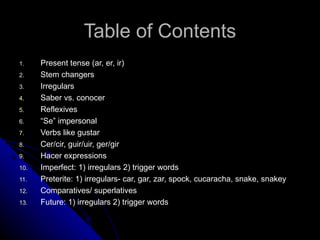
Table of Contents Present tense (ar, er, ir) Stem changers  Irregulars  Saber vs. conocer Reflexives  “ Se” impersonal Verbs like gustar Cer/cir, guir/uir, ger/gir Hacer expressions Imperfect: 1) irregulars 2) trigger words Preterite: 1) irregulars- car, gar, zar, spock, cucaracha, snake, snakey Comparatives/ superlatives Future: 1) irregulars 2) trigger words
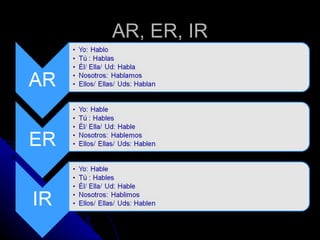
AR, ER, IR
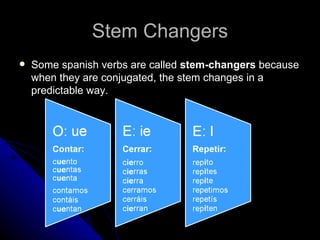
Stem Changers Some spanish verbs are called  stem-changers  because when they are conjugated, the stem changes in a predictable way.
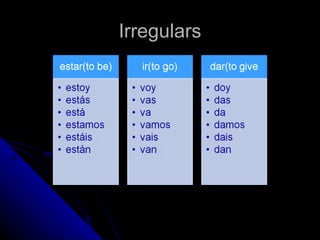
Irregulars
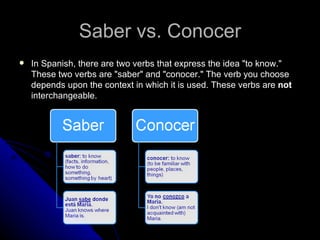
Saber vs. Conocer In Spanish, there are two verbs that express the idea "to know." These two verbs are "saber" and "conocer." The verb you choose depends upon the context in which it is used. These verbs are  not  interchangeable.
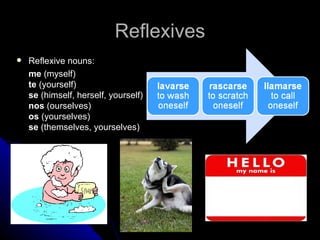
Reflexives Reflexive nouns: me  (myself) te  (yourself) se  (himself, herself, yourself) nos  (ourselves) os  (yourselves) se  (themselves, yourselves)
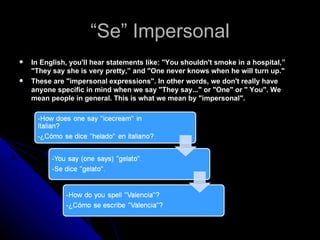
“ Se” Impersonal In English, you'll hear statements like: "You shouldn't smoke in a hospital,” "They say she is very pretty,” and "One never knows when he will turn up." These are "impersonal expressions". In other words, we don't really have anyone specific in mind when we say "They say..." or "One" or " You". We mean people in general. This is what we mean by "impersonal".
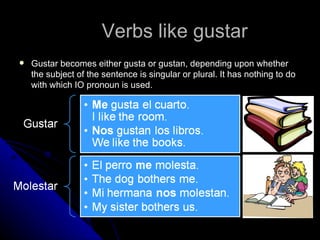
Verbs like gustar Gustar becomes either gusta or gustan, depending upon whether the subject of the sentence is singular or plural. It has nothing to do with which IO pronoun is used.
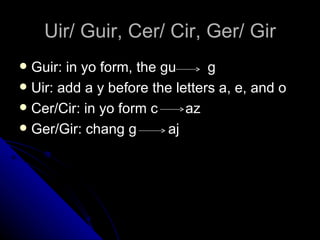
Uir/ Guir, Cer/ Cir, Ger/ Gir Guir: in yo form, the gu  g Uir: add a y before the letters a, e, and o Cer/Cir: in yo form c  az Ger/Gir: chang g  aj
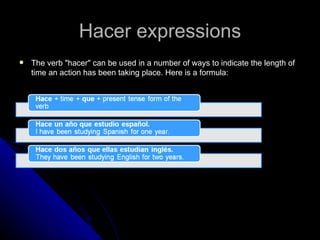
Hacer expressions The verb "hacer" can be used in a number of ways to indicate the length of time an action has been taking place. Here is a formula:
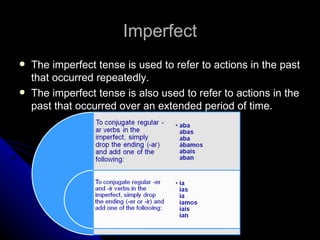
Imperfect The imperfect tense is used to refer to actions in the past that occurred repeatedly. The imperfect tense is also used to refer to actions in the past that occurred over an extended period of time.
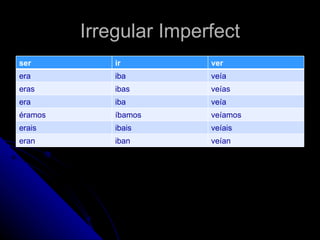
Irregular Imperfect ser ir ver era iba veía eras ibas veías era iba veía éramos íbamos veíamos erais ibais veíais eran iban veían
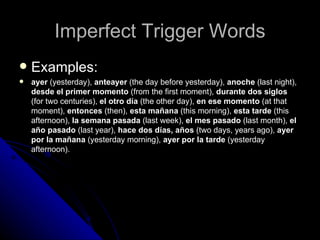
Imperfect Trigger Words Examples: ayer  (yesterday),  anteayer  (the day before yesterday),  anoche  (last night),  desde el primer momento  (from the first moment),  durante dos siglos  (for two centuries),  el otro día  (the other day),  en ese momento  (at that moment),  entonces  (then),  esta mañana  (this morning),  esta tarde  (this afternoon),  la semana pasada  (last week),  el mes pasado  (last month),  el año pasado  (last year),  hace dos días, años  (two days, years ago),  ayer por la mañana  (yesterday morning),  ayer por la tarde  (yesterday afternoon).
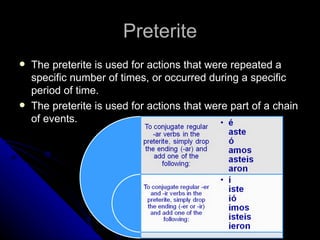
Preterite The preterite is used for actions that were repeated a specific number of times, or occurred during a specific period of time. The preterite is used for actions that were part of a chain of events.
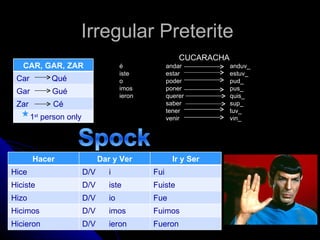
Irregular Preterite  CUCARACHA é andar anduv_ iste estar estuv_ o poder pud_ imos poner pus_ ieron querer quis_ saber sup_ tener tuv_ venir vin_ CAR, GAR, ZAR Car  Qué Gar  Gu é Zar  C é 1 st  person only Hacer Dar y Ver Ir y Ser Hice D/V  i Fui Hiciste D/V  iste Fuiste Hizo D/V  io Fue Hicimos D/V  imos Fuimos Hicieron D/V  ieron Fueron
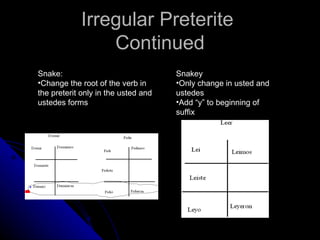
Irregular Preterite  Continued Snake: Change the root of the verb in the preterit only in the usted and ustedes forms Snakey Only change in usted and ustedes Add “y” to beginning of suffix
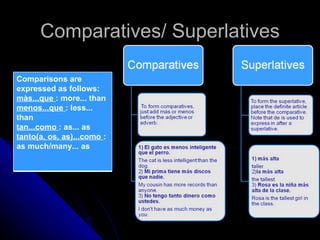
Comparatives/ Superlatives Comparisons are expressed as follows: màs...que  : more... than menos...que  : less... than tan...como  : as... as tanto(a, os, as)...como  : as much/many... as
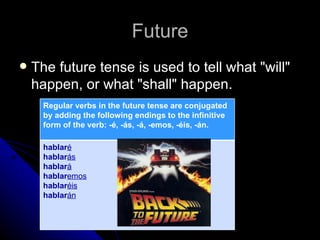
Future The future tense is used to tell what "will" happen, or what "shall" happen. Regular verbs in the future tense are conjugated by adding the following endings to the infinitive form of the verb: -é, -ás, -á, -emos, -éis, -án. hablar é hablar ás hablar á hablar emos hablar éis hablar án
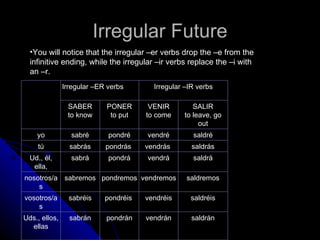
Irregular Future You will notice that the irregular –er verbs drop the –e from the infinitive ending, while the irregular –ir verbs replace the –i with an –r. Irregular –ER verbs Irregular –IR verbs SABER to know PONER to put VENIR to come SALIR to leave, go out yo sabré pondré vendré saldré tú sabrás pondrás  vendrás  saldrás Ud., él, ella, sabrá pondrá vendrá saldrá nosotros/as sabremos pondremos vendremos saldremos vosotros/as sabréis pondréis  vendréis saldréis Uds., ellos, ellas sabrán pondrán vendrán saldrán

Grammarbook

  • 1.
    GRAMMAR BOOK WalbertoHaynes Spanish 3 Period 1
  • 2.
    Table of ContentsPresent tense (ar, er, ir) Stem changers Irregulars Saber vs. conocer Reflexives “ Se” impersonal Verbs like gustar Cer/cir, guir/uir, ger/gir Hacer expressions Imperfect: 1) irregulars 2) trigger words Preterite: 1) irregulars- car, gar, zar, spock, cucaracha, snake, snakey Comparatives/ superlatives Future: 1) irregulars 2) trigger words
  • 3.
  • 4.
    Stem Changers Somespanish verbs are called stem-changers because when they are conjugated, the stem changes in a predictable way.
  • 5.
  • 6.
    Saber vs. ConocerIn Spanish, there are two verbs that express the idea "to know." These two verbs are "saber" and "conocer." The verb you choose depends upon the context in which it is used. These verbs are not interchangeable.
  • 7.
    Reflexives Reflexive nouns:me (myself) te (yourself) se (himself, herself, yourself) nos (ourselves) os (yourselves) se (themselves, yourselves)
  • 8.
    “ Se” ImpersonalIn English, you'll hear statements like: "You shouldn't smoke in a hospital,” "They say she is very pretty,” and "One never knows when he will turn up." These are "impersonal expressions". In other words, we don't really have anyone specific in mind when we say "They say..." or "One" or " You". We mean people in general. This is what we mean by "impersonal".
  • 9.
    Verbs like gustarGustar becomes either gusta or gustan, depending upon whether the subject of the sentence is singular or plural. It has nothing to do with which IO pronoun is used.
  • 10.
    Uir/ Guir, Cer/Cir, Ger/ Gir Guir: in yo form, the gu g Uir: add a y before the letters a, e, and o Cer/Cir: in yo form c az Ger/Gir: chang g aj
  • 11.
    Hacer expressions Theverb "hacer" can be used in a number of ways to indicate the length of time an action has been taking place. Here is a formula:
  • 12.
    Imperfect The imperfecttense is used to refer to actions in the past that occurred repeatedly. The imperfect tense is also used to refer to actions in the past that occurred over an extended period of time.
  • 13.
    Irregular Imperfect serir ver era iba veía eras ibas veías era iba veía éramos íbamos veíamos erais ibais veíais eran iban veían
  • 14.
    Imperfect Trigger WordsExamples: ayer (yesterday), anteayer (the day before yesterday), anoche (last night), desde el primer momento (from the first moment), durante dos siglos (for two centuries), el otro día (the other day), en ese momento (at that moment), entonces (then), esta mañana (this morning), esta tarde (this afternoon), la semana pasada (last week), el mes pasado (last month), el año pasado (last year), hace dos días, años (two days, years ago), ayer por la mañana (yesterday morning), ayer por la tarde (yesterday afternoon).
  • 15.
    Preterite The preteriteis used for actions that were repeated a specific number of times, or occurred during a specific period of time. The preterite is used for actions that were part of a chain of events.
  • 16.
    Irregular Preterite CUCARACHA é andar anduv_ iste estar estuv_ o poder pud_ imos poner pus_ ieron querer quis_ saber sup_ tener tuv_ venir vin_ CAR, GAR, ZAR Car Qué Gar Gu é Zar C é 1 st person only Hacer Dar y Ver Ir y Ser Hice D/V i Fui Hiciste D/V iste Fuiste Hizo D/V io Fue Hicimos D/V imos Fuimos Hicieron D/V ieron Fueron
  • 17.
    Irregular Preterite Continued Snake: Change the root of the verb in the preterit only in the usted and ustedes forms Snakey Only change in usted and ustedes Add “y” to beginning of suffix
  • 18.
    Comparatives/ Superlatives Comparisonsare expressed as follows: màs...que : more... than menos...que : less... than tan...como : as... as tanto(a, os, as)...como : as much/many... as
  • 19.
    Future The futuretense is used to tell what "will" happen, or what "shall" happen. Regular verbs in the future tense are conjugated by adding the following endings to the infinitive form of the verb: -é, -ás, -á, -emos, -éis, -án. hablar é hablar ás hablar á hablar emos hablar éis hablar án
  • 20.
    Irregular Future Youwill notice that the irregular –er verbs drop the –e from the infinitive ending, while the irregular –ir verbs replace the –i with an –r. Irregular –ER verbs Irregular –IR verbs SABER to know PONER to put VENIR to come SALIR to leave, go out yo sabré pondré vendré saldré tú sabrás pondrás vendrás saldrás Ud., él, ella, sabrá pondrá vendrá saldrá nosotros/as sabremos pondremos vendremos saldremos vosotros/as sabréis pondréis vendréis saldréis Uds., ellos, ellas sabrán pondrán vendrán saldrán