Grammar Book 
By: Tommy Humphrey
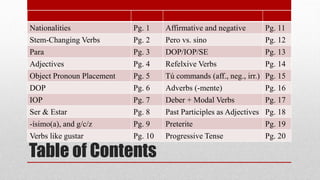
Nationalities Pg. 1 Affirmative and negative Pg. 11 
Stem-Changing Verbs Pg. 2 Pero vs. sino Pg. 12 
Para Pg. 3 DOP/IOP/SE Pg. 13 
Adjectives Pg. 4 Refelxive Verbs Pg. 14 
Object Pronoun Placement Pg. 5 Tú commands (aff., neg., irr.) Pg. 15 
DOP Pg. 6 Adverbs (-mente) Pg. 16 
IOP Pg. 7 Deber + Modal Verbs Pg. 17 
Ser & Estar Pg. 8 Past Participles as Adjectives Pg. 18 
-ísimo(a), and g/c/z Pg. 9 Preterite Pg. 19 
Verbs like gustar Pg. 10 Progressive Tense Pg. 20 
Table of Contents
Country Nationality Capital 
Mexico Mexicano(a) Mexico, D.F. 
Guatemala Guatemalteco(a) Guatemala 
El Salvador Salvadoreño(a) San Salvador 
Honduras Hondureño(a) Tegucigalpa 
Nicaragua Nicaragüense(a) Managua 
Costa Rica Costarricense(a) San Jose 
Panama Panameño(a) Panama 
Colombia Colombiano(a) Bogota 
Venezuela Venezolano(a) Caracas 
Ecuador Ecuatoriano(a) Quito 
Peru Peruano(a) Lima 
Bolivia Boliviano(a) La Paz (Sucre) 
Chile Chileno(a) Santiago 
Paraguay Paraguayo(a) Asuncion 
Argentina Argentino(a) Buenos Aires 
Uruguay Uruguayo(a) Montevideo 
Cuba Cubano Havana 
Dominican Republic Dominicano Santo Domingo 
Nationalities
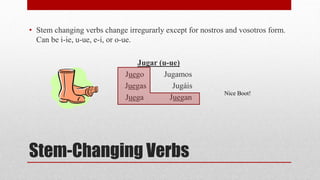
• Stem changing verbs change irregurarly except for nostros and vosotros form. 
Can be i-ie, u-ue, e-i, or o-ue. 
Jugar (u-ue) 
Juego Jugamos 
Juegas Jugáis 
Juega Juegan 
Stem-Changing Verbs 
Nice Boot!
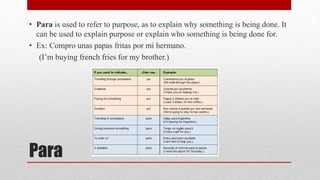
• Para is used to refer to purpose, as to explain why something is being done. It 
can be used to explain purpose or explain who something is being done for. 
• Ex: Compro unas papas fritas por mi hermano. 
(I’m buying french fries for my brother.) 
Para
• Adjectives in spanish are used just like adjectives in english, describing a 
noun in a sentence. 
• Adjectives usually come after a noun in a sentence. 
• Most adjectives have different endings when applying to male/female 
people or things. 
• Male: ends in –o 
• Female: ends in –a 
• Some adjectives do not change for males, instead adding an –a to the end 
of them. (ex: trabajador, trabajadora) 
• Adjectives that end in –e do not change at all for males and females. (ex: 
interesante) 
Adjectives
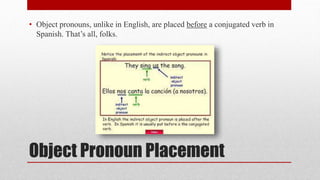
• Object pronouns, unlike in English, are placed before a conjugated verb in 
Spanish. That’s all, folks. 
Object Pronoun Placement
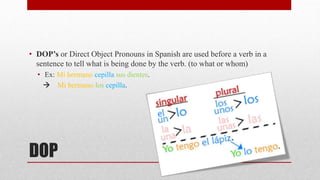
• DOP’s or Direct Object Pronouns in Spanish are used before a verb in a 
sentence to tell what is being done by the verb. (to what or whom) 
• Ex: Mi hermano cepilla sus dientes. 
 Mi hermano los cepilla. 
DOP
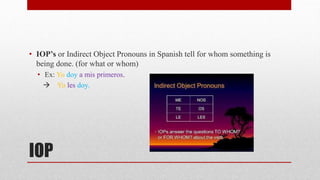
• IOP’s or Indirect Object Pronouns in Spanish tell for whom something is 
being done. (for what or whom) 
• Ex: Yo doy a mis primeros. 
 Yo les doy. 
IOP
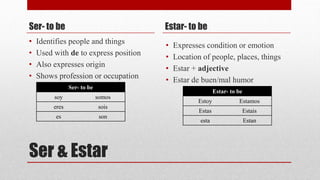
Ser- to be 
• Identifies people and things 
• Used with de to express position 
• Also expresses origin 
• Shows profession or occupation 
Ser & Estar 
Estar- to be 
Ser- to be 
soy somos 
eres sois 
es son 
• Expresses condition or emotion 
• Location of people, places, things 
• Estar + adjective 
• Estar de buen/mal humor 
Estar- to be 
Estoy Estamos 
Estas Estais 
esta Estan
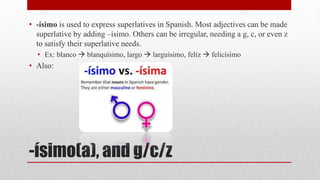
• -ísimo is used to express superlatives in Spanish. Most adjectives can be made 
superlative by adding –ísimo. Others can be irregular, needing a g, c, or even z 
to satisfy their superlative needs. 
• Ex: blanco  blanquísimo, largo  larguísimo, feliz  felicísimo 
• Also: 
-ísimo(a), and g/c/z
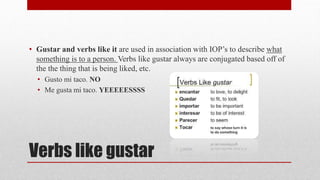
• Gustar and verbs like it are used in association with IOP’s to describe what 
something is to a person. Verbs like gustar always are conjugated based off of 
the the thing that is being liked, etc. 
• Gusto mi taco. NO 
• Me gusta mi taco. YEEEEESSSS 
Verbs like gustar
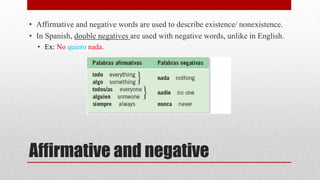
• Affirmative and negative words are used to describe existence/ nonexistence. 
• In Spanish, double negatives are used with negative words, unlike in English. 
• Ex: No quiero nada. 
Affirmative and negative
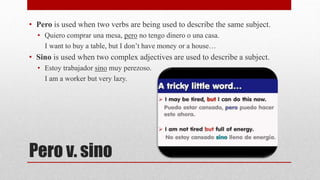
• Pero is used when two verbs are being used to describe the same subject. 
• Quiero comprar una mesa, pero no tengo dinero o una casa. 
I want to buy a table, but I don’t have money or a house… 
• Sino is used when two complex adjectives are used to describe a subject. 
• Estoy trabajador sino muy perezoso. 
I am a worker but very lazy. 
Pero v. sino
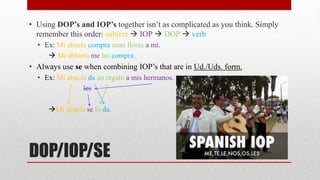
• Using DOP’s and IOP’s together isn’t as complicated as you think. Simply 
remember this order: subject  IOP  DOP  verb 
• Ex: Mi abuela compra unas floras a mí. 
 Mi abluela me las compra. 
• Always use se when combining IOP’s that are in Ud./Uds. form. 
• Ex: Mi abuela da un regalo a mis hermanos. 
les 
Mi abuela se lo da. 
DOP/IOP/SE
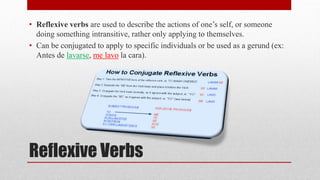
• Reflexive verbs are used to describe the actions of one’s self, or someone 
doing something intransitive, rather only applying to themselves. 
• Can be conjugated to apply to specific individuals or be used as a gerund (ex: 
Antes de lavarse, me lavo la cara). 
Reflexive Verbs
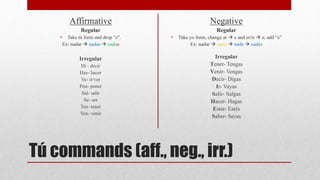
Affirmative 
Regular 
• Take tú form and drop “s”. 
Ex: nadar  nadas  nadas 
Irregular 
Di - decir 
Haz- hacer 
Ve- ir/ver 
Pon- poner 
Sal- salir 
Se- ser 
Ten- tener 
Ven- venir 
Negative 
Regular 
• Take yo form, change ar  e and er/ir  a; add “s” 
Ex: nadar  nado  nade  nades 
Irregular 
Tener- Tengas 
Venir- Vengas 
Decir- Digas 
Ir- Vayas 
Salir- Salgas 
Hacer- Hagas 
Estar- Estés 
Saber- Secas 
Tú commands (aff., neg., irr.)
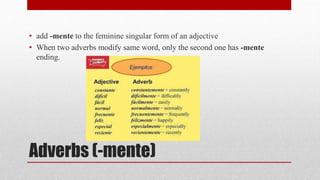
• add -mente to the feminine singular form of an adjective 
• When two adverbs modify same word, only the second one has -mente 
ending. 
Adverbs (-mente)
• Modal verbs in Spanish are much like helping verbs in English. They are 
used to assist in the indication of modality- likelihood, ability, obligation, etc. 
• Deber + infinitive: Debo jugar más deportes. (I should play more sports.) 
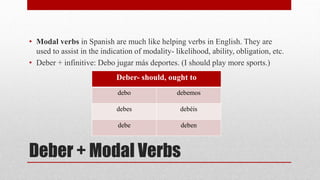
Deber- should, ought to 
debo debemos 
debes debéis 
debe deben 
Deber + Modal Verbs
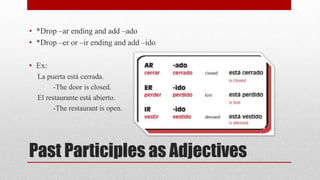
• *Drop –ar ending and add –ado 
• *Drop –er or –ir ending and add –ido 
• Ex: 
La puerta está cerrada. 
-The door is closed. 
El restaurante está abierto. 
-The restaurant is open. 
Past Participles as Adjectives
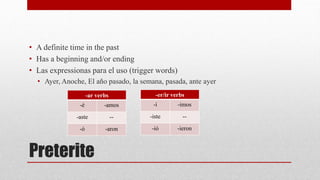
• A definite time in the past 
• Has a beginning and/or ending 
• Las expressionas para el uso (trigger words) 
• Ayer, Anoche, El año pasado, la semana, pasada, ante ayer 
Preterite 
-er/ir verbs 
-í -imos 
-iste -- 
-ió -ieron 
-ar verbs 
-é -amos 
-aste -- 
-ó -aron
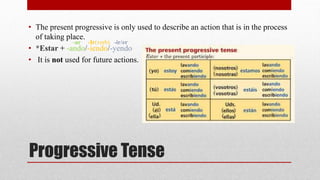
• The present progressive is only used to describe an action that is in the process 
of taking place. 
-ar -Ir(verb) -ir/er 
• *Estar + -ando/-iendo/-yendo 
• It is not used for future actions. 
Progressive Tense

Grammar Book Tajo H.

  • 1.
    Grammar Book By:Tommy Humphrey
  • 2.
    Nationalities Pg. 1Affirmative and negative Pg. 11 Stem-Changing Verbs Pg. 2 Pero vs. sino Pg. 12 Para Pg. 3 DOP/IOP/SE Pg. 13 Adjectives Pg. 4 Refelxive Verbs Pg. 14 Object Pronoun Placement Pg. 5 Tú commands (aff., neg., irr.) Pg. 15 DOP Pg. 6 Adverbs (-mente) Pg. 16 IOP Pg. 7 Deber + Modal Verbs Pg. 17 Ser & Estar Pg. 8 Past Participles as Adjectives Pg. 18 -ísimo(a), and g/c/z Pg. 9 Preterite Pg. 19 Verbs like gustar Pg. 10 Progressive Tense Pg. 20 Table of Contents
  • 3.
    Country Nationality Capital Mexico Mexicano(a) Mexico, D.F. Guatemala Guatemalteco(a) Guatemala El Salvador Salvadoreño(a) San Salvador Honduras Hondureño(a) Tegucigalpa Nicaragua Nicaragüense(a) Managua Costa Rica Costarricense(a) San Jose Panama Panameño(a) Panama Colombia Colombiano(a) Bogota Venezuela Venezolano(a) Caracas Ecuador Ecuatoriano(a) Quito Peru Peruano(a) Lima Bolivia Boliviano(a) La Paz (Sucre) Chile Chileno(a) Santiago Paraguay Paraguayo(a) Asuncion Argentina Argentino(a) Buenos Aires Uruguay Uruguayo(a) Montevideo Cuba Cubano Havana Dominican Republic Dominicano Santo Domingo Nationalities
  • 4.
    • Stem changingverbs change irregurarly except for nostros and vosotros form. Can be i-ie, u-ue, e-i, or o-ue. Jugar (u-ue) Juego Jugamos Juegas Jugáis Juega Juegan Stem-Changing Verbs Nice Boot!
  • 5.
    • Para isused to refer to purpose, as to explain why something is being done. It can be used to explain purpose or explain who something is being done for. • Ex: Compro unas papas fritas por mi hermano. (I’m buying french fries for my brother.) Para
  • 6.
    • Adjectives inspanish are used just like adjectives in english, describing a noun in a sentence. • Adjectives usually come after a noun in a sentence. • Most adjectives have different endings when applying to male/female people or things. • Male: ends in –o • Female: ends in –a • Some adjectives do not change for males, instead adding an –a to the end of them. (ex: trabajador, trabajadora) • Adjectives that end in –e do not change at all for males and females. (ex: interesante) Adjectives
  • 7.
    • Object pronouns,unlike in English, are placed before a conjugated verb in Spanish. That’s all, folks. Object Pronoun Placement
  • 8.
    • DOP’s orDirect Object Pronouns in Spanish are used before a verb in a sentence to tell what is being done by the verb. (to what or whom) • Ex: Mi hermano cepilla sus dientes.  Mi hermano los cepilla. DOP
  • 9.
    • IOP’s orIndirect Object Pronouns in Spanish tell for whom something is being done. (for what or whom) • Ex: Yo doy a mis primeros.  Yo les doy. IOP
  • 10.
    Ser- to be • Identifies people and things • Used with de to express position • Also expresses origin • Shows profession or occupation Ser & Estar Estar- to be Ser- to be soy somos eres sois es son • Expresses condition or emotion • Location of people, places, things • Estar + adjective • Estar de buen/mal humor Estar- to be Estoy Estamos Estas Estais esta Estan
  • 11.
    • -ísimo isused to express superlatives in Spanish. Most adjectives can be made superlative by adding –ísimo. Others can be irregular, needing a g, c, or even z to satisfy their superlative needs. • Ex: blanco  blanquísimo, largo  larguísimo, feliz  felicísimo • Also: -ísimo(a), and g/c/z
  • 12.
    • Gustar andverbs like it are used in association with IOP’s to describe what something is to a person. Verbs like gustar always are conjugated based off of the the thing that is being liked, etc. • Gusto mi taco. NO • Me gusta mi taco. YEEEEESSSS Verbs like gustar
  • 13.
    • Affirmative andnegative words are used to describe existence/ nonexistence. • In Spanish, double negatives are used with negative words, unlike in English. • Ex: No quiero nada. Affirmative and negative
  • 14.
    • Pero isused when two verbs are being used to describe the same subject. • Quiero comprar una mesa, pero no tengo dinero o una casa. I want to buy a table, but I don’t have money or a house… • Sino is used when two complex adjectives are used to describe a subject. • Estoy trabajador sino muy perezoso. I am a worker but very lazy. Pero v. sino
  • 15.
    • Using DOP’sand IOP’s together isn’t as complicated as you think. Simply remember this order: subject  IOP  DOP  verb • Ex: Mi abuela compra unas floras a mí.  Mi abluela me las compra. • Always use se when combining IOP’s that are in Ud./Uds. form. • Ex: Mi abuela da un regalo a mis hermanos. les Mi abuela se lo da. DOP/IOP/SE
  • 16.
    • Reflexive verbsare used to describe the actions of one’s self, or someone doing something intransitive, rather only applying to themselves. • Can be conjugated to apply to specific individuals or be used as a gerund (ex: Antes de lavarse, me lavo la cara). Reflexive Verbs
  • 17.
    Affirmative Regular •Take tú form and drop “s”. Ex: nadar  nadas  nadas Irregular Di - decir Haz- hacer Ve- ir/ver Pon- poner Sal- salir Se- ser Ten- tener Ven- venir Negative Regular • Take yo form, change ar  e and er/ir  a; add “s” Ex: nadar  nado  nade  nades Irregular Tener- Tengas Venir- Vengas Decir- Digas Ir- Vayas Salir- Salgas Hacer- Hagas Estar- Estés Saber- Secas Tú commands (aff., neg., irr.)
  • 18.
    • add -menteto the feminine singular form of an adjective • When two adverbs modify same word, only the second one has -mente ending. Adverbs (-mente)
  • 19.
    • Modal verbsin Spanish are much like helping verbs in English. They are used to assist in the indication of modality- likelihood, ability, obligation, etc. • Deber + infinitive: Debo jugar más deportes. (I should play more sports.) Deber- should, ought to debo debemos debes debéis debe deben Deber + Modal Verbs
  • 20.
    • *Drop –arending and add –ado • *Drop –er or –ir ending and add –ido • Ex: La puerta está cerrada. -The door is closed. El restaurante está abierto. -The restaurant is open. Past Participles as Adjectives
  • 21.
    • A definitetime in the past • Has a beginning and/or ending • Las expressionas para el uso (trigger words) • Ayer, Anoche, El año pasado, la semana, pasada, ante ayer Preterite -er/ir verbs -í -imos -iste -- -ió -ieron -ar verbs -é -amos -aste -- -ó -aron
  • 22.
    • The presentprogressive is only used to describe an action that is in the process of taking place. -ar -Ir(verb) -ir/er • *Estar + -ando/-iendo/-yendo • It is not used for future actions. Progressive Tense