The Present Subjunctive – Indirect
 Objects and More Fun with “Se”
              E. SIler
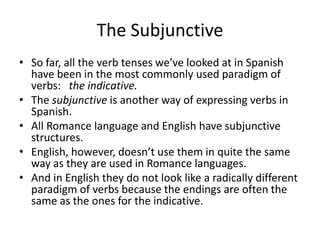
The Subjunctive
• So far, all the verb tenses we’ve looked at in Spanish
  have been in the most commonly used paradigm of
  verbs: the indicative.
• The subjunctive is another way of expressing verbs in
  Spanish.
• All Romance language and English have subjunctive
  structures.
• English, however, doesn’t use them in quite the same
  way as they are used in Romance languages.
• And in English they do not look like a radically different
  paradigm of verbs because the endings are often the
  same as the ones for the indicative.
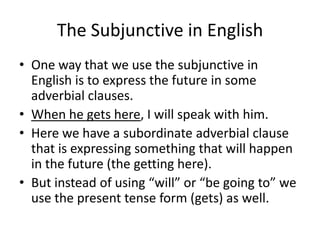
The Subjunctive in English
• One way that we use the subjunctive in
  English is to express the future in some
  adverbial clauses.
• When he gets here, I will speak with him.
• Here we have a subordinate adverbial clause
  that is expressing something that will happen
  in the future (the getting here).
• But instead of using “will” or “be going to” we
  use the present tense form (gets) as well.
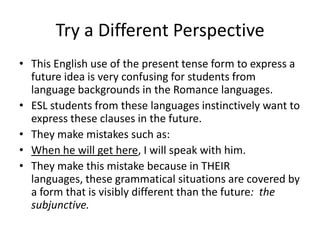
Try a Different Perspective
• This English use of the present tense form to express a
  future idea is very confusing for students from
  language backgrounds in the Romance languages.
• ESL students from these languages instinctively want to
  express these clauses in the future.
• They make mistakes such as:
• When he will get here, I will speak with him.
• They make this mistake because in THEIR
  languages, these grammatical situations are covered by
  a form that is visibly different than the future: the
  subjunctive.
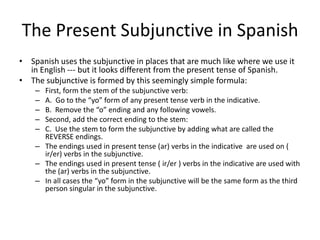
The Present Subjunctive in Spanish
• Spanish uses the subjunctive in places that are much like where we use it
  in English --- but it looks different from the present tense of Spanish.
• The subjunctive is formed by this seemingly simple formula:
    – First, form the stem of the subjunctive verb:
    – A. Go to the “yo” form of any present tense verb in the indicative.
    – B. Remove the “o” ending and any following vowels.
    – Second, add the correct ending to the stem:
    – C. Use the stem to form the subjunctive by adding what are called the
      REVERSE endings.
    – The endings used in present tense (ar) verbs in the indicative are used on (
      ir/er) verbs in the subjunctive.
    – The endings used in present tense ( ir/er ) verbs in the indicative are used with
      the (ar) verbs in the subjunctive.
    – In all cases the “yo” form in the subjunctive will be the same form as the third
      person singular in the subjunctive.
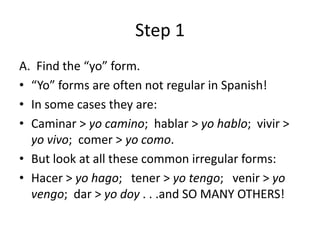
Step 1
A. Find the “yo” form.
• “Yo” forms are often not regular in Spanish!
• In some cases they are:
• Caminar > yo camino; hablar > yo hablo; vivir >
  yo vivo; comer > yo como.
• But look at all these common irregular forms:
• Hacer > yo hago; tener > yo tengo; venir > yo
  vengo; dar > yo doy . . .and SO MANY OTHERS!
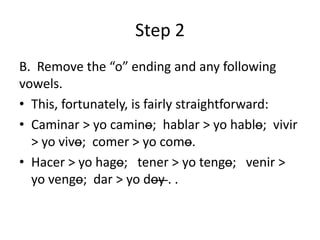
Step 2
B. Remove the “o” ending and any following
vowels.
• This, fortunately, is fairly straightforward:
• Caminar > yo camino; hablar > yo hablo; vivir
  > yo vivo; comer > yo como.
• Hacer > yo hago; tener > yo tengo; venir >
  yo vengo; dar > yo doy . .
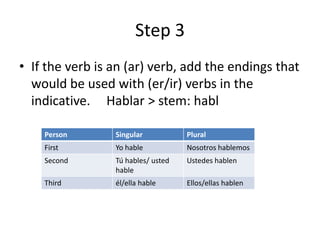
Step 3
• If the verb is an (ar) verb, add the endings that
  would be used with (er/ir) verbs in the
  indicative. Hablar > stem: habl

    Person       Singular           Plural
    First        Yo hable           Nosotros hablemos
    Second       Tú hables/ usted   Ustedes hablen
                 hable
    Third        él/ella hable      Ellos/ellas hablen
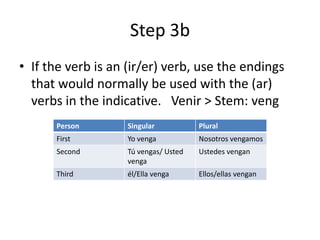
Step 3b
• If the verb is an (ir/er) verb, use the endings
  that would normally be used with the (ar)
  verbs in the indicative. Venir > Stem: veng
      Person        Singular           Plural
      First         Yo venga           Nosotros vengamos
      Second        Tú vengas/ Usted   Ustedes vengan
                    venga
      Third         él/Ella venga      Ellos/ellas vengan
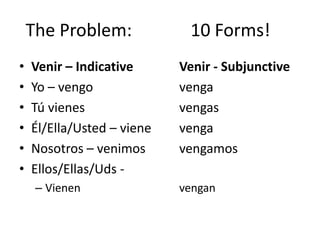
The Problem:             10 Forms!
•   Venir – Indicative      Venir - Subjunctive
•   Yo – vengo              venga
•   Tú vienes               vengas
•   Él/Ella/Usted – viene   venga
•   Nosotros – venimos      vengamos
•   Ellos/Ellas/Uds -
     – Vienen               vengan
The Subjunctive Interpreted
• The subjunctive is best thought of as just a
  variant of the present.
• In some cases it will translate well as the
  future or a slightly nuanced “possibility”.
• In most, however, you can safely get away
  with translating into the present.
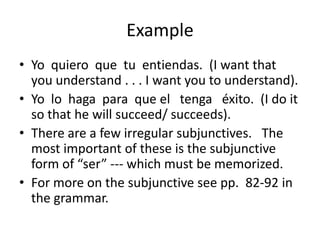
Example
• Yo quiero que tu entiendas. (I want that
  you understand . . . I want you to understand).
• Yo lo haga para que el tenga éxito. (I do it
  so that he will succeed/ succeeds).
• There are a few irregular subjunctives. The
  most important of these is the subjunctive
  form of “ser” --- which must be memorized.
• For more on the subjunctive see pp. 82-92 in
  the grammar.
Indirect Object Pronouns
• In addition to the direct object pronouns
  previously studied, Spanish also has indirect
  object pronouns.
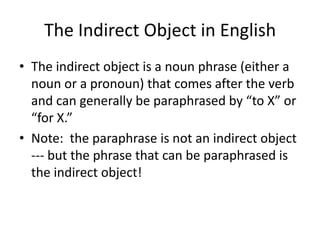
The Indirect Object in English
• The indirect object is a noun phrase (either a
  noun or a pronoun) that comes after the verb
  and can generally be paraphrased by “to X” or
  “for X.”
• Note: the paraphrase is not an indirect object
  --- but the phrase that can be paraphrased is
  the indirect object!
English Examples
• The indirect objects are underlined. The
  paraphrases are in brackets.
• He told me the truth > He told the truth [to
  me].
• I gave my husband the cat for Christmas > I
  gave the cat [to my husband] for Christmas.
• We did the police a great favor > We did a
  great favor [for the police].
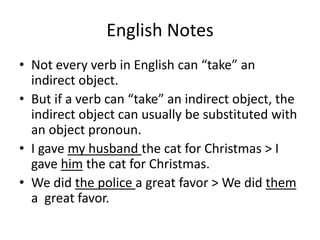
English Notes
• Not every verb in English can “take” an
  indirect object.
• But if a verb can “take” an indirect object, the
  indirect object can usually be substituted with
  an object pronoun.
• I gave my husband the cat for Christmas > I
  gave him the cat for Christmas.
• We did the police a great favor > We did them
  a great favor.
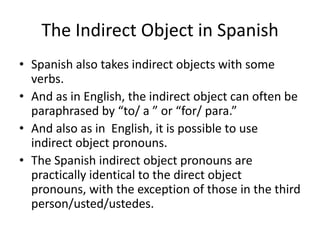
The Indirect Object in Spanish
• Spanish also takes indirect objects with some
  verbs.
• And as in English, the indirect object can often be
  paraphrased by “to/ a ” or “for/ para.”
• And also as in English, it is possible to use
  indirect object pronouns.
• The Spanish indirect object pronouns are
  practically identical to the direct object
  pronouns, with the exception of those in the third
  person/usted/ustedes.
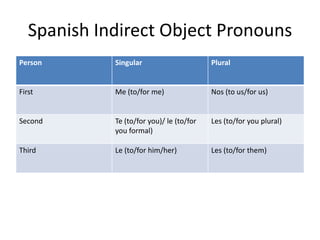
Spanish Indirect Object Pronouns
Person       Singular                      Plural


First        Me (to/for me)                Nos (to us/for us)


Second       Te (to/for you)/ le (to/for   Les (to/for you plural)
             you formal)

Third        Le (to/for him/her)           Les (to/for them)
More on Indirect Objects
• Indirect object pronouns in Spanish generally
  come before the first verb in the verb phrase.
• If there is also a direct object pronoun, the
  indirect comes before that.
• El hombre me dio el gato. (The man gave [to]
  me the cat).
• El hombre me lo dio. (The man gave [to me]
  it).
Indirect Objects 2
• If a verb phrase ends in an –ing participle or
  an infinitive, the indirect object pronoun (just
  as the direct object) can hang off the end of
  the participle or infinitive.
• Él quiere hacerme el favor/ Él me quiere hacer
  el favor (He wants to do [for] me the favor).
• Ella me está dando galletas/ Ella está
  dándome galletas (She is giving [to]me
  cookies).
Mixed Pronouns
• Just as in English we can have both a direct
  object and an indirect object pronoun in a
  sentence, we can also do that in Spanish.
• English: He gave me it.
• Spanish: Él me lo dio.
• HOWEVER, and yes, here it comes . . .
SE AGAIN
• When the direct object pronoun is third
  person and the indirect object pronoun is also
  third person, the indirect object pronoun
  turns into “se.”
• He gave her it. Él se lo dio.
• He wants to give her it. Él se lo quiere dar / Él
  quiere dárselo.
More on The Indirect Object
• If you have a burning desire to read more
  about it, see pp. 123 – 129 in the grammar.
More on Se
• Thought for the day: Will this ever end?
• Answer: no.
• There are still MORE uses of “se” you should
  be aware of.
Another Use: Accidents/Unplanned
            Occurrences
• Remember this sentence from Paragraph 2?
• Las provisiones se les agotaron.
• This is a very unusual use of “se” (and note
  the indirect object pronoun).
• The absolute best translation would be:
• They exhausted the supplies.
How This Structure Works
• Condition: You must want to express an accidental or unplanned
  occurrence.
• First, think of the object: their supplies.
• The verb in this situation is going to agree with the object in
  Spanish.
• Las provisiones agotaron. (Object can come before or after verb ---
  in this case it comes before.)
• Second, add “se” to show that this was something that it was
  accidental or unplanned.
• Las provisiones se agotaron.
• Third, add the indirect object pronoun to show who was involved in
  the experience. Effectively the INDIRECT OBJECT PRONOUN
  becomes the “agent” of the verb – the one who “does” the verb.
• Las provisiones se les agotaron.
Think About Mitt Romney’s Dog
• He went on vacation and when his wife realized
  he’d left the dog on the roof of his car he
  probably would have said to her: “Se me olvidó
  el perro.”
• See how a person can get out of accepting
  responsibility for the action?
• This unplanned/accidental/mostly unfortunate
  thing happened (the dog being forgotten on the
  roof of the car) and I was there ( but I was not
  culpable) but it was an accident.
In a very real sense
• This meaning of “se” basically carries the
  meaning of “s**t happens” and someone was
  there.
• In English, we translate it though to show the
  indirect object is the subject-agent of the
  verb: I forgot the dog.
• As an occasional legal translator, I want to
  point out that this is a very hard structure to
  get across to judges.
Another Use of Se
• “Se” can also sometimes be translated as “it”
  or even “one” or casually “they” --- especially
  in phrases that have to do with speaking or
  telling something.
• Se dice que ella es muy buena profesora.
• It is said that she is a really good professor.
• One says that . . .
• They say that . . .
And a final use of “se”
• Sometimes “se” can be added to a verb to give it
  an intensified, somewhat nuanced, meaning.
• Note the difference in these two sentences:
• Mi nieta comió la comida. (My granddaughter
  ate the food).
• Mi nieta se comió la comida. (My granddaughter
  ate up the food).
• Think about it: In which of these sentences
  does my granddaughter come across as being
  more hungry?

Spanish600 l10.

  • 1.
    The Present Subjunctive– Indirect Objects and More Fun with “Se” E. SIler
  • 2.
    The Subjunctive • Sofar, all the verb tenses we’ve looked at in Spanish have been in the most commonly used paradigm of verbs: the indicative. • The subjunctive is another way of expressing verbs in Spanish. • All Romance language and English have subjunctive structures. • English, however, doesn’t use them in quite the same way as they are used in Romance languages. • And in English they do not look like a radically different paradigm of verbs because the endings are often the same as the ones for the indicative.
  • 3.
    The Subjunctive inEnglish • One way that we use the subjunctive in English is to express the future in some adverbial clauses. • When he gets here, I will speak with him. • Here we have a subordinate adverbial clause that is expressing something that will happen in the future (the getting here). • But instead of using “will” or “be going to” we use the present tense form (gets) as well.
  • 4.
    Try a DifferentPerspective • This English use of the present tense form to express a future idea is very confusing for students from language backgrounds in the Romance languages. • ESL students from these languages instinctively want to express these clauses in the future. • They make mistakes such as: • When he will get here, I will speak with him. • They make this mistake because in THEIR languages, these grammatical situations are covered by a form that is visibly different than the future: the subjunctive.
  • 5.
    The Present Subjunctivein Spanish • Spanish uses the subjunctive in places that are much like where we use it in English --- but it looks different from the present tense of Spanish. • The subjunctive is formed by this seemingly simple formula: – First, form the stem of the subjunctive verb: – A. Go to the “yo” form of any present tense verb in the indicative. – B. Remove the “o” ending and any following vowels. – Second, add the correct ending to the stem: – C. Use the stem to form the subjunctive by adding what are called the REVERSE endings. – The endings used in present tense (ar) verbs in the indicative are used on ( ir/er) verbs in the subjunctive. – The endings used in present tense ( ir/er ) verbs in the indicative are used with the (ar) verbs in the subjunctive. – In all cases the “yo” form in the subjunctive will be the same form as the third person singular in the subjunctive.
  • 6.
    Step 1 A. Findthe “yo” form. • “Yo” forms are often not regular in Spanish! • In some cases they are: • Caminar > yo camino; hablar > yo hablo; vivir > yo vivo; comer > yo como. • But look at all these common irregular forms: • Hacer > yo hago; tener > yo tengo; venir > yo vengo; dar > yo doy . . .and SO MANY OTHERS!
  • 7.
    Step 2 B. Removethe “o” ending and any following vowels. • This, fortunately, is fairly straightforward: • Caminar > yo camino; hablar > yo hablo; vivir > yo vivo; comer > yo como. • Hacer > yo hago; tener > yo tengo; venir > yo vengo; dar > yo doy . .
  • 8.
    Step 3 • Ifthe verb is an (ar) verb, add the endings that would be used with (er/ir) verbs in the indicative. Hablar > stem: habl Person Singular Plural First Yo hable Nosotros hablemos Second Tú hables/ usted Ustedes hablen hable Third él/ella hable Ellos/ellas hablen
  • 9.
    Step 3b • Ifthe verb is an (ir/er) verb, use the endings that would normally be used with the (ar) verbs in the indicative. Venir > Stem: veng Person Singular Plural First Yo venga Nosotros vengamos Second Tú vengas/ Usted Ustedes vengan venga Third él/Ella venga Ellos/ellas vengan
  • 10.
    The Problem: 10 Forms! • Venir – Indicative Venir - Subjunctive • Yo – vengo venga • Tú vienes vengas • Él/Ella/Usted – viene venga • Nosotros – venimos vengamos • Ellos/Ellas/Uds - – Vienen vengan
  • 11.
    The Subjunctive Interpreted •The subjunctive is best thought of as just a variant of the present. • In some cases it will translate well as the future or a slightly nuanced “possibility”. • In most, however, you can safely get away with translating into the present.
  • 12.
    Example • Yo quieroque tu entiendas. (I want that you understand . . . I want you to understand). • Yo lo haga para que el tenga éxito. (I do it so that he will succeed/ succeeds). • There are a few irregular subjunctives. The most important of these is the subjunctive form of “ser” --- which must be memorized. • For more on the subjunctive see pp. 82-92 in the grammar.
  • 13.
    Indirect Object Pronouns •In addition to the direct object pronouns previously studied, Spanish also has indirect object pronouns.
  • 14.
    The Indirect Objectin English • The indirect object is a noun phrase (either a noun or a pronoun) that comes after the verb and can generally be paraphrased by “to X” or “for X.” • Note: the paraphrase is not an indirect object --- but the phrase that can be paraphrased is the indirect object!
  • 15.
    English Examples • Theindirect objects are underlined. The paraphrases are in brackets. • He told me the truth > He told the truth [to me]. • I gave my husband the cat for Christmas > I gave the cat [to my husband] for Christmas. • We did the police a great favor > We did a great favor [for the police].
  • 16.
    English Notes • Notevery verb in English can “take” an indirect object. • But if a verb can “take” an indirect object, the indirect object can usually be substituted with an object pronoun. • I gave my husband the cat for Christmas > I gave him the cat for Christmas. • We did the police a great favor > We did them a great favor.
  • 17.
    The Indirect Objectin Spanish • Spanish also takes indirect objects with some verbs. • And as in English, the indirect object can often be paraphrased by “to/ a ” or “for/ para.” • And also as in English, it is possible to use indirect object pronouns. • The Spanish indirect object pronouns are practically identical to the direct object pronouns, with the exception of those in the third person/usted/ustedes.
  • 18.
    Spanish Indirect ObjectPronouns Person Singular Plural First Me (to/for me) Nos (to us/for us) Second Te (to/for you)/ le (to/for Les (to/for you plural) you formal) Third Le (to/for him/her) Les (to/for them)
  • 19.
    More on IndirectObjects • Indirect object pronouns in Spanish generally come before the first verb in the verb phrase. • If there is also a direct object pronoun, the indirect comes before that. • El hombre me dio el gato. (The man gave [to] me the cat). • El hombre me lo dio. (The man gave [to me] it).
  • 20.
    Indirect Objects 2 •If a verb phrase ends in an –ing participle or an infinitive, the indirect object pronoun (just as the direct object) can hang off the end of the participle or infinitive. • Él quiere hacerme el favor/ Él me quiere hacer el favor (He wants to do [for] me the favor). • Ella me está dando galletas/ Ella está dándome galletas (She is giving [to]me cookies).
  • 21.
    Mixed Pronouns • Justas in English we can have both a direct object and an indirect object pronoun in a sentence, we can also do that in Spanish. • English: He gave me it. • Spanish: Él me lo dio. • HOWEVER, and yes, here it comes . . .
  • 22.
    SE AGAIN • Whenthe direct object pronoun is third person and the indirect object pronoun is also third person, the indirect object pronoun turns into “se.” • He gave her it. Él se lo dio. • He wants to give her it. Él se lo quiere dar / Él quiere dárselo.
  • 23.
    More on TheIndirect Object • If you have a burning desire to read more about it, see pp. 123 – 129 in the grammar.
  • 24.
    More on Se •Thought for the day: Will this ever end? • Answer: no. • There are still MORE uses of “se” you should be aware of.
  • 25.
    Another Use: Accidents/Unplanned Occurrences • Remember this sentence from Paragraph 2? • Las provisiones se les agotaron. • This is a very unusual use of “se” (and note the indirect object pronoun). • The absolute best translation would be: • They exhausted the supplies.
  • 26.
    How This StructureWorks • Condition: You must want to express an accidental or unplanned occurrence. • First, think of the object: their supplies. • The verb in this situation is going to agree with the object in Spanish. • Las provisiones agotaron. (Object can come before or after verb --- in this case it comes before.) • Second, add “se” to show that this was something that it was accidental or unplanned. • Las provisiones se agotaron. • Third, add the indirect object pronoun to show who was involved in the experience. Effectively the INDIRECT OBJECT PRONOUN becomes the “agent” of the verb – the one who “does” the verb. • Las provisiones se les agotaron.
  • 27.
    Think About MittRomney’s Dog • He went on vacation and when his wife realized he’d left the dog on the roof of his car he probably would have said to her: “Se me olvidó el perro.” • See how a person can get out of accepting responsibility for the action? • This unplanned/accidental/mostly unfortunate thing happened (the dog being forgotten on the roof of the car) and I was there ( but I was not culpable) but it was an accident.
  • 28.
    In a veryreal sense • This meaning of “se” basically carries the meaning of “s**t happens” and someone was there. • In English, we translate it though to show the indirect object is the subject-agent of the verb: I forgot the dog. • As an occasional legal translator, I want to point out that this is a very hard structure to get across to judges.
  • 29.
    Another Use ofSe • “Se” can also sometimes be translated as “it” or even “one” or casually “they” --- especially in phrases that have to do with speaking or telling something. • Se dice que ella es muy buena profesora. • It is said that she is a really good professor. • One says that . . . • They say that . . .
  • 30.
    And a finaluse of “se” • Sometimes “se” can be added to a verb to give it an intensified, somewhat nuanced, meaning. • Note the difference in these two sentences: • Mi nieta comió la comida. (My granddaughter ate the food). • Mi nieta se comió la comida. (My granddaughter ate up the food). • Think about it: In which of these sentences does my granddaughter come across as being more hungry?