Solutions &
Colloids
Chapter # 10
Chemistry XI FDC
Ms. Sidra Javed
Phase
A samle of mater
having a fixed
composition and
uniform properties
throught is called
phase
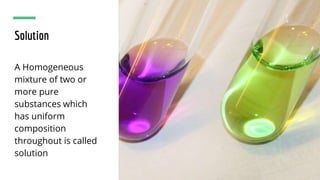
Solution
A Homogeneous
mixture of two or
more pure
substances which
has uniform
composition
throughout is called
solution
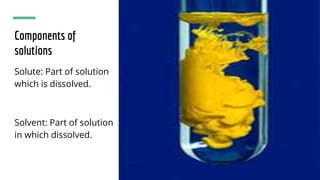
Components of
solutions
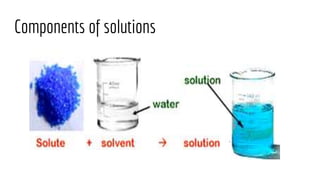
Solute: Part of solution
which is dissolved.
Solvent: Part of solution
in which dissolved.
Components of solutions
Solution of Gas in Gas
1. Air
2. Oxygen - Acetylene
(welding apparatus)
Solution of Gas in Liquid
1. Oxygen in water
2. Carbonated Drinks
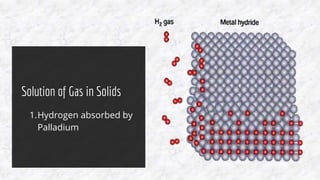
Solution of Gas in Solids
1.Hydrogen absorbed by
Palladium
Solution of Liquid in Gas
1. Mist
2. Fog
3. Clouds
Solution of Liquid in Liquid
1. Alcohol in water
2. Milk
Solution of Liquid in Solid
1. Mercury in silver
2. Butter
3. Cheese
Solution of Solid in Gas
1. Dust particles in
smoke
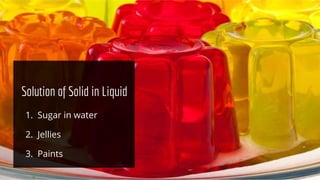
Solution of Solid in Liquid
1. Sugar in water
2. Jellies
3. Paints
Solution of Solid in Solid
1. Metal alloys
2. Pearls
3. Opals
4. Carbon in Iron (Steel)
Hydrophilic Molecules
Molecules that are
completely miscible
with water is called
hydrophilic molecules
Such molecules can
form Hydrogen bonds
with water
Examples are: C2H5OH,
CH3COOH
Hydrophobic
molecules
Molecules that do not
dissolve in water is
called hydrophobic
molecules.
Examples are:
Molecules of organic
fats & oils, molecules
present on surface of a
leaf
Nature Of Solution In
Liquid Phase
1. Completely
miscible liquids
2. Partially miscible
liquids
3. Completely
immiscible liquids
Completely miscible
liquid solutions
Liquids which are
miscible in all
proportions is
completely miscible.
Example: Water -
alcohol, benzene -
cyclohexane
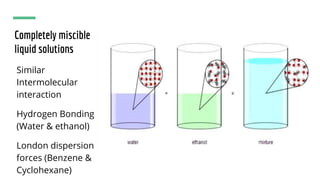
Completely miscible
liquid solutions
Similar
Intermolecular
interaction
Hydrogen Bonding
(Water & ethanol)
London dispersion
forces (Benzene &
Cyclohexane)
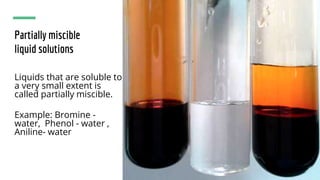
Partially miscible
liquid solutions
Liquids that are soluble to
a very small extent is
called partially miscible.
Example: Bromine -
water, Phenol - water ,
Aniline- water
Bromine Water Bromine +
Water
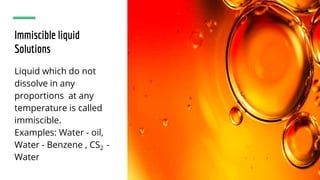
Immiscible liquid
Solutions
Liquid which do not
dissolve in any
proportions at any
temperature is called
immiscible.
Examples: Water - oil,
Water - Benzene , CS2 -
Water
Dissolution process
When solute is dissolved in a suitable
solvent, dissolution occurs.
The measure of speed of solution is
called dissolution rate
Factors affecting Solubility or
dissolution rate
1. Particle size
2. Temperature
3. Concentration of solute
4. Stirring
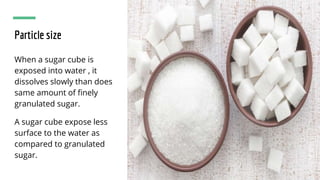
Particle size
When a sugar cube is
exposed into water , it
dissolves slowly than does
same amount of finely
granulated sugar.
A sugar cube expose less
surface to the water as
compared to granulated
sugar.
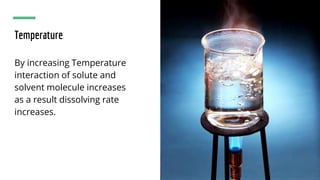
Temperature
By increasing Temperature
interaction of solute and
solvent molecule increases
as a result dissolving rate
increases.
Concentration of
solution
Higher the concentration
of solution, lower rate of
dissolution, lower
solubility
A Saturated solution can
dissolve no more solute
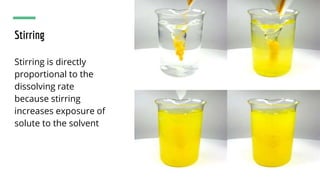
Stirring
Stirring is directly
proportional to the
dissolving rate
because stirring
increases exposure of
solute to the solvent
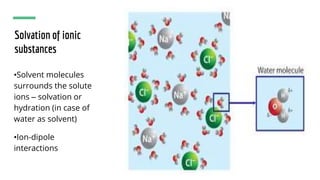
Solvation of ionic
substances
•Solvent molecules
surrounds the solute
ions – solvation or
hydration (in case of
water as solvent)
•Ion-dipole
interactions
Solvation of molecular
solids
•Polar solids dissolves in
polar solvent
•Non polar solids dissolves
in non polar solvent
•Dipole-dipole , London
dispersion forces, Hydrogen
bonding
d+d- polar
solute
H
O
H
d+d-
H
O
H
d+d-
HEAT ABSORBED OR EVOLVED DURRING DISSOLVING
PROCESS
Durring dissolving process the heat may be absorbed or evolved durring
dissolved.
It depends upon three types of interaction.
Solute-solute interaction, solvent-solute interaction, solvent-solvent
interaction.
Heat of solution depends upon the heat of solution, heat of hydration,
lattice energy.
DAILY LIFE APPLICATION OF HEAT OF SOLUTION
Hot and cold packs are commonly use
today.
Cold packs are used for treatment of
injuries and reduction of swelling.
Hot packs are used for instant warmth
for hikers and skiers and treatment of
pulled muscles.
End of Lesson

Solutions