Classification  of  Reactions
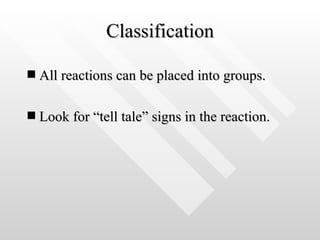
Classification All reactions can be placed into groups. Look for “tell tale” signs in the reaction.
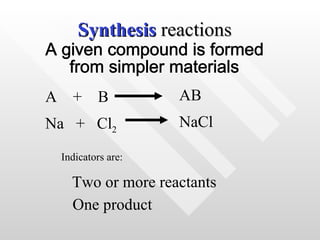
Synthesis  reactions A given compound is formed  from simpler materials A  +  B AB Na  +  Cl 2 NaCl Indicators are: Two or more reactants One product
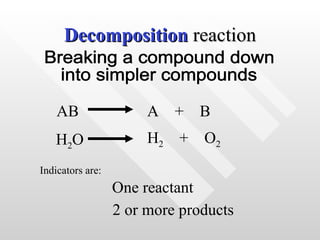
Decomposition  reaction Breaking a compound down into simpler compounds AB A  +  B H 2 O H 2   +  O 2 Indicators are: One reactant 2 or more products
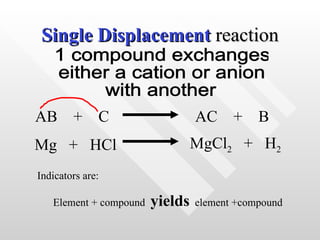
Single Displacement  reaction 1 compound exchanges either a cation or anion  with another AB  +  C AC  +  B Mg  +  HCl MgCl 2   +  H 2 Indicators are: Element + compound  yields   element +compound
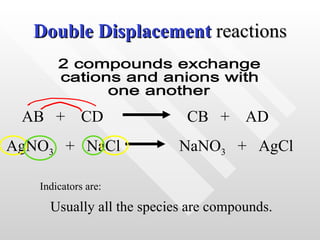
Double Displacement  reactions 2 compounds exchange cations and anions with  one another AB  +  CD CB  +  AD AgNO 3   +  NaCl NaNO 3   +  AgCl Indicators are: Usually all the species are compounds.
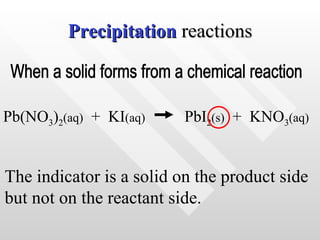
Precipitation  reactions When a solid forms from a chemical reaction Pb(NO 3 ) 2 (aq)   +  KI (aq)   PbI 2 (s)   +  KNO 3 (aq)   The indicator is a solid on the product side  but not on the reactant side.
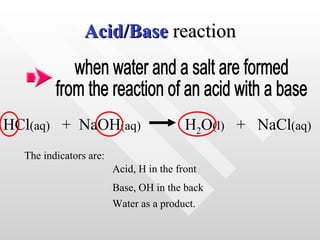
Acid/Base  reaction HCl (aq)   +  NaOH (aq) H 2 O (l)   +  NaCl (aq) The indicators are: Acid, H in the front Base, OH in the back Water as a product. when water and a salt are formed from the reaction of an acid with a base
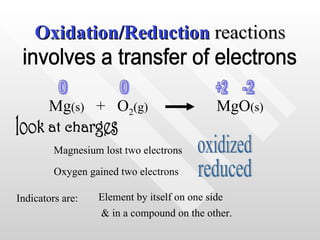
Oxidation/Reduction  reactions involves a transfer of electrons Mg (s)   +  O 2 (g) MgO (s) look at charges 0 0 +2 -2 Magnesium lost two electrons oxidized Oxygen gained two electrons reduced Indicators are: Element by itself on one side & in a compound on the other.
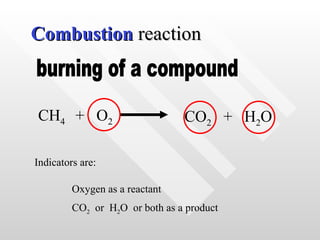
Combustion  reaction burning of a compound CH 4  +  O 2 CO 2   +  H 2 O Indicators are: Oxygen as a reactant CO 2   or  H 2 O  or both as a product
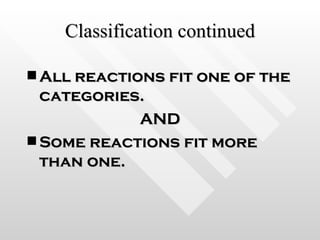
Classification continued All reactions fit one of the categories. AND Some reactions fit more than one.
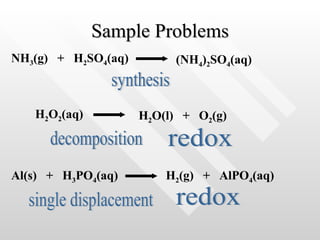
Sample Problems NH 3 (g)  +  H 2 SO 4 (aq) (NH 4 ) 2 SO 4 (aq) synthesis H 2 O 2 (aq) H 2 O(l)  +  O 2 (g) decomposition redox Al(s)  +  H 3 PO 4 (aq) H 2 (g)  +  AlPO 4 (aq) single displacement redox
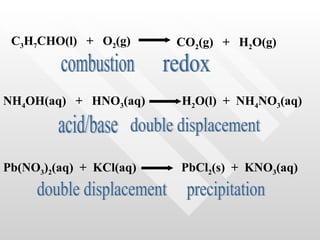
C 3 H 7 CHO(l)  +  O 2 (g) CO 2 (g)  +  H 2 O(g) combustion redox NH 4 OH(aq)  +  HNO 3 (aq) H 2 O(l)  +  NH 4 NO 3 (aq) acid/base double displacement Pb(NO 3 ) 2 (aq)  +  KCl(aq) PbCl 2 (s)  +  KNO 3 (aq) double displacement precipitation

Classification of Reactions

  • 1.
  • 2.
    Classification All reactionscan be placed into groups. Look for “tell tale” signs in the reaction.
  • 3.
    Synthesis reactionsA given compound is formed from simpler materials A + B AB Na + Cl 2 NaCl Indicators are: Two or more reactants One product
  • 4.
    Decomposition reactionBreaking a compound down into simpler compounds AB A + B H 2 O H 2 + O 2 Indicators are: One reactant 2 or more products
  • 5.
    Single Displacement reaction 1 compound exchanges either a cation or anion with another AB + C AC + B Mg + HCl MgCl 2 + H 2 Indicators are: Element + compound yields element +compound
  • 6.
    Double Displacement reactions 2 compounds exchange cations and anions with one another AB + CD CB + AD AgNO 3 + NaCl NaNO 3 + AgCl Indicators are: Usually all the species are compounds.
  • 7.
    Precipitation reactionsWhen a solid forms from a chemical reaction Pb(NO 3 ) 2 (aq) + KI (aq) PbI 2 (s) + KNO 3 (aq) The indicator is a solid on the product side but not on the reactant side.
  • 8.
    Acid/Base reactionHCl (aq) + NaOH (aq) H 2 O (l) + NaCl (aq) The indicators are: Acid, H in the front Base, OH in the back Water as a product. when water and a salt are formed from the reaction of an acid with a base
  • 9.
    Oxidation/Reduction reactionsinvolves a transfer of electrons Mg (s) + O 2 (g) MgO (s) look at charges 0 0 +2 -2 Magnesium lost two electrons oxidized Oxygen gained two electrons reduced Indicators are: Element by itself on one side & in a compound on the other.
  • 10.
    Combustion reactionburning of a compound CH 4 + O 2 CO 2 + H 2 O Indicators are: Oxygen as a reactant CO 2 or H 2 O or both as a product
  • 11.
    Classification continued Allreactions fit one of the categories. AND Some reactions fit more than one.
  • 12.
    Sample Problems NH3 (g) + H 2 SO 4 (aq) (NH 4 ) 2 SO 4 (aq) synthesis H 2 O 2 (aq) H 2 O(l) + O 2 (g) decomposition redox Al(s) + H 3 PO 4 (aq) H 2 (g) + AlPO 4 (aq) single displacement redox
  • 13.
    C 3 H7 CHO(l) + O 2 (g) CO 2 (g) + H 2 O(g) combustion redox NH 4 OH(aq) + HNO 3 (aq) H 2 O(l) + NH 4 NO 3 (aq) acid/base double displacement Pb(NO 3 ) 2 (aq) + KCl(aq) PbCl 2 (s) + KNO 3 (aq) double displacement precipitation