SOLIDIFICATION
Presented by :
P. Agastya sai manihar.
18ME651
Assignment-1
Contents:
• Introduction
• Nucleation by growth
• Solidification mechanism
• Freeze mechanism
• Solidification defects
• References
Introduction
• Casting is a process in which the molten metal(or) liquid plastic is poured into the
mold cavity & allowed to become hard, in order to make product’s (or) parts. The
various steps involved casting are:
 Pattern & Mold making.
 Melting & pouring.
 “Solidification” & cooling.
 Removal, Cleaning, & finishing.
Introduction (cont.)
A. Cooling curve for pure metal B. Cooling curve for alloy’s
Solidification by nucleation
• At solidification temperature, atoms from liquid begins to bond together to form
crystals. The moment a crystal begins to grow is called nucleus and the point at
which it starts is the nucleation point. When metal begins to solidify , multiple
crystals begins to grow and the final size of crystal depends on the number of
nucleation or nucleation rate. Crystal grows by further addition of atoms until it
impinges upon adjacent growing crystals.
Solidification by nucleation(Cont.)
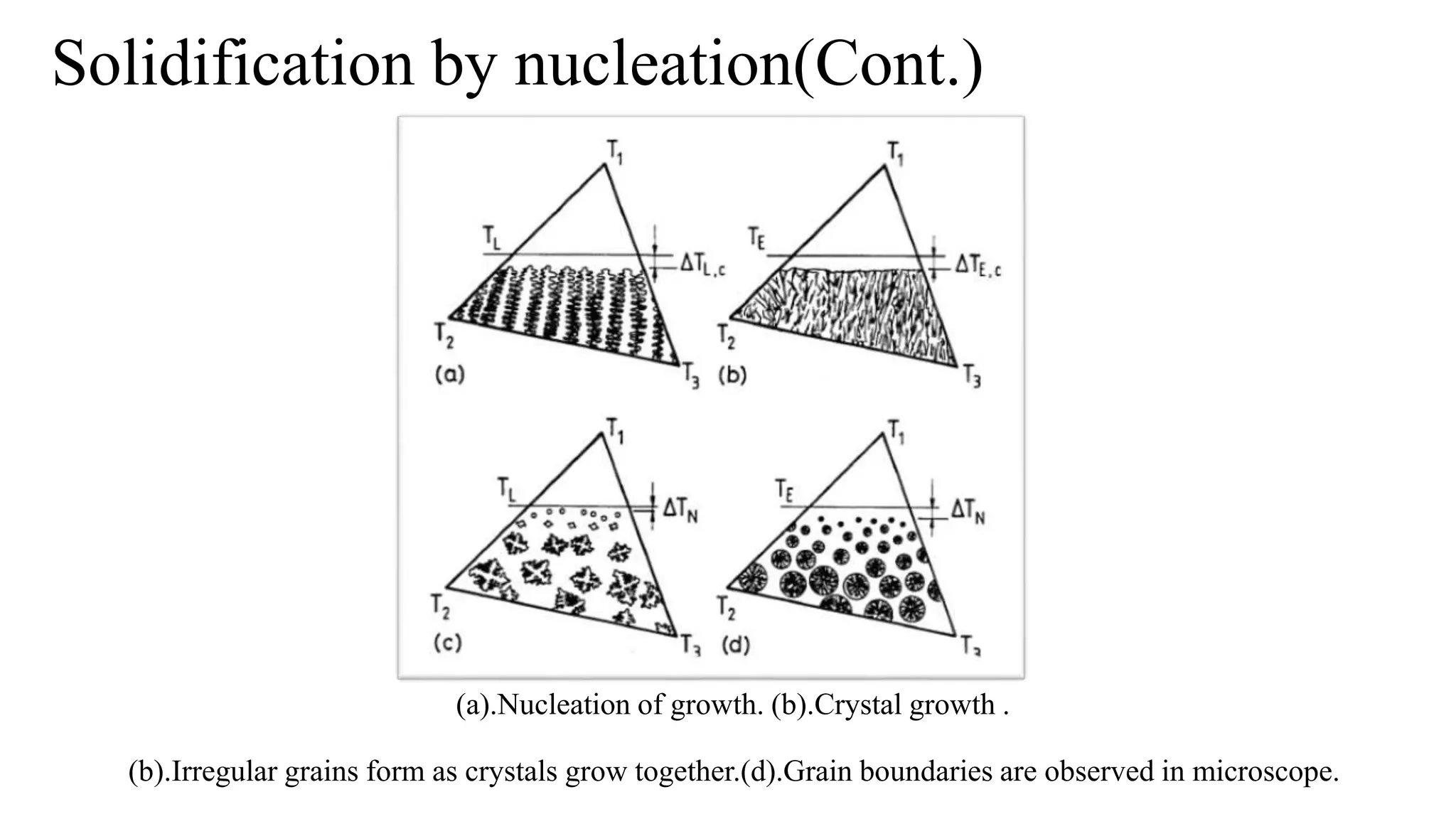
(a).Nucleation of growth. (b).Crystal growth .
(b).Irregular grains form as crystals grow together.(d).Grain boundaries are observed in microscope.
Solidification by nucleation(Cont.)
1045steel Columnar dendrite zone at the edge of small ingot cast samples.
Magnification 3.7 times
Solidification by nucleation(Cont.)
Photomicrograph of Fe-l.0 pct Ce alloy levitated droplet
Solidification mechanism
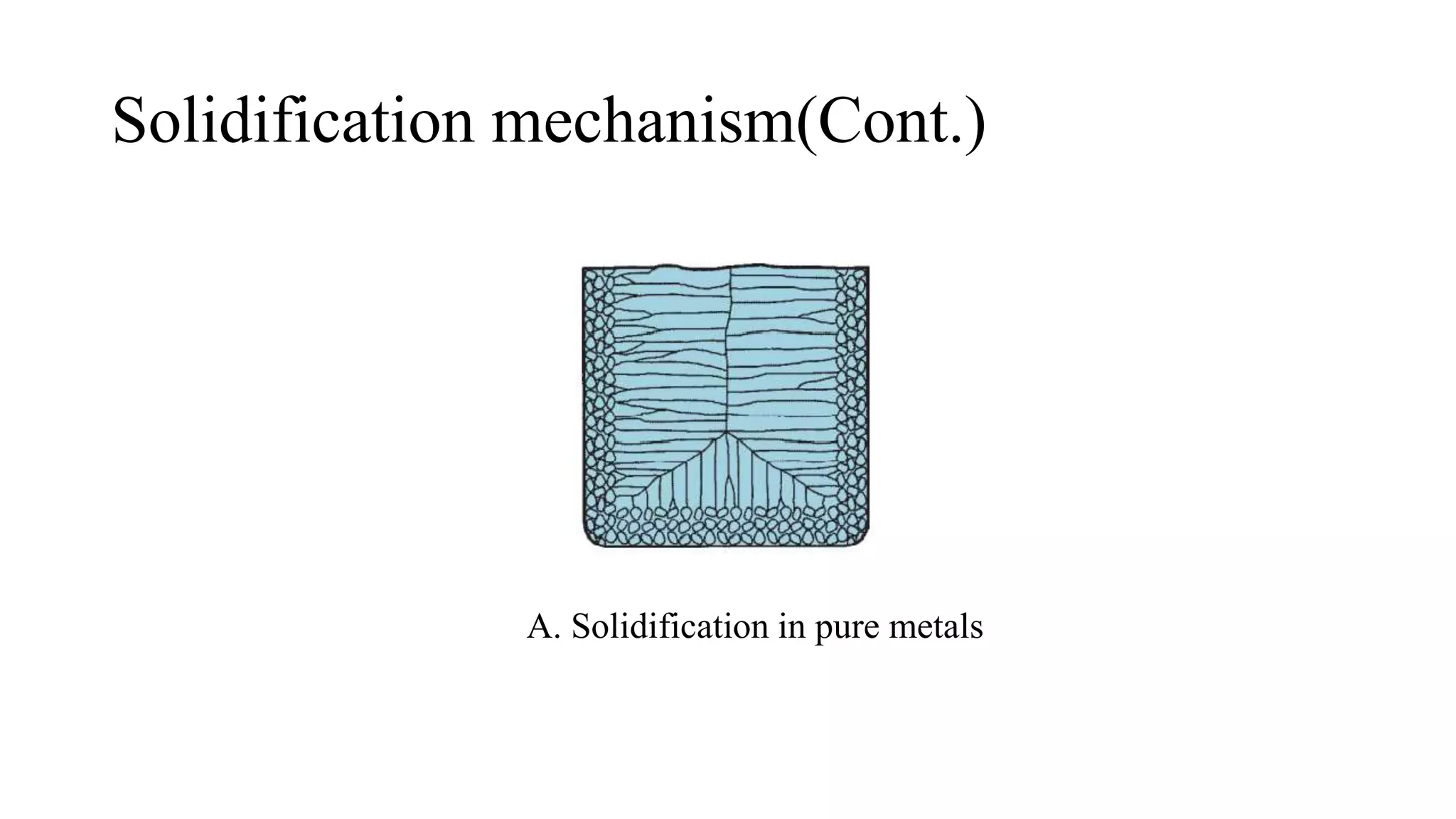
• The large degree of under cooling leads to increase the nucleation growth. From
the small nuclei at the surfaces the skin is formed with the effect of chilling.
• From the chilling of the wall of cavity it starts to grow further. Thickness of this
skin which is frozen varies with square root of time. So, there is an expression
which talks about the thickness of the skin formed and that is given as
𝐷=𝑘√𝑡−𝑐
Solidification mechanism(Cont.)
A. Solidification in pure metals
Solidification mechanism(Cont.)
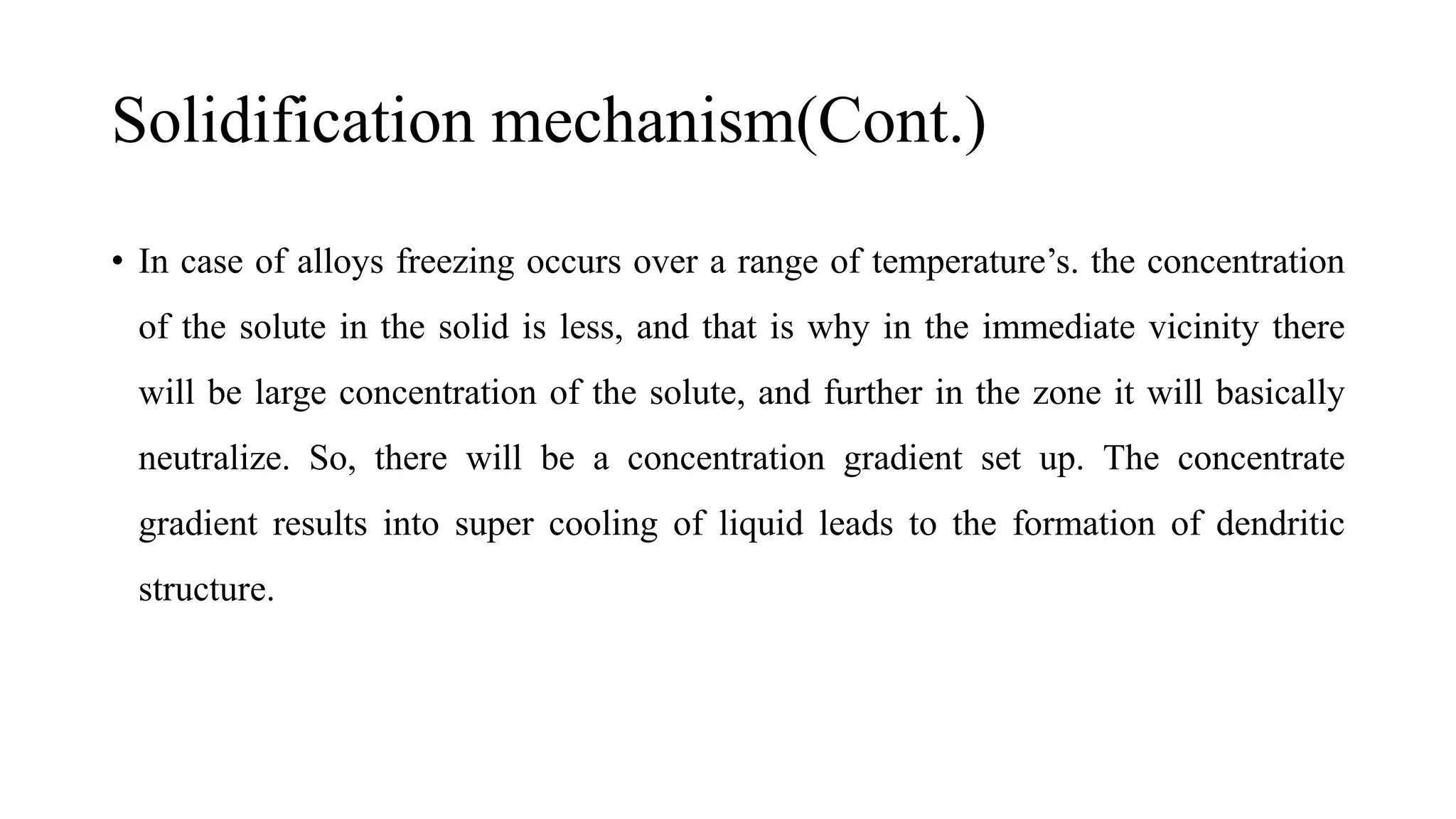
• In case of alloys freezing occurs over a range of temperature’s. the concentration
of the solute in the solid is less, and that is why in the immediate vicinity there
will be large concentration of the solute, and further in the zone it will basically
neutralize. So, there will be a concentration gradient set up. The concentrate
gradient results into super cooling of liquid leads to the formation of dendritic
structure.
Solidification mechanism(Cont.)
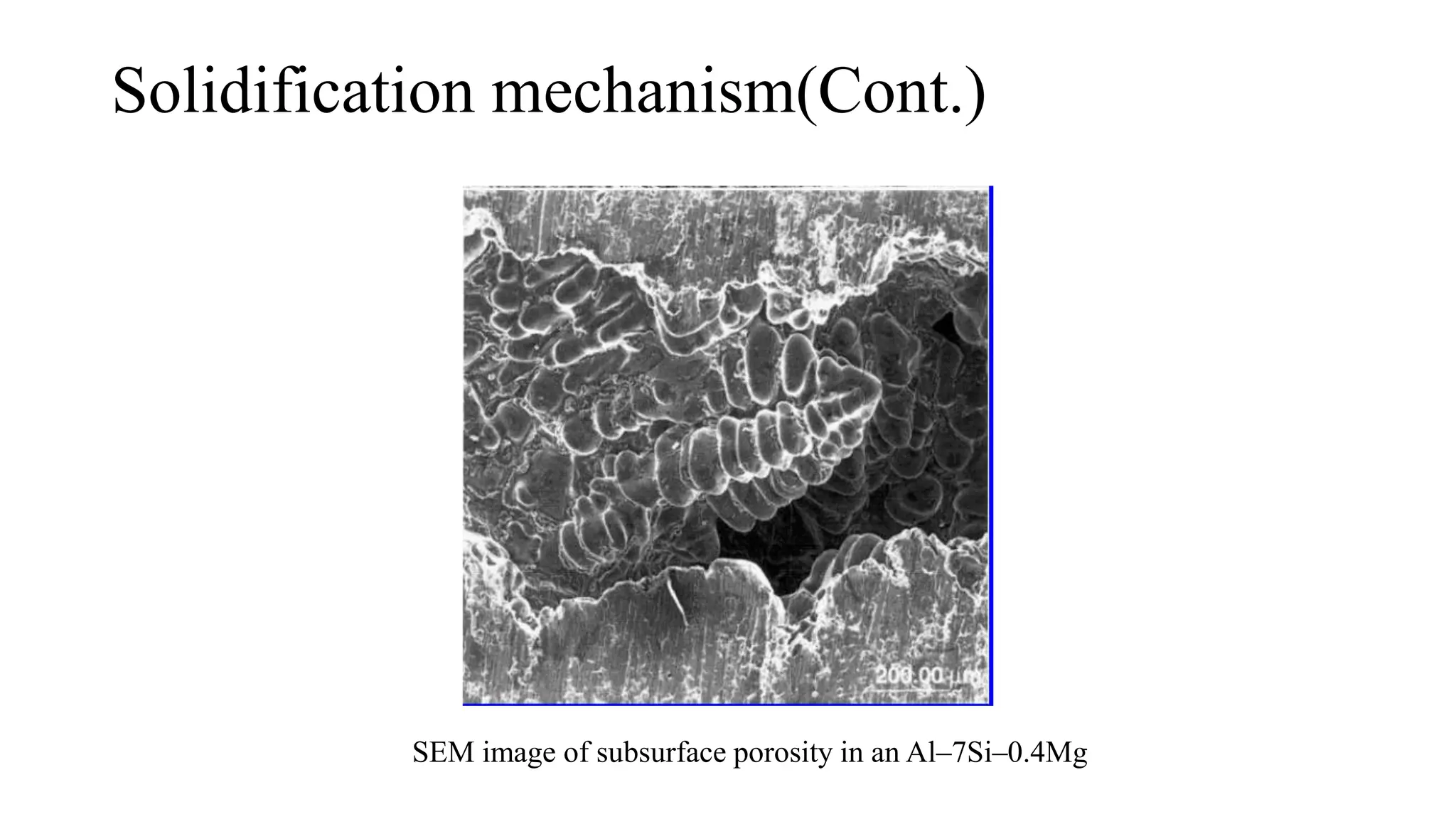
SEM image of subsurface porosity in an Al–7Si–0.4Mg
Freeze wave mechanism & solidification time
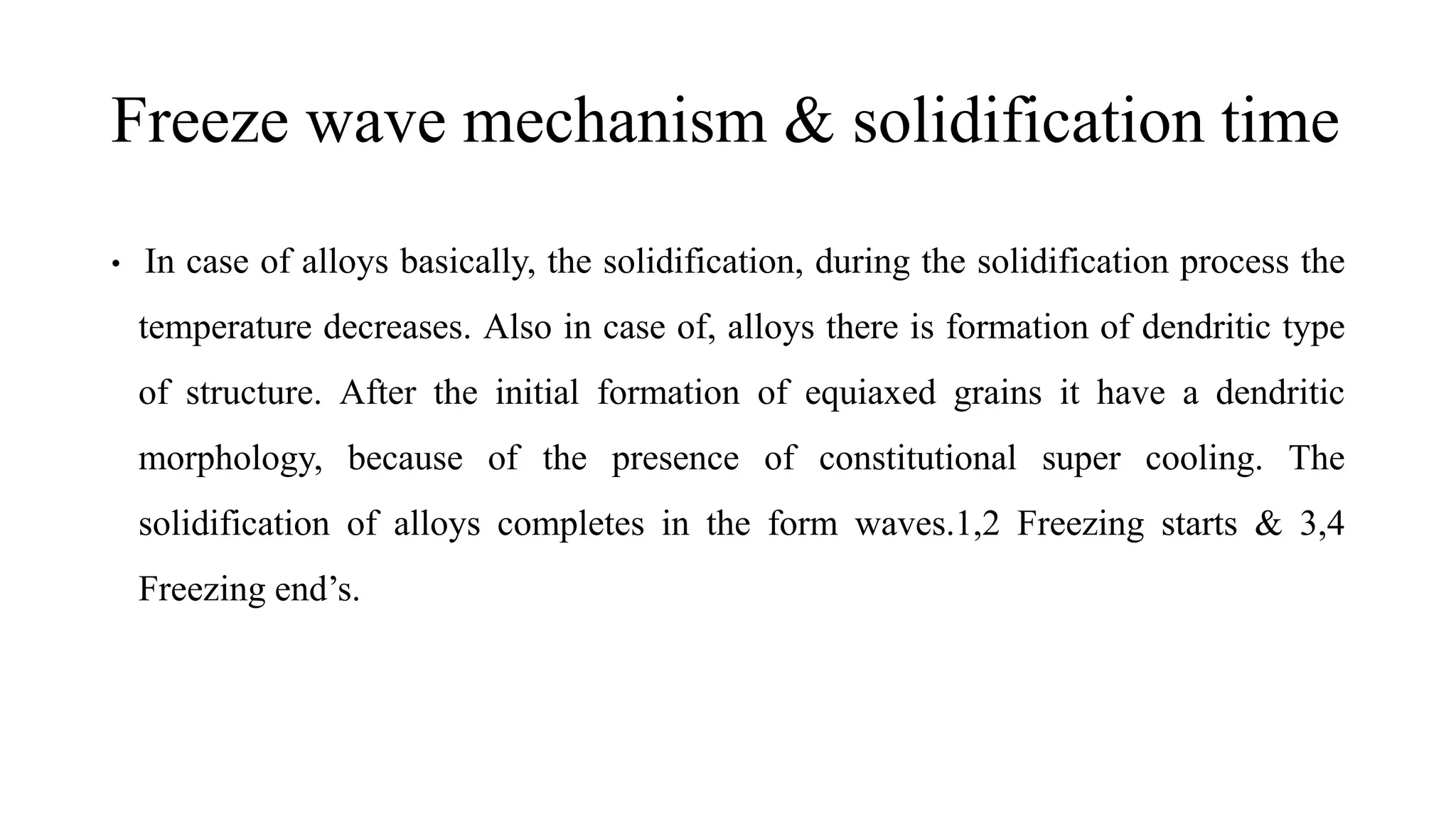
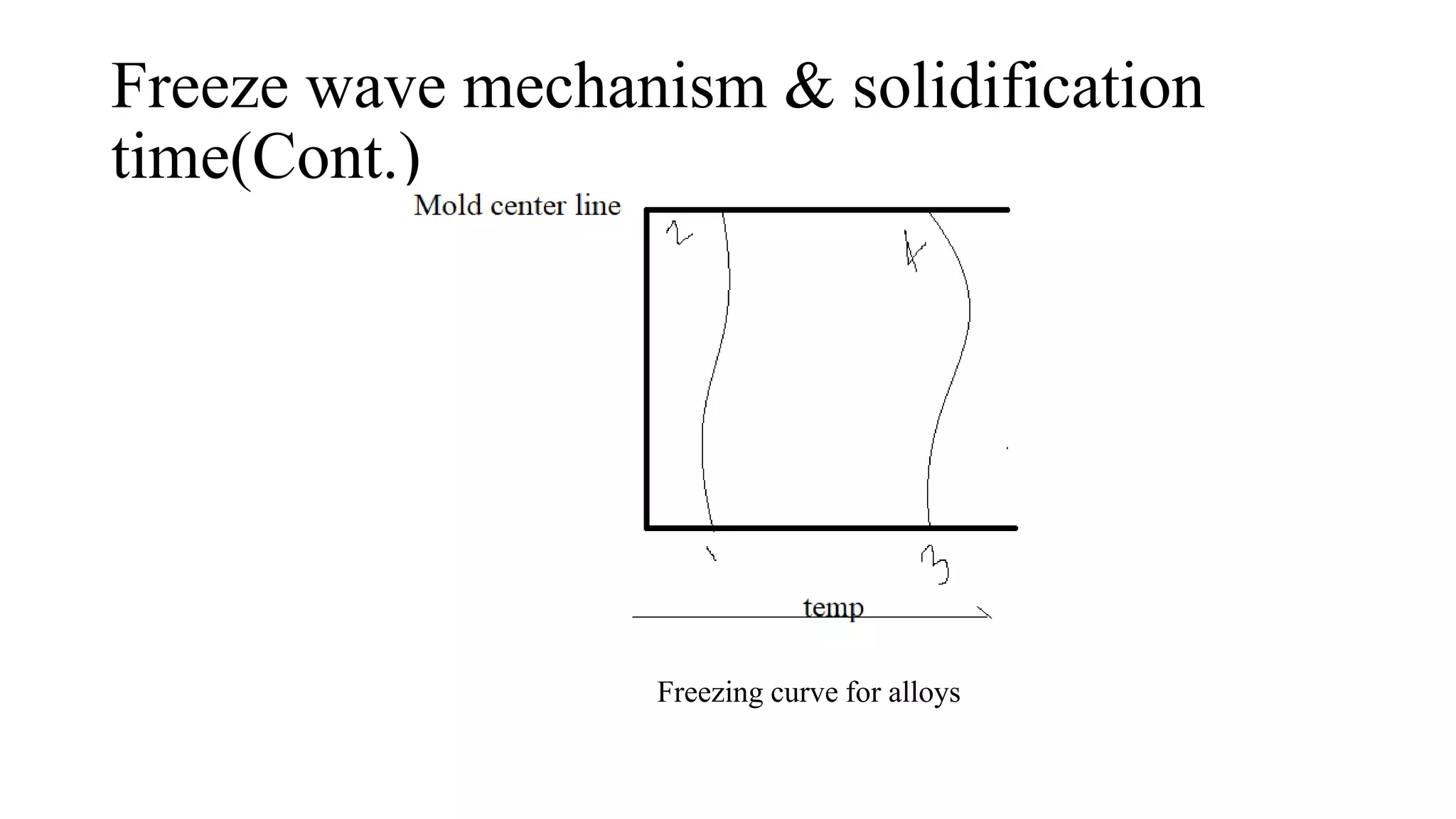
• In case of alloys basically, the solidification, during the solidification process the
temperature decreases. Also in case of, alloys there is formation of dendritic type
of structure. After the initial formation of equiaxed grains it have a dendritic
morphology, because of the presence of constitutional super cooling. The
solidification of alloys completes in the form waves.1,2 Freezing starts & 3,4
Freezing end’s.
Freeze wave mechanism & solidification
time(Cont.)
Freezing curve for alloys
Freeze wave mechanism & solidification
time(Cont.)
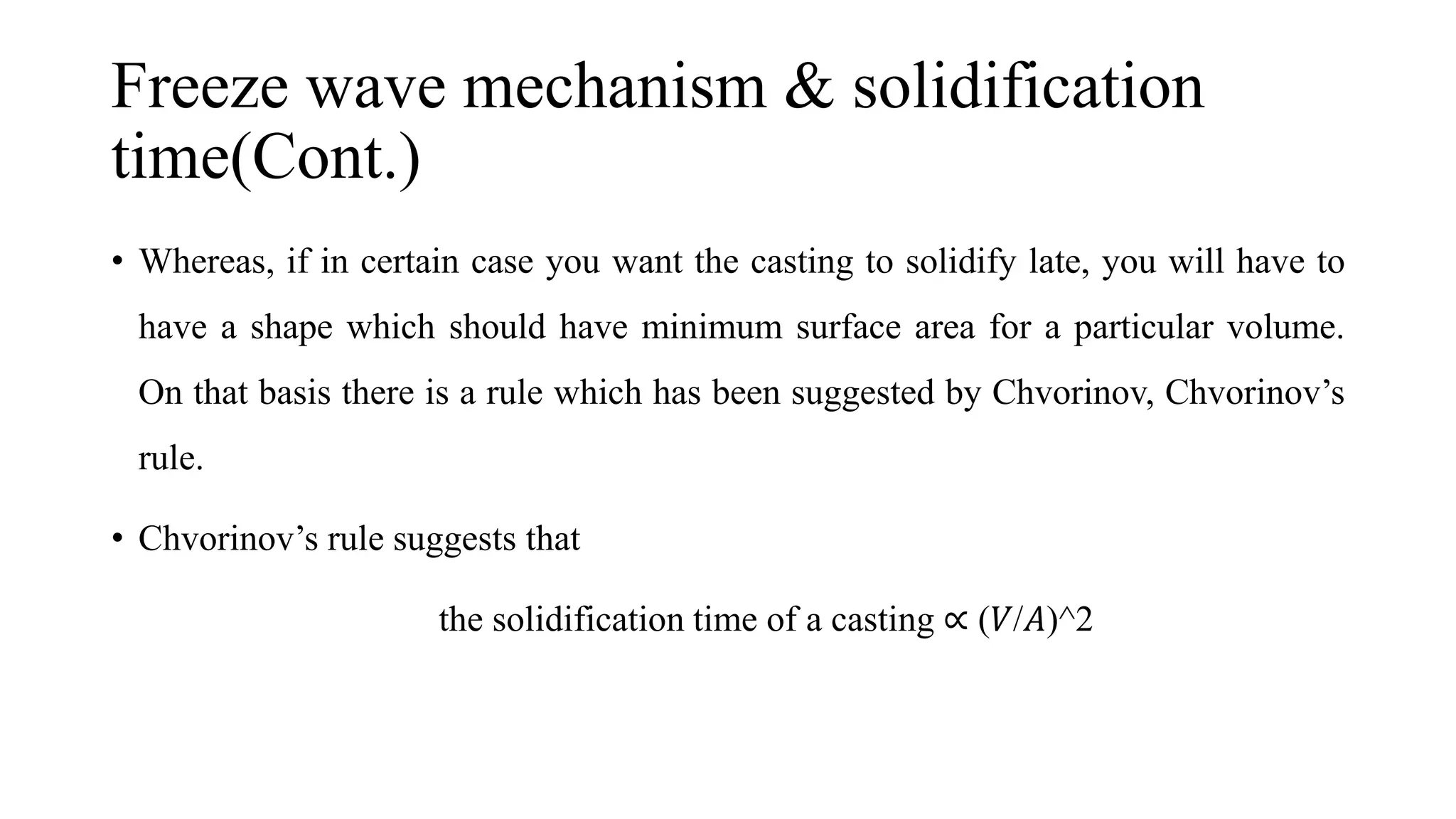
• Whereas, if in certain case you want the casting to solidify late, you will have to
have a shape which should have minimum surface area for a particular volume.
On that basis there is a rule which has been suggested by Chvorinov, Chvorinov’s
rule.
• Chvorinov’s rule suggests that
the solidification time of a casting ∝ (𝑉/𝐴)^2
Freeze wave mechanism & solidification
time(Cont.)
TST=Cm(V/A)^n.
Where:
• TST=total solidification time
• V=Volume of the casting
• A=surface area of casting
• n=exponent usually taken as 2
• Cm=constant which depends upon mould material.
Solidification defects
• Shrinkage
• Micro shrinkage
• Gas porosity
• Sievert’s law
Solidification defects(Cont.)
Schematic representation of surface turbulence causing the entrainment of bi films and associated bubbles.
Small entrained bubbles form pores that decorate the bi film, crack AB, whereas large bubbles, C and D, are
buoyant
Solidification defects(Cont.)
SEM images of fracture surfaces of a single Al–4?5Cu alloy casting showing (a) the part that was subjected to a
turbulent backwave, and the consequential entrained bifilm flattened by dendrite growth. The nearly invisible oxide
film covering the whole surface is seen in (b) in a folded area (arrowed). (c) Distant part of the same casting that
enjoyed a more tranquil fill, so exhibiting fracture influenced only by the original bifilms in the (rather poor) melt. (d)
Areas of ductile dimples confirming true metal to metal contact in the tensile fracture from this second part of the
casting (courtesy Jaiwei Mi).[
Reference’s
1. Modelling of microstructure formation in solidification processes, M. Rappaz.
2. Development of the as-cast microstructure in magnesium aluminum Alloys Arne
K. Dahle *, Young C. Lee, Mark D. Nave, Paul L. Schafer, David H. St John.
3. Influence of Rare Earth Metals on the Nucleation and Solidification Behavior of
Iron and 1045 Steel. H. LI, A. Mc LEAN, J.W. RUTTER, and I.D.
SOMMERVILLE.
4. MATERIALS PERSPECTIVE Entrainment defects, J. Campbell
Solidification

Solidification

  • 1.
    SOLIDIFICATION Presented by : P.Agastya sai manihar. 18ME651 Assignment-1
  • 2.
    Contents: • Introduction • Nucleationby growth • Solidification mechanism • Freeze mechanism • Solidification defects • References
  • 3.
    Introduction • Casting isa process in which the molten metal(or) liquid plastic is poured into the mold cavity & allowed to become hard, in order to make product’s (or) parts. The various steps involved casting are:  Pattern & Mold making.  Melting & pouring.  “Solidification” & cooling.  Removal, Cleaning, & finishing.
  • 4.
    Introduction (cont.) A. Coolingcurve for pure metal B. Cooling curve for alloy’s
  • 5.
    Solidification by nucleation •At solidification temperature, atoms from liquid begins to bond together to form crystals. The moment a crystal begins to grow is called nucleus and the point at which it starts is the nucleation point. When metal begins to solidify , multiple crystals begins to grow and the final size of crystal depends on the number of nucleation or nucleation rate. Crystal grows by further addition of atoms until it impinges upon adjacent growing crystals.
  • 6.
    Solidification by nucleation(Cont.) (a).Nucleationof growth. (b).Crystal growth . (b).Irregular grains form as crystals grow together.(d).Grain boundaries are observed in microscope.
  • 7.
    Solidification by nucleation(Cont.) 1045steelColumnar dendrite zone at the edge of small ingot cast samples. Magnification 3.7 times
  • 8.
    Solidification by nucleation(Cont.) Photomicrographof Fe-l.0 pct Ce alloy levitated droplet
  • 9.
    Solidification mechanism • Thelarge degree of under cooling leads to increase the nucleation growth. From the small nuclei at the surfaces the skin is formed with the effect of chilling. • From the chilling of the wall of cavity it starts to grow further. Thickness of this skin which is frozen varies with square root of time. So, there is an expression which talks about the thickness of the skin formed and that is given as 𝐷=𝑘√𝑡−𝑐
  • 10.
  • 11.
    Solidification mechanism(Cont.) • Incase of alloys freezing occurs over a range of temperature’s. the concentration of the solute in the solid is less, and that is why in the immediate vicinity there will be large concentration of the solute, and further in the zone it will basically neutralize. So, there will be a concentration gradient set up. The concentrate gradient results into super cooling of liquid leads to the formation of dendritic structure.
  • 12.
    Solidification mechanism(Cont.) SEM imageof subsurface porosity in an Al–7Si–0.4Mg
  • 13.
    Freeze wave mechanism& solidification time • In case of alloys basically, the solidification, during the solidification process the temperature decreases. Also in case of, alloys there is formation of dendritic type of structure. After the initial formation of equiaxed grains it have a dendritic morphology, because of the presence of constitutional super cooling. The solidification of alloys completes in the form waves.1,2 Freezing starts & 3,4 Freezing end’s.
  • 14.
    Freeze wave mechanism& solidification time(Cont.) Freezing curve for alloys
  • 15.
    Freeze wave mechanism& solidification time(Cont.) • Whereas, if in certain case you want the casting to solidify late, you will have to have a shape which should have minimum surface area for a particular volume. On that basis there is a rule which has been suggested by Chvorinov, Chvorinov’s rule. • Chvorinov’s rule suggests that the solidification time of a casting ∝ (𝑉/𝐴)^2
  • 16.
    Freeze wave mechanism& solidification time(Cont.) TST=Cm(V/A)^n. Where: • TST=total solidification time • V=Volume of the casting • A=surface area of casting • n=exponent usually taken as 2 • Cm=constant which depends upon mould material.
  • 17.
    Solidification defects • Shrinkage •Micro shrinkage • Gas porosity • Sievert’s law
  • 18.
    Solidification defects(Cont.) Schematic representationof surface turbulence causing the entrainment of bi films and associated bubbles. Small entrained bubbles form pores that decorate the bi film, crack AB, whereas large bubbles, C and D, are buoyant
  • 19.
    Solidification defects(Cont.) SEM imagesof fracture surfaces of a single Al–4?5Cu alloy casting showing (a) the part that was subjected to a turbulent backwave, and the consequential entrained bifilm flattened by dendrite growth. The nearly invisible oxide film covering the whole surface is seen in (b) in a folded area (arrowed). (c) Distant part of the same casting that enjoyed a more tranquil fill, so exhibiting fracture influenced only by the original bifilms in the (rather poor) melt. (d) Areas of ductile dimples confirming true metal to metal contact in the tensile fracture from this second part of the casting (courtesy Jaiwei Mi).[
  • 20.
    Reference’s 1. Modelling ofmicrostructure formation in solidification processes, M. Rappaz. 2. Development of the as-cast microstructure in magnesium aluminum Alloys Arne K. Dahle *, Young C. Lee, Mark D. Nave, Paul L. Schafer, David H. St John. 3. Influence of Rare Earth Metals on the Nucleation and Solidification Behavior of Iron and 1045 Steel. H. LI, A. Mc LEAN, J.W. RUTTER, and I.D. SOMMERVILLE. 4. MATERIALS PERSPECTIVE Entrainment defects, J. Campbell