Department of Mechanical & Manufacturing Engineering, MIT, Manipal 1 of 3
SOLIDFICATION
Chapter-2
Department of Mechanical & Manufacturing Engineering, MIT, Manipal 2 of 3
Solidification
Transformation of metals from the liquid to the solid
state is known as solidification or crystallization.
Melting or Fusion of Metals:
Time
T
O
A B
C
Latent heat
Super heat
Melting Temp.
S
L + S
L
Melting process
Department of Mechanical & Manufacturing Engineering, MIT, Manipal 3 of 3
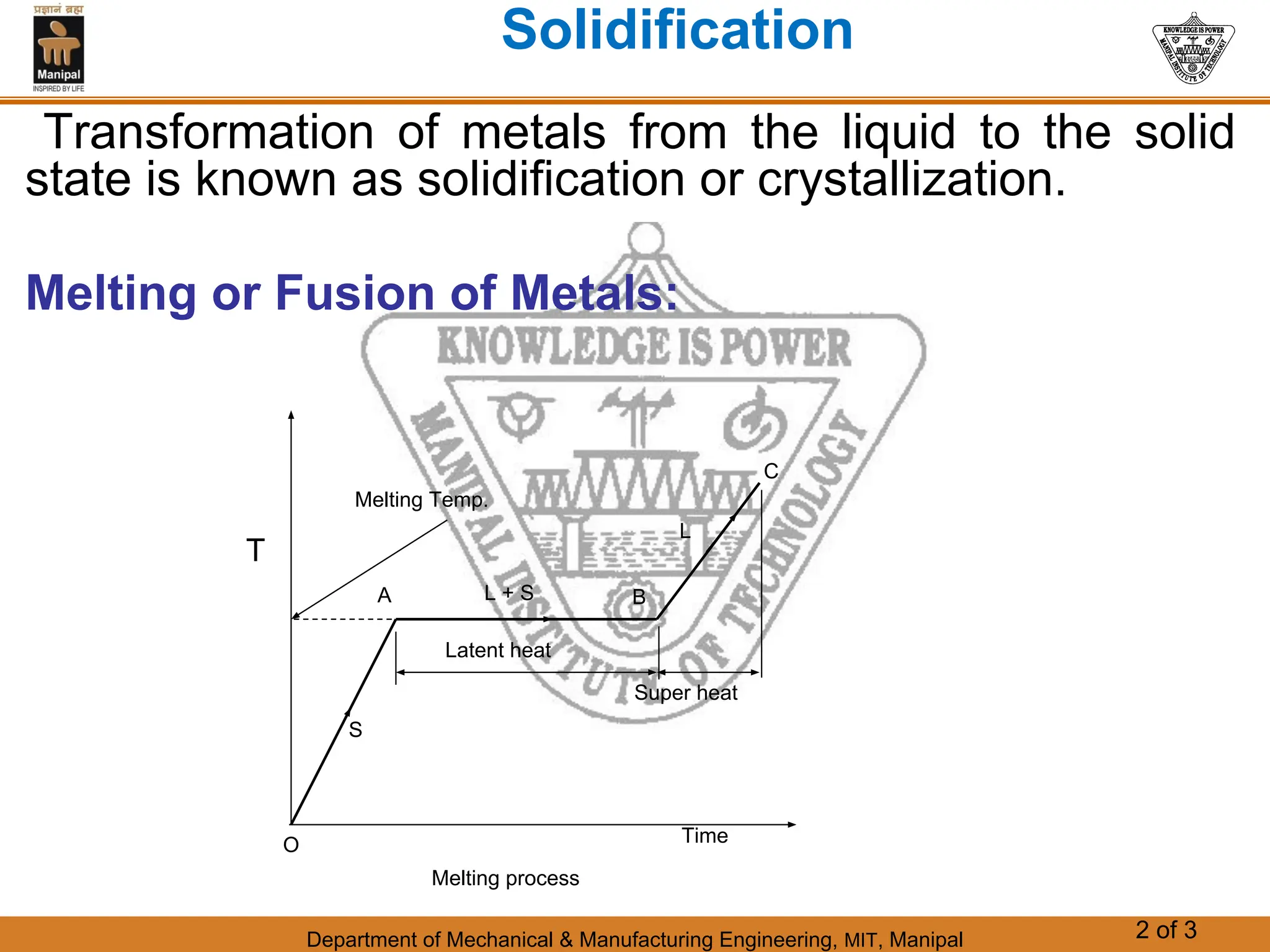
The process of melting takes place at constant
temperature as the heat added is utilized in breaking
the bonds between the atoms of the solid crystal
structure.
The heat that is added to the metal to convert all the
solid metal into liquid state is called the “Latent heat”.
It is isothermal in the case of pure metal (AB).
The heat that is further added to the metal in the
molten metal is called the “Super heat”.
Department of Mechanical & Manufacturing Engineering, MIT, Manipal 4 of 3
Time
T
F
D E
C
Latent heat
Super heat
Freezing temp.
S
L + S
L
Freezing or Solidification or Crystallization
of metals
Cooling Curve
Department of Mechanical & Manufacturing Engineering, MIT, Manipal 5 of 3
Solidification
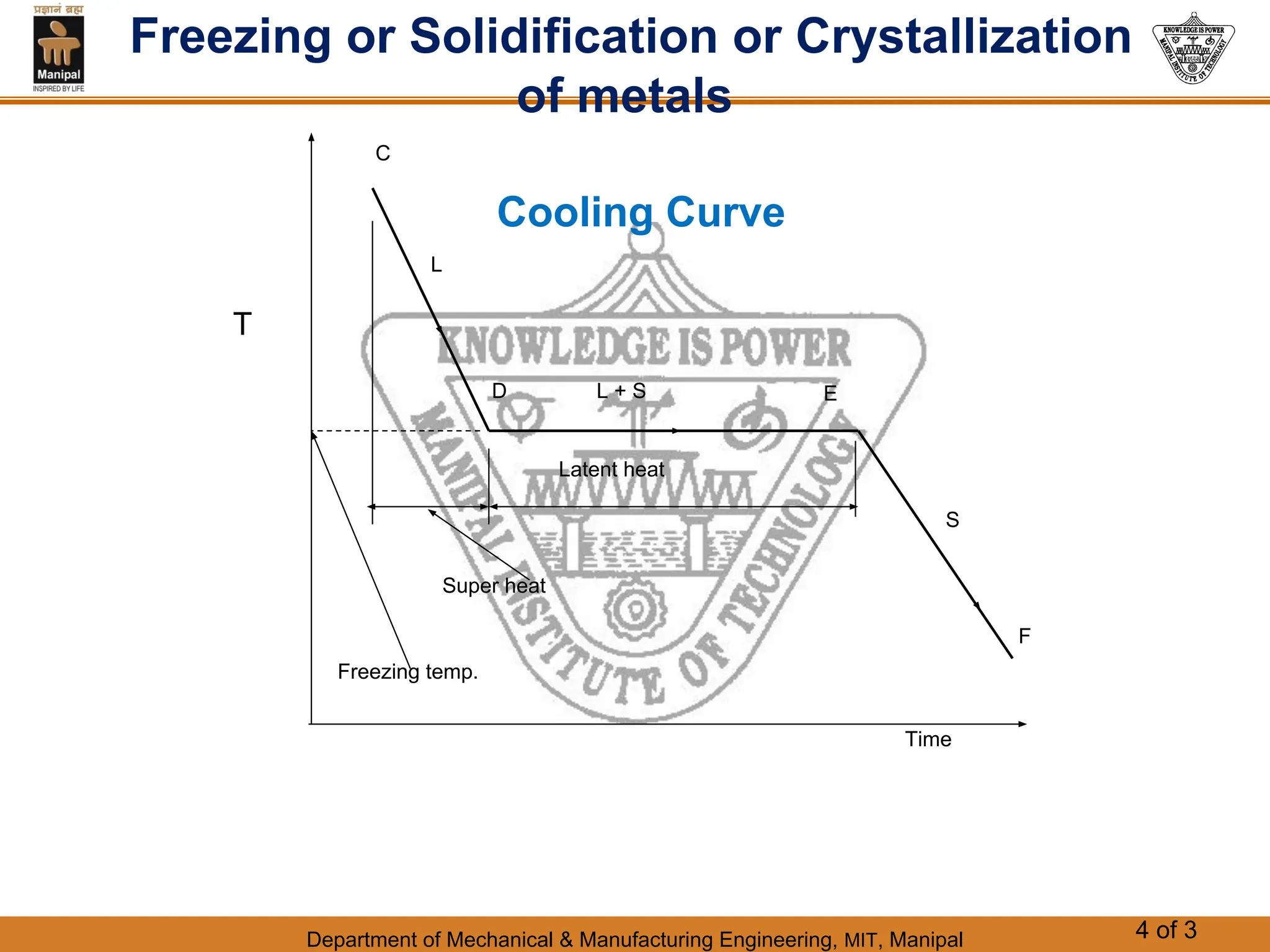
• Reverse process of melting.
• The pure metal in its molten state first gives up its
superheat upon cooling.
• When the temperature drops to the freezing
(solidification) temperature, the solidification process
starts.
• The metal starts to give out its latent heat at constant
freezing temperature, known as latent heat of fusion.
i.e., It is isothermal in the case of pure metal.
• This continues until all the metal in the liquid state is
converted into the solid state.
• Further the metal in the solid state is cooled to room
temperature.
Department of Mechanical & Manufacturing Engineering, MIT, Manipal 6 of 3
Cooling curve for pure metal and alloy:
Time
F
D E
C
S
L + S
L
Fig (a) Cooling curve for a
pure metal
TS
Time
F
D
E
C
S
L + S
L
Fig (b) Cooling curve for an
alloy
T1
T2
Department of Mechanical & Manufacturing Engineering, MIT, Manipal 7 of 3
The solidification of a pure metal takes place at a
constant temperature TS figure (a).
The solidification line DE is horizontal on the cooling
curve for a pure metal which means that solidification
begins and ends at the same temperature TS
.
Whereas, the solidification of an alloy takes place over
a range of temperature T1
to T2
as shown in figure (b).
The solidification line DE is inclined on the cooling
curve for an alloy which means that solidification begins
at temperature T1
and ends at temperature T2
.
Department of Mechanical & Manufacturing Engineering, MIT, Manipal 8 of 3
The process of solidification:
• The Transformation of metals from the liquid to the
solid state, proceeds due to the conversion of matter
to more stable thermodynamic condition with less
free energy.
• At any given temperature the total energy content H of
a system is divided between free energy (F or G) and
bound energy (TS).
i.e., H = G+TS
Department of Mechanical & Manufacturing Engineering, MIT, Manipal 9 of 3
The process of solidification:
• Free Energy (G): Described as the isothermally
available energy i.e., under certain conditions it can be
released by or removed from the system without
change in the temperature of the system.
• Bound Energy (TS): Exists as the kinetic energy of
the random motions of the atoms within the system
and as potential energy of the atoms arrangement
relative to each other.
• Expressed as the product of absolute temperature (T)
and entropy(S).
Department of Mechanical & Manufacturing Engineering, MIT, Manipal 10 of 3
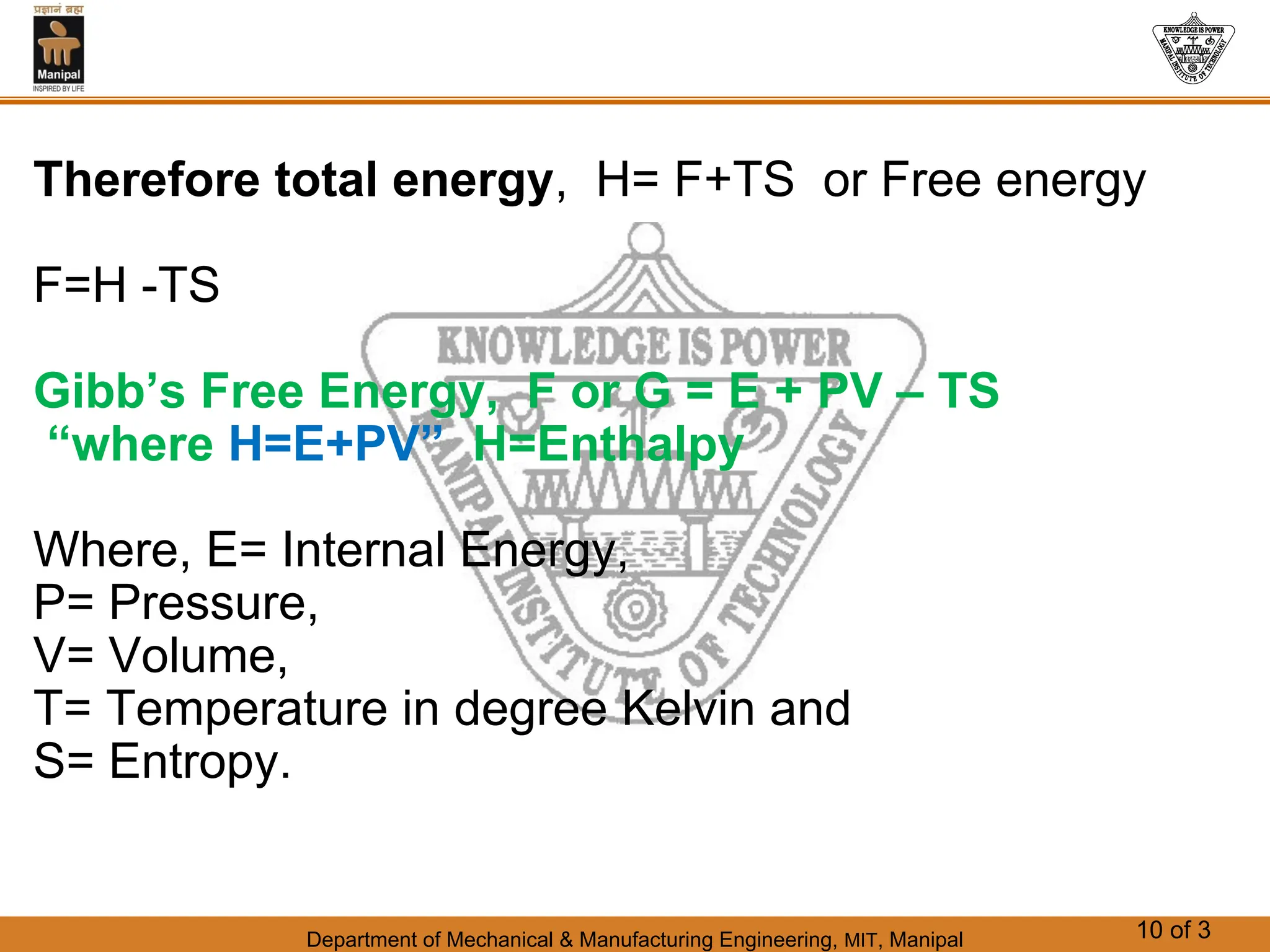
Therefore total energy, H= F+TS or Free energy
F=H -TS
Gibb’s Free Energy, F or G = E + PV – TS
“where H=E+PV” H=Enthalpy
Where, E= Internal Energy,
P= Pressure,
V= Volume,
T= Temperature in degree Kelvin and
S= Entropy.
Department of Mechanical & Manufacturing Engineering, MIT, Manipal 11 of 3
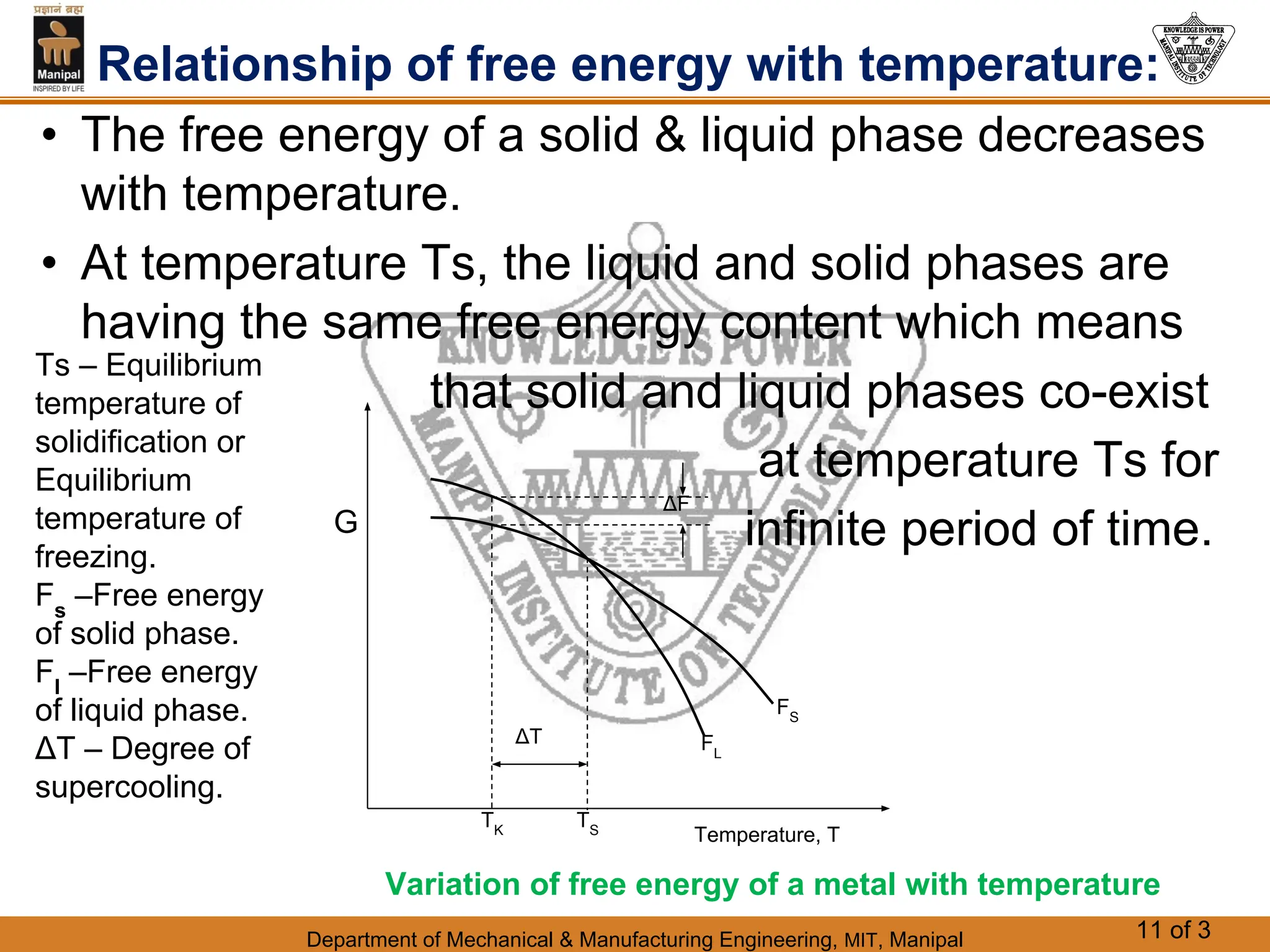
Relationship of free energy with temperature:
• The free energy of a solid & liquid phase decreases
with temperature.
• At temperature Ts, the liquid and solid phases are
having the same free energy content which means
that solid and liquid phases co-exist
at temperature Ts for
infinite period of time.
FS
FL
ΔF
ΔT
TK
TS Temperature, T
Variation of free energy of a metal with temperature
Ts – Equilibrium
temperature of
solidification or
Equilibrium
temperature of
freezing.
Fs
–Free energy
of solid phase.
Fl
–Free energy
of liquid phase.
ΔT – Degree of
supercooling.
G
Department of Mechanical & Manufacturing Engineering, MIT, Manipal 12 of 3
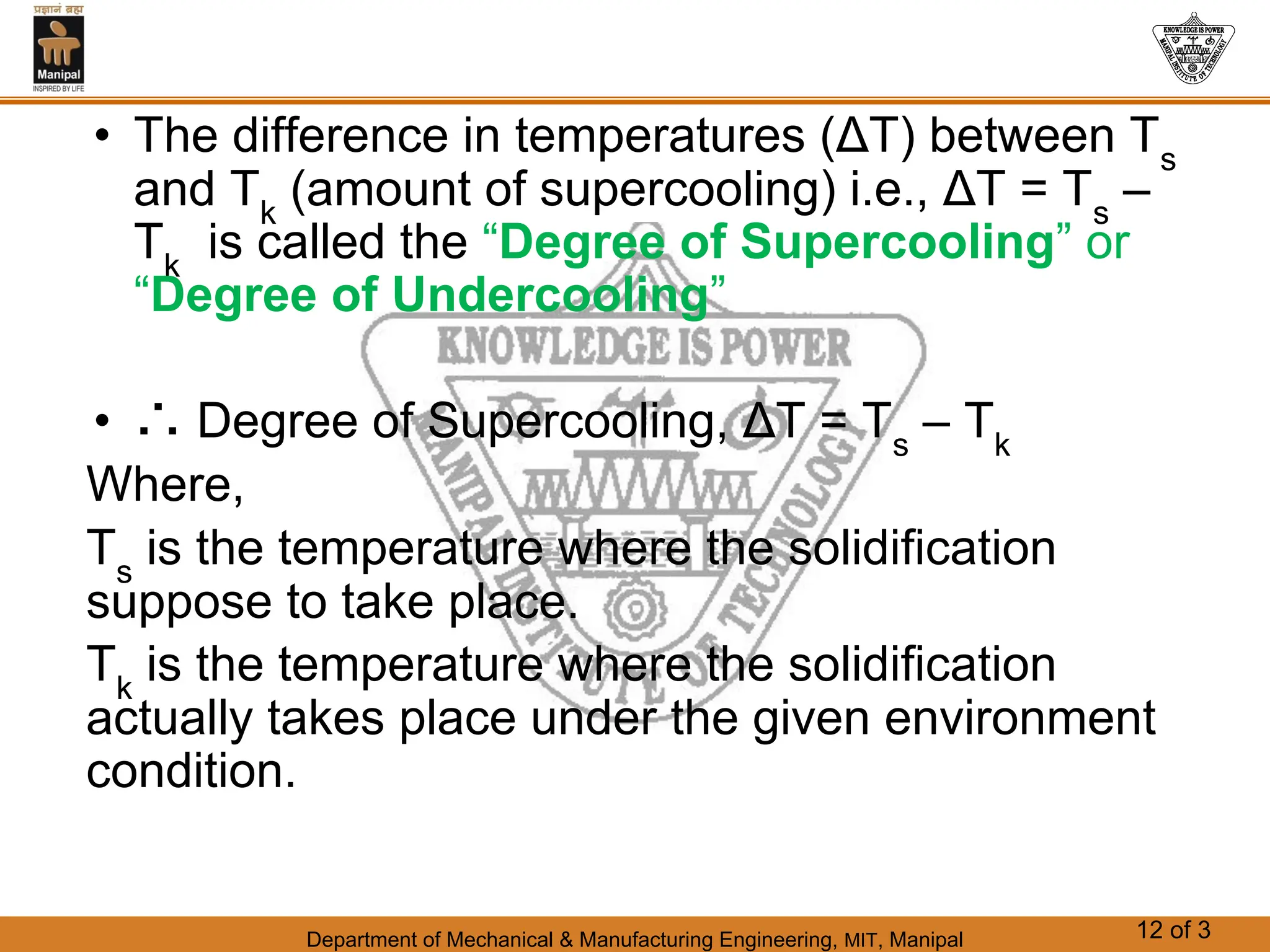
• The difference in temperatures (ΔT) between Ts
and Tk
(amount of supercooling) i.e., ΔT = Ts
–
Tk
is called the “Degree of Supercooling” or
“Degree of Undercooling”
• ∴ Degree of Supercooling, ΔT = Ts
– Tk
Where,
Ts
is the temperature where the solidification
suppose to take place.
Tk
is the temperature where the solidification
actually takes place under the given environment
condition.
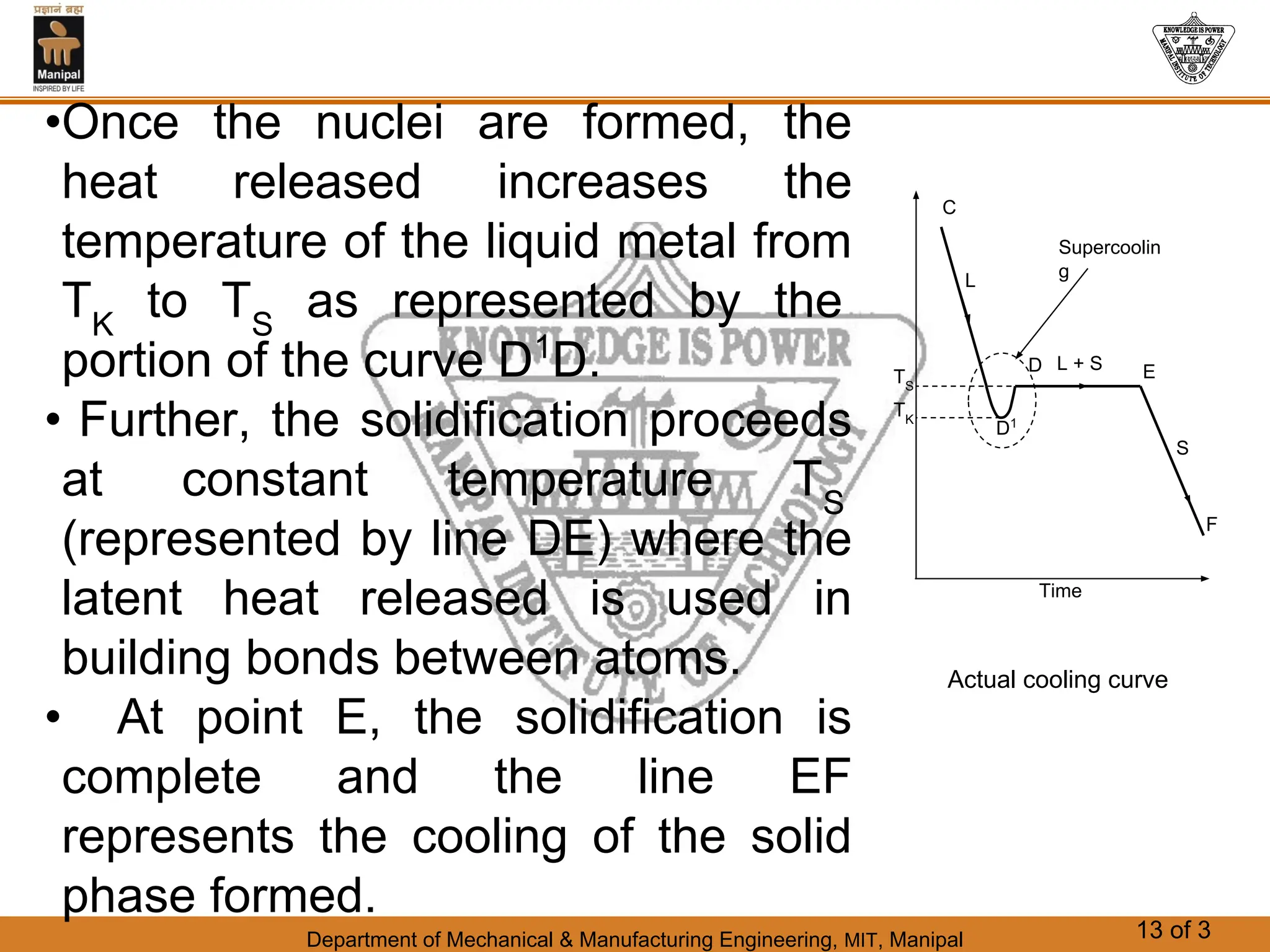
Department of Mechanical & Manufacturing Engineering, MIT, Manipal 13 of 3
Time
F
D E
C
S
L + S
L
TS
TK
D1
Supercoolin
g
•Once the nuclei are formed, the
heat released increases the
temperature of the liquid metal from
TK
to TS
as represented by the
portion of the curve D1
D.
• Further, the solidification proceeds
at constant temperature TS
(represented by line DE) where the
latent heat released is used in
building bonds between atoms.
• At point E, the solidification is
complete and the line EF
represents the cooling of the solid
phase formed.
Actual cooling curve
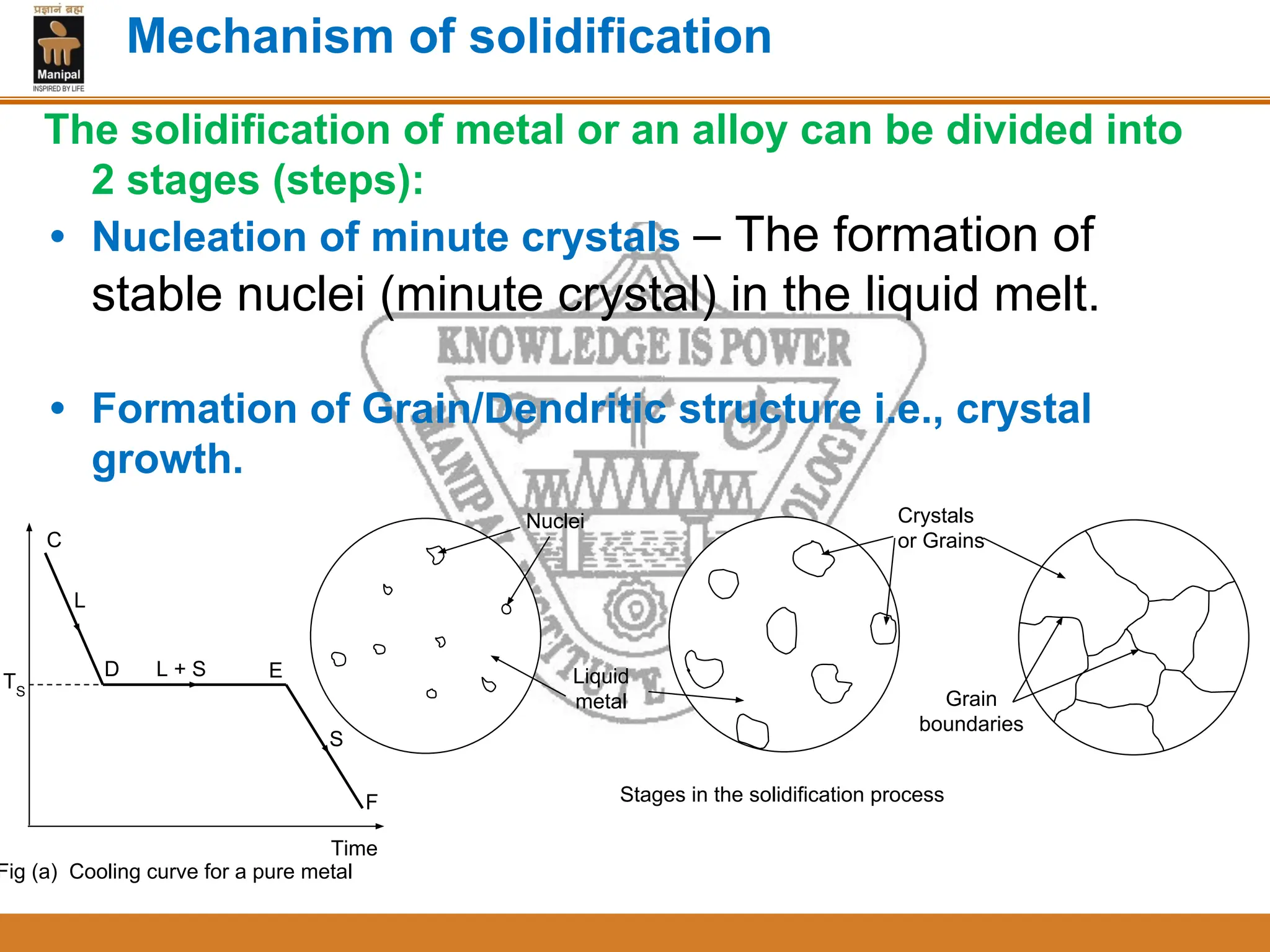
Mechanism of solidification
The solidification of metal or an alloy can be divided into
2 stages (steps):
• Nucleation of minute crystals – The formation of
stable nuclei (minute crystal) in the liquid melt.
• Formation of Grain/Dendritic structure i.e., crystal
growth.
Nuclei
Liquid
metal
Crystals
or Grains
Grain
boundaries
Stages in the solidification process
Time
F
D E
C
S
L + S
L
Fig (a) Cooling curve for a pure metal
TS
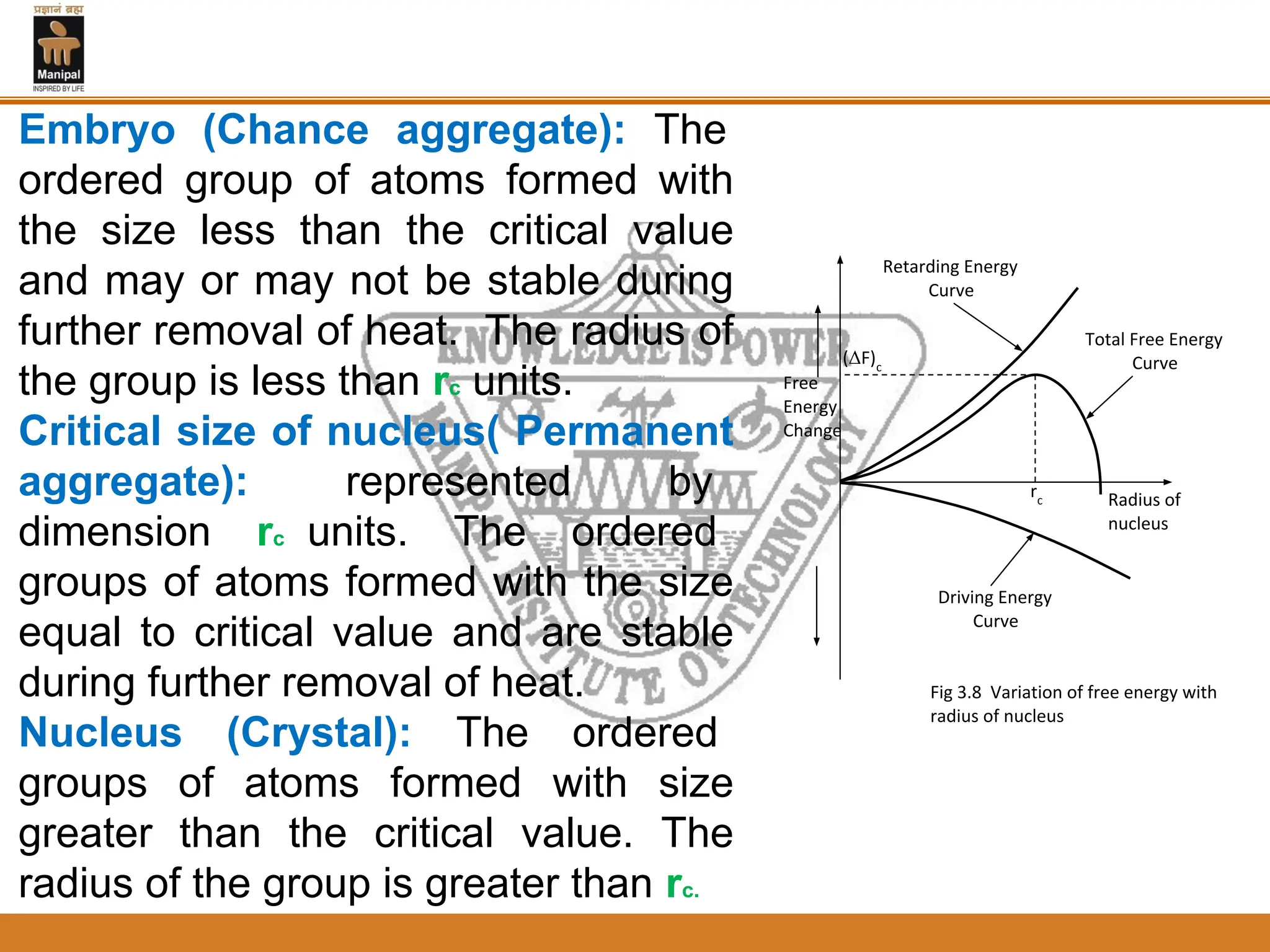
rc
(ΔF)c
Radius of
nucleus
Free
Energy
Change
Driving Energy
Curve
Total Free Energy
Curve
Retarding Energy
Curve
Fig 3.8 Variation of free energy with
radius of nucleus
Embryo (Chance aggregate): The
ordered group of atoms formed with
the size less than the critical value
and may or may not be stable during
further removal of heat. The radius of
the group is less than rc units.
Critical size of nucleus( Permanent
aggregate): represented by
dimension rc units. The ordered
groups of atoms formed with the size
equal to critical value and are stable
during further removal of heat.
Nucleus (Crystal): The ordered
groups of atoms formed with size
greater than the critical value. The
radius of the group is greater than rc.
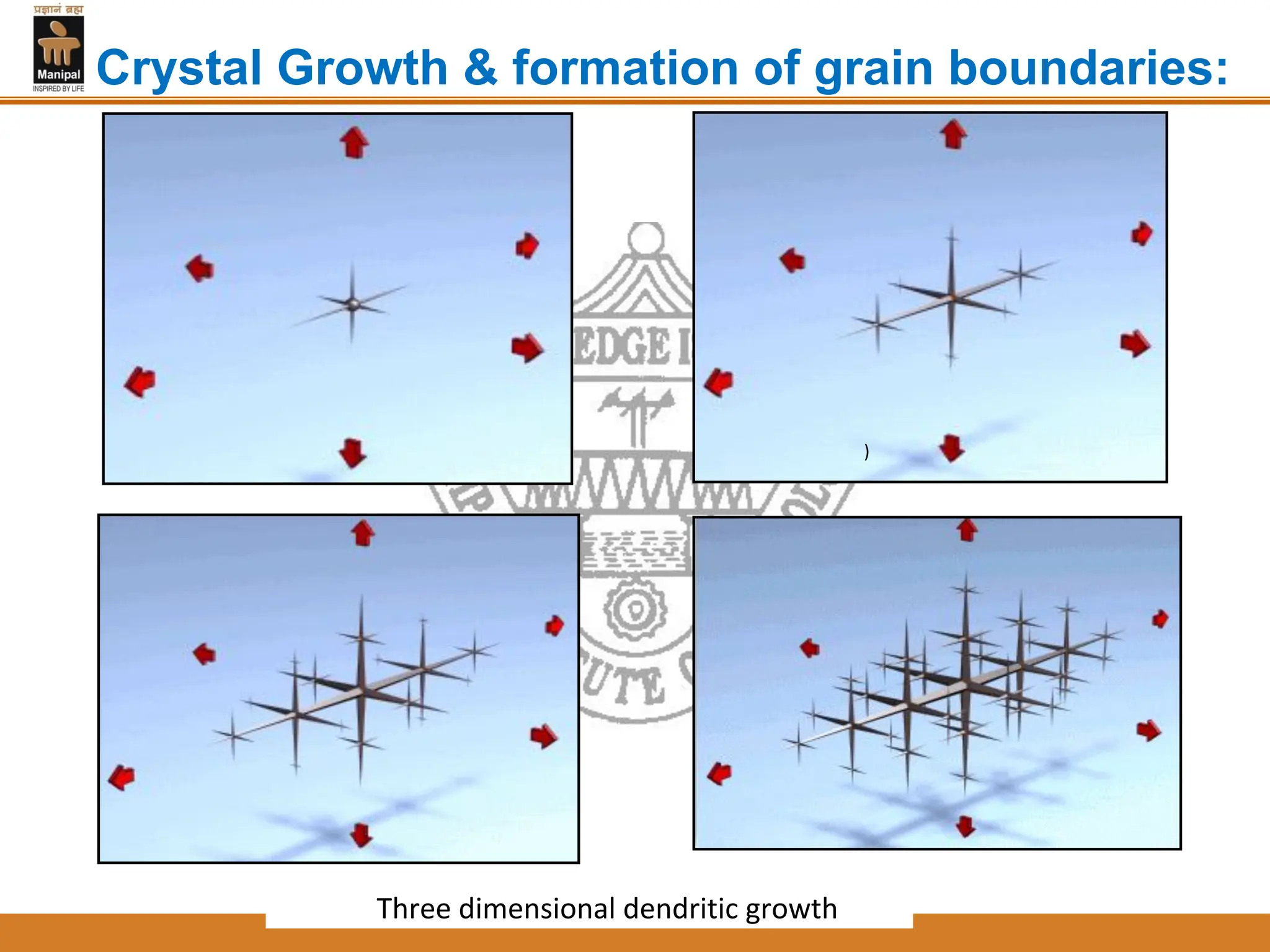
Three dimensional dendritic growth
)
Crystal Growth & formation of grain boundaries:
Nucleation types:
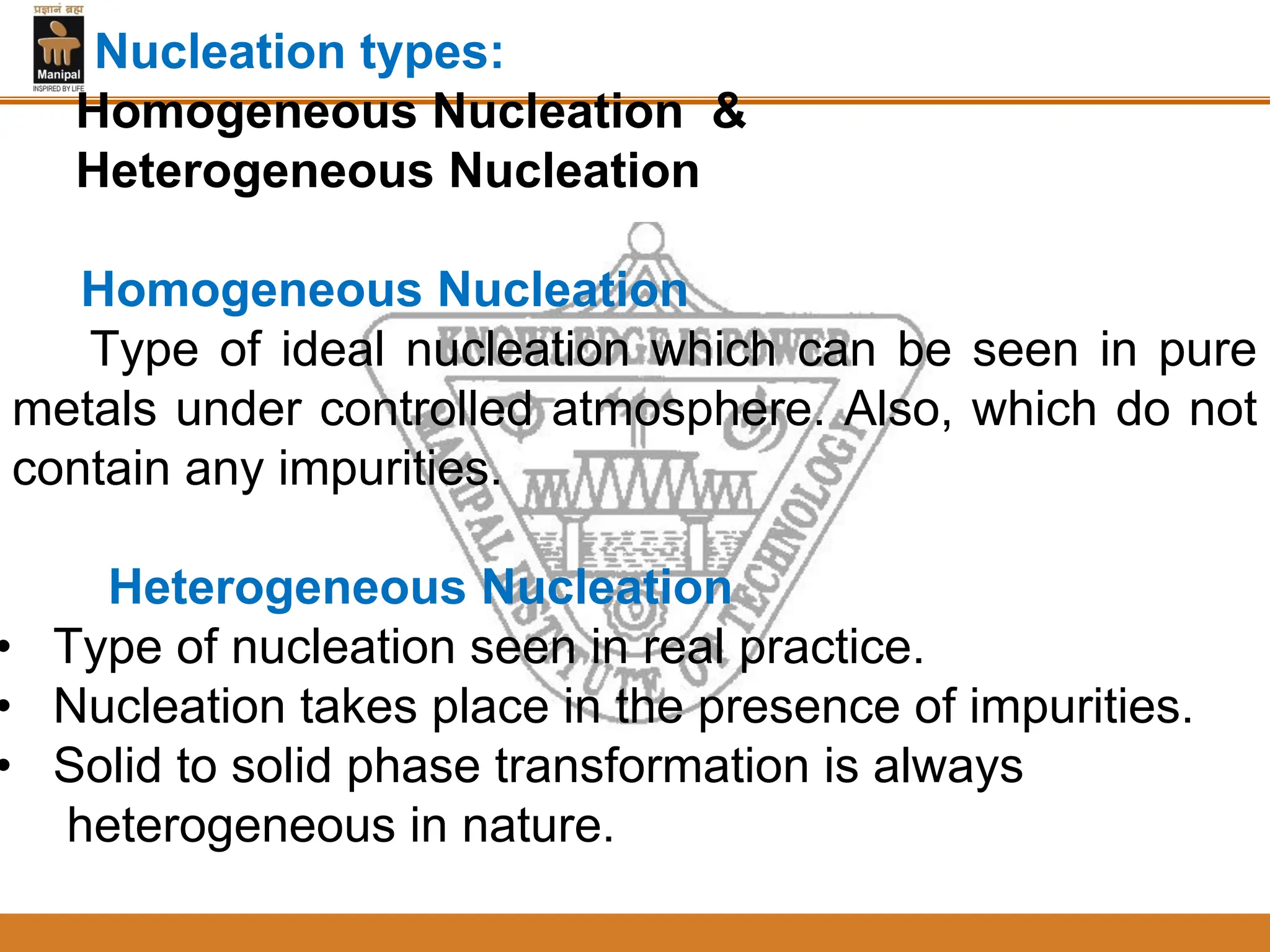
Homogeneous Nucleation &
Heterogeneous Nucleation
Homogeneous Nucleation
Type of ideal nucleation which can be seen in pure
metals under controlled atmosphere. Also, which do not
contain any impurities.
Heterogeneous Nucleation
• Type of nucleation seen in real practice.
• Nucleation takes place in the presence of impurities.
• Solid to solid phase transformation is always
heterogeneous in nature.
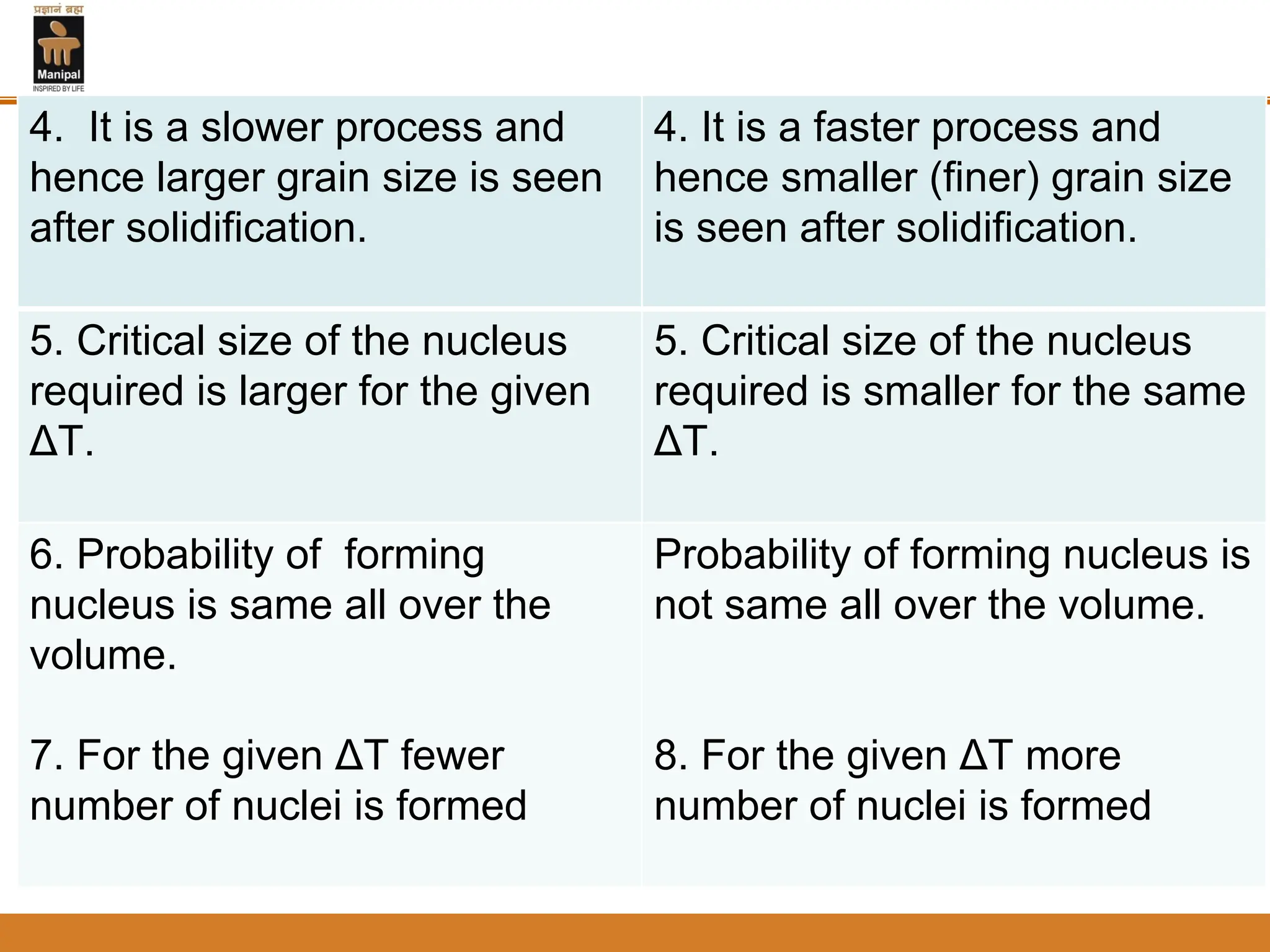
Homogeneous Nucleation Heterogeneous Nucleation
1. Nucleation takes place
in controlled atm. without
the presence (help) of
any impurity atoms.
1. Nucleation takes place in
the presence of impurity
atoms or defects.
2. It is an ideal case of
nucleation and occurs in
pure metal solidification.
2. It is found in actual
practice and occurs in all
metals and alloys.
3. Nucleation may be
initiated at any site
within the liquid melt
simultaneously.
3. Nucleation is initiated on
substrate (impurity)
surfaces.
Comparison between Homogeneous and Heterogeneous
Nucleation:
4. It is a slower process and
hence larger grain size is seen
after solidification.
4. It is a faster process and
hence smaller (finer) grain size
is seen after solidification.
5. Critical size of the nucleus
required is larger for the given
ΔT.
5. Critical size of the nucleus
required is smaller for the same
ΔT.
6. Probability of forming
nucleus is same all over the
volume.
7. For the given ΔT fewer
number of nuclei is formed
Probability of forming nucleus is
not same all over the volume.
8. For the given ΔT more
number of nuclei is formed
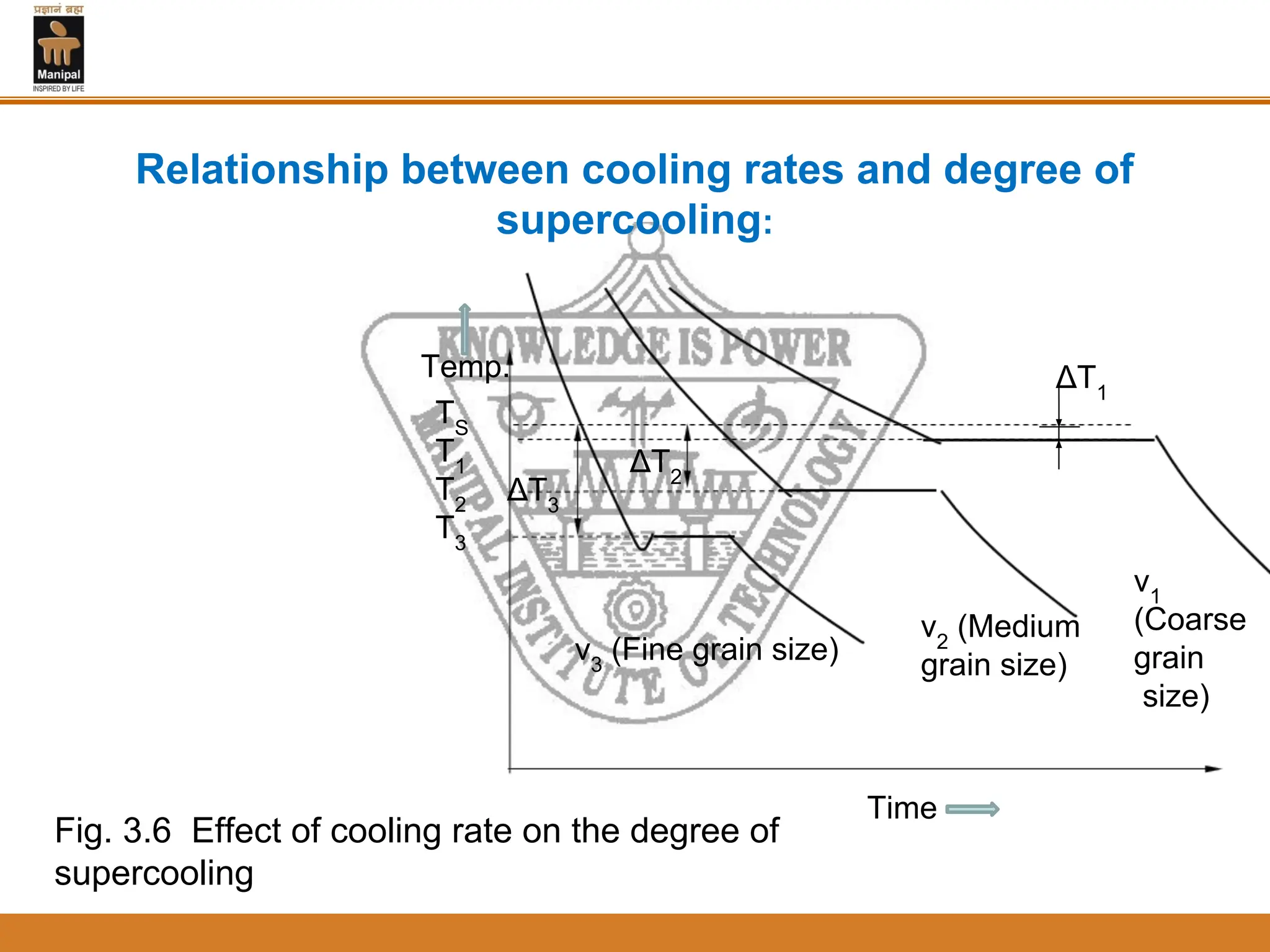
Relationship between cooling rates and degree of
supercooling:
ΔT2
ΔT3
v2
(Medium
grain size)
v3
(Fine grain size)
v1
(Coarse
grain
size)
Temp.
TS
T1
T2
T3
Time
Fig. 3.6 Effect of cooling rate on the degree of
supercooling
ΔT1
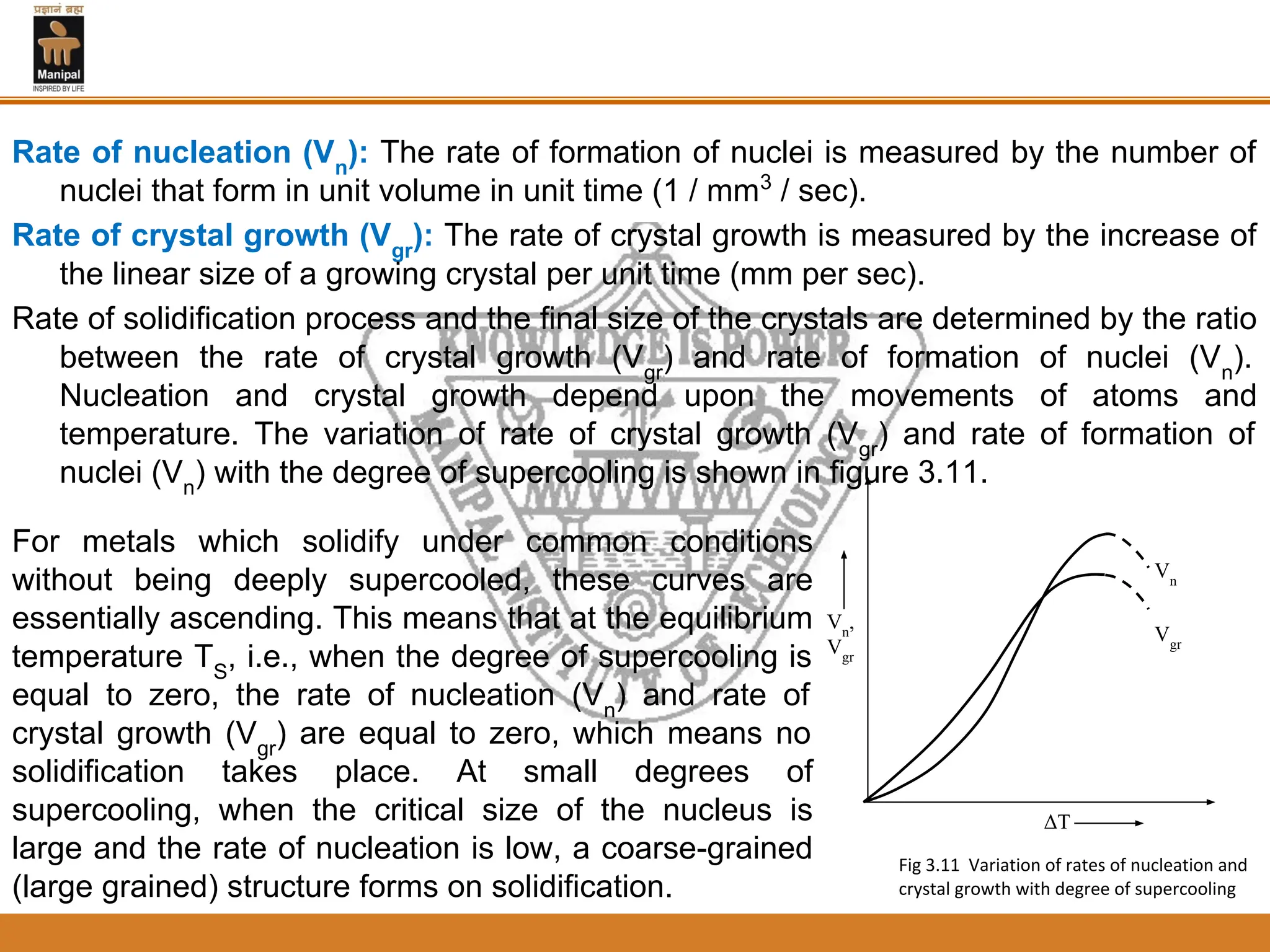
Rate of nucleation (Vn
): The rate of formation of nuclei is measured by the number of
nuclei that form in unit volume in unit time (1 / mm3
/ sec).
Rate of crystal growth (Vgr
): The rate of crystal growth is measured by the increase of
the linear size of a growing crystal per unit time (mm per sec).
Rate of solidification process and the final size of the crystals are determined by the ratio
between the rate of crystal growth (Vgr
) and rate of formation of nuclei (Vn
).
Nucleation and crystal growth depend upon the movements of atoms and
temperature. The variation of rate of crystal growth (Vgr
) and rate of formation of
nuclei (Vn
) with the degree of supercooling is shown in figure 3.11.
For metals which solidify under common conditions
without being deeply supercooled, these curves are
essentially ascending. This means that at the equilibrium
temperature TS
, i.e., when the degree of supercooling is
equal to zero, the rate of nucleation (Vn
) and rate of
crystal growth (Vgr
) are equal to zero, which means no
solidification takes place. At small degrees of
supercooling, when the critical size of the nucleus is
large and the rate of nucleation is low, a coarse-grained
(large grained) structure forms on solidification.
ΔT
Vn
,
Vgr
Vgr
Vn
Fig 3.11 Variation of rates of nucleation and
crystal growth with degree of supercooling
When the rate of nucleation and crystal growth are
equal, a moderate size-grained structure forms on
solidification.
When the rate of nucleation is higher than the rate of
crystal growth, a large number of nuclei is formed in
the given volume, leads finer size-grained structure on
solidification with enormous number of crystal defects.
The time required for solidification is depend upon the
extent of growth (Degree of supercooling and
heterogeneous nucleation sites available).
Longer the time, coarser the grain.
Finer the grain, lesser is the time duration for
solidification.

Solidification.pdf .

  • 1.
    Department of Mechanical& Manufacturing Engineering, MIT, Manipal 1 of 3 SOLIDFICATION Chapter-2
  • 2.
    Department of Mechanical& Manufacturing Engineering, MIT, Manipal 2 of 3 Solidification Transformation of metals from the liquid to the solid state is known as solidification or crystallization. Melting or Fusion of Metals: Time T O A B C Latent heat Super heat Melting Temp. S L + S L Melting process
  • 3.
    Department of Mechanical& Manufacturing Engineering, MIT, Manipal 3 of 3 The process of melting takes place at constant temperature as the heat added is utilized in breaking the bonds between the atoms of the solid crystal structure. The heat that is added to the metal to convert all the solid metal into liquid state is called the “Latent heat”. It is isothermal in the case of pure metal (AB). The heat that is further added to the metal in the molten metal is called the “Super heat”.
  • 4.
    Department of Mechanical& Manufacturing Engineering, MIT, Manipal 4 of 3 Time T F D E C Latent heat Super heat Freezing temp. S L + S L Freezing or Solidification or Crystallization of metals Cooling Curve
  • 5.
    Department of Mechanical& Manufacturing Engineering, MIT, Manipal 5 of 3 Solidification • Reverse process of melting. • The pure metal in its molten state first gives up its superheat upon cooling. • When the temperature drops to the freezing (solidification) temperature, the solidification process starts. • The metal starts to give out its latent heat at constant freezing temperature, known as latent heat of fusion. i.e., It is isothermal in the case of pure metal. • This continues until all the metal in the liquid state is converted into the solid state. • Further the metal in the solid state is cooled to room temperature.
  • 6.
    Department of Mechanical& Manufacturing Engineering, MIT, Manipal 6 of 3 Cooling curve for pure metal and alloy: Time F D E C S L + S L Fig (a) Cooling curve for a pure metal TS Time F D E C S L + S L Fig (b) Cooling curve for an alloy T1 T2
  • 7.
    Department of Mechanical& Manufacturing Engineering, MIT, Manipal 7 of 3 The solidification of a pure metal takes place at a constant temperature TS figure (a). The solidification line DE is horizontal on the cooling curve for a pure metal which means that solidification begins and ends at the same temperature TS . Whereas, the solidification of an alloy takes place over a range of temperature T1 to T2 as shown in figure (b). The solidification line DE is inclined on the cooling curve for an alloy which means that solidification begins at temperature T1 and ends at temperature T2 .
  • 8.
    Department of Mechanical& Manufacturing Engineering, MIT, Manipal 8 of 3 The process of solidification: • The Transformation of metals from the liquid to the solid state, proceeds due to the conversion of matter to more stable thermodynamic condition with less free energy. • At any given temperature the total energy content H of a system is divided between free energy (F or G) and bound energy (TS). i.e., H = G+TS
  • 9.
    Department of Mechanical& Manufacturing Engineering, MIT, Manipal 9 of 3 The process of solidification: • Free Energy (G): Described as the isothermally available energy i.e., under certain conditions it can be released by or removed from the system without change in the temperature of the system. • Bound Energy (TS): Exists as the kinetic energy of the random motions of the atoms within the system and as potential energy of the atoms arrangement relative to each other. • Expressed as the product of absolute temperature (T) and entropy(S).
  • 10.
    Department of Mechanical& Manufacturing Engineering, MIT, Manipal 10 of 3 Therefore total energy, H= F+TS or Free energy F=H -TS Gibb’s Free Energy, F or G = E + PV – TS “where H=E+PV” H=Enthalpy Where, E= Internal Energy, P= Pressure, V= Volume, T= Temperature in degree Kelvin and S= Entropy.
  • 11.
    Department of Mechanical& Manufacturing Engineering, MIT, Manipal 11 of 3 Relationship of free energy with temperature: • The free energy of a solid & liquid phase decreases with temperature. • At temperature Ts, the liquid and solid phases are having the same free energy content which means that solid and liquid phases co-exist at temperature Ts for infinite period of time. FS FL ΔF ΔT TK TS Temperature, T Variation of free energy of a metal with temperature Ts – Equilibrium temperature of solidification or Equilibrium temperature of freezing. Fs –Free energy of solid phase. Fl –Free energy of liquid phase. ΔT – Degree of supercooling. G
  • 12.
    Department of Mechanical& Manufacturing Engineering, MIT, Manipal 12 of 3 • The difference in temperatures (ΔT) between Ts and Tk (amount of supercooling) i.e., ΔT = Ts – Tk is called the “Degree of Supercooling” or “Degree of Undercooling” • ∴ Degree of Supercooling, ΔT = Ts – Tk Where, Ts is the temperature where the solidification suppose to take place. Tk is the temperature where the solidification actually takes place under the given environment condition.
  • 13.
    Department of Mechanical& Manufacturing Engineering, MIT, Manipal 13 of 3 Time F D E C S L + S L TS TK D1 Supercoolin g •Once the nuclei are formed, the heat released increases the temperature of the liquid metal from TK to TS as represented by the portion of the curve D1 D. • Further, the solidification proceeds at constant temperature TS (represented by line DE) where the latent heat released is used in building bonds between atoms. • At point E, the solidification is complete and the line EF represents the cooling of the solid phase formed. Actual cooling curve
  • 14.
    Mechanism of solidification Thesolidification of metal or an alloy can be divided into 2 stages (steps): • Nucleation of minute crystals – The formation of stable nuclei (minute crystal) in the liquid melt. • Formation of Grain/Dendritic structure i.e., crystal growth. Nuclei Liquid metal Crystals or Grains Grain boundaries Stages in the solidification process Time F D E C S L + S L Fig (a) Cooling curve for a pure metal TS
  • 15.
    rc (ΔF)c Radius of nucleus Free Energy Change Driving Energy Curve TotalFree Energy Curve Retarding Energy Curve Fig 3.8 Variation of free energy with radius of nucleus Embryo (Chance aggregate): The ordered group of atoms formed with the size less than the critical value and may or may not be stable during further removal of heat. The radius of the group is less than rc units. Critical size of nucleus( Permanent aggregate): represented by dimension rc units. The ordered groups of atoms formed with the size equal to critical value and are stable during further removal of heat. Nucleus (Crystal): The ordered groups of atoms formed with size greater than the critical value. The radius of the group is greater than rc.
  • 16.
    Three dimensional dendriticgrowth ) Crystal Growth & formation of grain boundaries:
  • 17.
    Nucleation types: Homogeneous Nucleation& Heterogeneous Nucleation Homogeneous Nucleation Type of ideal nucleation which can be seen in pure metals under controlled atmosphere. Also, which do not contain any impurities. Heterogeneous Nucleation • Type of nucleation seen in real practice. • Nucleation takes place in the presence of impurities. • Solid to solid phase transformation is always heterogeneous in nature.
  • 18.
    Homogeneous Nucleation HeterogeneousNucleation 1. Nucleation takes place in controlled atm. without the presence (help) of any impurity atoms. 1. Nucleation takes place in the presence of impurity atoms or defects. 2. It is an ideal case of nucleation and occurs in pure metal solidification. 2. It is found in actual practice and occurs in all metals and alloys. 3. Nucleation may be initiated at any site within the liquid melt simultaneously. 3. Nucleation is initiated on substrate (impurity) surfaces. Comparison between Homogeneous and Heterogeneous Nucleation:
  • 19.
    4. It isa slower process and hence larger grain size is seen after solidification. 4. It is a faster process and hence smaller (finer) grain size is seen after solidification. 5. Critical size of the nucleus required is larger for the given ΔT. 5. Critical size of the nucleus required is smaller for the same ΔT. 6. Probability of forming nucleus is same all over the volume. 7. For the given ΔT fewer number of nuclei is formed Probability of forming nucleus is not same all over the volume. 8. For the given ΔT more number of nuclei is formed
  • 20.
    Relationship between coolingrates and degree of supercooling: ΔT2 ΔT3 v2 (Medium grain size) v3 (Fine grain size) v1 (Coarse grain size) Temp. TS T1 T2 T3 Time Fig. 3.6 Effect of cooling rate on the degree of supercooling ΔT1
  • 21.
    Rate of nucleation(Vn ): The rate of formation of nuclei is measured by the number of nuclei that form in unit volume in unit time (1 / mm3 / sec). Rate of crystal growth (Vgr ): The rate of crystal growth is measured by the increase of the linear size of a growing crystal per unit time (mm per sec). Rate of solidification process and the final size of the crystals are determined by the ratio between the rate of crystal growth (Vgr ) and rate of formation of nuclei (Vn ). Nucleation and crystal growth depend upon the movements of atoms and temperature. The variation of rate of crystal growth (Vgr ) and rate of formation of nuclei (Vn ) with the degree of supercooling is shown in figure 3.11. For metals which solidify under common conditions without being deeply supercooled, these curves are essentially ascending. This means that at the equilibrium temperature TS , i.e., when the degree of supercooling is equal to zero, the rate of nucleation (Vn ) and rate of crystal growth (Vgr ) are equal to zero, which means no solidification takes place. At small degrees of supercooling, when the critical size of the nucleus is large and the rate of nucleation is low, a coarse-grained (large grained) structure forms on solidification. ΔT Vn , Vgr Vgr Vn Fig 3.11 Variation of rates of nucleation and crystal growth with degree of supercooling
  • 22.
    When the rateof nucleation and crystal growth are equal, a moderate size-grained structure forms on solidification. When the rate of nucleation is higher than the rate of crystal growth, a large number of nuclei is formed in the given volume, leads finer size-grained structure on solidification with enormous number of crystal defects. The time required for solidification is depend upon the extent of growth (Degree of supercooling and heterogeneous nucleation sites available). Longer the time, coarser the grain. Finer the grain, lesser is the time duration for solidification.