Welding of
Cast Irons
Cast Irons
• Contain 2 – 4 % carbon 10 X that of steel with
1 -3 % silicon
• Grey Cast Irons- have graphite flakes in a
ferritic, pearlitic or ferritic-pearlitic matrix
• SG ( spheroidal graphite ) irons - also known as
Nodular Cast irons or ductile iron
• Heat-treated SG irons – Best strength and
toughness properties
• White Cast Irons ( reduced carbon & silicon )
carbon present as cementite – very hard
• Malleable irons – produced by heat-treatment
of white cast irons
• White and malleable irons not much used these
days
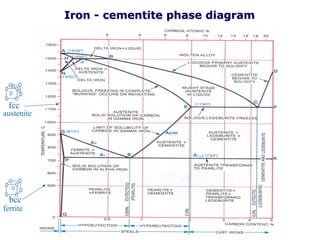
Iron - cementite phase diagram
fcc
bcc
austenite
ferrite
Grey Cast Irons
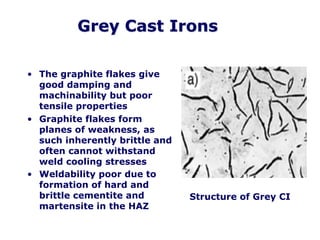
• The graphite flakes give
good damping and
machinability but poor
tensile properties
• Graphite flakes form
planes of weakness, as
such inherently brittle and
often cannot withstand
weld cooling stresses
• Weldability poor due to
formation of hard and
brittle cementite and
martensite in the HAZ
Structure of Grey CI
SG Cast Irons
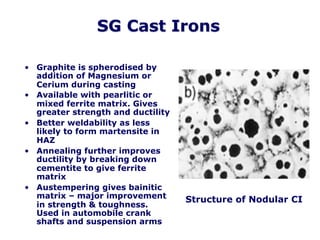
• Graphite is spherodised by
addition of Magnesium or
Cerium during casting
• Available with pearlitic or
mixed ferrite matrix. Gives
greater strength and ductility
• Better weldability as less
likely to form martensite in
HAZ
• Annealing further improves
ductility by breaking down
cementite to give ferrite
matrix
• Austempering gives bainitic
matrix – major improvement
in strength & toughness.
Used in automobile crank
shafts and suspension arms
Structure of Nodular CI
Welding of Cast Irons
• Cast Irons generally welded only for repair or joining to
steel components
• Formation of hard and brittle structure in HAZ make
them prone to HAZ cracking during post-weld cooling.
• Pre-heating combined with slow cooling reduces risk of
HAZ cracking by producing softer structures
• Alternatively large castings, difficult to preheat, maybe
welded with very low heat input to minimise HAZ
formation and shrinkage stresses
• Generally welded with Nickel, Monel or Fe-Nickel filler
metal. The resulting austenitic weld metal is not
sensitive to carbon pick-up and deposits are soft and
ductile and yield preferentially to relieve shrinkage
stresses
• Low-hydrogen mild steel electrodes can also be used for
non-machinable fill repair welds or after buttering with
a nickel or monel electrode
Metallurgical Considerations
• During welding carbon may diffuse into the austenite which
transforms into martensite when cooled. Extent and hardness
depending on type and composition of cast iron, preheat and
heat input
• Ferritic cast irons contain most of their carbon as graphite which
dissolves slowly and produces less martensite as compared to
pearlitic matrix irons in the HAZ
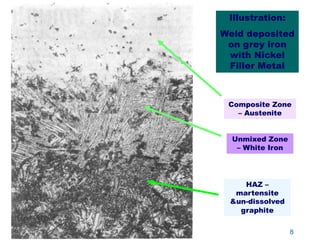
• The partially melted zone freezes as white iron the extent
depending on heat input and is the hardest part of the weld and
most prone to cracking.
• Most effective way to reduce severity of cracking problems in
cast iron is to reduce peak temperatures and duration of welding
at high temperatures so as to minimise width of HAZ and PMZ.
• This maybe achieved by using low diameter electrodes at low
currents, low melting filler metal and reduced pre-heat.
• Use of nickel alloy filler metal which has low solubility for carbon
and does not form carbides.
8
Composite Zone
– Austenite
Unmixed Zone
– White Iron
HAZ –
martensite
&un-dissolved
graphite
Illustration:
Weld deposited
on grey iron
with Nickel
Filler Metal
Welding processes and
procedure for Cast Irons
• Can be Oxy-acetylene gas welded
using matching cast iron rods with
high Silicon
• Can be Braze welded using copper
alloy filler metal
• MMAW, MIG or FCAW processes
can be used with nickel, monel or
Fe-nickel filler
• Always pre-heat parts slowly
and uniformly
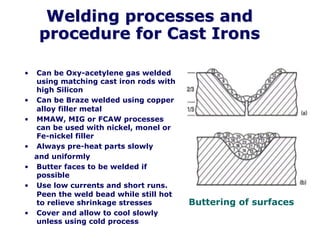
• Butter faces to be welded if
possible
• Use low currents and short runs.
Peen the weld bead while still hot
to relieve shrinkage stresses
• Cover and allow to cool slowly
unless using cold process
Buttering of surfaces
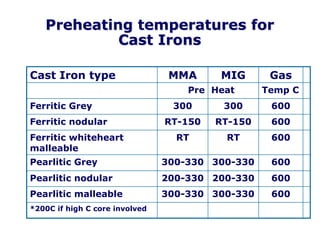
Preheating temperatures for
Cast Irons
Cast Iron type MMA MIG Gas
Pre Heat Temp C
Ferritic Grey 300 300 600
Ferritic nodular RT-150 RT-150 600
Ferritic whiteheart
malleable
RT RT 600
Pearlitic Grey 300-330 300-330 600
Pearlitic nodular 200-330 200-330 600
Pearlitic malleable 300-330 300-330 600
*200C if high C core involved
THANK YOU

Welding of ci

  • 1.
  • 2.
    Cast Irons • Contain2 – 4 % carbon 10 X that of steel with 1 -3 % silicon • Grey Cast Irons- have graphite flakes in a ferritic, pearlitic or ferritic-pearlitic matrix • SG ( spheroidal graphite ) irons - also known as Nodular Cast irons or ductile iron • Heat-treated SG irons – Best strength and toughness properties • White Cast Irons ( reduced carbon & silicon ) carbon present as cementite – very hard • Malleable irons – produced by heat-treatment of white cast irons • White and malleable irons not much used these days
  • 3.
    Iron - cementitephase diagram fcc bcc austenite ferrite
  • 4.
    Grey Cast Irons •The graphite flakes give good damping and machinability but poor tensile properties • Graphite flakes form planes of weakness, as such inherently brittle and often cannot withstand weld cooling stresses • Weldability poor due to formation of hard and brittle cementite and martensite in the HAZ Structure of Grey CI
  • 5.
    SG Cast Irons •Graphite is spherodised by addition of Magnesium or Cerium during casting • Available with pearlitic or mixed ferrite matrix. Gives greater strength and ductility • Better weldability as less likely to form martensite in HAZ • Annealing further improves ductility by breaking down cementite to give ferrite matrix • Austempering gives bainitic matrix – major improvement in strength & toughness. Used in automobile crank shafts and suspension arms Structure of Nodular CI
  • 6.
    Welding of CastIrons • Cast Irons generally welded only for repair or joining to steel components • Formation of hard and brittle structure in HAZ make them prone to HAZ cracking during post-weld cooling. • Pre-heating combined with slow cooling reduces risk of HAZ cracking by producing softer structures • Alternatively large castings, difficult to preheat, maybe welded with very low heat input to minimise HAZ formation and shrinkage stresses • Generally welded with Nickel, Monel or Fe-Nickel filler metal. The resulting austenitic weld metal is not sensitive to carbon pick-up and deposits are soft and ductile and yield preferentially to relieve shrinkage stresses • Low-hydrogen mild steel electrodes can also be used for non-machinable fill repair welds or after buttering with a nickel or monel electrode
  • 7.
    Metallurgical Considerations • Duringwelding carbon may diffuse into the austenite which transforms into martensite when cooled. Extent and hardness depending on type and composition of cast iron, preheat and heat input • Ferritic cast irons contain most of their carbon as graphite which dissolves slowly and produces less martensite as compared to pearlitic matrix irons in the HAZ • The partially melted zone freezes as white iron the extent depending on heat input and is the hardest part of the weld and most prone to cracking. • Most effective way to reduce severity of cracking problems in cast iron is to reduce peak temperatures and duration of welding at high temperatures so as to minimise width of HAZ and PMZ. • This maybe achieved by using low diameter electrodes at low currents, low melting filler metal and reduced pre-heat. • Use of nickel alloy filler metal which has low solubility for carbon and does not form carbides.
  • 8.
    8 Composite Zone – Austenite UnmixedZone – White Iron HAZ – martensite &un-dissolved graphite Illustration: Weld deposited on grey iron with Nickel Filler Metal
  • 9.
    Welding processes and procedurefor Cast Irons • Can be Oxy-acetylene gas welded using matching cast iron rods with high Silicon • Can be Braze welded using copper alloy filler metal • MMAW, MIG or FCAW processes can be used with nickel, monel or Fe-nickel filler • Always pre-heat parts slowly and uniformly • Butter faces to be welded if possible • Use low currents and short runs. Peen the weld bead while still hot to relieve shrinkage stresses • Cover and allow to cool slowly unless using cold process Buttering of surfaces
  • 10.
    Preheating temperatures for CastIrons Cast Iron type MMA MIG Gas Pre Heat Temp C Ferritic Grey 300 300 600 Ferritic nodular RT-150 RT-150 600 Ferritic whiteheart malleable RT RT 600 Pearlitic Grey 300-330 300-330 600 Pearlitic nodular 200-330 200-330 600 Pearlitic malleable 300-330 300-330 600 *200C if high C core involved
  • 11.