PROF. MAYUR S MODI
ASSISTANT PROFESSOR
MECHANICAL ENGINEERING DEPARTMENT
SHREE SWAMI ATMANAND SARASWATI INSTITUTE OF TECHNOLOGY,SURAT
PHASE ANDPHASE AND
PHASE DIAGRAMPHASE DIAGRAM
Material Science and Metallurgy
(2131904)
INTRODUCTION
• One of the important objectives of engineering
metallurgy is to determine the properties of material.
• The properties of material is a function of the
microstructure which is further dependent on the
overall composition and variables such as temp.,
pressure and composition.
• Equilibrium diagram or phase diagram is a graphical
representation of various phases present in the
material system at various temp. and compositions.
01/03/19 PROF.MAYUR S MODI 2
USEFUL TERMINOLOGY
01/03/19 PROF.MAYUR S MODI 3
• A pure substance, under equilibrium conditions,
may exist as either of a phase namely vapor, liquid
or solid, depending upon the conditions of
temperature and pressure.
• A phase can be defined as a homogeneous portion
of a system that has uniform physical and chemical
characteristics i.e. it is a physically distinct from
other phases, chemically homogeneous and
mechanically separable portion of a system.
• Other words, a phase is a structurally homogeneous
portion of matter.
01/03/19 PROF.MAYUR S MODI 4
01/03/19 PROF.MAYUR S MODI 5
It is a region that differs in it’s microstructure and composition
from another region.
For the same composition, different crystal structures represent
different phases.
A solid solution has atoms mixed at atomic level thus it represents
a single phase.
A single-phase system is termed as homogeneous, and systems
composed of two or more phases are termed as mixtures or
heterogeneous. Most of the alloy systems and composites are
heterogeneous
• System
Thermodynamically, a system is an isolated body of
matter. It refers to a specific portion of a object
within specified boundaries subjected to specified
variables.
OR
This refers to any portion of objective space within
specified boundaries subject to specified variables.
An alloy system is a combination of two or more
elements forming alloys which are considered
within a specified range of temp. , pressure and
concentration.
01/03/19 PROF.MAYUR S MODI 6
• Phase : It is a physically and chemically
homogeneous composition of a system, separated
from other portions by surface and an interface.
• But each portion have different composition and
properties.
• In an equilibrium diagram, liquid is one phase and
solid solution is another phase.
01/03/19 PROF.MAYUR S MODI 7
• Variable :
• A particular phase exists under various conditions of
temp., pressure and concentrations.
• These parameter are known as the variables of the
phase.
01/03/19 PROF.MAYUR S MODI 8
• Component – These are the substances, either
chemical elements or chemical compounds whose
presence is necessary and sufficient to make a
system.
• Pure metal is a one-component system whereas an
alloy of two metal is a two-component system.
• H2o 1 component = Ice, Water and Steam( 3
phase)
• Cu-Ni = 2 component
01/03/19 PROF.MAYUR S MODI 9
• Alloy :
• It is a mixture of two or more elements having
metallic properties.
• In the mixture, metal is in the large proportion and
the others can be metals or non-metals.
• The element in the largest amount is called as base
metal(Parent metal) or solvent and the other
elements are called as alloying elements or solute.
01/03/19 PROF.MAYUR S MODI 10
• Phase equilibrium –
• it refers to the set of conditions where more than
one phase may exist.
• It can be reflected by constancy with time in the
phase characteristics of a system.
• In most metallurgical and materials systems, phase
equilibrium involves just solid phases.
01/03/19 PROF.MAYUR S MODI 11
01/03/19 PROF.MAYUR S MODI 12
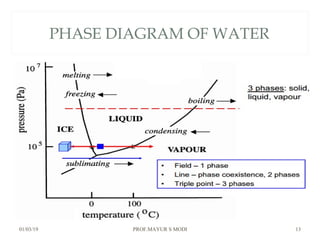
PHASE DIAGRAM OF WATER
01/03/19 PROF.MAYUR S MODI 13
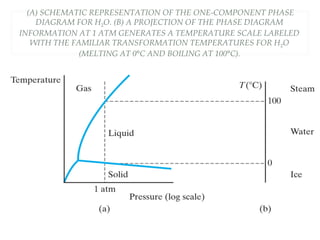
(A) SCHEMATIC REPRESENTATION OF THE ONE-COMPONENT PHASE
DIAGRAM FOR H2O. (B) A PROJECTION OF THE PHASE DIAGRAM
INFORMATION AT 1 ATM GENERATES A TEMPERATURE SCALE LABELED
WITH THE FAMILIAR TRANSFORMATION TEMPERATURES FOR H2O
(MELTING AT 0°C AND BOILING AT 100°C).
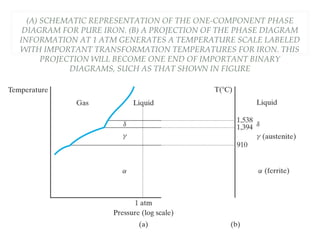
(A) SCHEMATIC REPRESENTATION OF THE ONE-COMPONENT PHASE
DIAGRAM FOR PURE IRON. (B) A PROJECTION OF THE PHASE DIAGRAM
INFORMATION AT 1 ATM GENERATES A TEMPERATURE SCALE LABELED
WITH IMPORTANT TRANSFORMATION TEMPERATURES FOR IRON. THIS
PROJECTION WILL BECOME ONE END OF IMPORTANT BINARY
DIAGRAMS, SUCH AS THAT SHOWN IN FIGURE
HUME-ROTHERY’S RULES FOR SOLID
SOLUTION
• Solid solution is an alloy of two or more elements
wherein the atomic crystal structure of the alloying
element (solute) is same as that of the base metal
matrix(solvent).
• The solubility limit of the solute in the solvent is
govern by certain factors.
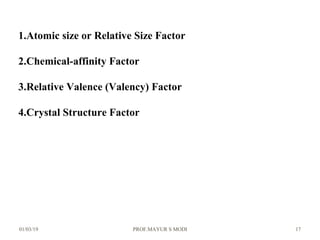
• These governing factors are known as Heme-
Rothery’s rules for solid solubility.
01/03/19 PROF.MAYUR S MODI 16
01/03/19 PROF.MAYUR S MODI 17
1.Atomic size or Relative Size Factor
2.Chemical-affinity Factor
3.Relative Valence (Valency) Factor
4.Crystal Structure Factor
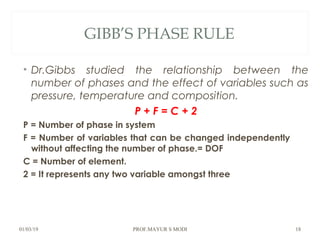
GIBB’S PHASE RULE
• Dr.Gibbs studied the relationship between the
number of phases and the effect of variables such as
pressure, temperature and composition.
P + F = C + 2
P = Number of phase in system
F = Number of variables that can be changed independently
without affecting the number of phase.= DOF
C = Number of element.
2 = It represents any two variable amongst three
01/03/19 PROF.MAYUR S MODI 18
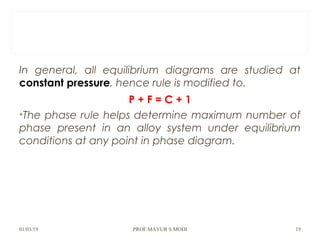
In general, all equilibrium diagrams are studied at
constant pressure, hence rule is modified to.
P + F = C + 1
•The phase rule helps determine maximum number of
phase present in an alloy system under equilibrium
conditions at any point in phase diagram.
01/03/19 PROF.MAYUR S MODI 19
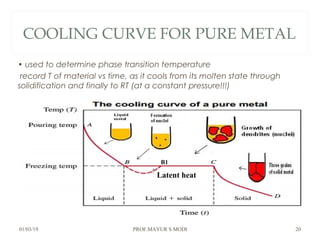
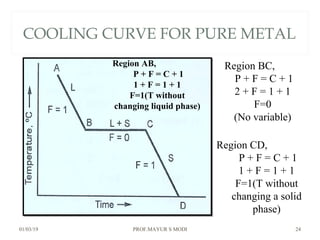
COOLING CURVE FOR PURE METAL
• used to determine phase transition temperature
record T of material vs time, as it cools from its molten state through
solidification and finally to RT (at a constant pressure!!!)
01/03/19 PROF.MAYUR S MODI 20
Latent heat
B1
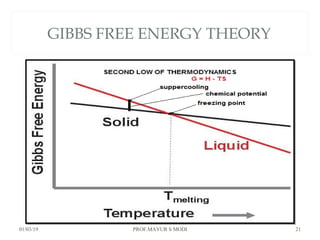
GIBBS FREE ENERGY THEORY
01/03/19 PROF.MAYUR S MODI 21
NUCLEATION
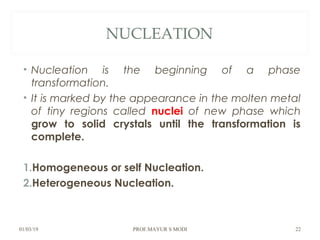
• Nucleation is the beginning of a phase
transformation.
• It is marked by the appearance in the molten metal
of tiny regions called nuclei of new phase which
grow to solid crystals until the transformation is
complete.
1.Homogeneous or self Nucleation.
2.Heterogeneous Nucleation.
01/03/19 PROF.MAYUR S MODI 22
01/03/19 PROF.MAYUR S MODI 23
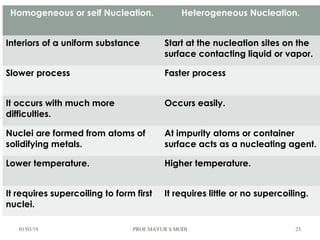
Homogeneous or self Nucleation. Heterogeneous Nucleation.
Interiors of a uniform substance Start at the nucleation sites on the
surface contacting liquid or vapor.
Slower process Faster process
It occurs with much more
difficulties.
Occurs easily.
Nuclei are formed from atoms of
solidifying metals.
At impurity atoms or container
surface acts as a nucleating agent.
Lower temperature. Higher temperature.
It requires supercoiling to form first
nuclei.
It requires little or no supercoiling.
COOLING CURVE FOR PURE METAL
01/03/19 PROF.MAYUR S MODI 24
Region AB,
P + F = C + 1
1 + F = 1 + 1
F=1(T without
changing liquid phase)
Region BC,
P + F = C + 1
2 + F = 1 + 1
F=0
(No variable)
Region CD,
P + F = C + 1
1 + F = 1 + 1
F=1(T without
changing a solid
phase)
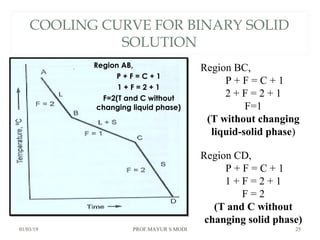
COOLING CURVE FOR BINARY SOLID
SOLUTION
01/03/19 PROF.MAYUR S MODI 25
Region AB,
P + F = C + 1
1 + F = 2 + 1
F=2(T and C without
changing liquid phase)
Region BC,
P + F = C + 1
2 + F = 2 + 1
F=1
(T without changing
liquid-solid phase)
Region CD,
P + F = C + 1
1 + F = 2 + 1
F = 2
(T and C without
changing solid phase)
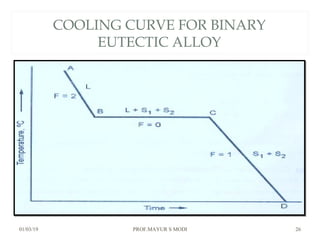
COOLING CURVE FOR BINARY
EUTECTIC ALLOY
01/03/19 PROF.MAYUR S MODI 26
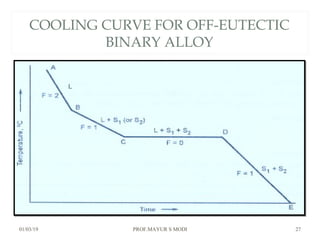
COOLING CURVE FOR OFF-EUTECTIC
BINARY ALLOY
01/03/19 PROF.MAYUR S MODI 27
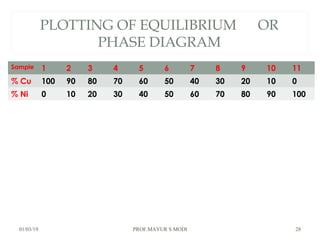
PLOTTING OF EQUILIBRIUM OR
PHASE DIAGRAM
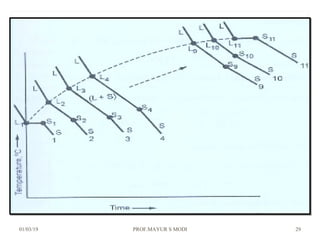
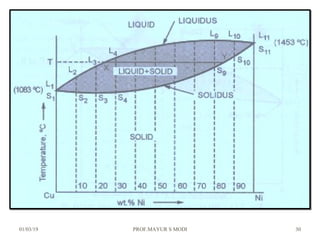
Sample 1 2 3 4 5 6 7 8 9 10 11
% Cu 100 90 80 70 60 50 40 30 20 10 0
% Ni 0 10 20 30 40 50 60 70 80 90 100
01/03/19 PROF.MAYUR S MODI 28
01/03/19 PROF.MAYUR S MODI 29
01/03/19 PROF.MAYUR S MODI 30
LEVER RULE
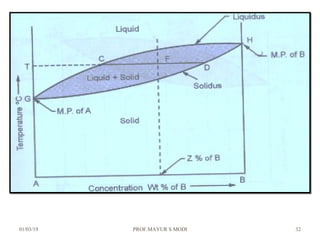
• It is the method used to find out the exact amount
of a particular phase existing in a binary system for
a given alloy at any temperature under
consideration.
• Let us consider an alloy A and B.
• Z be the composition of alloy under consideration
and T be the temperature at which phase content
is to be found.
01/03/19 PROF.MAYUR S MODI 31
01/03/19 PROF.MAYUR S MODI 32
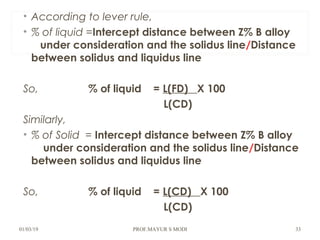
• According to lever rule,
• % of liquid =Intercept distance between Z% B alloy
under consideration and the solidus line/Distance
between solidus and liquidus line
So, % of liquid = L(FD) X 100
L(CD)
Similarly,
• % of Solid = Intercept distance between Z% B alloy
under consideration and the solidus line/Distance
between solidus and liquidus line
So, % of liquid = L(CD) X 100
L(CD)
01/03/19 PROF.MAYUR S MODI 33
01/03/19 PROF.MAYUR S MODI 34
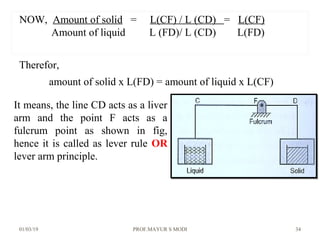
NOW, Amount of solid = L(CF) / L (CD) = L(CF)
Amount of liquid L (FD)/ L (CD) L(FD)
Therefor,
amount of solid x L(FD) = amount of liquid x L(CF)
It means, the line CD acts as a liver
arm and the point F acts as a
fulcrum point as shown in fig,
hence it is called as lever rule OR
lever arm principle.
01/03/19 PROF.MAYUR S MODI 35
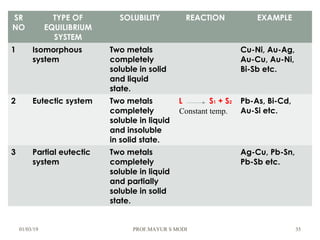
SR
NO
TYPE OF
EQUILIBRIUM
SYSTEM
SOLUBILITY REACTION EXAMPLE
1 Isomorphous
system
Two metals
completely
soluble in solid
and liquid
state.
Cu-Ni, Au-Ag,
Au-Cu, Au-Ni,
Bi-Sb etc.
2 Eutectic system Two metals
completely
soluble in liquid
and insoluble
in solid state.
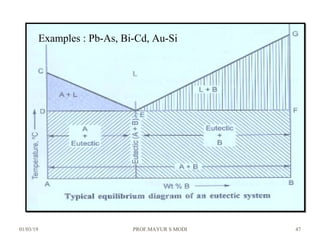
L S1 + S2 Pb-As, Bi-Cd,
Au-Si etc.
3 Partial eutectic
system
Two metals
completely
soluble in liquid
and partially
soluble in solid
state.
Ag-Cu, Pb-Sn,
Pb-Sb etc.
Constant temp.
01/03/19 PROF.MAYUR S MODI 36
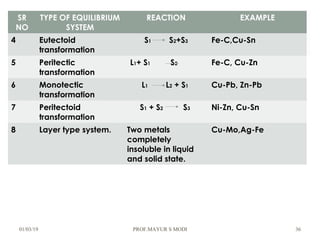
SR
NO
TYPE OF EQUILIBRIUM
SYSTEM
REACTION EXAMPLE
4 Eutectoid
transformation
S1 S2+S3 Fe-C,Cu-Sn
5 Peritectic
transformation
L1+ S1 S2 Fe-C, Cu-Zn
6 Monotectic
transformation
L1 L2 + S1 Cu-Pb, Zn-Pb
7 Peritectoid
transformation
S1 + S2 S3 Ni-Zn, Cu-Sn
8 Layer type system. Two metals
completely
insoluble in liquid
and solid state.
Cu-Mo,Ag-Fe
37
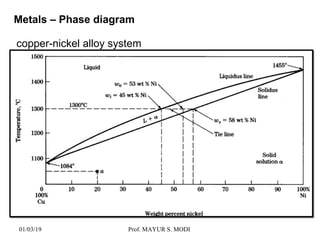
Metals – Phase diagram
The following things are known from
(1) Pure copper melts at 1084 C
(2) Pure nickel melts at 1455 C
(3) The system is a solid solution throughout
(4) Below solidus line – solid
(5) Above liquidus line – liquid
(6) Between, two phases: solid and liquid
Metals – Phase diagram
copper-nickel alloy system
01/03/19 Prof. MAYUR S. MODI
PHASE DIAGRAMS
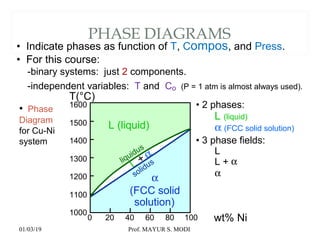
• Indicate phases as function of T, Compos, and Press.
• For this course:
-binary systems: just 2 components.
-independent variables: T and Co (P = 1 atm is almost always used).
• Phase
Diagram
for Cu-Ni
system
• 2 phases:
L (liquid)
α (FCC solid solution)
• 3 phase fields:
L
L + α
α
wt% Ni20 40 60 80 1000
1000
1100
1200
1300
1400
1500
1600
T(°C)
L (liquid)
α
(FCC solid
solution)
L + αliquidus
solidus
01/03/19 Prof. MAYUR S. MODI
wt% Ni20 40 60 80 1000
1000
1100
1200
1300
1400
1500
1600
T(°C)
L (liquid)
α
(FCC solid
solution)
L
+ α
liquidus
solidus
Cu-Ni
phase
diagram
PHASE DIAGRAMS:
# AND TYPES OF PHASES
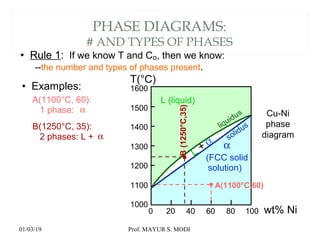
• Rule 1: If we know T and Co, then we know:
--the number and types of phases present.
• Examples:
A(1100°C, 60):
1 phase: α
B(1250°C, 35):
2 phases: L + α
B(1250°C,35) A(1100°C,60)
01/03/19 Prof. MAYUR S. MODI
wt% Ni
20
1200
1300
T(°C)
L (liquid)
α
(solid)L +α
liquidus
solidus
30 40 50
L +α
Cu-Ni
system
PHASE DIAGRAMS:
COMPOSITION OF PHASES
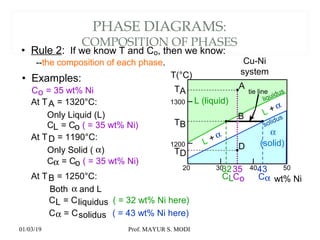
• Rule 2: If we know T and Co, then we know:
--the composition of each phase.
• Examples:
TA
A
35
Co
32
CL
At TA = 1320°C:
Only Liquid (L)
CL = Co ( = 35 wt% Ni)
At TB = 1250°C:
Both α and L
CL = Cliquidus ( = 32 wt% Ni here)
Cα = Csolidus ( = 43 wt% Ni here)
At TD = 1190°C:
Only Solid ( α)
Cα = Co ( = 35 wt% Ni)
Co = 35 wt% Ni
B
TB
D
TD
tie line
4
Cα
3
01/03/19 Prof. MAYUR S. MODI
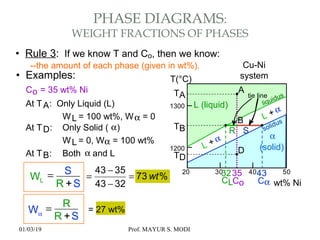
• Rule 3: If we know T and Co, then we know:
--the amount of each phase (given in wt%).
• Examples:
At TA: Only Liquid (L)
WL = 100 wt%, Wα = 0
At TD: Only Solid ( α)
WL = 0, Wα = 100 wt%
Co = 35 wt% Ni
PHASE DIAGRAMS:
WEIGHT FRACTIONS OF PHASES
wt% Ni
20
1200
1300
T(°C)
L (liquid)
α
(solid)L +α
liquidus
solidus
30 40 50
L +α
Cu-Ni
system
TA
A
35
Co
32
CL
B
TB
D
TD
tie line
4
Cα
3
R S
At TB: Both α and L
%73
3243
3543
wt=
−
−
=
= 27 wt%
WL
= S
R +S
Wα
= R
R +S
01/03/19 Prof. MAYUR S. MODI
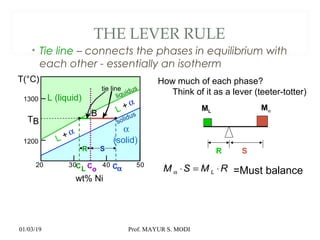
• Tie line – connects the phases in equilibrium with
each other - essentially an isotherm
THE LEVER RULE
How much of each phase?
Think of it as a lever (teeter-totter)
ML
Mα
R S
RMSM L ⋅=⋅α
wt% Ni
20
1200
1300
T(°C)
L (liquid)
α
(solid)L +α
liquidus
solidus
30 40 50
L +α
B
TB
tie line
CoCL Cα
SR
=Must balance
01/03/19 Prof. MAYUR S. MODI
wt% Ni
20
1200
1300
30 40 50
1100
L (liquid)
α
(solid)
L +
α
L +
α
T(°C)
A
35
Co
L: 35wt%Ni
Cu-Ni
system
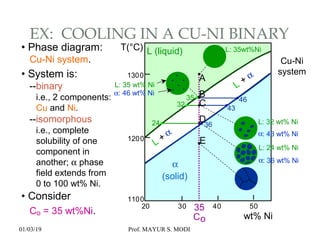
• Phase diagram:
Cu-Ni system.
• System is:
--binary
i.e., 2 components:
Cu and Ni.
--isomorphous
i.e., complete
solubility of one
component in
another; α phase
field extends from
0 to 100 wt% Ni.
• Consider
Co = 35 wt%Ni.
EX: COOLING IN A CU-NI BINARY
4635
43
32
α: 43 wt% Ni
L: 32 wt% Ni
L: 24 wt% Ni
α: 36 wt% Ni
Bα: 46 wt% Ni
L: 35 wt% Ni
C
D
E
24 36
01/03/19 Prof. MAYUR S. MODI
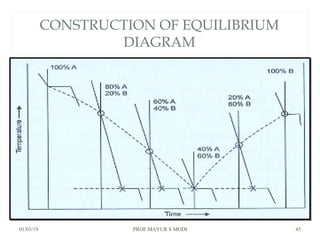
CONSTRUCTION OF EQUILIBRIUM
DIAGRAM
01/03/19 PROF.MAYUR S MODI 45
01/03/19 PROF.MAYUR S MODI 46
01/03/19 PROF.MAYUR S MODI 47
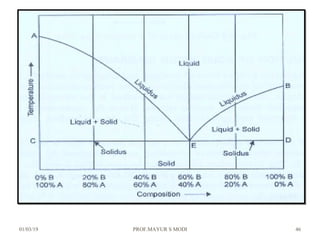
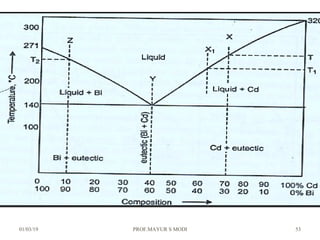
Examples : Pb-As, Bi-Cd, Au-Si
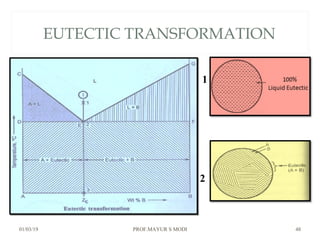
EUTECTIC TRANSFORMATION
01/03/19 PROF.MAYUR S MODI 48
1
2
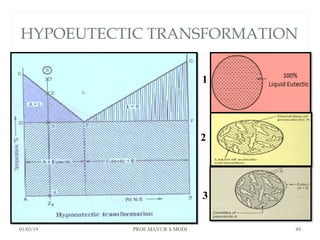
HYPOEUTECTIC TRANSFORMATION
01/03/19 PROF.MAYUR S MODI 49
1
2
3
01/03/19 PROF.MAYUR S MODI 50
At just below point 3
The already separated pro-eutectic A remains unchanged.
% Amount pro-eutectic A = l(3E)/l(DE) ……….at point 3.
% Amount eutectic = l(D3)/l(DE) ……….at point 3.
At point 4
Total amount of metal A at point 4
=[amount of pro-eutectic A] + [amount of eutectic A]
=[amount of pro-eutectic A] + [ A in the eutectic x amount of eutectic]
=[l(3E)/l(DE)] + [l(EF)/l(DF) x l(D3)/l(DE)]
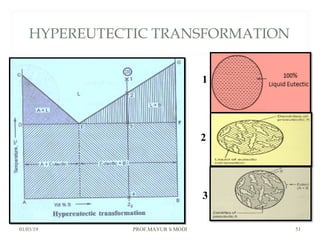
HYPEREUTECTIC TRANSFORMATION
01/03/19 PROF.MAYUR S MODI 51
1
2
3
01/03/19 PROF.MAYUR S MODI 52
At just below point 3
The already separated pro-eutectic A remains unchanged.
% Amount pro-eutectic B = l(E3)/l(EF) ……….at point 3.
% Amount eutectic = l(3F)/l(EF) ……….at point 3.
At point 4
Total amount of metal A at point 4
=[amount of pro-eutectic B] + [amount of eutectic B]
=[amount of pro-eutectic B] + [ B in the eutectic x amount of
eutectic]
=[l(E3)/l(EF)] + [l(DE)/l(DF) x l(3F)/l(EF)]
01/03/19 PROF.MAYUR S MODI 53
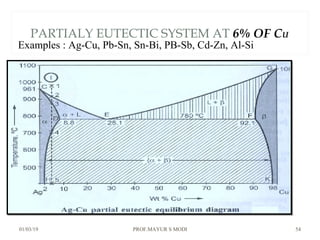
PARTIALY EUTECTIC SYSTEM AT 6% OF CU
01/03/19 PROF.MAYUR S MODI 54
Examples : Ag-Cu, Pb-Sn, Sn-Bi, PB-Sb, Cd-Zn, Al-Si
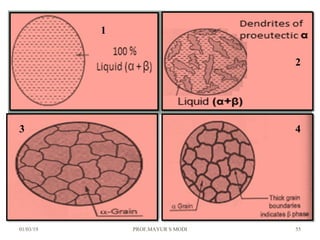
01/03/19 PROF.MAYUR S MODI 55
1
2
3 4
01/03/19 PROF.MAYUR S MODI 56
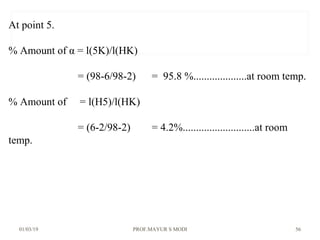
At point 5.
% Amount of α = l(5K)/l(HK)
= (98-6/98-2) = 95.8 %....................at room temp.
% Amount of = l(H5)/l(HK)
= (6-2/98-2) = 4.2%...........................at room
temp.
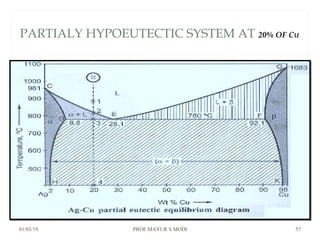
PARTIALY HYPOEUTECTIC SYSTEM AT 20% OF CU
01/03/19 PROF.MAYUR S MODI 57
01/03/19 PROF.MAYUR S MODI 58
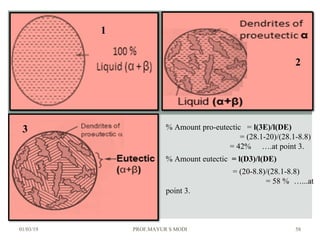
1
2
3 % Amount pro-eutectic = l(3E)/l(DE)
= (28.1-20)/(28.1-8.8)
= 42% ….at point 3.
% Amount eutectic = l(D3)/l(DE)
= (20-8.8)/(28.1-8.8)
= 58 % …...at
point 3.
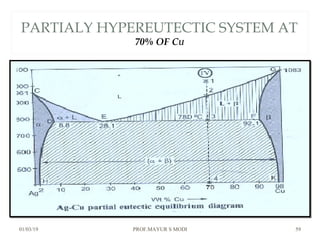
PARTIALY HYPEREUTECTIC SYSTEM AT
70% OF CU
01/03/19 PROF.MAYUR S MODI 59
01/03/19 PROF.MAYUR S MODI 60
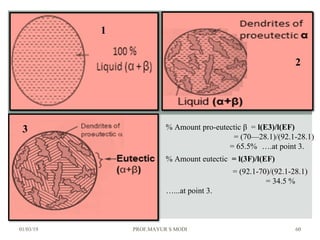
1
2
3 % Amount pro-eutectic β = l(E3)/l(EF)
= (70—28.1)/(92.1-28.1)
= 65.5% ….at point 3.
% Amount eutectic = l(3F)/l(EF)
= (92.1-70)/(92.1-28.1)
= 34.5 %
…...at point 3.
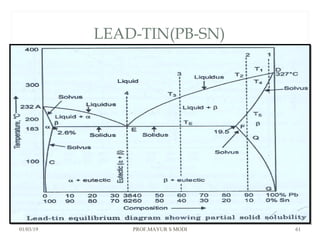
LEAD-TIN(PB-SN)
01/03/19 PROF.MAYUR S MODI 61
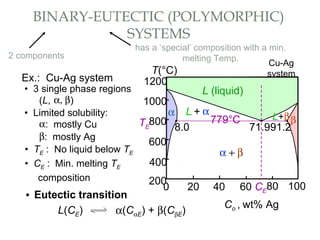
: Min. melting TE
2 components
has a ‘special’ composition with a min.
melting Temp.
BINARY-EUTECTIC (POLYMORPHIC)
SYSTEMS
• Eutectic transition
L(CE) α(CαE) + β(CβE)
• 3 single phase regions
(L, α, β)
• Limited solubility:
α: mostly Cu
β: mostly Ag
• TE : No liquid below TE
• CE
composition
Ex.: Cu-Ag system
Cu-Ag
system
L (liquid)
α L + α
L+ββ
α + β
Co , wt% Ag
20 40 60 80 1000
200
1200
T(°C)
400
600
800
1000
CE
TE 8.0 71.991.2
779°C
L+α
L+β
α + β
200
T(°C)
18.3
C, wt% Sn
20 60 80 1000
300
100
L (liquid)
α 183°C
61.9 97.8
β
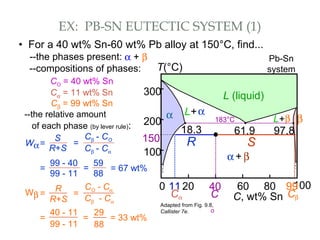
• For a 40 wt% Sn-60 wt% Pb alloy at 150°C, find...
--the phases present: Pb-Sn
system
EX: PB-SN EUTECTIC SYSTEM (1)
α + β
--compositions of phases:
CO = 40 wt% Sn
--the relative amount
of each phase (by lever rule):
150
40
C
o
11
Cα
99
Cβ
SR
Cα = 11 wt% Sn
Cβ = 99 wt% Sn
Wα=
Cβ - CO
Cβ - Cα
=
99 - 40
99 - 11
=
59
88
= 67 wt%
S
R+S
=
Wβ =
CO - Cα
Cβ - Cα
=
R
R+S
=
29
88
= 33 wt%=
40 - 11
99 - 11
Adapted from Fig. 9.8,
Callister 7e.
L+β
α + β
200
T(°C)
C, wt% Sn
20 60 80 1000
300
100
L (liquid)
α β
L+α
183°C
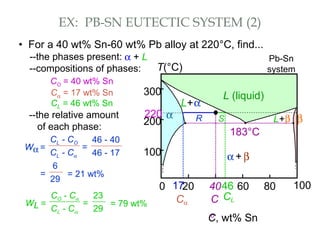
• For a 40 wt% Sn-60 wt% Pb alloy at 220°C, find...
--the phases present: Pb-Sn
system
EX: PB-SN EUTECTIC SYSTEM (2)
α + L
--compositions of phases:
CO = 40 wt% Sn
--the relative amount
of each phase:
Wα =
CL - CO
CL - Cα
=
46 - 40
46 - 17
=
6
29
= 21 wt%
WL =
CO - Cα
CL - Cα
=
23
29
= 79 wt%
40
C
o
46
CL
17
Cα
220 SR
Cα = 17 wt% Sn
CL = 46 wt% Sn
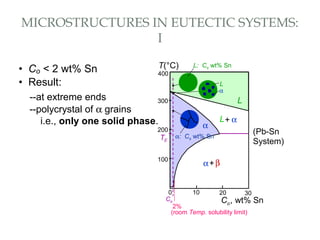
• Co < 2 wt% Sn
• Result:
--at extreme ends
--polycrystal of α grains
i.e., only one solid phase.
MICROSTRUCTURES IN EUTECTIC SYSTEMS:
I
0
L+ α
200
T(°C)
Co, wt% Sn
10
2%
20
Co
300
100
L
α
30
α+β
400
(room Temp. solubility limit)
TE
(Pb-Sn
System)
α
L
L: Co wt% Sn
α: Co wt% Sn
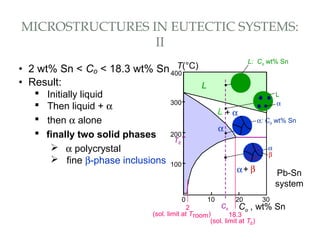
• 2 wt% Sn < Co < 18.3 wt% Sn
• Result:
 Initially liquid
 Then liquid + α
 then α alone
 finally two solid phases
 α polycrystal
 fine β-phase inclusions
MICROSTRUCTURES IN EUTECTIC SYSTEMS:
II
Pb-Sn
system
L + α
200
T(°C)
Co , wt% Sn
10
18.3
200
Co
300
100
L
α
30
α+ β
400
(sol. limit at TE)
TE
2
(sol. limit at Troom)
L
α
L: Co wt% Sn
α
β
α: Co wt% Sn
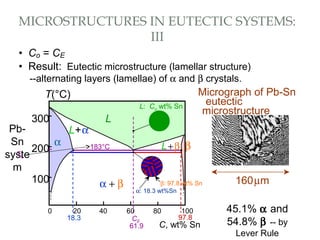
• Co = CE
• Result: Eutectic microstructure (lamellar structure)
--alternating layers (lamellae) of α and β crystals.
MICROSTRUCTURES IN EUTECTIC SYSTEMS:
III
160µm
Micrograph of Pb-Sn
eutectic
microstructure
Pb-
Sn
syste
m
L+β
α + β
200
T(°C)
C, wt% Sn
20 60 80 1000
300
100
L
α β
L+α
183°C
40
TE
18.3
α: 18.3 wt%Sn
97.8
β: 97.8 wt% Sn
CE
61.9
L: Co wt% Sn
45.1% α and
54.8% β -- by
Lever Rule
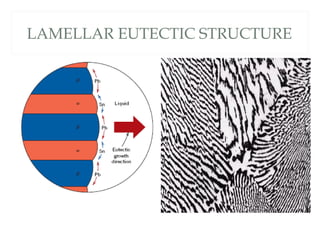
LAMELLAR EUTECTIC STRUCTURE
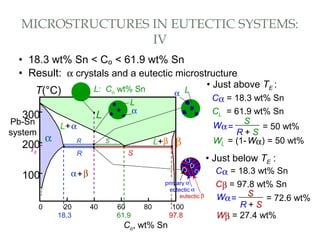
• 18.3 wt% Sn < Co < 61.9 wt% Sn
• Result: α crystals and a eutectic microstructure
MICROSTRUCTURES IN EUTECTIC SYSTEMS:
IV
18.3 61.9
SR
97.8
SR
primary α
eutectic α
eutectic β
WL = (1-Wα) = 50 wt%
Cα = 18.3 wt% Sn
CL = 61.9 wt% Sn
S
R + S
Wα= = 50 wt%
• Just above TE :
• Just below TE :
Cα = 18.3 wt% Sn
Cβ = 97.8 wt% Sn
S
R + S
Wα= = 72.6 wt%
Wβ = 27.4 wt%
Pb-Sn
system
L+β200
T(°C)
Co, wt% Sn
20 60 80 1000
300
100
L
α β
L+α
40
α+β
TE
L: Co wt% Sn Lα
L
α
L+α
L+β
α+β
200
Co, wt% Sn20 60 80 1000
300
100
L
α βTE
40
(Pb-Sn
System)
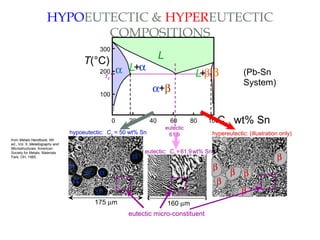
HYPOEUTECTIC & HYPEREUTECTIC
COMPOSITIONS
160 µm
eutectic micro-constituent
hypereutectic: (illustration only)
β
β
β
β
β
β
from Metals Handbook, 9th
ed., Vol. 9, Metallography and
Microstructures, American
Society for Metals, Materials
Park, OH, 1985.
175 µm
α
α
α
α
α
α
hypoeutectic: Co = 50 wt% Sn
T(°C)
61.9
eutectic
eutectic: Co =61.9wt% Sn
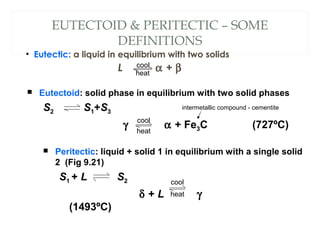
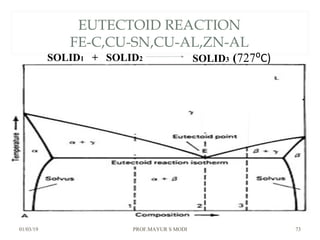
 Eutectoid: solid phase in equilibrium with two solid phases
S2 S1+S3
γ α + Fe3C (727ºC)
intermetallic compound - cementite
cool
heat
 Peritectic: liquid + solid 1 in equilibrium with a single solid
2 (Fig 9.21)
S1 + L S2
δ + L γ
(1493ºC)
cool
heat
• Eutectic: a liquid in equilibrium with two solids
L α + β
EUTECTOID & PERITECTIC – SOME
DEFINITIONS
cool
heat
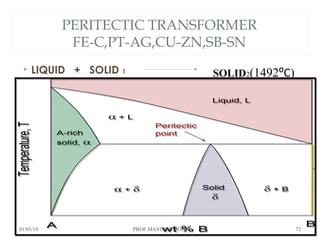
PERITECTIC TRANSFORMER
FE-C,PT-AG,CU-ZN,SB-SN
• LIQUID + SOLID 1
01/03/19 PROF.MAYUR S MODI 72
SOLID2(1492⁰C)
EUTECTOID REACTION
FE-C,CU-SN,CU-AL,ZN-AL
01/03/19 PROF.MAYUR S MODI 73
SOLID1 + SOLID2 SOLID3 (727⁰C)
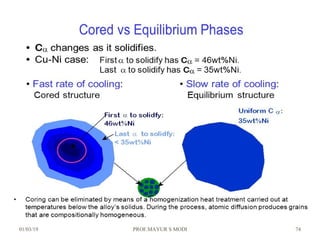
01/03/19 PROF.MAYUR S MODI 74
INTRODUCTION TO IRON
CARBON DIAGRAM
01/03/19 PROF.MAYUR S MODI 75
ALLOTROPY OF IRON
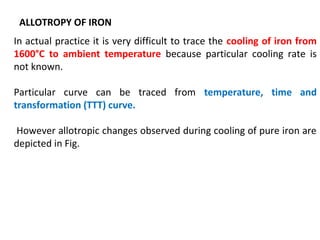
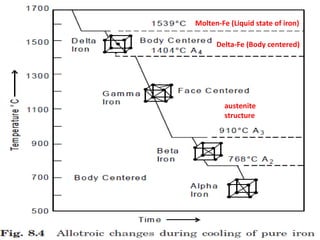
In actual practice it is very difficult to trace the cooling of iron from
1600°C to ambient temperature because particular cooling rate is
not known.
Particular curve can be traced from temperature, time and
transformation (TTT) curve.
However allotropic changes observed during cooling of pure iron are
depicted in Fig.
Molten-Fe (Liquid state of iron)
Delta-Fe (Body centered)
austenite
structure
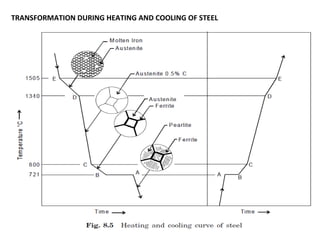
TRANSFORMATION DURING HEATING AND COOLING OF STEEL
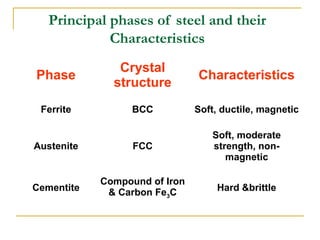
Principal phases of steel and their
Characteristics
Phase
Crystal
structure
Characteristics
Ferrite BCC Soft, ductile, magnetic
Austenite FCC
Soft, moderate
strength, non-
magnetic
Cementite
Compound of Iron
& Carbon Fe3C Hard &brittle
01/03/19 PROF.MAYUR S MODI 80
01/03/19 PROF.MAYUR S MODI 81
01/03/19 PROF.MAYUR S MODI 82
01/03/19 PROF.MAYUR S MODI 83
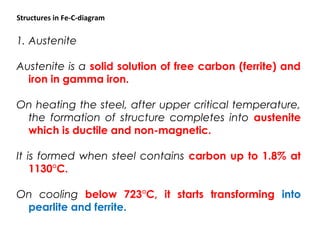
1. Austenite
Austenite is a solid solution of free carbon (ferrite) and
iron in gamma iron.
On heating the steel, after upper critical temperature,
the formation of structure completes into austenite
which is ductile and non-magnetic.
It is formed when steel contains carbon up to 1.8% at
1130°C.
On cooling below 723°C, it starts transforming into
pearlite and ferrite.
Structures in Fe-C-diagram
Ferrite
Ferrite contains very little or no carbon in iron.
It is the name given to pure iron crystals which are soft and ductile.
The slow cooling of low carbon steel below the critical temperature
produces ferrite structure.
Ferrite does not harden when cooled rapidly.
Cementite
Cementite is a chemical compound of carbon with iron and is known
as iron carbide (Fe3C).
Cast iron having 6.67% carbon is possessing complete structure of
cementite.
It is extremely hard.
It is magnetic below 200°C.
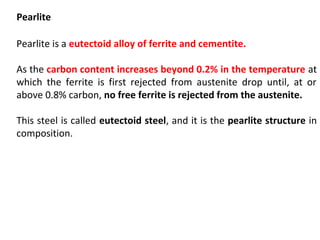
Pearlite
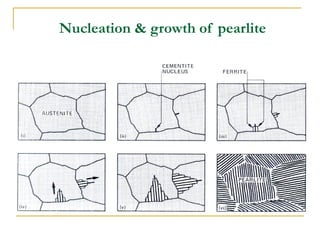
Pearlite is a eutectoid alloy of ferrite and cementite.
As the carbon content increases beyond 0.2% in the temperature at
which the ferrite is first rejected from austenite drop until, at or
above 0.8% carbon, no free ferrite is rejected from the austenite.
This steel is called eutectoid steel, and it is the pearlite structure in
composition.
01/03/19 PROF.MAYUR S MODI 88
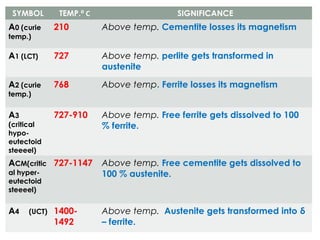
SYMBOL TEMP.⁰ C SIGNIFICANCE
A0 (curie
temp.)
210 Above temp. Cementite losses its magnetism
A1 (LCT) 727 Above temp. perlite gets transformed in
austenite
A2 (curie
temp.)
768 Above temp. Ferrite losses its magnetism
A3
(critical
hypo-
eutectoid
steeeel)
727-910 Above temp. Free ferrite gets dissolved to 100
% ferrite.
ACM(critic
al hyper-
eutectoid
steeeel)
727-1147 Above temp. Free cementite gets dissolved to
100 % austenite.
A4 (UCT) 1400-
1492
Above temp. Austenite gets transformed into δ
– ferrite.
01/03/19 PROF.MAYUR S MODI 89
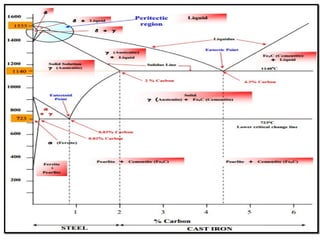
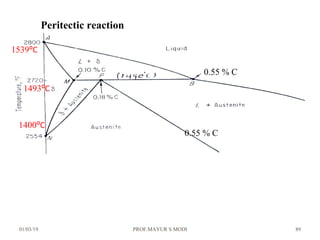
Peritectic reaction
0.55 % C
0.55 % C
1400⁰C
1493⁰C
1539⁰C
01/03/19 PROF.MAYUR S MODI 90
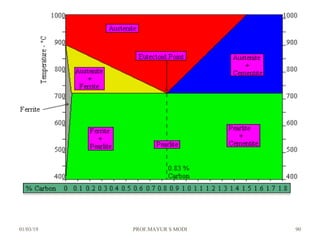
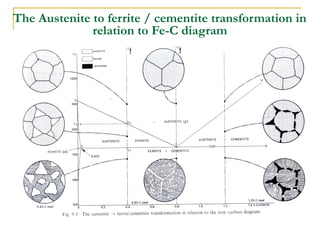
The Austenite to ferrite / cementite transformation in
relation to Fe-C diagram
Nucleation & growth of pearlite
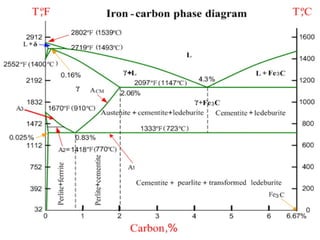
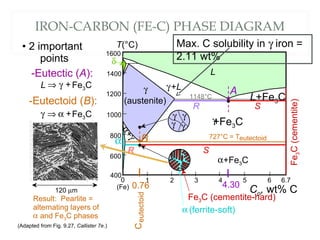
IRON-CARBON (FE-C) PHASE DIAGRAM
• 2 important
points
-Eutectoid (B):
γ ⇒ α +Fe3C
-Eutectic (A):
L ⇒ γ +Fe3C
Fe3C(cementite)
1600
1400
1200
1000
800
600
400
0 1 2 3 4 5 6 6.7
L
γ
(austenite)
γ+L
γ+Fe3C
α+Fe3C
α+γ
L+Fe3C
δ
(Fe)
Co, wt% C
1148°C
T(°C)
α 727°C = Teutectoid
A
SR
4.30
Result: Pearlite =
alternating layers of
α and Fe3C phases
120 µm
(Adapted from Fig. 9.27, Callister 7e.)
γ γ
γγ
R S
0.76
CeutectoidB
Fe3C (cementite-hard)
α (ferrite-soft)
Max. C solubility in γ iron =
2.11 wt%
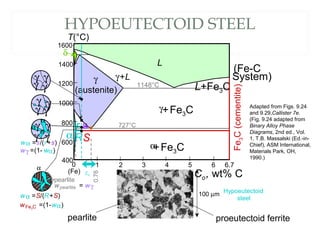
HYPOEUTECTOID STEEL
Adapted from Figs. 9.24
and 9.29,Callister 7e.
(Fig. 9.24 adapted from
Binary Alloy Phase
Diagrams, 2nd ed., Vol.
1, T.B. Massalski (Ed.-in-
Chief), ASM International,
Materials Park, OH,
1990.)
Fe3C(cementite)
1600
1400
1200
1000
800
600
400
0 1 2 3 4 5 6 6.7
L
γ
(austenite)
γ+L
γ+Fe3C
α+Fe3C
L+Fe3C
δ
(Fe)
Co, wt% C
1148°C
T(°C)
α
727°C
(Fe-C
System)
C0
0.76
proeutectoid ferritepearlite
100 µm
Hypoeutectoid
steel
RS
α
wα =S/(R+S)
wFe3C =(1-wα)
wpearlite = wγ
pearlite
r s
wα =s/(r+s)
wγ =(1- wα)
γ
γ γ
γ
α
α
α
γγ
γ γ
γ γ
γγ
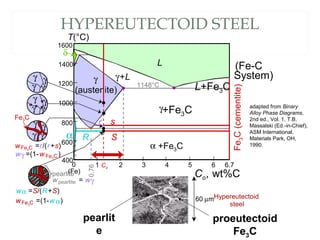
HYPEREUTECTOID STEEL
Fe3C(cementite)
1600
1400
1200
1000
800
600
400
0 1 2 3 4 5 6 6.7
L
γ
(austenite)
γ+L
γ+Fe3C
α +Fe3C
L+Fe3C
δ
(Fe)
Co, wt%C
1148°C
T(°C)
α
adapted from Binary
Alloy Phase Diagrams,
2nd ed., Vol. 1, T.B.
Massalski (Ed.-in-Chief),
ASM International,
Materials Park, OH,
1990.
(Fe-C
System)
0.76
Co
proeutectoid
Fe3C
60 µmHypereutectoid
steel
pearlit
e
R S
wα =S/(R+S)
wFe3C =(1-wα)
wpearlite = wγ
pearlite
sr
wFe3C =r/(r+s)
wγ =(1-w Fe3C )
Fe3C
γγ
γ γ
γγ
γ γ
γγ
γ γ
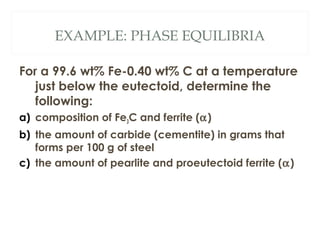
EXAMPLE: PHASE EQUILIBRIA
For a 99.6 wt% Fe-0.40 wt% C at a temperature
just below the eutectoid, determine the
following:
a) composition of Fe3C and ferrite (α)
b) the amount of carbide (cementite) in grams that
forms per 100 g of steel
c) the amount of pearlite and proeutectoid ferrite (α)
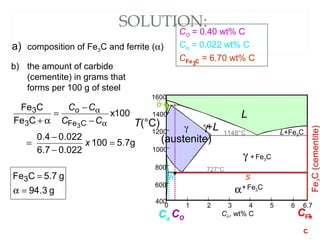
SOLUTION:
g3.94
g5.7CFe
g7.5100
022.07.6
022.04.0
100x
CFe
CFe
3
CFe3
3
3
=α
=
=
−
−
=
−
−
=
α+ α
α
x
CC
CCo
b) the amount of carbide
(cementite) in grams that
forms per 100 g of steel
a) composition of Fe3C and ferrite (α)
CO = 0.40 wt% C
Cα = 0.022 wt% C
CFe C = 6.70 wt% C
3
FeC(cementite)
1600
1400
1200
1000
800
600
400
0 1 2 3 4 5 6 6.7
L
γ
(austenite)
γ+L
γ + Fe3C
α+ Fe3C
L+Fe3C
δ
Co, wt% C
1148°C
T(°C)
727°C
CO
R S
CFe
C
3Cα
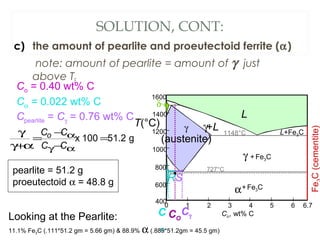
SOLUTION, CONT:
c) the amount of pearlite and proeutectoid ferrite (α)
note: amount of pearlite = amount of γ just
above TE
Co = 0.40 wt% C
Cα = 0.022 wt% C
Cpearlite = Cγ = 0.76 wt% C
γ
γ+α
=
Co −Cα
Cγ−Cα
x 100 =51.2 g
pearlite = 51.2 g
proeutectoid α = 48.8 g
FeC(cementite)
1600
1400
1200
1000
800
600
400
0 1 2 3 4 5 6 6.7
L
γ
(austenite)
γ+L
γ + Fe3C
α+ Fe3C
L+Fe3C
δ
Co, wt% C
1148°C
T(°C)
727°C
CO
RS
CγC
α
Looking at the Pearlite:
11.1% Fe3C (.111*51.2 gm = 5.66 gm) & 88.9% α (.889*51.2gm = 45.5 gm)
01/03/19 PROF.MAYUR S MODI 99
01/03/19 PROF.MAYUR S MODI 100

Chapter 3 phase diagram

  • 1.
    PROF. MAYUR SMODI ASSISTANT PROFESSOR MECHANICAL ENGINEERING DEPARTMENT SHREE SWAMI ATMANAND SARASWATI INSTITUTE OF TECHNOLOGY,SURAT PHASE ANDPHASE AND PHASE DIAGRAMPHASE DIAGRAM Material Science and Metallurgy (2131904)
  • 2.
    INTRODUCTION • One ofthe important objectives of engineering metallurgy is to determine the properties of material. • The properties of material is a function of the microstructure which is further dependent on the overall composition and variables such as temp., pressure and composition. • Equilibrium diagram or phase diagram is a graphical representation of various phases present in the material system at various temp. and compositions. 01/03/19 PROF.MAYUR S MODI 2
  • 3.
  • 4.
    • A puresubstance, under equilibrium conditions, may exist as either of a phase namely vapor, liquid or solid, depending upon the conditions of temperature and pressure. • A phase can be defined as a homogeneous portion of a system that has uniform physical and chemical characteristics i.e. it is a physically distinct from other phases, chemically homogeneous and mechanically separable portion of a system. • Other words, a phase is a structurally homogeneous portion of matter. 01/03/19 PROF.MAYUR S MODI 4
  • 5.
    01/03/19 PROF.MAYUR SMODI 5 It is a region that differs in it’s microstructure and composition from another region. For the same composition, different crystal structures represent different phases. A solid solution has atoms mixed at atomic level thus it represents a single phase. A single-phase system is termed as homogeneous, and systems composed of two or more phases are termed as mixtures or heterogeneous. Most of the alloy systems and composites are heterogeneous
  • 6.
    • System Thermodynamically, asystem is an isolated body of matter. It refers to a specific portion of a object within specified boundaries subjected to specified variables. OR This refers to any portion of objective space within specified boundaries subject to specified variables. An alloy system is a combination of two or more elements forming alloys which are considered within a specified range of temp. , pressure and concentration. 01/03/19 PROF.MAYUR S MODI 6
  • 7.
    • Phase :It is a physically and chemically homogeneous composition of a system, separated from other portions by surface and an interface. • But each portion have different composition and properties. • In an equilibrium diagram, liquid is one phase and solid solution is another phase. 01/03/19 PROF.MAYUR S MODI 7
  • 8.
    • Variable : •A particular phase exists under various conditions of temp., pressure and concentrations. • These parameter are known as the variables of the phase. 01/03/19 PROF.MAYUR S MODI 8
  • 9.
    • Component –These are the substances, either chemical elements or chemical compounds whose presence is necessary and sufficient to make a system. • Pure metal is a one-component system whereas an alloy of two metal is a two-component system. • H2o 1 component = Ice, Water and Steam( 3 phase) • Cu-Ni = 2 component 01/03/19 PROF.MAYUR S MODI 9
  • 10.
    • Alloy : •It is a mixture of two or more elements having metallic properties. • In the mixture, metal is in the large proportion and the others can be metals or non-metals. • The element in the largest amount is called as base metal(Parent metal) or solvent and the other elements are called as alloying elements or solute. 01/03/19 PROF.MAYUR S MODI 10
  • 11.
    • Phase equilibrium– • it refers to the set of conditions where more than one phase may exist. • It can be reflected by constancy with time in the phase characteristics of a system. • In most metallurgical and materials systems, phase equilibrium involves just solid phases. 01/03/19 PROF.MAYUR S MODI 11
  • 12.
  • 13.
    PHASE DIAGRAM OFWATER 01/03/19 PROF.MAYUR S MODI 13
  • 14.
    (A) SCHEMATIC REPRESENTATIONOF THE ONE-COMPONENT PHASE DIAGRAM FOR H2O. (B) A PROJECTION OF THE PHASE DIAGRAM INFORMATION AT 1 ATM GENERATES A TEMPERATURE SCALE LABELED WITH THE FAMILIAR TRANSFORMATION TEMPERATURES FOR H2O (MELTING AT 0°C AND BOILING AT 100°C).
  • 15.
    (A) SCHEMATIC REPRESENTATIONOF THE ONE-COMPONENT PHASE DIAGRAM FOR PURE IRON. (B) A PROJECTION OF THE PHASE DIAGRAM INFORMATION AT 1 ATM GENERATES A TEMPERATURE SCALE LABELED WITH IMPORTANT TRANSFORMATION TEMPERATURES FOR IRON. THIS PROJECTION WILL BECOME ONE END OF IMPORTANT BINARY DIAGRAMS, SUCH AS THAT SHOWN IN FIGURE
  • 16.
    HUME-ROTHERY’S RULES FORSOLID SOLUTION • Solid solution is an alloy of two or more elements wherein the atomic crystal structure of the alloying element (solute) is same as that of the base metal matrix(solvent). • The solubility limit of the solute in the solvent is govern by certain factors. • These governing factors are known as Heme- Rothery’s rules for solid solubility. 01/03/19 PROF.MAYUR S MODI 16
  • 17.
    01/03/19 PROF.MAYUR SMODI 17 1.Atomic size or Relative Size Factor 2.Chemical-affinity Factor 3.Relative Valence (Valency) Factor 4.Crystal Structure Factor
  • 18.
    GIBB’S PHASE RULE •Dr.Gibbs studied the relationship between the number of phases and the effect of variables such as pressure, temperature and composition. P + F = C + 2 P = Number of phase in system F = Number of variables that can be changed independently without affecting the number of phase.= DOF C = Number of element. 2 = It represents any two variable amongst three 01/03/19 PROF.MAYUR S MODI 18
  • 19.
    In general, allequilibrium diagrams are studied at constant pressure, hence rule is modified to. P + F = C + 1 •The phase rule helps determine maximum number of phase present in an alloy system under equilibrium conditions at any point in phase diagram. 01/03/19 PROF.MAYUR S MODI 19
  • 20.
    COOLING CURVE FORPURE METAL • used to determine phase transition temperature record T of material vs time, as it cools from its molten state through solidification and finally to RT (at a constant pressure!!!) 01/03/19 PROF.MAYUR S MODI 20 Latent heat B1
  • 21.
    GIBBS FREE ENERGYTHEORY 01/03/19 PROF.MAYUR S MODI 21
  • 22.
    NUCLEATION • Nucleation isthe beginning of a phase transformation. • It is marked by the appearance in the molten metal of tiny regions called nuclei of new phase which grow to solid crystals until the transformation is complete. 1.Homogeneous or self Nucleation. 2.Heterogeneous Nucleation. 01/03/19 PROF.MAYUR S MODI 22
  • 23.
    01/03/19 PROF.MAYUR SMODI 23 Homogeneous or self Nucleation. Heterogeneous Nucleation. Interiors of a uniform substance Start at the nucleation sites on the surface contacting liquid or vapor. Slower process Faster process It occurs with much more difficulties. Occurs easily. Nuclei are formed from atoms of solidifying metals. At impurity atoms or container surface acts as a nucleating agent. Lower temperature. Higher temperature. It requires supercoiling to form first nuclei. It requires little or no supercoiling.
  • 24.
    COOLING CURVE FORPURE METAL 01/03/19 PROF.MAYUR S MODI 24 Region AB, P + F = C + 1 1 + F = 1 + 1 F=1(T without changing liquid phase) Region BC, P + F = C + 1 2 + F = 1 + 1 F=0 (No variable) Region CD, P + F = C + 1 1 + F = 1 + 1 F=1(T without changing a solid phase)
  • 25.
    COOLING CURVE FORBINARY SOLID SOLUTION 01/03/19 PROF.MAYUR S MODI 25 Region AB, P + F = C + 1 1 + F = 2 + 1 F=2(T and C without changing liquid phase) Region BC, P + F = C + 1 2 + F = 2 + 1 F=1 (T without changing liquid-solid phase) Region CD, P + F = C + 1 1 + F = 2 + 1 F = 2 (T and C without changing solid phase)
  • 26.
    COOLING CURVE FORBINARY EUTECTIC ALLOY 01/03/19 PROF.MAYUR S MODI 26
  • 27.
    COOLING CURVE FOROFF-EUTECTIC BINARY ALLOY 01/03/19 PROF.MAYUR S MODI 27
  • 28.
    PLOTTING OF EQUILIBRIUMOR PHASE DIAGRAM Sample 1 2 3 4 5 6 7 8 9 10 11 % Cu 100 90 80 70 60 50 40 30 20 10 0 % Ni 0 10 20 30 40 50 60 70 80 90 100 01/03/19 PROF.MAYUR S MODI 28
  • 29.
  • 30.
  • 31.
    LEVER RULE • Itis the method used to find out the exact amount of a particular phase existing in a binary system for a given alloy at any temperature under consideration. • Let us consider an alloy A and B. • Z be the composition of alloy under consideration and T be the temperature at which phase content is to be found. 01/03/19 PROF.MAYUR S MODI 31
  • 32.
  • 33.
    • According tolever rule, • % of liquid =Intercept distance between Z% B alloy under consideration and the solidus line/Distance between solidus and liquidus line So, % of liquid = L(FD) X 100 L(CD) Similarly, • % of Solid = Intercept distance between Z% B alloy under consideration and the solidus line/Distance between solidus and liquidus line So, % of liquid = L(CD) X 100 L(CD) 01/03/19 PROF.MAYUR S MODI 33
  • 34.
    01/03/19 PROF.MAYUR SMODI 34 NOW, Amount of solid = L(CF) / L (CD) = L(CF) Amount of liquid L (FD)/ L (CD) L(FD) Therefor, amount of solid x L(FD) = amount of liquid x L(CF) It means, the line CD acts as a liver arm and the point F acts as a fulcrum point as shown in fig, hence it is called as lever rule OR lever arm principle.
  • 35.
    01/03/19 PROF.MAYUR SMODI 35 SR NO TYPE OF EQUILIBRIUM SYSTEM SOLUBILITY REACTION EXAMPLE 1 Isomorphous system Two metals completely soluble in solid and liquid state. Cu-Ni, Au-Ag, Au-Cu, Au-Ni, Bi-Sb etc. 2 Eutectic system Two metals completely soluble in liquid and insoluble in solid state. L S1 + S2 Pb-As, Bi-Cd, Au-Si etc. 3 Partial eutectic system Two metals completely soluble in liquid and partially soluble in solid state. Ag-Cu, Pb-Sn, Pb-Sb etc. Constant temp.
  • 36.
    01/03/19 PROF.MAYUR SMODI 36 SR NO TYPE OF EQUILIBRIUM SYSTEM REACTION EXAMPLE 4 Eutectoid transformation S1 S2+S3 Fe-C,Cu-Sn 5 Peritectic transformation L1+ S1 S2 Fe-C, Cu-Zn 6 Monotectic transformation L1 L2 + S1 Cu-Pb, Zn-Pb 7 Peritectoid transformation S1 + S2 S3 Ni-Zn, Cu-Sn 8 Layer type system. Two metals completely insoluble in liquid and solid state. Cu-Mo,Ag-Fe
  • 37.
    37 Metals – Phasediagram The following things are known from (1) Pure copper melts at 1084 C (2) Pure nickel melts at 1455 C (3) The system is a solid solution throughout (4) Below solidus line – solid (5) Above liquidus line – liquid (6) Between, two phases: solid and liquid
  • 38.
    Metals – Phasediagram copper-nickel alloy system 01/03/19 Prof. MAYUR S. MODI
  • 39.
    PHASE DIAGRAMS • Indicatephases as function of T, Compos, and Press. • For this course: -binary systems: just 2 components. -independent variables: T and Co (P = 1 atm is almost always used). • Phase Diagram for Cu-Ni system • 2 phases: L (liquid) α (FCC solid solution) • 3 phase fields: L L + α α wt% Ni20 40 60 80 1000 1000 1100 1200 1300 1400 1500 1600 T(°C) L (liquid) α (FCC solid solution) L + αliquidus solidus 01/03/19 Prof. MAYUR S. MODI
  • 40.
    wt% Ni20 4060 80 1000 1000 1100 1200 1300 1400 1500 1600 T(°C) L (liquid) α (FCC solid solution) L + α liquidus solidus Cu-Ni phase diagram PHASE DIAGRAMS: # AND TYPES OF PHASES • Rule 1: If we know T and Co, then we know: --the number and types of phases present. • Examples: A(1100°C, 60): 1 phase: α B(1250°C, 35): 2 phases: L + α B(1250°C,35) A(1100°C,60) 01/03/19 Prof. MAYUR S. MODI
  • 41.
    wt% Ni 20 1200 1300 T(°C) L (liquid) α (solid)L+α liquidus solidus 30 40 50 L +α Cu-Ni system PHASE DIAGRAMS: COMPOSITION OF PHASES • Rule 2: If we know T and Co, then we know: --the composition of each phase. • Examples: TA A 35 Co 32 CL At TA = 1320°C: Only Liquid (L) CL = Co ( = 35 wt% Ni) At TB = 1250°C: Both α and L CL = Cliquidus ( = 32 wt% Ni here) Cα = Csolidus ( = 43 wt% Ni here) At TD = 1190°C: Only Solid ( α) Cα = Co ( = 35 wt% Ni) Co = 35 wt% Ni B TB D TD tie line 4 Cα 3 01/03/19 Prof. MAYUR S. MODI
  • 42.
    • Rule 3:If we know T and Co, then we know: --the amount of each phase (given in wt%). • Examples: At TA: Only Liquid (L) WL = 100 wt%, Wα = 0 At TD: Only Solid ( α) WL = 0, Wα = 100 wt% Co = 35 wt% Ni PHASE DIAGRAMS: WEIGHT FRACTIONS OF PHASES wt% Ni 20 1200 1300 T(°C) L (liquid) α (solid)L +α liquidus solidus 30 40 50 L +α Cu-Ni system TA A 35 Co 32 CL B TB D TD tie line 4 Cα 3 R S At TB: Both α and L %73 3243 3543 wt= − − = = 27 wt% WL = S R +S Wα = R R +S 01/03/19 Prof. MAYUR S. MODI
  • 43.
    • Tie line– connects the phases in equilibrium with each other - essentially an isotherm THE LEVER RULE How much of each phase? Think of it as a lever (teeter-totter) ML Mα R S RMSM L ⋅=⋅α wt% Ni 20 1200 1300 T(°C) L (liquid) α (solid)L +α liquidus solidus 30 40 50 L +α B TB tie line CoCL Cα SR =Must balance 01/03/19 Prof. MAYUR S. MODI
  • 44.
    wt% Ni 20 1200 1300 30 4050 1100 L (liquid) α (solid) L + α L + α T(°C) A 35 Co L: 35wt%Ni Cu-Ni system • Phase diagram: Cu-Ni system. • System is: --binary i.e., 2 components: Cu and Ni. --isomorphous i.e., complete solubility of one component in another; α phase field extends from 0 to 100 wt% Ni. • Consider Co = 35 wt%Ni. EX: COOLING IN A CU-NI BINARY 4635 43 32 α: 43 wt% Ni L: 32 wt% Ni L: 24 wt% Ni α: 36 wt% Ni Bα: 46 wt% Ni L: 35 wt% Ni C D E 24 36 01/03/19 Prof. MAYUR S. MODI
  • 45.
  • 46.
  • 47.
    01/03/19 PROF.MAYUR SMODI 47 Examples : Pb-As, Bi-Cd, Au-Si
  • 48.
  • 49.
  • 50.
    01/03/19 PROF.MAYUR SMODI 50 At just below point 3 The already separated pro-eutectic A remains unchanged. % Amount pro-eutectic A = l(3E)/l(DE) ……….at point 3. % Amount eutectic = l(D3)/l(DE) ……….at point 3. At point 4 Total amount of metal A at point 4 =[amount of pro-eutectic A] + [amount of eutectic A] =[amount of pro-eutectic A] + [ A in the eutectic x amount of eutectic] =[l(3E)/l(DE)] + [l(EF)/l(DF) x l(D3)/l(DE)]
  • 51.
  • 52.
    01/03/19 PROF.MAYUR SMODI 52 At just below point 3 The already separated pro-eutectic A remains unchanged. % Amount pro-eutectic B = l(E3)/l(EF) ……….at point 3. % Amount eutectic = l(3F)/l(EF) ……….at point 3. At point 4 Total amount of metal A at point 4 =[amount of pro-eutectic B] + [amount of eutectic B] =[amount of pro-eutectic B] + [ B in the eutectic x amount of eutectic] =[l(E3)/l(EF)] + [l(DE)/l(DF) x l(3F)/l(EF)]
  • 53.
  • 54.
    PARTIALY EUTECTIC SYSTEMAT 6% OF CU 01/03/19 PROF.MAYUR S MODI 54 Examples : Ag-Cu, Pb-Sn, Sn-Bi, PB-Sb, Cd-Zn, Al-Si
  • 55.
    01/03/19 PROF.MAYUR SMODI 55 1 2 3 4
  • 56.
    01/03/19 PROF.MAYUR SMODI 56 At point 5. % Amount of α = l(5K)/l(HK) = (98-6/98-2) = 95.8 %....................at room temp. % Amount of = l(H5)/l(HK) = (6-2/98-2) = 4.2%...........................at room temp.
  • 57.
    PARTIALY HYPOEUTECTIC SYSTEMAT 20% OF CU 01/03/19 PROF.MAYUR S MODI 57
  • 58.
    01/03/19 PROF.MAYUR SMODI 58 1 2 3 % Amount pro-eutectic = l(3E)/l(DE) = (28.1-20)/(28.1-8.8) = 42% ….at point 3. % Amount eutectic = l(D3)/l(DE) = (20-8.8)/(28.1-8.8) = 58 % …...at point 3.
  • 59.
    PARTIALY HYPEREUTECTIC SYSTEMAT 70% OF CU 01/03/19 PROF.MAYUR S MODI 59
  • 60.
    01/03/19 PROF.MAYUR SMODI 60 1 2 3 % Amount pro-eutectic β = l(E3)/l(EF) = (70—28.1)/(92.1-28.1) = 65.5% ….at point 3. % Amount eutectic = l(3F)/l(EF) = (92.1-70)/(92.1-28.1) = 34.5 % …...at point 3.
  • 61.
  • 62.
    : Min. meltingTE 2 components has a ‘special’ composition with a min. melting Temp. BINARY-EUTECTIC (POLYMORPHIC) SYSTEMS • Eutectic transition L(CE) α(CαE) + β(CβE) • 3 single phase regions (L, α, β) • Limited solubility: α: mostly Cu β: mostly Ag • TE : No liquid below TE • CE composition Ex.: Cu-Ag system Cu-Ag system L (liquid) α L + α L+ββ α + β Co , wt% Ag 20 40 60 80 1000 200 1200 T(°C) 400 600 800 1000 CE TE 8.0 71.991.2 779°C
  • 63.
    L+α L+β α + β 200 T(°C) 18.3 C,wt% Sn 20 60 80 1000 300 100 L (liquid) α 183°C 61.9 97.8 β • For a 40 wt% Sn-60 wt% Pb alloy at 150°C, find... --the phases present: Pb-Sn system EX: PB-SN EUTECTIC SYSTEM (1) α + β --compositions of phases: CO = 40 wt% Sn --the relative amount of each phase (by lever rule): 150 40 C o 11 Cα 99 Cβ SR Cα = 11 wt% Sn Cβ = 99 wt% Sn Wα= Cβ - CO Cβ - Cα = 99 - 40 99 - 11 = 59 88 = 67 wt% S R+S = Wβ = CO - Cα Cβ - Cα = R R+S = 29 88 = 33 wt%= 40 - 11 99 - 11 Adapted from Fig. 9.8, Callister 7e.
  • 64.
    L+β α + β 200 T(°C) C,wt% Sn 20 60 80 1000 300 100 L (liquid) α β L+α 183°C • For a 40 wt% Sn-60 wt% Pb alloy at 220°C, find... --the phases present: Pb-Sn system EX: PB-SN EUTECTIC SYSTEM (2) α + L --compositions of phases: CO = 40 wt% Sn --the relative amount of each phase: Wα = CL - CO CL - Cα = 46 - 40 46 - 17 = 6 29 = 21 wt% WL = CO - Cα CL - Cα = 23 29 = 79 wt% 40 C o 46 CL 17 Cα 220 SR Cα = 17 wt% Sn CL = 46 wt% Sn
  • 65.
    • Co <2 wt% Sn • Result: --at extreme ends --polycrystal of α grains i.e., only one solid phase. MICROSTRUCTURES IN EUTECTIC SYSTEMS: I 0 L+ α 200 T(°C) Co, wt% Sn 10 2% 20 Co 300 100 L α 30 α+β 400 (room Temp. solubility limit) TE (Pb-Sn System) α L L: Co wt% Sn α: Co wt% Sn
  • 66.
    • 2 wt%Sn < Co < 18.3 wt% Sn • Result:  Initially liquid  Then liquid + α  then α alone  finally two solid phases  α polycrystal  fine β-phase inclusions MICROSTRUCTURES IN EUTECTIC SYSTEMS: II Pb-Sn system L + α 200 T(°C) Co , wt% Sn 10 18.3 200 Co 300 100 L α 30 α+ β 400 (sol. limit at TE) TE 2 (sol. limit at Troom) L α L: Co wt% Sn α β α: Co wt% Sn
  • 67.
    • Co =CE • Result: Eutectic microstructure (lamellar structure) --alternating layers (lamellae) of α and β crystals. MICROSTRUCTURES IN EUTECTIC SYSTEMS: III 160µm Micrograph of Pb-Sn eutectic microstructure Pb- Sn syste m L+β α + β 200 T(°C) C, wt% Sn 20 60 80 1000 300 100 L α β L+α 183°C 40 TE 18.3 α: 18.3 wt%Sn 97.8 β: 97.8 wt% Sn CE 61.9 L: Co wt% Sn 45.1% α and 54.8% β -- by Lever Rule
  • 68.
  • 69.
    • 18.3 wt%Sn < Co < 61.9 wt% Sn • Result: α crystals and a eutectic microstructure MICROSTRUCTURES IN EUTECTIC SYSTEMS: IV 18.3 61.9 SR 97.8 SR primary α eutectic α eutectic β WL = (1-Wα) = 50 wt% Cα = 18.3 wt% Sn CL = 61.9 wt% Sn S R + S Wα= = 50 wt% • Just above TE : • Just below TE : Cα = 18.3 wt% Sn Cβ = 97.8 wt% Sn S R + S Wα= = 72.6 wt% Wβ = 27.4 wt% Pb-Sn system L+β200 T(°C) Co, wt% Sn 20 60 80 1000 300 100 L α β L+α 40 α+β TE L: Co wt% Sn Lα L α
  • 70.
    L+α L+β α+β 200 Co, wt% Sn2060 80 1000 300 100 L α βTE 40 (Pb-Sn System) HYPOEUTECTIC & HYPEREUTECTIC COMPOSITIONS 160 µm eutectic micro-constituent hypereutectic: (illustration only) β β β β β β from Metals Handbook, 9th ed., Vol. 9, Metallography and Microstructures, American Society for Metals, Materials Park, OH, 1985. 175 µm α α α α α α hypoeutectic: Co = 50 wt% Sn T(°C) 61.9 eutectic eutectic: Co =61.9wt% Sn
  • 71.
     Eutectoid: solidphase in equilibrium with two solid phases S2 S1+S3 γ α + Fe3C (727ºC) intermetallic compound - cementite cool heat  Peritectic: liquid + solid 1 in equilibrium with a single solid 2 (Fig 9.21) S1 + L S2 δ + L γ (1493ºC) cool heat • Eutectic: a liquid in equilibrium with two solids L α + β EUTECTOID & PERITECTIC – SOME DEFINITIONS cool heat
  • 72.
    PERITECTIC TRANSFORMER FE-C,PT-AG,CU-ZN,SB-SN • LIQUID+ SOLID 1 01/03/19 PROF.MAYUR S MODI 72 SOLID2(1492⁰C)
  • 73.
    EUTECTOID REACTION FE-C,CU-SN,CU-AL,ZN-AL 01/03/19 PROF.MAYURS MODI 73 SOLID1 + SOLID2 SOLID3 (727⁰C)
  • 74.
  • 75.
    INTRODUCTION TO IRON CARBONDIAGRAM 01/03/19 PROF.MAYUR S MODI 75
  • 76.
    ALLOTROPY OF IRON Inactual practice it is very difficult to trace the cooling of iron from 1600°C to ambient temperature because particular cooling rate is not known. Particular curve can be traced from temperature, time and transformation (TTT) curve. However allotropic changes observed during cooling of pure iron are depicted in Fig.
  • 77.
    Molten-Fe (Liquid stateof iron) Delta-Fe (Body centered) austenite structure
  • 78.
    TRANSFORMATION DURING HEATINGAND COOLING OF STEEL
  • 79.
    Principal phases ofsteel and their Characteristics Phase Crystal structure Characteristics Ferrite BCC Soft, ductile, magnetic Austenite FCC Soft, moderate strength, non- magnetic Cementite Compound of Iron & Carbon Fe3C Hard &brittle
  • 80.
  • 81.
  • 82.
  • 83.
  • 84.
    1. Austenite Austenite isa solid solution of free carbon (ferrite) and iron in gamma iron. On heating the steel, after upper critical temperature, the formation of structure completes into austenite which is ductile and non-magnetic. It is formed when steel contains carbon up to 1.8% at 1130°C. On cooling below 723°C, it starts transforming into pearlite and ferrite. Structures in Fe-C-diagram
  • 85.
    Ferrite Ferrite contains verylittle or no carbon in iron. It is the name given to pure iron crystals which are soft and ductile. The slow cooling of low carbon steel below the critical temperature produces ferrite structure. Ferrite does not harden when cooled rapidly.
  • 86.
    Cementite Cementite is achemical compound of carbon with iron and is known as iron carbide (Fe3C). Cast iron having 6.67% carbon is possessing complete structure of cementite. It is extremely hard. It is magnetic below 200°C.
  • 87.
    Pearlite Pearlite is aeutectoid alloy of ferrite and cementite. As the carbon content increases beyond 0.2% in the temperature at which the ferrite is first rejected from austenite drop until, at or above 0.8% carbon, no free ferrite is rejected from the austenite. This steel is called eutectoid steel, and it is the pearlite structure in composition.
  • 88.
    01/03/19 PROF.MAYUR SMODI 88 SYMBOL TEMP.⁰ C SIGNIFICANCE A0 (curie temp.) 210 Above temp. Cementite losses its magnetism A1 (LCT) 727 Above temp. perlite gets transformed in austenite A2 (curie temp.) 768 Above temp. Ferrite losses its magnetism A3 (critical hypo- eutectoid steeeel) 727-910 Above temp. Free ferrite gets dissolved to 100 % ferrite. ACM(critic al hyper- eutectoid steeeel) 727-1147 Above temp. Free cementite gets dissolved to 100 % austenite. A4 (UCT) 1400- 1492 Above temp. Austenite gets transformed into δ – ferrite.
  • 89.
    01/03/19 PROF.MAYUR SMODI 89 Peritectic reaction 0.55 % C 0.55 % C 1400⁰C 1493⁰C 1539⁰C
  • 90.
  • 91.
    The Austenite toferrite / cementite transformation in relation to Fe-C diagram
  • 92.
  • 93.
    IRON-CARBON (FE-C) PHASEDIAGRAM • 2 important points -Eutectoid (B): γ ⇒ α +Fe3C -Eutectic (A): L ⇒ γ +Fe3C Fe3C(cementite) 1600 1400 1200 1000 800 600 400 0 1 2 3 4 5 6 6.7 L γ (austenite) γ+L γ+Fe3C α+Fe3C α+γ L+Fe3C δ (Fe) Co, wt% C 1148°C T(°C) α 727°C = Teutectoid A SR 4.30 Result: Pearlite = alternating layers of α and Fe3C phases 120 µm (Adapted from Fig. 9.27, Callister 7e.) γ γ γγ R S 0.76 CeutectoidB Fe3C (cementite-hard) α (ferrite-soft) Max. C solubility in γ iron = 2.11 wt%
  • 94.
    HYPOEUTECTOID STEEL Adapted fromFigs. 9.24 and 9.29,Callister 7e. (Fig. 9.24 adapted from Binary Alloy Phase Diagrams, 2nd ed., Vol. 1, T.B. Massalski (Ed.-in- Chief), ASM International, Materials Park, OH, 1990.) Fe3C(cementite) 1600 1400 1200 1000 800 600 400 0 1 2 3 4 5 6 6.7 L γ (austenite) γ+L γ+Fe3C α+Fe3C L+Fe3C δ (Fe) Co, wt% C 1148°C T(°C) α 727°C (Fe-C System) C0 0.76 proeutectoid ferritepearlite 100 µm Hypoeutectoid steel RS α wα =S/(R+S) wFe3C =(1-wα) wpearlite = wγ pearlite r s wα =s/(r+s) wγ =(1- wα) γ γ γ γ α α α γγ γ γ γ γ γγ
  • 95.
    HYPEREUTECTOID STEEL Fe3C(cementite) 1600 1400 1200 1000 800 600 400 0 12 3 4 5 6 6.7 L γ (austenite) γ+L γ+Fe3C α +Fe3C L+Fe3C δ (Fe) Co, wt%C 1148°C T(°C) α adapted from Binary Alloy Phase Diagrams, 2nd ed., Vol. 1, T.B. Massalski (Ed.-in-Chief), ASM International, Materials Park, OH, 1990. (Fe-C System) 0.76 Co proeutectoid Fe3C 60 µmHypereutectoid steel pearlit e R S wα =S/(R+S) wFe3C =(1-wα) wpearlite = wγ pearlite sr wFe3C =r/(r+s) wγ =(1-w Fe3C ) Fe3C γγ γ γ γγ γ γ γγ γ γ
  • 96.
    EXAMPLE: PHASE EQUILIBRIA Fora 99.6 wt% Fe-0.40 wt% C at a temperature just below the eutectoid, determine the following: a) composition of Fe3C and ferrite (α) b) the amount of carbide (cementite) in grams that forms per 100 g of steel c) the amount of pearlite and proeutectoid ferrite (α)
  • 97.
    SOLUTION: g3.94 g5.7CFe g7.5100 022.07.6 022.04.0 100x CFe CFe 3 CFe3 3 3 =α = = − − = − − = α+ α α x CC CCo b) theamount of carbide (cementite) in grams that forms per 100 g of steel a) composition of Fe3C and ferrite (α) CO = 0.40 wt% C Cα = 0.022 wt% C CFe C = 6.70 wt% C 3 FeC(cementite) 1600 1400 1200 1000 800 600 400 0 1 2 3 4 5 6 6.7 L γ (austenite) γ+L γ + Fe3C α+ Fe3C L+Fe3C δ Co, wt% C 1148°C T(°C) 727°C CO R S CFe C 3Cα
  • 98.
    SOLUTION, CONT: c) theamount of pearlite and proeutectoid ferrite (α) note: amount of pearlite = amount of γ just above TE Co = 0.40 wt% C Cα = 0.022 wt% C Cpearlite = Cγ = 0.76 wt% C γ γ+α = Co −Cα Cγ−Cα x 100 =51.2 g pearlite = 51.2 g proeutectoid α = 48.8 g FeC(cementite) 1600 1400 1200 1000 800 600 400 0 1 2 3 4 5 6 6.7 L γ (austenite) γ+L γ + Fe3C α+ Fe3C L+Fe3C δ Co, wt% C 1148°C T(°C) 727°C CO RS CγC α Looking at the Pearlite: 11.1% Fe3C (.111*51.2 gm = 5.66 gm) & 88.9% α (.889*51.2gm = 45.5 gm)
  • 99.
  • 100.

Editor's Notes

  • #18 Atomic size or Relative Size Factor Chemical-affinity Factor Relative Valence (Valency) Factor Crystal Structure Factor
  • #19 P + F = C + 2
  • #20 P + F = C + 1
  • #21 Latent heat B1
  • #25 Region Cd, P + F = C + 1 2 + F = 1 + 1 F=0
  • #34 According to lever rule, % of liquid =Intercept distance between Z% B alloy under consideration and the solidus line Distance between solidus and liquidus line So, % of liquid = L(FD) X 100 L(CD)
  • #35 NOW, Amount of solid = L(CF) / L (CD) = L(CF) Amount of liquid L (FD)/ L (CD) L(FD) There for amount of solid x L(FD) = amount of liquid x L(CF) It means, the line CD acts as a liver arm and the point F acts as a fulcrum point as shown in fig, hence it is called as lever rule OR lever arm principle.
  • #36 Constant temp.
  • #37 S1 S2 S3 L1 L2
  • #42 Last 2 points -&amp;gt; Melting point of Ni is more than Cu, it means that solidus phase will consist of more percentage of Ni as compared to that in liquidus phase
  • #44 M -&amp;gt; Mass; C0 -&amp;gt; original composition
  • #48 Examples : Pb-As, Bi-Cd, Au-Si
  • #51 At just below pt 3 The already separated pro-eutectic A remains unchanged. % Amount proeutectic A = l(3E)/l(DE) ……….at pt 3. % Amount eutectic = l(D3)/(DE) ……….at pt 3.
  • #55 Ag-Cu, Pb-Sn, Sn-Bi, PB-Sb, Cd-Zn, Al-Si
  • #56 1
  • #57 At point 5. % Amount of α = l(5k)/l(hk) = (98-6/98-2) = 95.8 %............................at room temp. % Amount of = l(H5)/l(HK) = (6-2/98-2) = 42%...........................at room temp.
  • #59 1
  • #61 1
  • #73 SOLID2
  • #74 SOLID3
  • #90 1539⁰C