Poly Ghosh
NILD, KOLKATA
SOCKET
 One of the single most determining factors of whether a person will use a
prosthesis is prosthetic socket design.
 socket designs and careful consideration of residual limb presentation sets
the stage for patient success-
1. maximizing range of motion.
2. providing stability throughout daily activities.
3. comfortably distributing the forces exerted on the residual limb during
movement and suspension.
 Socket design for body powered prosthesis-
1. Harness suspended
2. Self suspended
AMPUTATION LEVELS
1. Transphalangeal amputation
2. Transmetacarpal amputation
3. Transcarpal amputation
4. Wrist disarticulation
5. Transradial amputation
6. Elbow disarticulation
7. Transhumeral amputation
8. Shoulder disarticulation
9. Interscapulothoracic disarticulation
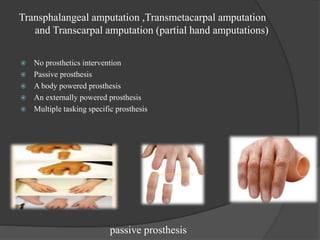
Transphalangeal amputation ,Transmetacarpal amputation
and Transcarpal amputation (partial hand amputations)
 No prosthetics intervention
 Passive prosthesis
 A body powered prosthesis
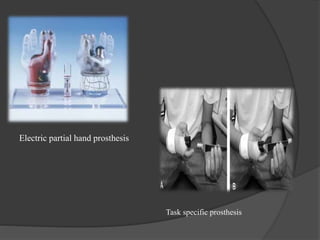
 An externally powered prosthesis
 Multiple tasking specific prosthesis
passive prosthesis
Electric partial hand prosthesis
Task specific prosthesis
Socket design for partial hand amputation
 Socket designs for partial hand prostheses preserve function of wrist joint
and other proximal jt.
 Trimlines and socket contours are generally dictated by the geometry of
the remaining portions of the hand and fingers.
 Goals:-
1. Protection of the residual limb.
2. bimanual stability
3. provide acceptable cosmesis and durability
TRANSRADIAL AND WRIST DISARTICULATION
SOCKET DESIGN
 Socket designs fall into four categories:-
1. Supracondyler brims
2. External suspension sleeves
3. Suprastyloid suspensions
4. Internall roll-on locking liners
SUPRACONDYLER DESIGNS
1. Muenster socket
2. Northwestern supracondyler socket
3. Modified supracondyler brim
4. Floating brim suspension
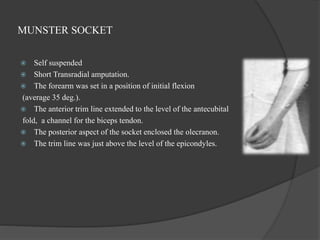
MUNSTER SOCKET
 Self suspended
 Short Transradial amputation.
 The forearm was set in a position of initial flexion
(average 35 deg.).
 The anterior trim line extended to the level of the antecubital
fold, a channel for the biceps tendon.
 The posterior aspect of the socket enclosed the olecranon.
 The trim line was just above the level of the epicondyles.
BIOMECHANICAL FUNCTION
 Range of motion- 35 deg. to 105 deg. Flexion.
 No active pronation and supination.
ADVANTAGES & DISADVANTAGES
 Adv:-
1. Comfort and security.
2. Lifting and holding forces generally superior.
3. "Axial load"—resisting vertical downward force with the elbow extended.
 Disadv:-
1. Active pronation & supination is eliminated.
2. Difficulty in donning and doffing as stump length increases.
3. Decrease in flexion range required modification in case of bi-lateral
socket.
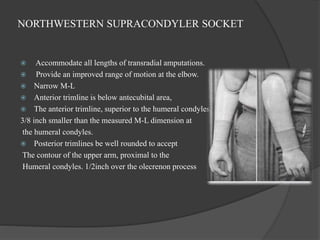
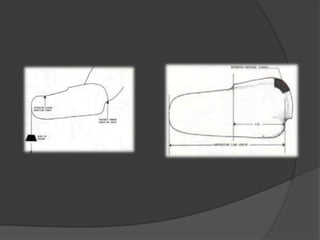
NORTHWESTERN SUPRACONDYLER SOCKET
 Accommodate all lengths of transradial amputations.
 Provide an improved range of motion at the elbow.
 Narrow M-L
 Anterior trimline is below antecubital area,
 The anterior trimline, superior to the humeral condyles, should be at least
3/8 inch smaller than the measured M-L dimension at
the humeral condyles.
 Posterior trimlines be well rounded to accept
The contour of the upper arm, proximal to the
Humeral condyles. 1/2inch over the olecrenon process
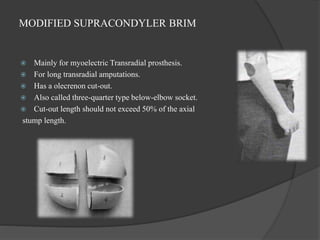
MODIFIED SUPRACONDYLER BRIM
 Mainly for myoelectric Transradial prosthesis.
 For long transradial amputations.
 Has a olecrenon cut-out.
 Also called three-quarter type below-elbow socket.
 Cut-out length should not exceed 50% of the axial
stump length.
 Adv:-
 Ventilation greatly improved,
 The skin of the stump remains dry making for a cooler socket in the
summer and a warmer stump in the winter.
 Skin problems caused by maceration are eliminated
 Comfort and wearing tolerance are greatly improved.
 Suspension improved
 Anatomical elbow is free to move.
 Increased elbow flexion range.
 Reduced bulkness at olecrenon areas.
 Cosmetically pleasing.
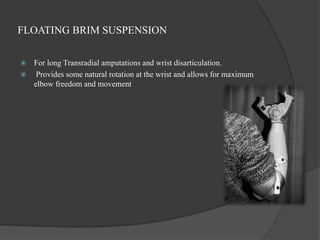
FLOATING BRIM SUSPENSION
 For long Transradial amputations and wrist disarticulation.
 Provides some natural rotation at the wrist and allows for maximum
elbow freedom and movement
EXTERNAL SLEEVE SUSPENSION
1. Latex rubber or silicone sleeves – atmospheric pressure suspension
2. Neoprene sleeves - atmospheric pressure and skin traction
3. Elastic sleeves- skin traction suspension socket
SUPRASTYLOID SUSPENSIONS
 For wrist disarticulaion with prominent styloid process
1. Silicone bladder suspension- Allow volume adjustibility of stump.
2. Window/door suspension
INTERNALL ROLL-ON LOCKING LINERS
1. Shuttle lock system- For short and midlength transradial amputation
2. Lanyard locking system- long transradial amputation and wrist
disarticulation
 Terminate distal to epicondyles
TRAC SOCKET
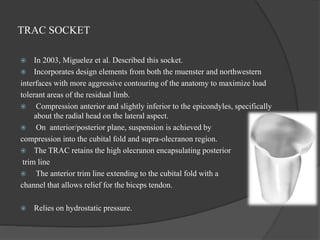
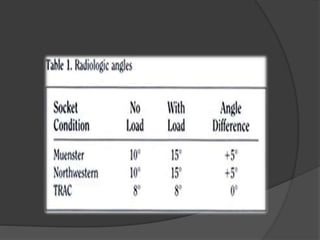
 In 2003, Miguelez et al. Described this socket.
 Incorporates design elements from both the muenster and northwestern
interfaces with more aggressive contouring of the anatomy to maximize load
tolerant areas of the residual limb.
 Compression anterior and slightly inferior to the epicondyles, specifically
about the radial head on the lateral aspect.
 On anterior/posterior plane, suspension is achieved by
compression into the cubital fold and supra-olecranon region.
 The TRAC retains the high olecranon encapsulating posterior
trim line
 The anterior trim line extending to the cubital fold with a
channel that allows relief for the biceps tendon.
 Relies on hydrostatic pressure.
 The TRAC addresses the deficits of previous designs by contouring five
key areas:
 1) the antecubital region,
 2) the olecranon region,
 3) the epicondylar region,
 4) the distal radial region, and
 5) the wrist extensor and flexor musculature
 The position and degree of displacement of the skeletal substructure while
wearing the TRAC interface are less affected during loading
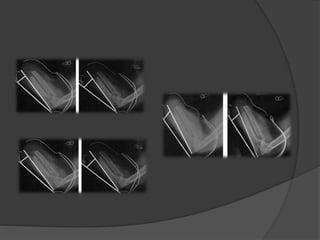
TRIMLINE
 Anterior:- follows the cubital fold.
 Medial and lateral:-should parallel the medial border of the ulna and the
lateral border of the radius.
 Posterior:-approximately 12 to 18 mm proximal to the superior aspect of
the olecranon, with a width similar to the width of the olecranon
CRS SOCKET
 Compression/release stabilized socket
 Longitudinal depressions added in the socket walls with
open release areas between the depressions that receive the
displaced tissue .
 Reduce motion of the underlying bony structures with
respect to both the socket and the rest of the prosthesis.
 The depressions and releases during cast-taking but only
by radically changing the way casts are taken.
 Requires selective pressure during cast-taking.
ELBOW DISARTICULATION & TRANSHUMERAL
SOCKET
 Socket design will vary with the length of the residual limb and
suspension method.
 Different design:- Elbow disarticulation
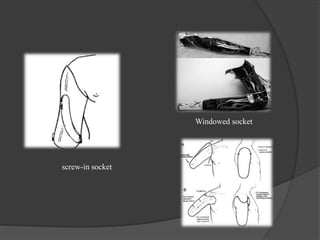
1. Windowed socket
2. Screw-in socket
3. Flexible open frame
4. Fenestrated
Windowed socket
screw-in socket
TRANSHUMERAL DESIGN
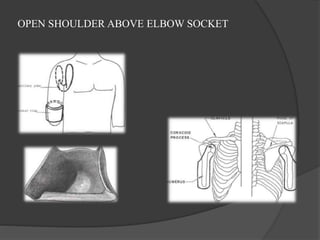
 OPEN SHOULDER ABOVE ELBOW SOCKET
 CLOSED ENCASULATED DESIGN
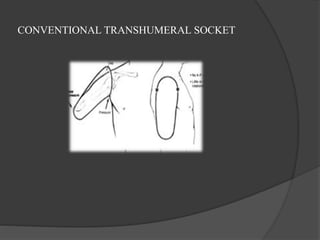
CONVENTIONAL TRANSHUMERAL SOCKET
OPEN SHOULDER ABOVE ELBOW SOCKET
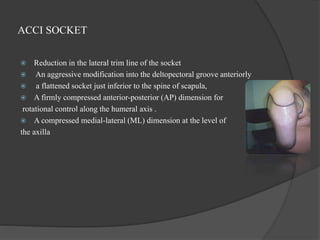
ACCI SOCKET
 Reduction in the lateral trim line of the socket
 An aggressive modification into the deltopectoral groove anteriorly
 a flattened socket just inferior to the spine of scapula,
 A firmly compressed anterior-posterior (AP) dimension for
rotational control along the humeral axis .
 A compressed medial-lateral (ML) dimension at the level of
the axilla
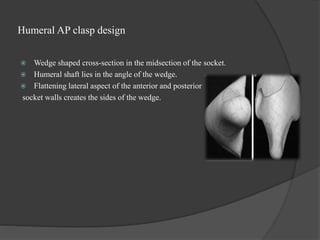
Humeral AP clasp design
 Wedge shaped cross-section in the midsection of the socket.
 Humeral shaft lies in the angle of the wedge.
 Flattening lateral aspect of the anterior and posterior
socket walls creates the sides of the wedge.
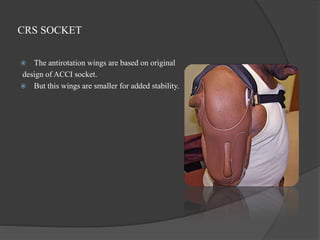
CRS SOCKET
 The antirotation wings are based on original
design of ACCI socket.
 But this wings are smaller for added stability.
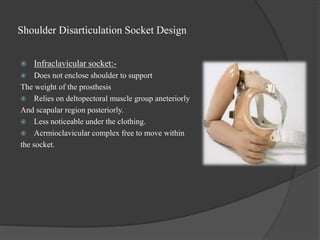
Shoulder Disarticulation Socket Design
 Infraclavicular socket:-
 Does not enclose shoulder to support
The weight of the prosthesis
 Relies on deltopectoral muscle group aneteriorly
And scapular region posteriorly.
 Less noticeable under the clothing.
 Acrmioclavicular complex free to move within
the socket.
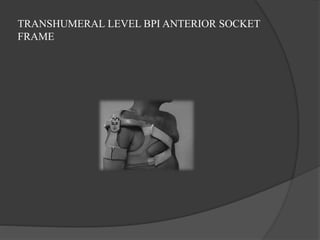
TRANSHUMERAL LEVEL BPI ANTERIOR SOCKET
FRAME
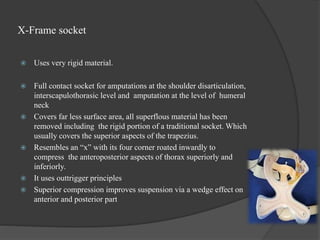
X-Frame socket
 Uses very rigid material.
 Full contact socket for amputations at the shoulder disarticulation,
interscapulothorasic level and amputation at the level of humeral
neck
 Covers far less surface area, all superflous material has been
removed including the rigid portion of a traditional socket. Which
usually covers the superior aspects of the trapezius.
 Resembles an “x” with its four corner roated inwardly to
compress the anteroposterior aspects of thorax superiorly and
inferiorly.
 It uses outtrigger principles
 Superior compression improves suspension via a wedge effect on
anterior and posterior part
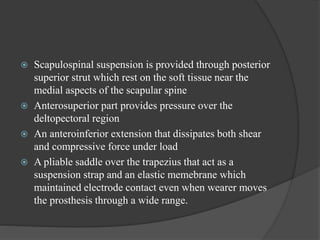
 Scapulospinal suspension is provided through posterior
superior strut which rest on the soft tissue near the
medial aspects of the scapular spine
 Anterosuperior part provides pressure over the
deltopectoral region
 An anteroinferior extension that dissipates both shear
and compressive force under load
 A pliable saddle over the trapezius that act as a
suspension strap and an elastic memebrane which
maintained electrode contact even when wearer moves
the prosthesis through a wide range.
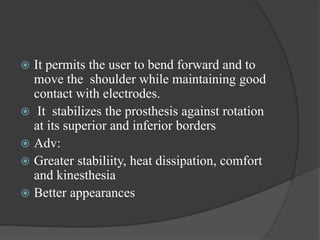
 It permits the user to bend forward and to
move the shoulder while maintaining good
contact with electrodes.
 It stabilizes the prosthesis against rotation
at its superior and inferior borders
 Adv:
 Greater stabiliity, heat dissipation, comfort
and kinesthesia
 Better appearances
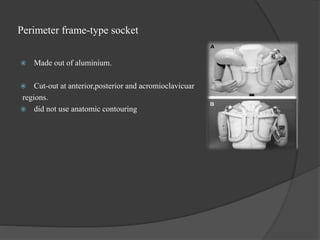
Perimeter frame-type socket
 Made out of aluminium.
 Cut-out at anterior,posterior and acromioclavicuar
regions.
 did not use anatomic contouring
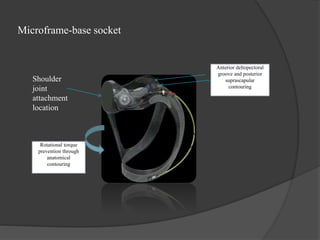
Microframe-base socket
Shoulder
joint
attachment
location
Anterior deltopectoral
groove and posterior
suprascapular
contouring
Rotational torque
prevention through
anatomical
contouring
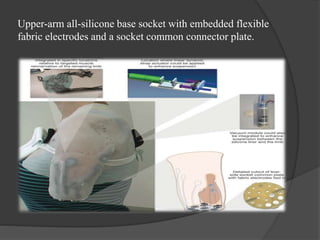
Upper-arm all-silicone base socket with embedded flexible
fabric electrodes and a socket common connector plate.
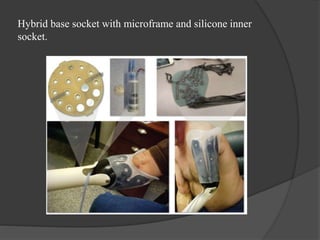
Hybrid base socket with microframe and silicone inner
socket.
Reference
1. The Munster-Type Below-Elbow Socket, an Evaluation, Artificial Limbs,
Vol. 8, No. 2, pp. 4-.14, Autumn 1964.
 The Northwestern University Supracondylar Suspension Technique for
Below-Elbow Amputations,
 Prosthetic sockets stabilized by alternating areas of tissue compression
and release , JRRD Volume 48, Number 6, 2011 Pages -679–696 .
 Atlas of prosthetics, 4th edition
 Advances in Sockets, inMotion Volume 13, Issue 5 September/October
2003
 Shoulder Region Socket Considerations, Troy Farnsworth, CP, FAAOP, et
all. Volume 20 • Number 3 • 2008 93
Socket variants in upper extremity prosthesis.pptx1

Socket variants in upper extremity prosthesis.pptx1

  • 1.
  • 2.
    SOCKET  One ofthe single most determining factors of whether a person will use a prosthesis is prosthetic socket design.  socket designs and careful consideration of residual limb presentation sets the stage for patient success- 1. maximizing range of motion. 2. providing stability throughout daily activities. 3. comfortably distributing the forces exerted on the residual limb during movement and suspension.  Socket design for body powered prosthesis- 1. Harness suspended 2. Self suspended
  • 3.
    AMPUTATION LEVELS 1. Transphalangealamputation 2. Transmetacarpal amputation 3. Transcarpal amputation 4. Wrist disarticulation 5. Transradial amputation 6. Elbow disarticulation 7. Transhumeral amputation 8. Shoulder disarticulation 9. Interscapulothoracic disarticulation
  • 4.
    Transphalangeal amputation ,Transmetacarpalamputation and Transcarpal amputation (partial hand amputations)  No prosthetics intervention  Passive prosthesis  A body powered prosthesis  An externally powered prosthesis  Multiple tasking specific prosthesis passive prosthesis
  • 5.
    Electric partial handprosthesis Task specific prosthesis
  • 6.
    Socket design forpartial hand amputation  Socket designs for partial hand prostheses preserve function of wrist joint and other proximal jt.  Trimlines and socket contours are generally dictated by the geometry of the remaining portions of the hand and fingers.  Goals:- 1. Protection of the residual limb. 2. bimanual stability 3. provide acceptable cosmesis and durability
  • 7.
    TRANSRADIAL AND WRISTDISARTICULATION SOCKET DESIGN  Socket designs fall into four categories:- 1. Supracondyler brims 2. External suspension sleeves 3. Suprastyloid suspensions 4. Internall roll-on locking liners
  • 8.
    SUPRACONDYLER DESIGNS 1. Muenstersocket 2. Northwestern supracondyler socket 3. Modified supracondyler brim 4. Floating brim suspension
  • 9.
    MUNSTER SOCKET  Selfsuspended  Short Transradial amputation.  The forearm was set in a position of initial flexion (average 35 deg.).  The anterior trim line extended to the level of the antecubital fold, a channel for the biceps tendon.  The posterior aspect of the socket enclosed the olecranon.  The trim line was just above the level of the epicondyles.
  • 10.
    BIOMECHANICAL FUNCTION  Rangeof motion- 35 deg. to 105 deg. Flexion.  No active pronation and supination.
  • 11.
    ADVANTAGES & DISADVANTAGES Adv:- 1. Comfort and security. 2. Lifting and holding forces generally superior. 3. "Axial load"—resisting vertical downward force with the elbow extended.  Disadv:- 1. Active pronation & supination is eliminated. 2. Difficulty in donning and doffing as stump length increases. 3. Decrease in flexion range required modification in case of bi-lateral socket.
  • 12.
    NORTHWESTERN SUPRACONDYLER SOCKET Accommodate all lengths of transradial amputations.  Provide an improved range of motion at the elbow.  Narrow M-L  Anterior trimline is below antecubital area,  The anterior trimline, superior to the humeral condyles, should be at least 3/8 inch smaller than the measured M-L dimension at the humeral condyles.  Posterior trimlines be well rounded to accept The contour of the upper arm, proximal to the Humeral condyles. 1/2inch over the olecrenon process
  • 14.
    MODIFIED SUPRACONDYLER BRIM Mainly for myoelectric Transradial prosthesis.  For long transradial amputations.  Has a olecrenon cut-out.  Also called three-quarter type below-elbow socket.  Cut-out length should not exceed 50% of the axial stump length.
  • 15.
     Adv:-  Ventilationgreatly improved,  The skin of the stump remains dry making for a cooler socket in the summer and a warmer stump in the winter.  Skin problems caused by maceration are eliminated  Comfort and wearing tolerance are greatly improved.  Suspension improved  Anatomical elbow is free to move.  Increased elbow flexion range.  Reduced bulkness at olecrenon areas.  Cosmetically pleasing.
  • 16.
    FLOATING BRIM SUSPENSION For long Transradial amputations and wrist disarticulation.  Provides some natural rotation at the wrist and allows for maximum elbow freedom and movement
  • 17.
    EXTERNAL SLEEVE SUSPENSION 1.Latex rubber or silicone sleeves – atmospheric pressure suspension 2. Neoprene sleeves - atmospheric pressure and skin traction 3. Elastic sleeves- skin traction suspension socket
  • 18.
    SUPRASTYLOID SUSPENSIONS  Forwrist disarticulaion with prominent styloid process 1. Silicone bladder suspension- Allow volume adjustibility of stump. 2. Window/door suspension
  • 19.
    INTERNALL ROLL-ON LOCKINGLINERS 1. Shuttle lock system- For short and midlength transradial amputation 2. Lanyard locking system- long transradial amputation and wrist disarticulation  Terminate distal to epicondyles
  • 20.
    TRAC SOCKET  In2003, Miguelez et al. Described this socket.  Incorporates design elements from both the muenster and northwestern interfaces with more aggressive contouring of the anatomy to maximize load tolerant areas of the residual limb.  Compression anterior and slightly inferior to the epicondyles, specifically about the radial head on the lateral aspect.  On anterior/posterior plane, suspension is achieved by compression into the cubital fold and supra-olecranon region.  The TRAC retains the high olecranon encapsulating posterior trim line  The anterior trim line extending to the cubital fold with a channel that allows relief for the biceps tendon.  Relies on hydrostatic pressure.
  • 21.
     The TRACaddresses the deficits of previous designs by contouring five key areas:  1) the antecubital region,  2) the olecranon region,  3) the epicondylar region,  4) the distal radial region, and  5) the wrist extensor and flexor musculature  The position and degree of displacement of the skeletal substructure while wearing the TRAC interface are less affected during loading
  • 22.
    TRIMLINE  Anterior:- followsthe cubital fold.  Medial and lateral:-should parallel the medial border of the ulna and the lateral border of the radius.  Posterior:-approximately 12 to 18 mm proximal to the superior aspect of the olecranon, with a width similar to the width of the olecranon
  • 25.
    CRS SOCKET  Compression/releasestabilized socket  Longitudinal depressions added in the socket walls with open release areas between the depressions that receive the displaced tissue .  Reduce motion of the underlying bony structures with respect to both the socket and the rest of the prosthesis.  The depressions and releases during cast-taking but only by radically changing the way casts are taken.  Requires selective pressure during cast-taking.
  • 26.
    ELBOW DISARTICULATION &TRANSHUMERAL SOCKET  Socket design will vary with the length of the residual limb and suspension method.  Different design:- Elbow disarticulation 1. Windowed socket 2. Screw-in socket 3. Flexible open frame 4. Fenestrated
  • 27.
  • 28.
    TRANSHUMERAL DESIGN  OPENSHOULDER ABOVE ELBOW SOCKET  CLOSED ENCASULATED DESIGN
  • 29.
  • 30.
    OPEN SHOULDER ABOVEELBOW SOCKET
  • 31.
    ACCI SOCKET  Reductionin the lateral trim line of the socket  An aggressive modification into the deltopectoral groove anteriorly  a flattened socket just inferior to the spine of scapula,  A firmly compressed anterior-posterior (AP) dimension for rotational control along the humeral axis .  A compressed medial-lateral (ML) dimension at the level of the axilla
  • 32.
    Humeral AP claspdesign  Wedge shaped cross-section in the midsection of the socket.  Humeral shaft lies in the angle of the wedge.  Flattening lateral aspect of the anterior and posterior socket walls creates the sides of the wedge.
  • 33.
    CRS SOCKET  Theantirotation wings are based on original design of ACCI socket.  But this wings are smaller for added stability.
  • 34.
    Shoulder Disarticulation SocketDesign  Infraclavicular socket:-  Does not enclose shoulder to support The weight of the prosthesis  Relies on deltopectoral muscle group aneteriorly And scapular region posteriorly.  Less noticeable under the clothing.  Acrmioclavicular complex free to move within the socket.
  • 35.
    TRANSHUMERAL LEVEL BPIANTERIOR SOCKET FRAME
  • 36.
    X-Frame socket  Usesvery rigid material.  Full contact socket for amputations at the shoulder disarticulation, interscapulothorasic level and amputation at the level of humeral neck  Covers far less surface area, all superflous material has been removed including the rigid portion of a traditional socket. Which usually covers the superior aspects of the trapezius.  Resembles an “x” with its four corner roated inwardly to compress the anteroposterior aspects of thorax superiorly and inferiorly.  It uses outtrigger principles  Superior compression improves suspension via a wedge effect on anterior and posterior part
  • 37.
     Scapulospinal suspensionis provided through posterior superior strut which rest on the soft tissue near the medial aspects of the scapular spine  Anterosuperior part provides pressure over the deltopectoral region  An anteroinferior extension that dissipates both shear and compressive force under load  A pliable saddle over the trapezius that act as a suspension strap and an elastic memebrane which maintained electrode contact even when wearer moves the prosthesis through a wide range.
  • 38.
     It permitsthe user to bend forward and to move the shoulder while maintaining good contact with electrodes.  It stabilizes the prosthesis against rotation at its superior and inferior borders  Adv:  Greater stabiliity, heat dissipation, comfort and kinesthesia  Better appearances
  • 39.
    Perimeter frame-type socket Made out of aluminium.  Cut-out at anterior,posterior and acromioclavicuar regions.  did not use anatomic contouring
  • 40.
    Microframe-base socket Shoulder joint attachment location Anterior deltopectoral grooveand posterior suprascapular contouring Rotational torque prevention through anatomical contouring
  • 41.
    Upper-arm all-silicone basesocket with embedded flexible fabric electrodes and a socket common connector plate.
  • 42.
    Hybrid base socketwith microframe and silicone inner socket.
  • 43.
    Reference 1. The Munster-TypeBelow-Elbow Socket, an Evaluation, Artificial Limbs, Vol. 8, No. 2, pp. 4-.14, Autumn 1964.  The Northwestern University Supracondylar Suspension Technique for Below-Elbow Amputations,  Prosthetic sockets stabilized by alternating areas of tissue compression and release , JRRD Volume 48, Number 6, 2011 Pages -679–696 .  Atlas of prosthetics, 4th edition  Advances in Sockets, inMotion Volume 13, Issue 5 September/October 2003  Shoulder Region Socket Considerations, Troy Farnsworth, CP, FAAOP, et all. Volume 20 • Number 3 • 2008 93