o In recent years considerable interest has been generated all over the
world about new style above-knee prosthetic sockets, variously referred
to as Narrow M-L, NASNA, CAT-CAM and SCAT-CAM.
o There have been more or less confusion in determining the actual fact:
what should be the actual biomechanical interface for an above knee
amputee?
o Moreover, the impression has been created that they are not governed
by the basic biomechanical rules identified by Radcliffe as affecting the
quadrilateral socket.
o This presentation deals with the clinical importance of the quadrilateral
socket over its counterparts.
o The term quadrilateral refers to the appearance of the socket when
viewed in the transverse plane because there are four distinguishable
sides or walls of the socket.
o The orientation of the four walls will vary according to the amputee's
specific anatomy and the biomechanical requirements of the socket.
o According to Radcliffe, "the socket is truly more than just a cross-
section shape at the ischial level, it is a three-dimensional receptacle
for the stump with contours at every level which are justifiable on a
sound biomechanical basis.“
o The total-contact quadrilateral socket was the socket of choice from
the 1960s until recently and remains the most commonly prescribed
socket system even today, despite new designs and techniques.
When working with transfemoral amputees, the two main goals are:
o Medio-lateral pelvis/trunk stability
o A narrow base gait
 With the transfemoral amputee, the femur in effect is “floating” in a
mass of muscle tissue and fluid, thus it tend to move laterally when the
hip abductors are acting in an attempt to stabilize the trunk.
 The lack of support during the stance phase will result in too much
pelvic tilt and discomfort at the perennial area for which the amputee
adopts wide based gait and use lateral trunk bending to avoid using the
hip abductors.
 Stability and narrow-based gait can only be achieved by good lateral
support of the femur.
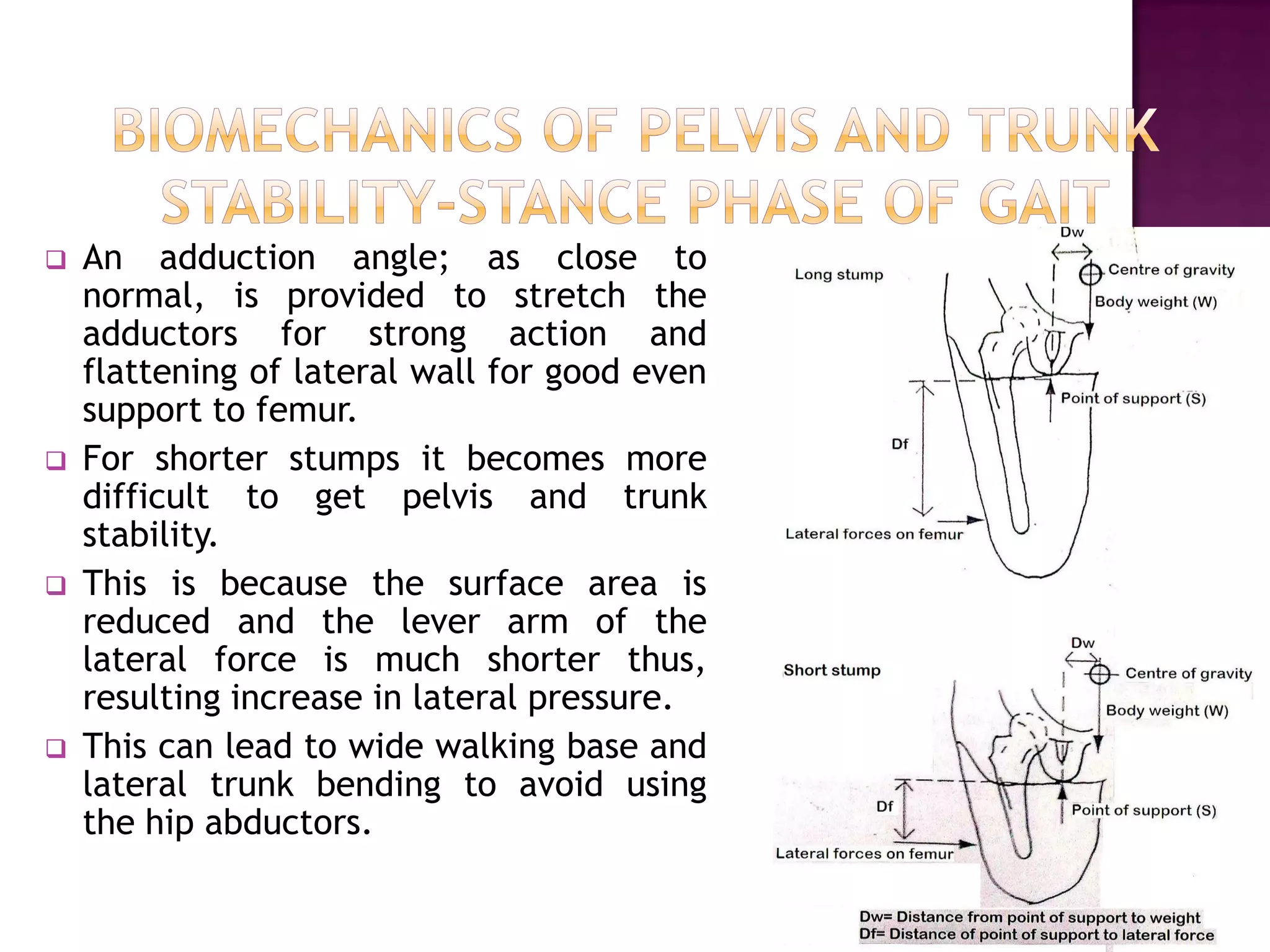
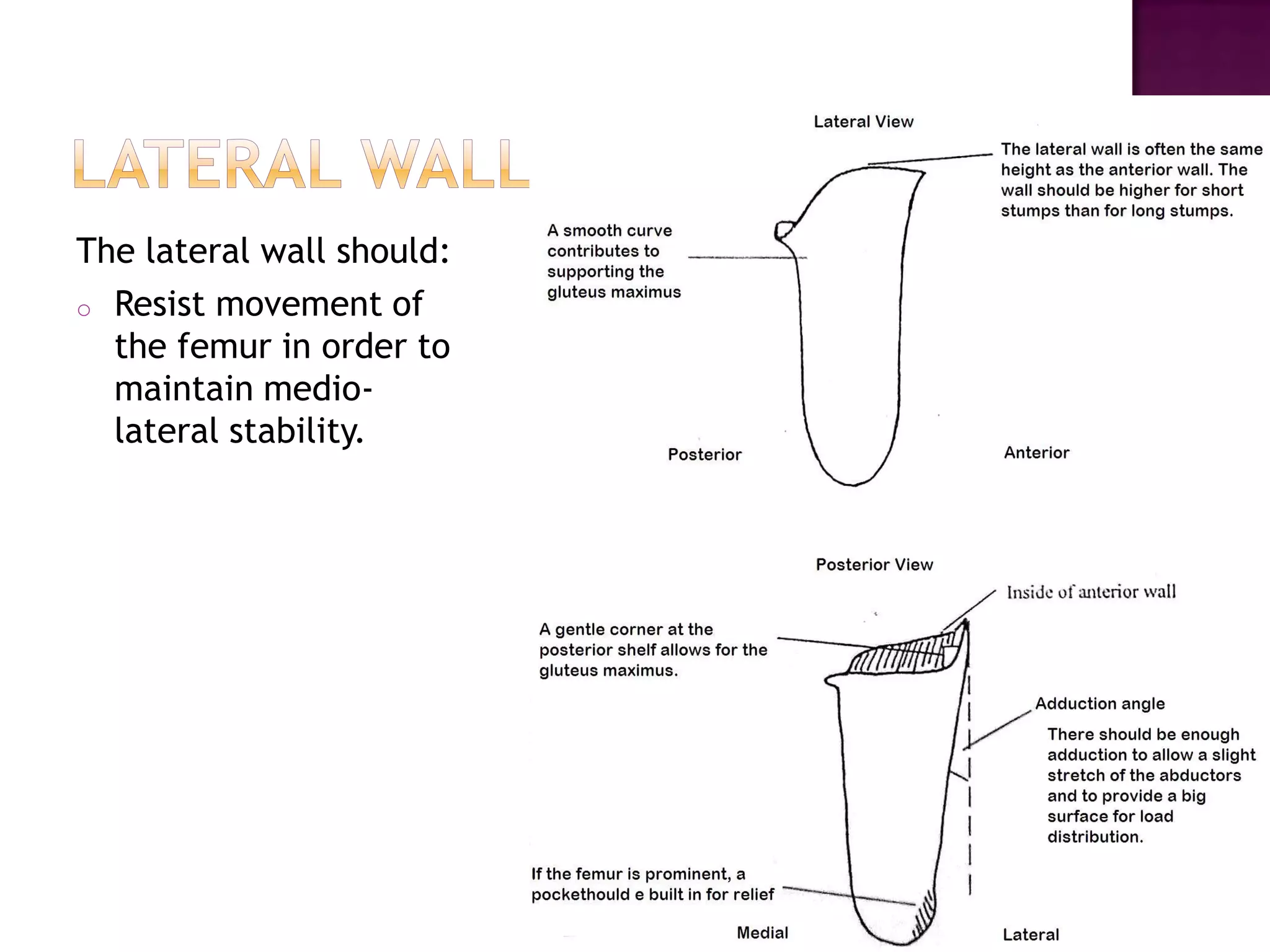
 An adduction angle; as close to
normal, is provided to stretch the
adductors for strong action and
flattening of lateral wall for good even
support to femur.
 For shorter stumps it becomes more
difficult to get pelvis and trunk
stability.
 This is because the surface area is
reduced and the lever arm of the
lateral force is much shorter thus,
resulting increase in lateral pressure.
 This can lead to wide walking base and
lateral trunk bending to avoid using
the hip abductors.
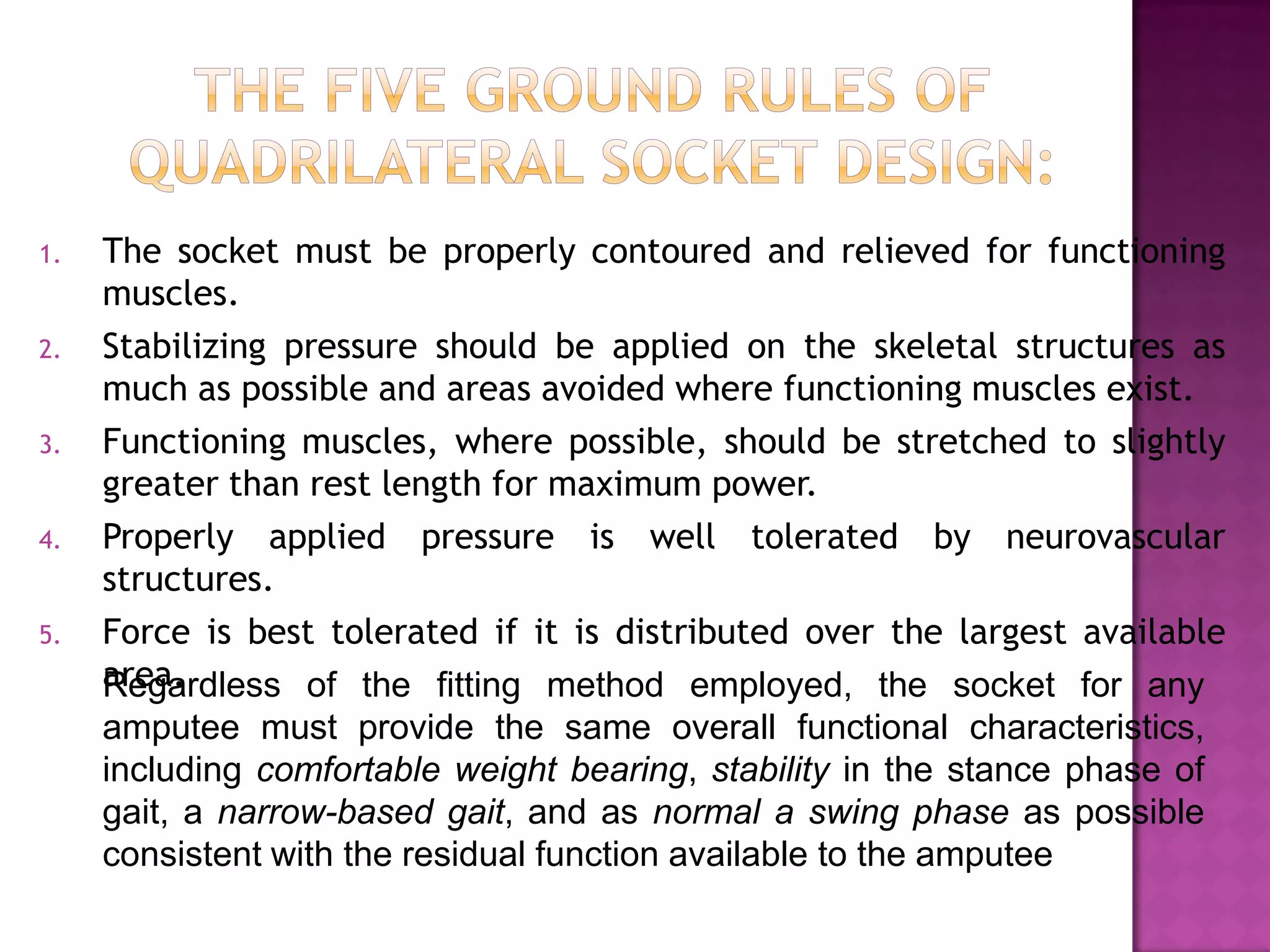
1. The socket must be properly contoured and relieved for functioning
muscles.
2. Stabilizing pressure should be applied on the skeletal structures as
much as possible and areas avoided where functioning muscles exist.
3. Functioning muscles, where possible, should be stretched to slightly
greater than rest length for maximum power.
4. Properly applied pressure is well tolerated by neurovascular
structures.
5. Force is best tolerated if it is distributed over the largest available
area.Regardless of the fitting method employed, the socket for any
amputee must provide the same overall functional characteristics,
including comfortable weight bearing, stability in the stance phase of
gait, a narrow-based gait, and as normal a swing phase as possible
consistent with the residual function available to the amputee
o The quadrilateral socket is the most commonly prescribed socket for
transfemoral amputee today because it is theonly socket that is
biomechanically proved and stable.
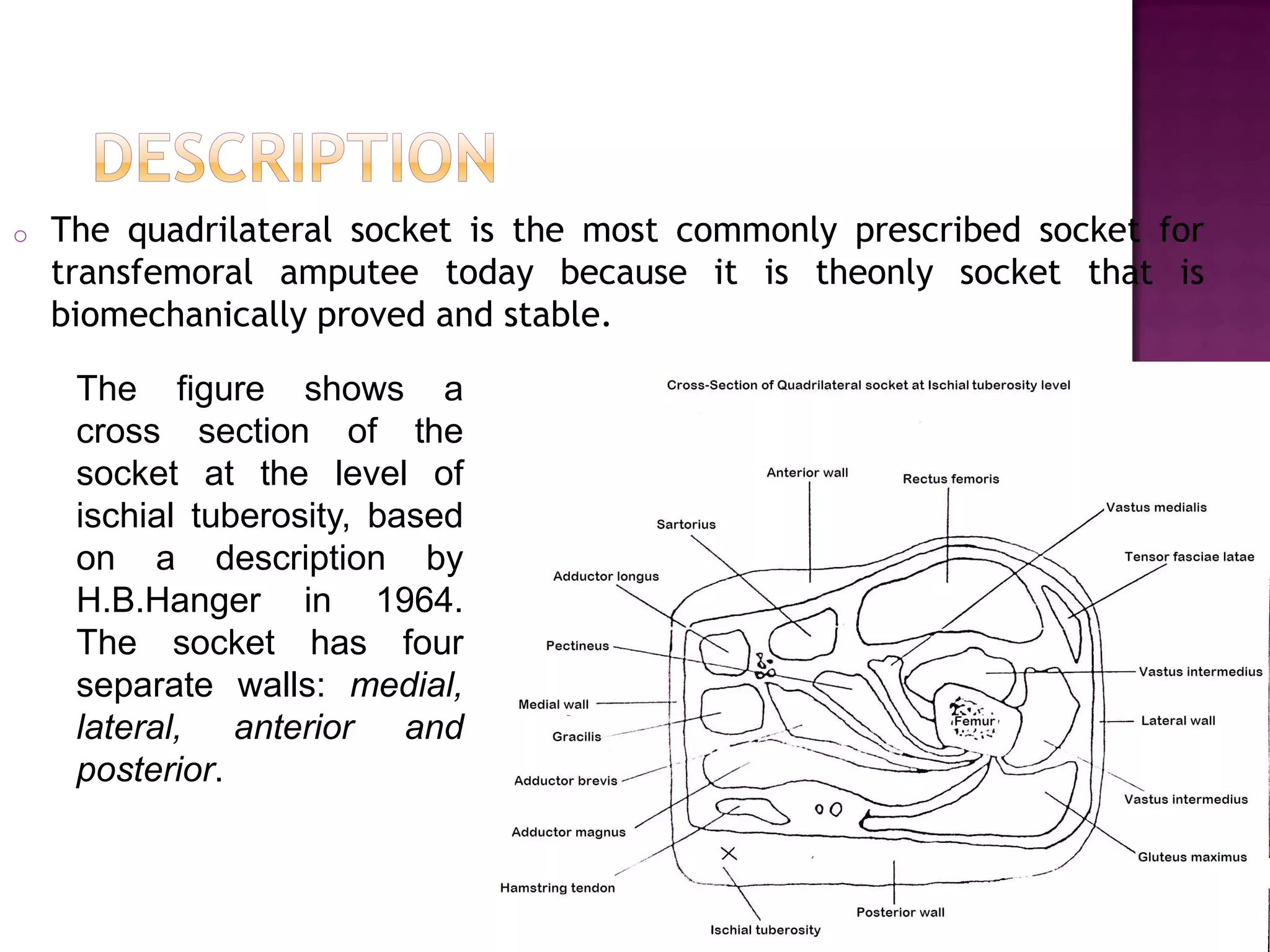
The figure shows a
cross section of the
socket at the level of
ischial tuberosity, based
on a description by
H.B.Hanger in 1964.
The socket has four
separate walls: medial,
lateral, anterior and
posterior.
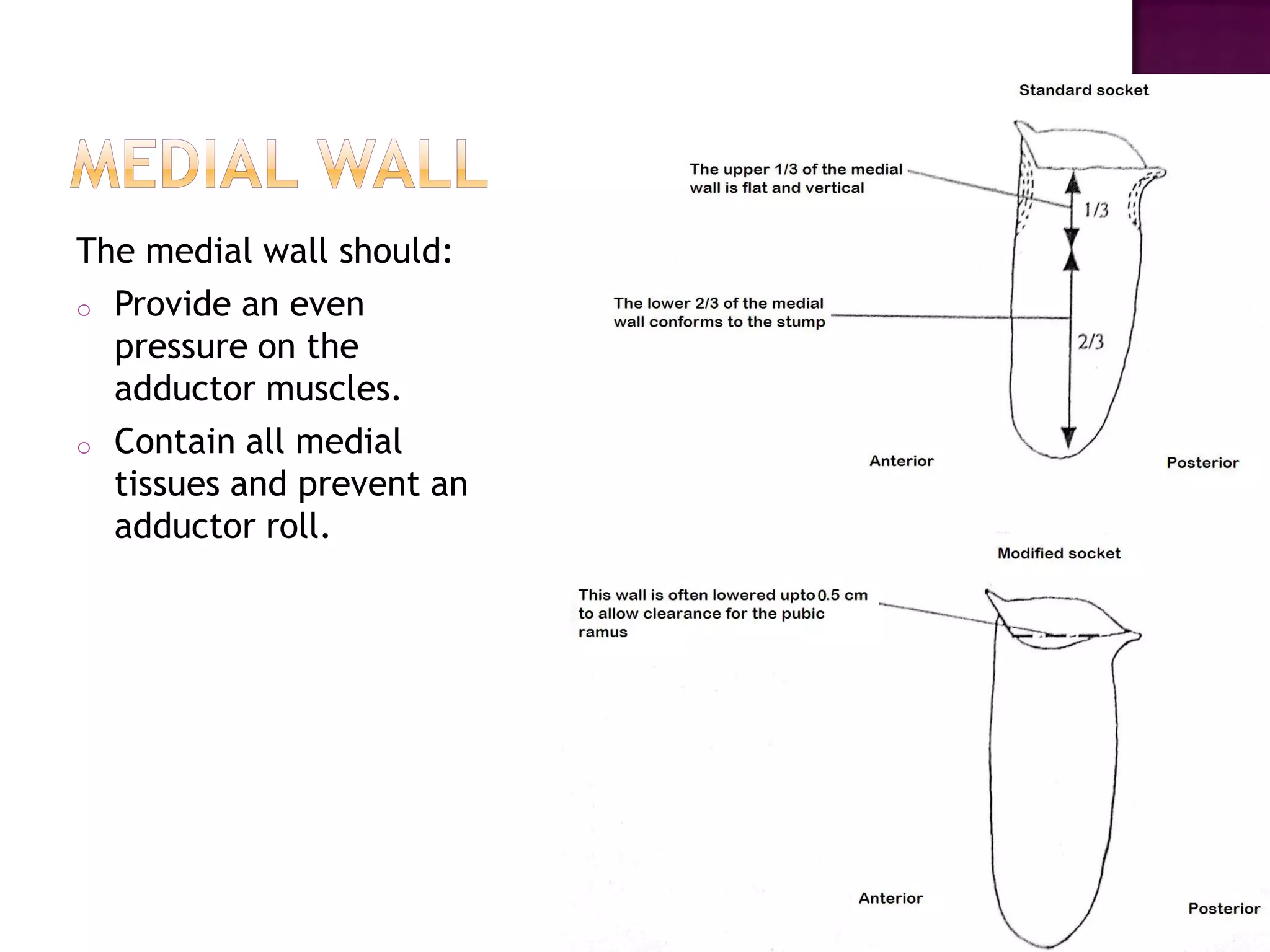
The medial wall should:
o Provide an even
pressure on the
adductor muscles.
o Contain all medial
tissues and prevent an
adductor roll.
The lateral wall should:
o Resist movement of
the femur in order to
maintain medio-
lateral stability.
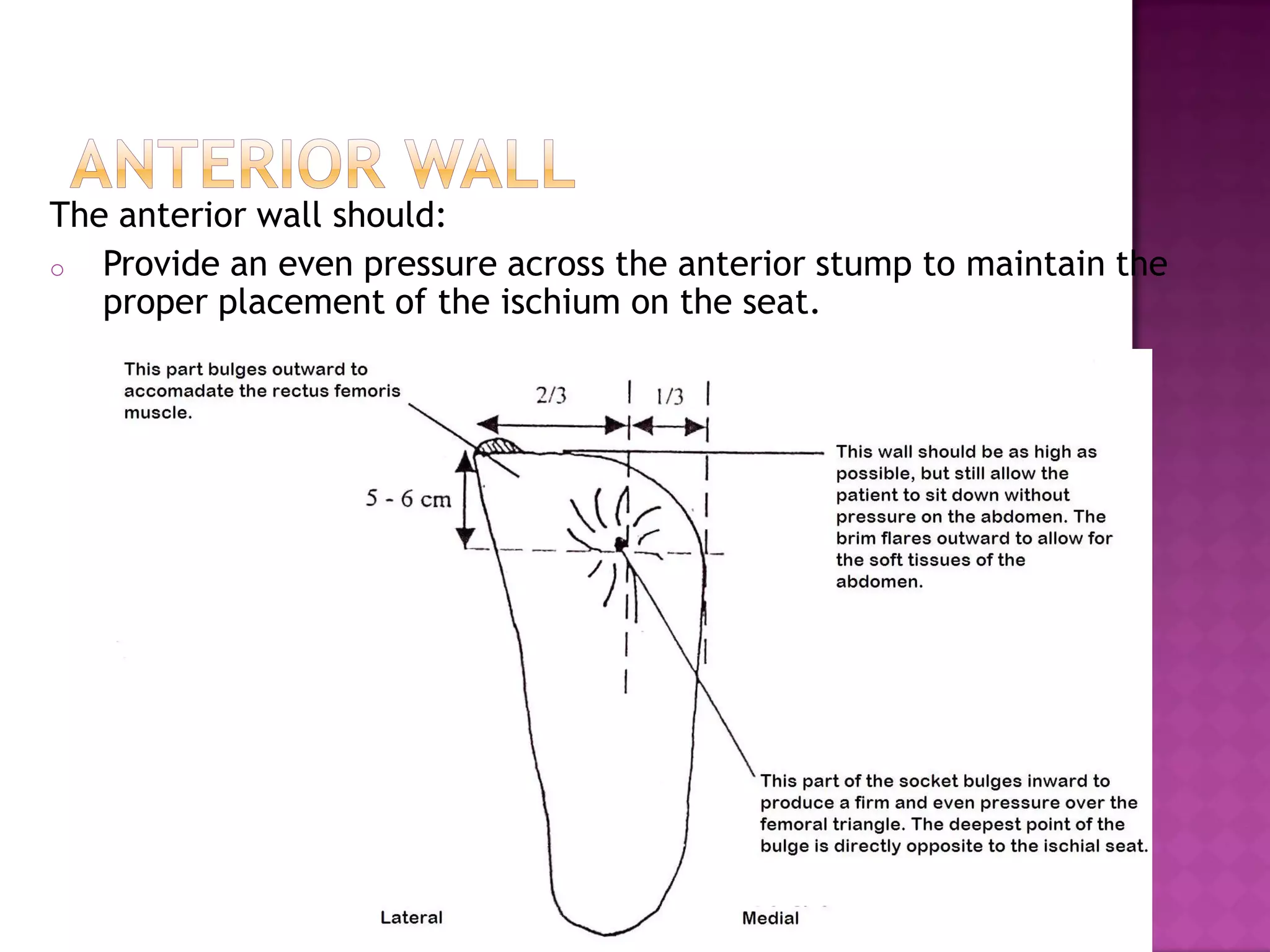
The anterior wall should:
o Provide an even pressure across the anterior stump to maintain the
proper placement of the ischium on the seat.
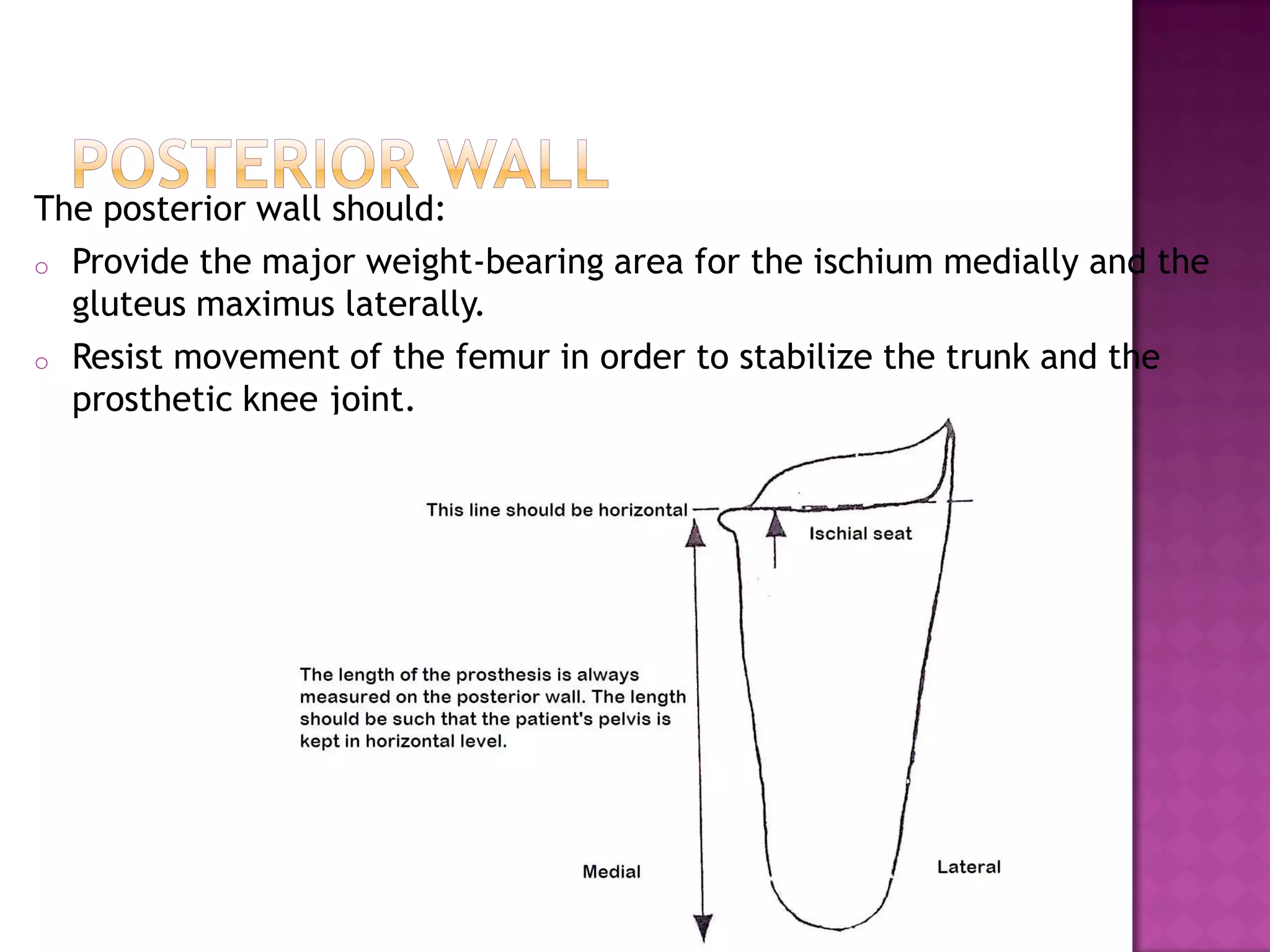
The posterior wall should:
o Provide the major weight-bearing area for the ischium medially and the
gluteus maximus laterally.
o Resist movement of the femur in order to stabilize the trunk and the
prosthetic knee joint.
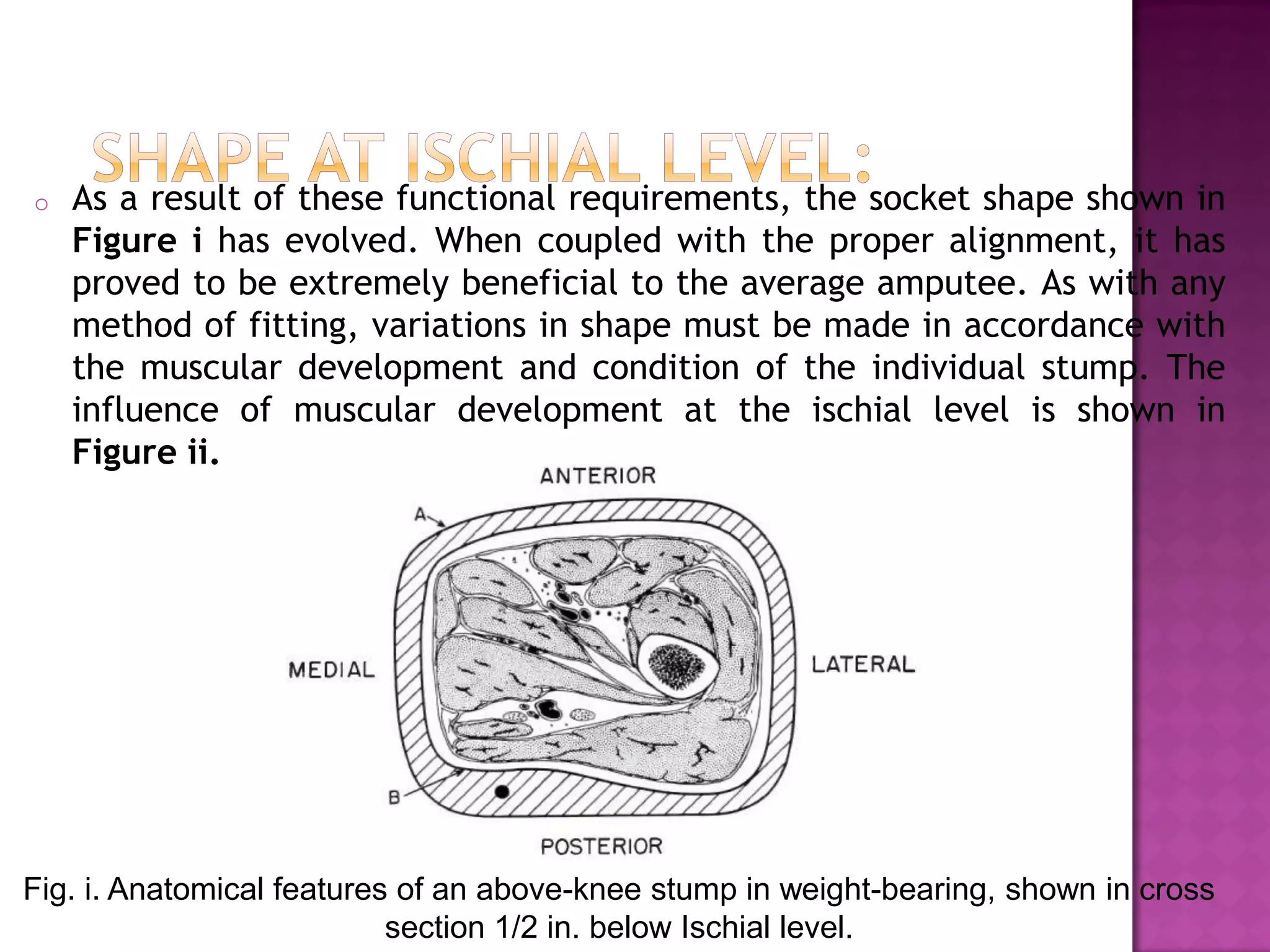
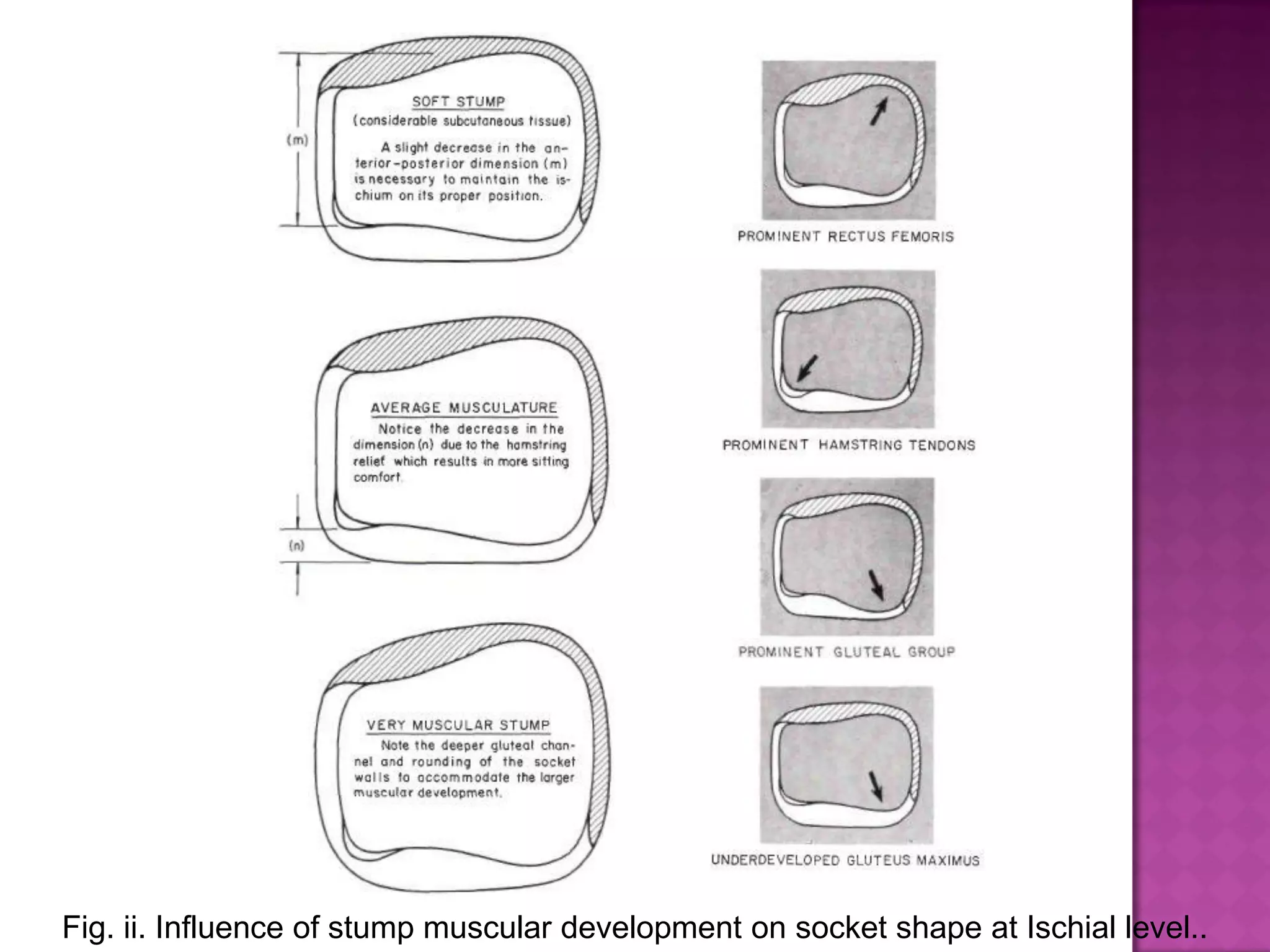
o As a result of these functional requirements, the socket shape shown in
Figure i has evolved. When coupled with the proper alignment, it has
proved to be extremely beneficial to the average amputee. As with any
method of fitting, variations in shape must be made in accordance with
the muscular development and condition of the individual stump. The
influence of muscular development at the ischial level is shown in
Figure ii.
Fig. i. Anatomical features of an above-knee stump in weight-bearing, shown in cross
section 1/2 in. below Ischial level.
Fig. ii. Influence of stump muscular development on socket shape at Ischial level..
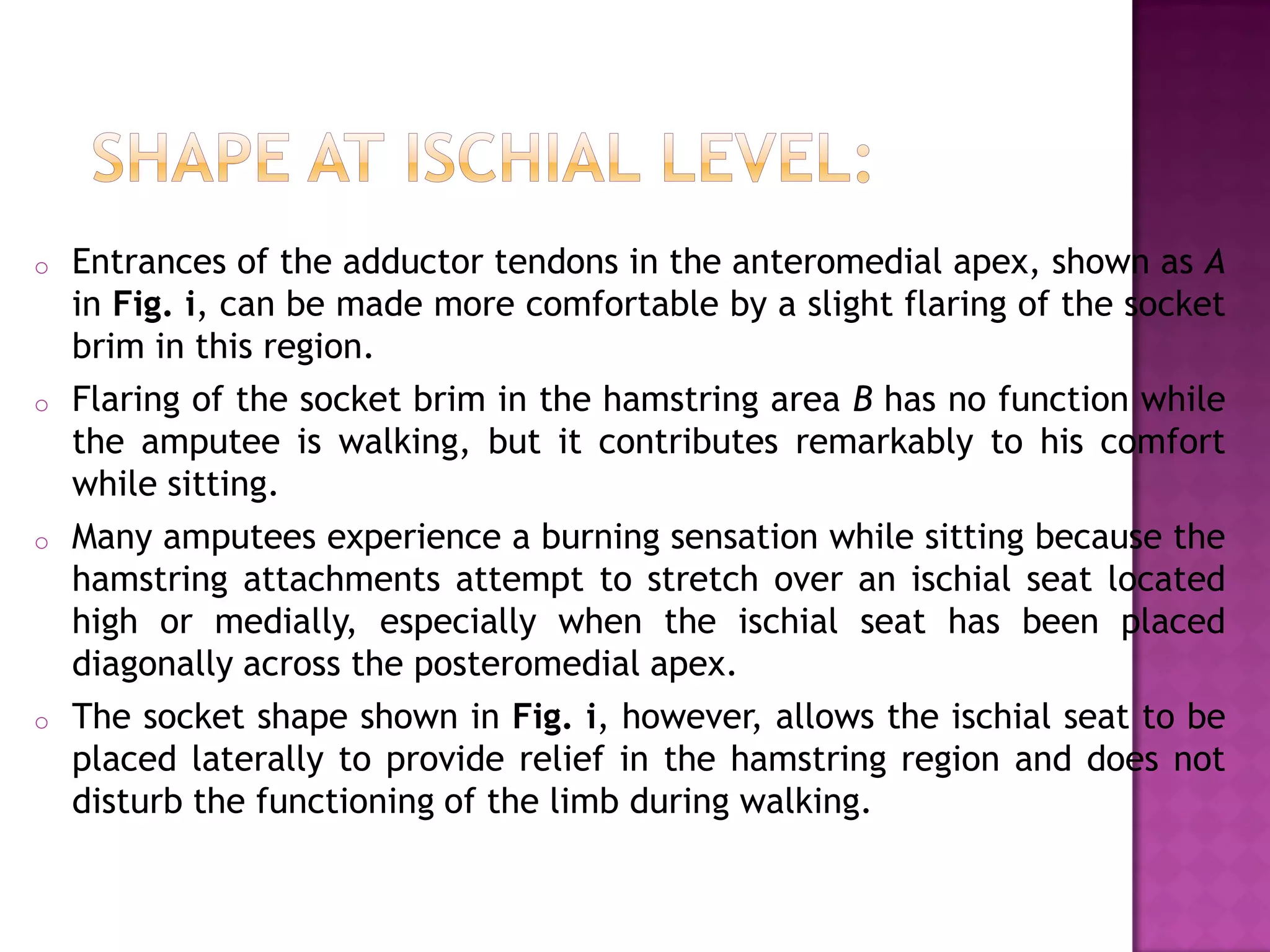
o Entrances of the adductor tendons in the anteromedial apex, shown as A
in Fig. i, can be made more comfortable by a slight flaring of the socket
brim in this region.
o Flaring of the socket brim in the hamstring area B has no function while
the amputee is walking, but it contributes remarkably to his comfort
while sitting.
o Many amputees experience a burning sensation while sitting because the
hamstring attachments attempt to stretch over an ischial seat located
high or medially, especially when the ischial seat has been placed
diagonally across the posteromedial apex.
o The socket shape shown in Fig. i, however, allows the ischial seat to be
placed laterally to provide relief in the hamstring region and does not
disturb the functioning of the limb during walking.
1. The advantage of a total contact socket.
• Helps in venous return; preventing edema.
• Increase in stump contact are; decrease in localized stump pressure.
• Increases sensory feedback; better control over prosthesis.
2. The principle of pressure on firm/soft tissues.
• Relief to contracting muscles, cord-like tendons and bony
prominences.3. The effect of sloped surfaces on
stump/socket pressures (the role of
ischial tuberosity).
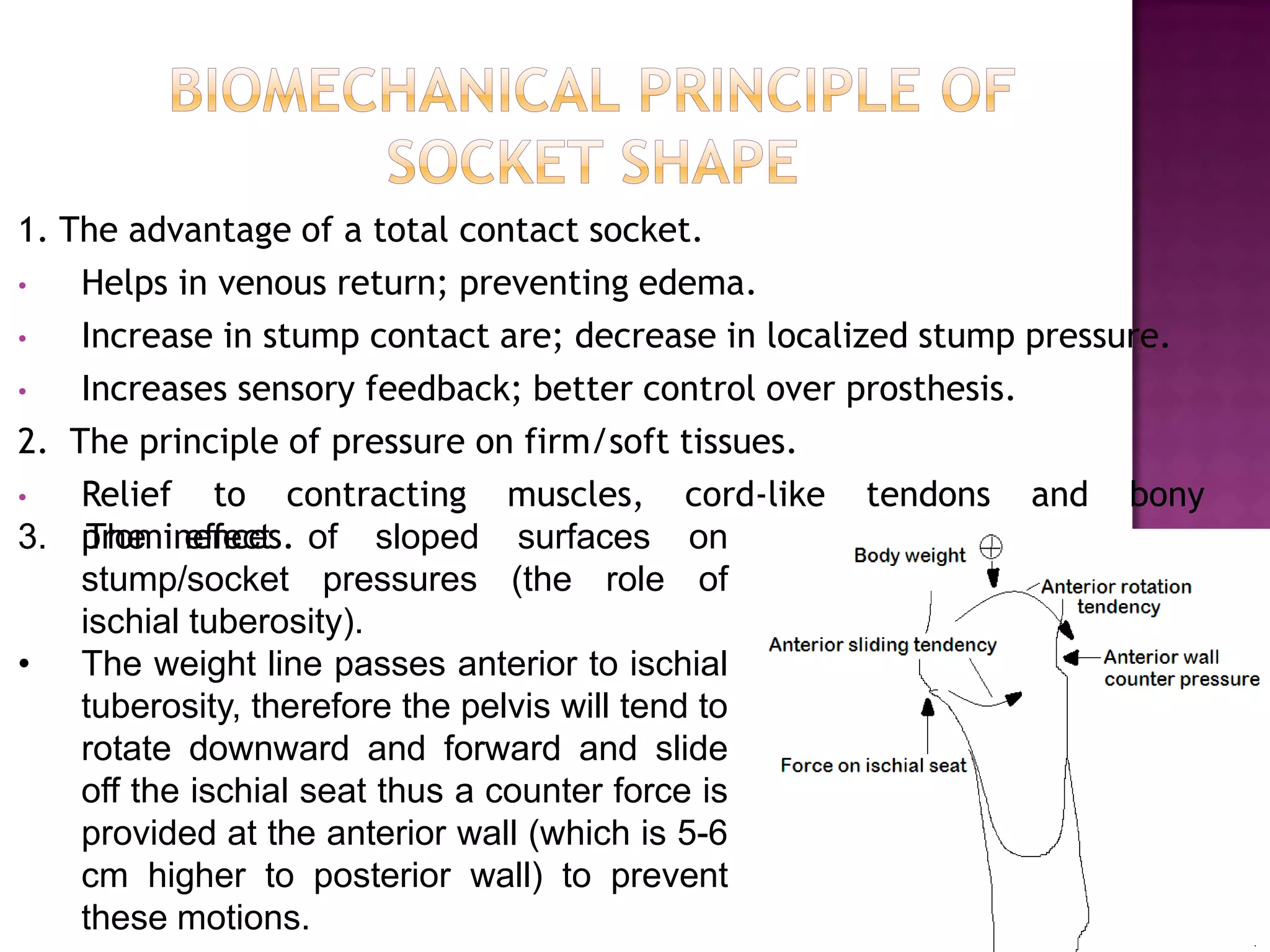
• The weight line passes anterior to ischial
tuberosity, therefore the pelvis will tend to
rotate downward and forward and slide
off the ischial seat thus a counter force is
provided at the anterior wall (which is 5-6
cm higher to posterior wall) to prevent
these motions.
There are primarily two casting methods:
I. Hand casting method
II. Brim casting method
o The hand casting method was developed by Ottobock, Germany.
o Prominences such as GT, cut end of femur, adductor longus
tendon are marked over the casting socks prior to casting.
o Even pressure is applied while casting all over the stump.
o Hand pressure on the ischial seat, femoral triangle and above
the GT is maintained with the help of an assistant.
o Moulding of lateral wall, medial wall and distal end are
thoroughly done.
 During the last decade significant and controversial progress
and change have taken place in transfemoral prosthetics in
India.
 Clinical improvements and new materials and components
will continue to be developed.
 The fundamental goals of comfort, function, and cosmesis
are unchanged.
 Through the use of new materials, components, and designs,
the transfemoral amputee can now achieve a higher activity
level than was possible before.
Clinical consideration of quadrilateral socket 2000

Clinical consideration of quadrilateral socket 2000

  • 2.
    o In recentyears considerable interest has been generated all over the world about new style above-knee prosthetic sockets, variously referred to as Narrow M-L, NASNA, CAT-CAM and SCAT-CAM. o There have been more or less confusion in determining the actual fact: what should be the actual biomechanical interface for an above knee amputee? o Moreover, the impression has been created that they are not governed by the basic biomechanical rules identified by Radcliffe as affecting the quadrilateral socket. o This presentation deals with the clinical importance of the quadrilateral socket over its counterparts.
  • 3.
    o The termquadrilateral refers to the appearance of the socket when viewed in the transverse plane because there are four distinguishable sides or walls of the socket. o The orientation of the four walls will vary according to the amputee's specific anatomy and the biomechanical requirements of the socket. o According to Radcliffe, "the socket is truly more than just a cross- section shape at the ischial level, it is a three-dimensional receptacle for the stump with contours at every level which are justifiable on a sound biomechanical basis.“ o The total-contact quadrilateral socket was the socket of choice from the 1960s until recently and remains the most commonly prescribed socket system even today, despite new designs and techniques.
  • 4.
    When working withtransfemoral amputees, the two main goals are: o Medio-lateral pelvis/trunk stability o A narrow base gait  With the transfemoral amputee, the femur in effect is “floating” in a mass of muscle tissue and fluid, thus it tend to move laterally when the hip abductors are acting in an attempt to stabilize the trunk.  The lack of support during the stance phase will result in too much pelvic tilt and discomfort at the perennial area for which the amputee adopts wide based gait and use lateral trunk bending to avoid using the hip abductors.  Stability and narrow-based gait can only be achieved by good lateral support of the femur.
  • 5.
     An adductionangle; as close to normal, is provided to stretch the adductors for strong action and flattening of lateral wall for good even support to femur.  For shorter stumps it becomes more difficult to get pelvis and trunk stability.  This is because the surface area is reduced and the lever arm of the lateral force is much shorter thus, resulting increase in lateral pressure.  This can lead to wide walking base and lateral trunk bending to avoid using the hip abductors.
  • 6.
    1. The socketmust be properly contoured and relieved for functioning muscles. 2. Stabilizing pressure should be applied on the skeletal structures as much as possible and areas avoided where functioning muscles exist. 3. Functioning muscles, where possible, should be stretched to slightly greater than rest length for maximum power. 4. Properly applied pressure is well tolerated by neurovascular structures. 5. Force is best tolerated if it is distributed over the largest available area.Regardless of the fitting method employed, the socket for any amputee must provide the same overall functional characteristics, including comfortable weight bearing, stability in the stance phase of gait, a narrow-based gait, and as normal a swing phase as possible consistent with the residual function available to the amputee
  • 7.
    o The quadrilateralsocket is the most commonly prescribed socket for transfemoral amputee today because it is theonly socket that is biomechanically proved and stable. The figure shows a cross section of the socket at the level of ischial tuberosity, based on a description by H.B.Hanger in 1964. The socket has four separate walls: medial, lateral, anterior and posterior.
  • 8.
    The medial wallshould: o Provide an even pressure on the adductor muscles. o Contain all medial tissues and prevent an adductor roll.
  • 9.
    The lateral wallshould: o Resist movement of the femur in order to maintain medio- lateral stability.
  • 10.
    The anterior wallshould: o Provide an even pressure across the anterior stump to maintain the proper placement of the ischium on the seat.
  • 11.
    The posterior wallshould: o Provide the major weight-bearing area for the ischium medially and the gluteus maximus laterally. o Resist movement of the femur in order to stabilize the trunk and the prosthetic knee joint.
  • 12.
    o As aresult of these functional requirements, the socket shape shown in Figure i has evolved. When coupled with the proper alignment, it has proved to be extremely beneficial to the average amputee. As with any method of fitting, variations in shape must be made in accordance with the muscular development and condition of the individual stump. The influence of muscular development at the ischial level is shown in Figure ii. Fig. i. Anatomical features of an above-knee stump in weight-bearing, shown in cross section 1/2 in. below Ischial level.
  • 13.
    Fig. ii. Influenceof stump muscular development on socket shape at Ischial level..
  • 14.
    o Entrances ofthe adductor tendons in the anteromedial apex, shown as A in Fig. i, can be made more comfortable by a slight flaring of the socket brim in this region. o Flaring of the socket brim in the hamstring area B has no function while the amputee is walking, but it contributes remarkably to his comfort while sitting. o Many amputees experience a burning sensation while sitting because the hamstring attachments attempt to stretch over an ischial seat located high or medially, especially when the ischial seat has been placed diagonally across the posteromedial apex. o The socket shape shown in Fig. i, however, allows the ischial seat to be placed laterally to provide relief in the hamstring region and does not disturb the functioning of the limb during walking.
  • 15.
    1. The advantageof a total contact socket. • Helps in venous return; preventing edema. • Increase in stump contact are; decrease in localized stump pressure. • Increases sensory feedback; better control over prosthesis. 2. The principle of pressure on firm/soft tissues. • Relief to contracting muscles, cord-like tendons and bony prominences.3. The effect of sloped surfaces on stump/socket pressures (the role of ischial tuberosity). • The weight line passes anterior to ischial tuberosity, therefore the pelvis will tend to rotate downward and forward and slide off the ischial seat thus a counter force is provided at the anterior wall (which is 5-6 cm higher to posterior wall) to prevent these motions.
  • 16.
    There are primarilytwo casting methods: I. Hand casting method II. Brim casting method o The hand casting method was developed by Ottobock, Germany. o Prominences such as GT, cut end of femur, adductor longus tendon are marked over the casting socks prior to casting. o Even pressure is applied while casting all over the stump. o Hand pressure on the ischial seat, femoral triangle and above the GT is maintained with the help of an assistant. o Moulding of lateral wall, medial wall and distal end are thoroughly done.
  • 17.
     During thelast decade significant and controversial progress and change have taken place in transfemoral prosthetics in India.  Clinical improvements and new materials and components will continue to be developed.  The fundamental goals of comfort, function, and cosmesis are unchanged.  Through the use of new materials, components, and designs, the transfemoral amputee can now achieve a higher activity level than was possible before.