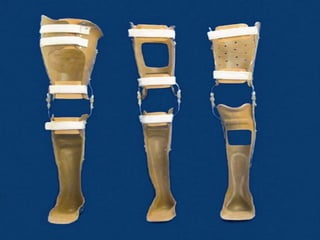
KNEE ANKLE FOOT ORTHOSIS
(KAFO)
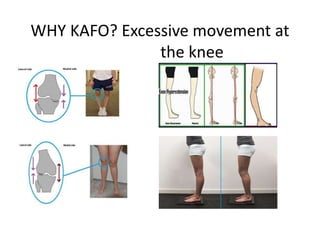
WHY KAFO? Excessive movement at
the knee
INTRODUCTION
• DEFINITION:
As the name suggests, a KAFO is a device
that controls the movements of the knee and
ankle joints, and holds the foot in a desired
posture.
Qn.
compared to FOs and AFOs, why is it seen
that energy expenditues using KAFO is much
higher than when using FOs and AFOs?
Ans: This is due to compensatory movements
that must be made in order to swing the limb.
KAFO TYPES
• So far there are three(3) TYPES of the KAFO:
depending on the materials
CONVETIONAL KAFO
THERMOPLASTIC KAFO and
THERMOSETTING KAFO.
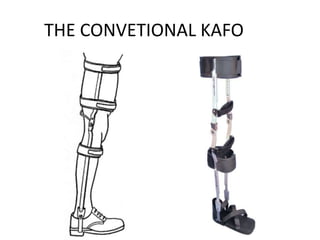
THE CONVETIONAL KAFO
• Has a metal frame (double upright) that is
attached to a shoe via a stirrup system
• Metal cuff bands covered with leather to hold
the thigh and cuff
• Typically, a pair of orthotic ankle joints is used
to connect the stirrup to the distal metal
upright, and a pair of the orthotic knee joints
connect the distal and proximal metal uprights
advantages
• Easily to wear
• Very strong
• Easily adjusted-
Can be repaired locally
• Most durable
• - Cooler than plastic
• - Materials available locally
disadvantages
• Heavy
• Patient cannot easily change the shoe
• Cannot wear the device without shoe
• Few contact points reduce control
• Small points of contact means that forces are
concentrated on the small areas and thus
pressures are high
• - Shoe must be modified
• - Difficult to clean
• - Less cosmetic
INDICATIONS
• - Insensate skin (not absolute)
• - Oedema(-for patient with uncontrolled or
fluctuating edema)
• - Patient preference
• When maximum strength and durability are
needed
• For patient with significant obesity
CONTRAINDICATIONS
• - Strong corrective forces needed
• - Patient works in wet / muddy environment
• - Patient concerned about cosmesis
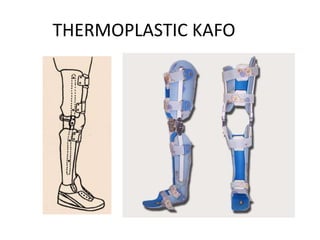
THERMOPLASTIC KAFO
• This is the shell KAFO,in which the shell is vacuum
over the positive modal of the patient limb.
• Distal molded shell,which fits over the foot ankle
and lower leg, this is basically an AFO section
with a proximal anterior strap(usually velcro)
closure
NOW,depending on the patient’s needs,this
distal component may be either a solid ankle or
articulating design(ie, AFO with or without joint)
• The proximal molded shell encases the thigh from
the greater tronchanter to just above the femoral
condyles and typically has a pair of anterior
straps(again usually velcro) for closure.
- These two molded sections can made from
plastic or laminated materials.
•metal uprights with knee joints and side
bars(made of stainless steel, aluminiun) connect
the proximal and distal shells.
advantages
• Lighter weight
• Interchangeability of shoes
• Greater cosmetic
• Large forces are distributed and hence reduced
pressure on the patient limb
• - Close fitting / cosmesis
• - Good control of movement
• - Plastic easy to adjust
• - Easy to clean
disadvantages
• Hot and sweaty
• Hot and sweaty
• - More time spent in manufacture
• - Requires workshop to repair
• - Materials must be imported
indications
• When energy expenditure makes weight of the
orthosis an issue
• When intimate /total contact fit is needed to
make maximum control of the limbStrong
corrective forces needed
• - Patient works in wet / muddy environment
• - Patient preference
• - Patient concerned about cosmesis
• - Patient doesn’t wear shoes
contraindications
• Obese patient
• Patient with fluctuating odema
• - Insensate skin (not absolute)
• - Oedema
• - Scarring in contact or high pressure areas
THERMOSETTING KAFO
INDICATIONS
• - Patient has weight fluctuations
• - Patient preference
CONTRAINDICATIONS
• - Insensate skin( not absolute)
• - Oedema
• - Scarring in contact areas
ADVANTAGES
• - Can use normal shoes
• - Close fitting
• - Good control of movement
• - Thigh section cooler
DISADVANTAGES
• - More steps in manufacture
• - Requires workshop to repair
KAFO DESIGNS
• These depend upon the need of the patient
ISCHIAL WEIGHT BEARING KAFO
ANTERIOR SHELL KAFO
POSTERIOR SHELL KAFO
ISCHIAL WEIGHT BEARING KAFO
NOTE:
When a patient cannot bear weight through
the skeletal structure of the leg because of
pain, fracture or weakness an Ischial Weight
Bearing KAFO can be made. The orthoses can
be either conventional or using shells, and
uses similar modifications to a TF socket.
INDICATIONS
• - hip, knee or ankle pain / damage
• - non healed fracture in lower limb
CONTRAINDICATIONS
• - hip dislocation
• - if weight relief is not required
ADVANTAGES
• - can take weight through suitable structure
• - quadrilateral proximal area helps to control
rotation
DISADVANTAGES
• - very large orthosis
• - less sitting comfort
Anterior Shell
• INDICATIONS
- knee collapse
- posterior scarring
- PCL laxity
CONTRAINDICATION
• - knee hyperextension
• - ACL laxity
• - anterior scarring
ADVANTAGES
- sitting comfort
DISAVANTAGES
- difficult to don
- pressure on bone area (tibia)
Posterior Shell
Indications
- knee hyperextension
- ACL laxity
- anterior scarring
Contraindications
- knee collapse
- posterior scarring
- PCL laxity
Advantages
- easy to don
- all pressures on soft tissue
Disadvantages
- discomfort when sitting
Each design has advantages and
disadvantages, indications and
contraindications, and these must be carefully
considered when developing the prescription.
KAFO Components
DISTAL COMPONENT
(which is an AFO section)
KNEE COMPONENT
(Knee joints)
PROXIMAL COMPONENT
(thigh section)
DISTAL COMPONENT
• AFO section
• The choice of AFO design within the KAFO should follow the
principles already learned. The control of the foot and ankle must
be achieved to provide the patient with a stable base of support.
• One key point to bear in mind is that ankle position has a direct
relationship to knee and hip position in standing and gait.
• If the AFO is dorsi-flexed it will encourage knee and hip flexion.
• If the AFO is plantarflexed it will encourage knee extension.
• The positioning of the ankle and tibial angulation is very important.
The ideal position is to have a line from the Greater Trochanter fall
between the navicular and malleolus in midstance.
KNEE COMPONENT
• Knee joints
One of the key components of a KAFO is the
knee joint. As in prosthetics there are many
designs and variations, but can be divided into
broad categories
1.Single Axis Free motion
2. Polycentric Free motion
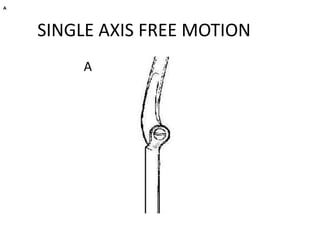
SINGLE AXIS FREE MOTION
A
A
The joint is very simple and allows free
movement in the sagittal plane. Most joints
have a stop at 180° (full extension) and a good
range of flexion. This type of joint would be
used in patients who require control of
coronal plane movement, or in cases of knee
hyperextension, but not control of knee
flexion.
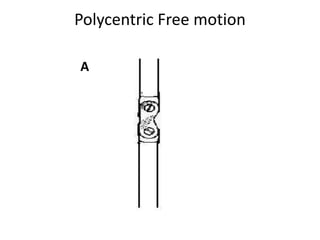
Polycentric Free motion
A
• The joint has two axes, and thus attempts to
mimic the movement of the tibiofemoral joint.
This type of joint is used as above.
Posterior Offset joint
A
• The posterior offset joint, as the name suggests,
has the axis of the joint placed posterior of the
line of the uprights. The idea is to move the joints
posterior to the GRF, and in this way create
stability. For this to work some of the patients
body weight must pass through the device. This
type of joint is used mostly for patients who have
some weakness of knee extensors (at least Grade
3) and good hip extensors
indications
• - knee M-L instability
• - knee hyperextension
• - older patients (improve stability)
• - knee extensors > Gd 3+
• - hip extensors > Gd 4
•
contraindication
• - knee extensors < Gd 3+
• - hip extensors < Gd4
advantages
• - normal swing phase
• - simple and easy
• - lightweight
• - little maintenance
disadvantages
• - may collapse on inclines
• - not safe on uneven ground
• - requires some weight bearing through KAFO
structure
DROP LOCK
• A
• This type of joint offers a simple locking mechanism,
but one that offers a positive lock of knee movement.
The joint is single axis and is locked when a ring of
metal drops down over the joint, blocking all
movement. The lock is easy to operate, as when the
patient stands and the uprights are straightened gravity
pulls the ring down and into place. In some cases the
ring is assisted to drop by the use of a spring.
• To unlock the knee the patient has to lift the ring and
flex the knee. This requires that the patient has good
hand function.
• Indications
- knee A-P instability
- knee M-L instability
- knee hyperextension
- knee extensors < Gd 3
- hip extensors < Gd 3
• Contraindications
- poor hand function
- knee extensors > Gd 3+
- hip extensors > Gd 3
• Advantages
- Complete control of knee
- low maintenance
Disadvantages
• - Patient must lift locks
• - knee must be fully extended to engage locks
• - Can “rattle”
• - Can “jam”
BAIL LOCK
A
• This type of lock uses a mechanical block
within the joint to prevent motion. The block
is operated by a lever which sticks out from
the posterior side of the joint. These levers are
often welded to a metal ring around the
posterior aspect of the brace, so that both
locks can be operated with one hand, or by
knocking the ring against a chair.
Indications
• - knee A-P instability
• - knee M-L instability
• - knee hyperextension
• - knee extensors < Gd 3
• - hip extensors < Gd 3
• - poor hand function
•
•
•
•
contraindications
• - knee extensors > Gd 3+
• - hip extensors > Gd 3
•
advantages
• - Complete control of knee
• - One handed operation possible
•
disadvantages
• - knee must be fully extended to engage locks
• - Can “rattle”
• - can be unlocked with bump to posterior.
• - bulky / reduced cosmesis
Advanced knee joints
• The joints described above are very simple and rely upon
basic mechanisms. There has been a lot of money spent on
developing better orthotic knee joints. This research has
been ongoing for many years. One of the goals of this
research has been to develop joints that have stance
and/or swing phase controls. However there is very little
available that is reliable and affordable.
• The biggest problem is that orthotic joints must be thin and
small so they don’t affect cosmesis. So the control
mechanisms have to be very small. These small parts then
have to take large forces, and are prone to failure.
•
• Overview - http://www.oandp.com/news The following are
some recent attempts at better orthotic knee joints. Look at them
on the internet.
• /jmcorner/2002-05/1.asp
• - http://www.stancecontrol.com/
• Pendulum lock - http://www.spsco.com/press/10-30-02c.html
• - http://www.oandp.com/edge/issues/articles/2002-07_14.asp
• UTX - http://www.rslsteeper.co.uk (search for “UTX swing”)
• - http://www.beckerorthopedic.com/utx/utx.htm
• Load Response Knee -
http://www.beckerorthopedic.com/knee/load_response.htm
• Extension assist -
http://www.beckerorthopedic.com/knee/g_knee.htm
ALIGNMENT
Function
– To control motion around the knee joint: describe
which motion is being controlled
– To offload a joint
– To prevent deformity
• To increase stability
KNEE ANKLE FOOT ORTHOSIS.pptx