ASSIGNMENT
OF
“ORTHOTICS
AND
PROSTHETICS”
Name: Asma Tariq
Roll No.: M-15740
Semester: 7th
TOPIC :
UPPER AND LOWER LIMB PROSTHESIS
• Prosthetic: Referring to a prosthesis, an artificial substitute or replacement of a
part of the body such as a tooth, eye, a facial bone, the palate, a hip, a knee or
another joint, the leg, an arm, etc.
• A prosthesis is designed for functional or cosmetic reasons or both.
• a prosthesis (plural: prostheses; from Ancient Greek prósthesis, "addition,
application, attachment") is an artificial device that replaces a missing body part,
which may be lost through trauma, disease, or congenital conditions.
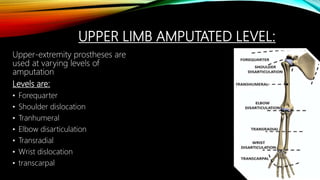
UPPER LIMB AMPUTATED LEVEL:
Upper-extremity prostheses are
used at varying levels of
amputation
Levels are:
• Forequarter
• Shoulder dislocation
• Tranhumeral
• Elbow disarticulation
• Transradial
• Wrist dislocation
• transcarpal
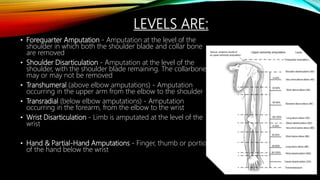
LEVELS ARE:
• Forequarter Amputation - Amputation at the level of the
shoulder in which both the shoulder blade and collar bone
are removed
• Shoulder Disarticulation - Amputation at the level of the
shoulder, with the shoulder blade remaining. The collarbone
may or may not be removed
• Transhumeral (above elbow amputations) - Amputation
occurring in the upper arm from the elbow to the shoulder
• Transradial (below elbow amputations) - Amputation
occurring in the forearm, from the elbow to the wrist
• Wrist Disarticulation - Limb is amputated at the level of the
wrist
• Hand & Partial-Hand Amputations - Finger, thumb or portion
of the hand below the wrist
PROSTHESIS OF UPPER LIMB
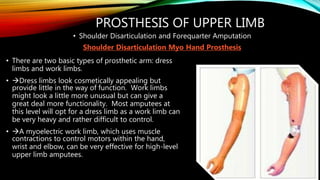
• Shoulder Disarticulation and Forequarter Amputation
Shoulder Disarticulation Myo Hand Prosthesis
• There are two basic types of prosthetic arm: dress
limbs and work limbs.
• Dress limbs look cosmetically appealing but
provide little in the way of function. Work limbs
might look a little more unusual but can give a
great deal more functionality. Most amputees at
this level will opt for a dress limb as a work limb can
be very heavy and rather difficult to control.
• A myoelectric work limb, which uses muscle
contractions to control motors within the hand,
wrist and elbow, can be very effective for high-level
upper limb amputees.
SHOULDER DISARTICULATION
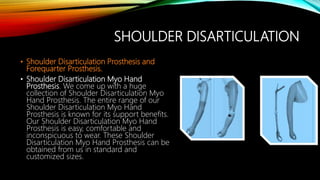
• Shoulder Disarticulation Prosthesis and
Forequarter Prosthesis.
• Shoulder Disarticulation Myo Hand
Prosthesis. We come up with a huge
collection of Shoulder Disarticulation Myo
Hand Prosthesis. The entire range of our
Shoulder Disarticulation Myo Hand
Prosthesis is known for its support benefits.
Our Shoulder Disarticulation Myo Hand
Prosthesis is easy, comfortable and
inconspicuous to wear. These Shoulder
Disarticulation Myo Hand Prosthesis can be
obtained from us in standard and
customized sizes.
TRANHUMERAL
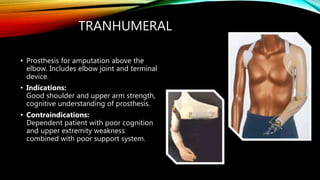
• Prosthesis for amputation above the
elbow. Includes elbow joint and terminal
device.
• Indications:
Good shoulder and upper arm strength,
cognitive understanding of prosthesis.
• Contraindications:
Dependent patient with poor cognition
and upper extremity weakness
combined with poor support system.
ABOVE ELBOW MYO HAND
PROSTHESIS
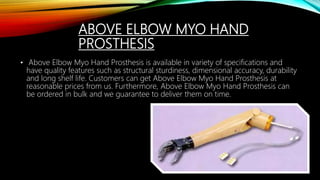
• Above Elbow Myo Hand Prosthesis is available in variety of specifications and
have quality features such as structural sturdiness, dimensional accuracy, durability
and long shelf life. Customers can get Above Elbow Myo Hand Prosthesis at
reasonable prices from us. Furthermore, Above Elbow Myo Hand Prosthesis can
be ordered in bulk and we guarantee to deliver them on time.
ELBOW DISARTICULATION
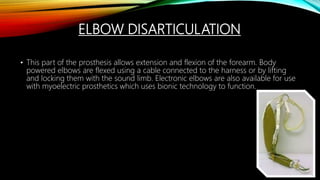
• This part of the prosthesis allows extension and flexion of the forearm. Body
powered elbows are flexed using a cable connected to the harness or by lifting
and locking them with the sound limb. Electronic elbows are also available for use
with myoelectric prosthetics which uses bionic technology to function.
TRANSRADIAL
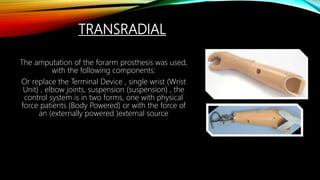
The amputation of the forarm prosthesis was used,
with the following components:
Or replace the Terminal Device , single wrist (Wrist
Unit) , elbow joints, suspension (suspension) , the
control system is in two forms, one with physical
force patients (Body Powered) or with the force of
an (externally powered )external source
WRIST DISLOCATION
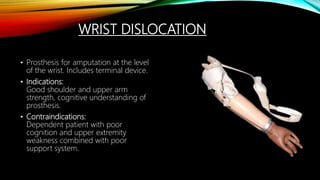
• Prosthesis for amputation at the level
of the wrist. Includes terminal device.
• Indications:
Good shoulder and upper arm
strength, cognitive understanding of
prosthesis.
• Contraindications:
Dependent patient with poor
cognition and upper extremity
weakness combined with poor
support system.
MYOELECTRIC HAND PROSTHESIS
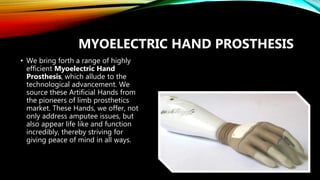
• We bring forth a range of highly
efficient Myoelectric Hand
Prosthesis, which allude to the
technological advancement. We
source these Artificial Hands from
the pioneers of limb prosthetics
market. These Hands, we offer, not
only address amputee issues, but
also appear life like and function
incredibly, thereby striving for
giving peace of mind in all ways.
TRANSCARPAL
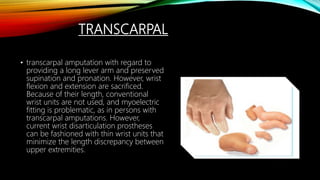
• transcarpal amputation with regard to
providing a long lever arm and preserved
supination and pronation. However, wrist
flexion and extension are sacrificed.
Because of their length, conventional
wrist units are not used, and myoelectric
fitting is problematic, as in persons with
transcarpal amputations. However,
current wrist disarticulation prostheses
can be fashioned with thin wrist units that
minimize the length discrepancy between
upper extremities.
HANDS
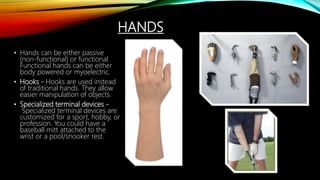
• Hands can be either passive
(non-functional) or functional.
Functional hands can be either
body powered or myoelectric.
• Hooks - Hooks are used instead
of traditional hands. They allow
easier manipulation of objects.
• Specialized terminal devices -
Specialized terminal devices are
customized for a sport, hobby, or
profession. You could have a
baseball mitt attached to the
wrist or a pool/snooker rest.
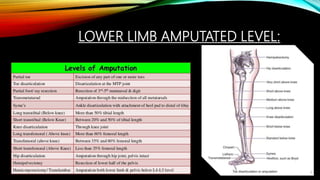
LOWER LIMB AMPUTATED LEVEL:
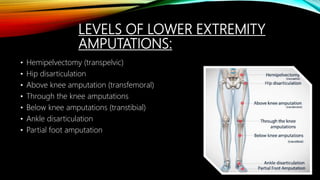
LEVELS OF LOWER EXTREMITY
AMPUTATIONS:
• Hemipelvectomy (transpelvic)
• Hip disarticulation
• Above knee amputation (transfemoral)
• Through the knee amputations
• Below knee amputations (transtibial)
• Ankle disarticulation
• Partial foot amputation
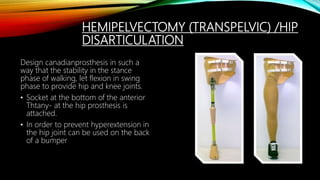
HEMIPELVECTOMY (TRANSPELVIC) /HIP
DISARTICULATION
Design canadianprosthesis in such a
way that the stability in the stance
phase of walking, let flexion in swing
phase to provide hip and knee joints.
• Socket at the bottom of the anterior
Thtany- at the hip prosthesis is
attached.
• In order to prevent hyperextension in
the hip joint can be used on the back
of a bumper
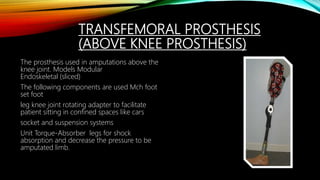
TRANSFEMORAL PROSTHESIS
(ABOVE KNEE PROSTHESIS)
The prosthesis used in amputations above the
knee joint. Models Modular
Endoskeletal (sliced)
The following components are used Mch foot
set foot
leg knee joint rotating adapter to facilitate
patient sitting in confined spaces like cars
socket and suspension systems
Unit Torque-Absorber legs for shock
absorption and decrease the pressure to be
amputated limb.
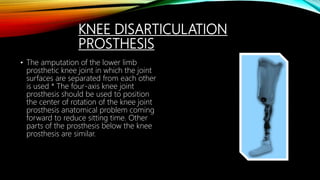
KNEE DISARTICULATION
PROSTHESIS
• The amputation of the lower limb
prosthetic knee joint in which the joint
surfaces are separated from each other
is used * The four-axis knee joint
prosthesis should be used to position
the center of rotation of the knee joint
prosthesis anatomical problem coming
forward to reduce sitting time. Other
parts of the prosthesis below the knee
prosthesis are similar.
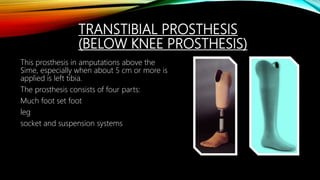
TRANSTIBIAL PROSTHESIS
(BELOW KNEE PROSTHESIS)
This prosthesis in amputations above the
Sime, especially when about 5 cm or more is
applied is left tibia.
The prosthesis consists of four parts:
Much foot set foot
leg
socket and suspension systems
PARTIAL FOOT PROSTHESIS
• This type of prosthesis used in
the amputation of the leg. The main
function of this type of prosthesis to
provide a natural appearance and is
suitable for leg amputation after
surgery. Help take the Push-Off when
walking and also help maintain the
balance of other applications of this
type of prosthesis is
•Thank u sir g…!!!

Orthotics and prosthetics

  • 1.
  • 2.
    TOPIC : UPPER ANDLOWER LIMB PROSTHESIS • Prosthetic: Referring to a prosthesis, an artificial substitute or replacement of a part of the body such as a tooth, eye, a facial bone, the palate, a hip, a knee or another joint, the leg, an arm, etc. • A prosthesis is designed for functional or cosmetic reasons or both. • a prosthesis (plural: prostheses; from Ancient Greek prósthesis, "addition, application, attachment") is an artificial device that replaces a missing body part, which may be lost through trauma, disease, or congenital conditions.
  • 3.
    UPPER LIMB AMPUTATEDLEVEL: Upper-extremity prostheses are used at varying levels of amputation Levels are: • Forequarter • Shoulder dislocation • Tranhumeral • Elbow disarticulation • Transradial • Wrist dislocation • transcarpal
  • 4.
    LEVELS ARE: • ForequarterAmputation - Amputation at the level of the shoulder in which both the shoulder blade and collar bone are removed • Shoulder Disarticulation - Amputation at the level of the shoulder, with the shoulder blade remaining. The collarbone may or may not be removed • Transhumeral (above elbow amputations) - Amputation occurring in the upper arm from the elbow to the shoulder • Transradial (below elbow amputations) - Amputation occurring in the forearm, from the elbow to the wrist • Wrist Disarticulation - Limb is amputated at the level of the wrist • Hand & Partial-Hand Amputations - Finger, thumb or portion of the hand below the wrist
  • 5.
    PROSTHESIS OF UPPERLIMB • Shoulder Disarticulation and Forequarter Amputation Shoulder Disarticulation Myo Hand Prosthesis • There are two basic types of prosthetic arm: dress limbs and work limbs. • Dress limbs look cosmetically appealing but provide little in the way of function. Work limbs might look a little more unusual but can give a great deal more functionality. Most amputees at this level will opt for a dress limb as a work limb can be very heavy and rather difficult to control. • A myoelectric work limb, which uses muscle contractions to control motors within the hand, wrist and elbow, can be very effective for high-level upper limb amputees.
  • 6.
    SHOULDER DISARTICULATION • ShoulderDisarticulation Prosthesis and Forequarter Prosthesis. • Shoulder Disarticulation Myo Hand Prosthesis. We come up with a huge collection of Shoulder Disarticulation Myo Hand Prosthesis. The entire range of our Shoulder Disarticulation Myo Hand Prosthesis is known for its support benefits. Our Shoulder Disarticulation Myo Hand Prosthesis is easy, comfortable and inconspicuous to wear. These Shoulder Disarticulation Myo Hand Prosthesis can be obtained from us in standard and customized sizes.
  • 7.
    TRANHUMERAL • Prosthesis foramputation above the elbow. Includes elbow joint and terminal device. • Indications: Good shoulder and upper arm strength, cognitive understanding of prosthesis. • Contraindications: Dependent patient with poor cognition and upper extremity weakness combined with poor support system.
  • 8.
    ABOVE ELBOW MYOHAND PROSTHESIS • Above Elbow Myo Hand Prosthesis is available in variety of specifications and have quality features such as structural sturdiness, dimensional accuracy, durability and long shelf life. Customers can get Above Elbow Myo Hand Prosthesis at reasonable prices from us. Furthermore, Above Elbow Myo Hand Prosthesis can be ordered in bulk and we guarantee to deliver them on time.
  • 9.
    ELBOW DISARTICULATION • Thispart of the prosthesis allows extension and flexion of the forearm. Body powered elbows are flexed using a cable connected to the harness or by lifting and locking them with the sound limb. Electronic elbows are also available for use with myoelectric prosthetics which uses bionic technology to function.
  • 10.
    TRANSRADIAL The amputation ofthe forarm prosthesis was used, with the following components: Or replace the Terminal Device , single wrist (Wrist Unit) , elbow joints, suspension (suspension) , the control system is in two forms, one with physical force patients (Body Powered) or with the force of an (externally powered )external source
  • 11.
    WRIST DISLOCATION • Prosthesisfor amputation at the level of the wrist. Includes terminal device. • Indications: Good shoulder and upper arm strength, cognitive understanding of prosthesis. • Contraindications: Dependent patient with poor cognition and upper extremity weakness combined with poor support system.
  • 12.
    MYOELECTRIC HAND PROSTHESIS •We bring forth a range of highly efficient Myoelectric Hand Prosthesis, which allude to the technological advancement. We source these Artificial Hands from the pioneers of limb prosthetics market. These Hands, we offer, not only address amputee issues, but also appear life like and function incredibly, thereby striving for giving peace of mind in all ways.
  • 13.
    TRANSCARPAL • transcarpal amputationwith regard to providing a long lever arm and preserved supination and pronation. However, wrist flexion and extension are sacrificed. Because of their length, conventional wrist units are not used, and myoelectric fitting is problematic, as in persons with transcarpal amputations. However, current wrist disarticulation prostheses can be fashioned with thin wrist units that minimize the length discrepancy between upper extremities.
  • 14.
    HANDS • Hands canbe either passive (non-functional) or functional. Functional hands can be either body powered or myoelectric. • Hooks - Hooks are used instead of traditional hands. They allow easier manipulation of objects. • Specialized terminal devices - Specialized terminal devices are customized for a sport, hobby, or profession. You could have a baseball mitt attached to the wrist or a pool/snooker rest.
  • 15.
  • 16.
    LEVELS OF LOWEREXTREMITY AMPUTATIONS: • Hemipelvectomy (transpelvic) • Hip disarticulation • Above knee amputation (transfemoral) • Through the knee amputations • Below knee amputations (transtibial) • Ankle disarticulation • Partial foot amputation
  • 17.
    HEMIPELVECTOMY (TRANSPELVIC) /HIP DISARTICULATION Designcanadianprosthesis in such a way that the stability in the stance phase of walking, let flexion in swing phase to provide hip and knee joints. • Socket at the bottom of the anterior Thtany- at the hip prosthesis is attached. • In order to prevent hyperextension in the hip joint can be used on the back of a bumper
  • 18.
    TRANSFEMORAL PROSTHESIS (ABOVE KNEEPROSTHESIS) The prosthesis used in amputations above the knee joint. Models Modular Endoskeletal (sliced) The following components are used Mch foot set foot leg knee joint rotating adapter to facilitate patient sitting in confined spaces like cars socket and suspension systems Unit Torque-Absorber legs for shock absorption and decrease the pressure to be amputated limb.
  • 19.
    KNEE DISARTICULATION PROSTHESIS • Theamputation of the lower limb prosthetic knee joint in which the joint surfaces are separated from each other is used * The four-axis knee joint prosthesis should be used to position the center of rotation of the knee joint prosthesis anatomical problem coming forward to reduce sitting time. Other parts of the prosthesis below the knee prosthesis are similar.
  • 20.
    TRANSTIBIAL PROSTHESIS (BELOW KNEEPROSTHESIS) This prosthesis in amputations above the Sime, especially when about 5 cm or more is applied is left tibia. The prosthesis consists of four parts: Much foot set foot leg socket and suspension systems
  • 21.
    PARTIAL FOOT PROSTHESIS •This type of prosthesis used in the amputation of the leg. The main function of this type of prosthesis to provide a natural appearance and is suitable for leg amputation after surgery. Help take the Push-Off when walking and also help maintain the balance of other applications of this type of prosthesis is
  • 22.