PEDIATRIC HIP ORTHOSES
Dibya Ranjan Swain
MPO
SWAMI VIVEKANAND NATIONAL INSTITUTE OF REHABILITATION TRAINING AND RESAERCH
LAYOUT OF PRESENTATION
 INTRODUCTION
 DEVELOPMENTAL DYSPLASIA OF HIP
 CEREBRAL PALSY
 LEGG-CALVE PERTHES DISEASE
 TORSIONAL DEFORMITIES
 LOWER EXTREMITY WEAKNESS NAD PARALYSIS
 POST-OPERATIVE HIP ORTHOSES
 REFERENCES
INTRODUCTION
 Generally the hip orthoses consist of hip joint, pelvic band, waist belt or pelvic strap, thigh
band or thigh cuff.
 Conditions that fall within this category include :-
1. Developmental dysplasia of the hip (DDH), Legg-Calvé-Perthes disease(LCPD)
2. cerebral palsy (CP)
3. lower limb weakness or paralysis associated with neuromuscular disorders
4. Myelo-dysplasia and spinal cord injury.
 Functions of hip orthoses :-
1. Resist femoral adduction in CP with spastic adduction.
2. In case of LCPD the hip orthoses is used for maintaining the femur in abduction for
containment of femoral head inside the acetabulum.
3. In adults with total hip replacement, hip orthosis is used for post-operative protection of
hip.
DEVELOPMENTAL DYSPLASIA OF THE HIP
 CDH or DDH may be defined as the partial or complete displacement of femoral head from acetabular
cavity.
 DDH is the most common hip disorder in the pediatric population, with 1% to 3% of all newborns
being diagnosed at birth.
 Purpose of orthosis :-
 To attain a concentric reduction of the hip;
 To maintain the reduction;
 To produce normal acetabular and femoral head development;
 To avoid complications of treatment, including stiffness, infection, avascular necrosis (AVN) of femoral
head and femoral nerve palsy.
TYPES OF ORTHOSES
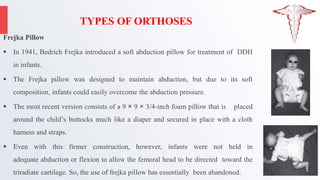
Frejka Pillow
 In 1941, Bedrich Frejka introduced a soft abduction pillow for treatment of DDH
in infants.
 The Frejka pillow was designed to maintain abduction, but due to its soft
composition, infants could easily overcome the abduction pressure.
 The most recent version consists of a 9 × 9 × 3/4-inch foam pillow that is placed
around the child’s buttocks much like a diaper and secured in place with a cloth
harness and straps.
 Even with this firmer construction, however, infants were not held in
adequate abduction or flexion to allow the femoral head to be directed toward the
triradiate cartilage. So, the use of frejka pillow has essentially been abandoned.
Pavlik Harness
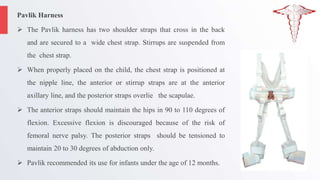
 The Pavlik harness has two shoulder straps that cross in the back
and are secured to a wide chest strap. Stirrups are suspended from
the chest strap.
 When properly placed on the child, the chest strap is positioned at
the nipple line, the anterior or stirrup straps are at the anterior
axillary line, and the posterior straps overlie the scapulae.
 The anterior straps should maintain the hips in 90 to 110 degrees of
flexion. Excessive flexion is discouraged because of the risk of
femoral nerve palsy. The posterior straps should be tensioned to
maintain 20 to 30 degrees of abduction only.
 Pavlik recommended its use for infants under the age of 12 months.
Tübingen Hip Orthosis
 The splint is an update of the traditional Pavlik design.
 It provides hip flexion beyond 90 degrees and abduction but offers the
advantage of leaving the knee and ankle joints free.
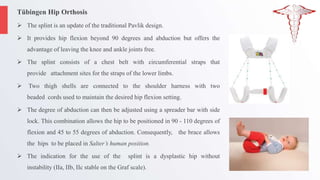
 The splint consists of a chest belt with circumferential straps that
provide attachment sites for the straps of the lower limbs.
 Two thigh shells are connected to the shoulder harness with two
beaded cords used to maintain the desired hip flexion setting.
 The degree of abduction can then be adjusted using a spreader bar with side
lock. This combination allows the hip to be positioned in 90 - 110 degrees of
flexion and 45 to 55 degrees of abduction. Consequently, the brace allows
the hips to be placed in Salter’s human position.
 The indication for the use of the splint is a dysplastic hip without
instability (IIa, IIb, IIc stable on the Graf scale).
Von Rosen Orthosis
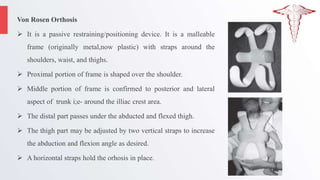
 It is a passive restraining/positioning device. It is a malleable
frame (originally metal,now plastic) with straps around the
shoulders, waist, and thighs.
 Proximal portion of frame is shaped over the shoulder.
 Middle portion of frame is confirmed to posterior and lateral
aspect of trunk i;e- around the illiac crest area.
 The distal part passes under the abducted and flexed thigh.
 The thigh part may be adjusted by two vertical straps to increase
the abduction and flexion angle as desired.
 A horizontal straps hold the orhosis in place.
Ilfeld Orthosis
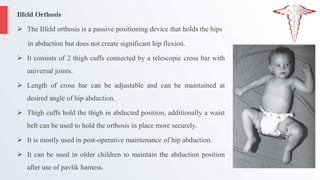
 The Ilfeld orthosis is a passive positioning device that holds the hips
in abduction but does not create significant hip flexion.
 It consists of 2 thigh cuffs connected by a telescopic cross bar with
universal joints.
 Length of cross bar can be adjustable and can be maintained at
desired angle of hip abduction.
 Thigh cuffs hold the thigh in abducted position, additionally a waist
belt can be used to hold the orthosis in place more securely.
 It is mostly used in post-operative maintenance of hip abduction.
 It can be used in older children to maintain the abduction position
after use of pavlik harness.
 Semirigid Plastazote Hip Abduction Orthoses
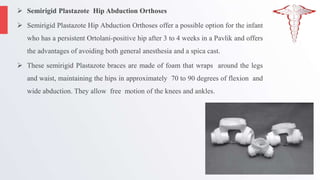
 Semirigid Plastazote Hip Abduction Orthoses offer a possible option for the infant
who has a persistent Ortolani-positive hip after 3 to 4 weeks in a Pavlik and offers
the advantages of avoiding both general anesthesia and a spica cast.
 These semirigid Plastazote braces are made of foam that wraps around the legs
and waist, maintaining the hips in approximately 70 to 90 degrees of flexion and
wide abduction. They allow free motion of the knees and ankles.
Camp Dynamic Hip Abduction Orthosis
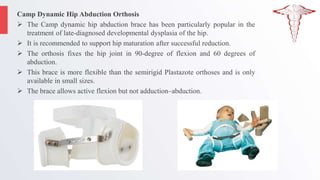
 The Camp dynamic hip abduction brace has been particularly popular in the
treatment of late-diagnosed developmental dysplasia of the hip.
 It is recommended to support hip maturation after successful reduction.
 The orthosis fixes the hip joint in 90-degree of flexion and 60 degrees of
abduction.
 This brace is more flexible than the semirigid Plastazote orthoses and is only
available in small sizes.
 The brace allows active flexion but not adduction–abduction.
CEREBRAL PALSY
 The increased muscle tone and muscular imbalance found in children with CP
leads to limitations in hip ROM and subluxations/dislocations of the hip.
 The goals of treating these hips are to
(1) prevent painful hip subluxation/dislocation and
(2) maintain or improve ROM for purposes of ambulation, sitting balance, and
hygiene.
 Literature on the use of orthoses for the treatment of CP is scant, probably
because of the limited indications for their use in these patients.
 Most commonly, they are used as a temporary adjunct to other treatment modal
ities, such as botulinum toxin type A (Botox) injections or surgical intervention.
TYPES OF ORTHOSES
Resting Abduction Orthoses
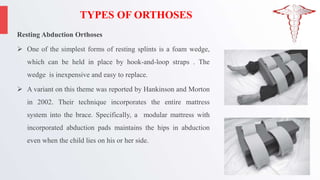
 One of the simplest forms of resting splints is a foam wedge,
which can be held in place by hook-and-loop straps . The
wedge is inexpensive and easy to replace.
 A variant on this theme was reported by Hankinson and Morton
in 2002. Their technique incorporates the entire mattress
system into the brace. Specifically, a modular mattress with
incorporated abduction pads maintains the hips in abduction
even when the child lies on his or her side.
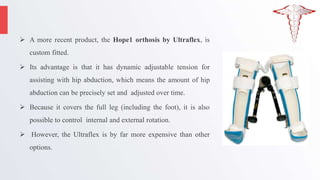
 A more recent product, the Hope1 orthosis by Ultraflex, is
custom fitted.
 Its advantage is that it has dynamic adjustable tension for
assisting with hip abduction, which means the amount of hip
abduction can be precisely set and adjusted over time.
 Because it covers the full leg (including the foot), it is also
possible to control internal and external rotation.
 However, the Ultraflex is by far more expensive than other
options.
SWASH Orthosis
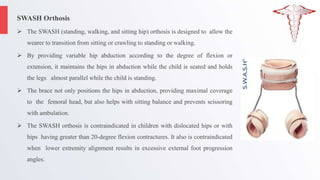
 The SWASH (standing, walking, and sitting hip) orthosis is designed to allow the
wearer to transition from sitting or crawling to standing or walking.
 By providing variable hip abduction according to the degree of flexion or
extension, it maintains the hips in abduction while the child is seated and holds
the legs almost parallel while the child is standing.
 The brace not only positions the hips in abduction, providing maximal coverage
to the femoral head, but also helps with sitting balance and prevents scissoring
with ambulation.
 The SWASH orthosis is contraindicated in children with dislocated hips or with
hips having greater than 20-degree flexion contractures. It also is contraindicated
when lower extremity alignment results in excessive external foot progression
angles.
Lycra Garments
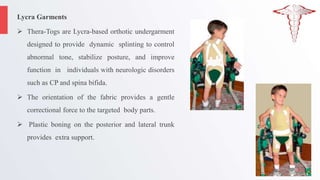
 Thera-Togs are Lycra-based orthotic undergarment
designed to provide dynamic splinting to control
abnormal tone, stabilize posture, and improve
function in individuals with neurologic disorders
such as CP and spina bifida.
 The orientation of the fabric provides a gentle
correctional force to the targeted body parts.
 Plastic boning on the posterior and lateral trunk
provides extra support.
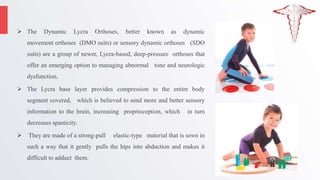
 The Dynamic Lycra Orthoses, better known as dynamic
movement orthoses (DMO suits) or sensory dynamic orthoses (SDO
suits) are a group of newer, Lycra-based, deep-pressure orthoses that
offer an emerging option to managing abnormal tone and neurologic
dysfunction.
 The Lycra base layer provides compression to the entire body
segment covered, which is believed to send more and better sensory
information to the brain, increasing proprioception, which in turn
decreases spasticity.
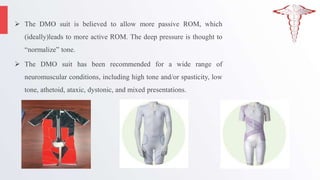
 They are made of a strong-pull elastic-type material that is sewn in
such a way that it gently pulls the hips into abduction and makes it
difficult to adduct them.
 The DMO suit is believed to allow more passive ROM, which
(ideally)leads to more active ROM. The deep pressure is thought to
“normalize” tone.
 The DMO suit has been recommended for a wide range of
neuromuscular conditions, including high tone and/or spasticity, low
tone, athetoid, ataxic, dystonic, and mixed presentations.
LEGG-CALVÉ-PERTHES DISEASE
 This may be defined as an osteochondritis of the capital femoral epiphysis,
characterised by avascular necrosis of the femoral head and disordered
enchondral ossification of the primary and secondary centers of ossification.
 Aim of treatment:-
1. Proper maintenance of shape of femoral head.
2. Prevention of femoral head deformity.
3. Prevention of 2 degree degenerative osteoarthritis.
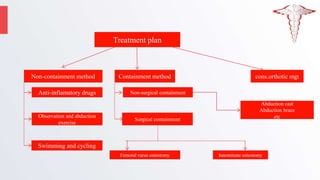
Treatment plan
Non-containment method Containment method cons.orthotic mgt
Anti-inflamatory drugs
Observation and abduction
exercise
Swimming and cycling
Non-surgical containment
Surgical containment
Femoral varus osteotomy Innominate osteotomy
Abduction cast
Abduction brace
etc
TYPES OF ORTHOSES
 Goals of orthotic management
1) Provide non-surgical ambulatory containment option.
2) Reduce synovitis to make the disease symptomatically more tolerable.
3) Promote greater ROM.
Classification
Non-ambulatory orthoses Ambulatory orthoses
NON-AMBULATORY ORTHOSES
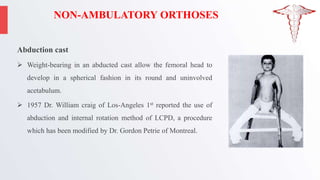
Abduction cast
 Weight-bearing in an abducted cast allow the femoral head to
develop in a spherical fashion in its round and uninvolved
acetabulum.
 1957 Dr. William craig of Los-Angeles 1st reported the use of
abduction and internal rotation method of LCPD, a procedure
which has been modified by Dr. Gordon Petrie of Montreal.
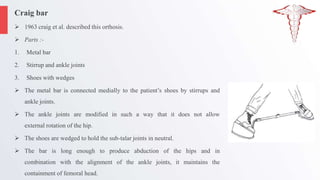
Craig bar
 1963 craig et al. described this orthosis.
 Parts :-
1. Metal bar
2. Stirrup and ankle joints
3. Shoes with wedges
 The metal bar is connected medially to the patient’s shoes by stirrups and
ankle joints.
 The ankle joints are modified in such a way that it does not allow
external rotation of the hip.
 The shoes are wedged to hold the sub-talar joints in neutral.
 The bar is long enough to produce abduction of the hips and in
combination with the alignment of the ankle joints, it maintains the
containment of femoral head.
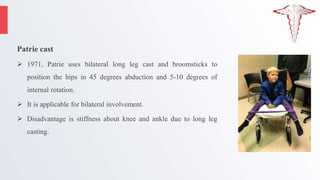
Patrie cast
 1971, Patrie uses bilateral long leg cast and broomsticks to
position the hips in 45 degrees abduction and 5-10 degrees of
internal rotation.
 It is applicable for bilateral involvement.
 Disadvantage is stiffness about knee and ankle due to long leg
casting.
AMBULATORY ORTHOSES
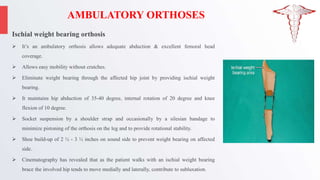
Ischial weight bearing orthosis
 It’s an ambulatory orthosis allows adequate abduction & excellent femoral head
coverage.
 Allows easy mobility without crutches.
 Eliminate weight bearing through the affected hip joint by providing ischial weight
bearing.
 It maintains hip abduction of 35-40 degree, internal rotation of 20 degree and knee
flexion of 10 degree.
 Socket suspension by a shoulder strap and occasionally by a silesian bandage to
minimize pistoning of the orthosis on the leg and to provide rotational stability.
 Shoe build-up of 2 ½ - 3 ½ inches on sound side to prevent weight bearing on affected
side.
 Cinematography has revealed that as the patient walks with an ischial weight bearing
brace the involved hip tends to move medially and laterally, contribute to subluxation.
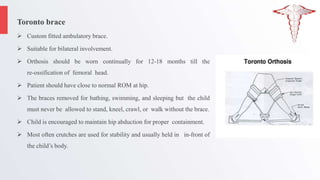
Toronto brace
 Custom fitted ambulatory brace.
 Suitable for bilateral involvement.
 Orthosis should be worn continually for 12-18 months till the
re-ossification of femoral head.
 Patient should have close to normal ROM at hip.
 The braces removed for bathing, swimming, and sleeping but the child
must never be allowed to stand, kneel, crawl, or walk without the brace.
 Child is encouraged to maintain hip abduction for proper containment.
 Most often crutches are used for stability and usually held in in-front of
the child’s body.
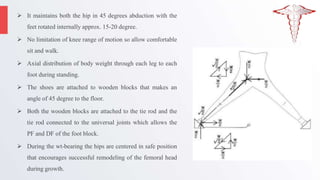
 It maintains both the hip in 45 degrees abduction with the
feet rotated internally approx. 15-20 degree.
 No limitation of knee range of motion so allow comfortable
sit and walk.
 Axial distribution of body weight through each leg to each
foot during standing.
 The shoes are attached to wooden blocks that makes an
angle of 45 degree to the floor.
 Both the wooden blocks are attached to the tie rod and the
tie rod connected to the universal joints which allows the
PF and DF of the foot block.
 During the wt-bearing the hips are centered in safe position
that encourages successful remodeling of the femoral head
during growth.
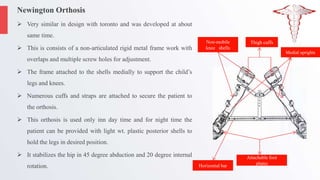
Newington Orthosis
 Very similar in design with toronto and was developed at about
same time.
 This is consists of a non-articulated rigid metal frame work with
overlaps and multiple screw holes for adjustment.
 The frame attached to the shells medially to support the child’s
legs and knees.
 Numerous cuffs and straps are attached to secure the patient to
the orthosis.
 This orthosis is used only inn day time and for night time the
patient can be provided with light wt. plastic posterior shells to
hold the legs in desired position.
 It stabilizes the hip in 45 degree abduction and 20 degree internal
rotation.
Thigh cuffs
Non-mobile
knee shells
Medial uprights
Attachable foot
plates
Horizontal bar
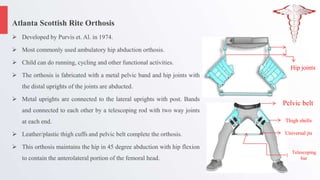
Atlanta Scottish Rite Orthosis
 Developed by Purvis et. Al. in 1974.
 Most commonly used ambulatory hip abduction orthosis.
 Child can do running, cycling and other functional activities.
 The orthosis is fabricated with a metal pelvic band and hip joints with
the distal uprights of the joints are abducted.
 Metal uprights are connected to the lateral uprights with post. Bands
and connected to each other by a telescoping rod with two way joints
at each end.
 Leather/plastic thigh cuffs and pelvic belt complete the orthosis.
 This orthosis maintains the hip in 45 degree abduction with hip flexion
to contain the anterolateral portion of the femoral head.
Pelvic belt
Hip joints
Thigh shells
Universal jts
Telescoping
bar
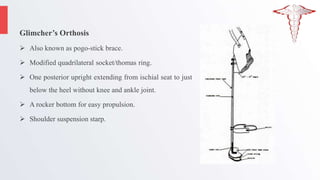
Glimcher’s Orthosis
 Also known as pogo-stick brace.
 Modified quadrilateral socket/thomas ring.
 One posterior upright extending from ischial seat to just
below the heel without knee and ankle joint.
 A rocker bottom for easy propulsion.
 Shoulder suspension starp.
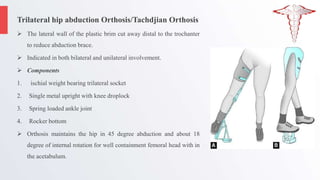
Trilateral hip abduction Orthosis/Tachdjian Orthosis
 The lateral wall of the plastic brim cut away distal to the trochanter
to reduce abduction brace.
 Indicated in both bilateral and unilateral involvement.
 Components
1. ischial weight bearing trilateral socket
2. Single metal upright with knee droplock
3. Spring loaded ankle joint
4. Rocker bottom
 Orthosis maintains the hip in 45 degree abduction and about 18
degree of internal rotation for well containment femoral head with in
the acetabulum.
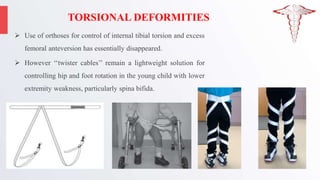
TORSIONAL DEFORMITIES
 Use of orthoses for control of internal tibial torsion and excess
femoral anteversion has essentially disappeared.
 However ‘‘twister cables’’ remain a lightweight solution for
controlling hip and foot rotation in the young child with lower
extremity weakness, particularly spina bifida.
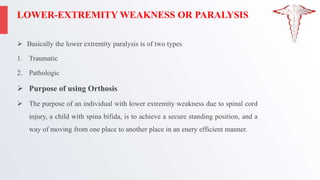
LOWER-EXTREMITY WEAKNESS OR PARALYSIS
 Basically the lower extremity paralysis is of two types
1. Traumatic
2. Pathologic
 Purpose of using Orthosis
 The purpose of an individual with lower extremity weakness due to spinal cord
injury, a child with spina bifida, is to achieve a secure standing position, and a
way of moving from one place to another place in an enery efficient manner.
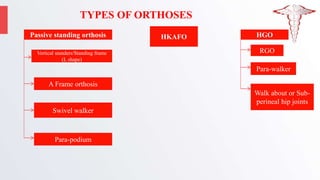
TYPES OF ORTHOSES
Passive standing orthosis
Vertical standers/Standing frame
(L shape)
A Frame orthosis
Swivel walker
Para-podium
HKAFO HGO
RGO
Para-walker
Walk about or Sub-
perineal hip joints
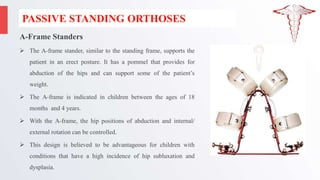
A-Frame Standers
 The A-frame stander, similar to the standing frame, supports the
patient in an erect posture. It has a pommel that provides for
abduction of the hips and can support some of the patient’s
weight.
 The A-frame is indicated in children between the ages of 18
months and 4 years.
 With the A-frame, the hip positions of abduction and internal/
external rotation can be controlled.
 This design is believed to be advantageous for children with
conditions that have a high incidence of hip subluxation and
dysplasia.
PASSIVE STANDING ORTHOSES
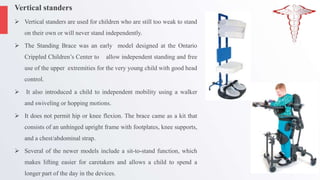
Vertical standers
 Vertical standers are used for children who are still too weak to stand
on their own or will never stand independently.
 The Standing Brace was an early model designed at the Ontario
Crippled Children’s Center to allow independent standing and free
use of the upper extremities for the very young child with good head
control.
 It also introduced a child to independent mobility using a walker
and swiveling or hopping motions.
 It does not permit hip or knee flexion. The brace came as a kit that
consists of an unhinged upright frame with footplates, knee supports,
and a chest/abdominal strap.
 Several of the newer models include a sit-to-stand function, which
makes lifting easier for caretakers and allows a child to spend a
longer part of the day in the devices.
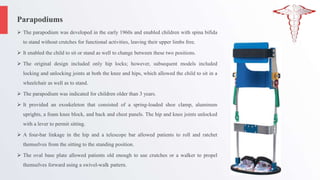
Parapodiums
 The parapodium was developed in the early 1960s and enabled children with spina bifida
to stand without crutches for functional activities, leaving their upper limbs free.
 It enabled the child to sit or stand as well to change between these two positions.
 The original design included only hip locks; however, subsequent models included
locking and unlocking joints at both the knee and hips, which allowed the child to sit in a
wheelchair as well as to stand.
 The parapodium was indicated for children older than 3 years.
 It provided an exoskeleton that consisted of a spring-loaded shoe clamp, aluminum
uprights, a foam knee block, and back and chest panels. The hip and knee joints unlocked
with a lever to permit sitting.
 A four-bar linkage in the hip and a telescope bar allowed patients to roll and ratchet
themselves from the sitting to the standing position.
 The oval base plate allowed patients old enough to use crutches or a walker to propel
themselves forward using a swivel-walk pattern.
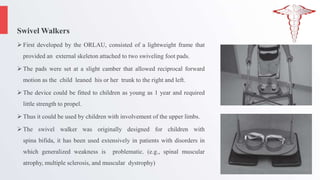
Swivel Walkers
 First developed by the ORLAU, consisted of a lightweight frame that
provided an external skeleton attached to two swiveling foot pads.
 The pads were set at a slight camber that allowed reciprocal forward
motion as the child leaned his or her trunk to the right and left.
 The device could be fitted to children as young as 1 year and required
little strength to propel.
 Thus it could be used by children with involvement of the upper limbs.
 The swivel walker was originally designed for children with
spina bifida, it has been used extensively in patients with disorders in
which generalized weakness is problematic. (e.g., spinal muscular
atrophy, multiple sclerosis, and muscular dystrophy)
 Advantages
 The swivel walker was extremely durable and easily adjusted for growth, amortizing its
cost.
 Disadvantages
 One disadvantage was that it could be used only on flat, smooth surfaces (not uneven
terrain or thick carpets).
 The device was heavy, and two to three people were often required to lift a child upright.
 Finally, movement in the swivel walker was slow. For these reasons, an RGO is generally
preferred for individuals with good trunk and upper limb function.
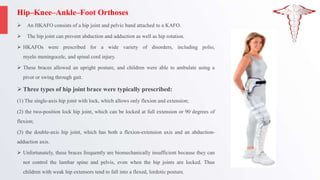
Hip–Knee–Ankle–Foot Orthoses
 An HKAFO consists of a hip joint and pelvic band attached to a KAFO.
 The hip joint can prevent abduction and adduction as well as hip rotation.
 HKAFOs were prescribed for a wide variety of disorders, including polio,
myelo meningocele, and spinal cord injury.
 These braces allowed an upright posture, and children were able to ambulate using a
pivot or swing through gait.
 Three types of hip joint brace were typically prescribed:
(1) The single-axis hip joint with lock, which allows only flexion and extension;
(2) the two-position lock hip joint, which can be locked at full extension or 90 degrees of
flexion;
(3) the double-axis hip joint, which has both a flexion-extension axis and an abduction-
adduction axis.
 Unfortunately, these braces frequently are biomechanically insufficient because they can
not control the lumbar spine and pelvis, even when the hip joints are locked. Thus
children with weak hip extensors tend to fall into a flexed, lordotic posture.
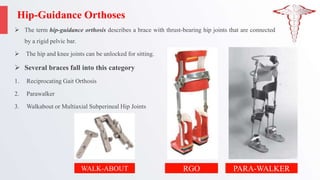
Hip-Guidance Orthoses
 The term hip-guidance orthosis describes a brace with thrust-bearing hip joints that are connected
by a rigid pelvic bar.
 The hip and knee joints can be unlocked for sitting.
 Several braces fall into this category
1. Reciprocating Gait Orthosis
2. Parawalker
3. Walkabout or Multiaxial Subperineal Hip Joints
RGO PARA-WALKER
WALK-ABOUT
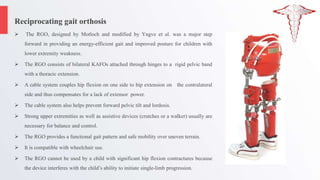
Reciprocating gait orthosis
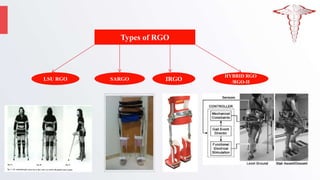
 The RGO, designed by Motloch and modified by Yngve et al. was a major step
forward in providing an energy-efficient gait and improved posture for children with
lower extremity weakness.
 The RGO consists of bilateral KAFOs attached through hinges to a rigid pelvic band
with a thoracic extension.
 A cable system couples hip flexion on one side to hip extension on the contralateral
side and thus compensates for a lack of extensor power.
 The cable system also helps prevent forward pelvic tilt and lordosis.
 Strong upper extremities as well as assistive devices (crutches or a walker) usually are
necessary for balance and control.
 The RGO provides a functional gait pattern and safe mobility over uneven terrain.
 It is compatible with wheelchair use.
 The RGO cannot be used by a child with significant hip flexion contractures because
the device interferes with the child’s ability to initiate single-limb progression.
Types of RGO
LSU RGO SARGO IRGO
HYBRID RGO
/RGO-II
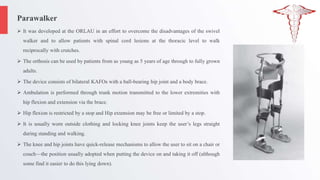
Parawalker
 It was developed at the ORLAU in an effort to overcome the disadvantages of the swivel
walker and to allow patients with spinal cord lesions at the thoracic level to walk
reciprocally with crutches.
 The orthosis can be used by patients from as young as 5 years of age through to fully grown
adults.
 The device consists of bilateral KAFOs with a ball-bearing hip joint and a body brace.
 Ambulation is performed through trunk motion transmitted to the lower extremities with
hip flexion and extension via the brace.
 Hip flexion is restricted by a stop and Hip extension may be free or limited by a stop.
 It is usually worn outside clothing and locking knee joints keep the user’s legs straight
during standing and walking.
 The knee and hip joints have quick-release mechanisms to allow the user to sit on a chair or
couch—the position usually adopted when putting the device on and taking it off (although
some find it easier to do this lying down).
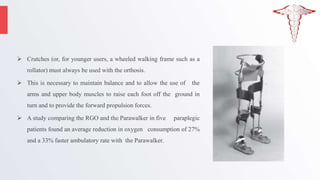
 Crutches (or, for younger users, a wheeled walking frame such as a
rollator) must always be used with the orthosis.
 This is necessary to maintain balance and to allow the use of the
arms and upper body muscles to raise each foot off the ground in
turn and to provide the forward propulsion forces.
 A study comparing the RGO and the Parawalker in five paraplegic
patients found an average reduction in oxygen consumption of 27%
and a 33% faster ambulatory rate with the Parawalker.
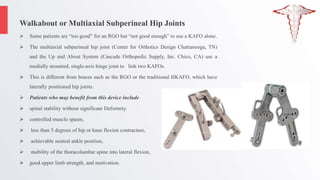
Walkabout or Multiaxial Subperineal Hip Joints
 Some patients are “too good” for an RGO but “not good enough” to use a KAFO alone.
 The multiaxial subperineal hip joint (Center for Orthotics Design Chattanooga, TN)
and the Up and About System (Cascade Orthopedic Supply, Inc. Chico, CA) use a
medially mounted, single-axis hinge joint to link two KAFOs.
 This is different from braces such as the RGO or the traditional HKAFO, which have
laterally positioned hip joints.
 Patients who may benefit from this device include
 spinal stability without significant Deformity.
 controlled muscle spasm,
 less than 5 degrees of hip or knee flexion contracture,
 achievable neutral ankle position,
 mobility of the thoracolumbar spine into lateral flexion,
 good upper limb strength, and motivation.
POSTOPERATIVE HIP ORTHOSES
 After hip-reconstruction surgery for children with hip dysplasia, CP, and spina bifida, hip spica
casts have traditionally been applied and set at 30 degrees of unilateral hip abduction
(combined 60-degree angle) and 30 degrees of hip flexion.
 Hip spicas have a number of disadvantages:-
 They take considerable time to apply at the end of an often already lengthy surgery,
 they preclude visual inspection of surgical wounds during the postoperative period,
 they can cause complications such as pressure sores.
 Other disadvantages of hip spica casts are the need for intensive physiotherapy.
 in some cases, hospital readmission to regain ROM in hip and knee joints that stiffen from
immobility in the cast.
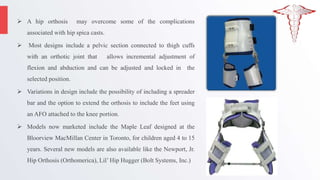
 A hip orthosis may overcome some of the complications
associated with hip spica casts.
 Most designs include a pelvic section connected to thigh cuffs
with an orthotic joint that allows incremental adjustment of
flexion and abduction and can be adjusted and locked in the
selected position.
 Variations in design include the possibility of including a spreader
bar and the option to extend the orthosis to include the feet using
an AFO attached to the knee portion.
 Models now marketed include the Maple Leaf designed at the
Bloorview MacMillan Center in Toronto, for children aged 4 to 15
years. Several new models are also available like the Newport, Jr.
Hip Orthosis (Orthomerica), Lil’ Hip Hugger (Bolt Systems, Inc.)
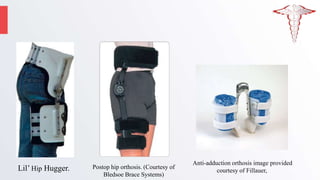
Anti-adduction orthosis image provided
courtesy of Fillauer,
Postop hip orthosis. (Courtesy of
Bledsoe Brace Systems)
Lil’ Hip Hugger.
REFERENCES
1. Abd El-Kafy EM. The clinical impact of orthotic correction of lower limb rotational
deformities in children with cerebral palsy: A randomized controlled trial. Clin Rehabil.
2014;28:1004–1014.
2. Blair E, Ballantyne J, Horsman S, et al. A study of a dynamic proximal stability splint in the
management of children with cerebral palsy. Dev Med Child Neurol. 1995;37:544–554.
3. Anziska Y, Inan S. Exercise in neuromuscular disease. Semin Neurol. 2014;34:542–556.
4. Atalar H, Gunay C, Komurcu M. Functional treatment of developmental hip dysplasia with
the Tübingen hip flexion splint. Hip Int. 2014;24:295–301.
5. Atalar H, Sayli U, Yavuz OY, et al. Indicators of successful use of the Pavlik harness in
infants with developmental dysplasia of the hip. Int Orthop. 2007;31:145–150.
Thank You!!

Pediatric hip orthoses.pptx

  • 1.
    PEDIATRIC HIP ORTHOSES DibyaRanjan Swain MPO SWAMI VIVEKANAND NATIONAL INSTITUTE OF REHABILITATION TRAINING AND RESAERCH
  • 2.
    LAYOUT OF PRESENTATION INTRODUCTION  DEVELOPMENTAL DYSPLASIA OF HIP  CEREBRAL PALSY  LEGG-CALVE PERTHES DISEASE  TORSIONAL DEFORMITIES  LOWER EXTREMITY WEAKNESS NAD PARALYSIS  POST-OPERATIVE HIP ORTHOSES  REFERENCES
  • 3.
    INTRODUCTION  Generally thehip orthoses consist of hip joint, pelvic band, waist belt or pelvic strap, thigh band or thigh cuff.  Conditions that fall within this category include :- 1. Developmental dysplasia of the hip (DDH), Legg-Calvé-Perthes disease(LCPD) 2. cerebral palsy (CP) 3. lower limb weakness or paralysis associated with neuromuscular disorders 4. Myelo-dysplasia and spinal cord injury.  Functions of hip orthoses :- 1. Resist femoral adduction in CP with spastic adduction. 2. In case of LCPD the hip orthoses is used for maintaining the femur in abduction for containment of femoral head inside the acetabulum. 3. In adults with total hip replacement, hip orthosis is used for post-operative protection of hip.
  • 4.
    DEVELOPMENTAL DYSPLASIA OFTHE HIP  CDH or DDH may be defined as the partial or complete displacement of femoral head from acetabular cavity.  DDH is the most common hip disorder in the pediatric population, with 1% to 3% of all newborns being diagnosed at birth.  Purpose of orthosis :-  To attain a concentric reduction of the hip;  To maintain the reduction;  To produce normal acetabular and femoral head development;  To avoid complications of treatment, including stiffness, infection, avascular necrosis (AVN) of femoral head and femoral nerve palsy.
  • 5.
    TYPES OF ORTHOSES FrejkaPillow  In 1941, Bedrich Frejka introduced a soft abduction pillow for treatment of DDH in infants.  The Frejka pillow was designed to maintain abduction, but due to its soft composition, infants could easily overcome the abduction pressure.  The most recent version consists of a 9 × 9 × 3/4-inch foam pillow that is placed around the child’s buttocks much like a diaper and secured in place with a cloth harness and straps.  Even with this firmer construction, however, infants were not held in adequate abduction or flexion to allow the femoral head to be directed toward the triradiate cartilage. So, the use of frejka pillow has essentially been abandoned.
  • 6.
    Pavlik Harness  ThePavlik harness has two shoulder straps that cross in the back and are secured to a wide chest strap. Stirrups are suspended from the chest strap.  When properly placed on the child, the chest strap is positioned at the nipple line, the anterior or stirrup straps are at the anterior axillary line, and the posterior straps overlie the scapulae.  The anterior straps should maintain the hips in 90 to 110 degrees of flexion. Excessive flexion is discouraged because of the risk of femoral nerve palsy. The posterior straps should be tensioned to maintain 20 to 30 degrees of abduction only.  Pavlik recommended its use for infants under the age of 12 months.
  • 7.
    Tübingen Hip Orthosis The splint is an update of the traditional Pavlik design.  It provides hip flexion beyond 90 degrees and abduction but offers the advantage of leaving the knee and ankle joints free.  The splint consists of a chest belt with circumferential straps that provide attachment sites for the straps of the lower limbs.  Two thigh shells are connected to the shoulder harness with two beaded cords used to maintain the desired hip flexion setting.  The degree of abduction can then be adjusted using a spreader bar with side lock. This combination allows the hip to be positioned in 90 - 110 degrees of flexion and 45 to 55 degrees of abduction. Consequently, the brace allows the hips to be placed in Salter’s human position.  The indication for the use of the splint is a dysplastic hip without instability (IIa, IIb, IIc stable on the Graf scale).
  • 8.
    Von Rosen Orthosis It is a passive restraining/positioning device. It is a malleable frame (originally metal,now plastic) with straps around the shoulders, waist, and thighs.  Proximal portion of frame is shaped over the shoulder.  Middle portion of frame is confirmed to posterior and lateral aspect of trunk i;e- around the illiac crest area.  The distal part passes under the abducted and flexed thigh.  The thigh part may be adjusted by two vertical straps to increase the abduction and flexion angle as desired.  A horizontal straps hold the orhosis in place.
  • 9.
    Ilfeld Orthosis  TheIlfeld orthosis is a passive positioning device that holds the hips in abduction but does not create significant hip flexion.  It consists of 2 thigh cuffs connected by a telescopic cross bar with universal joints.  Length of cross bar can be adjustable and can be maintained at desired angle of hip abduction.  Thigh cuffs hold the thigh in abducted position, additionally a waist belt can be used to hold the orthosis in place more securely.  It is mostly used in post-operative maintenance of hip abduction.  It can be used in older children to maintain the abduction position after use of pavlik harness.
  • 10.
     Semirigid PlastazoteHip Abduction Orthoses  Semirigid Plastazote Hip Abduction Orthoses offer a possible option for the infant who has a persistent Ortolani-positive hip after 3 to 4 weeks in a Pavlik and offers the advantages of avoiding both general anesthesia and a spica cast.  These semirigid Plastazote braces are made of foam that wraps around the legs and waist, maintaining the hips in approximately 70 to 90 degrees of flexion and wide abduction. They allow free motion of the knees and ankles.
  • 11.
    Camp Dynamic HipAbduction Orthosis  The Camp dynamic hip abduction brace has been particularly popular in the treatment of late-diagnosed developmental dysplasia of the hip.  It is recommended to support hip maturation after successful reduction.  The orthosis fixes the hip joint in 90-degree of flexion and 60 degrees of abduction.  This brace is more flexible than the semirigid Plastazote orthoses and is only available in small sizes.  The brace allows active flexion but not adduction–abduction.
  • 12.
    CEREBRAL PALSY  Theincreased muscle tone and muscular imbalance found in children with CP leads to limitations in hip ROM and subluxations/dislocations of the hip.  The goals of treating these hips are to (1) prevent painful hip subluxation/dislocation and (2) maintain or improve ROM for purposes of ambulation, sitting balance, and hygiene.  Literature on the use of orthoses for the treatment of CP is scant, probably because of the limited indications for their use in these patients.  Most commonly, they are used as a temporary adjunct to other treatment modal ities, such as botulinum toxin type A (Botox) injections or surgical intervention.
  • 13.
    TYPES OF ORTHOSES RestingAbduction Orthoses  One of the simplest forms of resting splints is a foam wedge, which can be held in place by hook-and-loop straps . The wedge is inexpensive and easy to replace.  A variant on this theme was reported by Hankinson and Morton in 2002. Their technique incorporates the entire mattress system into the brace. Specifically, a modular mattress with incorporated abduction pads maintains the hips in abduction even when the child lies on his or her side.
  • 14.
     A morerecent product, the Hope1 orthosis by Ultraflex, is custom fitted.  Its advantage is that it has dynamic adjustable tension for assisting with hip abduction, which means the amount of hip abduction can be precisely set and adjusted over time.  Because it covers the full leg (including the foot), it is also possible to control internal and external rotation.  However, the Ultraflex is by far more expensive than other options.
  • 15.
    SWASH Orthosis  TheSWASH (standing, walking, and sitting hip) orthosis is designed to allow the wearer to transition from sitting or crawling to standing or walking.  By providing variable hip abduction according to the degree of flexion or extension, it maintains the hips in abduction while the child is seated and holds the legs almost parallel while the child is standing.  The brace not only positions the hips in abduction, providing maximal coverage to the femoral head, but also helps with sitting balance and prevents scissoring with ambulation.  The SWASH orthosis is contraindicated in children with dislocated hips or with hips having greater than 20-degree flexion contractures. It also is contraindicated when lower extremity alignment results in excessive external foot progression angles.
  • 16.
    Lycra Garments  Thera-Togsare Lycra-based orthotic undergarment designed to provide dynamic splinting to control abnormal tone, stabilize posture, and improve function in individuals with neurologic disorders such as CP and spina bifida.  The orientation of the fabric provides a gentle correctional force to the targeted body parts.  Plastic boning on the posterior and lateral trunk provides extra support.
  • 17.
     The DynamicLycra Orthoses, better known as dynamic movement orthoses (DMO suits) or sensory dynamic orthoses (SDO suits) are a group of newer, Lycra-based, deep-pressure orthoses that offer an emerging option to managing abnormal tone and neurologic dysfunction.  The Lycra base layer provides compression to the entire body segment covered, which is believed to send more and better sensory information to the brain, increasing proprioception, which in turn decreases spasticity.  They are made of a strong-pull elastic-type material that is sewn in such a way that it gently pulls the hips into abduction and makes it difficult to adduct them.
  • 18.
     The DMOsuit is believed to allow more passive ROM, which (ideally)leads to more active ROM. The deep pressure is thought to “normalize” tone.  The DMO suit has been recommended for a wide range of neuromuscular conditions, including high tone and/or spasticity, low tone, athetoid, ataxic, dystonic, and mixed presentations.
  • 19.
    LEGG-CALVÉ-PERTHES DISEASE  Thismay be defined as an osteochondritis of the capital femoral epiphysis, characterised by avascular necrosis of the femoral head and disordered enchondral ossification of the primary and secondary centers of ossification.  Aim of treatment:- 1. Proper maintenance of shape of femoral head. 2. Prevention of femoral head deformity. 3. Prevention of 2 degree degenerative osteoarthritis.
  • 20.
    Treatment plan Non-containment methodContainment method cons.orthotic mgt Anti-inflamatory drugs Observation and abduction exercise Swimming and cycling Non-surgical containment Surgical containment Femoral varus osteotomy Innominate osteotomy Abduction cast Abduction brace etc
  • 21.
    TYPES OF ORTHOSES Goals of orthotic management 1) Provide non-surgical ambulatory containment option. 2) Reduce synovitis to make the disease symptomatically more tolerable. 3) Promote greater ROM. Classification Non-ambulatory orthoses Ambulatory orthoses
  • 22.
    NON-AMBULATORY ORTHOSES Abduction cast Weight-bearing in an abducted cast allow the femoral head to develop in a spherical fashion in its round and uninvolved acetabulum.  1957 Dr. William craig of Los-Angeles 1st reported the use of abduction and internal rotation method of LCPD, a procedure which has been modified by Dr. Gordon Petrie of Montreal.
  • 23.
    Craig bar  1963craig et al. described this orthosis.  Parts :- 1. Metal bar 2. Stirrup and ankle joints 3. Shoes with wedges  The metal bar is connected medially to the patient’s shoes by stirrups and ankle joints.  The ankle joints are modified in such a way that it does not allow external rotation of the hip.  The shoes are wedged to hold the sub-talar joints in neutral.  The bar is long enough to produce abduction of the hips and in combination with the alignment of the ankle joints, it maintains the containment of femoral head.
  • 24.
    Patrie cast  1971,Patrie uses bilateral long leg cast and broomsticks to position the hips in 45 degrees abduction and 5-10 degrees of internal rotation.  It is applicable for bilateral involvement.  Disadvantage is stiffness about knee and ankle due to long leg casting.
  • 25.
    AMBULATORY ORTHOSES Ischial weightbearing orthosis  It’s an ambulatory orthosis allows adequate abduction & excellent femoral head coverage.  Allows easy mobility without crutches.  Eliminate weight bearing through the affected hip joint by providing ischial weight bearing.  It maintains hip abduction of 35-40 degree, internal rotation of 20 degree and knee flexion of 10 degree.  Socket suspension by a shoulder strap and occasionally by a silesian bandage to minimize pistoning of the orthosis on the leg and to provide rotational stability.  Shoe build-up of 2 ½ - 3 ½ inches on sound side to prevent weight bearing on affected side.  Cinematography has revealed that as the patient walks with an ischial weight bearing brace the involved hip tends to move medially and laterally, contribute to subluxation.
  • 26.
    Toronto brace  Customfitted ambulatory brace.  Suitable for bilateral involvement.  Orthosis should be worn continually for 12-18 months till the re-ossification of femoral head.  Patient should have close to normal ROM at hip.  The braces removed for bathing, swimming, and sleeping but the child must never be allowed to stand, kneel, crawl, or walk without the brace.  Child is encouraged to maintain hip abduction for proper containment.  Most often crutches are used for stability and usually held in in-front of the child’s body.
  • 27.
     It maintainsboth the hip in 45 degrees abduction with the feet rotated internally approx. 15-20 degree.  No limitation of knee range of motion so allow comfortable sit and walk.  Axial distribution of body weight through each leg to each foot during standing.  The shoes are attached to wooden blocks that makes an angle of 45 degree to the floor.  Both the wooden blocks are attached to the tie rod and the tie rod connected to the universal joints which allows the PF and DF of the foot block.  During the wt-bearing the hips are centered in safe position that encourages successful remodeling of the femoral head during growth.
  • 28.
    Newington Orthosis  Verysimilar in design with toronto and was developed at about same time.  This is consists of a non-articulated rigid metal frame work with overlaps and multiple screw holes for adjustment.  The frame attached to the shells medially to support the child’s legs and knees.  Numerous cuffs and straps are attached to secure the patient to the orthosis.  This orthosis is used only inn day time and for night time the patient can be provided with light wt. plastic posterior shells to hold the legs in desired position.  It stabilizes the hip in 45 degree abduction and 20 degree internal rotation. Thigh cuffs Non-mobile knee shells Medial uprights Attachable foot plates Horizontal bar
  • 29.
    Atlanta Scottish RiteOrthosis  Developed by Purvis et. Al. in 1974.  Most commonly used ambulatory hip abduction orthosis.  Child can do running, cycling and other functional activities.  The orthosis is fabricated with a metal pelvic band and hip joints with the distal uprights of the joints are abducted.  Metal uprights are connected to the lateral uprights with post. Bands and connected to each other by a telescoping rod with two way joints at each end.  Leather/plastic thigh cuffs and pelvic belt complete the orthosis.  This orthosis maintains the hip in 45 degree abduction with hip flexion to contain the anterolateral portion of the femoral head. Pelvic belt Hip joints Thigh shells Universal jts Telescoping bar
  • 30.
    Glimcher’s Orthosis  Alsoknown as pogo-stick brace.  Modified quadrilateral socket/thomas ring.  One posterior upright extending from ischial seat to just below the heel without knee and ankle joint.  A rocker bottom for easy propulsion.  Shoulder suspension starp.
  • 31.
    Trilateral hip abductionOrthosis/Tachdjian Orthosis  The lateral wall of the plastic brim cut away distal to the trochanter to reduce abduction brace.  Indicated in both bilateral and unilateral involvement.  Components 1. ischial weight bearing trilateral socket 2. Single metal upright with knee droplock 3. Spring loaded ankle joint 4. Rocker bottom  Orthosis maintains the hip in 45 degree abduction and about 18 degree of internal rotation for well containment femoral head with in the acetabulum.
  • 32.
    TORSIONAL DEFORMITIES  Useof orthoses for control of internal tibial torsion and excess femoral anteversion has essentially disappeared.  However ‘‘twister cables’’ remain a lightweight solution for controlling hip and foot rotation in the young child with lower extremity weakness, particularly spina bifida.
  • 33.
    LOWER-EXTREMITY WEAKNESS ORPARALYSIS  Basically the lower extremity paralysis is of two types 1. Traumatic 2. Pathologic  Purpose of using Orthosis  The purpose of an individual with lower extremity weakness due to spinal cord injury, a child with spina bifida, is to achieve a secure standing position, and a way of moving from one place to another place in an enery efficient manner.
  • 34.
    TYPES OF ORTHOSES Passivestanding orthosis Vertical standers/Standing frame (L shape) A Frame orthosis Swivel walker Para-podium HKAFO HGO RGO Para-walker Walk about or Sub- perineal hip joints
  • 35.
    A-Frame Standers  TheA-frame stander, similar to the standing frame, supports the patient in an erect posture. It has a pommel that provides for abduction of the hips and can support some of the patient’s weight.  The A-frame is indicated in children between the ages of 18 months and 4 years.  With the A-frame, the hip positions of abduction and internal/ external rotation can be controlled.  This design is believed to be advantageous for children with conditions that have a high incidence of hip subluxation and dysplasia. PASSIVE STANDING ORTHOSES
  • 36.
    Vertical standers  Verticalstanders are used for children who are still too weak to stand on their own or will never stand independently.  The Standing Brace was an early model designed at the Ontario Crippled Children’s Center to allow independent standing and free use of the upper extremities for the very young child with good head control.  It also introduced a child to independent mobility using a walker and swiveling or hopping motions.  It does not permit hip or knee flexion. The brace came as a kit that consists of an unhinged upright frame with footplates, knee supports, and a chest/abdominal strap.  Several of the newer models include a sit-to-stand function, which makes lifting easier for caretakers and allows a child to spend a longer part of the day in the devices.
  • 37.
    Parapodiums  The parapodiumwas developed in the early 1960s and enabled children with spina bifida to stand without crutches for functional activities, leaving their upper limbs free.  It enabled the child to sit or stand as well to change between these two positions.  The original design included only hip locks; however, subsequent models included locking and unlocking joints at both the knee and hips, which allowed the child to sit in a wheelchair as well as to stand.  The parapodium was indicated for children older than 3 years.  It provided an exoskeleton that consisted of a spring-loaded shoe clamp, aluminum uprights, a foam knee block, and back and chest panels. The hip and knee joints unlocked with a lever to permit sitting.  A four-bar linkage in the hip and a telescope bar allowed patients to roll and ratchet themselves from the sitting to the standing position.  The oval base plate allowed patients old enough to use crutches or a walker to propel themselves forward using a swivel-walk pattern.
  • 38.
    Swivel Walkers  Firstdeveloped by the ORLAU, consisted of a lightweight frame that provided an external skeleton attached to two swiveling foot pads.  The pads were set at a slight camber that allowed reciprocal forward motion as the child leaned his or her trunk to the right and left.  The device could be fitted to children as young as 1 year and required little strength to propel.  Thus it could be used by children with involvement of the upper limbs.  The swivel walker was originally designed for children with spina bifida, it has been used extensively in patients with disorders in which generalized weakness is problematic. (e.g., spinal muscular atrophy, multiple sclerosis, and muscular dystrophy)
  • 39.
     Advantages  Theswivel walker was extremely durable and easily adjusted for growth, amortizing its cost.  Disadvantages  One disadvantage was that it could be used only on flat, smooth surfaces (not uneven terrain or thick carpets).  The device was heavy, and two to three people were often required to lift a child upright.  Finally, movement in the swivel walker was slow. For these reasons, an RGO is generally preferred for individuals with good trunk and upper limb function.
  • 40.
    Hip–Knee–Ankle–Foot Orthoses  AnHKAFO consists of a hip joint and pelvic band attached to a KAFO.  The hip joint can prevent abduction and adduction as well as hip rotation.  HKAFOs were prescribed for a wide variety of disorders, including polio, myelo meningocele, and spinal cord injury.  These braces allowed an upright posture, and children were able to ambulate using a pivot or swing through gait.  Three types of hip joint brace were typically prescribed: (1) The single-axis hip joint with lock, which allows only flexion and extension; (2) the two-position lock hip joint, which can be locked at full extension or 90 degrees of flexion; (3) the double-axis hip joint, which has both a flexion-extension axis and an abduction- adduction axis.  Unfortunately, these braces frequently are biomechanically insufficient because they can not control the lumbar spine and pelvis, even when the hip joints are locked. Thus children with weak hip extensors tend to fall into a flexed, lordotic posture.
  • 41.
    Hip-Guidance Orthoses  Theterm hip-guidance orthosis describes a brace with thrust-bearing hip joints that are connected by a rigid pelvic bar.  The hip and knee joints can be unlocked for sitting.  Several braces fall into this category 1. Reciprocating Gait Orthosis 2. Parawalker 3. Walkabout or Multiaxial Subperineal Hip Joints RGO PARA-WALKER WALK-ABOUT
  • 42.
    Reciprocating gait orthosis The RGO, designed by Motloch and modified by Yngve et al. was a major step forward in providing an energy-efficient gait and improved posture for children with lower extremity weakness.  The RGO consists of bilateral KAFOs attached through hinges to a rigid pelvic band with a thoracic extension.  A cable system couples hip flexion on one side to hip extension on the contralateral side and thus compensates for a lack of extensor power.  The cable system also helps prevent forward pelvic tilt and lordosis.  Strong upper extremities as well as assistive devices (crutches or a walker) usually are necessary for balance and control.  The RGO provides a functional gait pattern and safe mobility over uneven terrain.  It is compatible with wheelchair use.  The RGO cannot be used by a child with significant hip flexion contractures because the device interferes with the child’s ability to initiate single-limb progression.
  • 43.
    Types of RGO LSURGO SARGO IRGO HYBRID RGO /RGO-II
  • 44.
    Parawalker  It wasdeveloped at the ORLAU in an effort to overcome the disadvantages of the swivel walker and to allow patients with spinal cord lesions at the thoracic level to walk reciprocally with crutches.  The orthosis can be used by patients from as young as 5 years of age through to fully grown adults.  The device consists of bilateral KAFOs with a ball-bearing hip joint and a body brace.  Ambulation is performed through trunk motion transmitted to the lower extremities with hip flexion and extension via the brace.  Hip flexion is restricted by a stop and Hip extension may be free or limited by a stop.  It is usually worn outside clothing and locking knee joints keep the user’s legs straight during standing and walking.  The knee and hip joints have quick-release mechanisms to allow the user to sit on a chair or couch—the position usually adopted when putting the device on and taking it off (although some find it easier to do this lying down).
  • 45.
     Crutches (or,for younger users, a wheeled walking frame such as a rollator) must always be used with the orthosis.  This is necessary to maintain balance and to allow the use of the arms and upper body muscles to raise each foot off the ground in turn and to provide the forward propulsion forces.  A study comparing the RGO and the Parawalker in five paraplegic patients found an average reduction in oxygen consumption of 27% and a 33% faster ambulatory rate with the Parawalker.
  • 46.
    Walkabout or MultiaxialSubperineal Hip Joints  Some patients are “too good” for an RGO but “not good enough” to use a KAFO alone.  The multiaxial subperineal hip joint (Center for Orthotics Design Chattanooga, TN) and the Up and About System (Cascade Orthopedic Supply, Inc. Chico, CA) use a medially mounted, single-axis hinge joint to link two KAFOs.  This is different from braces such as the RGO or the traditional HKAFO, which have laterally positioned hip joints.  Patients who may benefit from this device include  spinal stability without significant Deformity.  controlled muscle spasm,  less than 5 degrees of hip or knee flexion contracture,  achievable neutral ankle position,  mobility of the thoracolumbar spine into lateral flexion,  good upper limb strength, and motivation.
  • 47.
    POSTOPERATIVE HIP ORTHOSES After hip-reconstruction surgery for children with hip dysplasia, CP, and spina bifida, hip spica casts have traditionally been applied and set at 30 degrees of unilateral hip abduction (combined 60-degree angle) and 30 degrees of hip flexion.  Hip spicas have a number of disadvantages:-  They take considerable time to apply at the end of an often already lengthy surgery,  they preclude visual inspection of surgical wounds during the postoperative period,  they can cause complications such as pressure sores.  Other disadvantages of hip spica casts are the need for intensive physiotherapy.  in some cases, hospital readmission to regain ROM in hip and knee joints that stiffen from immobility in the cast.
  • 48.
     A hiporthosis may overcome some of the complications associated with hip spica casts.  Most designs include a pelvic section connected to thigh cuffs with an orthotic joint that allows incremental adjustment of flexion and abduction and can be adjusted and locked in the selected position.  Variations in design include the possibility of including a spreader bar and the option to extend the orthosis to include the feet using an AFO attached to the knee portion.  Models now marketed include the Maple Leaf designed at the Bloorview MacMillan Center in Toronto, for children aged 4 to 15 years. Several new models are also available like the Newport, Jr. Hip Orthosis (Orthomerica), Lil’ Hip Hugger (Bolt Systems, Inc.)
  • 49.
    Anti-adduction orthosis imageprovided courtesy of Fillauer, Postop hip orthosis. (Courtesy of Bledsoe Brace Systems) Lil’ Hip Hugger.
  • 50.
    REFERENCES 1. Abd El-KafyEM. The clinical impact of orthotic correction of lower limb rotational deformities in children with cerebral palsy: A randomized controlled trial. Clin Rehabil. 2014;28:1004–1014. 2. Blair E, Ballantyne J, Horsman S, et al. A study of a dynamic proximal stability splint in the management of children with cerebral palsy. Dev Med Child Neurol. 1995;37:544–554. 3. Anziska Y, Inan S. Exercise in neuromuscular disease. Semin Neurol. 2014;34:542–556. 4. Atalar H, Gunay C, Komurcu M. Functional treatment of developmental hip dysplasia with the Tübingen hip flexion splint. Hip Int. 2014;24:295–301. 5. Atalar H, Sayli U, Yavuz OY, et al. Indicators of successful use of the Pavlik harness in infants with developmental dysplasia of the hip. Int Orthop. 2007;31:145–150.
  • 51.