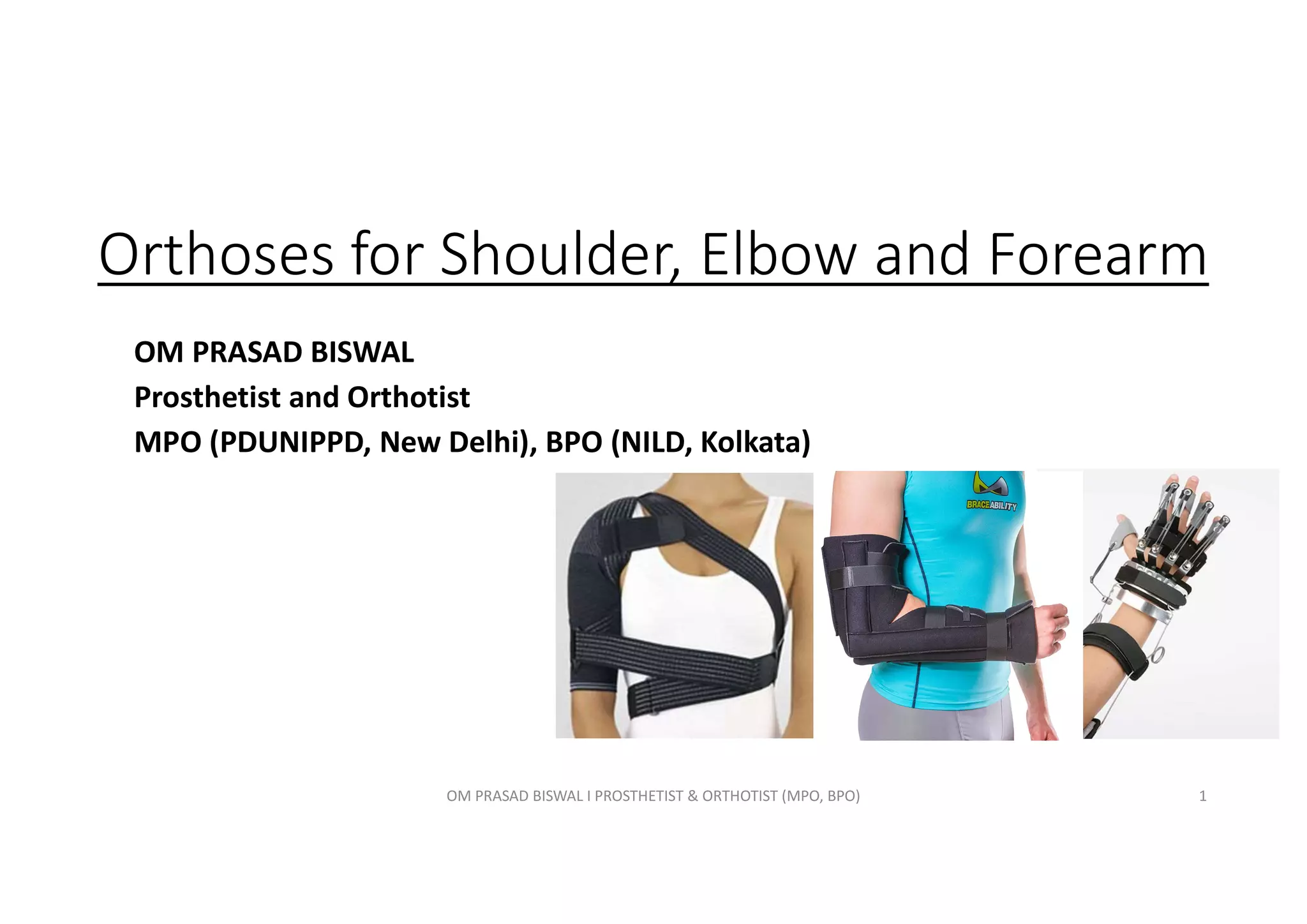
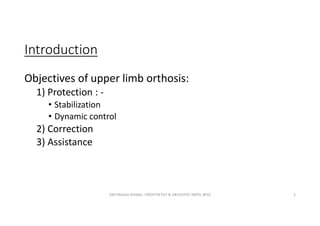
Orthoses for Shoulder, Elbow and Forearm
OM PRASAD BISWAL
Prosthetist and Orthotist
MPO (PDUNIPPD, New Delhi), BPO (NILD, Kolkata)
OM PRASAD BISWAL I PROSTHETIST & ORTHOTIST (MPO, BPO) 1
Introduction
Objectives of upper limb orthosis:
1) Protection : -
• Stabilization
• Dynamic control
2) Correction
3) Assistance
OM PRASAD BISWAL I PROSTHETIST & ORTHOTIST (MPO, BPO) 2
• To immobilize a body part to promote tissue healing
• Prevent contractures
• Increase ROM
• Correct deformities
• Strengthen muscles
• Reduce tone
• Reduce pain
• Restrict motion to prevent harmful postures
OM PRASAD BISWAL I PROSTHETIST & ORTHOTIST (MPO, BPO) 3
Nomenclature
On basis of –
• Joint they cover
• the function they provide
• condition they treat
• by appearance
• name of the person who designed them
OM PRASAD BISWAL I PROSTHETIST & ORTHOTIST (MPO, BPO) 4
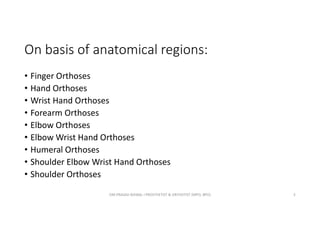
On basis of anatomical regions:
• Finger Orthoses
• Hand Orthoses
• Wrist Hand Orthoses
• Forearm Orthoses
• Elbow Orthoses
• Elbow Wrist Hand Orthoses
• Humeral Orthoses
• Shoulder Elbow Wrist Hand Orthoses
• Shoulder Orthoses
OM PRASAD BISWAL I PROSTHETIST & ORTHOTIST (MPO, BPO) 5
American Society of Hand Therapists published ASHT splint classification
system (SCS) which gives function and body part wise-
There are a total of ten joint levels in the upper extremity. These include
the shoulder, elbow, forearm, wrist, finger MP, finger PIP, finger DIP,
thumb CMC, thumb MP, and thumb IP levels. The type element requires
counting the secondary joint levels. It is critical to understand that only
the joint levels are counted, not the individual joints.
OM PRASAD BISWAL I PROSTHETIST & ORTHOTIST (MPO, BPO) 6
OM PRASAD BISWAL I PROSTHETIST & ORTHOTIST (MPO, BPO) 7
Based on design:
• Non-articular
• Static
• Serial static
• Static motion-blocking
• Static progressive
• Dynamic
• Dynamic motion-blocking
• Dynamic traction splints
• Tenodesis
• Continuous passive motion orthoses
• Adaptive or functional usage
OM PRASAD BISWAL I PROSTHETIST & ORTHOTIST (MPO, BPO) 8
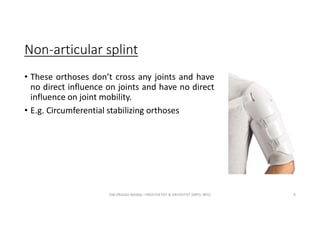
Non-articular splint
• These orthoses don’t cross any joints and have
no direct influence on joints and have no direct
influence on joint mobility.
• E.g. Circumferential stabilizing orthoses
OM PRASAD BISWAL I PROSTHETIST & ORTHOTIST (MPO, BPO) 9
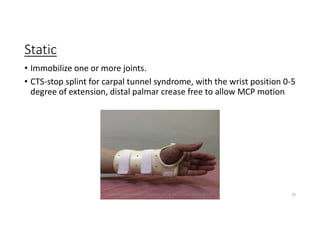
Static
• Immobilize one or more joints.
• CTS-stop splint for carpal tunnel syndrome, with the wrist position 0-5
degree of extension, distal palmar crease free to allow MCP motion
OM PRASAD BISWAL I PROSTHETIST & ORTHOTIST (MPO, BPO) 10
Cont.
• Maintain tissue length to prevent contractures.
• Rest injured or inflamed tissues to reduce inflammation and pain.
• Stabilize injured structures to promote healing.
• Unload tissues to promote resorption of lax structures such as
ligaments or capsules to correct joint instability.
• Reduce muscle tone of spastic muscles.
OM PRASAD BISWAL I PROSTHETIST & ORTHOTIST (MPO, BPO) 11
Serial static splint
• Immobilize one or more joints.
• It is also static but is periodically changed to alter the joint angle at
which the splint is positioned. The splints are applied with the tissue at
its maximum length.
• Reduce muscle tone of spastic muscles.
• Correct contractures by applying a gentle, prolonged stretch to
promote growth of contracted soft tissues.
OM PRASAD BISWAL I PROSTHETIST & ORTHOTIST (MPO, BPO) 12
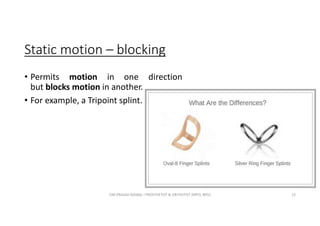
Static motion – blocking
• Permits motion in one direction
but blocks motion in another.
• For example, a Tripoint splint.
OM PRASAD BISWAL I PROSTHETIST & ORTHOTIST (MPO, BPO) 13
Cont.
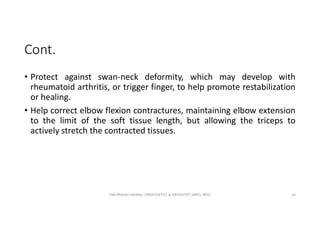
• Protect against swan-neck deformity, which may develop with
rheumatoid arthritis, or trigger finger, to help promote restabilization
or healing.
• Help correct elbow flexion contractures, maintaining elbow extension
to the limit of the soft tissue length, but allowing the triceps to
actively stretch the contracted tissues.
OM PRASAD BISWAL I PROSTHETIST & ORTHOTIST (MPO, BPO) 14
Static progressive splint
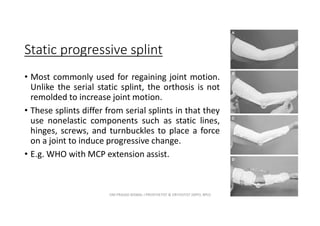
• Most commonly used for regaining joint motion.
Unlike the serial static splint, the orthosis is not
remolded to increase joint motion.
• These splints differ from serial splints in that they
use nonelastic components such as static lines,
hinges, screws, and turnbuckles to place a force
on a joint to induce progressive change.
• E.g. WHO with MCP extension assist.
OM PRASAD BISWAL I PROSTHETIST & ORTHOTIST (MPO, BPO) 15
Dynamic splint
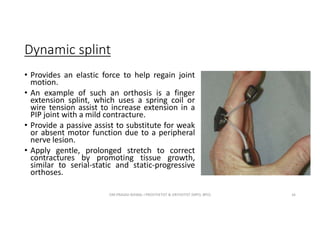
• Provides an elastic force to help regain joint
motion.
• An example of such an orthosis is a finger
extension splint, which uses a spring coil or
wire tension assist to increase extension in a
PIP joint with a mild contracture.
• Provide a passive assist to substitute for weak
or absent motor function due to a peripheral
nerve lesion.
• Apply gentle, prolonged stretch to correct
contractures by promoting tissue growth,
similar to serial-static and static-progressive
orthoses.
OM PRASAD BISWAL I PROSTHETIST & ORTHOTIST (MPO, BPO) 16
Dynamic motion-blocking splint
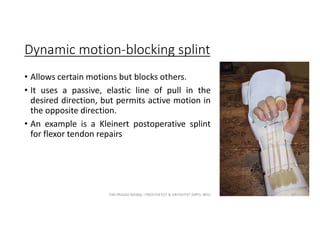
• Allows certain motions but blocks others.
• It uses a passive, elastic line of pull in the
desired direction, but permits active motion in
the opposite direction.
• An example is a Kleinert postoperative splint
for flexor tendon repairs
OM PRASAD BISWAL I PROSTHETIST & ORTHOTIST (MPO, BPO) 17
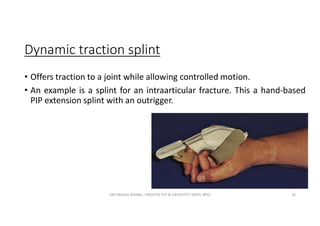
Dynamic traction splint
• Offers traction to a joint while allowing controlled motion.
• An example is a splint for an intraarticular fracture. This a hand-based
PIP extension splint with an outrigger.
OM PRASAD BISWAL I PROSTHETIST & ORTHOTIST (MPO, BPO) 18
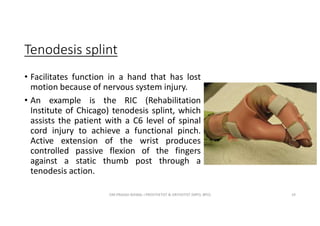
Tenodesis splint
• Facilitates function in a hand that has lost
motion because of nervous system injury.
• An example is the RIC (Rehabilitation
Institute of Chicago) tenodesis splint, which
assists the patient with a C6 level of spinal
cord injury to achieve a functional pinch.
Active extension of the wrist produces
controlled passive flexion of the fingers
against a static thumb post through a
tenodesis action.
OM PRASAD BISWAL I PROSTHETIST & ORTHOTIST (MPO, BPO) 19
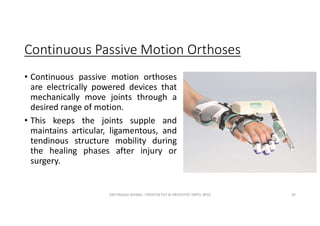
Continuous Passive Motion Orthoses
• Continuous passive motion orthoses
are electrically powered devices that
mechanically move joints through a
desired range of motion.
• This keeps the joints supple and
maintains articular, ligamentous, and
tendinous structure mobility during
the healing phases after injury or
surgery.
OM PRASAD BISWAL I PROSTHETIST & ORTHOTIST (MPO, BPO) 20
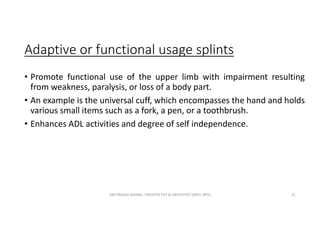
Adaptive or functional usage splints
• Promote functional use of the upper limb with impairment resulting
from weakness, paralysis, or loss of a body part.
• An example is the universal cuff, which encompasses the hand and holds
various small items such as a fork, a pen, or a toothbrush.
• Enhances ADL activities and degree of self independence.
OM PRASAD BISWAL I PROSTHETIST & ORTHOTIST (MPO, BPO) 21
Orthoses for Shoulder and Elbow
OM PRASAD BISWAL I PROSTHETIST & ORTHOTIST (MPO, BPO) 22
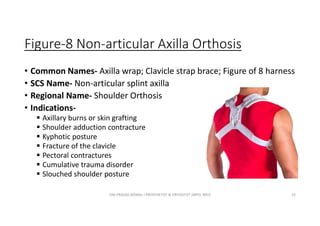
Figure-8 Non-articular Axilla Orthosis
• Common Names- Axilla wrap; Clavicle strap brace; Figure of 8 harness
• SCS Name- Non-articular splint axilla
• Regional Name- Shoulder Orthosis
• Indications-
 Axillary burns or skin grafting
 Shoulder adduction contracture
 Kyphotic posture
 Fracture of the clavicle
 Pectoral contractures
 Cumulative trauma disorder
 Slouched shoulder posture
OM PRASAD BISWAL I PROSTHETIST & ORTHOTIST (MPO, BPO) 23
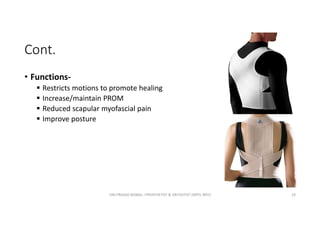
Cont.
• Functions-
 Restricts motions to promote healing
 Increase/maintain PROM
 Reduced scapular myofascial pain
 Improve posture
OM PRASAD BISWAL I PROSTHETIST & ORTHOTIST (MPO, BPO) 24
Lateral Trunk-Based Static Shoulder-Elbow-Wrist
Orthosis
• Common Names- Shoulder/Gunslinger Splint
• SCS Name-Shoulder adduction or abduction
immobilization; type 3[4]
• Functions-
 To fully immobilize the shoulder (and sometimes the
elbow) to promote healing of surgically repaired
bony or soft tissues.
 The elbow and wrist are immobilized to maintain full
control of the shoulder.
OM PRASAD BISWAL I PROSTHETIST & ORTHOTIST (MPO, BPO) 25
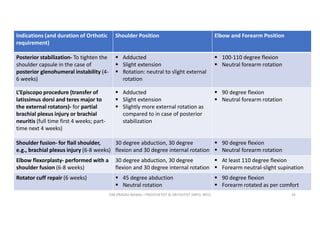
Indications (and duration of Orthotic
requirement)
Shoulder Position Elbow and Forearm Position
Posterior stabilization- To tighten the
shoulder capsule in the case of
posterior glenohumeral instability (4-
6 weeks)
 Adducted
 Slight extension
 Rotation: neutral to slight external
rotation
 100-110 degree flexion
 Neutral forearm rotation
L’Episcopo procedure (transfer of
latissimus dorsi and teres major to
the external rotators)- for partial
brachial plexus injury or brachial
neuritis (full time first 4 weeks; part-
time next 4 weeks)
 Adducted
 Slight extension
 Slightly more external rotation as
compared to in case of posterior
stabilization
 90 degree flexion
 Neutral forearm rotation
Shoulder fusion- for flail shoulder,
e.g., brachial plexus injury (6-8 weeks)
30 degree abduction, 30 degree
flexion and 30 degree internal rotation
 90 degree flexion
 Neutral forearm rotation
Elbow flexorplasty- performed with a
shoulder fusion (6-8 weeks)
30 degree abduction, 30 degree
flexion and 30 degree internal rotation
 At least 110 degree flexion
 Forearm neutral-slight supination
Rotator cuff repair (6 weeks)  45 degree abduction
 Neutral rotation
 90 degree flexion
 Forearm rotated as per comfort
OM PRASAD BISWAL I PROSTHETIST & ORTHOTIST (MPO, BPO) 26
Lateral Trunk-Based Static (or Serial-Static)
Shoulder-Abduction (Elbow-Wrist) Orthosis
• Common Names- Axilla/Airplane
splint/Conformer/Arm abduction splint
• SCS Name- 120 degree shoulder abduction
immobilization/mobilization; type 3[4]
• Indications-
 Axillary burns contractures
 Post operative shoulder fusion
 Post operative scar release
 Shoulder dislocation
 Burns –Shoulder adduction contractures
OM PRASAD BISWAL I PROSTHETIST & ORTHOTIST (MPO, BPO) 27
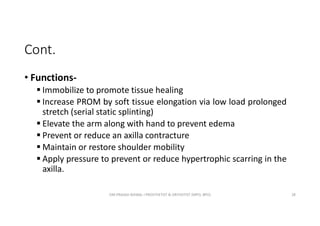
Cont.
• Functions-
 Immobilize to promote tissue healing
 Increase PROM by soft tissue elongation via low load prolonged
stretch (serial static splinting)
 Elevate the arm along with hand to prevent edema
 Prevent or reduce an axilla contracture
 Maintain or restore shoulder mobility
 Apply pressure to prevent or reduce hypertrophic scarring in the
axilla.
OM PRASAD BISWAL I PROSTHETIST & ORTHOTIST (MPO, BPO) 28
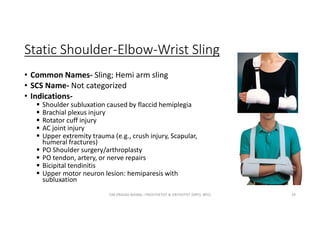
Static Shoulder-Elbow-Wrist Sling
• Common Names- Sling; Hemi arm sling
• SCS Name- Not categorized
• Indications-
 Shoulder subluxation caused by flaccid hemiplegia
 Brachial plexus injury
 Rotator cuff injury
 AC joint injury
 Upper extremity trauma (e.g., crush injury, Scapular,
humeral fractures)
 PO Shoulder surgery/arthroplasty
 PO tendon, artery, or nerve repairs
 Bicipital tendinitis
 Upper motor neuron lesion: hemiparesis with
subluxation
OM PRASAD BISWAL I PROSTHETIST & ORTHOTIST (MPO, BPO) 29
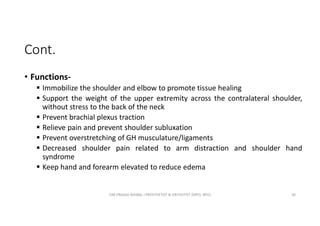
Cont.
• Functions-
 Immobilize the shoulder and elbow to promote tissue healing
 Support the weight of the upper extremity across the contralateral shoulder,
without stress to the back of the neck
 Prevent brachial plexus traction
 Relieve pain and prevent shoulder subluxation
 Prevent overstretching of GH musculature/ligaments
 Decreased shoulder pain related to arm distraction and shoulder hand
syndrome
 Keep hand and forearm elevated to reduce edema
OM PRASAD BISWAL I PROSTHETIST & ORTHOTIST (MPO, BPO) 30
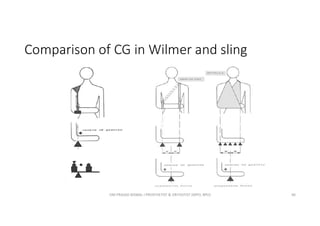
Wilmer Carrying Orthosis
• Indication- Partial or complete shoulder
subluxation, BPI, hemiplegia
• Functions-
 Effective neutralization of shoulder
subluxation.
 Regain some of the arm functions.
 Reduced chance of edema formation in hand,
fingers and forearm.
 Reduced pain and discomfort in arm and
shoulder.
 No neck loading.
 It consists of 3C philosophy.
 Can be worn fully underneath clothing
 Light weight construction.
OM PRASAD BISWAL I PROSTHETIST & ORTHOTIST (MPO, BPO) 31
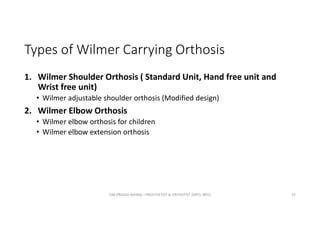
Types of Wilmer Carrying Orthosis
1. Wilmer Shoulder Orthosis ( Standard Unit, Hand free unit and
Wrist free unit)
• Wilmer adjustable shoulder orthosis (Modified design)
2. Wilmer Elbow Orthosis
• Wilmer elbow orthosis for children
• Wilmer elbow extension orthosis
OM PRASAD BISWAL I PROSTHETIST & ORTHOTIST (MPO, BPO) 32
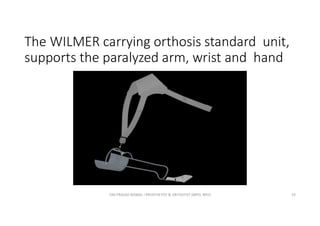
The WILMER carrying orthosis standard unit,
supports the paralyzed arm, wrist and hand
OM PRASAD BISWAL I PROSTHETIST & ORTHOTIST (MPO, BPO) 33
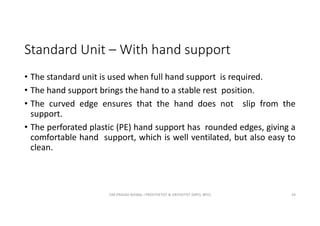
Standard Unit – With hand support
• The standard unit is used when full hand support is required.
• The hand support brings the hand to a stable rest position.
• The curved edge ensures that the hand does not slip from the
support.
• The perforated plastic (PE) hand support has rounded edges, giving a
comfortable hand support, which is well ventilated, but also easy to
clean.
OM PRASAD BISWAL I PROSTHETIST & ORTHOTIST (MPO, BPO) 34
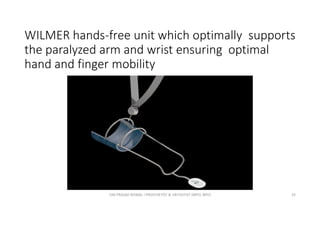
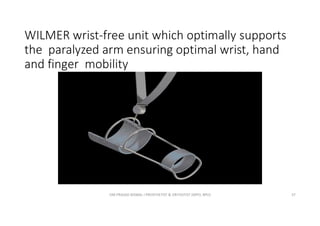
WILMER hands-free unit which optimally supports
the paralyzed arm and wrist ensuring optimal
hand and finger mobility
OM PRASAD BISWAL I PROSTHETIST & ORTHOTIST (MPO, BPO) 35
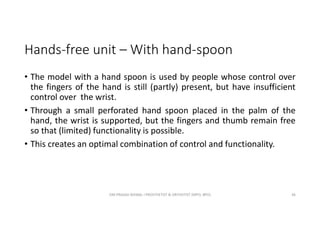
Hands-free unit – With hand-spoon
• The model with a hand spoon is used by people whose control over
the fingers of the hand is still (partly) present, but have insufficient
control over the wrist.
• Through a small perforated hand spoon placed in the palm of the
hand, the wrist is supported, but the fingers and thumb remain free
so that (limited) functionality is possible.
• This creates an optimal combination of control and functionality.
OM PRASAD BISWAL I PROSTHETIST & ORTHOTIST (MPO, BPO) 36
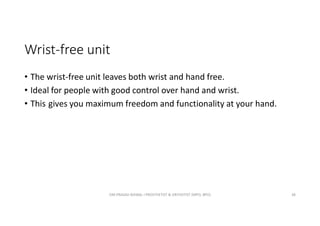
WILMER wrist-free unit which optimally supports
the paralyzed arm ensuring optimal wrist, hand
and finger mobility
OM PRASAD BISWAL I PROSTHETIST & ORTHOTIST (MPO, BPO) 37
Wrist-free unit
• The wrist-free unit leaves both wrist and hand free.
• Ideal for people with good control over hand and wrist.
• This gives you maximum freedom and functionality at your hand.
OM PRASAD BISWAL I PROSTHETIST & ORTHOTIST (MPO, BPO) 38
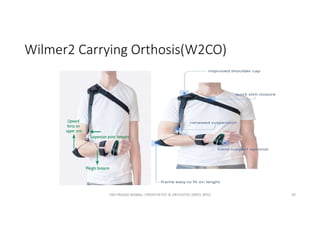
Wilmer2 Carrying Orthosis(W2CO)
OM PRASAD BISWAL I PROSTHETIST & ORTHOTIST (MPO, BPO) 39
Comparison of CG in Wilmer and sling
OM PRASAD BISWAL I PROSTHETIST & ORTHOTIST (MPO, BPO) 40
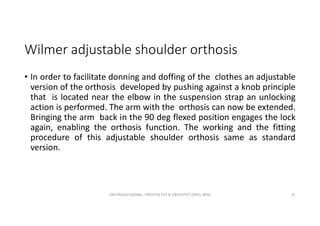
Wilmer adjustable shoulder orthosis
• In order to facilitate donning and doffing of the clothes an adjustable
version of the orthosis developed by pushing against a knob principle
that is located near the elbow in the suspension strap an unlocking
action is performed. The arm with the orthosis can now be extended.
Bringing the arm back in the 90 deg flexed position engages the lock
again, enabling the orthosis function. The working and the fitting
procedure of this adjustable shoulder orthosis same as standard
version.
OM PRASAD BISWAL I PROSTHETIST & ORTHOTIST (MPO, BPO) 41
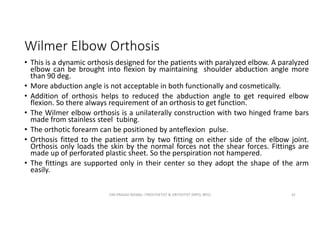
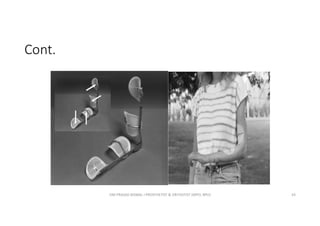
Wilmer Elbow Orthosis
• This is a dynamic orthosis designed for the patients with paralyzed elbow. A paralyzed
elbow can be brought into flexion by maintaining shoulder abduction angle more
than 90 deg.
• More abduction angle is not acceptable in both functionally and cosmetically.
• Addition of orthosis helps to reduced the abduction angle to get required elbow
flexion. So there always requirement of an orthosis to get function.
• The Wilmer elbow orthosis is a unilaterally construction with two hinged frame bars
made from stainless steel tubing.
• The orthotic forearm can be positioned by anteflexion pulse.
• Orthosis fitted to the patient arm by two fitting on either side of the elbow joint.
Orthosis only loads the skin by the normal forces not the shear forces. Fittings are
made up of perforated plastic sheet. So the perspiration not hampered.
• The fittings are supported only in their center so they adopt the shape of the arm
easily.
OM PRASAD BISWAL I PROSTHETIST & ORTHOTIST (MPO, BPO) 42
Cont.
OM PRASAD BISWAL I PROSTHETIST & ORTHOTIST (MPO, BPO) 43
Cont.
• A locking mechanism is added to the orthosis to enable the patient to
retain the flail arm in the flexed position independent of the
abduction/anteflexion angle.
• In this locked position the arm + orthosis is suitable to lift and carry
objects. Second locking position at the near extended arm enables
pushing or clamping of objects, this is useful in donning and doffing.
OM PRASAD BISWAL I PROSTHETIST & ORTHOTIST (MPO, BPO) 44
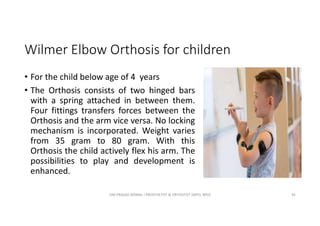
Wilmer Elbow Orthosis for children
• For the child below age of 4 years
• The Orthosis consists of two hinged bars
with a spring attached in between them.
Four fittings transfers forces between the
Orthosis and the arm vice versa. No locking
mechanism is incorporated. Weight varies
from 35 gram to 80 gram. With this
Orthosis the child actively flex his arm. The
possibilities to play and development is
enhanced.
OM PRASAD BISWAL I PROSTHETIST & ORTHOTIST (MPO, BPO) 45
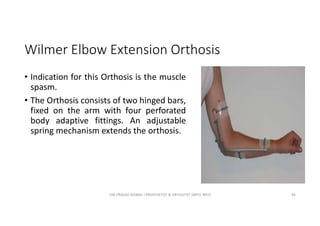
Wilmer Elbow Extension Orthosis
• Indication for this Orthosis is the muscle
spasm.
• The Orthosis consists of two hinged bars,
fixed on the arm with four perforated
body adaptive fittings. An adjustable
spring mechanism extends the orthosis.
OM PRASAD BISWAL I PROSTHETIST & ORTHOTIST (MPO, BPO) 46
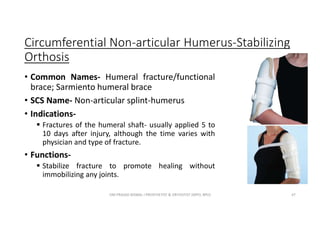
Circumferential Non-articular Humerus-Stabilizing
Orthosis
• Common Names- Humeral fracture/functional
brace; Sarmiento humeral brace
• SCS Name- Non-articular splint-humerus
• Indications-
 Fractures of the humeral shaft- usually applied 5 to
10 days after injury, although the time varies with
physician and type of fracture.
• Functions-
 Stabilize fracture to promote healing without
immobilizing any joints.
OM PRASAD BISWAL I PROSTHETIST & ORTHOTIST (MPO, BPO) 47
Posterior Static Elbow (Wrist) Orthosis
Posterior Static Elbow Flexion-Blocking Orthosis
• Common Names- (Posterior) Elbow Splint/Sugar-tong splint
• SCS Name-
 90 degree flexion immobilization; type 0[1];
 If the wrist is included, it ill be named 90 degree elbow flexion immobilization; type
1[1]
• Indications-
 Rheumatoid arthritis
 CTD
 Forearm fractures
 Post operative elbow arthroplasty
 Elbow surgery
o Ulnar nerve transposition
o Tendon transfers
o Nerve repairs
OM PRASAD BISWAL I PROSTHETIST & ORTHOTIST (MPO, BPO) 48
Cont.
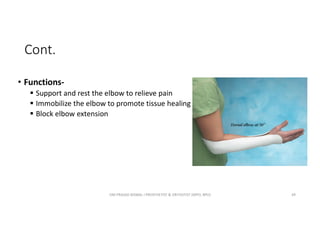
• Functions-
 Support and rest the elbow to relieve pain
 Immobilize the elbow to promote tissue healing
 Block elbow extension
OM PRASAD BISWAL I PROSTHETIST & ORTHOTIST (MPO, BPO) 49
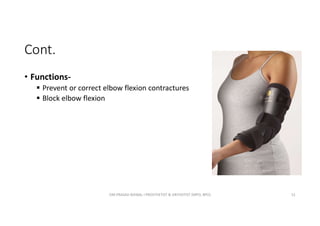
Anterior Static Elbow Orthosis
Anterior Serial-Static Elbow Corrective-Extension Orthosis
Anterior Static Elbow Flexion-Blocking Orthosis
• Common Name- (Anterior) Elbow Splint
• SCS Name- Elbow extension immobilization or mobilization; type 0[1]
• Indications-
 Burns
 Ulnar nerve entrapment
 Capsular tightness
 Elbow injury or surgery
o Multiple trauma
o Intra-articular fractures
o Triceps rupture
o Tumor resection
o Total elbow arthroplasty
OM PRASAD BISWAL I PROSTHETIST & ORTHOTIST (MPO, BPO) 50
Cont.
• Functions-
 Prevent or correct elbow flexion contractures
 Block elbow flexion
OM PRASAD BISWAL I PROSTHETIST & ORTHOTIST (MPO, BPO) 51
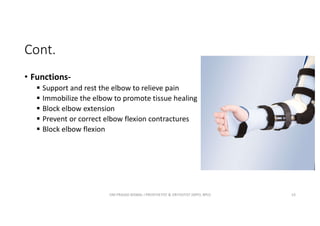
Bi-surfaced Static Elbow Orthosis
Bi-surfaced Serial-Static Elbow Corrective-Flexion/Extension Orthosis
Bi-surfaced Static Elbow Flexion-Blocking Orthosis
• Common Name- Elbow splint
• SCS Name- Elbow extension immobilization splint; type 0[1]
• Indications-
 Burns
 Ulnar nerve entrapment
 Capsular tightness
 Rheumatoid arthritis
 Forearm fractures
 Post operative elbow arthroplasty
 Elbow surgery
o Ulnar nerve transposition
o Tendon transfers
o Nerve repairs
OM PRASAD BISWAL I PROSTHETIST & ORTHOTIST (MPO, BPO) 52
Cont.
• Functions-
 Support and rest the elbow to relieve pain
 Immobilize the elbow to promote tissue healing
 Block elbow extension
 Prevent or correct elbow flexion contractures
 Block elbow flexion
OM PRASAD BISWAL I PROSTHETIST & ORTHOTIST (MPO, BPO) 53
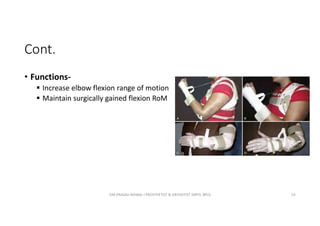
Static-Progressive Elbow-Flexion Harness
• Common Name- Elbow flexion splint
• SCS Name- Elbow flexion mobilization; type 1[2]
• Indications-
 Flexion contractures caused by
o Intra-articular fractures
o Multiple trauma
o Capsular tightness
o Supracondylar fracture
o Radial head fracture
 Post-operatively: total elbow arthroplasty
OM PRASAD BISWAL I PROSTHETIST & ORTHOTIST (MPO, BPO) 54
Cont.
• Functions-
 Increase elbow flexion range of motion
 Maintain surgically gained flexion RoM
OM PRASAD BISWAL I PROSTHETIST & ORTHOTIST (MPO, BPO) 55
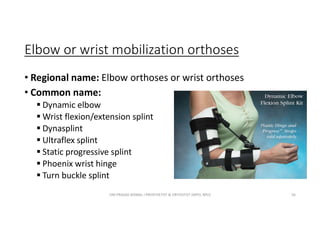
Elbow or wrist mobilization orthoses
• Regional name: Elbow orthoses or wrist orthoses
• Common name:
 Dynamic elbow
 Wrist flexion/extension splint
 Dynasplint
 Ultraflex splint
 Static progressive splint
 Phoenix wrist hinge
 Turn buckle splint
OM PRASAD BISWAL I PROSTHETIST & ORTHOTIST (MPO, BPO) 56
Cont.
• Indications-
 Contracture
 Post operative scar release
 Burns
 Fracture (late phase) Radial nerve lesion
 Spinal cord injury
 Brachial plexus lesion
 Polio
• Functions-
 Increased PROM by soft tissue elongation via low-load prolonged
stretch
 Replace or assist weak wrist extensors to enhance ADL
OM PRASAD BISWAL I PROSTHETIST & ORTHOTIST (MPO, BPO) 57
Biomechanical Efficacy:
Two distinct methods can be used to stretch soft tissue, thereby
encouraging tissue elongation and increased PROM.
1) Serial splinting: With low temperature thermoplastics
(progressive static splinting) or serial casting.
• Advantages: good conformity, little shifting
• Disadvantage : potential skin breakdown
2) Traction : (via elastics, coils, or springs) is applied across the
joint(often a hinged joint)
• Advantage : amount of load can be adjusted
• Disadvantage: forces can cause shifting of orthosis such splints are
more difficult to fabricate unless prefabrications are used.
OM PRASAD BISWAL I PROSTHETIST & ORTHOTIST (MPO, BPO) 58
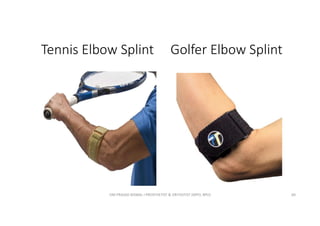
Circumferential Non-articular Proximal Forearm
Strap
• Common Name- Tennis elbow strap; counterforce strap/golfer elbow
strap
• SCS Name- Non-articular splint- proximal forearm
• Indications-
 Inflammation of the common tendon origin of
o Wrist extensors: lateral epicondylitis (Tennis elbow)
o Wrist flexors: medial epicondylitis (Golfer’s elbow)
• Functions-
 Reduce pain and inflammation by reducing tensile force exerted by wrist
extensors or flexors at their origins from the lateral or medial epicondyle,
respectively.
OM PRASAD BISWAL I PROSTHETIST & ORTHOTIST (MPO, BPO) 59
OM PRASAD BISWAL I PROSTHETIST & ORTHOTIST (MPO, BPO) 60
Tennis Elbow Splint Golfer Elbow Splint
Spiral Dynamic Forearm-Rotation Thumb-Abduction
Strap
• Common Name- Thumb abduction supination splint; Prefabricated Rolyan Upper
extremity Tone and Positioning (TAP) Splint
• SCS Name- Forearm pronation/supination mobilization, thumb abduction
mobilization; type 1[3]- i.e., thumb MCP is the secondary joints; primary joints are
forearm and thumb CMC; total joints=3
• Indications-
 Hypertonicity/hypotonicity associated with-
o Head injury
o Cerebral palsy
o Multiple sclerosis
o Cerebrovascular accident
 Peripheral or central nerve lesions
 Distal radio-ulnar joint stiffness
 Forearm stiffness secondary to cast immobilization for a wrist fracture
OM PRASAD BISWAL I PROSTHETIST & ORTHOTIST (MPO, BPO) 61
Cont.
• Functions-
 Abduct the thumb and, depending on the
direction in which the strap is wrapped, to
promote either supination or pronation. The
elbow and wrist are free to move.
 Reduce the tone of hypertonic muscles by
abducting the thumb and supinating the
forearm.
 Assist weak muscles.
 Promote functional use of the hand.
 Increase either supination or pronation ROM.
OM PRASAD BISWAL I PROSTHETIST & ORTHOTIST (MPO, BPO) 62
Forearm-Based Orthoses
OM PRASAD BISWAL I PROSTHETIST & ORTHOTIST (MPO, BPO) 63
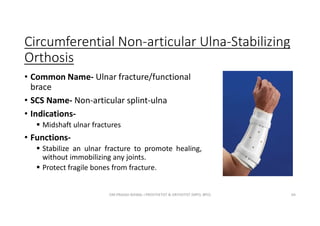
Circumferential Non-articular Ulna-Stabilizing
Orthosis
• Common Name- Ulnar fracture/functional
brace
• SCS Name- Non-articular splint-ulna
• Indications-
 Midshaft ulnar fractures
• Functions-
 Stabilize an ulnar fracture to promote healing,
without immobilizing any joints.
 Protect fragile bones from fracture.
OM PRASAD BISWAL I PROSTHETIST & ORTHOTIST (MPO, BPO) 64
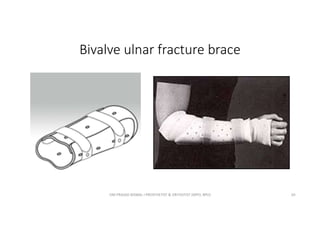
Bivalve ulnar fracture brace
OM PRASAD BISWAL I PROSTHETIST & ORTHOTIST (MPO, BPO) 65
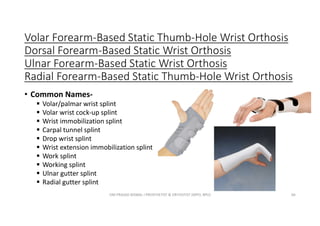
Volar Forearm-Based Static Thumb-Hole Wrist Orthosis
Dorsal Forearm-Based Static Wrist Orthosis
Ulnar Forearm-Based Static Wrist Orthosis
Radial Forearm-Based Static Thumb-Hole Wrist Orthosis
• Common Names-
 Volar/palmar wrist splint
 Volar wrist cock-up splint
 Wrist immobilization splint
 Carpal tunnel splint
 Drop wrist splint
 Wrist extension immobilization splint
 Work splint
 Working splint
 Ulnar gutter splint
 Radial gutter splint
OM PRASAD BISWAL I PROSTHETIST & ORTHOTIST (MPO, BPO) 66
Cont.
• SCS Name- Wrist extension immobilization; type 0[1]
• Design Considerations-
 Volar: Provides optimal support to the carpal bones; recommended for joint
inflammation or instability; cane be used to mount flexion outriggers.
 Dorsal: Blocks sensation less than other designs; can be used to mount
extension outriggers; has integrated palmar bar.
 Ulnar: Can be used to mount flexion or extension outriggers.
 Radial: Restricts wrist motion less than other designs, permitting wrist ulnar
deviation and some flexion; can be used to mount flexion or extension
outriggers.
OM PRASAD BISWAL I PROSTHETIST & ORTHOTIST (MPO, BPO) 67
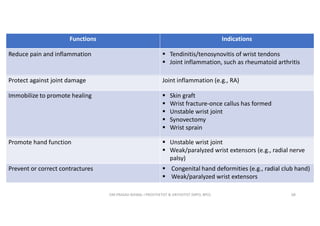
Functions Indications
Reduce pain and inflammation  Tendinitis/tenosynovitis of wrist tendons
 Joint inflammation, such as rheumatoid arthritis
Protect against joint damage Joint inflammation (e.g., RA)
Immobilize to promote healing  Skin graft
 Wrist fracture-once callus has formed
 Unstable wrist joint
 Synovectomy
 Wrist sprain
Promote hand function  Unstable wrist joint
 Weak/paralyzed wrist extensors (e.g., radial nerve
palsy)
Prevent or correct contractures  Congenital hand deformities (e.g., radial club hand)
 Weak/paralyzed wrist extensors
OM PRASAD BISWAL I PROSTHETIST & ORTHOTIST (MPO, BPO) 68
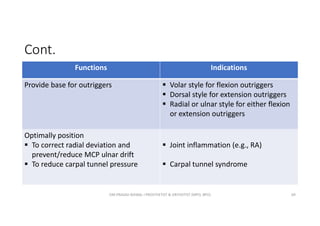
Cont.
Functions Indications
Provide base for outriggers  Volar style for flexion outriggers
 Dorsal style for extension outriggers
 Radial or ulnar style for either flexion
or extension outriggers
Optimally position
 To correct radial deviation and
prevent/reduce MCP ulnar drift
 To reduce carpal tunnel pressure
 Joint inflammation (e.g., RA)
 Carpal tunnel syndrome
OM PRASAD BISWAL I PROSTHETIST & ORTHOTIST (MPO, BPO) 69
Circumferential Forearm-Based Static Wrist
Orthosis (with Ulnar opening)
• Common Name- Circumferential
work(ing) splint; Gauntlet immobilization
splint; CTS Splint; Radial fracture brace
• SCS Name- Wrist extension
immobilization; type 0[1]
• Indications-
 Carpal tunnel syndrome (full circumferential)
 Fracture of the radius or base of the
metacarpal (with ulnar opening)
OM PRASAD BISWAL I PROSTHETIST & ORTHOTIST (MPO, BPO) 70
Cont.
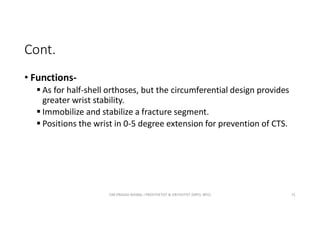
• Functions-
 As for half-shell orthoses, but the circumferential design provides
greater wrist stability.
 Immobilize and stabilize a fracture segment.
 Positions the wrist in 0-5 degree extension for prevention of CTS.
OM PRASAD BISWAL I PROSTHETIST & ORTHOTIST (MPO, BPO) 71
Dorsal Forearm-Based Dynamic Joint-Aligned
Coil-Spring Wrist Assistive-Extension Orthosis
• Common Name- Dynamic wrist extension splint
• SCS Name- Wrist extension immobilization; type
0[1]
• Indications-
 Weak or paralyzed wrist extensors (e.g., radial nerve
palsy)
• Functions-
 Passively extend the wrist while allowing active wrist
flexion.
 Prevent contracture of unopposed, innervated wrist
flexors.
OM PRASAD BISWAL I PROSTHETIST & ORTHOTIST (MPO, BPO) 72
Dorsal-Volar Forearm-Based Static Wrist Writing/Painting
Orthosis
• Common Name- Writing splint
• SCS Name- Wrist extension immobilization; type
0[1]
• Indications-
 Spinal cord injury at level C5 or above i.e. wrist
extensors are paralyzed.
• Functions-
 Enable writing, drawing, or painting by positioning
the wrist in functional extension and providing an
attachment for a pen, pencil, or paintbrush.
 Enable erasing of pencil marks or turning of pages
with the mounted eraser.
OM PRASAD BISWAL I PROSTHETIST & ORTHOTIST (MPO, BPO) 73
Radial Forearm-Based Static Wrist-Thumb Orthosis
• Common Names-
 De Quervain’s splint
 Wrist and thumb static splint
 Long thumb CMC immobilization splint
 Long opponens splint
 Radial thumb gutter splint
 Wrist-thumb orthosis for de Quervain’s tenosynovitis
• SCS Name- Thumb MP extension immobilization;
type 2[3]
• Indications-
 De Quervain’s tenosynovitis
OM PRASAD BISWAL I PROSTHETIST & ORTHOTIST (MPO, BPO) 74
Cont.
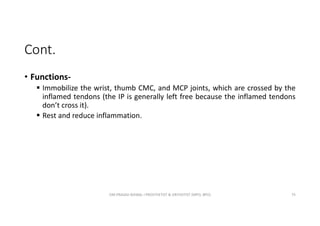
• Functions-
 Immobilize the wrist, thumb CMC, and MCP joints, which are crossed by the
inflamed tendons (the IP is generally left free because the inflamed tendons
don’t cross it).
 Rest and reduce inflammation.
OM PRASAD BISWAL I PROSTHETIST & ORTHOTIST (MPO, BPO) 75
Volar Forearm-Based Static Wrist-Thumb Orthosis
• Common Names-
 Scaphoid fracture splint
 Radial thumb gutter splint
 Thumb spica
 De Quervain’s static splint
• SCS Name- Thumb MC extension immobilization; type
2[3]
• Indications-
 De Quervain’s tenosynovitis
 Scaphoid fracture
 Bennett’s fracture-dislocation-at the base of the first MC
 Instability or joint inflammation of the wrist and thumb
CMC/MCP (e.g., RA)
 Quadriplegia
OM PRASAD BISWAL I PROSTHETIST & ORTHOTIST (MPO, BPO) 76
Cont.
• Functions-
 Immobilize the wrist and thumb CMC and MCP joints.
 Rest the hand to reduce inflammation.
 Stabilize the wrist and thumb.
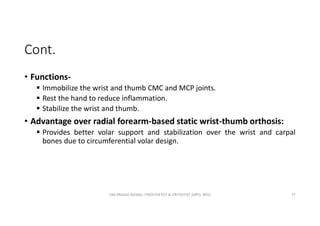
• Advantage over radial forearm-based static wrist-thumb orthosis:
 Provides better volar support and stabilization over the wrist and carpal
bones due to circumferential volar design.
OM PRASAD BISWAL I PROSTHETIST & ORTHOTIST (MPO, BPO) 77
Volar Forearm-Based Static Wrist and D2-5 MCP-
Stabilizing Orthosis
• Common Name- Wrist MCP splint
• SCS Name- Wrist and index through small finger
MP extension immobilization; type 0[5]
• Indications-
 Joint inflammation (e.g., RA with or without CTS)
• Functions-
 Immobilize the wrist and finger MCPs.
 Relieve pain and inflammation.
 Prevent or correct joint deformity (e.g., wrist radial
deviation and volar subluxation; MCP ulnar drift and
volar subluxation)
 Unload lax joint capsules and ligaments or promote
resorption and correct joint instability.
OM PRASAD BISWAL I PROSTHETIST & ORTHOTIST (MPO, BPO) 78
Dorsal Forearm-Based Dynamic Arching Spring-
Wire D1-5 MCP Assistive-Extension Orthosis
• Common Names-
 Radial nerve splint
 MCP extension-assist splint
 MCP arthroplasty splint
 Dynamic cock-up
• SCS Name- Index through small finger MP
extension mobilization; type 1[5]
• Indications-
 Weak wrist, finger MCPs, and thumb extensors; radial
nerve lesion
 MCP arthroplasty-angle the wires to pull the MCPs
radially
OM PRASAD BISWAL I PROSTHETIST & ORTHOTIST (MPO, BPO) 79
Cont.
OM PRASAD BISWAL I PROSTHETIST & ORTHOTIST (MPO, BPO) 80
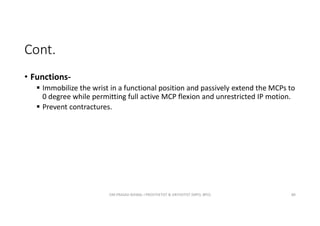
• Functions-
 Immobilize the wrist in a functional position and passively extend the MCPs to
0 degree while permitting full active MCP flexion and unrestricted IP motion.
 Prevent contractures.
Dorsal Forearm-Based Dynamic Arching Spring-Wire
Wrist and D1-5 MCP Assistive-Extension Orthosis
• Common Names- Radial nerve splint;
MCP extension assist splint; Dynamic
cock-up splint.
• SCS Name- Wrist and MP extension
mobilization; type 0[5]
• Indications-
 Weak wrist, finger MCPs, and thumb
extensors; radial nerve lesion
OM PRASAD BISWAL I PROSTHETIST & ORTHOTIST (MPO, BPO) 81
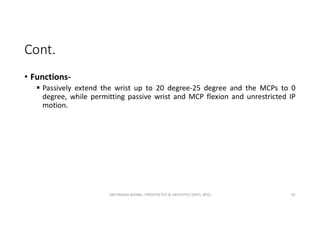
Cont.
• Functions-
 Passively extend the wrist up to 20 degree-25 degree and the MCPs to 0
degree, while permitting passive wrist and MCP flexion and unrestricted IP
motion.
OM PRASAD BISWAL I PROSTHETIST & ORTHOTIST (MPO, BPO) 82
Volar Forearm-Based Dynamic D2-5 MCP Corrective-
Flexion Orthosis
• Common Names- Dynamic MCP flexion splint
• SCS Name- Index through small finger MP
flexion mobilization; type 1[5]
• Indications-
 Extension contracture of the MCPs caused by
shortened collateral ligaments
• Functions-
 Gently stress the MCP collateral ligaments to
promote desired growth and increase flexion
range.
OM PRASAD BISWAL I PROSTHETIST & ORTHOTIST (MPO, BPO) 83
Volar Forearm-Based Static (or Serial-Static) C-Bar
Wrist-Hand Orthosis
• Common Name- Resting Hand Splint
• SCS Name- Wrist extension, index through small finger MCP and IP extension,
thumb CMC palmar abduction immobilization/mobilization; type 0[16]
• Indications-
 Dupuytren’s release
 Boxer’s fracture (neck of fifth MC)
 Crush injury
 Inflammatory joint disease
 Flaccid paralysis
 Burns
 Replantation
 Skin graft
 Scleroderma
OM PRASAD BISWAL I PROSTHETIST & ORTHOTIST (MPO, BPO) 84
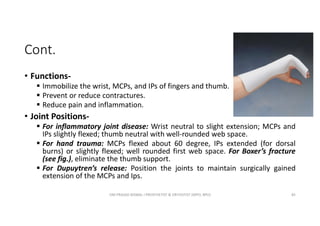
Cont.
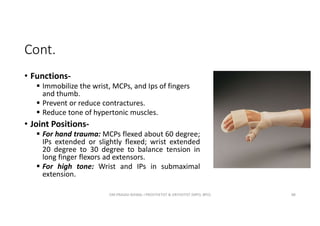
• Functions-
 Immobilize the wrist, MCPs, and IPs of fingers and thumb.
 Prevent or reduce contractures.
 Reduce pain and inflammation.
• Joint Positions-
 For inflammatory joint disease: Wrist neutral to slight extension; MCPs and
IPs slightly flexed; thumb neutral with well-rounded web space.
 For hand trauma: MCPs flexed about 60 degree, IPs extended (for dorsal
burns) or slightly flexed; well rounded first web space. For Boxer’s fracture
(see fig.), eliminate the thumb support.
 For Dupuytren’s release: Position the joints to maintain surgically gained
extension of the MCPs and Ips.
OM PRASAD BISWAL I PROSTHETIST & ORTHOTIST (MPO, BPO) 85
Ulnar Gutter Splint
OM PRASAD BISWAL I PROSTHETIST & ORTHOTIST (MPO, BPO) 86
Bisurfaced Forearm-Based Static (or Serial-Static)
Wrist-Hand Orthosis
• Common Name- Anti-spasticity splint; dorsal volar hand splint
• SCS Name- Wrist extension, index through small finger MCP and IP extension,
thumb CMC palmar abduction immobilization/mobilization; type 0[16]
• Indications-
 Dupuytren’s release (when it’s desirable for the proximal palm or volar surface
of the forearm to be uncovered)
 Boxer’s fracture (neck of fifth MC)
 Crush injury
 High tone associated with-
o Head injury
o Cerebral palsy
o Multiple sclerosis
o Cerebrovascular accident
OM PRASAD BISWAL I PROSTHETIST & ORTHOTIST (MPO, BPO) 87
Cont.
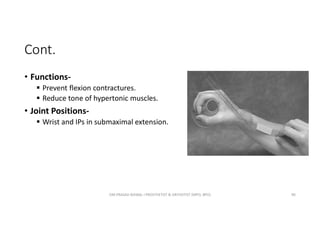
• Functions-
 Immobilize the wrist, MCPs, and Ips of fingers
and thumb.
 Prevent or reduce contractures.
 Reduce tone of hypertonic muscles.
• Joint Positions-
 For hand trauma: MCPs flexed about 60 degree;
IPs extended or slightly flexed; wrist extended
20 degree to 30 degree to balance tension in
long finger flexors ad extensors.
 For high tone: Wrist and IPs in submaximal
extension.
OM PRASAD BISWAL I PROSTHETIST & ORTHOTIST (MPO, BPO) 88
Ulnar Forearm-Based Static Wrist-Hand Cone-Style
Tone-Reducing Orthosis
• Common Name- Anti-spasticity cone splint
• SCS Name- Wrist extension, index through
small finger MCP and IP extension, thumb
CMC palmar abduction immobilization
/mobilization; type 0[16]
• Indications- High tone associated with-
 Head injury
 Cerebral palsy
 Multiple sclerosis
 Cerebrovascular accident
OM PRASAD BISWAL I PROSTHETIST & ORTHOTIST (MPO, BPO) 89
Cont.
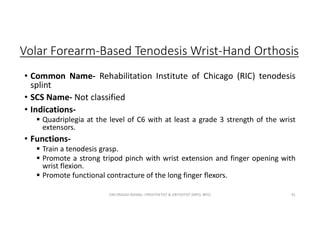
• Functions-
 Prevent flexion contractures.
 Reduce tone of hypertonic muscles.
• Joint Positions-
 Wrist and IPs in submaximal extension.
OM PRASAD BISWAL I PROSTHETIST & ORTHOTIST (MPO, BPO) 90
Volar Forearm-Based Tenodesis Wrist-Hand Orthosis
• Common Name- Rehabilitation Institute of Chicago (RIC) tenodesis
splint
• SCS Name- Not classified
• Indications-
 Quadriplegia at the level of C6 with at least a grade 3 strength of the wrist
extensors.
• Functions-
 Train a tenodesis grasp.
 Promote a strong tripod pinch with wrist extension and finger opening with
wrist flexion.
 Promote functional contracture of the long finger flexors.
OM PRASAD BISWAL I PROSTHETIST & ORTHOTIST (MPO, BPO) 91
Cont.
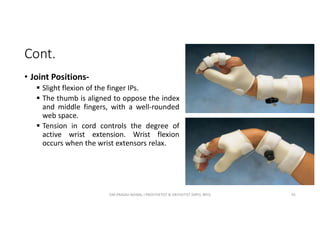
• Joint Positions-
 Slight flexion of the finger IPs.
 The thumb is aligned to oppose the index
and middle fingers, with a well-rounded
web space.
 Tension in cord controls the degree of
active wrist extension. Wrist flexion
occurs when the wrist extensors relax.
OM PRASAD BISWAL I PROSTHETIST & ORTHOTIST (MPO, BPO) 92
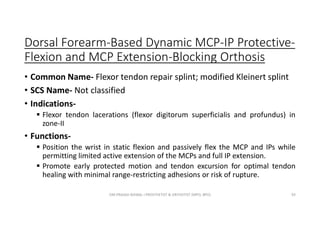
Dorsal Forearm-Based Dynamic MCP-IP Protective-
Flexion and MCP Extension-Blocking Orthosis
• Common Name- Flexor tendon repair splint; modified Kleinert splint
• SCS Name- Not classified
• Indications-
 Flexor tendon lacerations (flexor digitorum superficialis and profundus) in
zone-II
• Functions-
 Position the wrist in static flexion and passively flex the MCP and IPs while
permitting limited active extension of the MCPs and full IP extension.
 Promote early protected motion and tendon excursion for optimal tendon
healing with minimal range-restricting adhesions or risk of rupture.
OM PRASAD BISWAL I PROSTHETIST & ORTHOTIST (MPO, BPO) 93
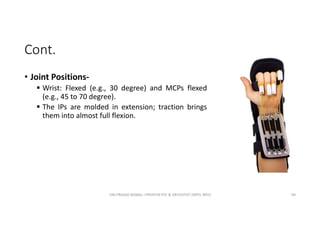
Cont.
• Joint Positions-
 Wrist: Flexed (e.g., 30 degree) and MCPs flexed
(e.g., 45 to 70 degree).
 The IPs are molded in extension; traction brings
them into almost full flexion.
OM PRASAD BISWAL I PROSTHETIST & ORTHOTIST (MPO, BPO) 94
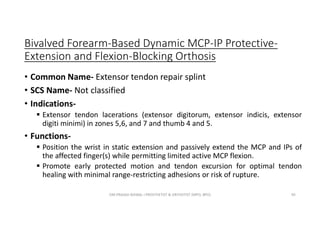
Bivalved Forearm-Based Dynamic MCP-IP Protective-
Extension and Flexion-Blocking Orthosis
• Common Name- Extensor tendon repair splint
• SCS Name- Not classified
• Indications-
 Extensor tendon lacerations (extensor digitorum, extensor indicis, extensor
digiti minimi) in zones 5,6, and 7 and thumb 4 and 5.
• Functions-
 Position the wrist in static extension and passively extend the MCP and IPs of
the affected finger(s) while permitting limited active MCP flexion.
 Promote early protected motion and tendon excursion for optimal tendon
healing with minimal range-restricting adhesions or risk of rupture.
OM PRASAD BISWAL I PROSTHETIST & ORTHOTIST (MPO, BPO) 95
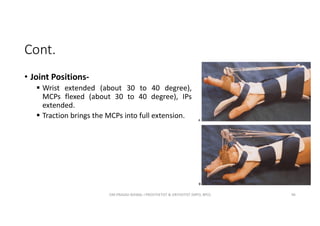
Cont.
• Joint Positions-
 Wrist extended (about 30 to 40 degree),
MCPs flexed (about 30 to 40 degree), IPs
extended.
 Traction brings the MCPs into full extension.
OM PRASAD BISWAL I PROSTHETIST & ORTHOTIST (MPO, BPO) 96
OM PRASAD BISWAL I PROSTHETIST & ORTHOTIST (MPO, BPO) 97

Orthoses for shoulder, elbow and forearm

  • 1.
    Orthoses for Shoulder,Elbow and Forearm OM PRASAD BISWAL Prosthetist and Orthotist MPO (PDUNIPPD, New Delhi), BPO (NILD, Kolkata) OM PRASAD BISWAL I PROSTHETIST & ORTHOTIST (MPO, BPO) 1
  • 2.
    Introduction Objectives of upperlimb orthosis: 1) Protection : - • Stabilization • Dynamic control 2) Correction 3) Assistance OM PRASAD BISWAL I PROSTHETIST & ORTHOTIST (MPO, BPO) 2
  • 3.
    • To immobilizea body part to promote tissue healing • Prevent contractures • Increase ROM • Correct deformities • Strengthen muscles • Reduce tone • Reduce pain • Restrict motion to prevent harmful postures OM PRASAD BISWAL I PROSTHETIST & ORTHOTIST (MPO, BPO) 3
  • 4.
    Nomenclature On basis of– • Joint they cover • the function they provide • condition they treat • by appearance • name of the person who designed them OM PRASAD BISWAL I PROSTHETIST & ORTHOTIST (MPO, BPO) 4
  • 5.
    On basis ofanatomical regions: • Finger Orthoses • Hand Orthoses • Wrist Hand Orthoses • Forearm Orthoses • Elbow Orthoses • Elbow Wrist Hand Orthoses • Humeral Orthoses • Shoulder Elbow Wrist Hand Orthoses • Shoulder Orthoses OM PRASAD BISWAL I PROSTHETIST & ORTHOTIST (MPO, BPO) 5
  • 6.
    American Society ofHand Therapists published ASHT splint classification system (SCS) which gives function and body part wise- There are a total of ten joint levels in the upper extremity. These include the shoulder, elbow, forearm, wrist, finger MP, finger PIP, finger DIP, thumb CMC, thumb MP, and thumb IP levels. The type element requires counting the secondary joint levels. It is critical to understand that only the joint levels are counted, not the individual joints. OM PRASAD BISWAL I PROSTHETIST & ORTHOTIST (MPO, BPO) 6
  • 7.
    OM PRASAD BISWALI PROSTHETIST & ORTHOTIST (MPO, BPO) 7
  • 8.
    Based on design: •Non-articular • Static • Serial static • Static motion-blocking • Static progressive • Dynamic • Dynamic motion-blocking • Dynamic traction splints • Tenodesis • Continuous passive motion orthoses • Adaptive or functional usage OM PRASAD BISWAL I PROSTHETIST & ORTHOTIST (MPO, BPO) 8
  • 9.
    Non-articular splint • Theseorthoses don’t cross any joints and have no direct influence on joints and have no direct influence on joint mobility. • E.g. Circumferential stabilizing orthoses OM PRASAD BISWAL I PROSTHETIST & ORTHOTIST (MPO, BPO) 9
  • 10.
    Static • Immobilize oneor more joints. • CTS-stop splint for carpal tunnel syndrome, with the wrist position 0-5 degree of extension, distal palmar crease free to allow MCP motion OM PRASAD BISWAL I PROSTHETIST & ORTHOTIST (MPO, BPO) 10
  • 11.
    Cont. • Maintain tissuelength to prevent contractures. • Rest injured or inflamed tissues to reduce inflammation and pain. • Stabilize injured structures to promote healing. • Unload tissues to promote resorption of lax structures such as ligaments or capsules to correct joint instability. • Reduce muscle tone of spastic muscles. OM PRASAD BISWAL I PROSTHETIST & ORTHOTIST (MPO, BPO) 11
  • 12.
    Serial static splint •Immobilize one or more joints. • It is also static but is periodically changed to alter the joint angle at which the splint is positioned. The splints are applied with the tissue at its maximum length. • Reduce muscle tone of spastic muscles. • Correct contractures by applying a gentle, prolonged stretch to promote growth of contracted soft tissues. OM PRASAD BISWAL I PROSTHETIST & ORTHOTIST (MPO, BPO) 12
  • 13.
    Static motion –blocking • Permits motion in one direction but blocks motion in another. • For example, a Tripoint splint. OM PRASAD BISWAL I PROSTHETIST & ORTHOTIST (MPO, BPO) 13
  • 14.
    Cont. • Protect againstswan-neck deformity, which may develop with rheumatoid arthritis, or trigger finger, to help promote restabilization or healing. • Help correct elbow flexion contractures, maintaining elbow extension to the limit of the soft tissue length, but allowing the triceps to actively stretch the contracted tissues. OM PRASAD BISWAL I PROSTHETIST & ORTHOTIST (MPO, BPO) 14
  • 15.
    Static progressive splint •Most commonly used for regaining joint motion. Unlike the serial static splint, the orthosis is not remolded to increase joint motion. • These splints differ from serial splints in that they use nonelastic components such as static lines, hinges, screws, and turnbuckles to place a force on a joint to induce progressive change. • E.g. WHO with MCP extension assist. OM PRASAD BISWAL I PROSTHETIST & ORTHOTIST (MPO, BPO) 15
  • 16.
    Dynamic splint • Providesan elastic force to help regain joint motion. • An example of such an orthosis is a finger extension splint, which uses a spring coil or wire tension assist to increase extension in a PIP joint with a mild contracture. • Provide a passive assist to substitute for weak or absent motor function due to a peripheral nerve lesion. • Apply gentle, prolonged stretch to correct contractures by promoting tissue growth, similar to serial-static and static-progressive orthoses. OM PRASAD BISWAL I PROSTHETIST & ORTHOTIST (MPO, BPO) 16
  • 17.
    Dynamic motion-blocking splint •Allows certain motions but blocks others. • It uses a passive, elastic line of pull in the desired direction, but permits active motion in the opposite direction. • An example is a Kleinert postoperative splint for flexor tendon repairs OM PRASAD BISWAL I PROSTHETIST & ORTHOTIST (MPO, BPO) 17
  • 18.
    Dynamic traction splint •Offers traction to a joint while allowing controlled motion. • An example is a splint for an intraarticular fracture. This a hand-based PIP extension splint with an outrigger. OM PRASAD BISWAL I PROSTHETIST & ORTHOTIST (MPO, BPO) 18
  • 19.
    Tenodesis splint • Facilitatesfunction in a hand that has lost motion because of nervous system injury. • An example is the RIC (Rehabilitation Institute of Chicago) tenodesis splint, which assists the patient with a C6 level of spinal cord injury to achieve a functional pinch. Active extension of the wrist produces controlled passive flexion of the fingers against a static thumb post through a tenodesis action. OM PRASAD BISWAL I PROSTHETIST & ORTHOTIST (MPO, BPO) 19
  • 20.
    Continuous Passive MotionOrthoses • Continuous passive motion orthoses are electrically powered devices that mechanically move joints through a desired range of motion. • This keeps the joints supple and maintains articular, ligamentous, and tendinous structure mobility during the healing phases after injury or surgery. OM PRASAD BISWAL I PROSTHETIST & ORTHOTIST (MPO, BPO) 20
  • 21.
    Adaptive or functionalusage splints • Promote functional use of the upper limb with impairment resulting from weakness, paralysis, or loss of a body part. • An example is the universal cuff, which encompasses the hand and holds various small items such as a fork, a pen, or a toothbrush. • Enhances ADL activities and degree of self independence. OM PRASAD BISWAL I PROSTHETIST & ORTHOTIST (MPO, BPO) 21
  • 22.
    Orthoses for Shoulderand Elbow OM PRASAD BISWAL I PROSTHETIST & ORTHOTIST (MPO, BPO) 22
  • 23.
    Figure-8 Non-articular AxillaOrthosis • Common Names- Axilla wrap; Clavicle strap brace; Figure of 8 harness • SCS Name- Non-articular splint axilla • Regional Name- Shoulder Orthosis • Indications-  Axillary burns or skin grafting  Shoulder adduction contracture  Kyphotic posture  Fracture of the clavicle  Pectoral contractures  Cumulative trauma disorder  Slouched shoulder posture OM PRASAD BISWAL I PROSTHETIST & ORTHOTIST (MPO, BPO) 23
  • 24.
    Cont. • Functions-  Restrictsmotions to promote healing  Increase/maintain PROM  Reduced scapular myofascial pain  Improve posture OM PRASAD BISWAL I PROSTHETIST & ORTHOTIST (MPO, BPO) 24
  • 25.
    Lateral Trunk-Based StaticShoulder-Elbow-Wrist Orthosis • Common Names- Shoulder/Gunslinger Splint • SCS Name-Shoulder adduction or abduction immobilization; type 3[4] • Functions-  To fully immobilize the shoulder (and sometimes the elbow) to promote healing of surgically repaired bony or soft tissues.  The elbow and wrist are immobilized to maintain full control of the shoulder. OM PRASAD BISWAL I PROSTHETIST & ORTHOTIST (MPO, BPO) 25
  • 26.
    Indications (and durationof Orthotic requirement) Shoulder Position Elbow and Forearm Position Posterior stabilization- To tighten the shoulder capsule in the case of posterior glenohumeral instability (4- 6 weeks)  Adducted  Slight extension  Rotation: neutral to slight external rotation  100-110 degree flexion  Neutral forearm rotation L’Episcopo procedure (transfer of latissimus dorsi and teres major to the external rotators)- for partial brachial plexus injury or brachial neuritis (full time first 4 weeks; part- time next 4 weeks)  Adducted  Slight extension  Slightly more external rotation as compared to in case of posterior stabilization  90 degree flexion  Neutral forearm rotation Shoulder fusion- for flail shoulder, e.g., brachial plexus injury (6-8 weeks) 30 degree abduction, 30 degree flexion and 30 degree internal rotation  90 degree flexion  Neutral forearm rotation Elbow flexorplasty- performed with a shoulder fusion (6-8 weeks) 30 degree abduction, 30 degree flexion and 30 degree internal rotation  At least 110 degree flexion  Forearm neutral-slight supination Rotator cuff repair (6 weeks)  45 degree abduction  Neutral rotation  90 degree flexion  Forearm rotated as per comfort OM PRASAD BISWAL I PROSTHETIST & ORTHOTIST (MPO, BPO) 26
  • 27.
    Lateral Trunk-Based Static(or Serial-Static) Shoulder-Abduction (Elbow-Wrist) Orthosis • Common Names- Axilla/Airplane splint/Conformer/Arm abduction splint • SCS Name- 120 degree shoulder abduction immobilization/mobilization; type 3[4] • Indications-  Axillary burns contractures  Post operative shoulder fusion  Post operative scar release  Shoulder dislocation  Burns –Shoulder adduction contractures OM PRASAD BISWAL I PROSTHETIST & ORTHOTIST (MPO, BPO) 27
  • 28.
    Cont. • Functions-  Immobilizeto promote tissue healing  Increase PROM by soft tissue elongation via low load prolonged stretch (serial static splinting)  Elevate the arm along with hand to prevent edema  Prevent or reduce an axilla contracture  Maintain or restore shoulder mobility  Apply pressure to prevent or reduce hypertrophic scarring in the axilla. OM PRASAD BISWAL I PROSTHETIST & ORTHOTIST (MPO, BPO) 28
  • 29.
    Static Shoulder-Elbow-Wrist Sling •Common Names- Sling; Hemi arm sling • SCS Name- Not categorized • Indications-  Shoulder subluxation caused by flaccid hemiplegia  Brachial plexus injury  Rotator cuff injury  AC joint injury  Upper extremity trauma (e.g., crush injury, Scapular, humeral fractures)  PO Shoulder surgery/arthroplasty  PO tendon, artery, or nerve repairs  Bicipital tendinitis  Upper motor neuron lesion: hemiparesis with subluxation OM PRASAD BISWAL I PROSTHETIST & ORTHOTIST (MPO, BPO) 29
  • 30.
    Cont. • Functions-  Immobilizethe shoulder and elbow to promote tissue healing  Support the weight of the upper extremity across the contralateral shoulder, without stress to the back of the neck  Prevent brachial plexus traction  Relieve pain and prevent shoulder subluxation  Prevent overstretching of GH musculature/ligaments  Decreased shoulder pain related to arm distraction and shoulder hand syndrome  Keep hand and forearm elevated to reduce edema OM PRASAD BISWAL I PROSTHETIST & ORTHOTIST (MPO, BPO) 30
  • 31.
    Wilmer Carrying Orthosis •Indication- Partial or complete shoulder subluxation, BPI, hemiplegia • Functions-  Effective neutralization of shoulder subluxation.  Regain some of the arm functions.  Reduced chance of edema formation in hand, fingers and forearm.  Reduced pain and discomfort in arm and shoulder.  No neck loading.  It consists of 3C philosophy.  Can be worn fully underneath clothing  Light weight construction. OM PRASAD BISWAL I PROSTHETIST & ORTHOTIST (MPO, BPO) 31
  • 32.
    Types of WilmerCarrying Orthosis 1. Wilmer Shoulder Orthosis ( Standard Unit, Hand free unit and Wrist free unit) • Wilmer adjustable shoulder orthosis (Modified design) 2. Wilmer Elbow Orthosis • Wilmer elbow orthosis for children • Wilmer elbow extension orthosis OM PRASAD BISWAL I PROSTHETIST & ORTHOTIST (MPO, BPO) 32
  • 33.
    The WILMER carryingorthosis standard unit, supports the paralyzed arm, wrist and hand OM PRASAD BISWAL I PROSTHETIST & ORTHOTIST (MPO, BPO) 33
  • 34.
    Standard Unit –With hand support • The standard unit is used when full hand support is required. • The hand support brings the hand to a stable rest position. • The curved edge ensures that the hand does not slip from the support. • The perforated plastic (PE) hand support has rounded edges, giving a comfortable hand support, which is well ventilated, but also easy to clean. OM PRASAD BISWAL I PROSTHETIST & ORTHOTIST (MPO, BPO) 34
  • 35.
    WILMER hands-free unitwhich optimally supports the paralyzed arm and wrist ensuring optimal hand and finger mobility OM PRASAD BISWAL I PROSTHETIST & ORTHOTIST (MPO, BPO) 35
  • 36.
    Hands-free unit –With hand-spoon • The model with a hand spoon is used by people whose control over the fingers of the hand is still (partly) present, but have insufficient control over the wrist. • Through a small perforated hand spoon placed in the palm of the hand, the wrist is supported, but the fingers and thumb remain free so that (limited) functionality is possible. • This creates an optimal combination of control and functionality. OM PRASAD BISWAL I PROSTHETIST & ORTHOTIST (MPO, BPO) 36
  • 37.
    WILMER wrist-free unitwhich optimally supports the paralyzed arm ensuring optimal wrist, hand and finger mobility OM PRASAD BISWAL I PROSTHETIST & ORTHOTIST (MPO, BPO) 37
  • 38.
    Wrist-free unit • Thewrist-free unit leaves both wrist and hand free. • Ideal for people with good control over hand and wrist. • This gives you maximum freedom and functionality at your hand. OM PRASAD BISWAL I PROSTHETIST & ORTHOTIST (MPO, BPO) 38
  • 39.
    Wilmer2 Carrying Orthosis(W2CO) OMPRASAD BISWAL I PROSTHETIST & ORTHOTIST (MPO, BPO) 39
  • 40.
    Comparison of CGin Wilmer and sling OM PRASAD BISWAL I PROSTHETIST & ORTHOTIST (MPO, BPO) 40
  • 41.
    Wilmer adjustable shoulderorthosis • In order to facilitate donning and doffing of the clothes an adjustable version of the orthosis developed by pushing against a knob principle that is located near the elbow in the suspension strap an unlocking action is performed. The arm with the orthosis can now be extended. Bringing the arm back in the 90 deg flexed position engages the lock again, enabling the orthosis function. The working and the fitting procedure of this adjustable shoulder orthosis same as standard version. OM PRASAD BISWAL I PROSTHETIST & ORTHOTIST (MPO, BPO) 41
  • 42.
    Wilmer Elbow Orthosis •This is a dynamic orthosis designed for the patients with paralyzed elbow. A paralyzed elbow can be brought into flexion by maintaining shoulder abduction angle more than 90 deg. • More abduction angle is not acceptable in both functionally and cosmetically. • Addition of orthosis helps to reduced the abduction angle to get required elbow flexion. So there always requirement of an orthosis to get function. • The Wilmer elbow orthosis is a unilaterally construction with two hinged frame bars made from stainless steel tubing. • The orthotic forearm can be positioned by anteflexion pulse. • Orthosis fitted to the patient arm by two fitting on either side of the elbow joint. Orthosis only loads the skin by the normal forces not the shear forces. Fittings are made up of perforated plastic sheet. So the perspiration not hampered. • The fittings are supported only in their center so they adopt the shape of the arm easily. OM PRASAD BISWAL I PROSTHETIST & ORTHOTIST (MPO, BPO) 42
  • 43.
    Cont. OM PRASAD BISWALI PROSTHETIST & ORTHOTIST (MPO, BPO) 43
  • 44.
    Cont. • A lockingmechanism is added to the orthosis to enable the patient to retain the flail arm in the flexed position independent of the abduction/anteflexion angle. • In this locked position the arm + orthosis is suitable to lift and carry objects. Second locking position at the near extended arm enables pushing or clamping of objects, this is useful in donning and doffing. OM PRASAD BISWAL I PROSTHETIST & ORTHOTIST (MPO, BPO) 44
  • 45.
    Wilmer Elbow Orthosisfor children • For the child below age of 4 years • The Orthosis consists of two hinged bars with a spring attached in between them. Four fittings transfers forces between the Orthosis and the arm vice versa. No locking mechanism is incorporated. Weight varies from 35 gram to 80 gram. With this Orthosis the child actively flex his arm. The possibilities to play and development is enhanced. OM PRASAD BISWAL I PROSTHETIST & ORTHOTIST (MPO, BPO) 45
  • 46.
    Wilmer Elbow ExtensionOrthosis • Indication for this Orthosis is the muscle spasm. • The Orthosis consists of two hinged bars, fixed on the arm with four perforated body adaptive fittings. An adjustable spring mechanism extends the orthosis. OM PRASAD BISWAL I PROSTHETIST & ORTHOTIST (MPO, BPO) 46
  • 47.
    Circumferential Non-articular Humerus-Stabilizing Orthosis •Common Names- Humeral fracture/functional brace; Sarmiento humeral brace • SCS Name- Non-articular splint-humerus • Indications-  Fractures of the humeral shaft- usually applied 5 to 10 days after injury, although the time varies with physician and type of fracture. • Functions-  Stabilize fracture to promote healing without immobilizing any joints. OM PRASAD BISWAL I PROSTHETIST & ORTHOTIST (MPO, BPO) 47
  • 48.
    Posterior Static Elbow(Wrist) Orthosis Posterior Static Elbow Flexion-Blocking Orthosis • Common Names- (Posterior) Elbow Splint/Sugar-tong splint • SCS Name-  90 degree flexion immobilization; type 0[1];  If the wrist is included, it ill be named 90 degree elbow flexion immobilization; type 1[1] • Indications-  Rheumatoid arthritis  CTD  Forearm fractures  Post operative elbow arthroplasty  Elbow surgery o Ulnar nerve transposition o Tendon transfers o Nerve repairs OM PRASAD BISWAL I PROSTHETIST & ORTHOTIST (MPO, BPO) 48
  • 49.
    Cont. • Functions-  Supportand rest the elbow to relieve pain  Immobilize the elbow to promote tissue healing  Block elbow extension OM PRASAD BISWAL I PROSTHETIST & ORTHOTIST (MPO, BPO) 49
  • 50.
    Anterior Static ElbowOrthosis Anterior Serial-Static Elbow Corrective-Extension Orthosis Anterior Static Elbow Flexion-Blocking Orthosis • Common Name- (Anterior) Elbow Splint • SCS Name- Elbow extension immobilization or mobilization; type 0[1] • Indications-  Burns  Ulnar nerve entrapment  Capsular tightness  Elbow injury or surgery o Multiple trauma o Intra-articular fractures o Triceps rupture o Tumor resection o Total elbow arthroplasty OM PRASAD BISWAL I PROSTHETIST & ORTHOTIST (MPO, BPO) 50
  • 51.
    Cont. • Functions-  Preventor correct elbow flexion contractures  Block elbow flexion OM PRASAD BISWAL I PROSTHETIST & ORTHOTIST (MPO, BPO) 51
  • 52.
    Bi-surfaced Static ElbowOrthosis Bi-surfaced Serial-Static Elbow Corrective-Flexion/Extension Orthosis Bi-surfaced Static Elbow Flexion-Blocking Orthosis • Common Name- Elbow splint • SCS Name- Elbow extension immobilization splint; type 0[1] • Indications-  Burns  Ulnar nerve entrapment  Capsular tightness  Rheumatoid arthritis  Forearm fractures  Post operative elbow arthroplasty  Elbow surgery o Ulnar nerve transposition o Tendon transfers o Nerve repairs OM PRASAD BISWAL I PROSTHETIST & ORTHOTIST (MPO, BPO) 52
  • 53.
    Cont. • Functions-  Supportand rest the elbow to relieve pain  Immobilize the elbow to promote tissue healing  Block elbow extension  Prevent or correct elbow flexion contractures  Block elbow flexion OM PRASAD BISWAL I PROSTHETIST & ORTHOTIST (MPO, BPO) 53
  • 54.
    Static-Progressive Elbow-Flexion Harness •Common Name- Elbow flexion splint • SCS Name- Elbow flexion mobilization; type 1[2] • Indications-  Flexion contractures caused by o Intra-articular fractures o Multiple trauma o Capsular tightness o Supracondylar fracture o Radial head fracture  Post-operatively: total elbow arthroplasty OM PRASAD BISWAL I PROSTHETIST & ORTHOTIST (MPO, BPO) 54
  • 55.
    Cont. • Functions-  Increaseelbow flexion range of motion  Maintain surgically gained flexion RoM OM PRASAD BISWAL I PROSTHETIST & ORTHOTIST (MPO, BPO) 55
  • 56.
    Elbow or wristmobilization orthoses • Regional name: Elbow orthoses or wrist orthoses • Common name:  Dynamic elbow  Wrist flexion/extension splint  Dynasplint  Ultraflex splint  Static progressive splint  Phoenix wrist hinge  Turn buckle splint OM PRASAD BISWAL I PROSTHETIST & ORTHOTIST (MPO, BPO) 56
  • 57.
    Cont. • Indications-  Contracture Post operative scar release  Burns  Fracture (late phase) Radial nerve lesion  Spinal cord injury  Brachial plexus lesion  Polio • Functions-  Increased PROM by soft tissue elongation via low-load prolonged stretch  Replace or assist weak wrist extensors to enhance ADL OM PRASAD BISWAL I PROSTHETIST & ORTHOTIST (MPO, BPO) 57
  • 58.
    Biomechanical Efficacy: Two distinctmethods can be used to stretch soft tissue, thereby encouraging tissue elongation and increased PROM. 1) Serial splinting: With low temperature thermoplastics (progressive static splinting) or serial casting. • Advantages: good conformity, little shifting • Disadvantage : potential skin breakdown 2) Traction : (via elastics, coils, or springs) is applied across the joint(often a hinged joint) • Advantage : amount of load can be adjusted • Disadvantage: forces can cause shifting of orthosis such splints are more difficult to fabricate unless prefabrications are used. OM PRASAD BISWAL I PROSTHETIST & ORTHOTIST (MPO, BPO) 58
  • 59.
    Circumferential Non-articular ProximalForearm Strap • Common Name- Tennis elbow strap; counterforce strap/golfer elbow strap • SCS Name- Non-articular splint- proximal forearm • Indications-  Inflammation of the common tendon origin of o Wrist extensors: lateral epicondylitis (Tennis elbow) o Wrist flexors: medial epicondylitis (Golfer’s elbow) • Functions-  Reduce pain and inflammation by reducing tensile force exerted by wrist extensors or flexors at their origins from the lateral or medial epicondyle, respectively. OM PRASAD BISWAL I PROSTHETIST & ORTHOTIST (MPO, BPO) 59
  • 60.
    OM PRASAD BISWALI PROSTHETIST & ORTHOTIST (MPO, BPO) 60 Tennis Elbow Splint Golfer Elbow Splint
  • 61.
    Spiral Dynamic Forearm-RotationThumb-Abduction Strap • Common Name- Thumb abduction supination splint; Prefabricated Rolyan Upper extremity Tone and Positioning (TAP) Splint • SCS Name- Forearm pronation/supination mobilization, thumb abduction mobilization; type 1[3]- i.e., thumb MCP is the secondary joints; primary joints are forearm and thumb CMC; total joints=3 • Indications-  Hypertonicity/hypotonicity associated with- o Head injury o Cerebral palsy o Multiple sclerosis o Cerebrovascular accident  Peripheral or central nerve lesions  Distal radio-ulnar joint stiffness  Forearm stiffness secondary to cast immobilization for a wrist fracture OM PRASAD BISWAL I PROSTHETIST & ORTHOTIST (MPO, BPO) 61
  • 62.
    Cont. • Functions-  Abductthe thumb and, depending on the direction in which the strap is wrapped, to promote either supination or pronation. The elbow and wrist are free to move.  Reduce the tone of hypertonic muscles by abducting the thumb and supinating the forearm.  Assist weak muscles.  Promote functional use of the hand.  Increase either supination or pronation ROM. OM PRASAD BISWAL I PROSTHETIST & ORTHOTIST (MPO, BPO) 62
  • 63.
    Forearm-Based Orthoses OM PRASADBISWAL I PROSTHETIST & ORTHOTIST (MPO, BPO) 63
  • 64.
    Circumferential Non-articular Ulna-Stabilizing Orthosis •Common Name- Ulnar fracture/functional brace • SCS Name- Non-articular splint-ulna • Indications-  Midshaft ulnar fractures • Functions-  Stabilize an ulnar fracture to promote healing, without immobilizing any joints.  Protect fragile bones from fracture. OM PRASAD BISWAL I PROSTHETIST & ORTHOTIST (MPO, BPO) 64
  • 65.
    Bivalve ulnar fracturebrace OM PRASAD BISWAL I PROSTHETIST & ORTHOTIST (MPO, BPO) 65
  • 66.
    Volar Forearm-Based StaticThumb-Hole Wrist Orthosis Dorsal Forearm-Based Static Wrist Orthosis Ulnar Forearm-Based Static Wrist Orthosis Radial Forearm-Based Static Thumb-Hole Wrist Orthosis • Common Names-  Volar/palmar wrist splint  Volar wrist cock-up splint  Wrist immobilization splint  Carpal tunnel splint  Drop wrist splint  Wrist extension immobilization splint  Work splint  Working splint  Ulnar gutter splint  Radial gutter splint OM PRASAD BISWAL I PROSTHETIST & ORTHOTIST (MPO, BPO) 66
  • 67.
    Cont. • SCS Name-Wrist extension immobilization; type 0[1] • Design Considerations-  Volar: Provides optimal support to the carpal bones; recommended for joint inflammation or instability; cane be used to mount flexion outriggers.  Dorsal: Blocks sensation less than other designs; can be used to mount extension outriggers; has integrated palmar bar.  Ulnar: Can be used to mount flexion or extension outriggers.  Radial: Restricts wrist motion less than other designs, permitting wrist ulnar deviation and some flexion; can be used to mount flexion or extension outriggers. OM PRASAD BISWAL I PROSTHETIST & ORTHOTIST (MPO, BPO) 67
  • 68.
    Functions Indications Reduce painand inflammation  Tendinitis/tenosynovitis of wrist tendons  Joint inflammation, such as rheumatoid arthritis Protect against joint damage Joint inflammation (e.g., RA) Immobilize to promote healing  Skin graft  Wrist fracture-once callus has formed  Unstable wrist joint  Synovectomy  Wrist sprain Promote hand function  Unstable wrist joint  Weak/paralyzed wrist extensors (e.g., radial nerve palsy) Prevent or correct contractures  Congenital hand deformities (e.g., radial club hand)  Weak/paralyzed wrist extensors OM PRASAD BISWAL I PROSTHETIST & ORTHOTIST (MPO, BPO) 68
  • 69.
    Cont. Functions Indications Provide basefor outriggers  Volar style for flexion outriggers  Dorsal style for extension outriggers  Radial or ulnar style for either flexion or extension outriggers Optimally position  To correct radial deviation and prevent/reduce MCP ulnar drift  To reduce carpal tunnel pressure  Joint inflammation (e.g., RA)  Carpal tunnel syndrome OM PRASAD BISWAL I PROSTHETIST & ORTHOTIST (MPO, BPO) 69
  • 70.
    Circumferential Forearm-Based StaticWrist Orthosis (with Ulnar opening) • Common Name- Circumferential work(ing) splint; Gauntlet immobilization splint; CTS Splint; Radial fracture brace • SCS Name- Wrist extension immobilization; type 0[1] • Indications-  Carpal tunnel syndrome (full circumferential)  Fracture of the radius or base of the metacarpal (with ulnar opening) OM PRASAD BISWAL I PROSTHETIST & ORTHOTIST (MPO, BPO) 70
  • 71.
    Cont. • Functions-  Asfor half-shell orthoses, but the circumferential design provides greater wrist stability.  Immobilize and stabilize a fracture segment.  Positions the wrist in 0-5 degree extension for prevention of CTS. OM PRASAD BISWAL I PROSTHETIST & ORTHOTIST (MPO, BPO) 71
  • 72.
    Dorsal Forearm-Based DynamicJoint-Aligned Coil-Spring Wrist Assistive-Extension Orthosis • Common Name- Dynamic wrist extension splint • SCS Name- Wrist extension immobilization; type 0[1] • Indications-  Weak or paralyzed wrist extensors (e.g., radial nerve palsy) • Functions-  Passively extend the wrist while allowing active wrist flexion.  Prevent contracture of unopposed, innervated wrist flexors. OM PRASAD BISWAL I PROSTHETIST & ORTHOTIST (MPO, BPO) 72
  • 73.
    Dorsal-Volar Forearm-Based StaticWrist Writing/Painting Orthosis • Common Name- Writing splint • SCS Name- Wrist extension immobilization; type 0[1] • Indications-  Spinal cord injury at level C5 or above i.e. wrist extensors are paralyzed. • Functions-  Enable writing, drawing, or painting by positioning the wrist in functional extension and providing an attachment for a pen, pencil, or paintbrush.  Enable erasing of pencil marks or turning of pages with the mounted eraser. OM PRASAD BISWAL I PROSTHETIST & ORTHOTIST (MPO, BPO) 73
  • 74.
    Radial Forearm-Based StaticWrist-Thumb Orthosis • Common Names-  De Quervain’s splint  Wrist and thumb static splint  Long thumb CMC immobilization splint  Long opponens splint  Radial thumb gutter splint  Wrist-thumb orthosis for de Quervain’s tenosynovitis • SCS Name- Thumb MP extension immobilization; type 2[3] • Indications-  De Quervain’s tenosynovitis OM PRASAD BISWAL I PROSTHETIST & ORTHOTIST (MPO, BPO) 74
  • 75.
    Cont. • Functions-  Immobilizethe wrist, thumb CMC, and MCP joints, which are crossed by the inflamed tendons (the IP is generally left free because the inflamed tendons don’t cross it).  Rest and reduce inflammation. OM PRASAD BISWAL I PROSTHETIST & ORTHOTIST (MPO, BPO) 75
  • 76.
    Volar Forearm-Based StaticWrist-Thumb Orthosis • Common Names-  Scaphoid fracture splint  Radial thumb gutter splint  Thumb spica  De Quervain’s static splint • SCS Name- Thumb MC extension immobilization; type 2[3] • Indications-  De Quervain’s tenosynovitis  Scaphoid fracture  Bennett’s fracture-dislocation-at the base of the first MC  Instability or joint inflammation of the wrist and thumb CMC/MCP (e.g., RA)  Quadriplegia OM PRASAD BISWAL I PROSTHETIST & ORTHOTIST (MPO, BPO) 76
  • 77.
    Cont. • Functions-  Immobilizethe wrist and thumb CMC and MCP joints.  Rest the hand to reduce inflammation.  Stabilize the wrist and thumb. • Advantage over radial forearm-based static wrist-thumb orthosis:  Provides better volar support and stabilization over the wrist and carpal bones due to circumferential volar design. OM PRASAD BISWAL I PROSTHETIST & ORTHOTIST (MPO, BPO) 77
  • 78.
    Volar Forearm-Based StaticWrist and D2-5 MCP- Stabilizing Orthosis • Common Name- Wrist MCP splint • SCS Name- Wrist and index through small finger MP extension immobilization; type 0[5] • Indications-  Joint inflammation (e.g., RA with or without CTS) • Functions-  Immobilize the wrist and finger MCPs.  Relieve pain and inflammation.  Prevent or correct joint deformity (e.g., wrist radial deviation and volar subluxation; MCP ulnar drift and volar subluxation)  Unload lax joint capsules and ligaments or promote resorption and correct joint instability. OM PRASAD BISWAL I PROSTHETIST & ORTHOTIST (MPO, BPO) 78
  • 79.
    Dorsal Forearm-Based DynamicArching Spring- Wire D1-5 MCP Assistive-Extension Orthosis • Common Names-  Radial nerve splint  MCP extension-assist splint  MCP arthroplasty splint  Dynamic cock-up • SCS Name- Index through small finger MP extension mobilization; type 1[5] • Indications-  Weak wrist, finger MCPs, and thumb extensors; radial nerve lesion  MCP arthroplasty-angle the wires to pull the MCPs radially OM PRASAD BISWAL I PROSTHETIST & ORTHOTIST (MPO, BPO) 79
  • 80.
    Cont. OM PRASAD BISWALI PROSTHETIST & ORTHOTIST (MPO, BPO) 80 • Functions-  Immobilize the wrist in a functional position and passively extend the MCPs to 0 degree while permitting full active MCP flexion and unrestricted IP motion.  Prevent contractures.
  • 81.
    Dorsal Forearm-Based DynamicArching Spring-Wire Wrist and D1-5 MCP Assistive-Extension Orthosis • Common Names- Radial nerve splint; MCP extension assist splint; Dynamic cock-up splint. • SCS Name- Wrist and MP extension mobilization; type 0[5] • Indications-  Weak wrist, finger MCPs, and thumb extensors; radial nerve lesion OM PRASAD BISWAL I PROSTHETIST & ORTHOTIST (MPO, BPO) 81
  • 82.
    Cont. • Functions-  Passivelyextend the wrist up to 20 degree-25 degree and the MCPs to 0 degree, while permitting passive wrist and MCP flexion and unrestricted IP motion. OM PRASAD BISWAL I PROSTHETIST & ORTHOTIST (MPO, BPO) 82
  • 83.
    Volar Forearm-Based DynamicD2-5 MCP Corrective- Flexion Orthosis • Common Names- Dynamic MCP flexion splint • SCS Name- Index through small finger MP flexion mobilization; type 1[5] • Indications-  Extension contracture of the MCPs caused by shortened collateral ligaments • Functions-  Gently stress the MCP collateral ligaments to promote desired growth and increase flexion range. OM PRASAD BISWAL I PROSTHETIST & ORTHOTIST (MPO, BPO) 83
  • 84.
    Volar Forearm-Based Static(or Serial-Static) C-Bar Wrist-Hand Orthosis • Common Name- Resting Hand Splint • SCS Name- Wrist extension, index through small finger MCP and IP extension, thumb CMC palmar abduction immobilization/mobilization; type 0[16] • Indications-  Dupuytren’s release  Boxer’s fracture (neck of fifth MC)  Crush injury  Inflammatory joint disease  Flaccid paralysis  Burns  Replantation  Skin graft  Scleroderma OM PRASAD BISWAL I PROSTHETIST & ORTHOTIST (MPO, BPO) 84
  • 85.
    Cont. • Functions-  Immobilizethe wrist, MCPs, and IPs of fingers and thumb.  Prevent or reduce contractures.  Reduce pain and inflammation. • Joint Positions-  For inflammatory joint disease: Wrist neutral to slight extension; MCPs and IPs slightly flexed; thumb neutral with well-rounded web space.  For hand trauma: MCPs flexed about 60 degree, IPs extended (for dorsal burns) or slightly flexed; well rounded first web space. For Boxer’s fracture (see fig.), eliminate the thumb support.  For Dupuytren’s release: Position the joints to maintain surgically gained extension of the MCPs and Ips. OM PRASAD BISWAL I PROSTHETIST & ORTHOTIST (MPO, BPO) 85
  • 86.
    Ulnar Gutter Splint OMPRASAD BISWAL I PROSTHETIST & ORTHOTIST (MPO, BPO) 86
  • 87.
    Bisurfaced Forearm-Based Static(or Serial-Static) Wrist-Hand Orthosis • Common Name- Anti-spasticity splint; dorsal volar hand splint • SCS Name- Wrist extension, index through small finger MCP and IP extension, thumb CMC palmar abduction immobilization/mobilization; type 0[16] • Indications-  Dupuytren’s release (when it’s desirable for the proximal palm or volar surface of the forearm to be uncovered)  Boxer’s fracture (neck of fifth MC)  Crush injury  High tone associated with- o Head injury o Cerebral palsy o Multiple sclerosis o Cerebrovascular accident OM PRASAD BISWAL I PROSTHETIST & ORTHOTIST (MPO, BPO) 87
  • 88.
    Cont. • Functions-  Immobilizethe wrist, MCPs, and Ips of fingers and thumb.  Prevent or reduce contractures.  Reduce tone of hypertonic muscles. • Joint Positions-  For hand trauma: MCPs flexed about 60 degree; IPs extended or slightly flexed; wrist extended 20 degree to 30 degree to balance tension in long finger flexors ad extensors.  For high tone: Wrist and IPs in submaximal extension. OM PRASAD BISWAL I PROSTHETIST & ORTHOTIST (MPO, BPO) 88
  • 89.
    Ulnar Forearm-Based StaticWrist-Hand Cone-Style Tone-Reducing Orthosis • Common Name- Anti-spasticity cone splint • SCS Name- Wrist extension, index through small finger MCP and IP extension, thumb CMC palmar abduction immobilization /mobilization; type 0[16] • Indications- High tone associated with-  Head injury  Cerebral palsy  Multiple sclerosis  Cerebrovascular accident OM PRASAD BISWAL I PROSTHETIST & ORTHOTIST (MPO, BPO) 89
  • 90.
    Cont. • Functions-  Preventflexion contractures.  Reduce tone of hypertonic muscles. • Joint Positions-  Wrist and IPs in submaximal extension. OM PRASAD BISWAL I PROSTHETIST & ORTHOTIST (MPO, BPO) 90
  • 91.
    Volar Forearm-Based TenodesisWrist-Hand Orthosis • Common Name- Rehabilitation Institute of Chicago (RIC) tenodesis splint • SCS Name- Not classified • Indications-  Quadriplegia at the level of C6 with at least a grade 3 strength of the wrist extensors. • Functions-  Train a tenodesis grasp.  Promote a strong tripod pinch with wrist extension and finger opening with wrist flexion.  Promote functional contracture of the long finger flexors. OM PRASAD BISWAL I PROSTHETIST & ORTHOTIST (MPO, BPO) 91
  • 92.
    Cont. • Joint Positions- Slight flexion of the finger IPs.  The thumb is aligned to oppose the index and middle fingers, with a well-rounded web space.  Tension in cord controls the degree of active wrist extension. Wrist flexion occurs when the wrist extensors relax. OM PRASAD BISWAL I PROSTHETIST & ORTHOTIST (MPO, BPO) 92
  • 93.
    Dorsal Forearm-Based DynamicMCP-IP Protective- Flexion and MCP Extension-Blocking Orthosis • Common Name- Flexor tendon repair splint; modified Kleinert splint • SCS Name- Not classified • Indications-  Flexor tendon lacerations (flexor digitorum superficialis and profundus) in zone-II • Functions-  Position the wrist in static flexion and passively flex the MCP and IPs while permitting limited active extension of the MCPs and full IP extension.  Promote early protected motion and tendon excursion for optimal tendon healing with minimal range-restricting adhesions or risk of rupture. OM PRASAD BISWAL I PROSTHETIST & ORTHOTIST (MPO, BPO) 93
  • 94.
    Cont. • Joint Positions- Wrist: Flexed (e.g., 30 degree) and MCPs flexed (e.g., 45 to 70 degree).  The IPs are molded in extension; traction brings them into almost full flexion. OM PRASAD BISWAL I PROSTHETIST & ORTHOTIST (MPO, BPO) 94
  • 95.
    Bivalved Forearm-Based DynamicMCP-IP Protective- Extension and Flexion-Blocking Orthosis • Common Name- Extensor tendon repair splint • SCS Name- Not classified • Indications-  Extensor tendon lacerations (extensor digitorum, extensor indicis, extensor digiti minimi) in zones 5,6, and 7 and thumb 4 and 5. • Functions-  Position the wrist in static extension and passively extend the MCP and IPs of the affected finger(s) while permitting limited active MCP flexion.  Promote early protected motion and tendon excursion for optimal tendon healing with minimal range-restricting adhesions or risk of rupture. OM PRASAD BISWAL I PROSTHETIST & ORTHOTIST (MPO, BPO) 95
  • 96.
    Cont. • Joint Positions- Wrist extended (about 30 to 40 degree), MCPs flexed (about 30 to 40 degree), IPs extended.  Traction brings the MCPs into full extension. OM PRASAD BISWAL I PROSTHETIST & ORTHOTIST (MPO, BPO) 96
  • 97.
    OM PRASAD BISWALI PROSTHETIST & ORTHOTIST (MPO, BPO) 97