AIIPMR Notes – basic orthotic knee joints
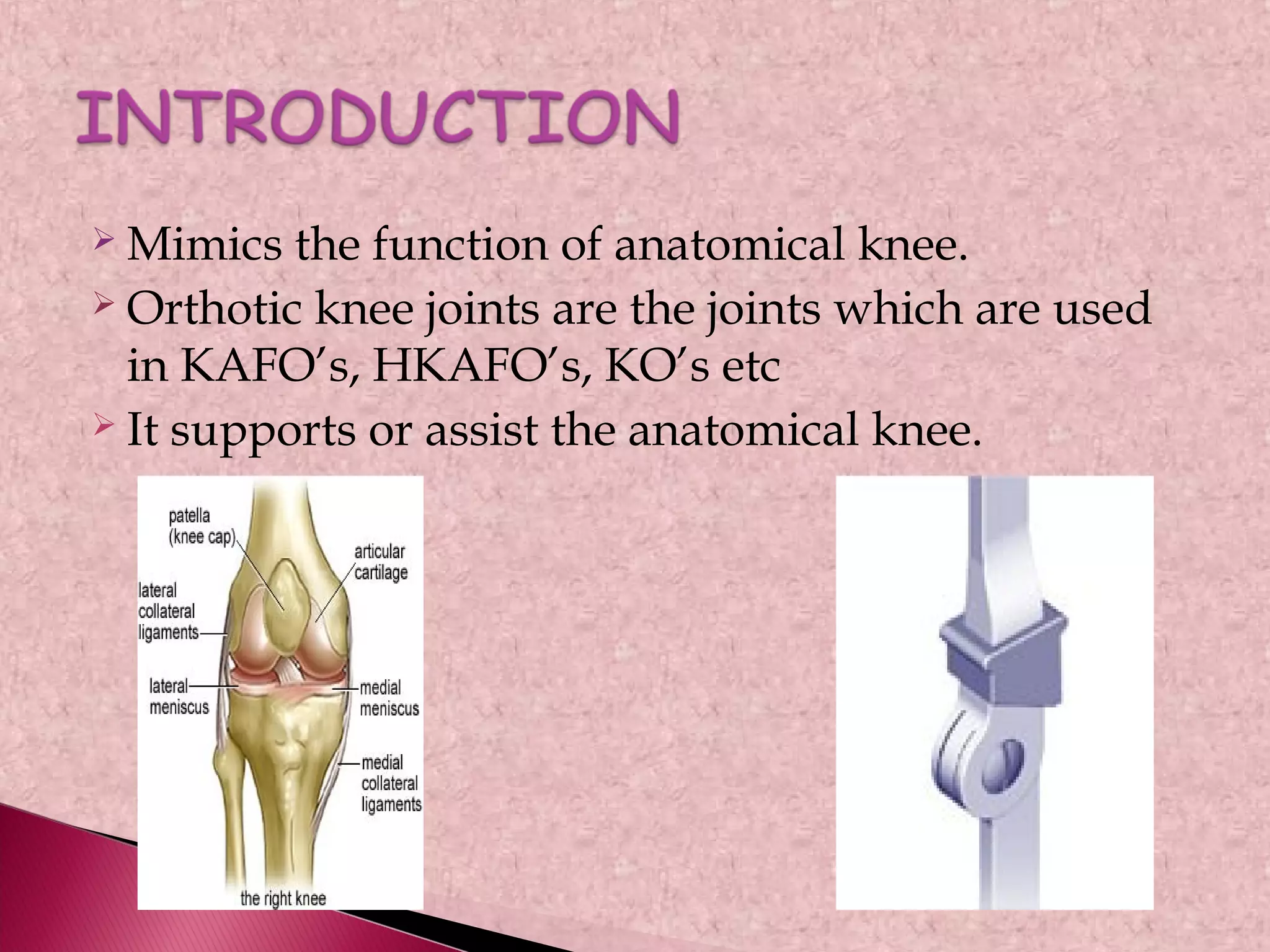
 Mimics the function of anatomical knee.
 Orthotic knee joints are the joints which are used
in KAFO’s, HKAFO’s, KO’s etc
 It supports or assist the anatomical knee.
 They can be classified according to the axis:
1) CONCENTRIC
2) ECCENTRIC
 Axis of the joint placed centrally.
 Made out of three parts: Joint unit,
Upper and Lower upright.
 Made up of die cast steel.
 Weight of joint is less.
 Give less flexion to knee.
 No positive locking and unlocking
system of joint.
 Male part of joint protrudes or project outwards.
 Cost is more.
 Joint is not very durable.
 Difficult to give shape as it is vulnerable to break .
 E.g. : ALIMCO JOINT
 Axis is not placed centrally.
 Made up of mild steel.
 Weight is more.
 Provide positive locking system.
 Made out of two parts: Male and
Female upright.
 Male part does not project out.
 Gives more flexion at knee.
 More durable joint.
 Cheap in cost.
 Ex : AIIPMR JOINT.
 Also known as straight
knee joint or free knee.
 Permits unrestricted
movement into flexion
and extension to 180
degrees.
 Mild to moderate genu
varum or valgum.
Mechanical axis is located
posterior to the weight line.
Stable without a lock.
Free to bend during swing
and allows sitting.
Moderate genu recurvatum.
Contraindicated to knee and
hip flexion contracture.
 Follow the natural motion at knee more
accurately.
 Principal designs of PKJ:
i) Two meshing gears
ii) A plate with two pivots
(genu-centric)
 Aids in patient’s comfort while
sitting.
 Fall with gravity or
are manually locked.
 Requires that each side
be unlocked independently.
 Simplest lock.
 Most secure lock.
 Paralysis, severe genu varum/
valgum or recurvatum.
 Also known as a Dial lock
or Adjustable position locking
knee joint.
 Simple, effective and sturdy.
 Can be locked while
accommodating knee flexion
contracture.
 Provides external mechanical
stability.
 Spastic paralysis, KFC.
 Also known as Bail, Pawl or French
lock.
 Permits unlocking of both joints
simultaneously.
 Easier to lock and unlock.
 Can unlock accidentally if bumped.
 Allows the medial and lateral knee
locks to be disengaged at the same
time by posterior pressure as
against the edge of seating surfaces.
 Useful for paraplegics.
 Designed for patients with quadriceps weakness.
 Its arrangement permit the patient with lower limb
paralysis to have more closely natural gait pattern.
 Advantages:
 Stance phase stability.
 Swing phase freedom
 Decrease need for compensatory strategy.
 Reduced energy expenditure.
 Less stress and strain applied to patient’s lower back
while walking
 Fix knee deformity
 Hip flexion deformity
 Hip contracture.
 Poor balance and in co-ordination.
1. Stance control orthotic knee joint (Horton)
2. UTX Swing knee joint
3. Swing phase lock orthotic knee joint.
4. Load response KJ.
5. G – Knee
6. E – Knee.
STANCE
KNEE
JOINT
G - KNEE
E - KNEE
UTX KNEE
JOINT
SWING KNEE
JOINT
LOAD
RESPONSE
KJ
 Track the instantaneous anatomical knee center.
 Eliminates the mechanical joint as a source of
pistoning, slippage or undesirable forces upon the
knee.
 Excellent sports knee joint.
 Minimizes effect of error in joint replacement.
 Made up of stainless steel, and is low profile.
 Successfully used by snow-skiers, foot-ball
players, runners etc.

Orthotic knee joints - AIIPMR notes ( SYBPO )

  • 1.
    AIIPMR Notes –basic orthotic knee joints
  • 2.
     Mimics thefunction of anatomical knee.  Orthotic knee joints are the joints which are used in KAFO’s, HKAFO’s, KO’s etc  It supports or assist the anatomical knee.
  • 3.
     They canbe classified according to the axis: 1) CONCENTRIC 2) ECCENTRIC
  • 4.
     Axis ofthe joint placed centrally.  Made out of three parts: Joint unit, Upper and Lower upright.  Made up of die cast steel.  Weight of joint is less.  Give less flexion to knee.  No positive locking and unlocking system of joint.
  • 5.
     Male partof joint protrudes or project outwards.  Cost is more.  Joint is not very durable.  Difficult to give shape as it is vulnerable to break .  E.g. : ALIMCO JOINT
  • 6.
     Axis isnot placed centrally.  Made up of mild steel.  Weight is more.  Provide positive locking system.  Made out of two parts: Male and Female upright.  Male part does not project out.  Gives more flexion at knee.
  • 7.
     More durablejoint.  Cheap in cost.  Ex : AIIPMR JOINT.
  • 8.
     Also knownas straight knee joint or free knee.  Permits unrestricted movement into flexion and extension to 180 degrees.  Mild to moderate genu varum or valgum.
  • 9.
    Mechanical axis islocated posterior to the weight line. Stable without a lock. Free to bend during swing and allows sitting. Moderate genu recurvatum. Contraindicated to knee and hip flexion contracture.
  • 10.
     Follow thenatural motion at knee more accurately.  Principal designs of PKJ: i) Two meshing gears ii) A plate with two pivots (genu-centric)  Aids in patient’s comfort while sitting.
  • 12.
     Fall withgravity or are manually locked.  Requires that each side be unlocked independently.  Simplest lock.  Most secure lock.  Paralysis, severe genu varum/ valgum or recurvatum.
  • 13.
     Also knownas a Dial lock or Adjustable position locking knee joint.  Simple, effective and sturdy.  Can be locked while accommodating knee flexion contracture.  Provides external mechanical stability.  Spastic paralysis, KFC.
  • 14.
     Also knownas Bail, Pawl or French lock.  Permits unlocking of both joints simultaneously.  Easier to lock and unlock.  Can unlock accidentally if bumped.  Allows the medial and lateral knee locks to be disengaged at the same time by posterior pressure as against the edge of seating surfaces.  Useful for paraplegics.
  • 17.
     Designed forpatients with quadriceps weakness.  Its arrangement permit the patient with lower limb paralysis to have more closely natural gait pattern.  Advantages:  Stance phase stability.  Swing phase freedom  Decrease need for compensatory strategy.  Reduced energy expenditure.  Less stress and strain applied to patient’s lower back while walking
  • 18.
     Fix kneedeformity  Hip flexion deformity  Hip contracture.  Poor balance and in co-ordination.
  • 19.
    1. Stance controlorthotic knee joint (Horton) 2. UTX Swing knee joint 3. Swing phase lock orthotic knee joint. 4. Load response KJ. 5. G – Knee 6. E – Knee.
  • 20.
  • 21.
  • 22.
     Track theinstantaneous anatomical knee center.  Eliminates the mechanical joint as a source of pistoning, slippage or undesirable forces upon the knee.  Excellent sports knee joint.  Minimizes effect of error in joint replacement.  Made up of stainless steel, and is low profile.  Successfully used by snow-skiers, foot-ball players, runners etc.