UPPER LIMB PROSTHESIS
Presented by:
Group 4
INTRODUCTION
Upper limb prosthesis designed to replace, as much as possible, the
function or appearance of a missing limb or body part.
Prosthesis can replace some grasping and manipulating functions of hand .
No sensory feedback.
A SUCCESSFUL PROSTHESIS:
Comfortable to wear
Easy to don and doff
Light weight and durable
Cosmetically pleasing
Reasonable maintenance
REASONS FOR AMPUTATION
• 1. infection
• 2. trauma
• 3. tumor
• 4. congenital deformity
• 5. 0 to 15 yrs: correction of congenitl deformity /tumor.
• 6. 15 to 45 yrs: trauma, tumor
• 7. 60 years: rare, tumor or medical disease.
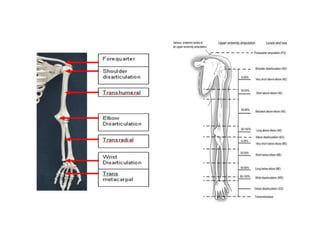
LEVELS OF AMPUTATION
• 1. INTERPHALANGEAL AMPUTATION
• 2. TRANSMETACARPAL AMPUTATION
• 3. TRANSCARPAL AMPUTATION
• 4. WRIST DISARTICULATION
• 5.TRANSRADIAL AMPUTATION
• 6. ELBOW DISARTICULATION
• 7. TRANSHUMERAL AMPUTATION
• 8. SHOULDER DISARTICULATION
• 9. INTERSCAPULOTHORACIC DISARTICULATION
TYPES OF PROSTHESIS
• 1. BODY POWERED/ CONVENTIONAL
• 2. EXTERNAL POWERED/ ELECTRICAL
• 3. COSMETIC/ PASSIVE
• 4. HYBRID
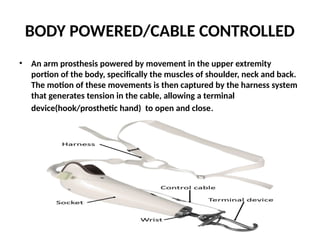
BODY POWERED/CABLE CONTROLLED
• An arm prosthesis powered by movement in the upper extremity
portion of the body, specifically the muscles of shoulder, neck and back.
The motion of these movements is then captured by the harness system
that generates tension in the cable, allowing a terminal
device(hook/prosthetic hand) to open and close.
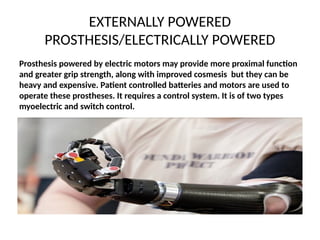
EXTERNALLY POWERED
PROSTHESIS/ELECTRICALLY POWERED
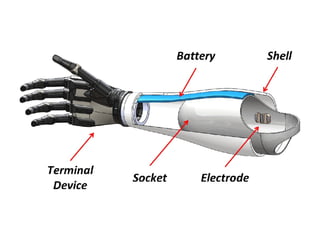
Prosthesis powered by electric motors may provide more proximal function
and greater grip strength, along with improved cosmesis but they can be
heavy and expensive. Patient controlled batteries and motors are used to
operate these prostheses. It requires a control system. It is of two types
myoelectric and switch control.
COMPONENTS OF UL PROSTHESIS
1. TERMINAL DEVICES
2. WRISTS
3. ELBOWS
4. SHOULDERS
5. SOCKET
6. SUSPENSION
TERMINAL DEVICES
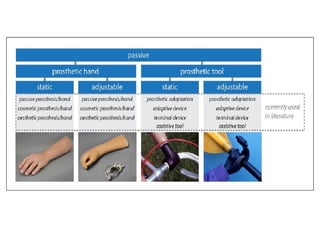
1. PASSIVE TERMINAL DEVICE
Falls into two classes those designed primarily for function and those to
provide cosmesis. Examples include child mitt frequently used on infants first
prosthesis to facilitate crawling or ball handling used for ball sports. Its
cosmetic appearance is very good. Cosmetic passive devices are more
expensive then active terminal devices.
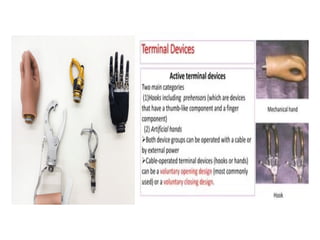
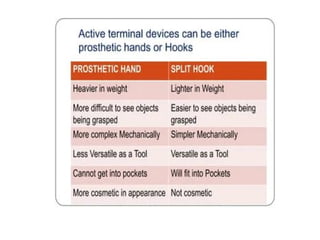
2. ACTIVE TERMINAL DEVICE
More functional than cosmetic. Two main categories
2. Hook
3. prosthetic hand
These are available to operate with cable or externally powered.
Prehensile/ non prehensile terminal devices
Non prehensile
Touching, feeling, pressing down with fingers, tapping vibrating the cord ,
lifting or pushing with hand.
Prehensile
The major function of the hand that the prosthesis tries to replicate is grip
(prehension).
The five types of grip are as follows
1. Precision grip
2. Tripod grip
3. Lateral grip
4. Hook power grip
5. Spherical grip
Components of Upper Limb
Prosthetics
Components of Upper Limb Prosthetics
• Following are the components of upper limb
prosthesis:
• Terminal device
• Cosmetic gloves
• Prosthetic wrists
• Prosthetic elbows
• Prosthetic sockets
• Suspension systems
(already discussed)
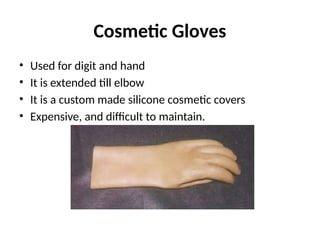
Cosmetic Gloves
• Used for digit and hand
• It is extended till elbow
• It is a custom made silicone cosmetic covers
• Expensive, and difficult to maintain.
Prosthetic Wrists
• Provide receptacle for connecting terminal
device
• Prono-supination or flexion based on
functional activities of patient
• Types of Prosthetic Wrists:
• The types are;
1. Mechanical
2. Electrical
Prosthetic Wrists (Cont.)
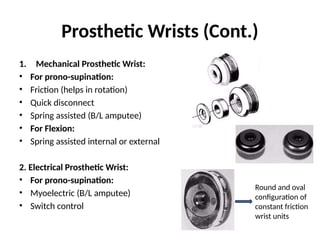
1. Mechanical Prosthetic Wrist:
• For prono-supination:
• Friction (helps in rotation)
• Quick disconnect
• Spring assisted (B/L amputee)
• For Flexion:
• Spring assisted internal or external
2. Electrical Prosthetic Wrist:
• For prono-supination:
• Myoelectric (B/L amputee)
• Switch control
Round and oval
configuration of
constant friction
wrist units
Prosthetic Wrists (Cont.)
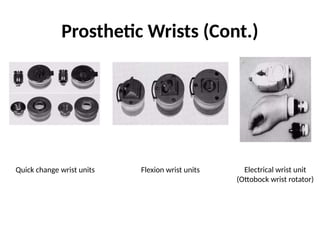
Quick change wrist units Flexion wrist units Electrical wrist unit
(Ottobock wrist rotator)
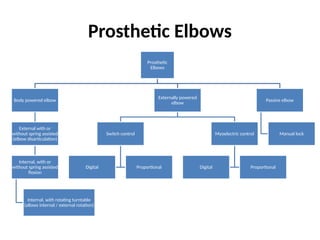
Prosthetic Elbows
Prosthetic
Elbows
Body powered elbow
External with or
without spring assisted
(elbow disarticulation)
Internal, with or
without spring assisted
flexion
Internal, with rotating turntable
(allows internal / external rotation)
Externally powered
elbow
Switch control
Digital Proportional
Myoelectric control
Digital Proportional
Passive elbow
Manual lock
Prosthetic Elbows (Cont.)
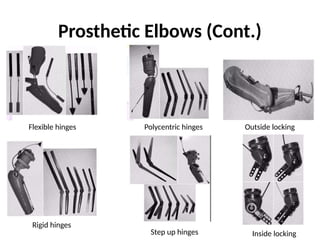
Flexible hinges
Rigid hinges
Polycentric hinges
Step up hinges
Outside locking
Inside locking
Prosthetic Elbows (Cont.)
• Electrical Powered Elbow:
• These elbows differ from one another in
mechanical configuration, drive mechanism
and control options.
• Boston elbow
• NY-Hosmer Electric Elbow
• Utah Arm
Prosthetic Sockets
• Functions:
• Comfortable residual limb – prosthesis interface
• Efficient energy transference to the prosthesis
• Secure suspension of the prosthesis
• Adequate cosmesis
• Types of Prosthetic Sockets:
• Wrist disarticulation socket
• Long below elbow (trans radial) socket
• Short below elbow socket
• Very short below elbow socket
• Muenster sockets
• Elbow disarticulation socket
• Standard above elbow socket
• Short above elbow socket
• Shoulder disarticulation socket
• Forequarter amputation socket
Suspension Systems
• Functions:
• Suspension – securing prosthesis to
residual limb
• Control of prosthesis / terminal devices
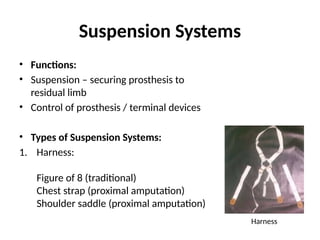
• Types of Suspension Systems:
1. Harness:
Figure of 8 (traditional)
Chest strap (proximal amputation)
Shoulder saddle (proximal amputation)
Harness
Suspension System (Cont.)
2. Self suspension:
Condylar
Munster (self suspending; not preferred in B/L transradial amputation)
Northwestern
3. Semi-suction:
Hypobaric semi-suction
4. Suction:
Full suction
Silicone sock
5. Sock:
Interface b/w residual limb and socket.
Layers adjustable to volume changes
Protect skin and improve hygiene
Sock with special silicone band and socket with one way valve are used in semi-suction type of suspension system
Suction suspension preferred for transhumeral amputee
with normal contralateral limb
Control Mechanisms
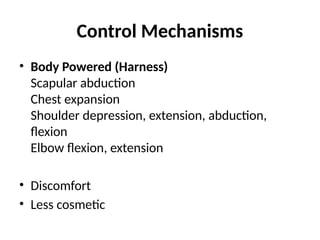
• Body Powered (Harness)
Scapular abduction
Chest expansion
Shoulder depression, extension, abduction,
flexion
Elbow flexion, extension
• Discomfort
• Less cosmetic
Control Mechanisms (Cont.)
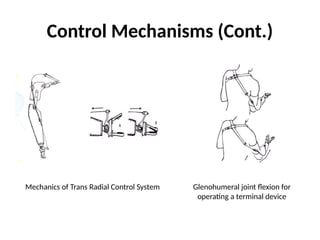
Mechanics of Trans Radial Control System Glenohumeral joint flexion for
operating a terminal device
Control Mechanisms (Cont.)
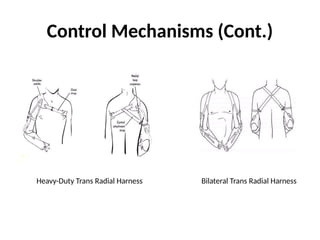
Heavy-Duty Trans Radial Harness Bilateral Trans Radial Harness
Control Mechanisms (Cont.)
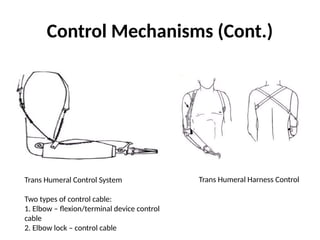
Trans Humeral Control System
Two types of control cable:
1. Elbow – flexion/terminal device control
cable
2. Elbow lock – control cable
Trans Humeral Harness Control
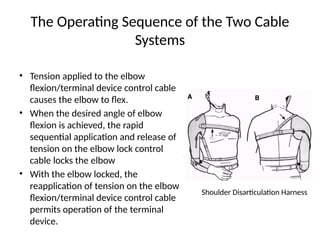
The Operating Sequence of the Two Cable
Systems
• Tension applied to the elbow
flexion/terminal device control cable
causes the elbow to flex.
• When the desired angle of elbow
flexion is achieved, the rapid
sequential application and release of
tension on the elbow lock control
cable locks the elbow
• With the elbow locked, the
reapplication of tension on the elbow
flexion/terminal device control cable
permits operation of the terminal
device.
Shoulder Disarticulation Harness
Prostheses by level of
amputation
Prosthesis by level of amputation
Partial Hand:
• Prosthesis not necessary
• Surgical reconstruction – opposition – for
prehension with proprioception
Prosthesis by level of amputation (Cont.)
Wrist Disarticulation:
• Distal radial-ulnar articulation preserved for
prono-supination
• Socket: tapered and flattened distally forming
an oval shape
• Wrist unit: thin, to minimize length.
• Cosmetically: trans-radial
Prosthesis by level of amputation (Cont.)
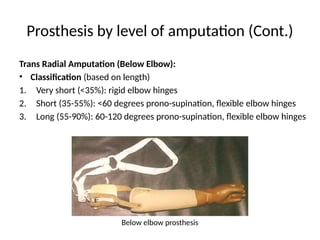
Trans Radial Amputation (Below Elbow):
• Classification (based on length)
1. Very short (<35%): rigid elbow hinges
2. Short (35-55%): <60 degrees prono-supination, flexible elbow hinges
3. Long (55-90%): 60-120 degrees prono-supination, flexible elbow hinges
Below elbow prosthesis
Prosthesis by level of amputation (Cont.)
Trans Radial Amputation With Decreased
Elbow ROM:
• Polycentric elbow joints or split socket with
step-up hinges used to provide additional
flexion
• Decreased elbow flexion power
Prosthesis by level of amputation (Cont.)
Elbow Disarticulation:
• Sockets: Flat and broad distally (like epicondyles)
• External elbow joint with cable operated lock in
medial joint
• Suspension: figure of 8, shoulder saddle, chest
strap
• Control System: two cables; one to lock the elbow,
other opens terminal device or flexes elbow
Prosthesis by level of amputation (Cont.)
Trans Humeral Amputation (Above Elbow):
Classification: (based on the length of humerus)
1. Very short (<30%)
2. Short (30-50%)
3. Standard (50-90%)
Prosthesis by level of amputation (Cont.)
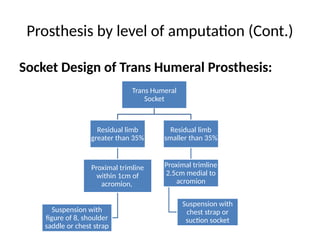
Socket Design of Trans Humeral Prosthesis:
Trans Humeral
Socket
Residual limb
greater than 35%
Proximal trimline
within 1cm of
acromion,
Suspension with
figure of 8, shoulder
saddle or chest strap
Residual limb
smaller than 35%
Proximal trimline
2.5cm medial to
acromion
Suspension with
chest strap or
suction socket
Prosthesis by level of amputation (Cont.)
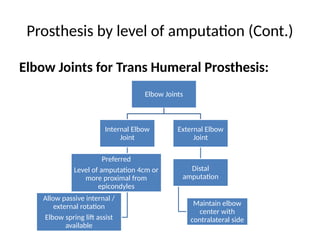
Elbow Joints for Trans Humeral Prosthesis:
Elbow Joints
Internal Elbow
Joint
Preferred
Level of amputation 4cm or
more proximal from
epicondyles
Allow passive internal /
external rotation
Elbow spring lift assist
available
External Elbow
Joint
Distal
amputation
Maintain elbow
center with
contralateral side
Prosthesis by level of amputation (Cont.)
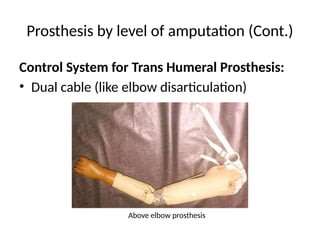
Control System for Trans Humeral Prosthesis:
• Dual cable (like elbow disarticulation)
Above elbow prosthesis
Prosthesis by level of amputation (Cont.)
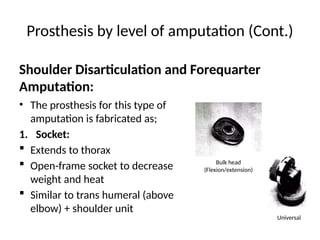
• The prosthesis for this type of
amputation is fabricated as;
1. Socket:
 Extends to thorax
 Open-frame socket to decrease
weight and heat
 Similar to trans humeral (above
elbow) + shoulder unit
Shoulder Disarticulation and Forequarter
Amputation:
Bulk head
(Flexion/extension)
Universal
Prosthesis by level of amputation (Cont.)
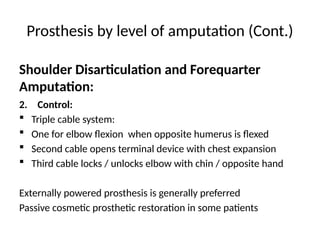
2. Control:
 Triple cable system:
 One for elbow flexion when opposite humerus is flexed
 Second cable opens terminal device with chest expansion
 Third cable locks / unlocks elbow with chin / opposite hand
Externally powered prosthesis is generally preferred
Passive cosmetic prosthetic restoration in some patients
Shoulder Disarticulation and Forequarter
Amputation:
UPPER LIMB PROSTHESIS.pptx.......................

  • 1.
  • 2.
    INTRODUCTION Upper limb prosthesisdesigned to replace, as much as possible, the function or appearance of a missing limb or body part. Prosthesis can replace some grasping and manipulating functions of hand . No sensory feedback. A SUCCESSFUL PROSTHESIS: Comfortable to wear Easy to don and doff Light weight and durable Cosmetically pleasing Reasonable maintenance
  • 3.
    REASONS FOR AMPUTATION •1. infection • 2. trauma • 3. tumor • 4. congenital deformity • 5. 0 to 15 yrs: correction of congenitl deformity /tumor. • 6. 15 to 45 yrs: trauma, tumor • 7. 60 years: rare, tumor or medical disease.
  • 4.
    LEVELS OF AMPUTATION •1. INTERPHALANGEAL AMPUTATION • 2. TRANSMETACARPAL AMPUTATION • 3. TRANSCARPAL AMPUTATION • 4. WRIST DISARTICULATION • 5.TRANSRADIAL AMPUTATION • 6. ELBOW DISARTICULATION • 7. TRANSHUMERAL AMPUTATION • 8. SHOULDER DISARTICULATION • 9. INTERSCAPULOTHORACIC DISARTICULATION
  • 6.
    TYPES OF PROSTHESIS •1. BODY POWERED/ CONVENTIONAL • 2. EXTERNAL POWERED/ ELECTRICAL • 3. COSMETIC/ PASSIVE • 4. HYBRID
  • 7.
    BODY POWERED/CABLE CONTROLLED •An arm prosthesis powered by movement in the upper extremity portion of the body, specifically the muscles of shoulder, neck and back. The motion of these movements is then captured by the harness system that generates tension in the cable, allowing a terminal device(hook/prosthetic hand) to open and close.
  • 8.
    EXTERNALLY POWERED PROSTHESIS/ELECTRICALLY POWERED Prosthesispowered by electric motors may provide more proximal function and greater grip strength, along with improved cosmesis but they can be heavy and expensive. Patient controlled batteries and motors are used to operate these prostheses. It requires a control system. It is of two types myoelectric and switch control.
  • 9.
    COMPONENTS OF ULPROSTHESIS 1. TERMINAL DEVICES 2. WRISTS 3. ELBOWS 4. SHOULDERS 5. SOCKET 6. SUSPENSION
  • 10.
    TERMINAL DEVICES 1. PASSIVETERMINAL DEVICE Falls into two classes those designed primarily for function and those to provide cosmesis. Examples include child mitt frequently used on infants first prosthesis to facilitate crawling or ball handling used for ball sports. Its cosmetic appearance is very good. Cosmetic passive devices are more expensive then active terminal devices. 2. ACTIVE TERMINAL DEVICE More functional than cosmetic. Two main categories 2. Hook 3. prosthetic hand These are available to operate with cable or externally powered.
  • 11.
    Prehensile/ non prehensileterminal devices Non prehensile Touching, feeling, pressing down with fingers, tapping vibrating the cord , lifting or pushing with hand. Prehensile The major function of the hand that the prosthesis tries to replicate is grip (prehension). The five types of grip are as follows 1. Precision grip 2. Tripod grip 3. Lateral grip 4. Hook power grip 5. Spherical grip
  • 16.
    Components of UpperLimb Prosthetics
  • 17.
    Components of UpperLimb Prosthetics • Following are the components of upper limb prosthesis: • Terminal device • Cosmetic gloves • Prosthetic wrists • Prosthetic elbows • Prosthetic sockets • Suspension systems (already discussed)
  • 18.
    Cosmetic Gloves • Usedfor digit and hand • It is extended till elbow • It is a custom made silicone cosmetic covers • Expensive, and difficult to maintain.
  • 19.
    Prosthetic Wrists • Providereceptacle for connecting terminal device • Prono-supination or flexion based on functional activities of patient • Types of Prosthetic Wrists: • The types are; 1. Mechanical 2. Electrical
  • 20.
    Prosthetic Wrists (Cont.) 1.Mechanical Prosthetic Wrist: • For prono-supination: • Friction (helps in rotation) • Quick disconnect • Spring assisted (B/L amputee) • For Flexion: • Spring assisted internal or external 2. Electrical Prosthetic Wrist: • For prono-supination: • Myoelectric (B/L amputee) • Switch control Round and oval configuration of constant friction wrist units
  • 21.
    Prosthetic Wrists (Cont.) Quickchange wrist units Flexion wrist units Electrical wrist unit (Ottobock wrist rotator)
  • 22.
    Prosthetic Elbows Prosthetic Elbows Body poweredelbow External with or without spring assisted (elbow disarticulation) Internal, with or without spring assisted flexion Internal, with rotating turntable (allows internal / external rotation) Externally powered elbow Switch control Digital Proportional Myoelectric control Digital Proportional Passive elbow Manual lock
  • 23.
    Prosthetic Elbows (Cont.) Flexiblehinges Rigid hinges Polycentric hinges Step up hinges Outside locking Inside locking
  • 24.
    Prosthetic Elbows (Cont.) •Electrical Powered Elbow: • These elbows differ from one another in mechanical configuration, drive mechanism and control options. • Boston elbow • NY-Hosmer Electric Elbow • Utah Arm
  • 25.
    Prosthetic Sockets • Functions: •Comfortable residual limb – prosthesis interface • Efficient energy transference to the prosthesis • Secure suspension of the prosthesis • Adequate cosmesis • Types of Prosthetic Sockets: • Wrist disarticulation socket • Long below elbow (trans radial) socket • Short below elbow socket • Very short below elbow socket • Muenster sockets • Elbow disarticulation socket • Standard above elbow socket • Short above elbow socket • Shoulder disarticulation socket • Forequarter amputation socket
  • 26.
    Suspension Systems • Functions: •Suspension – securing prosthesis to residual limb • Control of prosthesis / terminal devices • Types of Suspension Systems: 1. Harness: Figure of 8 (traditional) Chest strap (proximal amputation) Shoulder saddle (proximal amputation) Harness
  • 27.
    Suspension System (Cont.) 2.Self suspension: Condylar Munster (self suspending; not preferred in B/L transradial amputation) Northwestern 3. Semi-suction: Hypobaric semi-suction 4. Suction: Full suction Silicone sock 5. Sock: Interface b/w residual limb and socket. Layers adjustable to volume changes Protect skin and improve hygiene Sock with special silicone band and socket with one way valve are used in semi-suction type of suspension system Suction suspension preferred for transhumeral amputee with normal contralateral limb
  • 28.
    Control Mechanisms • BodyPowered (Harness) Scapular abduction Chest expansion Shoulder depression, extension, abduction, flexion Elbow flexion, extension • Discomfort • Less cosmetic
  • 29.
    Control Mechanisms (Cont.) Mechanicsof Trans Radial Control System Glenohumeral joint flexion for operating a terminal device
  • 30.
    Control Mechanisms (Cont.) Heavy-DutyTrans Radial Harness Bilateral Trans Radial Harness
  • 31.
    Control Mechanisms (Cont.) TransHumeral Control System Two types of control cable: 1. Elbow – flexion/terminal device control cable 2. Elbow lock – control cable Trans Humeral Harness Control
  • 32.
    The Operating Sequenceof the Two Cable Systems • Tension applied to the elbow flexion/terminal device control cable causes the elbow to flex. • When the desired angle of elbow flexion is achieved, the rapid sequential application and release of tension on the elbow lock control cable locks the elbow • With the elbow locked, the reapplication of tension on the elbow flexion/terminal device control cable permits operation of the terminal device. Shoulder Disarticulation Harness
  • 33.
    Prostheses by levelof amputation
  • 34.
    Prosthesis by levelof amputation Partial Hand: • Prosthesis not necessary • Surgical reconstruction – opposition – for prehension with proprioception
  • 35.
    Prosthesis by levelof amputation (Cont.) Wrist Disarticulation: • Distal radial-ulnar articulation preserved for prono-supination • Socket: tapered and flattened distally forming an oval shape • Wrist unit: thin, to minimize length. • Cosmetically: trans-radial
  • 36.
    Prosthesis by levelof amputation (Cont.) Trans Radial Amputation (Below Elbow): • Classification (based on length) 1. Very short (<35%): rigid elbow hinges 2. Short (35-55%): <60 degrees prono-supination, flexible elbow hinges 3. Long (55-90%): 60-120 degrees prono-supination, flexible elbow hinges Below elbow prosthesis
  • 37.
    Prosthesis by levelof amputation (Cont.) Trans Radial Amputation With Decreased Elbow ROM: • Polycentric elbow joints or split socket with step-up hinges used to provide additional flexion • Decreased elbow flexion power
  • 38.
    Prosthesis by levelof amputation (Cont.) Elbow Disarticulation: • Sockets: Flat and broad distally (like epicondyles) • External elbow joint with cable operated lock in medial joint • Suspension: figure of 8, shoulder saddle, chest strap • Control System: two cables; one to lock the elbow, other opens terminal device or flexes elbow
  • 39.
    Prosthesis by levelof amputation (Cont.) Trans Humeral Amputation (Above Elbow): Classification: (based on the length of humerus) 1. Very short (<30%) 2. Short (30-50%) 3. Standard (50-90%)
  • 40.
    Prosthesis by levelof amputation (Cont.) Socket Design of Trans Humeral Prosthesis: Trans Humeral Socket Residual limb greater than 35% Proximal trimline within 1cm of acromion, Suspension with figure of 8, shoulder saddle or chest strap Residual limb smaller than 35% Proximal trimline 2.5cm medial to acromion Suspension with chest strap or suction socket
  • 41.
    Prosthesis by levelof amputation (Cont.) Elbow Joints for Trans Humeral Prosthesis: Elbow Joints Internal Elbow Joint Preferred Level of amputation 4cm or more proximal from epicondyles Allow passive internal / external rotation Elbow spring lift assist available External Elbow Joint Distal amputation Maintain elbow center with contralateral side
  • 42.
    Prosthesis by levelof amputation (Cont.) Control System for Trans Humeral Prosthesis: • Dual cable (like elbow disarticulation) Above elbow prosthesis
  • 43.
    Prosthesis by levelof amputation (Cont.) • The prosthesis for this type of amputation is fabricated as; 1. Socket:  Extends to thorax  Open-frame socket to decrease weight and heat  Similar to trans humeral (above elbow) + shoulder unit Shoulder Disarticulation and Forequarter Amputation: Bulk head (Flexion/extension) Universal
  • 44.
    Prosthesis by levelof amputation (Cont.) 2. Control:  Triple cable system:  One for elbow flexion when opposite humerus is flexed  Second cable opens terminal device with chest expansion  Third cable locks / unlocks elbow with chin / opposite hand Externally powered prosthesis is generally preferred Passive cosmetic prosthetic restoration in some patients Shoulder Disarticulation and Forequarter Amputation: