Elbow disarticulation
Dr. G A Joshi
AP(PMR/ME)
CRC-Bhopal
Topics
• Background
• The Level
• Statistics
• Causes
• Management
• Surgical issues
• Prosthetic Components
• Functional restoration
Background
• Upper limb is the prehensile organ for human
beings
• Elbow ROM of 0o-150o provides versatile reach
combining with shoulder and wrist
• Wars have given the most amputees.
• Army has developed most of prosthetics
(www.indianarmy.gov.in/writereaddata/Docu
ments/165.pdf)
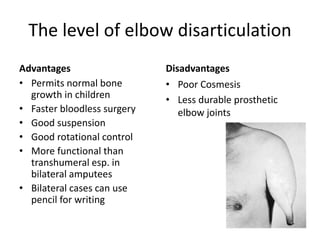
The level of elbow disarticulation
Advantages
• Permits normal bone
growth in children
• Faster bloodless surgery
• Good suspension
• Good rotational control
• More functional than
transhumeral esp. in
bilateral amputees
• Bilateral cases can use
pencil for writing
Disadvantages
• Poor Cosmesis
• Less durable prosthetic
elbow joints
Statistics
• 5 per thousand (1996 USA) cases have Upper
limb amputations
• Men in 15-45 age group
• Amputation of Lower Limb is far more
common than Upper Limb with UL:LL=1:6
• Congenital deficiency of Upper Limb is
commoner than Lower Limb
Causes
• Congenital limb deficiency
• Trauma – machine, road/rail, electric-burn
• Neoplastic
• Vascular – Thromboangiitis obliterans, Tropical
Diabetic Hand Syndrome, Frostbite
• Infection – Necrotizing Fasciitis
Management
• Conservative - thermal burns/frostbite
• Surgical
– Embolectomy
– Fasciotomy
– Reimplantation of transhumoral limb usually gives
functional elbow but poor hand function
– Amputation
– Allograft (esp. in Blind)
Phases of rehabilitation
• Preoperative
• Surgery/reconstruction
• Acute post-surgical
• Pre-prosthetic
• Prosthetic prescription
and fabrication
• Prosthetic training
• Community integration
• Vocational
rehabilitation
• Follow up
Evaluation
• ROM and strength of shoulder
• Vitality testing – clinical, Tc99mPyP nuclear
scan
• Manage any proximal bony or soft tissue
injuries
• Avoid multiple surgeries/revision amputation
as it will delay rehabilitation and thus reduce
effective use of prosthesis
Surgery
• Tourniquet is useful but contraindicated in
– Cancer
– Infection
• Skin and flaps
– Equal anteroposterior flaps
– Unconventional flaps like forearm extensor flap
may be brought at medial epicondyle (where skin
is thinnest) except in oncological cases
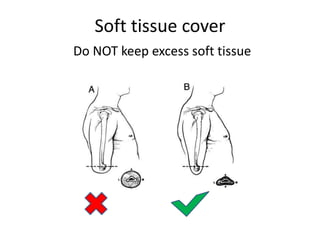
Soft tissue cover
Do NOT keep excess soft tissue
Surgery
• Bone
– May reduce epicondylar prominances in moderation
– Do not disturb articular cartilage
• Muscles
– Retain muscles esp. for myoelectric prosthesis
– Myoplasty gives firm residual limb, helps shoulder
control and improved EMG for myoelectric control
– Pectoralis cineplasty was used for elbow control in
past
Surgery
• Nerves
– Withdraw, cut sharp and allow to retract in soft tissue.
– Median and Ulnar nerves may be cut at different level
• Blood vessels
– Double ligation of major blood vessels
– Hemostasis and muscle tension managed after
deflating tourniquet
• Drain is essential for
– Hematoma prevention
– Fast wound healing
Early prosthetic fitment
• Golden period of 30 days
• Reduces edema
• Facilitates fast healing
• Reduces pain
• Enhances prosthetic use
• Early return to activities esp. two handed
grasping patterns
Prosthetic components
• Flat bulbous socket with snug fitting gives good
rotational control and self suspension
• External elbow joints
• Harness is Northwestern figure of 8 type or
shoulder saddle and chest strap
• Control system has 2 cables –
– Elbow lock control on medial prosthetic elbow joint
– Elbow flexion (when elbow is unlocked) cum terminal
device operation (when elbow is locked)
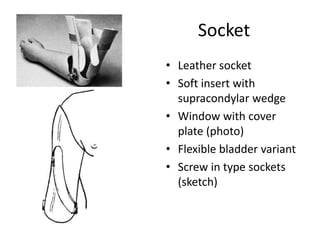
Socket
• Leather socket
• Soft insert with
supracondylar wedge
• Window with cover
plate (photo)
• Flexible bladder variant
• Screw in type sockets
(sketch)
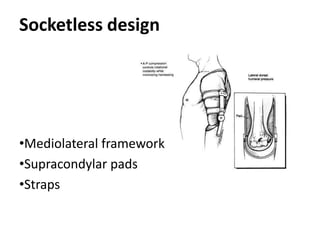
Socketless design
•Mediolateral framework
•Supracondylar pads
•Straps
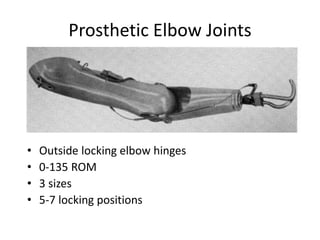
Prosthetic Elbow Joints
• Outside locking elbow hinges
• 0-135 ROM
• 3 sizes
• 5-7 locking positions
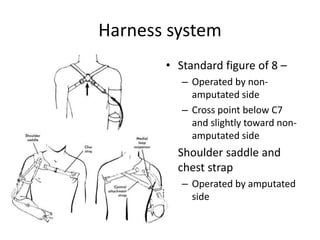
Harness system
• Standard figure of 8 –
– Operated by non-
amputated side
– Cross point below C7
and slightly toward non-
amputated side
• Shoulder saddle and
chest strap
– Operated by amputated
side
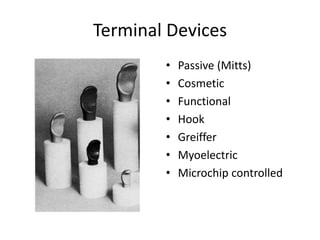
Terminal Devices
• Passive (Mitts)
• Cosmetic
• Functional
• Hook
• Greiffer
• Myoelectric
• Microchip controlled
Functional restoration
• Comfort fit
• Perceived value
• Follow up
– Adjusting socket to limb volume change
– Mastering functions of the prosthesis
– Re-evaluation and re-design of prosthesis as per
changing needs of patient
THANK YOU

Elbow disarticulation

  • 1.
    Elbow disarticulation Dr. GA Joshi AP(PMR/ME) CRC-Bhopal
  • 2.
    Topics • Background • TheLevel • Statistics • Causes • Management • Surgical issues • Prosthetic Components • Functional restoration
  • 3.
    Background • Upper limbis the prehensile organ for human beings • Elbow ROM of 0o-150o provides versatile reach combining with shoulder and wrist • Wars have given the most amputees. • Army has developed most of prosthetics (www.indianarmy.gov.in/writereaddata/Docu ments/165.pdf)
  • 4.
    The level ofelbow disarticulation Advantages • Permits normal bone growth in children • Faster bloodless surgery • Good suspension • Good rotational control • More functional than transhumeral esp. in bilateral amputees • Bilateral cases can use pencil for writing Disadvantages • Poor Cosmesis • Less durable prosthetic elbow joints
  • 5.
    Statistics • 5 perthousand (1996 USA) cases have Upper limb amputations • Men in 15-45 age group • Amputation of Lower Limb is far more common than Upper Limb with UL:LL=1:6 • Congenital deficiency of Upper Limb is commoner than Lower Limb
  • 6.
    Causes • Congenital limbdeficiency • Trauma – machine, road/rail, electric-burn • Neoplastic • Vascular – Thromboangiitis obliterans, Tropical Diabetic Hand Syndrome, Frostbite • Infection – Necrotizing Fasciitis
  • 7.
    Management • Conservative -thermal burns/frostbite • Surgical – Embolectomy – Fasciotomy – Reimplantation of transhumoral limb usually gives functional elbow but poor hand function – Amputation – Allograft (esp. in Blind)
  • 8.
    Phases of rehabilitation •Preoperative • Surgery/reconstruction • Acute post-surgical • Pre-prosthetic • Prosthetic prescription and fabrication • Prosthetic training • Community integration • Vocational rehabilitation • Follow up
  • 9.
    Evaluation • ROM andstrength of shoulder • Vitality testing – clinical, Tc99mPyP nuclear scan • Manage any proximal bony or soft tissue injuries • Avoid multiple surgeries/revision amputation as it will delay rehabilitation and thus reduce effective use of prosthesis
  • 10.
    Surgery • Tourniquet isuseful but contraindicated in – Cancer – Infection • Skin and flaps – Equal anteroposterior flaps – Unconventional flaps like forearm extensor flap may be brought at medial epicondyle (where skin is thinnest) except in oncological cases
  • 11.
    Soft tissue cover DoNOT keep excess soft tissue
  • 12.
    Surgery • Bone – Mayreduce epicondylar prominances in moderation – Do not disturb articular cartilage • Muscles – Retain muscles esp. for myoelectric prosthesis – Myoplasty gives firm residual limb, helps shoulder control and improved EMG for myoelectric control – Pectoralis cineplasty was used for elbow control in past
  • 13.
    Surgery • Nerves – Withdraw,cut sharp and allow to retract in soft tissue. – Median and Ulnar nerves may be cut at different level • Blood vessels – Double ligation of major blood vessels – Hemostasis and muscle tension managed after deflating tourniquet • Drain is essential for – Hematoma prevention – Fast wound healing
  • 14.
    Early prosthetic fitment •Golden period of 30 days • Reduces edema • Facilitates fast healing • Reduces pain • Enhances prosthetic use • Early return to activities esp. two handed grasping patterns
  • 15.
    Prosthetic components • Flatbulbous socket with snug fitting gives good rotational control and self suspension • External elbow joints • Harness is Northwestern figure of 8 type or shoulder saddle and chest strap • Control system has 2 cables – – Elbow lock control on medial prosthetic elbow joint – Elbow flexion (when elbow is unlocked) cum terminal device operation (when elbow is locked)
  • 16.
    Socket • Leather socket •Soft insert with supracondylar wedge • Window with cover plate (photo) • Flexible bladder variant • Screw in type sockets (sketch)
  • 17.
  • 18.
    Prosthetic Elbow Joints •Outside locking elbow hinges • 0-135 ROM • 3 sizes • 5-7 locking positions
  • 19.
    Harness system • Standardfigure of 8 – – Operated by non- amputated side – Cross point below C7 and slightly toward non- amputated side • Shoulder saddle and chest strap – Operated by amputated side
  • 20.
    Terminal Devices • Passive(Mitts) • Cosmetic • Functional • Hook • Greiffer • Myoelectric • Microchip controlled
  • 21.
    Functional restoration • Comfortfit • Perceived value • Follow up – Adjusting socket to limb volume change – Mastering functions of the prosthesis – Re-evaluation and re-design of prosthesis as per changing needs of patient
  • 22.