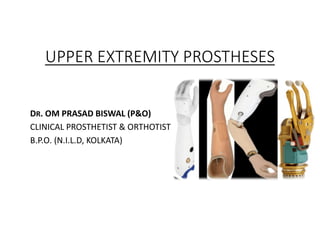

UPPER EXTREMITY PROSTHESES
DR. OM PRASAD BISWAL (P&O)
CLINICAL PROSTHETIST & ORTHOTIST
B.P.O. (N.I.L.D, KOLKATA)
Introduction
• Upper limb prosthesis designed to replace, as much as possible, the
function or appearance of a missing limb or body part.
• Prosthesis can replace some grasping and manipulating functions of
hand.
• No sensory feedback.
• Role of dominant function replaced to contra-lateral hand and
prosthesis assists bimanual function.
Factors
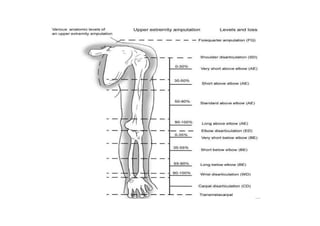
• Amputation level
• Expected function of the prosthesis
• Cognitive function of the patient
• Vocation of the patient
• Avocational interests of the patient
• Cosmetic importance of the prosthesis
• Financial resources of the patient
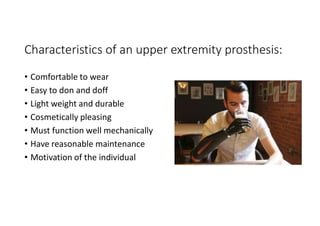
Characteristics of an upper extremity prosthesis:
• Comfortable to wear
• Easy to don and doff
• Light weight and durable
• Cosmetically pleasing
• Must function well mechanically
• Have reasonable maintenance
• Motivation of the individual
Prosthetic Rehabilitation
No prosthesis
Passive prostheses or restorations
Body powered or conventional
External powered or electric
Hybrid prosthesis
Activity specific
Passive Prostheses or Restorations
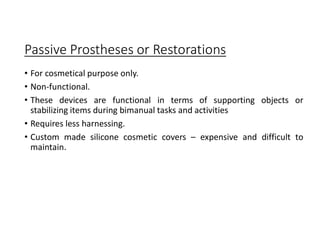
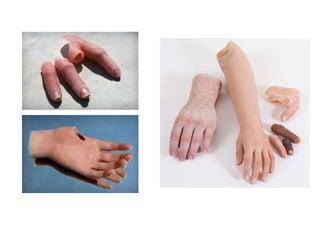
• For cosmetical purpose only.
• Non-functional.
• These devices are functional in terms of supporting objects or
stabilizing items during bimanual tasks and activities
• Requires less harnessing.
• Custom made silicone cosmetic covers – expensive and difficult to
maintain.
Body-powered Prostheses
• Conventional (body-powered) systems include any prosthesis that uses a
control cable system to translate volitional muscle force and shoulder or
arm movement to operate a terminal device or prosthetic elbow.
• These body-powered devices are durable, often weigh less than their
electrical counterparts.
• Their mechanics depend on proprioceptive feedback through the
harness system.
• Disadvantages of a body-powered prosthesis revolve around the
restrictive nature of its design.
• Long-term use of a body-powered prosthesis can accelerate shoulder
issues and anterior muscle imbalances and lead to nerve entrapment
within the contralateral axilla.
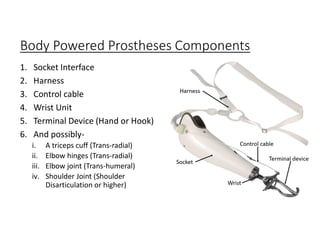
Body Powered Prostheses Components
1. Socket Interface
2. Harness
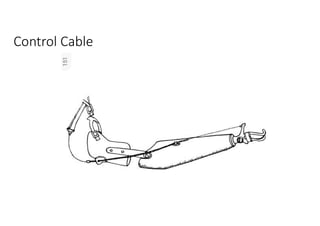
3. Control cable
4. Wrist Unit
5. Terminal Device (Hand or Hook)
6. And possibly-
i. A triceps cuff (Trans-radial)
ii. Elbow hinges (Trans-radial)
iii. Elbow joint (Trans-humeral)
iv. Shoulder Joint (Shoulder
Disarticulation or higher)
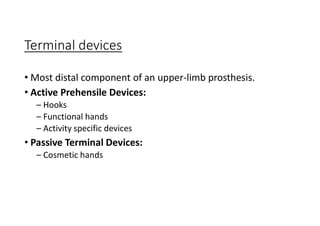
Terminal devices
• Most distal component of an upper-limb prosthesis.
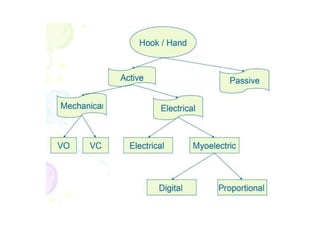
• Active Prehensile Devices:
– Hooks
– Functional hands
– Activity specific devices
• Passive Terminal Devices:
– Cosmetic hands
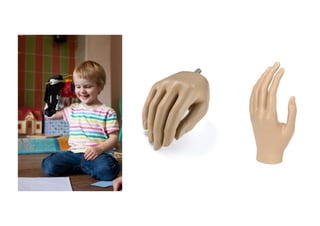
Passive Hand
• Users who opt for a passive prosthesis are primarily concerned with
aesthetics or body symmetry rather than function.
• But passive prostheses can assist with some actions like pushing,
pulling, stabilizing, supporting, light grasping and typing.
• Another category of passive terminal devices resembles children's
mittens, and hence they are called "mitts." The passive mitt is usually
a soft, flexible humanoid shape similar to the cupped human hand.
Terminal devices
• Voluntary Opening:
 Lower Maximum grip
 In closed position, by springs
 Patient pulls the cable to open
 Prehensile force – spring, relaxed full grip
 Simple mechanism
• Voluntary Closing:
 Higher maximum grip
 In open position
 Patient pulls the cable to close
 Prehensile force – patient, sustained tension for grip
 Cumbersome
 Greater proprioceptive input
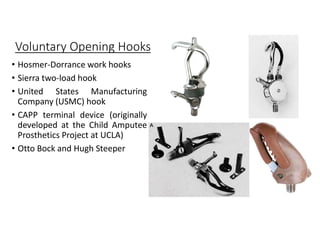
Voluntary Opening Hooks
• Hosmer-Dorrance work hooks
• Sierra two-load hook
• United States Manufacturing
Company (USMC) hook
• CAPP terminal device (originally
developed at the Child Amputee
Prosthetics Project at UCLA)
• Otto Bock and Hugh Steeper
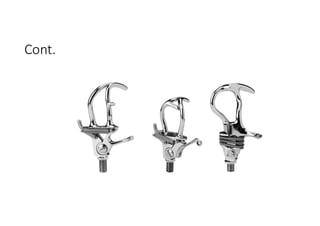
Cont.
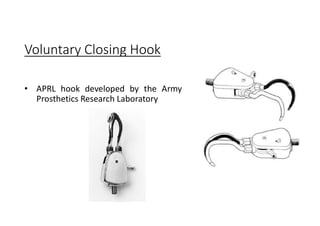
Voluntary Closing Hook
• APRL hook developed by the Army
Prosthetics Research Laboratory
Voluntary-Opening Hands Voluntary Closing Hands
• Becker Plylite Hand
• Becker Lock-Grip and Imperial Hands
• Robin-Aids Mechanical Hand
• Robin-Aids Soft Mechanical Hand
• Sierra Voluntary-Opening Hand
• Hosmer-Dorrance Functional Hands
• APRL Voluntary Closing
Hand
• Otto Bock System Hand
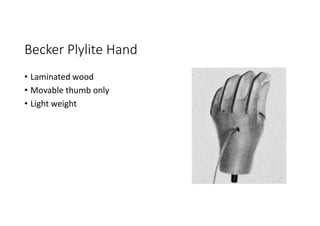
Becker Plylite Hand
• Laminated wood
• Movable thumb only
• Light weight
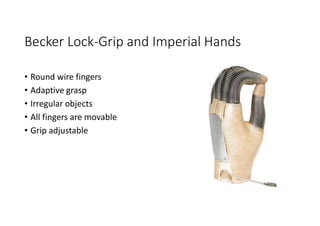
Becker Lock-Grip and Imperial Hands
• Round wire fingers
• Adaptive grasp
• Irregular objects
• All fingers are movable
• Grip adjustable
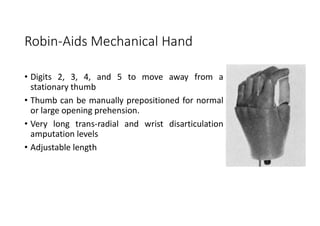
Robin-Aids Mechanical Hand
• Digits 2, 3, 4, and 5 to move away from a
stationary thumb
• Thumb can be manually prepositioned for normal
or large opening prehension.
• Very long trans-radial and wrist disarticulation
amputation levels
• Adjustable length
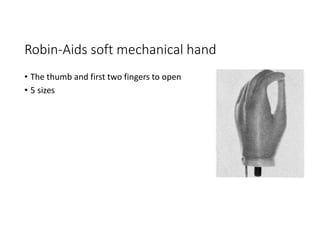
Robin-Aids soft mechanical hand
• The thumb and first two fingers to open
• 5 sizes
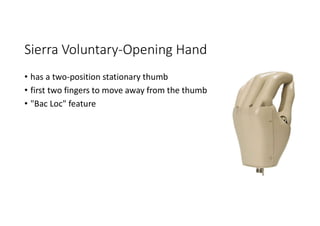
Sierra Voluntary-Opening Hand
• has a two-position stationary thumb
• first two fingers to move away from the thumb
• "Bac Loc" feature
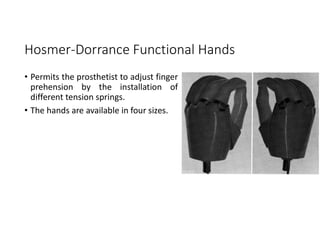
Hosmer-Dorrance Functional Hands
• Permits the prosthetist to adjust finger
prehension by the installation of
different tension springs.
• The hands are available in four sizes.
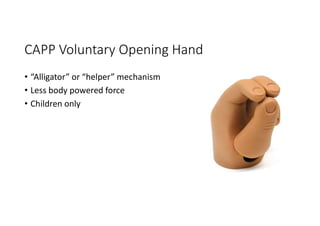
CAPP Voluntary Opening Hand
• “Alligator” or “helper” mechanism
• Less body powered force
• Children only
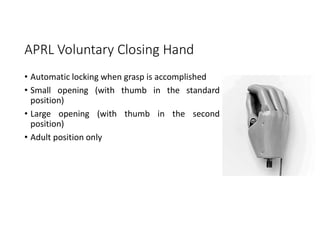
APRL Voluntary Closing Hand
• Automatic locking when grasp is accomplished
• Small opening (with thumb in the standard
position)
• Large opening (with thumb in the second
position)
• Adult position only
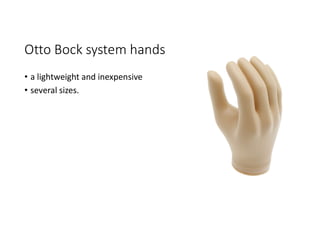
Otto Bock system hands
• a lightweight and inexpensive
• several sizes.
Prosthetic Wrist Units
• Provide receptacle for connecting terminal device.
• Pronation and supination or flexion based on functional activities of
patient.
Friction Wrist Unit-
oOval Friction Wrist Unit
Constant Friction Wrist Unit
Quick Change Disconnect Wrist Unit
Wrist Flexion Units-
oSierra Wrist flexion Unit
oAPRL Wrist Flexion Unit
Rotational Wrist Unit
Ball and Socket Wrist Unit
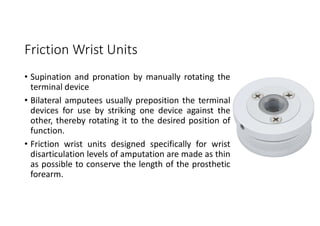
Friction Wrist Units
• Supination and pronation by manually rotating the
terminal device
• Bilateral amputees usually preposition the terminal
devices for use by striking one device against the
other, thereby rotating it to the desired position of
function.
• Friction wrist units designed specifically for wrist
disarticulation levels of amputation are made as thin
as possible to conserve the length of the prosthetic
forearm.
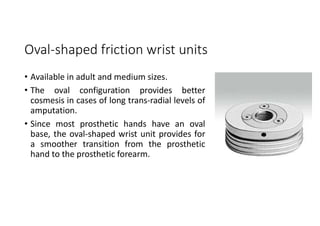
Oval-shaped friction wrist units
• Available in adult and medium sizes.
• The oval configuration provides better
cosmesis in cases of long trans-radial levels of
amputation.
• Since most prosthetic hands have an oval
base, the oval-shaped wrist unit provides for
a smoother transition from the prosthetic
hand to the prosthetic forearm.
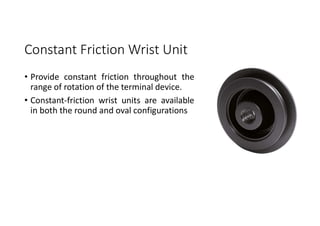
Constant Friction Wrist Unit
• Provide constant friction throughout the
range of rotation of the terminal device.
• Constant-friction wrist units are available
in both the round and oval configurations
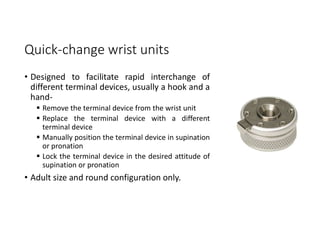
Quick-change wrist units
• Designed to facilitate rapid interchange of
different terminal devices, usually a hook and a
hand-
 Remove the terminal device from the wrist unit
 Replace the terminal device with a different
terminal device
 Manually position the terminal device in supination
or pronation
 Lock the terminal device in the desired attitude of
supination or pronation
• Adult size and round configuration only.
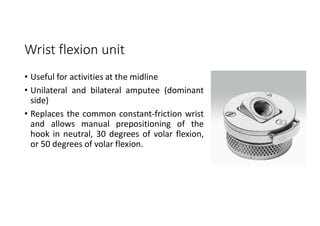
Wrist flexion unit
• Useful for activities at the midline
• Unilateral and bilateral amputee (dominant
side)
• Replaces the common constant-friction wrist
and allows manual prepositioning of the
hook in neutral, 30 degrees of volar flexion,
or 50 degrees of volar flexion.
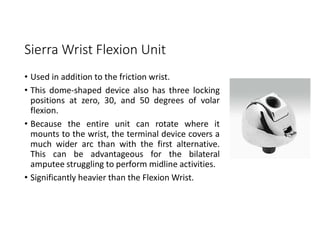
Sierra Wrist Flexion Unit
• Used in addition to the friction wrist.
• This dome-shaped device also has three locking
positions at zero, 30, and 50 degrees of volar
flexion.
• Because the entire unit can rotate where it
mounts to the wrist, the terminal device covers a
much wider arc than with the first alternative.
This can be advantageous for the bilateral
amputee struggling to perform midline activities.
• Significantly heavier than the Flexion Wrist.
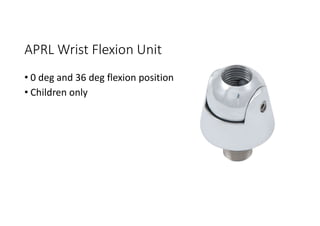
APRL Wrist Flexion Unit
• 0 deg and 36 deg flexion position
• Children only
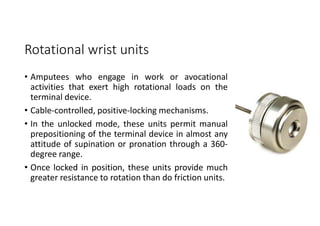
Rotational wrist units
• Amputees who engage in work or avocational
activities that exert high rotational loads on the
terminal device.
• Cable-controlled, positive-locking mechanisms.
• In the unlocked mode, these units permit manual
prepositioning of the terminal device in almost any
attitude of supination or pronation through a 360-
degree range.
• Once locked in position, these units provide much
greater resistance to rotation than do friction units.
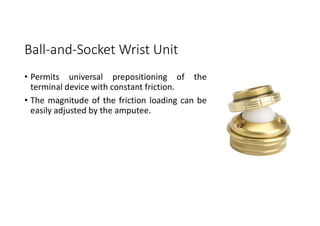
Ball-and-Socket Wrist Unit
• Permits universal prepositioning of the
terminal device with constant friction.
• The magnitude of the friction loading can be
easily adjusted by the amputee.
Prosthetics Elbow Units
• External with or without spring assisted flexion (elbow disarticulation)
• Internal, with or without spring assisted flexion
• Internal, with rotating turntable (allows internal/ external rotation)
Socket design for partial hand amputation
• Socket designs for partial hand prostheses preserve function of wrist
joint and other proximal jt.
• Trimlines and socket contours are generally dictated by the geometry
of the remaining portions of the hand and fingers.
Goals:-
1. Protection of the residual limb.
2. bimanual stability
3. provide acceptable cosmesis and durability
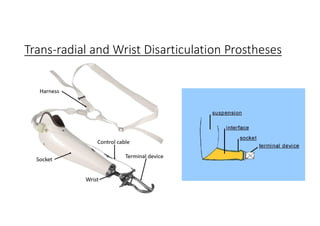
Trans-radial and Wrist Disarticulation Prostheses
Sockets
• Socket designs and careful consideration-
1. maximizing range of motion.
2. providing stability throughout daily activities.
3. comfortably distributing the forces exerted on the residual limb
during movement and suspension.
• Socket design for body powered prosthesis-
1. Harness suspended
2. Self suspended
Cont.
Socket designs fall into four categories:-
1. Supracondylar brims
2. External suspension sleeves
3. Suprastyloid suspensions
4. Internal roll-on locking liners
SUPRACONDYLAR DESIGNS
1. Muenster socket
2. Northwestern supracondylar socket
3. Modified supracondylar brim
4. Floating brim suspension
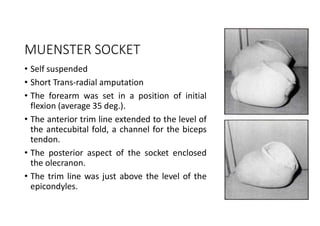
MUENSTER SOCKET
• Self suspended
• Short Trans-radial amputation
• The forearm was set in a position of initial
flexion (average 35 deg.).
• The anterior trim line extended to the level of
the antecubital fold, a channel for the biceps
tendon.
• The posterior aspect of the socket enclosed
the olecranon.
• The trim line was just above the level of the
epicondyles.
• Advantages-
1. Comfort and security.
2. Lifting and holding forces generally superior.
3. "Axial load"—resisting vertical downward force with the elbow
extended.
• Disadvantages-
1. Active pronation & supination is eliminated.
2. Difficulty in donning and doffing as stump length increases.
3. Decrease in flexion range required modification in case of bi-lateral
socket.
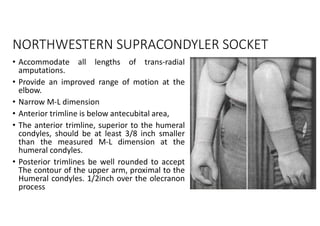
NORTHWESTERN SUPRACONDYLER SOCKET
• Accommodate all lengths of trans-radial
amputations.
• Provide an improved range of motion at the
elbow.
• Narrow M-L dimension
• Anterior trimline is below antecubital area,
• The anterior trimline, superior to the humeral
condyles, should be at least 3/8 inch smaller
than the measured M-L dimension at the
humeral condyles.
• Posterior trimlines be well rounded to accept
The contour of the upper arm, proximal to the
Humeral condyles. 1/2inch over the olecranon
process
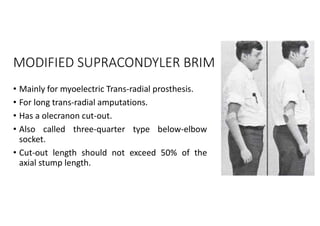
MODIFIED SUPRACONDYLER BRIM
• Mainly for myoelectric Trans-radial prosthesis.
• For long trans-radial amputations.
• Has a olecranon cut-out.
• Also called three-quarter type below-elbow
socket.
• Cut-out length should not exceed 50% of the
axial stump length.
Advantages-
• Ventilation greatly improved,
• The skin of the stump remains dry making for a cooler socket in the
summer and a warmer stump in the winter.
• Skin problems caused by maceration are eliminated
• Comfort and wearing tolerance are greatly improved.
• Suspension improved
• Anatomical elbow is free to move.
• Increased elbow flexion range.
• Reduced bulkiness at olecranon areas.
• Cosmetically pleasing.
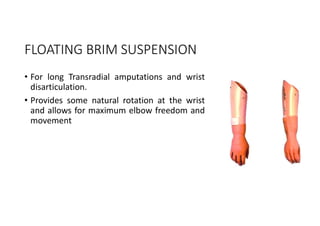
FLOATING BRIM SUSPENSION
• For long Transradial amputations and wrist
disarticulation.
• Provides some natural rotation at the wrist
and allows for maximum elbow freedom and
movement
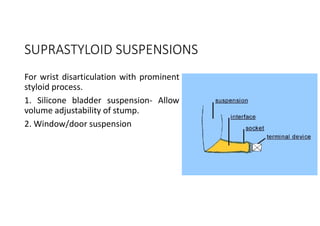
SUPRASTYLOID SUSPENSIONS
For wrist disarticulation with prominent
styloid process.
1. Silicone bladder suspension- Allow
volume adjustability of stump.
2. Window/door suspension
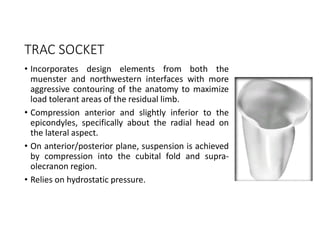
TRAC SOCKET
• Incorporates design elements from both the
muenster and northwestern interfaces with more
aggressive contouring of the anatomy to maximize
load tolerant areas of the residual limb.
• Compression anterior and slightly inferior to the
epicondyles, specifically about the radial head on
the lateral aspect.
• On anterior/posterior plane, suspension is achieved
by compression into the cubital fold and supra-
olecranon region.
• Relies on hydrostatic pressure.
Cont.
• The position and degree of displacement of the skeletal substructure
while wearing the TRAC interface are less affected during loading.
• The TRAC addresses the deficits of previous designs by contouring
five key areas:
1) the antecubital region,
2) the olecranon region,
3) the epicondylar region,
4) the distal radial region, and
5) the wrist extensor and flexor musculature
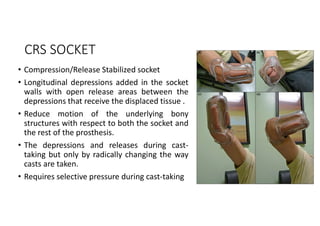
CRS SOCKET
• Compression/Release Stabilized socket
• Longitudinal depressions added in the socket
walls with open release areas between the
depressions that receive the displaced tissue .
• Reduce motion of the underlying bony
structures with respect to both the socket and
the rest of the prosthesis.
• The depressions and releases during cast-
taking but only by radically changing the way
casts are taken.
• Requires selective pressure during cast-taking
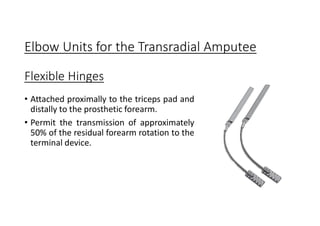
Elbow Units for the Transradial Amputee
Flexible Hinges
• Attached proximally to the triceps pad and
distally to the prosthetic forearm.
• Permit the transmission of approximately
50% of the residual forearm rotation to the
terminal device.
Rigid Hinges
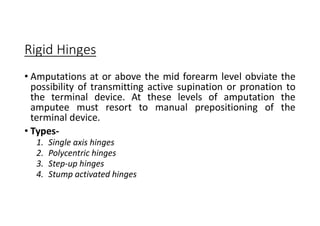
• Amputations at or above the mid forearm level obviate the
possibility of transmitting active supination or pronation to
the terminal device. At these levels of amputation the
amputee must resort to manual prepositioning of the
terminal device.
• Types-
1. Single axis hinges
2. Polycentric hinges
3. Step-up hinges
4. Stump activated hinges
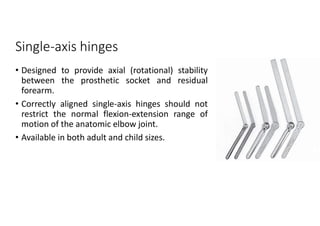
Single-axis hinges
• Designed to provide axial (rotational) stability
between the prosthetic socket and residual
forearm.
• Correctly aligned single-axis hinges should not
restrict the normal flexion-extension range of
motion of the anatomic elbow joint.
• Available in both adult and child sizes.
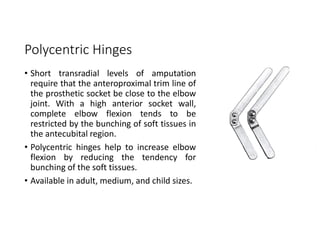
Polycentric Hinges
• Short transradial levels of amputation
require that the anteroproximal trim line of
the prosthetic socket be close to the elbow
joint. With a high anterior socket wall,
complete elbow flexion tends to be
restricted by the bunching of soft tissues in
the antecubital region.
• Polycentric hinges help to increase elbow
flexion by reducing the tendency for
bunching of the soft tissues.
• Available in adult, medium, and child sizes.
Step-Up Hinges
• Amputations immediately distal to the elbow joint require a prosthetic
socket with extremely high trim lines.
• The use of step-up hinges requires that the prosthetic forearm and socket
be separated. Consequently, protheses employing step-up hinges are
frequently referred to as split-socket prostheses.
• Amplify the excursion of anatomic elbow joint motion by a ratio of
approximately 2:1. Sixty degrees of flexion of the anatomic elbow joint
causes the prosthetic forearm (and terminal device) to move through a
range of approximately 120 degrees of motion.
• Adult, medium, child sizes.
Cont.
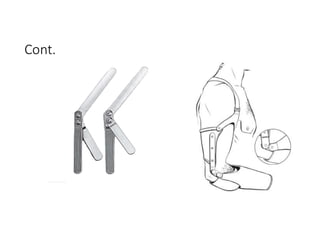
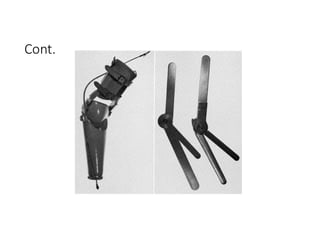
Stump-Activated Locking Hinge
• Amputees with very high transradial levels of amputation are often
unable to operate a conventional transradial prosthesis.
• A split socket prosthesis is used.
• Shoulder flexion on the amputated side flexes the mechanical elbow
joint.
• The residual limb is used only for locking and unlocking the
mechanical elbow joint.
• Adult and small size.
Cont.
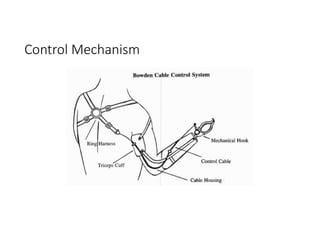
Control Mechanism
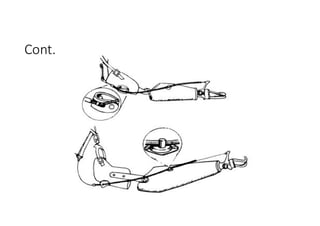
Control Cable
Cont.
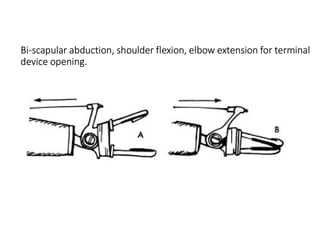
Bi-scapular abduction, shoulder flexion, elbow extension for terminal
device opening.
Transradial Harness Systems
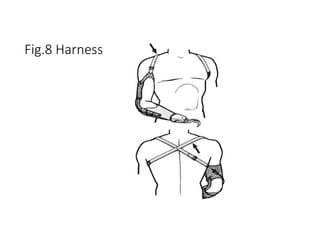
• Figure 8 Harness:
 Axillary Loop
 O ring
 Control Attachment Strap
 Inverted Y strap
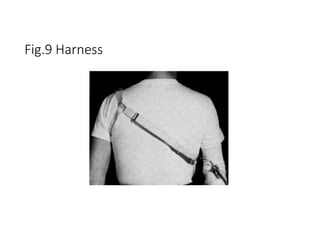
• Figure 9 Harness: In case of self suspended sockets
 Axillary loop
 O ring
 Control attachment strap
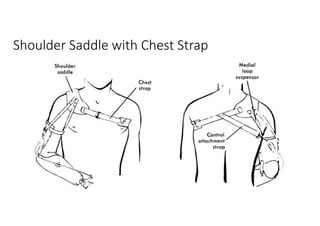
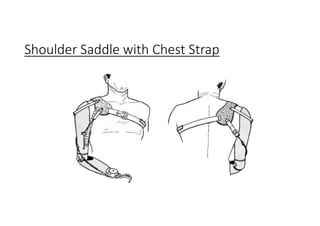
• Shoulder Saddle with Chest Strap: For Heavy Duty Users
 Shoulder Saddle
 Chest Strap
 Medial and Lateral Straps
 Control Attachment Strap
Fig.8 Harness
Fig.9 Harness
Shoulder Saddle with Chest Strap
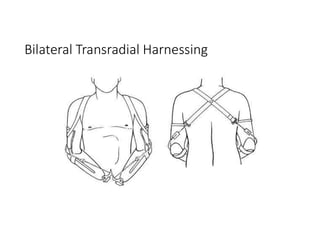
Bilateral Transradial Harnessing
Transhumeral and Elbow Disarticulation Prostheses
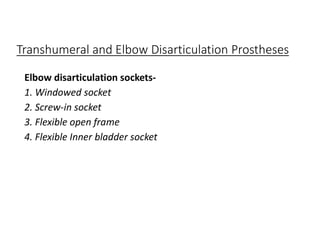
Elbow disarticulation sockets-
1. Windowed socket
2. Screw-in socket
3. Flexible open frame
4. Flexible Inner bladder socket
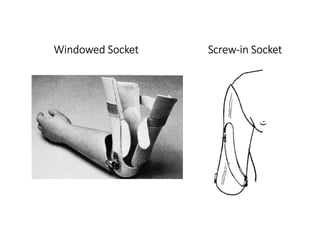
Windowed Socket Screw-in Socket
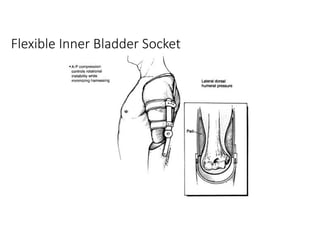
Flexible Inner Bladder Socket
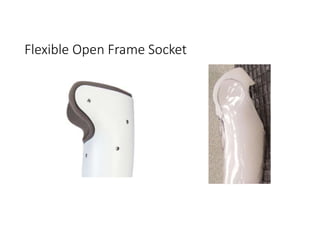
Flexible Open Frame Socket
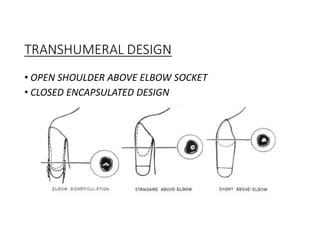
TRANSHUMERAL DESIGN
• OPEN SHOULDER ABOVE ELBOW SOCKET
• CLOSED ENCAPSULATED DESIGN
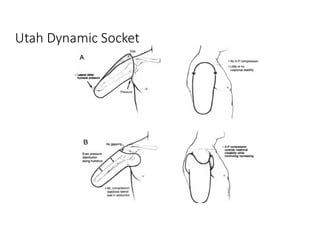
Utah Dynamic Socket
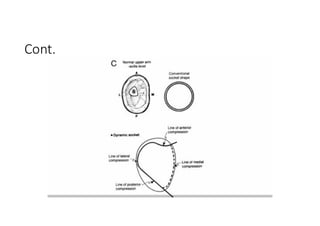
Cont.
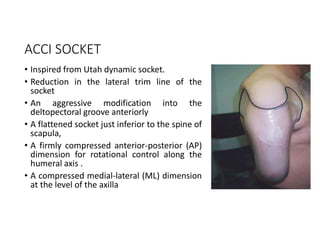
ACCI SOCKET
• Inspired from Utah dynamic socket.
• Reduction in the lateral trim line of the
socket
• An aggressive modification into the
deltopectoral groove anteriorly
• A flattened socket just inferior to the spine of
scapula,
• A firmly compressed anterior-posterior (AP)
dimension for rotational control along the
humeral axis .
• A compressed medial-lateral (ML) dimension
at the level of the axilla
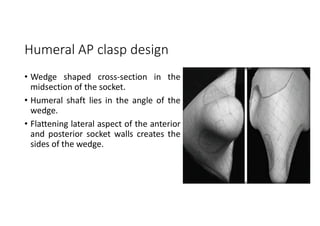
Humeral AP clasp design
• Wedge shaped cross-section in the
midsection of the socket.
• Humeral shaft lies in the angle of the
wedge.
• Flattening lateral aspect of the anterior
and posterior socket walls creates the
sides of the wedge.
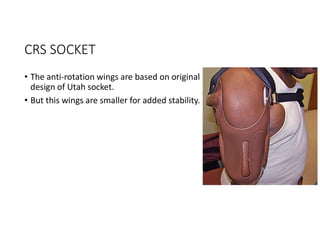
CRS SOCKET
• The anti-rotation wings are based on original
design of Utah socket.
• But this wings are smaller for added stability.
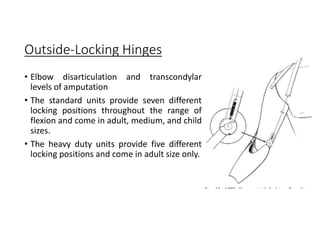
Outside-Locking Hinges
• Elbow disarticulation and transcondylar
levels of amputation
• The standard units provide seven different
locking positions throughout the range of
flexion and come in adult, medium, and child
sizes.
• The heavy duty units provide five different
locking positions and come in adult size only.
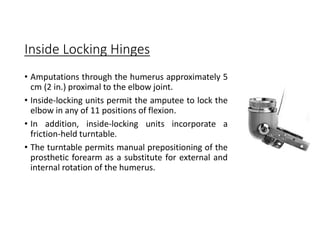
Inside Locking Hinges
• Amputations through the humerus approximately 5
cm (2 in.) proximal to the elbow joint.
• Inside-locking units permit the amputee to lock the
elbow in any of 11 positions of flexion.
• In addition, inside-locking units incorporate a
friction-held turntable.
• The turntable permits manual prepositioning of the
prosthetic forearm as a substitute for external and
internal rotation of the humerus.
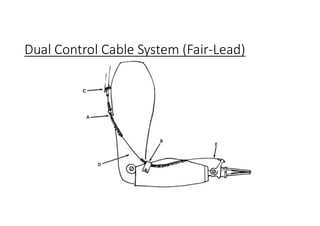
Dual Control Cable System (Fair-Lead)
Body-powered Movements for Transhumeral Amputation-
• Bi-scapular abduction and shoulder flexion for terminal device
operation and elbow flexion/extension.
• Shoulder depression, extension, internal rotation and abduction
for elbow locking/unlocking.
• Chest expansion, scapular abduction and shoulder flexion for
terminal device operation and elbow flexion/extension. (In case
of shoulder saddle with chest strap harness).
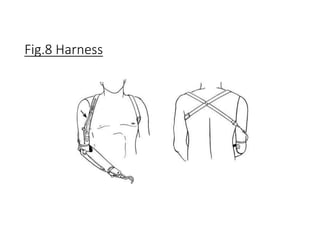
Fig.8 Harness
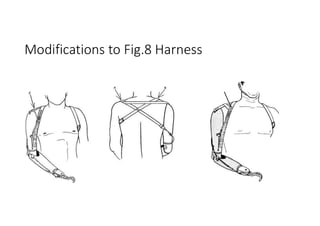
Modifications to Fig.8 Harness
Shoulder Saddle with Chest Strap
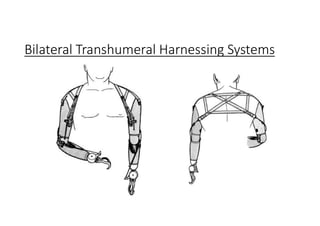
Bilateral Transhumeral Harnessing Systems
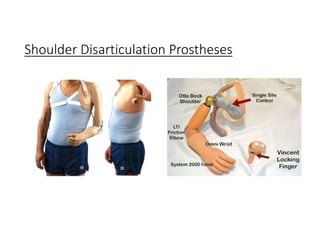
Shoulder Disarticulation Prostheses
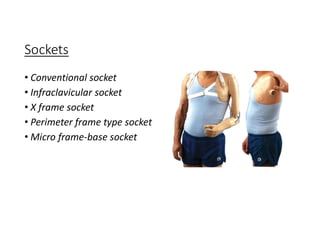
Sockets
• Conventional socket
• Infraclavicular socket
• X frame socket
• Perimeter frame type socket
• Micro frame-base socket
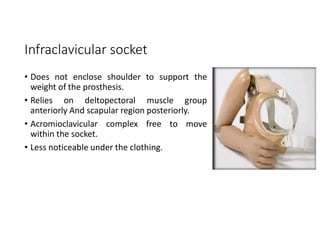
Infraclavicular socket
• Does not enclose shoulder to support the
weight of the prosthesis.
• Relies on deltopectoral muscle group
anteriorly And scapular region posteriorly.
• Acromioclavicular complex free to move
within the socket.
• Less noticeable under the clothing.
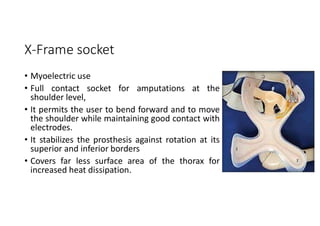
X-Frame socket
• Myoelectric use
• Full contact socket for amputations at the
shoulder level,
• It permits the user to bend forward and to move
the shoulder while maintaining good contact with
electrodes.
• It stabilizes the prosthesis against rotation at its
superior and inferior borders
• Covers far less surface area of the thorax for
increased heat dissipation.
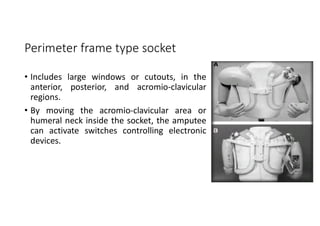
Perimeter frame type socket
• Includes large windows or cutouts, in the
anterior, posterior, and acromio-clavicular
regions.
• By moving the acromio-clavicular area or
humeral neck inside the socket, the amputee
can activate switches controlling electronic
devices.
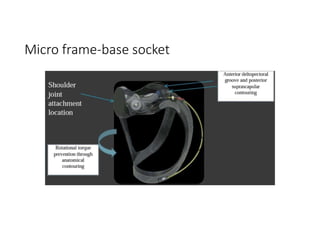
Micro frame-base socket
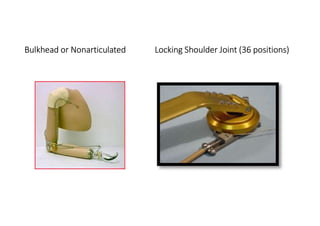
Bulkhead or Nonarticulated Locking Shoulder Joint (36 positions)
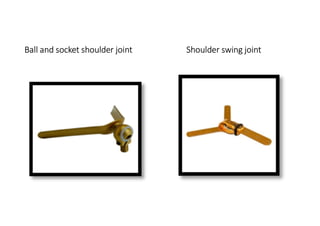
Ball and socket shoulder joint Shoulder swing joint
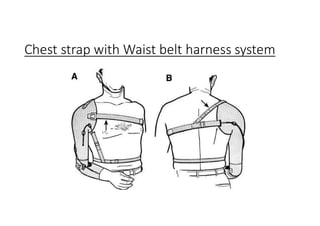
Body-powered movements for shoulder disarticulation-
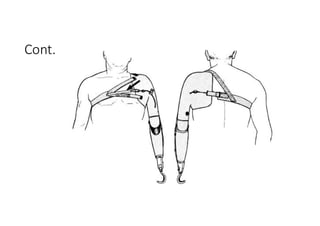
• Triple control cable systems
• Contralateral scapular abduction for terminal device operation,
mechanical shoulder and elbow flexion.
• Chest expansion and shoulder elevation for elbow locking/unlocking.
• Elbow locking and unlocking can also be achieved through chin/sound
limb.
Chest strap with Waist belt harness system
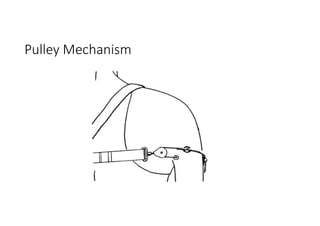
Pulley Mechanism
Cont.
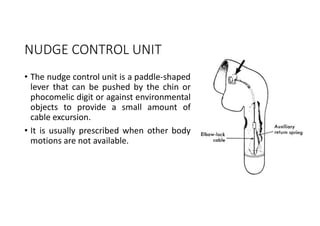
NUDGE CONTROL UNIT
• The nudge control unit is a paddle-shaped
lever that can be pushed by the chin or
phocomelic digit or against environmental
objects to provide a small amount of
cable excursion.
• It is usually prescribed when other body
motions are not available.
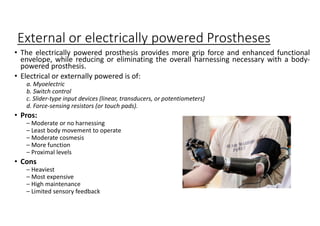
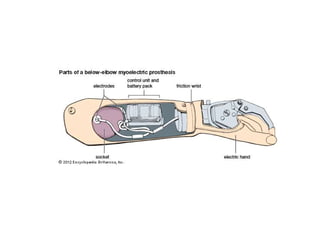
External or electrically powered Prostheses
• The electrically powered prosthesis provides more grip force and enhanced functional
envelope, while reducing or eliminating the overall harnessing necessary with a body-
powered prosthesis.
• Electrical or externally powered is of:
a. Myoelectric
b. Switch control
c. Slider-type input devices (linear, transducers, or potentiometers)
d. Force-sensing resistors (or touch pads).
• Pros:
– Moderate or no harnessing
– Least body movement to operate
– Moderate cosmesis
– More function
– Proximal levels
• Cons
– Heaviest
– Most expensive
– High maintenance
– Limited sensory feedback
External Terminal Devices
Hand like shape:
• Otto Bock System Electric Hands
• Steeper Electric Hands
Not having hand like shape:
• Otto Bock System Electric Greifer
• Hosmer NU-VA Synergetic Prehensor
• Steeper Powered Gripper
• NY-Hosmer Prehension Actuator
Myoelectric Elbow Units
• Hosmer NY electric elbow
• Boston digital arm system
• Motion control Utah arm 2
• ErgoArm Plus
• RSLSteeper electric elbow lock
• Automatic Forearm Balance
Myoelectric Wrist Units
• Electric wrist rotator
• Wrist flexion unit
Myoelectric Control Systems
Myoelectrodes collect and filter surface electromyogram signals
generated through muscle contractions and convert those signals into a
form that can influence electrical motors.
• 2-site/2-function (Dual Site) System: Separate electrodes for paired
prosthetic activity. FLEXTION/EXTENSION, SUPINATION/PRONA TION.
It is more physiological and easier to control.
• 1-site/2-function (Single Site) System: Used when limited control
sites (MUSCLES) are available in a residual limb. This system uses 1
electrode to control both functions of a paired activity
(Flexion/Extension), (Supination/Pronation)
Switch Control
• Switch controlled externally powered prosthesis utilize small switches,
rather than muscle signals, to operate the electric motors. A switch
can be activated by movement of a remnant digit or part of a bony
prominence against the switch or by a pull on a suspension harness
(similar to movement a patient makes, when operating a body-
powered prosthesis)
Slider-type input devices
• These convert distance, speed, or force into proportional movement
of a prosthetic limb.
• As a result, feedback enhances proprioception.
Force sensing resistors
• These types of input devices consist of a force-sensing resistor matrix.
• The amputee activates the force-sensing resistor by moving the
shoulder complex, a phocomelic finger, residual humeral neck, or
other residual anatomy.
• It reduces the incidence of phantom limb pain.
Activity Specific Prostheses
• The last prosthetic option is that of the activity specific prosthesis.
This type of prosthesis is designed for a specific activity where more
typical prosthetic options are not sufficient.
• These special prostheses allow patients to resume meaningful
activities and help life ‘‘return to normal’’ in a tangible way. These
devices also physically show to the amputee’s family and friends that
he or she is capable of doing many diverse activities.
Dr. Om Prasad Biswal (P&O)
Clinical Prosthetist & Orthotist
B.P.O (N.I.L.D, Kolkata)
Email Id: biswalomprasad@gmail.com
Phone No: 7978450567 (Call)
7044519795(What’s App)

Upper Extremity Prostheses

  • 1.
    UPPER EXTREMITY PROSTHESES DR.OM PRASAD BISWAL (P&O) CLINICAL PROSTHETIST & ORTHOTIST B.P.O. (N.I.L.D, KOLKATA)
  • 2.
    Introduction • Upper limbprosthesis designed to replace, as much as possible, the function or appearance of a missing limb or body part. • Prosthesis can replace some grasping and manipulating functions of hand. • No sensory feedback. • Role of dominant function replaced to contra-lateral hand and prosthesis assists bimanual function.
  • 3.
    Factors • Amputation level •Expected function of the prosthesis • Cognitive function of the patient • Vocation of the patient • Avocational interests of the patient • Cosmetic importance of the prosthesis • Financial resources of the patient
  • 4.
    Characteristics of anupper extremity prosthesis: • Comfortable to wear • Easy to don and doff • Light weight and durable • Cosmetically pleasing • Must function well mechanically • Have reasonable maintenance • Motivation of the individual
  • 6.
    Prosthetic Rehabilitation No prosthesis Passiveprostheses or restorations Body powered or conventional External powered or electric Hybrid prosthesis Activity specific
  • 7.
    Passive Prostheses orRestorations • For cosmetical purpose only. • Non-functional. • These devices are functional in terms of supporting objects or stabilizing items during bimanual tasks and activities • Requires less harnessing. • Custom made silicone cosmetic covers – expensive and difficult to maintain.
  • 9.
    Body-powered Prostheses • Conventional(body-powered) systems include any prosthesis that uses a control cable system to translate volitional muscle force and shoulder or arm movement to operate a terminal device or prosthetic elbow. • These body-powered devices are durable, often weigh less than their electrical counterparts. • Their mechanics depend on proprioceptive feedback through the harness system. • Disadvantages of a body-powered prosthesis revolve around the restrictive nature of its design. • Long-term use of a body-powered prosthesis can accelerate shoulder issues and anterior muscle imbalances and lead to nerve entrapment within the contralateral axilla.
  • 10.
    Body Powered ProsthesesComponents 1. Socket Interface 2. Harness 3. Control cable 4. Wrist Unit 5. Terminal Device (Hand or Hook) 6. And possibly- i. A triceps cuff (Trans-radial) ii. Elbow hinges (Trans-radial) iii. Elbow joint (Trans-humeral) iv. Shoulder Joint (Shoulder Disarticulation or higher)
  • 11.
    Terminal devices • Mostdistal component of an upper-limb prosthesis. • Active Prehensile Devices: – Hooks – Functional hands – Activity specific devices • Passive Terminal Devices: – Cosmetic hands
  • 13.
    Passive Hand • Userswho opt for a passive prosthesis are primarily concerned with aesthetics or body symmetry rather than function. • But passive prostheses can assist with some actions like pushing, pulling, stabilizing, supporting, light grasping and typing. • Another category of passive terminal devices resembles children's mittens, and hence they are called "mitts." The passive mitt is usually a soft, flexible humanoid shape similar to the cupped human hand.
  • 16.
    Terminal devices • VoluntaryOpening:  Lower Maximum grip  In closed position, by springs  Patient pulls the cable to open  Prehensile force – spring, relaxed full grip  Simple mechanism • Voluntary Closing:  Higher maximum grip  In open position  Patient pulls the cable to close  Prehensile force – patient, sustained tension for grip  Cumbersome  Greater proprioceptive input
  • 17.
    Voluntary Opening Hooks •Hosmer-Dorrance work hooks • Sierra two-load hook • United States Manufacturing Company (USMC) hook • CAPP terminal device (originally developed at the Child Amputee Prosthetics Project at UCLA) • Otto Bock and Hugh Steeper
  • 18.
  • 19.
    Voluntary Closing Hook •APRL hook developed by the Army Prosthetics Research Laboratory
  • 20.
    Voluntary-Opening Hands VoluntaryClosing Hands • Becker Plylite Hand • Becker Lock-Grip and Imperial Hands • Robin-Aids Mechanical Hand • Robin-Aids Soft Mechanical Hand • Sierra Voluntary-Opening Hand • Hosmer-Dorrance Functional Hands • APRL Voluntary Closing Hand • Otto Bock System Hand
  • 21.
    Becker Plylite Hand •Laminated wood • Movable thumb only • Light weight
  • 22.
    Becker Lock-Grip andImperial Hands • Round wire fingers • Adaptive grasp • Irregular objects • All fingers are movable • Grip adjustable
  • 23.
    Robin-Aids Mechanical Hand •Digits 2, 3, 4, and 5 to move away from a stationary thumb • Thumb can be manually prepositioned for normal or large opening prehension. • Very long trans-radial and wrist disarticulation amputation levels • Adjustable length
  • 24.
    Robin-Aids soft mechanicalhand • The thumb and first two fingers to open • 5 sizes
  • 25.
    Sierra Voluntary-Opening Hand •has a two-position stationary thumb • first two fingers to move away from the thumb • "Bac Loc" feature
  • 26.
    Hosmer-Dorrance Functional Hands •Permits the prosthetist to adjust finger prehension by the installation of different tension springs. • The hands are available in four sizes.
  • 27.
    CAPP Voluntary OpeningHand • “Alligator” or “helper” mechanism • Less body powered force • Children only
  • 28.
    APRL Voluntary ClosingHand • Automatic locking when grasp is accomplished • Small opening (with thumb in the standard position) • Large opening (with thumb in the second position) • Adult position only
  • 29.
    Otto Bock systemhands • a lightweight and inexpensive • several sizes.
  • 30.
    Prosthetic Wrist Units •Provide receptacle for connecting terminal device. • Pronation and supination or flexion based on functional activities of patient. Friction Wrist Unit- oOval Friction Wrist Unit Constant Friction Wrist Unit Quick Change Disconnect Wrist Unit Wrist Flexion Units- oSierra Wrist flexion Unit oAPRL Wrist Flexion Unit Rotational Wrist Unit Ball and Socket Wrist Unit
  • 31.
    Friction Wrist Units •Supination and pronation by manually rotating the terminal device • Bilateral amputees usually preposition the terminal devices for use by striking one device against the other, thereby rotating it to the desired position of function. • Friction wrist units designed specifically for wrist disarticulation levels of amputation are made as thin as possible to conserve the length of the prosthetic forearm.
  • 32.
    Oval-shaped friction wristunits • Available in adult and medium sizes. • The oval configuration provides better cosmesis in cases of long trans-radial levels of amputation. • Since most prosthetic hands have an oval base, the oval-shaped wrist unit provides for a smoother transition from the prosthetic hand to the prosthetic forearm.
  • 33.
    Constant Friction WristUnit • Provide constant friction throughout the range of rotation of the terminal device. • Constant-friction wrist units are available in both the round and oval configurations
  • 34.
    Quick-change wrist units •Designed to facilitate rapid interchange of different terminal devices, usually a hook and a hand-  Remove the terminal device from the wrist unit  Replace the terminal device with a different terminal device  Manually position the terminal device in supination or pronation  Lock the terminal device in the desired attitude of supination or pronation • Adult size and round configuration only.
  • 35.
    Wrist flexion unit •Useful for activities at the midline • Unilateral and bilateral amputee (dominant side) • Replaces the common constant-friction wrist and allows manual prepositioning of the hook in neutral, 30 degrees of volar flexion, or 50 degrees of volar flexion.
  • 36.
    Sierra Wrist FlexionUnit • Used in addition to the friction wrist. • This dome-shaped device also has three locking positions at zero, 30, and 50 degrees of volar flexion. • Because the entire unit can rotate where it mounts to the wrist, the terminal device covers a much wider arc than with the first alternative. This can be advantageous for the bilateral amputee struggling to perform midline activities. • Significantly heavier than the Flexion Wrist.
  • 37.
    APRL Wrist FlexionUnit • 0 deg and 36 deg flexion position • Children only
  • 38.
    Rotational wrist units •Amputees who engage in work or avocational activities that exert high rotational loads on the terminal device. • Cable-controlled, positive-locking mechanisms. • In the unlocked mode, these units permit manual prepositioning of the terminal device in almost any attitude of supination or pronation through a 360- degree range. • Once locked in position, these units provide much greater resistance to rotation than do friction units.
  • 39.
    Ball-and-Socket Wrist Unit •Permits universal prepositioning of the terminal device with constant friction. • The magnitude of the friction loading can be easily adjusted by the amputee.
  • 40.
    Prosthetics Elbow Units •External with or without spring assisted flexion (elbow disarticulation) • Internal, with or without spring assisted flexion • Internal, with rotating turntable (allows internal/ external rotation)
  • 41.
    Socket design forpartial hand amputation • Socket designs for partial hand prostheses preserve function of wrist joint and other proximal jt. • Trimlines and socket contours are generally dictated by the geometry of the remaining portions of the hand and fingers. Goals:- 1. Protection of the residual limb. 2. bimanual stability 3. provide acceptable cosmesis and durability
  • 42.
    Trans-radial and WristDisarticulation Prostheses
  • 43.
    Sockets • Socket designsand careful consideration- 1. maximizing range of motion. 2. providing stability throughout daily activities. 3. comfortably distributing the forces exerted on the residual limb during movement and suspension. • Socket design for body powered prosthesis- 1. Harness suspended 2. Self suspended
  • 44.
    Cont. Socket designs fallinto four categories:- 1. Supracondylar brims 2. External suspension sleeves 3. Suprastyloid suspensions 4. Internal roll-on locking liners
  • 45.
    SUPRACONDYLAR DESIGNS 1. Muenstersocket 2. Northwestern supracondylar socket 3. Modified supracondylar brim 4. Floating brim suspension
  • 46.
    MUENSTER SOCKET • Selfsuspended • Short Trans-radial amputation • The forearm was set in a position of initial flexion (average 35 deg.). • The anterior trim line extended to the level of the antecubital fold, a channel for the biceps tendon. • The posterior aspect of the socket enclosed the olecranon. • The trim line was just above the level of the epicondyles.
  • 47.
    • Advantages- 1. Comfortand security. 2. Lifting and holding forces generally superior. 3. "Axial load"—resisting vertical downward force with the elbow extended. • Disadvantages- 1. Active pronation & supination is eliminated. 2. Difficulty in donning and doffing as stump length increases. 3. Decrease in flexion range required modification in case of bi-lateral socket.
  • 48.
    NORTHWESTERN SUPRACONDYLER SOCKET •Accommodate all lengths of trans-radial amputations. • Provide an improved range of motion at the elbow. • Narrow M-L dimension • Anterior trimline is below antecubital area, • The anterior trimline, superior to the humeral condyles, should be at least 3/8 inch smaller than the measured M-L dimension at the humeral condyles. • Posterior trimlines be well rounded to accept The contour of the upper arm, proximal to the Humeral condyles. 1/2inch over the olecranon process
  • 49.
    MODIFIED SUPRACONDYLER BRIM •Mainly for myoelectric Trans-radial prosthesis. • For long trans-radial amputations. • Has a olecranon cut-out. • Also called three-quarter type below-elbow socket. • Cut-out length should not exceed 50% of the axial stump length.
  • 50.
    Advantages- • Ventilation greatlyimproved, • The skin of the stump remains dry making for a cooler socket in the summer and a warmer stump in the winter. • Skin problems caused by maceration are eliminated • Comfort and wearing tolerance are greatly improved. • Suspension improved • Anatomical elbow is free to move. • Increased elbow flexion range. • Reduced bulkiness at olecranon areas. • Cosmetically pleasing.
  • 51.
    FLOATING BRIM SUSPENSION •For long Transradial amputations and wrist disarticulation. • Provides some natural rotation at the wrist and allows for maximum elbow freedom and movement
  • 52.
    SUPRASTYLOID SUSPENSIONS For wristdisarticulation with prominent styloid process. 1. Silicone bladder suspension- Allow volume adjustability of stump. 2. Window/door suspension
  • 53.
    TRAC SOCKET • Incorporatesdesign elements from both the muenster and northwestern interfaces with more aggressive contouring of the anatomy to maximize load tolerant areas of the residual limb. • Compression anterior and slightly inferior to the epicondyles, specifically about the radial head on the lateral aspect. • On anterior/posterior plane, suspension is achieved by compression into the cubital fold and supra- olecranon region. • Relies on hydrostatic pressure.
  • 54.
    Cont. • The positionand degree of displacement of the skeletal substructure while wearing the TRAC interface are less affected during loading. • The TRAC addresses the deficits of previous designs by contouring five key areas: 1) the antecubital region, 2) the olecranon region, 3) the epicondylar region, 4) the distal radial region, and 5) the wrist extensor and flexor musculature
  • 55.
    CRS SOCKET • Compression/ReleaseStabilized socket • Longitudinal depressions added in the socket walls with open release areas between the depressions that receive the displaced tissue . • Reduce motion of the underlying bony structures with respect to both the socket and the rest of the prosthesis. • The depressions and releases during cast- taking but only by radically changing the way casts are taken. • Requires selective pressure during cast-taking
  • 56.
    Elbow Units forthe Transradial Amputee Flexible Hinges • Attached proximally to the triceps pad and distally to the prosthetic forearm. • Permit the transmission of approximately 50% of the residual forearm rotation to the terminal device.
  • 57.
    Rigid Hinges • Amputationsat or above the mid forearm level obviate the possibility of transmitting active supination or pronation to the terminal device. At these levels of amputation the amputee must resort to manual prepositioning of the terminal device. • Types- 1. Single axis hinges 2. Polycentric hinges 3. Step-up hinges 4. Stump activated hinges
  • 58.
    Single-axis hinges • Designedto provide axial (rotational) stability between the prosthetic socket and residual forearm. • Correctly aligned single-axis hinges should not restrict the normal flexion-extension range of motion of the anatomic elbow joint. • Available in both adult and child sizes.
  • 59.
    Polycentric Hinges • Shorttransradial levels of amputation require that the anteroproximal trim line of the prosthetic socket be close to the elbow joint. With a high anterior socket wall, complete elbow flexion tends to be restricted by the bunching of soft tissues in the antecubital region. • Polycentric hinges help to increase elbow flexion by reducing the tendency for bunching of the soft tissues. • Available in adult, medium, and child sizes.
  • 60.
    Step-Up Hinges • Amputationsimmediately distal to the elbow joint require a prosthetic socket with extremely high trim lines. • The use of step-up hinges requires that the prosthetic forearm and socket be separated. Consequently, protheses employing step-up hinges are frequently referred to as split-socket prostheses. • Amplify the excursion of anatomic elbow joint motion by a ratio of approximately 2:1. Sixty degrees of flexion of the anatomic elbow joint causes the prosthetic forearm (and terminal device) to move through a range of approximately 120 degrees of motion. • Adult, medium, child sizes.
  • 61.
  • 62.
    Stump-Activated Locking Hinge •Amputees with very high transradial levels of amputation are often unable to operate a conventional transradial prosthesis. • A split socket prosthesis is used. • Shoulder flexion on the amputated side flexes the mechanical elbow joint. • The residual limb is used only for locking and unlocking the mechanical elbow joint. • Adult and small size.
  • 63.
  • 64.
  • 65.
  • 66.
  • 67.
    Bi-scapular abduction, shoulderflexion, elbow extension for terminal device opening.
  • 68.
    Transradial Harness Systems •Figure 8 Harness:  Axillary Loop  O ring  Control Attachment Strap  Inverted Y strap • Figure 9 Harness: In case of self suspended sockets  Axillary loop  O ring  Control attachment strap • Shoulder Saddle with Chest Strap: For Heavy Duty Users  Shoulder Saddle  Chest Strap  Medial and Lateral Straps  Control Attachment Strap
  • 69.
  • 70.
  • 71.
  • 72.
  • 73.
    Transhumeral and ElbowDisarticulation Prostheses Elbow disarticulation sockets- 1. Windowed socket 2. Screw-in socket 3. Flexible open frame 4. Flexible Inner bladder socket
  • 74.
  • 75.
  • 76.
  • 77.
    TRANSHUMERAL DESIGN • OPENSHOULDER ABOVE ELBOW SOCKET • CLOSED ENCAPSULATED DESIGN
  • 78.
  • 79.
  • 80.
    ACCI SOCKET • Inspiredfrom Utah dynamic socket. • Reduction in the lateral trim line of the socket • An aggressive modification into the deltopectoral groove anteriorly • A flattened socket just inferior to the spine of scapula, • A firmly compressed anterior-posterior (AP) dimension for rotational control along the humeral axis . • A compressed medial-lateral (ML) dimension at the level of the axilla
  • 81.
    Humeral AP claspdesign • Wedge shaped cross-section in the midsection of the socket. • Humeral shaft lies in the angle of the wedge. • Flattening lateral aspect of the anterior and posterior socket walls creates the sides of the wedge.
  • 82.
    CRS SOCKET • Theanti-rotation wings are based on original design of Utah socket. • But this wings are smaller for added stability.
  • 83.
    Outside-Locking Hinges • Elbowdisarticulation and transcondylar levels of amputation • The standard units provide seven different locking positions throughout the range of flexion and come in adult, medium, and child sizes. • The heavy duty units provide five different locking positions and come in adult size only.
  • 84.
    Inside Locking Hinges •Amputations through the humerus approximately 5 cm (2 in.) proximal to the elbow joint. • Inside-locking units permit the amputee to lock the elbow in any of 11 positions of flexion. • In addition, inside-locking units incorporate a friction-held turntable. • The turntable permits manual prepositioning of the prosthetic forearm as a substitute for external and internal rotation of the humerus.
  • 85.
    Dual Control CableSystem (Fair-Lead)
  • 86.
    Body-powered Movements forTranshumeral Amputation- • Bi-scapular abduction and shoulder flexion for terminal device operation and elbow flexion/extension. • Shoulder depression, extension, internal rotation and abduction for elbow locking/unlocking. • Chest expansion, scapular abduction and shoulder flexion for terminal device operation and elbow flexion/extension. (In case of shoulder saddle with chest strap harness).
  • 87.
  • 88.
  • 89.
  • 90.
  • 91.
  • 92.
    Sockets • Conventional socket •Infraclavicular socket • X frame socket • Perimeter frame type socket • Micro frame-base socket
  • 93.
    Infraclavicular socket • Doesnot enclose shoulder to support the weight of the prosthesis. • Relies on deltopectoral muscle group anteriorly And scapular region posteriorly. • Acromioclavicular complex free to move within the socket. • Less noticeable under the clothing.
  • 94.
    X-Frame socket • Myoelectricuse • Full contact socket for amputations at the shoulder level, • It permits the user to bend forward and to move the shoulder while maintaining good contact with electrodes. • It stabilizes the prosthesis against rotation at its superior and inferior borders • Covers far less surface area of the thorax for increased heat dissipation.
  • 95.
    Perimeter frame typesocket • Includes large windows or cutouts, in the anterior, posterior, and acromio-clavicular regions. • By moving the acromio-clavicular area or humeral neck inside the socket, the amputee can activate switches controlling electronic devices.
  • 96.
  • 97.
    Bulkhead or NonarticulatedLocking Shoulder Joint (36 positions)
  • 98.
    Ball and socketshoulder joint Shoulder swing joint
  • 99.
    Body-powered movements forshoulder disarticulation- • Triple control cable systems • Contralateral scapular abduction for terminal device operation, mechanical shoulder and elbow flexion. • Chest expansion and shoulder elevation for elbow locking/unlocking. • Elbow locking and unlocking can also be achieved through chin/sound limb.
  • 100.
    Chest strap withWaist belt harness system
  • 101.
  • 102.
  • 103.
    NUDGE CONTROL UNIT •The nudge control unit is a paddle-shaped lever that can be pushed by the chin or phocomelic digit or against environmental objects to provide a small amount of cable excursion. • It is usually prescribed when other body motions are not available.
  • 104.
    External or electricallypowered Prostheses • The electrically powered prosthesis provides more grip force and enhanced functional envelope, while reducing or eliminating the overall harnessing necessary with a body- powered prosthesis. • Electrical or externally powered is of: a. Myoelectric b. Switch control c. Slider-type input devices (linear, transducers, or potentiometers) d. Force-sensing resistors (or touch pads). • Pros: – Moderate or no harnessing – Least body movement to operate – Moderate cosmesis – More function – Proximal levels • Cons – Heaviest – Most expensive – High maintenance – Limited sensory feedback
  • 106.
    External Terminal Devices Handlike shape: • Otto Bock System Electric Hands • Steeper Electric Hands Not having hand like shape: • Otto Bock System Electric Greifer • Hosmer NU-VA Synergetic Prehensor • Steeper Powered Gripper • NY-Hosmer Prehension Actuator
  • 107.
    Myoelectric Elbow Units •Hosmer NY electric elbow • Boston digital arm system • Motion control Utah arm 2 • ErgoArm Plus • RSLSteeper electric elbow lock • Automatic Forearm Balance
  • 108.
    Myoelectric Wrist Units •Electric wrist rotator • Wrist flexion unit
  • 109.
    Myoelectric Control Systems Myoelectrodescollect and filter surface electromyogram signals generated through muscle contractions and convert those signals into a form that can influence electrical motors. • 2-site/2-function (Dual Site) System: Separate electrodes for paired prosthetic activity. FLEXTION/EXTENSION, SUPINATION/PRONA TION. It is more physiological and easier to control. • 1-site/2-function (Single Site) System: Used when limited control sites (MUSCLES) are available in a residual limb. This system uses 1 electrode to control both functions of a paired activity (Flexion/Extension), (Supination/Pronation)
  • 110.
    Switch Control • Switchcontrolled externally powered prosthesis utilize small switches, rather than muscle signals, to operate the electric motors. A switch can be activated by movement of a remnant digit or part of a bony prominence against the switch or by a pull on a suspension harness (similar to movement a patient makes, when operating a body- powered prosthesis)
  • 111.
    Slider-type input devices •These convert distance, speed, or force into proportional movement of a prosthetic limb. • As a result, feedback enhances proprioception.
  • 112.
    Force sensing resistors •These types of input devices consist of a force-sensing resistor matrix. • The amputee activates the force-sensing resistor by moving the shoulder complex, a phocomelic finger, residual humeral neck, or other residual anatomy. • It reduces the incidence of phantom limb pain.
  • 113.
    Activity Specific Prostheses •The last prosthetic option is that of the activity specific prosthesis. This type of prosthesis is designed for a specific activity where more typical prosthetic options are not sufficient. • These special prostheses allow patients to resume meaningful activities and help life ‘‘return to normal’’ in a tangible way. These devices also physically show to the amputee’s family and friends that he or she is capable of doing many diverse activities.
  • 115.
    Dr. Om PrasadBiswal (P&O) Clinical Prosthetist & Orthotist B.P.O (N.I.L.D, Kolkata) Email Id: biswalomprasad@gmail.com Phone No: 7978450567 (Call) 7044519795(What’s App)