PROSTHETIC
KNEE JOINTS
PRENTATION OUTLINE
• INTRODUCTION
• CLASSIFICATIONS OF KNEE JOINTS
 TYPES OF KNEE AXES
Single axis
Polycentric(multi axis)
 CONTROL MECHANISM
Stance phase control mechanism.
 Swing phase control mechanisms.
• MICROPROCESSOR CONTROL KNEE UNIT
INTRODUCTION
• The prosthetic knee joint is component in hip
disarticulation prosthesis, transfermoral
prosthesis and knee disarticulation prosthesis.
• It should mimics the anatomical knee joint by
demonstrating biomechanical functions
during the gait cycle.
INTRODUCTION
• Prosthetic knee joints should have stability
during stance phase;(that is the ability of the
prosthetic knee to remain extended and full
supportive during the stance phase of
walking)
Therefore, a particular prosthetic knee is often
recommended on the basis of inherent knee
stability required.
FUNCTIONS
• Stimulate normal gait, it must have smooth
flexion or extension through swing phase.
• Remain stable as body weight rolls forward
over the prosthetic foot during stance
FUNCTIONS
• In stance phase, the prosthetic knee joint
protects the amputee from stumbling or
falling by providing desire flexion.
• In swing phase the prosthetic knee joint
controls the lower limb in such way that toe
clearance and subsequent weight bearing is
achieved.
CLASSIFICATIONS
• Prosthetics knee joints are classified into;
Axes
Stance Phase Control Mechanism
Swing Phase Control Mechanism
TYPES OF KNEE AXES
• There are TWO types of Prosthetics
Knee axes which includes;
Single Axis
Multi-Axis (Polycentric)
SINGLE AXES
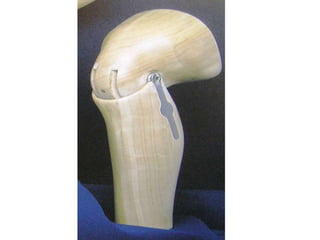
• Single axis Prosthetics knee joints consist of a simple
HINGE MECHANISM that allows free knee flexion
and extension.
• It provides stance phase stability but no swing phase
control.
• In stance phase knee stability is achieved by
combination of positioning of the knee joint with the
respect of the weight line(alignment)and muscular
control(activity of the hip extensors)
ADVANTAGES
• Light in weight
• Durable
• Low maintenances
DISADVANTAGES
• Lack of cadence response
therefore indicated for
patient who walk at the
same speed
• There is restricted
movement ,meaning no
mechanical stability
MULTI-AXES(POLYCENTRIC)
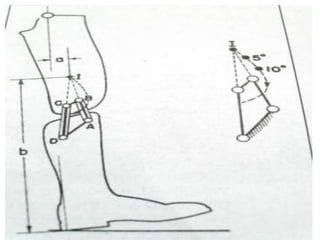
• The MULTI-AXES consist of a mechanically COMPLEX
four-bar linkage that provides more than one point
of rotation.
• A changing instantaneous centre of knee rotation
occurs, which adds stability in stance and provides
toe clearance during swing phase.
• More closely to simulating the anatomic axis of
motion.
• Stance phase stability is achieved by the presence of
mechanical characteristics of this type of knee unit
ADVANTAGES
• Enhance stance phase stability during gait.
this is because when the knee is full extended the
instantaneous center of rotation is positioned posterior
to weight line.
• Enhance toe clearance throughout swing phase,
as the knee unit flexes during swing phase, the
polycentric axis of motion lead to relative shortening of
the shank.
DISADVANTAGES
• Less durable.
• Require more maintenance than single axis
knee unit.
• Difficult to initiate flexion in the late stance
phase, this is due to its inherent stability.
CONTROL MECHANISM
• This controls the prosthetic knee joint in the
gait cycle, which provides stability in stance
phase and swing phase control.
• There are two types of control mechanism;
 Stance phase control mechanism.
 Swing phase control mechanisms.
STANCE PHASE CONTROL
MECHANISM (stability Mechanism)
• Transfemoral amputees rely upon two factors
to keep the prosthetic knee stable during
stance phase.
Stability offered by the knee joint itself
(friction, breaking and locking mechanism).
Stability offered by the muscles.
STANCE PHASE CONTROL
MECHANISM (stability Mechanism)
There are four types Stance Phase mechanism, which
includes;
 Free Knee(No lock) control mechanism
 Manual Locking Knee control mechanism.
 Weight-activated Stance Control Knee mechanism.
 Hydraulic knee control mechanism.
 Pneumatic knee control mechanism.
FREE KNEE (NO LOCK) CONTROL
MECHANISM
The patient has to rely upon the alignment
and their own muscle actions to ensure knee
stability.
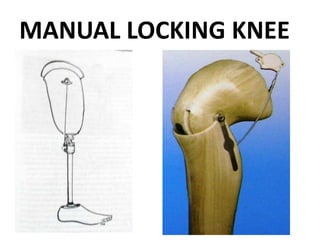
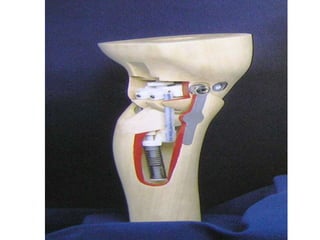
MANUAL LOCKING KNEE CONTROL
MECHANISM
It is Basically a single axis knee with locking pin
mechanism which locks automatically when the
knee is fully extended.
The simplest method to ensure knee stability is
to include a lock that can be operated by the
patient.
The knee can be locked in extension when the
patient stands and can be unlocked when the
patient sits.
MANUAL LOCKING KNEE
WEIGHT ACTIVATED CONTROL
• It is activated when weight is applied through
the knee which prevent( or at least retard)
unwanted knee flexion during stance phase.
• The amount of weight needed to engage the
break and prevent can be adjusted.
PNEUMATIC KNEE CONTROL
MECHANISM
• This uses compressed air to serve as a friction control and It
is unaffected by drastic changes in air temperature.
• It offers minimal resistance at initiation movement but
increasing resistance as the speed and movement
increases.
• This varying control of knee resistance is accomplished
through channels in which resistance to the flow of air
increases with increasing cadence.
• It is closed system so debris does not interfere with the
function of the unit.
HYDRAULIC KNEE CONTROL
MECHANISM
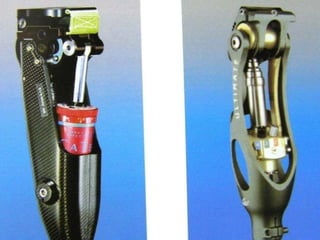
• It consists of hydraulic fluid flow which
provides frictional resistance, during forward
progression, the prosthetic shank changes as
gait speed changes.
• It allows the client to ambulate with greater
confidence over uneven surface (negotiating
hills, going down stairs)
HYDRAULIC KNEE CONTROL
MECHANISM
• More commonly prescribed than pneumatic units
because they allow ambulation at any speed from
very slow to very fast,
• Knee resistance automatically compensate to change
In walking speed. It uses oil (typically silicon oil) for
friction control. Silicon oil minimizes viscosity
fluctuations with temperature changes. Therefore,
stiffness in cold weather and looseness in hot
weather are avoided.
SWING PHASE CONTROL
MECHANISM
This provides certain mechanical function to
control swing phase action.
• There are five types which includes;
Free Knee
Locked Knee
Mechanical Extension Aid
Hydraulic/Pneumatic Control
FREE KNEE CONTROL
MECHANISM
• This offers no control at swing phase, the
client will have to solely rely on the pendulum
action.
• They will not be able to walk fast and will have
uneven timing gait.
MANUAL LOCKING KNEE CONTROL
MECHANISM(LOCKED KNEE)
• This control mechanism keeps the knee in full
extension at all times during swing phase.
The client will be able to walk at various speeds
and even “jog” but as the knee does not flex,
they will have to compensate by:
Vaulting
Circumducting
Lateral trunk bending
SPRING LOADED CONTROL
MECHANISM
• This has an inherent spring inside the knee
joint. (as in the case of weight activated
control mechanism).
• It flexes the knee and therefore propels the
shank into extension at the end of swing
phase thus reducing the effort required by the
client.
MECHANICAL EXTENSION
AID
• This can be made quite simple through
attaching an elastic band from the socket to
the shank anteriorly.
HYDRAULIC AND PNEUMATIC
CONTROL MECHANISM
• This has a unit with a cylinder and a piston rod
which will contain AIR (PNEUMATIC) or FLUID
(HYDRAULIC), which operates to provide
measured resistance to motion during swing
phase.
• The resistance increases with walking speed.
• It allows for control of variable walking speeds
and it is possible to adjust the flexion and
extension control independently.
• It’s expensive and difficult to repair.
MICROPROCESSOR
CONTROL KNEE UNIT
• The microprocessor control unit works on
strain and motion sensors.
• This unit sense whether a flexion or extension
moment is occurring and the specific knee
position that is present
• Resistance is adjusted accordingly for
ambulation on various types of walking
surfaces such as sand or concrete.
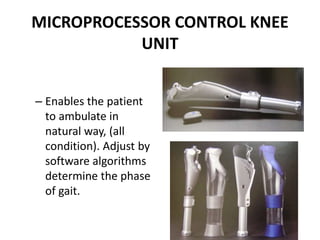
MICROPROCESSOR CONTROL KNEE
UNIT
– Enables the patient
to ambulate in
natural way, (all
condition). Adjust by
software algorithms
determine the phase
of gait.

PROSTHETICS KNEE JOINTS.ppt

  • 1.
  • 2.
    PRENTATION OUTLINE • INTRODUCTION •CLASSIFICATIONS OF KNEE JOINTS  TYPES OF KNEE AXES Single axis Polycentric(multi axis)  CONTROL MECHANISM Stance phase control mechanism.  Swing phase control mechanisms. • MICROPROCESSOR CONTROL KNEE UNIT
  • 3.
    INTRODUCTION • The prostheticknee joint is component in hip disarticulation prosthesis, transfermoral prosthesis and knee disarticulation prosthesis. • It should mimics the anatomical knee joint by demonstrating biomechanical functions during the gait cycle.
  • 4.
    INTRODUCTION • Prosthetic kneejoints should have stability during stance phase;(that is the ability of the prosthetic knee to remain extended and full supportive during the stance phase of walking) Therefore, a particular prosthetic knee is often recommended on the basis of inherent knee stability required.
  • 5.
    FUNCTIONS • Stimulate normalgait, it must have smooth flexion or extension through swing phase. • Remain stable as body weight rolls forward over the prosthetic foot during stance
  • 6.
    FUNCTIONS • In stancephase, the prosthetic knee joint protects the amputee from stumbling or falling by providing desire flexion. • In swing phase the prosthetic knee joint controls the lower limb in such way that toe clearance and subsequent weight bearing is achieved.
  • 7.
    CLASSIFICATIONS • Prosthetics kneejoints are classified into; Axes Stance Phase Control Mechanism Swing Phase Control Mechanism
  • 8.
    TYPES OF KNEEAXES • There are TWO types of Prosthetics Knee axes which includes; Single Axis Multi-Axis (Polycentric)
  • 9.
    SINGLE AXES • Singleaxis Prosthetics knee joints consist of a simple HINGE MECHANISM that allows free knee flexion and extension. • It provides stance phase stability but no swing phase control. • In stance phase knee stability is achieved by combination of positioning of the knee joint with the respect of the weight line(alignment)and muscular control(activity of the hip extensors)
  • 11.
    ADVANTAGES • Light inweight • Durable • Low maintenances DISADVANTAGES • Lack of cadence response therefore indicated for patient who walk at the same speed • There is restricted movement ,meaning no mechanical stability
  • 12.
    MULTI-AXES(POLYCENTRIC) • The MULTI-AXESconsist of a mechanically COMPLEX four-bar linkage that provides more than one point of rotation. • A changing instantaneous centre of knee rotation occurs, which adds stability in stance and provides toe clearance during swing phase. • More closely to simulating the anatomic axis of motion. • Stance phase stability is achieved by the presence of mechanical characteristics of this type of knee unit
  • 14.
    ADVANTAGES • Enhance stancephase stability during gait. this is because when the knee is full extended the instantaneous center of rotation is positioned posterior to weight line. • Enhance toe clearance throughout swing phase, as the knee unit flexes during swing phase, the polycentric axis of motion lead to relative shortening of the shank.
  • 15.
    DISADVANTAGES • Less durable. •Require more maintenance than single axis knee unit. • Difficult to initiate flexion in the late stance phase, this is due to its inherent stability.
  • 16.
    CONTROL MECHANISM • Thiscontrols the prosthetic knee joint in the gait cycle, which provides stability in stance phase and swing phase control. • There are two types of control mechanism;  Stance phase control mechanism.  Swing phase control mechanisms.
  • 17.
    STANCE PHASE CONTROL MECHANISM(stability Mechanism) • Transfemoral amputees rely upon two factors to keep the prosthetic knee stable during stance phase. Stability offered by the knee joint itself (friction, breaking and locking mechanism). Stability offered by the muscles.
  • 18.
    STANCE PHASE CONTROL MECHANISM(stability Mechanism) There are four types Stance Phase mechanism, which includes;  Free Knee(No lock) control mechanism  Manual Locking Knee control mechanism.  Weight-activated Stance Control Knee mechanism.  Hydraulic knee control mechanism.  Pneumatic knee control mechanism.
  • 19.
    FREE KNEE (NOLOCK) CONTROL MECHANISM The patient has to rely upon the alignment and their own muscle actions to ensure knee stability.
  • 20.
    MANUAL LOCKING KNEECONTROL MECHANISM It is Basically a single axis knee with locking pin mechanism which locks automatically when the knee is fully extended. The simplest method to ensure knee stability is to include a lock that can be operated by the patient. The knee can be locked in extension when the patient stands and can be unlocked when the patient sits.
  • 21.
  • 22.
    WEIGHT ACTIVATED CONTROL •It is activated when weight is applied through the knee which prevent( or at least retard) unwanted knee flexion during stance phase. • The amount of weight needed to engage the break and prevent can be adjusted.
  • 24.
    PNEUMATIC KNEE CONTROL MECHANISM •This uses compressed air to serve as a friction control and It is unaffected by drastic changes in air temperature. • It offers minimal resistance at initiation movement but increasing resistance as the speed and movement increases. • This varying control of knee resistance is accomplished through channels in which resistance to the flow of air increases with increasing cadence. • It is closed system so debris does not interfere with the function of the unit.
  • 25.
    HYDRAULIC KNEE CONTROL MECHANISM •It consists of hydraulic fluid flow which provides frictional resistance, during forward progression, the prosthetic shank changes as gait speed changes. • It allows the client to ambulate with greater confidence over uneven surface (negotiating hills, going down stairs)
  • 26.
    HYDRAULIC KNEE CONTROL MECHANISM •More commonly prescribed than pneumatic units because they allow ambulation at any speed from very slow to very fast, • Knee resistance automatically compensate to change In walking speed. It uses oil (typically silicon oil) for friction control. Silicon oil minimizes viscosity fluctuations with temperature changes. Therefore, stiffness in cold weather and looseness in hot weather are avoided.
  • 28.
    SWING PHASE CONTROL MECHANISM Thisprovides certain mechanical function to control swing phase action. • There are five types which includes; Free Knee Locked Knee Mechanical Extension Aid Hydraulic/Pneumatic Control
  • 29.
    FREE KNEE CONTROL MECHANISM •This offers no control at swing phase, the client will have to solely rely on the pendulum action. • They will not be able to walk fast and will have uneven timing gait.
  • 30.
    MANUAL LOCKING KNEECONTROL MECHANISM(LOCKED KNEE) • This control mechanism keeps the knee in full extension at all times during swing phase. The client will be able to walk at various speeds and even “jog” but as the knee does not flex, they will have to compensate by: Vaulting Circumducting Lateral trunk bending
  • 31.
    SPRING LOADED CONTROL MECHANISM •This has an inherent spring inside the knee joint. (as in the case of weight activated control mechanism). • It flexes the knee and therefore propels the shank into extension at the end of swing phase thus reducing the effort required by the client.
  • 32.
    MECHANICAL EXTENSION AID • Thiscan be made quite simple through attaching an elastic band from the socket to the shank anteriorly.
  • 33.
    HYDRAULIC AND PNEUMATIC CONTROLMECHANISM • This has a unit with a cylinder and a piston rod which will contain AIR (PNEUMATIC) or FLUID (HYDRAULIC), which operates to provide measured resistance to motion during swing phase. • The resistance increases with walking speed. • It allows for control of variable walking speeds and it is possible to adjust the flexion and extension control independently. • It’s expensive and difficult to repair.
  • 34.
    MICROPROCESSOR CONTROL KNEE UNIT •The microprocessor control unit works on strain and motion sensors. • This unit sense whether a flexion or extension moment is occurring and the specific knee position that is present • Resistance is adjusted accordingly for ambulation on various types of walking surfaces such as sand or concrete.
  • 35.
    MICROPROCESSOR CONTROL KNEE UNIT –Enables the patient to ambulate in natural way, (all condition). Adjust by software algorithms determine the phase of gait.