



SLA and socio-cultural theories: extension 
Facultad de Humanidades 
Escuela de Ciencias del Lenguaje 
Seminario de Lingüística Aplicada 
Prof. Carlos Mayora 
Octubre 2014
introduction 
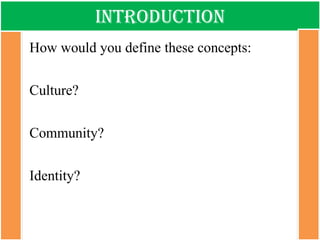
How would you define these concepts: 
Culture? 
Community? 
Identity?
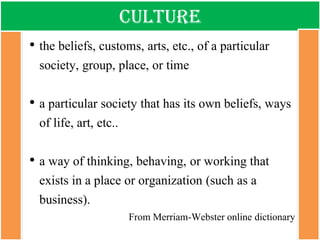
Culture
Culture 
•the beliefs, customs, arts, etc., of a particular society, group, place, or time 
•a particular society that has its own beliefs, ways of life, art, etc.. 
•a way of thinking, behaving, or working that exists in a place or organization (such as a business). 
From Merriam-Webster online dictionary
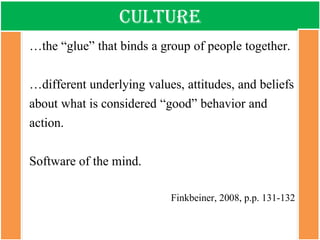
Culture 
…the “glue” that binds a group of people together. 
…different underlying values, attitudes, and beliefs about what is considered “good” behavior and action. 
Software of the mind. 
Finkbeiner, 2008, p.p. 131-132
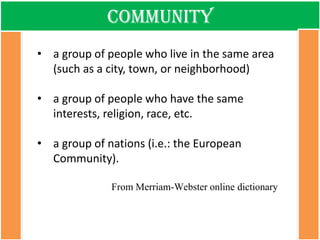
community
community 
•a group of people who live in the same area (such as a city, town, or neighborhood) 
•a group of people who have the same interests, religion, race, etc. 
•a group of nations (i.e.: the European Community). From Merriam-Webster online dictionary
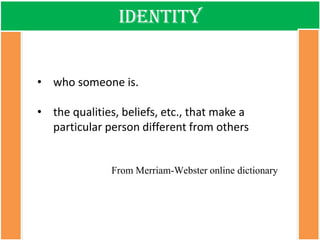
Identity
identity 
•who someone is. 
•the qualities, beliefs, etc., that make a particular person different from others From Merriam-Webster online dictionary
Sociocultural theory and sla
Sociocultural theory and sla 
General characteristics: 
•It draws on Vygotsky and Bakhtin. 
•Places greater importance on interaction, not from a psycholinguistic perspective, but from a social perspective. 
•Focuses on the importance of context, understood as the interplay of cultural influences and meaning derived from groups
Sociocultural theory and sla 
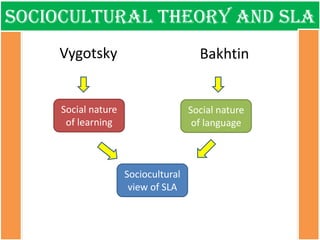
Social nature of learning 
Sociocultural view of SLA 
Social nature of language 
Vygotsky 
Bakhtin
Sociocultural theory and sla 
Definitions of learning: A process “whereby more experienced participants in a culture bring the ‘intellectual tools of society’ […] within the reach of less experienced members.” Norton adn Toohey, 2001
Sociocultural theory and sla 
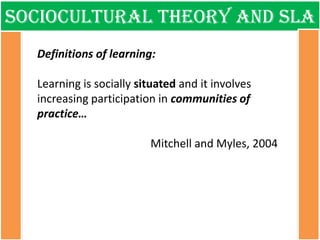
Definitions of learning: Learning is socially situated and it involves increasing participation in communities of practice… Mitchell and Myles, 2004
Sociocultural theory and sla 
Definitions of learning: 
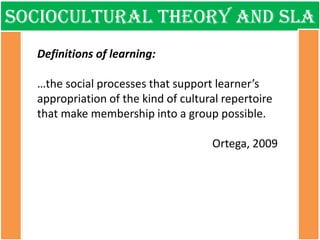
…the social processes that support learner’s appropriation of the kind of cultural repertoire that make membership into a group possible. 
Ortega, 2009
Communities of practice 
An aggregate of people who come together around mutual engagement in an endeavor […] it is defined by its membership and by the practice in which the membership engages. Eckhert and McConnell-Ginet, cited by Mitchell and Myles, 2004, p. 241.
Access and participation in CP 
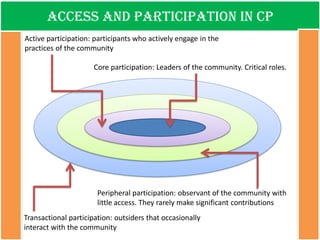
Transactional participation: outsiders that occasionally interact with the community 
Peripheral participation: observant of the community with little access. They rarely make significant contributions 
Active participation: participants who actively engage in the practices of the community 
Core participation: Leaders of the community. Critical roles.
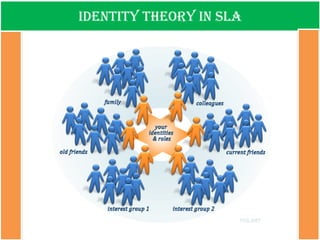
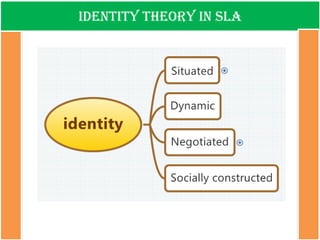
Identity theory in SLA 
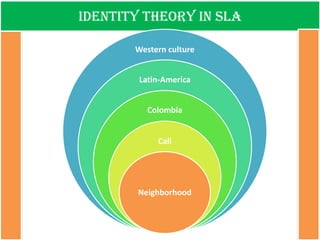
Western culture 
Latin-America 
Colombia 
Cali 
Neighborhood
Identity theory in SLA
Identity theory in SLA 
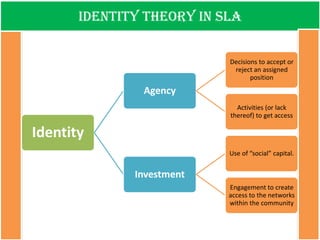
Identity 
Agency 
Decisions to accept or reject an assigned position 
Activities (or lack thereof) to get access 
Investment 
Use of “social” capital. 
Engagement to create access to the networks within the community
How does all that add up? 
From this perspective, learners of English participate in particular, local contexts in which specific practices create possibilities for them to learn English. 
Norton and Toohey, 2001, p. 311
How does all that add up? 
L2 learning is not seen… as a gradual and 
neutral process of internalizing the rules, structures, and vocabulary of a standard language; rather, learners are seen to appropriate the utterances of others in particular historical and cultural practices, situated in particular communities. Thus, researchers need to pay close attention to how communities and their practices are structured in order to examine how this structuring facilitates or constrains learners’ access to the linguistic resources of their communities. 
Norton and Toohey, 2001, p. 312
Implications 
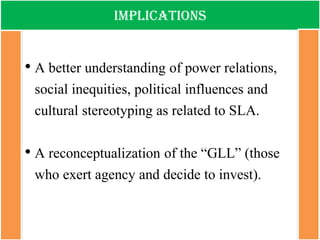
•A better understanding of power relations, social inequities, political influences and cultural stereotyping as related to SLA. 
•A reconceptualization of the “GLL” (those who exert agency and decide to invest).
Implications 
•A framework for the study, design and implementation of technology-mediated language teaching. 
•Integration of the view of “language as ideology”.
limitations 
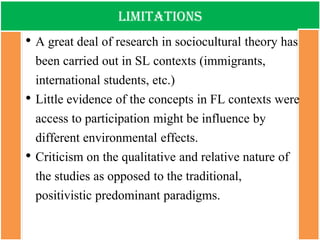
•A great deal of research in sociocultural theory has been carried out in SL contexts (immigrants, international students, etc.) 
•Little evidence of the concepts in FL contexts were access to participation might be influence by different environmental effects. 
•Criticism on the qualitative and relative nature of the studies as opposed to the traditional, positivistic predominant paradigms.
Your comments
references 
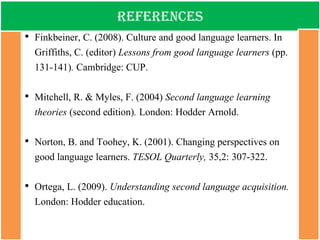
•Finkbeiner, C. (2008). Culture and good language learners. In Griffiths, C. (editor) Lessons from good language learners (pp. 131-141). Cambridge: CUP. 
•Mitchell, R. & Myles, F. (2004) Second language learning theories (second edition). London: Hodder Arnold. 
•Norton, B. and Toohey, K. (2001). Changing perspectives on good language learners. TESOL Quarterly, 35,2: 307-322. 
•Ortega, L. (2009). Understanding second language acquisition. London: Hodder education.

Sociocultural theory and SLA

  • 1.
    SLA and socio-culturaltheories: extension Facultad de Humanidades Escuela de Ciencias del Lenguaje Seminario de Lingüística Aplicada Prof. Carlos Mayora Octubre 2014
  • 2.
    introduction How wouldyou define these concepts: Culture? Community? Identity?
  • 3.
  • 4.
    Culture •the beliefs,customs, arts, etc., of a particular society, group, place, or time •a particular society that has its own beliefs, ways of life, art, etc.. •a way of thinking, behaving, or working that exists in a place or organization (such as a business). From Merriam-Webster online dictionary
  • 5.
    Culture …the “glue”that binds a group of people together. …different underlying values, attitudes, and beliefs about what is considered “good” behavior and action. Software of the mind. Finkbeiner, 2008, p.p. 131-132
  • 6.
  • 7.
    community •a groupof people who live in the same area (such as a city, town, or neighborhood) •a group of people who have the same interests, religion, race, etc. •a group of nations (i.e.: the European Community). From Merriam-Webster online dictionary
  • 8.
  • 9.
    identity •who someoneis. •the qualities, beliefs, etc., that make a particular person different from others From Merriam-Webster online dictionary
  • 10.
  • 11.
    Sociocultural theory andsla General characteristics: •It draws on Vygotsky and Bakhtin. •Places greater importance on interaction, not from a psycholinguistic perspective, but from a social perspective. •Focuses on the importance of context, understood as the interplay of cultural influences and meaning derived from groups
  • 12.
    Sociocultural theory andsla Social nature of learning Sociocultural view of SLA Social nature of language Vygotsky Bakhtin
  • 13.
    Sociocultural theory andsla Definitions of learning: A process “whereby more experienced participants in a culture bring the ‘intellectual tools of society’ […] within the reach of less experienced members.” Norton adn Toohey, 2001
  • 14.
    Sociocultural theory andsla Definitions of learning: Learning is socially situated and it involves increasing participation in communities of practice… Mitchell and Myles, 2004
  • 15.
    Sociocultural theory andsla Definitions of learning: …the social processes that support learner’s appropriation of the kind of cultural repertoire that make membership into a group possible. Ortega, 2009
  • 16.
    Communities of practice An aggregate of people who come together around mutual engagement in an endeavor […] it is defined by its membership and by the practice in which the membership engages. Eckhert and McConnell-Ginet, cited by Mitchell and Myles, 2004, p. 241.
  • 17.
    Access and participationin CP Transactional participation: outsiders that occasionally interact with the community Peripheral participation: observant of the community with little access. They rarely make significant contributions Active participation: participants who actively engage in the practices of the community Core participation: Leaders of the community. Critical roles.
  • 18.
    Identity theory inSLA Western culture Latin-America Colombia Cali Neighborhood
  • 19.
  • 20.
  • 21.
    Identity theory inSLA Identity Agency Decisions to accept or reject an assigned position Activities (or lack thereof) to get access Investment Use of “social” capital. Engagement to create access to the networks within the community
  • 22.
    How does allthat add up? From this perspective, learners of English participate in particular, local contexts in which specific practices create possibilities for them to learn English. Norton and Toohey, 2001, p. 311
  • 23.
    How does allthat add up? L2 learning is not seen… as a gradual and neutral process of internalizing the rules, structures, and vocabulary of a standard language; rather, learners are seen to appropriate the utterances of others in particular historical and cultural practices, situated in particular communities. Thus, researchers need to pay close attention to how communities and their practices are structured in order to examine how this structuring facilitates or constrains learners’ access to the linguistic resources of their communities. Norton and Toohey, 2001, p. 312
  • 24.
    Implications •A betterunderstanding of power relations, social inequities, political influences and cultural stereotyping as related to SLA. •A reconceptualization of the “GLL” (those who exert agency and decide to invest).
  • 25.
    Implications •A frameworkfor the study, design and implementation of technology-mediated language teaching. •Integration of the view of “language as ideology”.
  • 26.
    limitations •A greatdeal of research in sociocultural theory has been carried out in SL contexts (immigrants, international students, etc.) •Little evidence of the concepts in FL contexts were access to participation might be influence by different environmental effects. •Criticism on the qualitative and relative nature of the studies as opposed to the traditional, positivistic predominant paradigms.
  • 27.
  • 28.
    references •Finkbeiner, C.(2008). Culture and good language learners. In Griffiths, C. (editor) Lessons from good language learners (pp. 131-141). Cambridge: CUP. •Mitchell, R. & Myles, F. (2004) Second language learning theories (second edition). London: Hodder Arnold. •Norton, B. and Toohey, K. (2001). Changing perspectives on good language learners. TESOL Quarterly, 35,2: 307-322. •Ortega, L. (2009). Understanding second language acquisition. London: Hodder education.