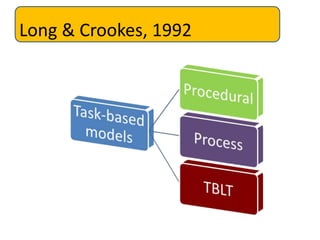
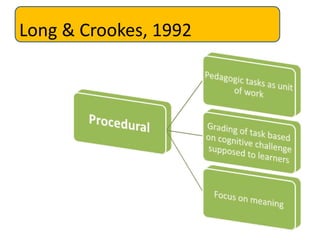
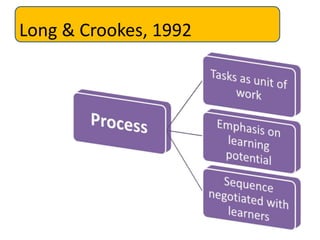
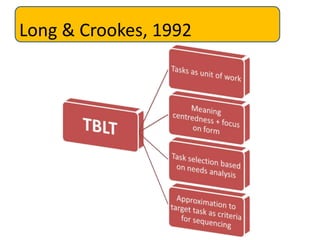
Language Course Design:
Content and Sequence
• Defining content
• Different perspectives on how to sequence
content
In this class
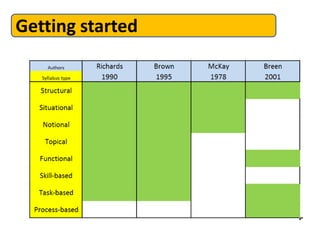
• Do you remember the different kinds of syllabi
discussed in class 1?
• What were the main characteristics of each
syllabus?
Getting started
Getting started
Defining Content
In general terms…
The units of knowledge that the learner
needs to master to attain course
objectives.
Content
In communicative-oriented models…
Information, topics, ideas that serve as an
excuse for presenting and practicing
language
Content
In content based instruction…
Knowledge from content areas
(math, science, history, etc.) through which
language is taught and practiced.
Content
Structural syllabus
Objective = students will be able to produce orally
grammatically correct affirmative sentences in the
present perfect.
Contents=
The present perfect
Third person present form of have (has)
Verbs in past participle
Irregular verbs in past participle
An Example
Content will depend on…
Course Goals and Objectives
Needs analysis
Important
Sequence
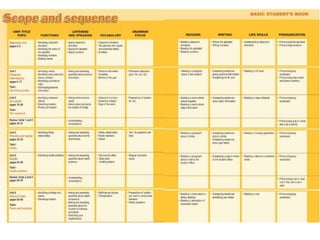
Take a look at the table of contents or the
«scope and sequence» of some English
textbooks.
1. How is content defined?
2. What is the underlying criterion for
sequence?
3. How would you classify each book in terms of
its syllabus?
Getting started
Three Perspectives on Content
Selection and Sequence
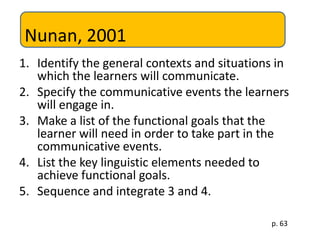
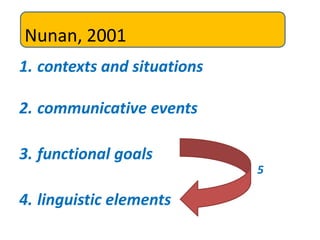
1. Identify the general contexts and situations in
which the learners will communicate.
2. Specify the communicative events the learners
will engage in.
3. Make a list of the functional goals that the
learner will need in order to take part in the
communicative events.
4. List the key linguistic elements needed to
achieve functional goals.
5. Sequence and integrate 3 and 4.
Nunan, 2001
p. 63
1. contexts and situations
2. communicative events
3. functional goals
4. linguistic elements
Nunan, 2001
5
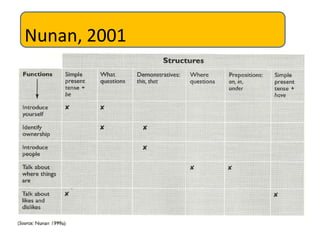
Nunan, 2001
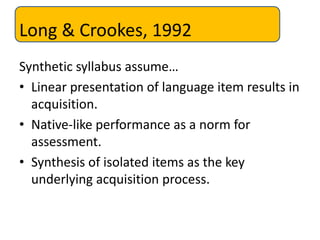
Long & Crookes, 1992
Synthetic syllabus assume…
• Linear presentation of language item results in
acquisition.
• Native-like performance as a norm for
assessment.
• Synthesis of isolated items as the key
underlying acquisition process.
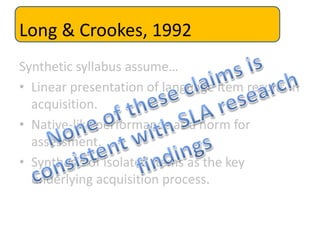
Long & Crookes, 1992
Synthetic syllabus assume…
• Linear presentation of language item results in
acquisition.
• Native-like performance as a norm for
assessment.
• Synthesis of isolated items as the key
underlying acquisition process.
Long & Crookes, 1992
Nation and Macalister, 2010
• The units of progression may vary from course
to course.
• Whatever unit of progression chosen, course
designers need to check other units are also
covered and dealt with within the appropriate
level for the student.
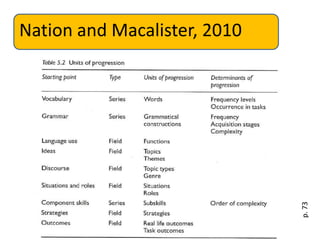
Nation and Macalister, 2010
p.73
Nation and Macalister, 2010
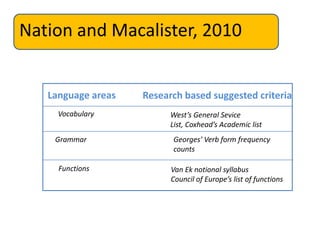
Language areas Research based suggested criteria
Vocabulary West’s General Sevice
List, Coxhead’s Academic list
Grammar Georges’ Verb form frequency
counts
Functions Van Ek notional syllabus
Council of Europe’s list of functions
Nation and Macalister, 2010
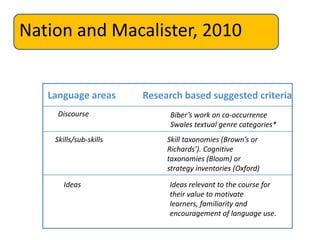
Language areas Research based suggested criteria
Discourse Biber’s work on co-occurrence
Swales textual genre categories*
Skills/sub-skills Skill taxonomies (Brown’s or
Richards’). Cognitive
taxonomies (Bloom) or
strategy inventories (Oxford)
Ideas Ideas relevant to the course for
their value to motivate
learners, familiarity and
encouragement of language use.
Nation and Macalister, 2010
Once units of progression have been
determined, the sequencing might take one of
these three approaches:
• Linear
• Spiral
• Matrix
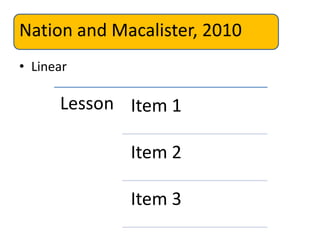
Nation and Macalister, 2010
• Linear
Lesson Item 1
Item 2
Item 3
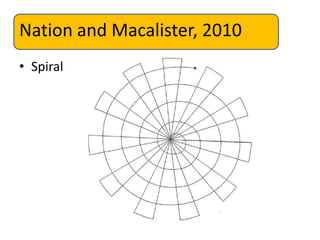
Nation and Macalister, 2010
• Spiral
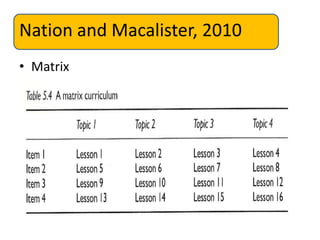
Nation and Macalister, 2010
• Matrix
References
• Long, M. & Crookes, G. (1992). Three Approaches to
Task-Based Syllabus Design. TESOL Quarterly, Vol.
26, No. 1. pp. 27-56.
• Nation, I.S.P. and Macalister, J. (2010). Language
Curriculum Design. New York: Routledge.
• Nunan, D. (2001). Syllabus design. En M. Celce-
Murcia (Ed.), Teaching English as a second or
foreign language (3º ed., pp. 55-65). Boston, MA:
Heinle & Heinle.

Content and sequence

  • 1.
  • 2.
    • Defining content •Different perspectives on how to sequence content In this class
  • 3.
    • Do youremember the different kinds of syllabi discussed in class 1? • What were the main characteristics of each syllabus? Getting started
  • 4.
  • 5.
  • 6.
    In general terms… Theunits of knowledge that the learner needs to master to attain course objectives. Content
  • 7.
    In communicative-oriented models… Information,topics, ideas that serve as an excuse for presenting and practicing language Content
  • 8.
    In content basedinstruction… Knowledge from content areas (math, science, history, etc.) through which language is taught and practiced. Content
  • 9.
    Structural syllabus Objective =students will be able to produce orally grammatically correct affirmative sentences in the present perfect. Contents= The present perfect Third person present form of have (has) Verbs in past participle Irregular verbs in past participle An Example
  • 10.
    Content will dependon… Course Goals and Objectives Needs analysis Important
  • 11.
  • 12.
    Take a lookat the table of contents or the «scope and sequence» of some English textbooks. 1. How is content defined? 2. What is the underlying criterion for sequence? 3. How would you classify each book in terms of its syllabus? Getting started
  • 14.
    Three Perspectives onContent Selection and Sequence
  • 15.
    1. Identify thegeneral contexts and situations in which the learners will communicate. 2. Specify the communicative events the learners will engage in. 3. Make a list of the functional goals that the learner will need in order to take part in the communicative events. 4. List the key linguistic elements needed to achieve functional goals. 5. Sequence and integrate 3 and 4. Nunan, 2001 p. 63
  • 16.
    1. contexts andsituations 2. communicative events 3. functional goals 4. linguistic elements Nunan, 2001 5
  • 17.
  • 18.
    Long & Crookes,1992 Synthetic syllabus assume… • Linear presentation of language item results in acquisition. • Native-like performance as a norm for assessment. • Synthesis of isolated items as the key underlying acquisition process.
  • 19.
    Long & Crookes,1992 Synthetic syllabus assume… • Linear presentation of language item results in acquisition. • Native-like performance as a norm for assessment. • Synthesis of isolated items as the key underlying acquisition process.
  • 20.
  • 21.
  • 22.
  • 23.
  • 24.
    Nation and Macalister,2010 • The units of progression may vary from course to course. • Whatever unit of progression chosen, course designers need to check other units are also covered and dealt with within the appropriate level for the student.
  • 25.
  • 26.
    Nation and Macalister,2010 Language areas Research based suggested criteria Vocabulary West’s General Sevice List, Coxhead’s Academic list Grammar Georges’ Verb form frequency counts Functions Van Ek notional syllabus Council of Europe’s list of functions
  • 27.
    Nation and Macalister,2010 Language areas Research based suggested criteria Discourse Biber’s work on co-occurrence Swales textual genre categories* Skills/sub-skills Skill taxonomies (Brown’s or Richards’). Cognitive taxonomies (Bloom) or strategy inventories (Oxford) Ideas Ideas relevant to the course for their value to motivate learners, familiarity and encouragement of language use.
  • 28.
    Nation and Macalister,2010 Once units of progression have been determined, the sequencing might take one of these three approaches: • Linear • Spiral • Matrix
  • 29.
    Nation and Macalister,2010 • Linear Lesson Item 1 Item 2 Item 3
  • 30.
    Nation and Macalister,2010 • Spiral
  • 31.
    Nation and Macalister,2010 • Matrix
  • 32.
    References • Long, M.& Crookes, G. (1992). Three Approaches to Task-Based Syllabus Design. TESOL Quarterly, Vol. 26, No. 1. pp. 27-56. • Nation, I.S.P. and Macalister, J. (2010). Language Curriculum Design. New York: Routledge. • Nunan, D. (2001). Syllabus design. En M. Celce- Murcia (Ed.), Teaching English as a second or foreign language (3º ed., pp. 55-65). Boston, MA: Heinle & Heinle.