
Language Course Design:
  Goals and Objectives
Getting started

• Are you familiar with the goals and objectives of
  the program you are currently teaching?

• How about the textbook you are using? Does it
  state explicitly the goals and objectives?

• When planning a lesson, do you usually refer to
  the list of goals and objectives of the program?
In this class
•   Definition of goals.
•   Definition of instructional objectives.
•   Differences between goals and objectives.
•   Components of objectives.
•   Deriving goals and objectives from needs.
•   Criticism to objectives.
•   Advantages of objectives.
•   Alternatives to goals and objectives.
•   Some exercises
Goals and Objectives:
     Definition
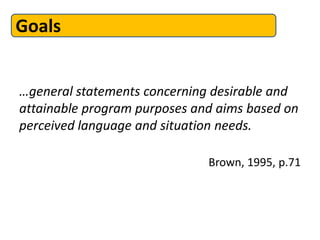
Goals


…general statements concerning desirable and
attainable program purposes and aims based on
perceived language and situation needs.

                              Brown, 1995, p.71
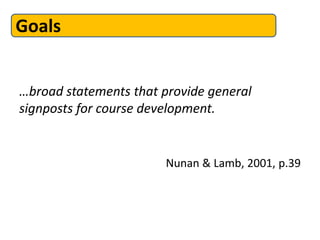
Goals


…broad statements that provide general
signposts for course development.


                       Nunan & Lamb, 2001, p.39
Goals purpose and characteristics
Goals…
• are general statements of the program’s
  purposes.
• focus on what the program hopes to accomplish
  in the future […] what they students should be
  able to do when they leave the program.
• serve as one basis for developing more precise
  and observable objectives.
• should never be viewed as permanent.

                              Brown, 1995, pp.71-72
Instructional objectives


specific statements that describe the particular
knowledge, behaviors, and/or skills that the
learner will be expected to know or perform at
the end of a course or program.

                                 Brown, 1995, p.73
Instructional objectives


Specifications of “what learners should be able
to do as a result of instruction.”


                         Nunan & Lamb, 2001, p.41
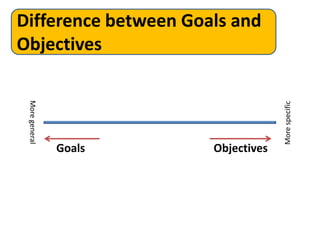
Difference between Goals and
Objectives
 More general


                                     More specific
                Goals   Objectives
Instructional objectives:
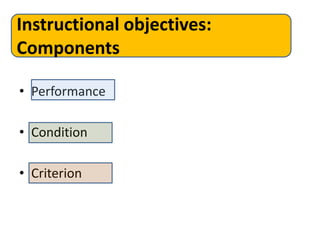
Components

• Performance

• Condition

• Criterion
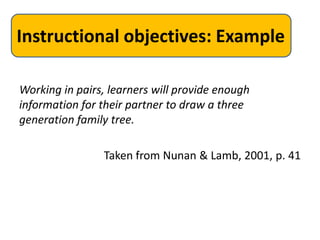
Instructional objectives: Example

Working in pairs, learners will provide enough
information for their partner to draw a three
generation family tree.

                Taken from Nunan & Lamb, 2001, p. 41
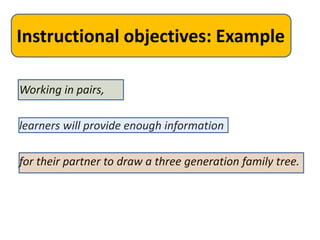
Instructional objectives: Example

Working in pairs,

learners will provide enough information

for their partner to draw a three generation family tree.
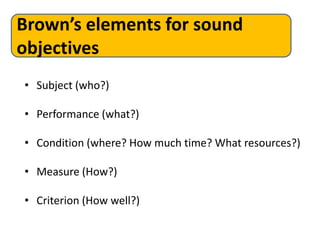
Brown’s elements for sound
objectives
• Subject (who?)

• Performance (what?)

• Condition (where? How much time? What resources?)

• Measure (How?)

• Criterion (How well?)
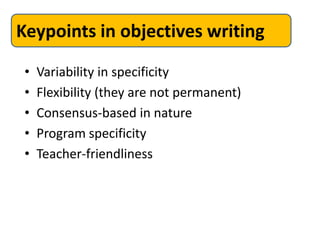
Keypoints in objectives writing

 •   Variability in specificity
 •   Flexibility (they are not permanent)
 •   Consensus-based in nature
 •   Program specificity
 •   Teacher-friendliness
Sources of ideas

 • Other language programs

 • The literature

 • Taxonomies
From Needs to Goals and
      Objectives
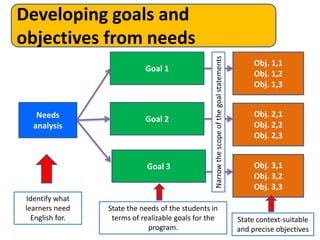
Developing goals and
objectives from needs


                                                   Narrow the scope of the goal statements
                                                                                                  Obj. 1,1
                             Goal 1
                                                                                                  Obj. 1,2
                                                                                                  Obj. 1,3


    Needs                                                                                         Obj. 2,1
                             Goal 2
   analysis                                                                                       Obj. 2,2
                                                                                                  Obj. 2,3


                              Goal 3                                                              Obj. 3,1
                                                                                                  Obj. 3,2
                                                                                                  Obj. 3,3
 Identify what
 learners need    State the needs of the students in
   English for.    terms of realizable goals for the                                         State context-suitable
                              program.                                                       and precise objectives
Objectives:
Criticism and Advantages
Criticism
• Association with behavioral psychology

• Issues with quantifyability

• Trivialization of instruction

• Limitations in teachers’ freedom

• inadequacy for expression of language learning

                                             Brown, 1995
Advantages
Objectives help teachers to…
• convert the perceived needs into teaching points.
• clarify and organize those teaching points.
• think through skills and sub-skills underlying
  instructional points.
• decide what they want students to be able to do.
• decide the level of specificity for teaching activities.

                                              Brown, 1995
Advantages
Objectives help teachers to…
• construct valid and reliable assessment tools.
• adopt, adapt and develop teaching materials.
• develop professionally
• evaluate students’ progress and program
  effectiveness.
• be part of the collective process of curriculum
  development.

                                           Brown, 1995
Alternatives to objectives
Competencies
a performance outline of language tasks that
lead to a demonstrated mastery of language
associated with specific skills that are necessary
for individuals to function proficiently in the
society in which they live


                            Grognet & Candall, 1982, p. 3
Competencies
Competencies refer to observable bahaviors (just
like objectives), but differ in
• a focus on successful functioning in society
• a focus on life skills
• task or performance centered orientations
• modularization of instruction (behaviors are
   broken down into sub-behaviors to be mastered).


                            Auerback, 1986, p. 411
Competencies


…written descriptions of what a student is able
to do with the language, usually in terms of
target language performance.


                           Richards & Schmidt, 2002, p. 94
Standards
…comprehensive description of what language
learners know in the target language at various
levels of proficiency, at various grade levels, or
both.

…a clear definition of what is to be taught and
what kind of performance is to be expected
across the school curriculum.

                            Richards & Schmidt, 2002, p. 511
Standards
Descriptions (rather than prescriptions) of what
people can actually do with the target language
at different levels (stages) of competence which
provide a framework to measure outcomes and
set expectations in progress.


                      Paraphrased from Omaggio, 1986
Standards
Descriptions (rather than prescriptions) of what
people can actually do with the target language
at different levels (stages) of competence which
provide a framework to measure outcomes and
set expectations in progress.


                      Paraphrased from Omaggio, 1986
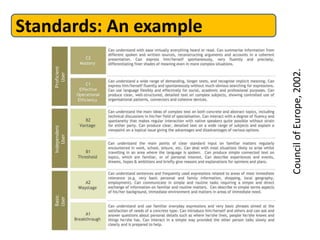
Standards: An example


Council of Europe, 2002.
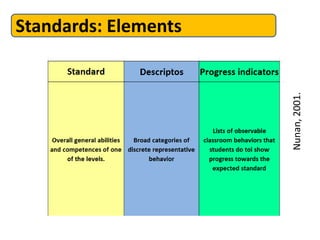
Standards: Elements


                      Nunan, 2001.
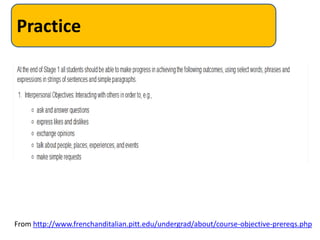
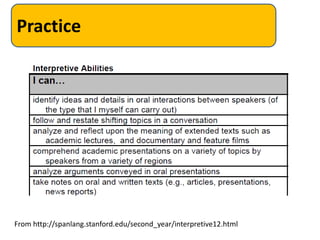
Practice
Practice
You will read different statements of purpose from different
language programs.

• Determine if the statement refers to a goal or an objective.

• If the statement is an objective, identify the main elements
  or components as described by Brown
  (subject, performance, condition, measure, criterion).

• Is the statement conceived as a performance objective, a
  competency or a standard descriptor.
Practice
The language program is designed to help students
achieve the following learning objectives :

1. engage in interactions with speakers of the target
   language for a variety of purposes and in a variety of
   contexts, using socially and culturally appropriate
   forms for participating in conversations, establishing
   relationships with others, providing and obtaining
   information, expressing feelings and emotions, and
   expressing opinions.


                                From the University of Pittsburg website
Practice
 At the end of the program, students should be
 able to:

 1. Describe, narrate, and ask/answer questions
    in the foreign language in the present time
    about a variety of topics related to
    family, daily activities, eating, and traveling.


From http://www.frenchanditalian.pitt.edu/undergrad/about/course-objective-prereqs.php
Practice


From http://www.frenchanditalian.pitt.edu/undergrad/about/course-objective-prereqs.php
Practice


From http://spanlang.stanford.edu/second_year/interpretive12.html
Practice
 • …every IUS student will be able to fully cope
   with the faculty programs. Students not only
   attain a high level of English Language
   proficiency at ELS, but also gain various study
   skills essential for successful participation in
   the academic activities of their faculties.


From http://www.ius.edu.ba/Default.aspx?PageContentID=24&tabid=70
References
• Auerback, E.R. (1986). Competency-based ESL: One step
  forward or two steps back? TESOL Quarterly, 20,3: 411-429

• Brown, J.D. (1995). The elements of Language Curriculum: A
  Systematic Approach to Program Development. Heinle &
  Heinle Publishers.

• Grognet, A. G. y Crandall, J. (1982). Competency-based
  curricula in adult ESL. ERIC/CLL News Bulletin, 6, 3-4.

• Nunan, D. (2001). Syllabus design. En M. Celce-Murcia
  (Ed.), Teaching English as a second or foreign language (3º
  ed., pp. 55-65). Boston, MA: Heinle & Heinle.
References
• Nunan, D & Lamb, C. (2001). Managing the learning process. In
  Hall, D. & Hewings, A. (Eds.) Innovation in English Language
  Teaching. A Reader (pp. 25-45) Oxford: Oxford University Press.
  London: Routledge.

• Omaggio, A.C. (1986). Teaching language in context. Proficiency
  oriented instyruction. Boston: Heinle & Heinle Publishers, Inc.

• Richards, J.C. & Schmidt, R. (2002). Longman Dictionary of
  language teaching and applied linguistics. Pearson Education
  Limited.

Goals and objectives

  • 1.
    Language Course Design: Goals and Objectives
  • 2.
    Getting started • Areyou familiar with the goals and objectives of the program you are currently teaching? • How about the textbook you are using? Does it state explicitly the goals and objectives? • When planning a lesson, do you usually refer to the list of goals and objectives of the program?
  • 3.
    In this class • Definition of goals. • Definition of instructional objectives. • Differences between goals and objectives. • Components of objectives. • Deriving goals and objectives from needs. • Criticism to objectives. • Advantages of objectives. • Alternatives to goals and objectives. • Some exercises
  • 4.
  • 5.
    Goals …general statements concerningdesirable and attainable program purposes and aims based on perceived language and situation needs. Brown, 1995, p.71
  • 6.
    Goals …broad statements thatprovide general signposts for course development. Nunan & Lamb, 2001, p.39
  • 7.
    Goals purpose andcharacteristics Goals… • are general statements of the program’s purposes. • focus on what the program hopes to accomplish in the future […] what they students should be able to do when they leave the program. • serve as one basis for developing more precise and observable objectives. • should never be viewed as permanent. Brown, 1995, pp.71-72
  • 8.
    Instructional objectives specific statementsthat describe the particular knowledge, behaviors, and/or skills that the learner will be expected to know or perform at the end of a course or program. Brown, 1995, p.73
  • 9.
    Instructional objectives Specifications of“what learners should be able to do as a result of instruction.” Nunan & Lamb, 2001, p.41
  • 10.
    Difference between Goalsand Objectives More general More specific Goals Objectives
  • 11.
  • 12.
    Instructional objectives: Example Workingin pairs, learners will provide enough information for their partner to draw a three generation family tree. Taken from Nunan & Lamb, 2001, p. 41
  • 13.
    Instructional objectives: Example Workingin pairs, learners will provide enough information for their partner to draw a three generation family tree.
  • 14.
    Brown’s elements forsound objectives • Subject (who?) • Performance (what?) • Condition (where? How much time? What resources?) • Measure (How?) • Criterion (How well?)
  • 15.
    Keypoints in objectiveswriting • Variability in specificity • Flexibility (they are not permanent) • Consensus-based in nature • Program specificity • Teacher-friendliness
  • 16.
    Sources of ideas • Other language programs • The literature • Taxonomies
  • 17.
    From Needs toGoals and Objectives
  • 18.
    Developing goals and objectivesfrom needs Narrow the scope of the goal statements Obj. 1,1 Goal 1 Obj. 1,2 Obj. 1,3 Needs Obj. 2,1 Goal 2 analysis Obj. 2,2 Obj. 2,3 Goal 3 Obj. 3,1 Obj. 3,2 Obj. 3,3 Identify what learners need State the needs of the students in English for. terms of realizable goals for the State context-suitable program. and precise objectives
  • 19.
  • 20.
    Criticism • Association withbehavioral psychology • Issues with quantifyability • Trivialization of instruction • Limitations in teachers’ freedom • inadequacy for expression of language learning Brown, 1995
  • 21.
    Advantages Objectives help teachersto… • convert the perceived needs into teaching points. • clarify and organize those teaching points. • think through skills and sub-skills underlying instructional points. • decide what they want students to be able to do. • decide the level of specificity for teaching activities. Brown, 1995
  • 22.
    Advantages Objectives help teachersto… • construct valid and reliable assessment tools. • adopt, adapt and develop teaching materials. • develop professionally • evaluate students’ progress and program effectiveness. • be part of the collective process of curriculum development. Brown, 1995
  • 23.
  • 24.
    Competencies a performance outlineof language tasks that lead to a demonstrated mastery of language associated with specific skills that are necessary for individuals to function proficiently in the society in which they live Grognet & Candall, 1982, p. 3
  • 25.
    Competencies Competencies refer toobservable bahaviors (just like objectives), but differ in • a focus on successful functioning in society • a focus on life skills • task or performance centered orientations • modularization of instruction (behaviors are broken down into sub-behaviors to be mastered). Auerback, 1986, p. 411
  • 26.
    Competencies …written descriptions ofwhat a student is able to do with the language, usually in terms of target language performance. Richards & Schmidt, 2002, p. 94
  • 27.
    Standards …comprehensive description ofwhat language learners know in the target language at various levels of proficiency, at various grade levels, or both. …a clear definition of what is to be taught and what kind of performance is to be expected across the school curriculum. Richards & Schmidt, 2002, p. 511
  • 28.
    Standards Descriptions (rather thanprescriptions) of what people can actually do with the target language at different levels (stages) of competence which provide a framework to measure outcomes and set expectations in progress. Paraphrased from Omaggio, 1986
  • 29.
    Standards Descriptions (rather thanprescriptions) of what people can actually do with the target language at different levels (stages) of competence which provide a framework to measure outcomes and set expectations in progress. Paraphrased from Omaggio, 1986
  • 30.
  • 31.
  • 32.
  • 33.
    Practice You will readdifferent statements of purpose from different language programs. • Determine if the statement refers to a goal or an objective. • If the statement is an objective, identify the main elements or components as described by Brown (subject, performance, condition, measure, criterion). • Is the statement conceived as a performance objective, a competency or a standard descriptor.
  • 34.
    Practice The language programis designed to help students achieve the following learning objectives : 1. engage in interactions with speakers of the target language for a variety of purposes and in a variety of contexts, using socially and culturally appropriate forms for participating in conversations, establishing relationships with others, providing and obtaining information, expressing feelings and emotions, and expressing opinions. From the University of Pittsburg website
  • 35.
    Practice At theend of the program, students should be able to: 1. Describe, narrate, and ask/answer questions in the foreign language in the present time about a variety of topics related to family, daily activities, eating, and traveling. From http://www.frenchanditalian.pitt.edu/undergrad/about/course-objective-prereqs.php
  • 36.
  • 37.
  • 38.
    Practice • …everyIUS student will be able to fully cope with the faculty programs. Students not only attain a high level of English Language proficiency at ELS, but also gain various study skills essential for successful participation in the academic activities of their faculties. From http://www.ius.edu.ba/Default.aspx?PageContentID=24&tabid=70
  • 39.
    References • Auerback, E.R.(1986). Competency-based ESL: One step forward or two steps back? TESOL Quarterly, 20,3: 411-429 • Brown, J.D. (1995). The elements of Language Curriculum: A Systematic Approach to Program Development. Heinle & Heinle Publishers. • Grognet, A. G. y Crandall, J. (1982). Competency-based curricula in adult ESL. ERIC/CLL News Bulletin, 6, 3-4. • Nunan, D. (2001). Syllabus design. En M. Celce-Murcia (Ed.), Teaching English as a second or foreign language (3º ed., pp. 55-65). Boston, MA: Heinle & Heinle.
  • 40.
    References • Nunan, D& Lamb, C. (2001). Managing the learning process. In Hall, D. & Hewings, A. (Eds.) Innovation in English Language Teaching. A Reader (pp. 25-45) Oxford: Oxford University Press. London: Routledge. • Omaggio, A.C. (1986). Teaching language in context. Proficiency oriented instyruction. Boston: Heinle & Heinle Publishers, Inc. • Richards, J.C. & Schmidt, R. (2002). Longman Dictionary of language teaching and applied linguistics. Pearson Education Limited.