LanguagePolicyand PlanningFacultad de HumanidadesEscuela de Ciencias del LenguajeSeminario de Lingüística AplicadaProf. Carlos MayoraDecember2014
•Definitions 
•Factors influencing the field 
•Historical developments 
•Models 
•Scope 
•Current issues 
Contents
Definitions
Definitions 
…la asignación de recursos, por parte de las personas que tienen autoridad para ello, para el logro de metas relacionadas con el estatus y el corpus del lenguaje; ya sea con relación a nuevas funciones –usos funcionales 
del lenguaje–que se desea desarrollar o con respecto a viejas funciones que necesitan ser descartadas. 
Pereira, 2013, p. 387
Definitions 
The discipline of language planning has been defined as systematic, future-oriented change in language code (corpus planning), use (status planning), learning and speaking (language-in-education planning) and/or language promotion (prestige planning) undertaken by some authoritative organisation –most frequently by governments, but increasingly by other organisations –with some community of speakers. 
Baldauf, 2012, p. 234
Definitions 
Se entiende por políticas lingüísticas la toma de decisiones de carácter normativo con respecto al uso de las lenguas en una nación, comunidad u organización […] la planificación lingüística se refiere al proceso sistemático para la elaboración e implementación de una política lingüística 
Mayora, en prensa
Definitions 
…language planning [can be considered]the quintessential 
example of applied linguistics, combining as it does the need for theoretical understandings about language and a requirement for application to real life 
situations. 
Baldauf, 2012, p. 234
Factors influencing the field
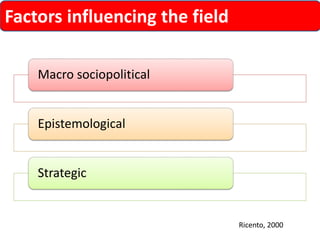
Macro sociopolitical 
Epistemological 
Strategic 
Ricento, 2000 
Factors influencing the field
Factors influencing the field 
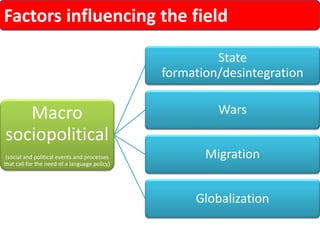
Macro sociopolitical 
(social and politicaleventsand processesthatcallfortheneedof a languagepolicy) 
Stateformation/desintegration 
Wars 
Migration 
Globalization
Factors influencing the field 
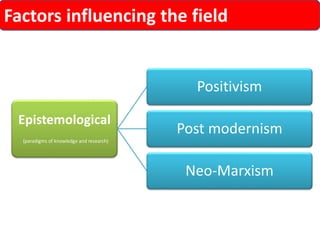
Epistemological 
(paradigmsof knowledgeand research) 
Positivism 
Post modernism 
Neo-Marxism
Factors influencing the field 
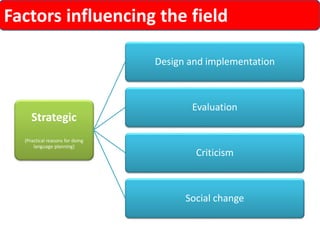
Strategic 
(Practicalreasonsfordoinglanguageplanning) 
Designand implementation 
Evaluation 
Criticism 
Social change
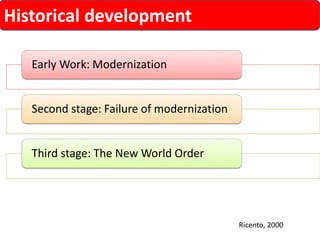
Historical development 
Early Work: Modernization 
Second stage: Failure of modernization 
Third stage: The New World Order 
Ricento, 2000
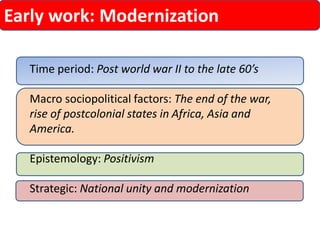
Early work: Modernization 
Time period: Post world war II to the late 60’s 
Macro sociopolitical factors: The end of the war, rise of postcolonial states in Africa, Asia and America. 
Epistemology: Positivism 
Strategic: National unity and modernization
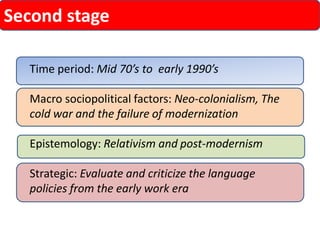
Second stage 
Time period: Mid 70’s to early 1990’s 
Macro sociopolitical factors: Neo-colonialism, The cold war and the failure of modernization 
Epistemology: Relativism and post-modernism 
Strategic: Evaluate and criticize the language policies from the early work era
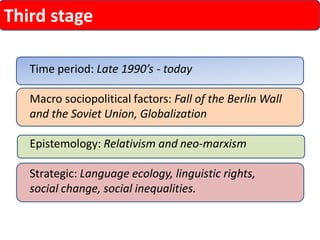
Third stage 
Time period: Late 1990’s -today 
Macro sociopolitical factors: Fall of the Berlin Wall and the Soviet Union, Globalization 
Epistemology: Relativism and neo-marxism 
Strategic: Language ecology, linguistic rights, social change, social inequalities.
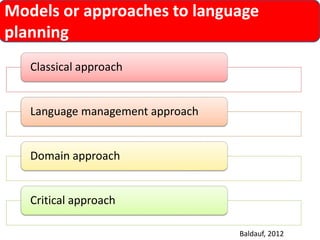
Models or approaches to language planning 
Classical approach 
Language management approach 
Domain approach 
Critical approach 
Baldauf, 2012
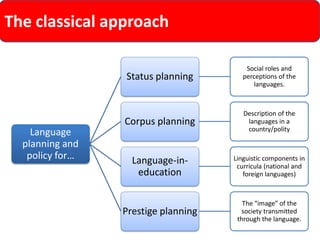
The classical approach 
Language planning and policy for… 
Status planning 
Social roles and perceptions of the languages. 
Corpus planning 
Description of the languages in a country/polity 
Language-in- education 
Linguistic components in curricula (national and foreign languages) 
Prestige planning 
The “image” of the society transmitted through the language.
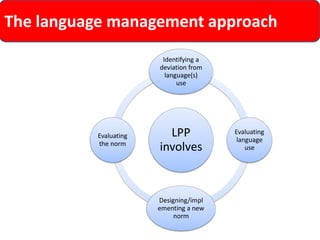
The language management approach 
LPP involves 
Identifying a deviation from language(s) use 
Evaluating language use 
Designing/implementing a new norm 
Evaluating the norm
The domain approach 
According to this approach, different languages in a polity can be assigned different status and roles in different domains (family, religion, the workplace, etc.). Language planning consists on in-field, ethnographic and interdisciplinary research to determine what role and in what domain each language should receive.
Critical approaches 
They evaluate and analyze how language policies perpetuate or challenge existing ideologies and power relations. 
Make extensive use of discourse analysis and critical discourse analysis 
Seek to transform reality rather tan merely describing it or prescribing it.
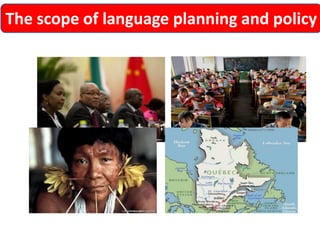
The scope of language planning and policy
The scope of language planning and policy 
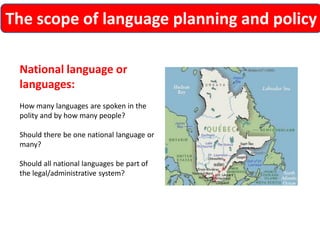
National language or languages: 
How many languages are spoken in the polity and by how many people? 
Should there be one national language or many? 
Should all national languages be part of the legal/administrative system?
The scope of language planning and policy 
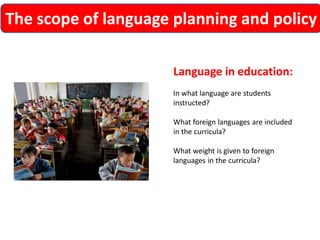
Language in education: 
In what language are students instructed? 
What foreign languages are included in the curricula? 
What weight is given to foreign languages in the curricula?
The scope of language planning and policy 
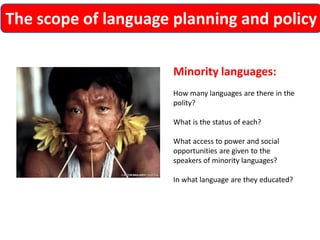
Minority languages: 
How many languages are there in the polity? 
What is the status of each? 
What access to power and social opportunities are given to the speakers of minority languages? 
In what language are they educated?
The scope of language planning and policy 
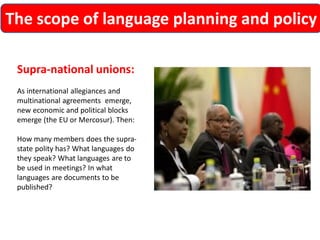
Supra-national unions: 
As international allegiances and multinational agreements emerge, new economic and political blocks emerge (the EU or Mercosur). Then: 
How many members does the supra- state polity has? What languages do they speak? What languages are to be used in meetings? In what languages are documents to be published?
Current issues
Current issues 
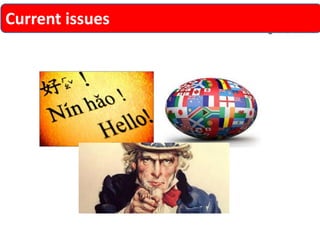
•The internationalization of English 
•Exclusion and inequality through language 
•The death of languages 
•Intercultural communication
«…el hecho es que los políticos, no muy sofisticados en asuntos lingüísticos, son quienes toman las decisiones, y las toman en gran medida de acuerdo a sus propias e individuales lealtades lingüísticas» 
(Kaplan, 1992, p. 151). 
Current issues
“…como idioma nacional, se le confiere al castellano mucho más prestigio y utilidad que a cualquier idioma indígena. La estigmatización de estos últimos[…] forma parte de la ideología lingüística nacional y permea toda la dinámica de contacto. [Cabe destacar el] hecho de que el ejercicio del poder pasa inexorablemente por el castellano, cuyos hablantes imponen, con mayor o menor sutileza, las reglas del juego. ” 
Villalón, 2011, p. 148 
Current issues
EU languages permeate the ongoing processes of creating a “union” […] language policy at the supra-national level is largely implicit and covert. As some languages are more “international” than others the equality of the 11 languages has in fact always been a myth 
Phillipson, 2001 
Current issues
Baldauf, R.B. (2012). Language planning: Where have we been? Where might we be going? RevistaBrasileirade LingüísticaAplicada, 12(2): 233-248. 
Kaplan, R. (1992). Applied linguistics and language policy and planning. EnGrabe, W. y Kaplan, R. (Comps.). Introduction to applied linguistics(pp. 143-165). Massachusetts: Addison-Wesley Publishing Company. 
Mayora, C. (en prensa). Aportes de la lingüística aplicada al estudio del poder. Lenguaje, 43(1). 
Pereira, S. (2013). Planificación y políticas lingüísticas en la enseñanza de lenguas extranjeras a nivel universitario: un análisis de percepciones. Lenguaje, 41(2): 383-406 
References
Phillipson, R. (2001). English yes, but equal language right first. The guardian [online version]. Available: http://www.theguardian.com/theguardian/2001/apr/19/guardianweekly.guardianweekly1 
Ricento, T. (2000). Historical and theoretical perspectives in language policy and planning. Journal of Sociolinguistics, 4(2):196-213. 
Villalón, M.E. (2011). Lenguas amenazadas y la homogeneización lingüística de Venezuela. Boletínde lingüística,23(35-36): 143-170. 
References

Language policy and planning

  • 1.
    LanguagePolicyand PlanningFacultad deHumanidadesEscuela de Ciencias del LenguajeSeminario de Lingüística AplicadaProf. Carlos MayoraDecember2014
  • 2.
    •Definitions •Factors influencingthe field •Historical developments •Models •Scope •Current issues Contents
  • 3.
  • 4.
    Definitions …la asignaciónde recursos, por parte de las personas que tienen autoridad para ello, para el logro de metas relacionadas con el estatus y el corpus del lenguaje; ya sea con relación a nuevas funciones –usos funcionales del lenguaje–que se desea desarrollar o con respecto a viejas funciones que necesitan ser descartadas. Pereira, 2013, p. 387
  • 5.
    Definitions The disciplineof language planning has been defined as systematic, future-oriented change in language code (corpus planning), use (status planning), learning and speaking (language-in-education planning) and/or language promotion (prestige planning) undertaken by some authoritative organisation –most frequently by governments, but increasingly by other organisations –with some community of speakers. Baldauf, 2012, p. 234
  • 6.
    Definitions Se entiendepor políticas lingüísticas la toma de decisiones de carácter normativo con respecto al uso de las lenguas en una nación, comunidad u organización […] la planificación lingüística se refiere al proceso sistemático para la elaboración e implementación de una política lingüística Mayora, en prensa
  • 7.
    Definitions …language planning[can be considered]the quintessential example of applied linguistics, combining as it does the need for theoretical understandings about language and a requirement for application to real life situations. Baldauf, 2012, p. 234
  • 8.
  • 9.
    Macro sociopolitical Epistemological Strategic Ricento, 2000 Factors influencing the field
  • 10.
    Factors influencing thefield Macro sociopolitical (social and politicaleventsand processesthatcallfortheneedof a languagepolicy) Stateformation/desintegration Wars Migration Globalization
  • 11.
    Factors influencing thefield Epistemological (paradigmsof knowledgeand research) Positivism Post modernism Neo-Marxism
  • 12.
    Factors influencing thefield Strategic (Practicalreasonsfordoinglanguageplanning) Designand implementation Evaluation Criticism Social change
  • 13.
    Historical development EarlyWork: Modernization Second stage: Failure of modernization Third stage: The New World Order Ricento, 2000
  • 14.
    Early work: Modernization Time period: Post world war II to the late 60’s Macro sociopolitical factors: The end of the war, rise of postcolonial states in Africa, Asia and America. Epistemology: Positivism Strategic: National unity and modernization
  • 15.
    Second stage Timeperiod: Mid 70’s to early 1990’s Macro sociopolitical factors: Neo-colonialism, The cold war and the failure of modernization Epistemology: Relativism and post-modernism Strategic: Evaluate and criticize the language policies from the early work era
  • 16.
    Third stage Timeperiod: Late 1990’s -today Macro sociopolitical factors: Fall of the Berlin Wall and the Soviet Union, Globalization Epistemology: Relativism and neo-marxism Strategic: Language ecology, linguistic rights, social change, social inequalities.
  • 17.
    Models or approachesto language planning Classical approach Language management approach Domain approach Critical approach Baldauf, 2012
  • 18.
    The classical approach Language planning and policy for… Status planning Social roles and perceptions of the languages. Corpus planning Description of the languages in a country/polity Language-in- education Linguistic components in curricula (national and foreign languages) Prestige planning The “image” of the society transmitted through the language.
  • 19.
    The language managementapproach LPP involves Identifying a deviation from language(s) use Evaluating language use Designing/implementing a new norm Evaluating the norm
  • 20.
    The domain approach According to this approach, different languages in a polity can be assigned different status and roles in different domains (family, religion, the workplace, etc.). Language planning consists on in-field, ethnographic and interdisciplinary research to determine what role and in what domain each language should receive.
  • 21.
    Critical approaches Theyevaluate and analyze how language policies perpetuate or challenge existing ideologies and power relations. Make extensive use of discourse analysis and critical discourse analysis Seek to transform reality rather tan merely describing it or prescribing it.
  • 22.
    The scope oflanguage planning and policy
  • 23.
    The scope oflanguage planning and policy National language or languages: How many languages are spoken in the polity and by how many people? Should there be one national language or many? Should all national languages be part of the legal/administrative system?
  • 24.
    The scope oflanguage planning and policy Language in education: In what language are students instructed? What foreign languages are included in the curricula? What weight is given to foreign languages in the curricula?
  • 25.
    The scope oflanguage planning and policy Minority languages: How many languages are there in the polity? What is the status of each? What access to power and social opportunities are given to the speakers of minority languages? In what language are they educated?
  • 26.
    The scope oflanguage planning and policy Supra-national unions: As international allegiances and multinational agreements emerge, new economic and political blocks emerge (the EU or Mercosur). Then: How many members does the supra- state polity has? What languages do they speak? What languages are to be used in meetings? In what languages are documents to be published?
  • 27.
  • 28.
    Current issues •Theinternationalization of English •Exclusion and inequality through language •The death of languages •Intercultural communication
  • 29.
    «…el hecho esque los políticos, no muy sofisticados en asuntos lingüísticos, son quienes toman las decisiones, y las toman en gran medida de acuerdo a sus propias e individuales lealtades lingüísticas» (Kaplan, 1992, p. 151). Current issues
  • 30.
    “…como idioma nacional,se le confiere al castellano mucho más prestigio y utilidad que a cualquier idioma indígena. La estigmatización de estos últimos[…] forma parte de la ideología lingüística nacional y permea toda la dinámica de contacto. [Cabe destacar el] hecho de que el ejercicio del poder pasa inexorablemente por el castellano, cuyos hablantes imponen, con mayor o menor sutileza, las reglas del juego. ” Villalón, 2011, p. 148 Current issues
  • 31.
    EU languages permeatethe ongoing processes of creating a “union” […] language policy at the supra-national level is largely implicit and covert. As some languages are more “international” than others the equality of the 11 languages has in fact always been a myth Phillipson, 2001 Current issues
  • 32.
    Baldauf, R.B. (2012).Language planning: Where have we been? Where might we be going? RevistaBrasileirade LingüísticaAplicada, 12(2): 233-248. Kaplan, R. (1992). Applied linguistics and language policy and planning. EnGrabe, W. y Kaplan, R. (Comps.). Introduction to applied linguistics(pp. 143-165). Massachusetts: Addison-Wesley Publishing Company. Mayora, C. (en prensa). Aportes de la lingüística aplicada al estudio del poder. Lenguaje, 43(1). Pereira, S. (2013). Planificación y políticas lingüísticas en la enseñanza de lenguas extranjeras a nivel universitario: un análisis de percepciones. Lenguaje, 41(2): 383-406 References
  • 33.
    Phillipson, R. (2001).English yes, but equal language right first. The guardian [online version]. Available: http://www.theguardian.com/theguardian/2001/apr/19/guardianweekly.guardianweekly1 Ricento, T. (2000). Historical and theoretical perspectives in language policy and planning. Journal of Sociolinguistics, 4(2):196-213. Villalón, M.E. (2011). Lenguas amenazadas y la homogeneización lingüística de Venezuela. Boletínde lingüística,23(35-36): 143-170. References