Second language acquisition
and
Uiversal grammar
Main source: Chomsky’s universal grammar
INTRODUCTION
The learning of a second language has
attracted the attention of linguists for
centuries, but the consideration of
second language acquisition as an
autonomous field of linguistic
inquiry is a very recent discovery.
What is
SLA?
A multidisciplinary field that studies:
Interlangauge (IL)
L2 Language Learning process
Learner variation
L2 language in the mind
What is
Universal
Grammar
?
Uniformly and speedy acquisition of a
first language
Learning is innate
Principles and parameters constrain
language
UG
and
SLA
Innate mechanism that guides
language learning
The question then is, do we have
access to this when learning the
second language?
If yes, how is it available?
Contrastive
Analysis
A former approach to second language
acquisition from a scientific perspective in this
century is provided by 'Contrastive Analysis',
a theory derived from behaviorism in
Psychology and structuralism in linguistics.
Within CA, learning a second language means
to acquire, one by one, a fixed set of habits
through a process of imitation and
reinforcement. Moreover, first language
experience plays a crucial role in the course of
second language acquisition.
CA basic tenets claims that learners will tend to
transfer elements from their native language to the
second language.
positive vs. Negative transfer:
Similarities between the two languages will result in
positive transfer.
And differences between the two languages will
cause 'negative transfer' (i.e.'interference') and
difficulties in learning.
.(Weiberger and Newmeyer, 1988: 35)
Monitor
Theory:
Krashen
1981
 A first attempt to provide a testable and predictive
theory of second language acquisition is Krashen
1981, 'Monitor Theory'. that there is a difference
between ‘acquisition’ and ‘learning’. Acquisition is
hypothesized to occur in a manner similar to L1
acquisition, that is, with the learner’s focus
on communicating messages and meanings; learning
is described as a conscious process, one in which the
learner’s attention is directed to the rules and forms
of the language.
Chomsky
and
Universal
Grammar
 Chomsky's attack on Skinner's approach, marked the
disrepute of behaviorism and the partial fall of CA
hypotheses. Language acquisition was not intended as
a 'habit formation process only, but as a creative
activity, as well.
 Second language learners use their cognitive abilities
to work out the hypothesis about the structure of a
second language. The acquisition process is
represented by a series of transitional structures or
'interlanguages‘.(Selinker, 1972)
 Later the issue of the application of Chomsky's UG
theory to second language acquisition has grown
considerably as a question.
 With regard to SLA, the question is more complicated.
On one hand, the first language is available to L2
learners. On the other hand, the end result of L2
learning is not native-like competence as it is the case in
the first language acquisition.
Thus currents research mainly focuses on the extent
that L2 learners have access to the innate system,
especially the concept of principles and parameters.
Different
Views on
Universal
Grammar
access in
regards to
SLA:
(White, 1986)
The Direct accessibility
The Indirect accessibility
The Inaccessibility
The Direct
accessibility:
The direct accessibility hypothesis asserts adult
learners learn both first and L2 by setting
parameters to UG. So if UG can be used in the
first language, it also can be applied in L2
learning. L2 learner makes full use of UG
including the part which is not reflected in his
mother tongue.
The Indirect
accessibility:
 this hypothesis assumes that UG works in SLA
through the grammar of mother tongue. When the
parameter setting of L2 is different from that of first
language, L2 learner cannot use the parameter which
has been lost in UG. They can only reset the
parameter of mother tongue grammar.
The
Inaccessibility
Inaccessibility hypothesis denies all the
influence of UG on SLA, assuming that the
parameters of UG have been set in the process
of first language acquisition, which cannot be
reset and suggesting that only first language
learner can get access to UG.
complementary
approaches to
second language
acquisition
(Eckman, 1988)
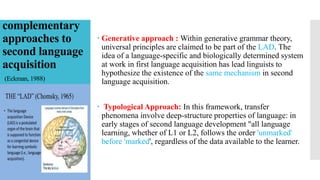
 Generative approach : Within generative grammar theory,
universal principles are claimed to be part of the LAD. The
idea of a language-specific and biologically determined system
at work in first language acquisition has lead linguists to
hypothesize the existence of the same mechanism in second
language acquisition.
 Typological Approach: In this framework, transfer
phenomena involve deep-structure properties of language: in
early stages of second language development "all language
learning, whether of L1 or L2, follows the order 'unmarked'
before 'marked', regardless of the data available to the learner.
The logical
problem of
second
language
acquisition
(White, 1986)
 The role of linguistic universals in second language acquisition is
more complicated than in L1 acquisition. This is because SLA
involves [at least] two languages - the target language and the
learner's native language. Thus, it may be that universal principles of
first language acquisition are subject to language transfer into a
second language grammar along with prior first language
experience. SO, hardly any second language learner achieves the
final 'steady state' typical of primary language acquisition.
Fossilization  Fossilization may occur in the course of second
language development. It may affect specific aspects
of second language development (phonology,
morphology, syntax). It happens that some second
language learners will stop at different points in
language development without being able to continue
any further. The causes of fossilization are not well
established, however it might be reasonably assumed
that motivational factors and the type of input second
language received play an important role.
THE
PROBLEMS
OF UG IN
SLA:
Chomsky, (1976)
 Firstly, the process of first language acquisition is
natural and unconscious while the SLA is
conscious.
 Secondly, cognitive ability of children is still in the
immature stage while that of adult is already
mature.
 Thirdly, the environment of first language
acquisition and that of SLA are different.
THE
PROBLEMS
OF UG IN
SLA:
 Fourthly, the input modes are different. Children get
first language input through spoken language. Adults get
L2 input through spoken language, written language as
well as notation.
 Last but not least, In the process of first language
acquisition, there is no interference from other language.
But L2 learner uses mother tongue constantly. Mother
tongue and L2 knowledge will interact with each other
somehow.
Conclusion
 All in all, despite the differences between first and
second acquisition processes, the consideration of the
poverty of stimulus argument seems to hold true in
second language acquisition process as well.
 To conclude, it can be seen that there are many problems
concerning the UG approach to SLA, which mainly
include the fundamental differences between the L1 and
L2 learning and numerous specific problems concerning
language processing, cognitive mechanism as well as
other issues.
Reference:
 Chomsky, N. (1976). Language and responsibility. Brighton:
Harvester Press.
 Cook, V,J (1996). "Chomsky's universal grammar: An introduction".
Blackwell publishers.
 Cook, V. J. (1993). Linguistics and second language acquisition.
Basingstoke: Macmilan.
 Cook, V. J. (1997). Inside language. London: St. Martin's
 Freeman, D., & Freeman, Y. (2004). Essential linguistics. Port
smouth: Heinemann. Press.
 White, L. (1989). Universal grammar and second language acquisition.
( 1989). Amsterdam: Benjamin.
Thank You

second language acquisition

  • 1.
    Second language acquisition and Uiversalgrammar Main source: Chomsky’s universal grammar
  • 2.
    INTRODUCTION The learning ofa second language has attracted the attention of linguists for centuries, but the consideration of second language acquisition as an autonomous field of linguistic inquiry is a very recent discovery.
  • 3.
    What is SLA? A multidisciplinaryfield that studies: Interlangauge (IL) L2 Language Learning process Learner variation L2 language in the mind
  • 4.
    What is Universal Grammar ? Uniformly andspeedy acquisition of a first language Learning is innate Principles and parameters constrain language
  • 5.
    UG and SLA Innate mechanism thatguides language learning The question then is, do we have access to this when learning the second language? If yes, how is it available?
  • 6.
    Contrastive Analysis A former approachto second language acquisition from a scientific perspective in this century is provided by 'Contrastive Analysis', a theory derived from behaviorism in Psychology and structuralism in linguistics. Within CA, learning a second language means to acquire, one by one, a fixed set of habits through a process of imitation and reinforcement. Moreover, first language experience plays a crucial role in the course of second language acquisition.
  • 7.
    CA basic tenetsclaims that learners will tend to transfer elements from their native language to the second language. positive vs. Negative transfer: Similarities between the two languages will result in positive transfer. And differences between the two languages will cause 'negative transfer' (i.e.'interference') and difficulties in learning. .(Weiberger and Newmeyer, 1988: 35)
  • 8.
    Monitor Theory: Krashen 1981  A firstattempt to provide a testable and predictive theory of second language acquisition is Krashen 1981, 'Monitor Theory'. that there is a difference between ‘acquisition’ and ‘learning’. Acquisition is hypothesized to occur in a manner similar to L1 acquisition, that is, with the learner’s focus on communicating messages and meanings; learning is described as a conscious process, one in which the learner’s attention is directed to the rules and forms of the language.
  • 9.
    Chomsky and Universal Grammar  Chomsky's attackon Skinner's approach, marked the disrepute of behaviorism and the partial fall of CA hypotheses. Language acquisition was not intended as a 'habit formation process only, but as a creative activity, as well.  Second language learners use their cognitive abilities to work out the hypothesis about the structure of a second language. The acquisition process is represented by a series of transitional structures or 'interlanguages‘.(Selinker, 1972)
  • 10.
     Later theissue of the application of Chomsky's UG theory to second language acquisition has grown considerably as a question.  With regard to SLA, the question is more complicated. On one hand, the first language is available to L2 learners. On the other hand, the end result of L2 learning is not native-like competence as it is the case in the first language acquisition. Thus currents research mainly focuses on the extent that L2 learners have access to the innate system, especially the concept of principles and parameters.
  • 11.
    Different Views on Universal Grammar access in regardsto SLA: (White, 1986) The Direct accessibility The Indirect accessibility The Inaccessibility
  • 12.
    The Direct accessibility: The directaccessibility hypothesis asserts adult learners learn both first and L2 by setting parameters to UG. So if UG can be used in the first language, it also can be applied in L2 learning. L2 learner makes full use of UG including the part which is not reflected in his mother tongue.
  • 13.
    The Indirect accessibility:  thishypothesis assumes that UG works in SLA through the grammar of mother tongue. When the parameter setting of L2 is different from that of first language, L2 learner cannot use the parameter which has been lost in UG. They can only reset the parameter of mother tongue grammar.
  • 14.
    The Inaccessibility Inaccessibility hypothesis deniesall the influence of UG on SLA, assuming that the parameters of UG have been set in the process of first language acquisition, which cannot be reset and suggesting that only first language learner can get access to UG.
  • 15.
    complementary approaches to second language acquisition (Eckman,1988)  Generative approach : Within generative grammar theory, universal principles are claimed to be part of the LAD. The idea of a language-specific and biologically determined system at work in first language acquisition has lead linguists to hypothesize the existence of the same mechanism in second language acquisition.  Typological Approach: In this framework, transfer phenomena involve deep-structure properties of language: in early stages of second language development "all language learning, whether of L1 or L2, follows the order 'unmarked' before 'marked', regardless of the data available to the learner.
  • 16.
    The logical problem of second language acquisition (White,1986)  The role of linguistic universals in second language acquisition is more complicated than in L1 acquisition. This is because SLA involves [at least] two languages - the target language and the learner's native language. Thus, it may be that universal principles of first language acquisition are subject to language transfer into a second language grammar along with prior first language experience. SO, hardly any second language learner achieves the final 'steady state' typical of primary language acquisition.
  • 17.
    Fossilization  Fossilizationmay occur in the course of second language development. It may affect specific aspects of second language development (phonology, morphology, syntax). It happens that some second language learners will stop at different points in language development without being able to continue any further. The causes of fossilization are not well established, however it might be reasonably assumed that motivational factors and the type of input second language received play an important role.
  • 18.
    THE PROBLEMS OF UG IN SLA: Chomsky,(1976)  Firstly, the process of first language acquisition is natural and unconscious while the SLA is conscious.  Secondly, cognitive ability of children is still in the immature stage while that of adult is already mature.  Thirdly, the environment of first language acquisition and that of SLA are different.
  • 19.
    THE PROBLEMS OF UG IN SLA: Fourthly, the input modes are different. Children get first language input through spoken language. Adults get L2 input through spoken language, written language as well as notation.  Last but not least, In the process of first language acquisition, there is no interference from other language. But L2 learner uses mother tongue constantly. Mother tongue and L2 knowledge will interact with each other somehow.
  • 20.
    Conclusion  All inall, despite the differences between first and second acquisition processes, the consideration of the poverty of stimulus argument seems to hold true in second language acquisition process as well.  To conclude, it can be seen that there are many problems concerning the UG approach to SLA, which mainly include the fundamental differences between the L1 and L2 learning and numerous specific problems concerning language processing, cognitive mechanism as well as other issues.
  • 21.
    Reference:  Chomsky, N.(1976). Language and responsibility. Brighton: Harvester Press.  Cook, V,J (1996). "Chomsky's universal grammar: An introduction". Blackwell publishers.  Cook, V. J. (1993). Linguistics and second language acquisition. Basingstoke: Macmilan.  Cook, V. J. (1997). Inside language. London: St. Martin's  Freeman, D., & Freeman, Y. (2004). Essential linguistics. Port smouth: Heinemann. Press.  White, L. (1989). Universal grammar and second language acquisition. ( 1989). Amsterdam: Benjamin.
  • 22.