Facultad de Humanidades 
Escuela de Ciencias del Lenguaje 
Seminario de Lingüística Aplicada 
Curricular Elements 
Prof. Carlos Mayora 
November 2014
Warm-up 
Beyond the design of methods, the design of 
instruction is a typical activity of applied 
linguistics. In this class, we will look at some of 
the tasks of course design and specially at 
curricular elements.
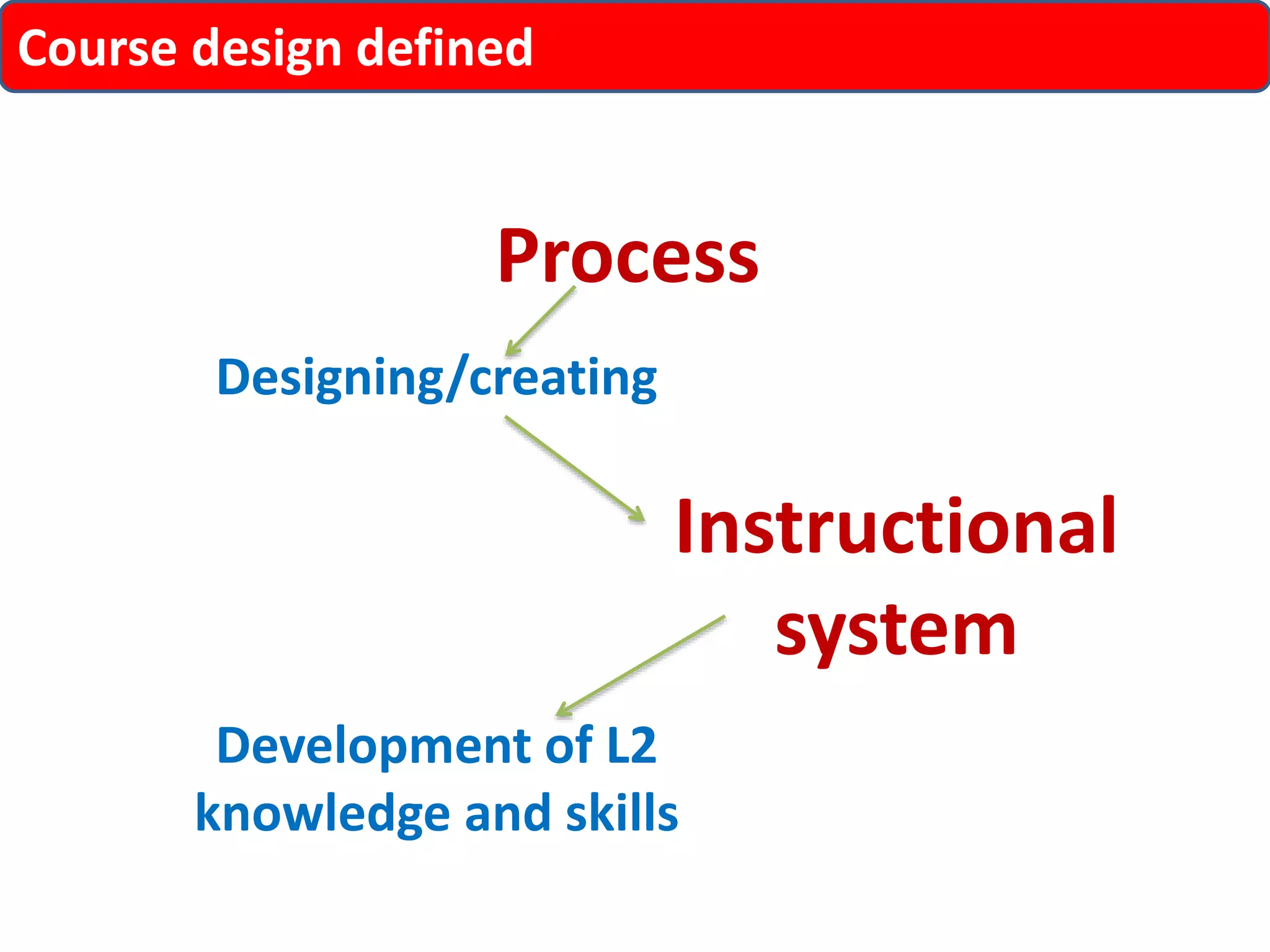
Course design defined 
Process 
Designing/creating 
Instructional 
system 
Development of L2 
knowledge and skills
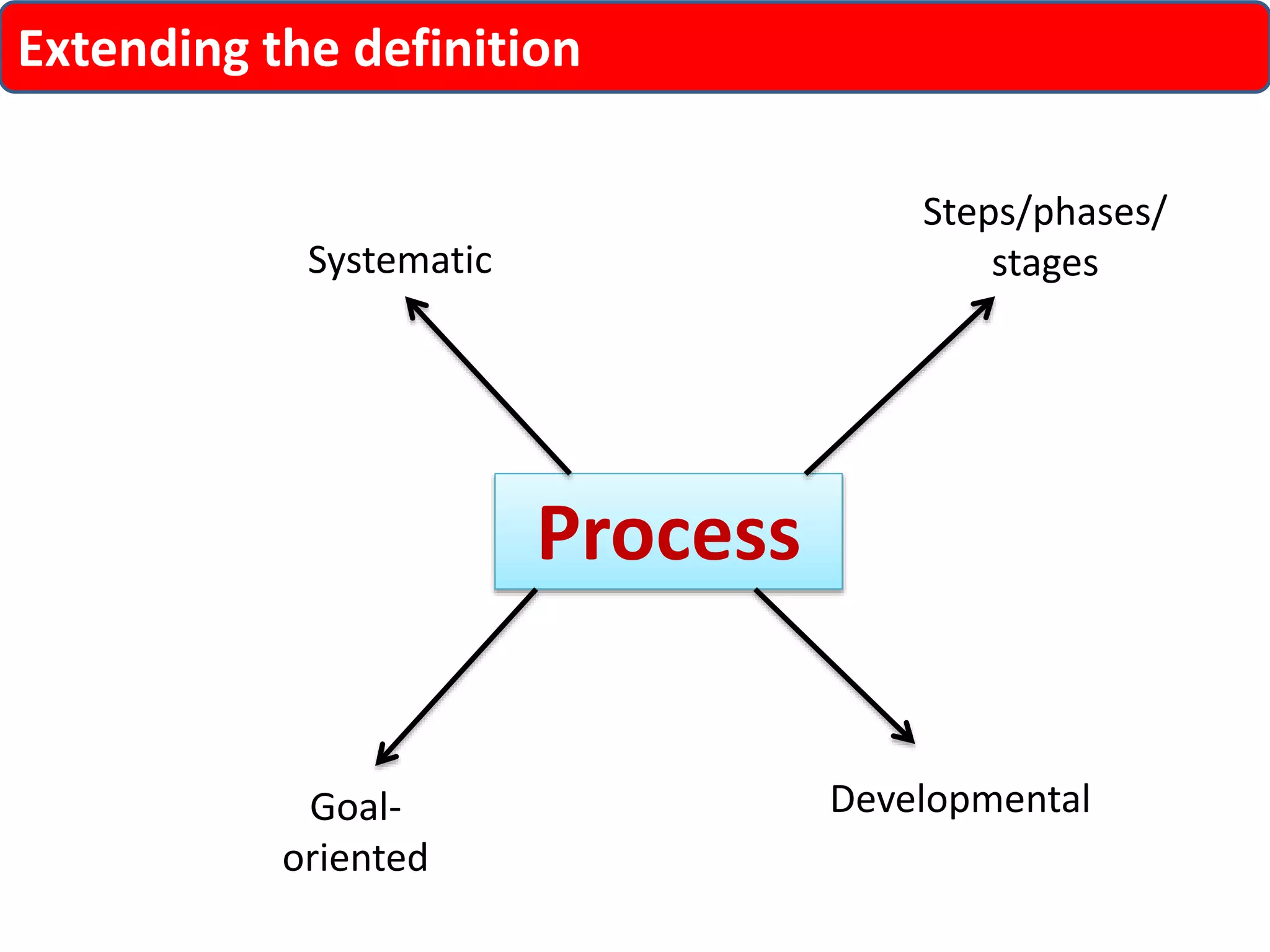
Extending the definition 
Process 
Systematic 
Steps/phases/ 
stages 
Goal-oriented 
Developmental
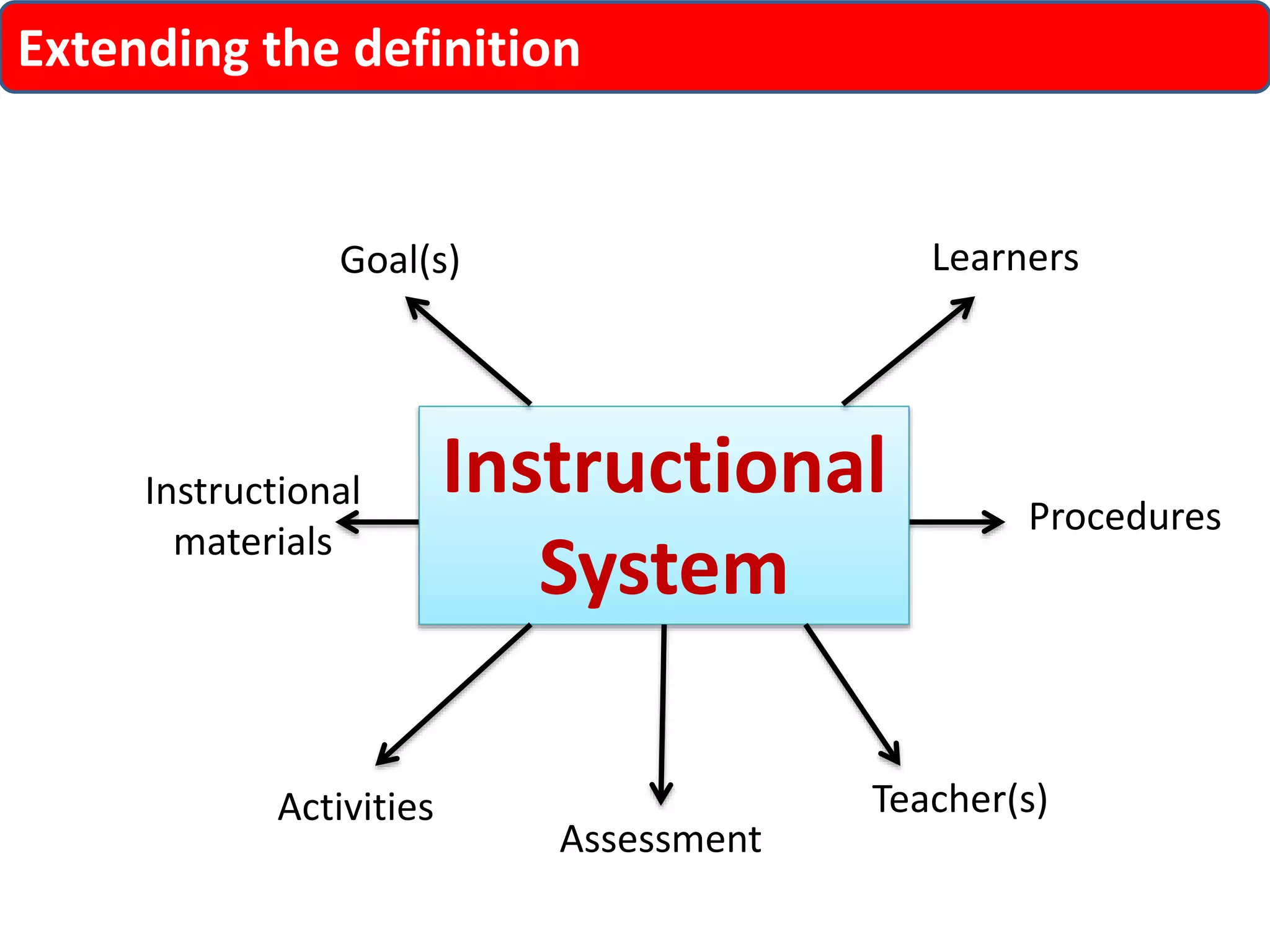
Extending the definition 
Goal(s) Learners 
Instructional 
System 
Instructional 
materials 
Procedures 
Activities Teacher(s) 
Assessment
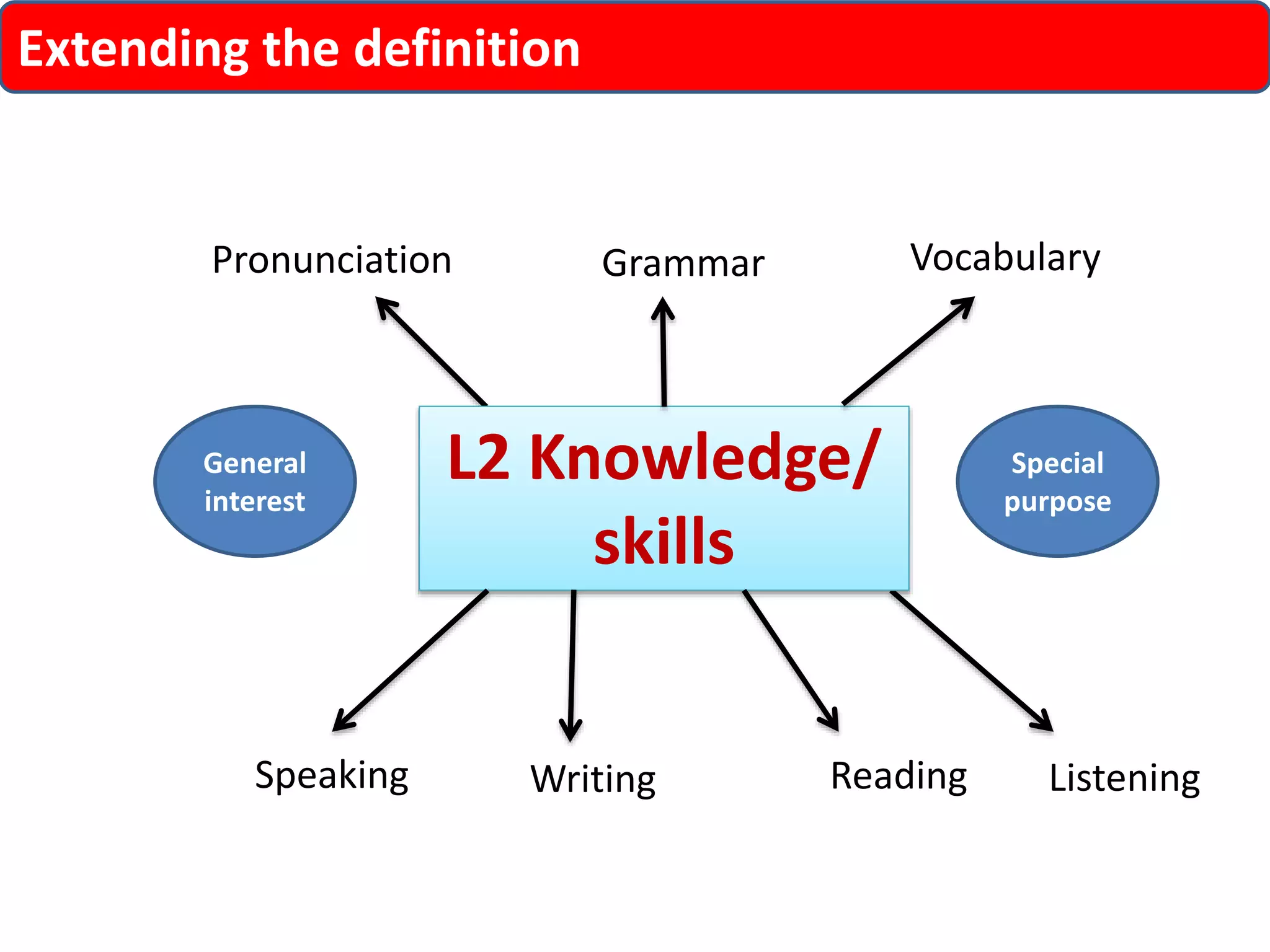
Grammar Vocabulary 
Pronunciation 
L2 Knowledge/ 
skills 
Speaking Reading 
Writing Listening 
General 
interest 
Special 
purpose 
Extending the definition
Extending the definition 
In that definition, we see that the process is 
a. systematic; 
b. practical; and 
c. it tackles a real-world language related problem. 
We could also add that the foundations of the process 
are interdisciplinary in nature since it deals with both 
the nature of language, the nature of learning and it 
needs to address a number of resources. Thus, it is 
applied linguistics in action.
• Curriculum 
and materials 
design. 
• Resources 
available, both 
material and 
human. 
• The 
linguistic 
system 
• Mental 
processes 
involved in 
learning 
Psychology Linguistics 
L2 curriculum design 
Management Education 
Interdisciplinarity
Central elements 
Approach Syllabus Techniques Exercises 
Brown’s categories (1995)
Central elements 
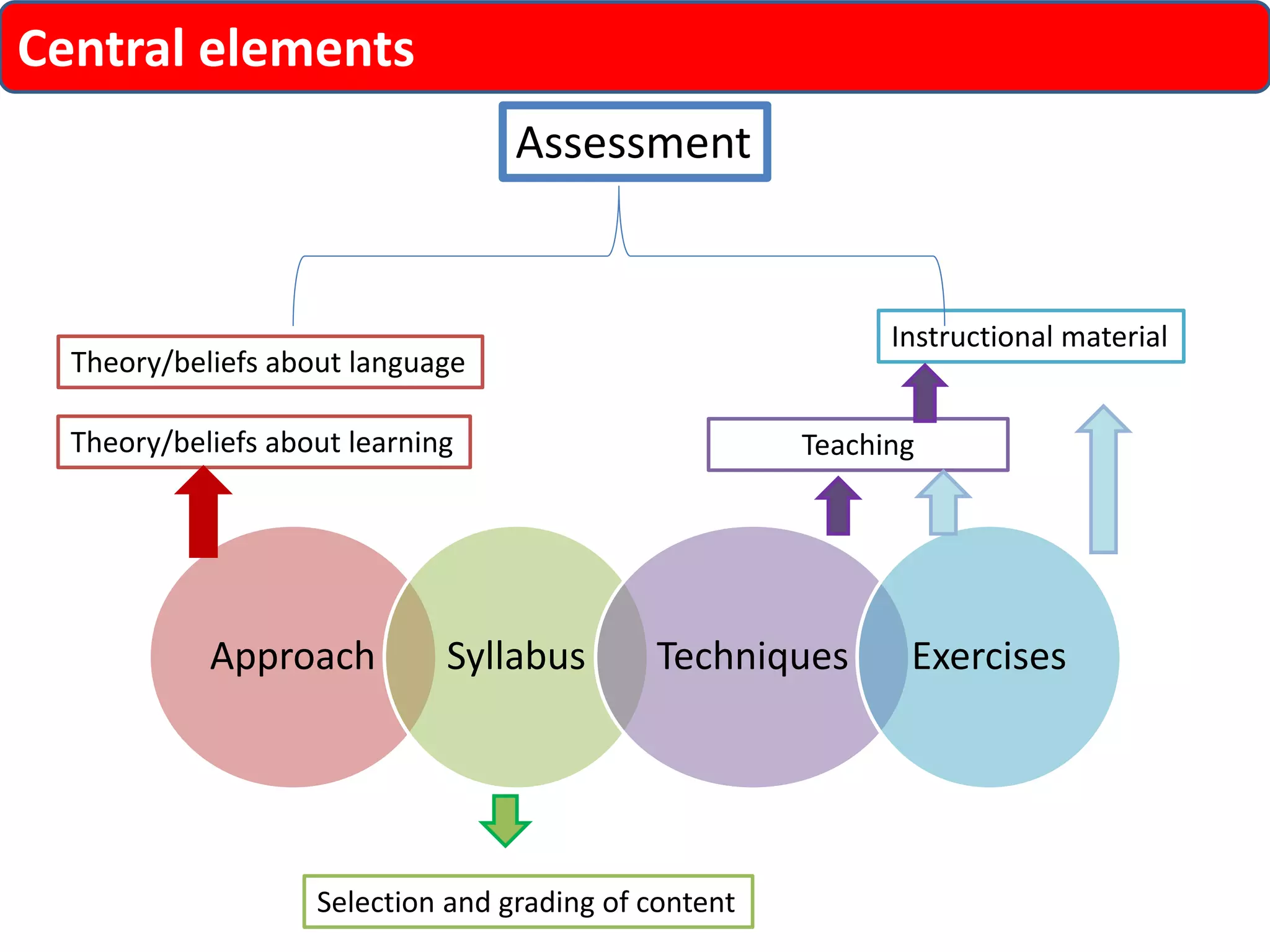
Theory/beliefs about language 
Theory/beliefs about learning 
Instructional material 
Approach Syllabus Techniques Exercises 
Selection and grading of content 
Teaching 
Assessment
Curriculum 
CURRICULA are concerned with making general 
statements about language learning, learning purpose and 
experience, evaluation and the relationships between 
teachers and learners… [ they also include] banks of 
learning items and suggestions about how these might be 
used in class 
Nunan, 1988, p. 3 
CURRICULUMis a very general concept which involves 
considerations of the whole complex of philosophical, 
social and administrative factors which contribute to the 
planning of an educational programme. 
Allen, 1984, p. 6
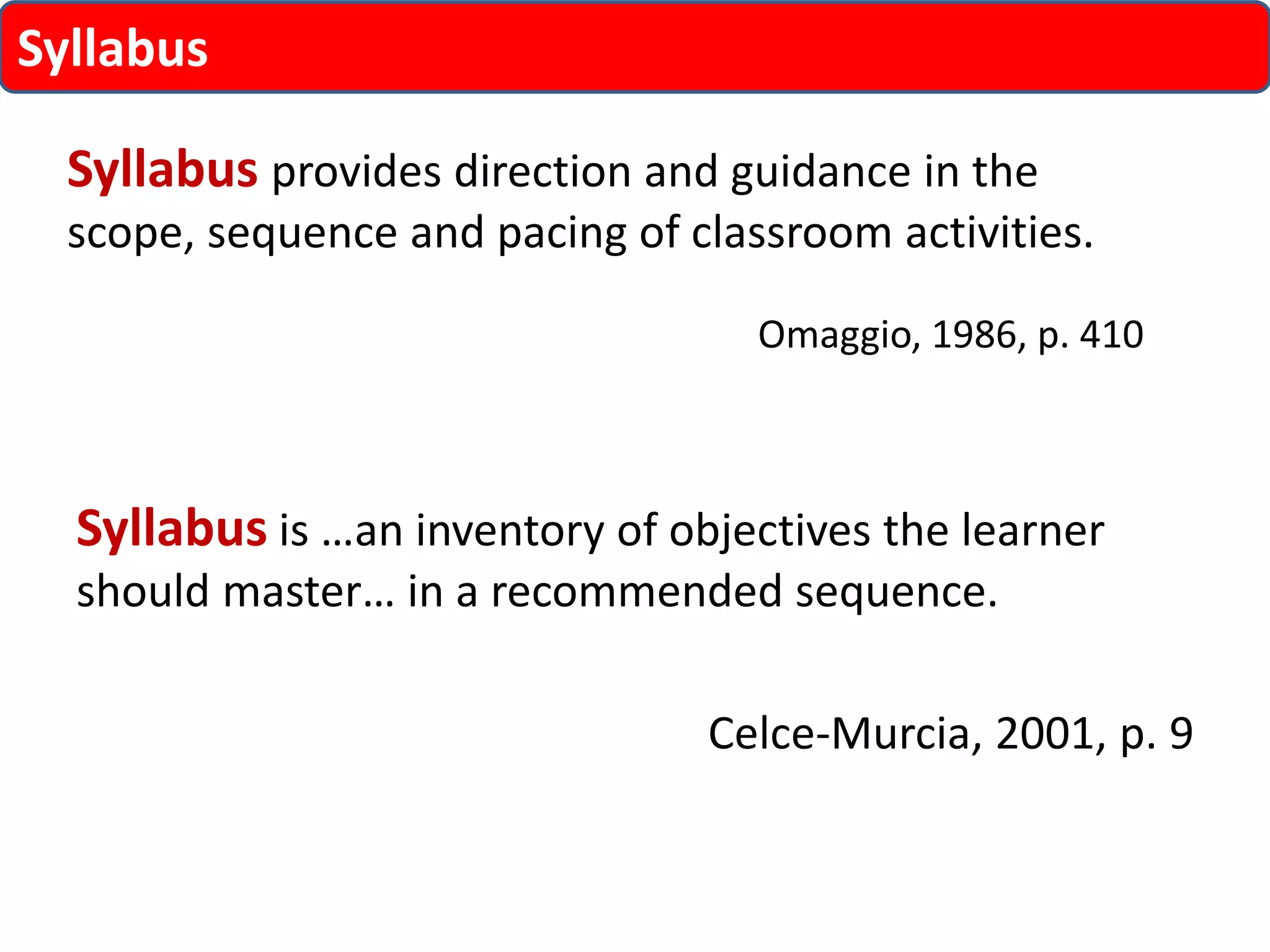
Syllabus provides direction and guidance in the 
scope, sequence and pacing of classroom activities. 
Omaggio, 1986, p. 410 
Syllabus 
Syllabus is …an inventory of objectives the learner 
should master… in a recommended sequence. 
Celce-Murcia, 2001, p. 9
Stages in educational planning 
National ministeries/offices 
Regional administrative unit 
The department 
The classroom 
Curriculum 
Syllabus 
Lesson 
The Institution
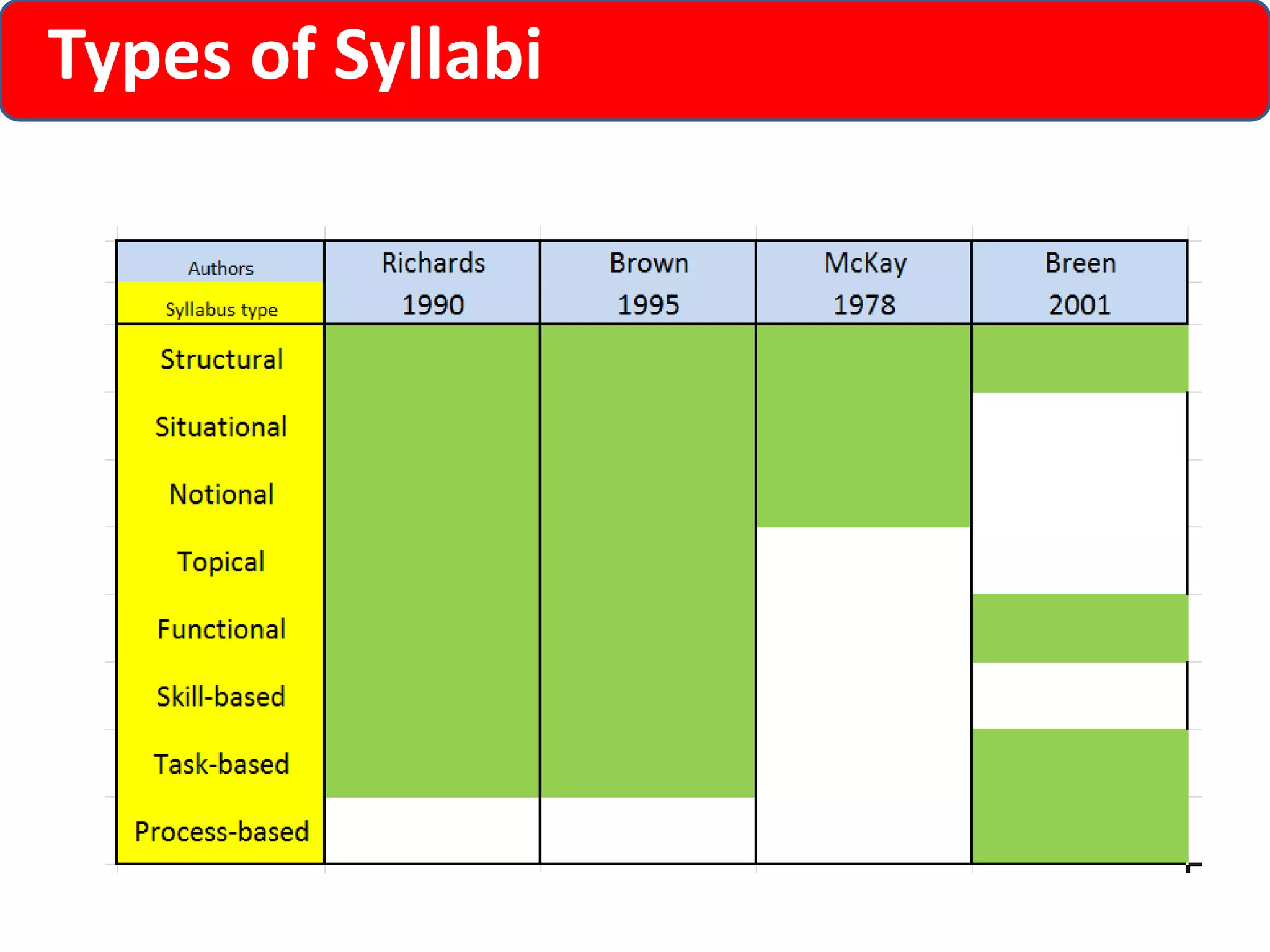
Types of Syllabi
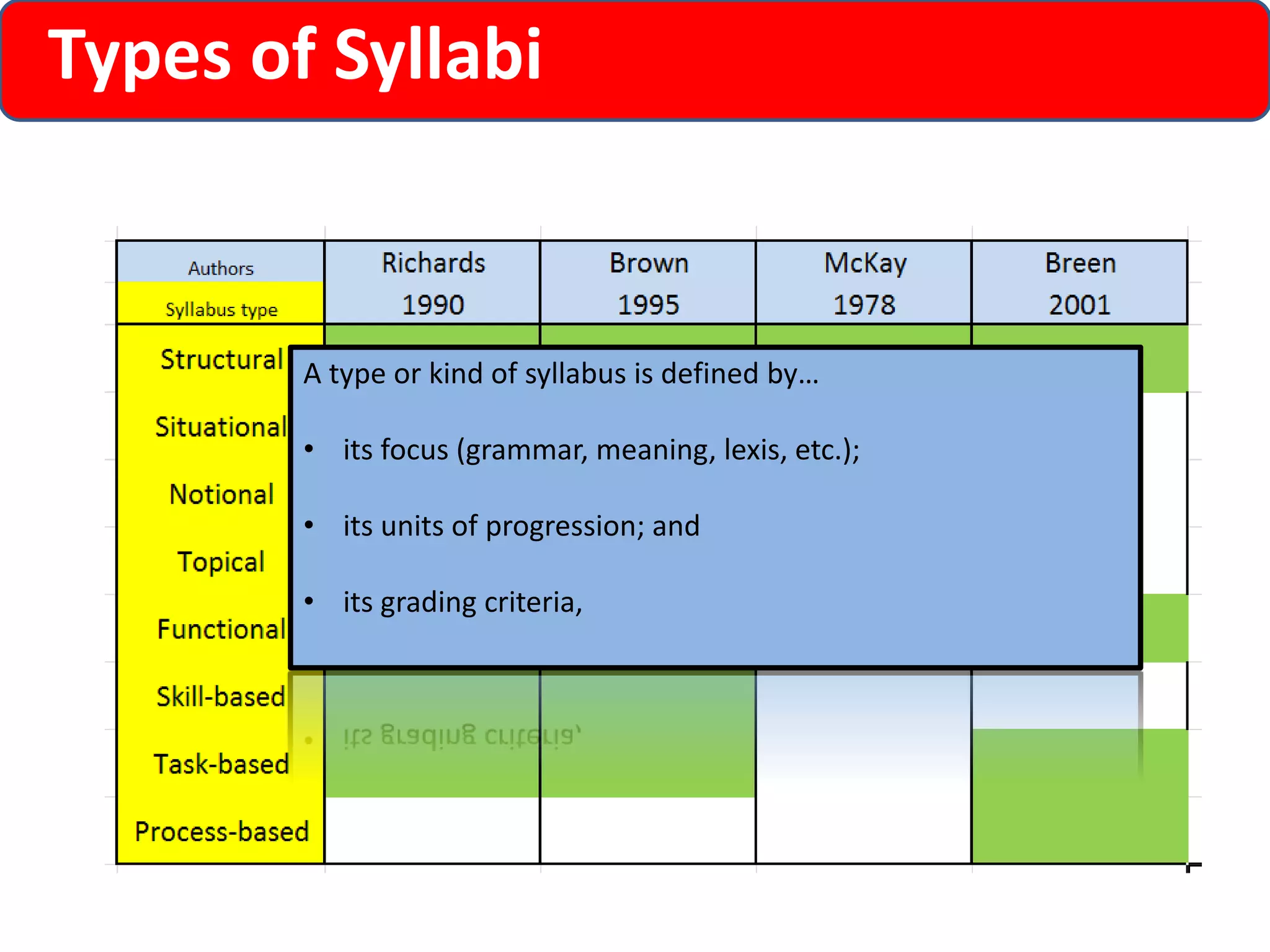
Types of Syllabi 
A type or kind of syllabus is defined by… 
• its focus (grammar, meaning, lexis, etc.); 
• its units of progression; and 
• its grading criteria,
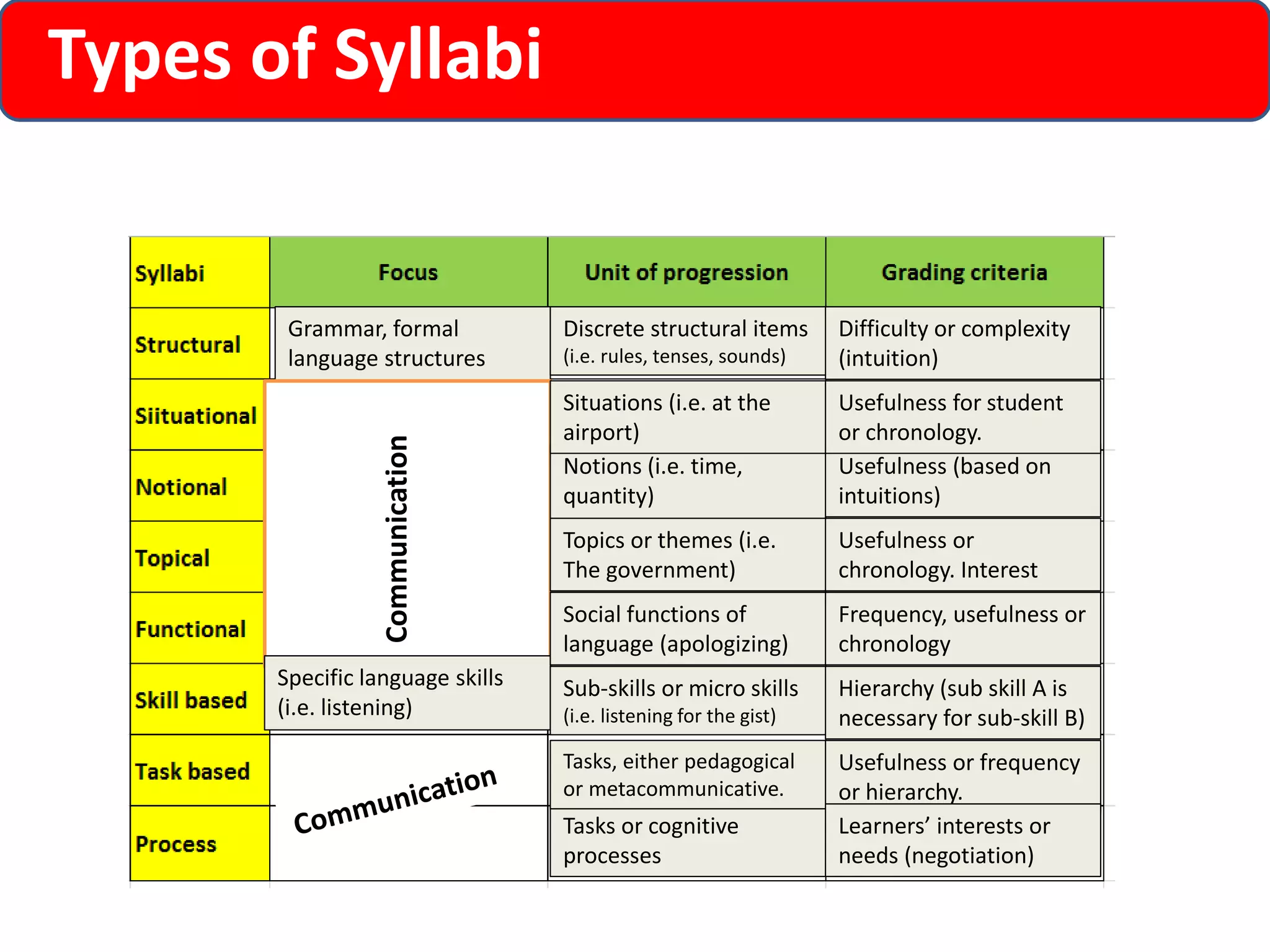
Grammar, formal 
language structures 
Communication 
Specific language skills 
(i.e. listening) 
Difficulty or complexity 
(intuition) 
Discrete structural items 
(i.e. rules, tenses, sounds) 
Situations (i.e. at the 
airport) 
Notions (i.e. time, 
quantity) 
Usefulness for student 
or chronology. 
Usefulness (based on 
intuitions) 
Topics or themes (i.e. 
The government) 
Usefulness or 
chronology. Interest 
Social functions of 
language (apologizing) 
Frequency, usefulness or 
chronology 
Hierarchy (sub skill A is 
necessary for sub-skill B) 
Sub-skills or micro skills 
(i.e. listening for the gist) 
Usefulness or frequency 
or hierarchy. 
Tasks, either pedagogical 
or metacommunicative. 
Tasks or cognitive 
processes 
Learners’ interests or 
needs (negotiation) 
Types of Syllabi
Three perspectives on selecting and grading content 
1. Identify the general contexts and situations in 
which the learners will communicate. 
2. Specify the communicative events the learners 
will engage in. 
3. Make a list of the functional goals that the 
learner will need in order to take part in the 
communicative events. 
4. List the key linguistic elements needed to 
achieve functional goals. 
5. Sequence and integrate 3 and 4. 
Nunan, 2001, p. 63
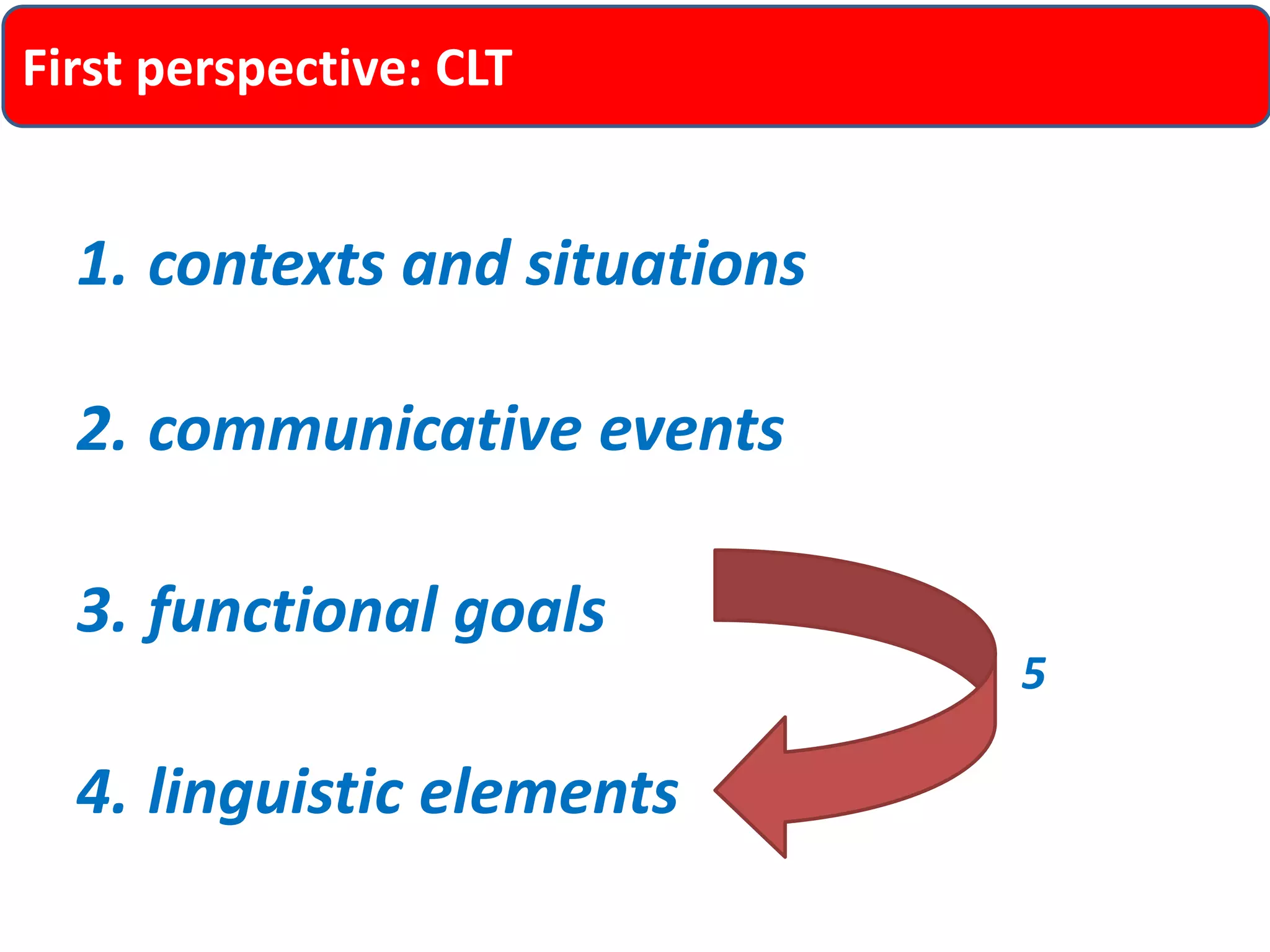
1. contexts and situations 
2. communicative events 
3. functional goals 
4. linguistic elements 
5 
First perspective: CLT
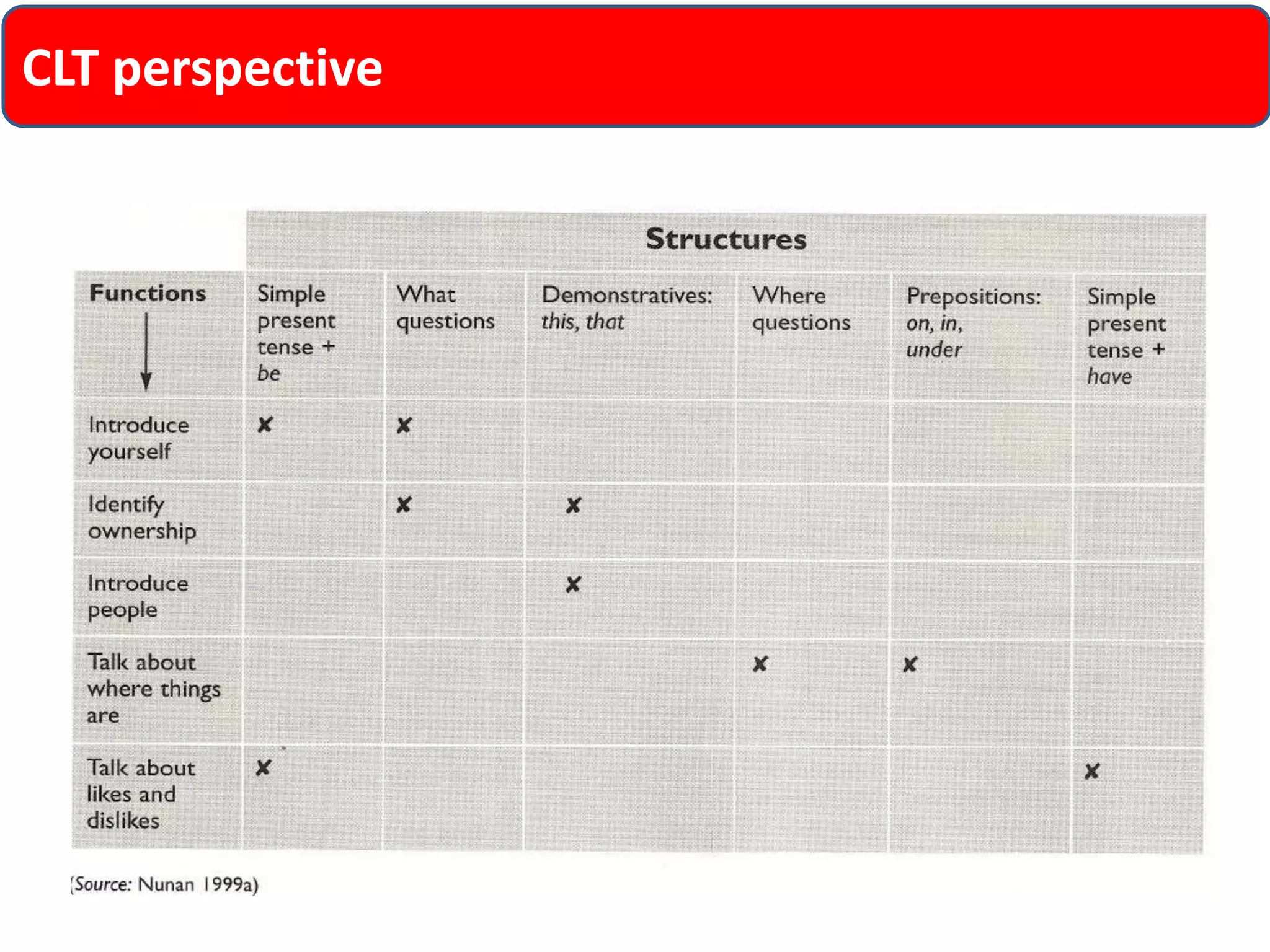
CLT perspective
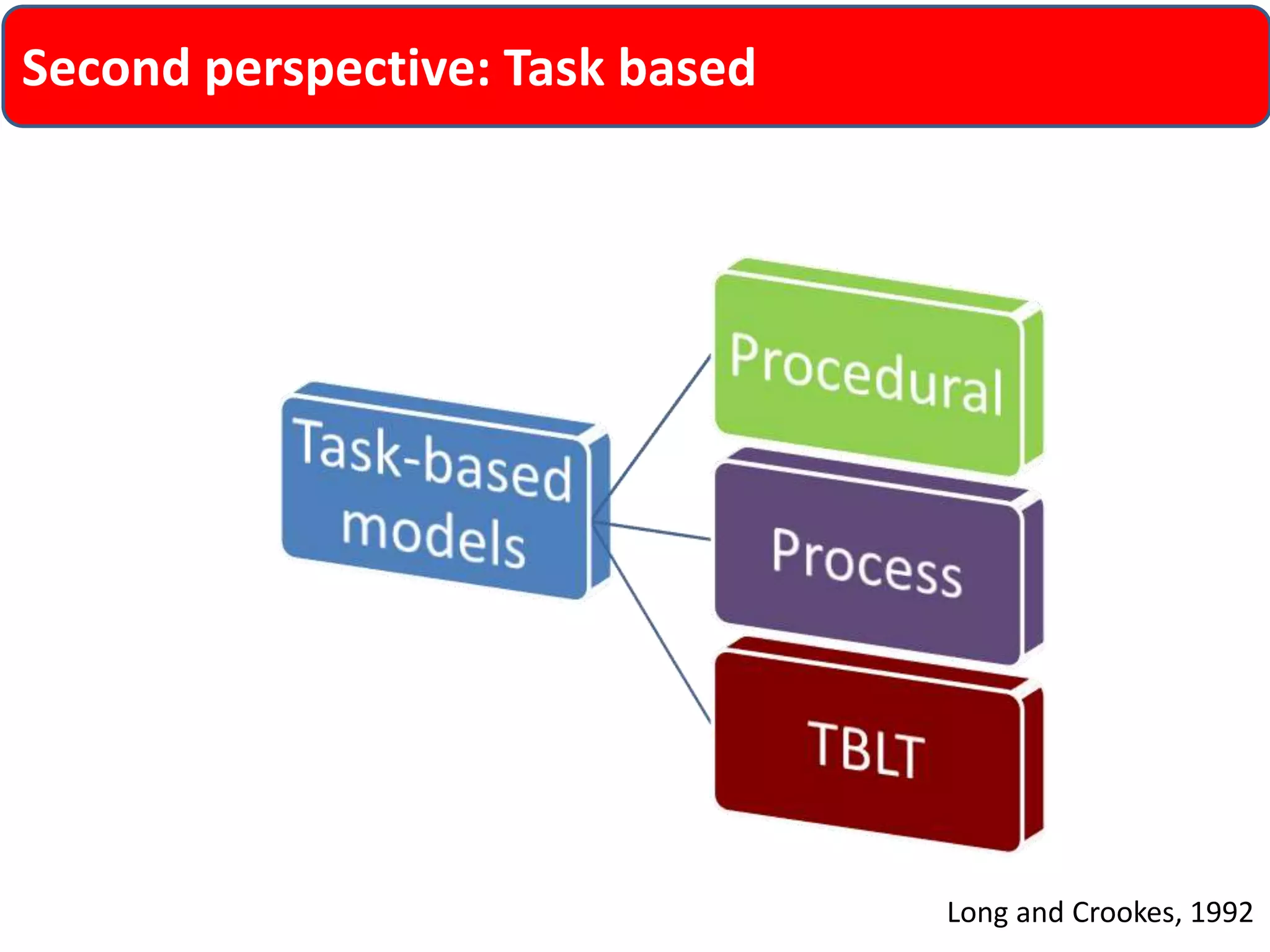
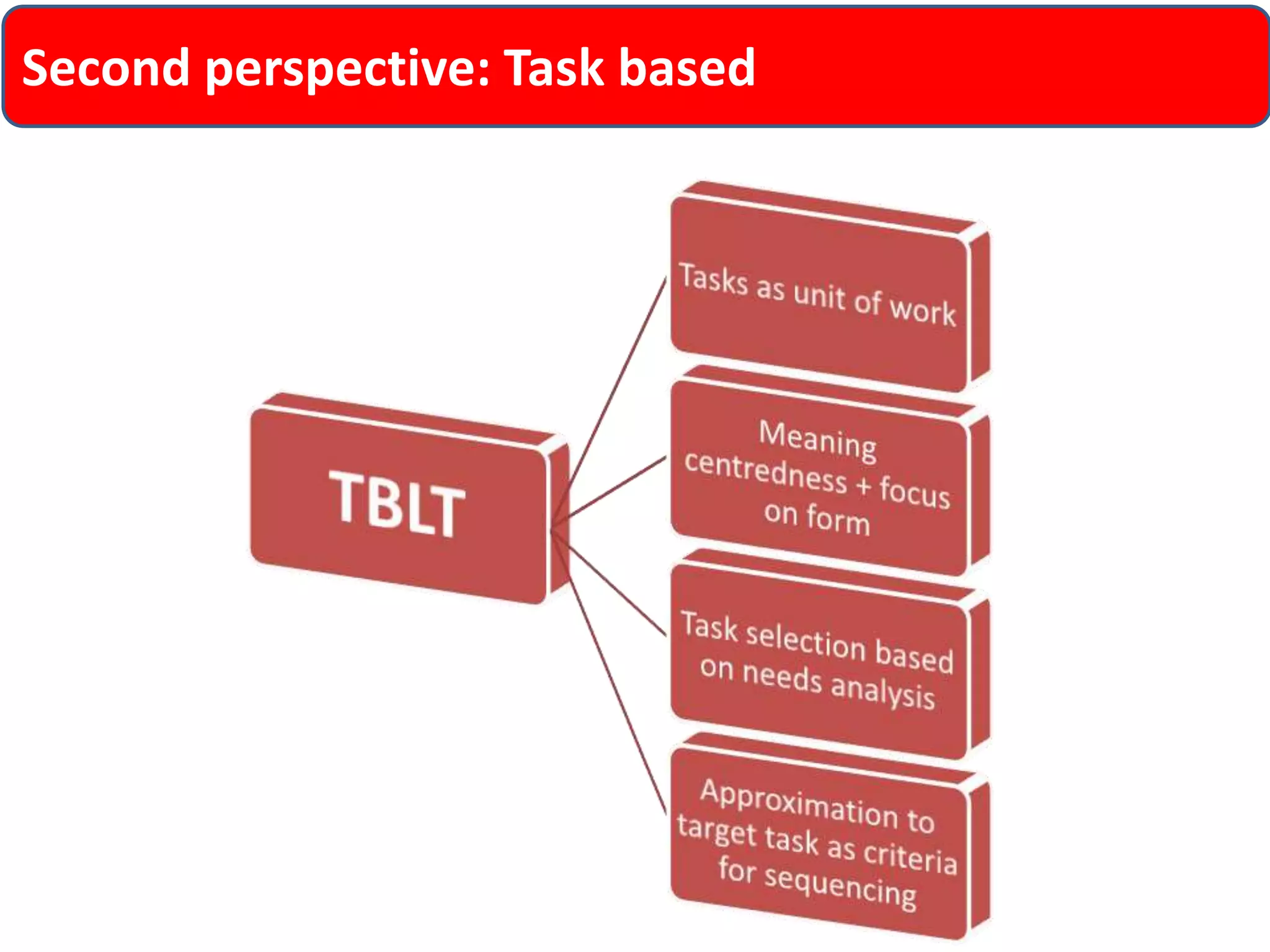
Second perspective: Task based 
Long and Crookes, 1992
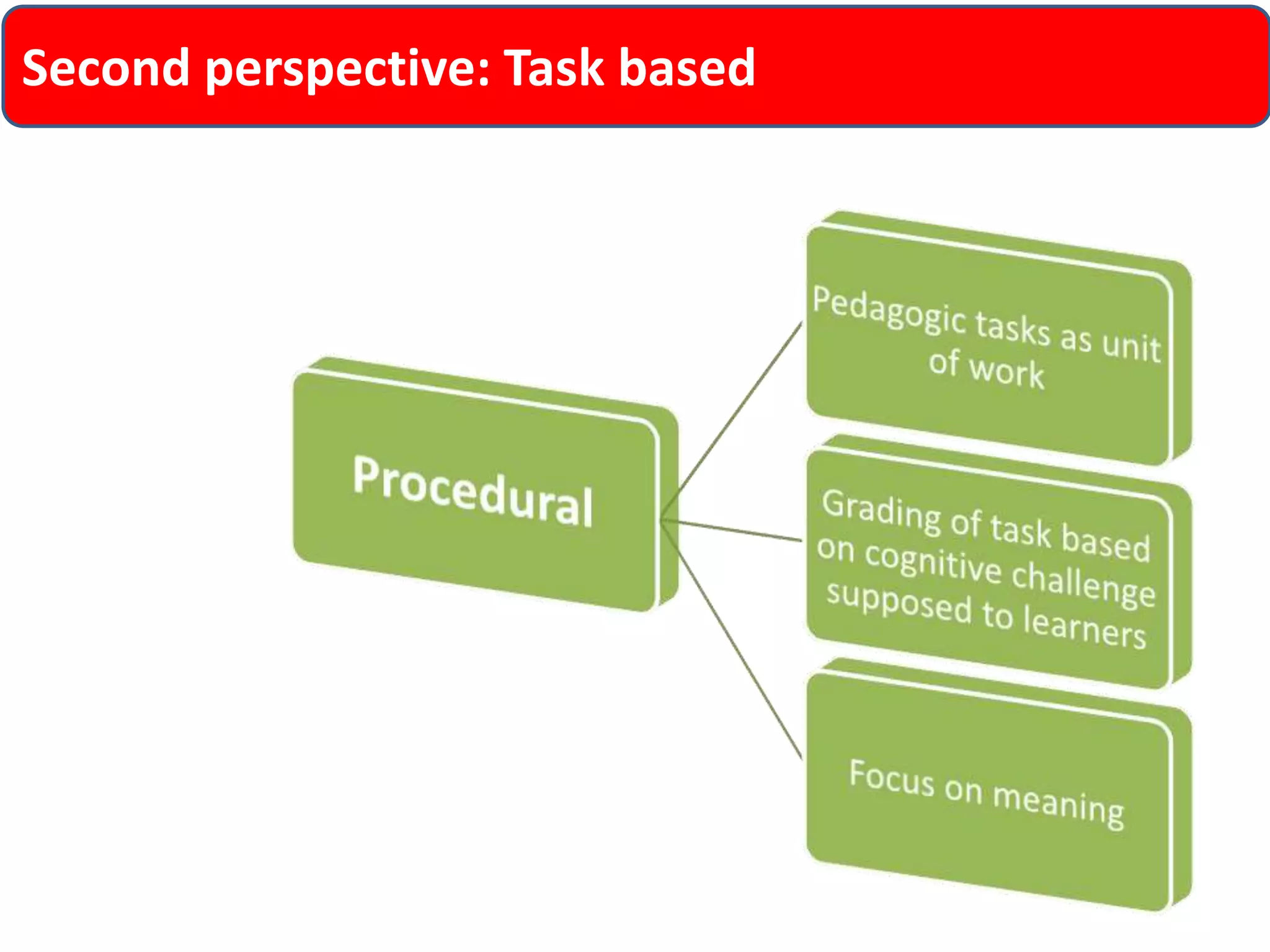
Second perspective: Task based
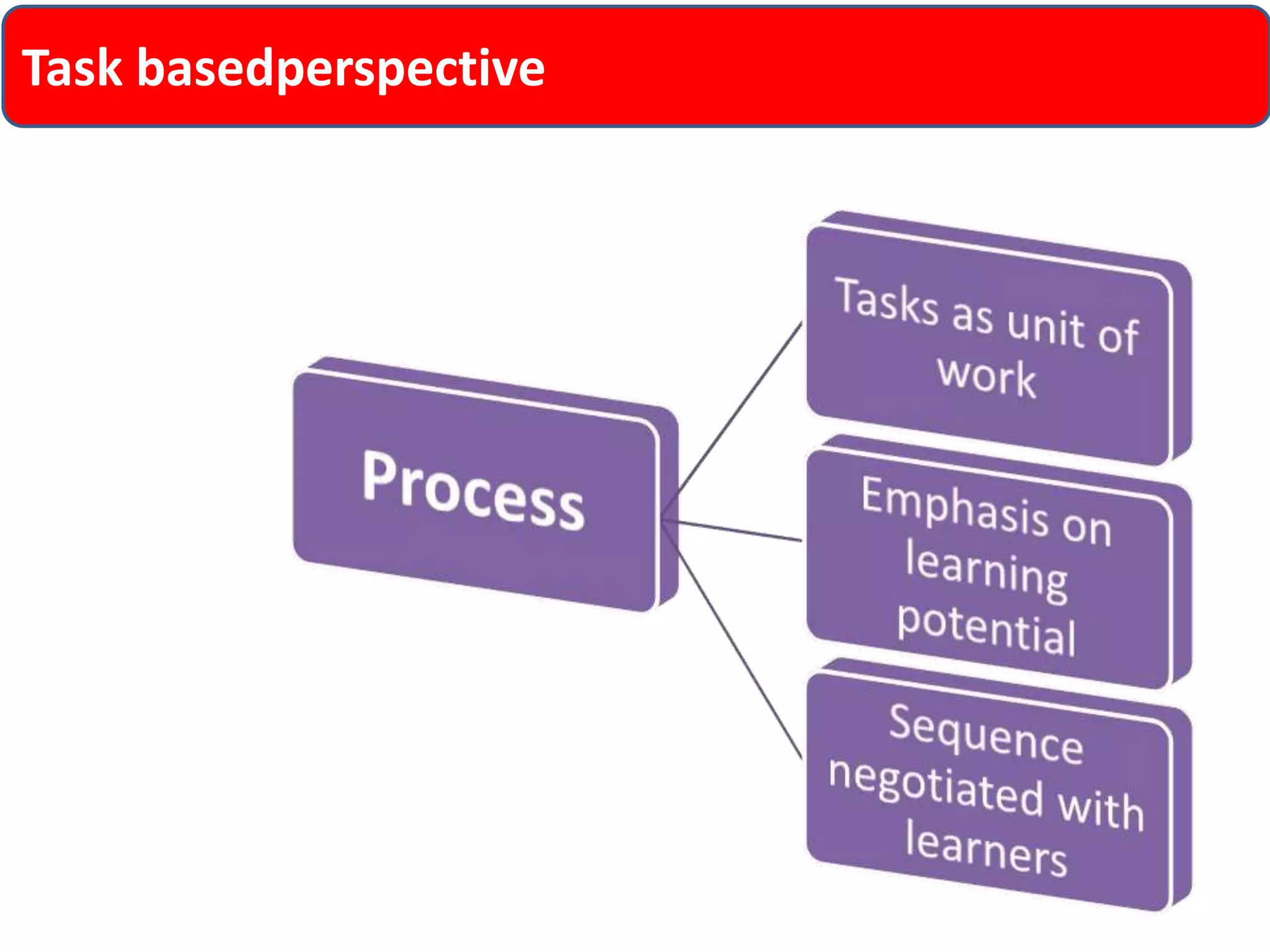
Task basedperspective
Second perspective: Task based
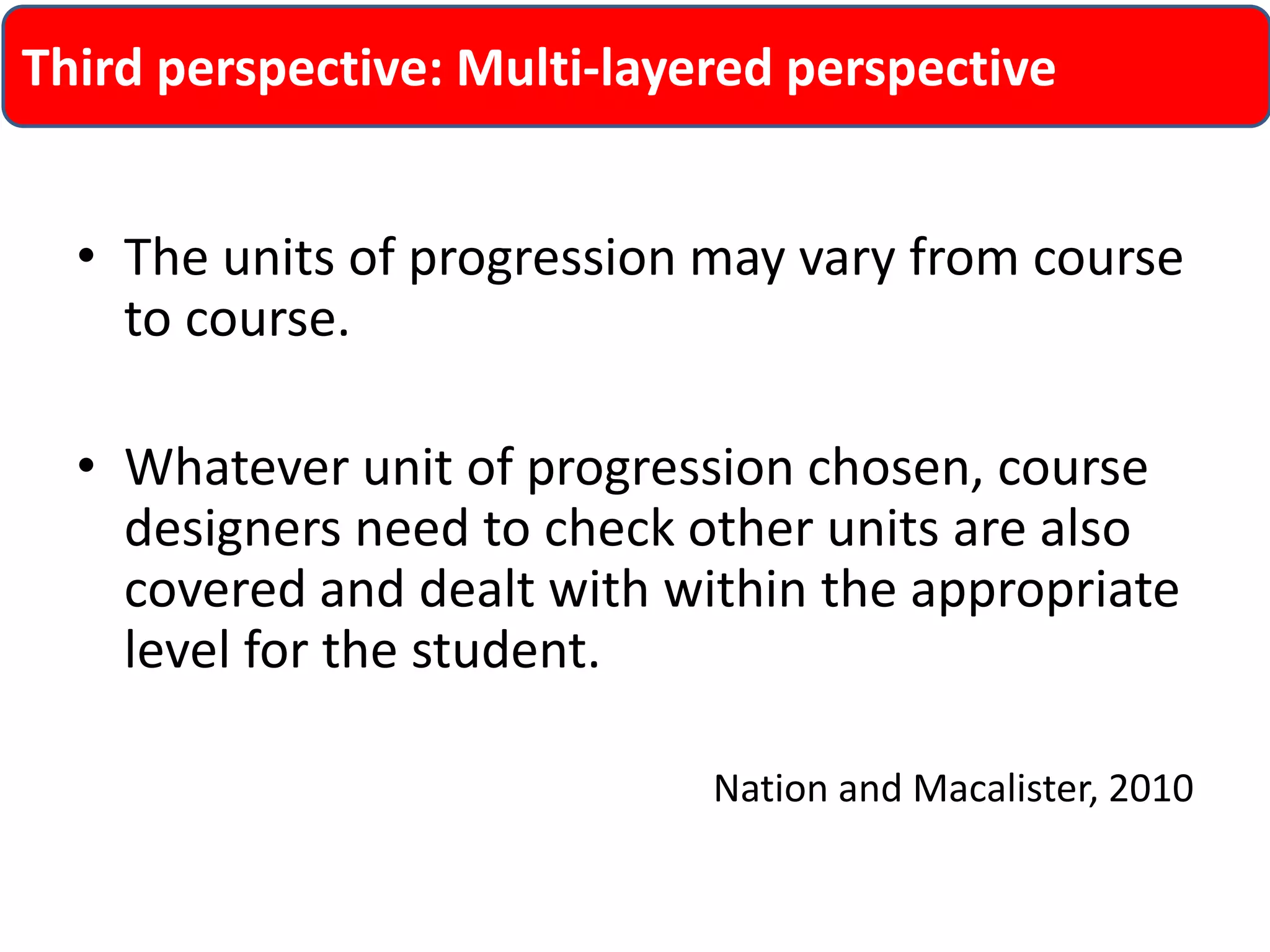
Third perspective: Multi-layered perspective 
• The units of progression may vary from course 
to course. 
• Whatever unit of progression chosen, course 
designers need to check other units are also 
covered and dealt with within the appropriate 
level for the student. 
Nation and Macalister, 2010
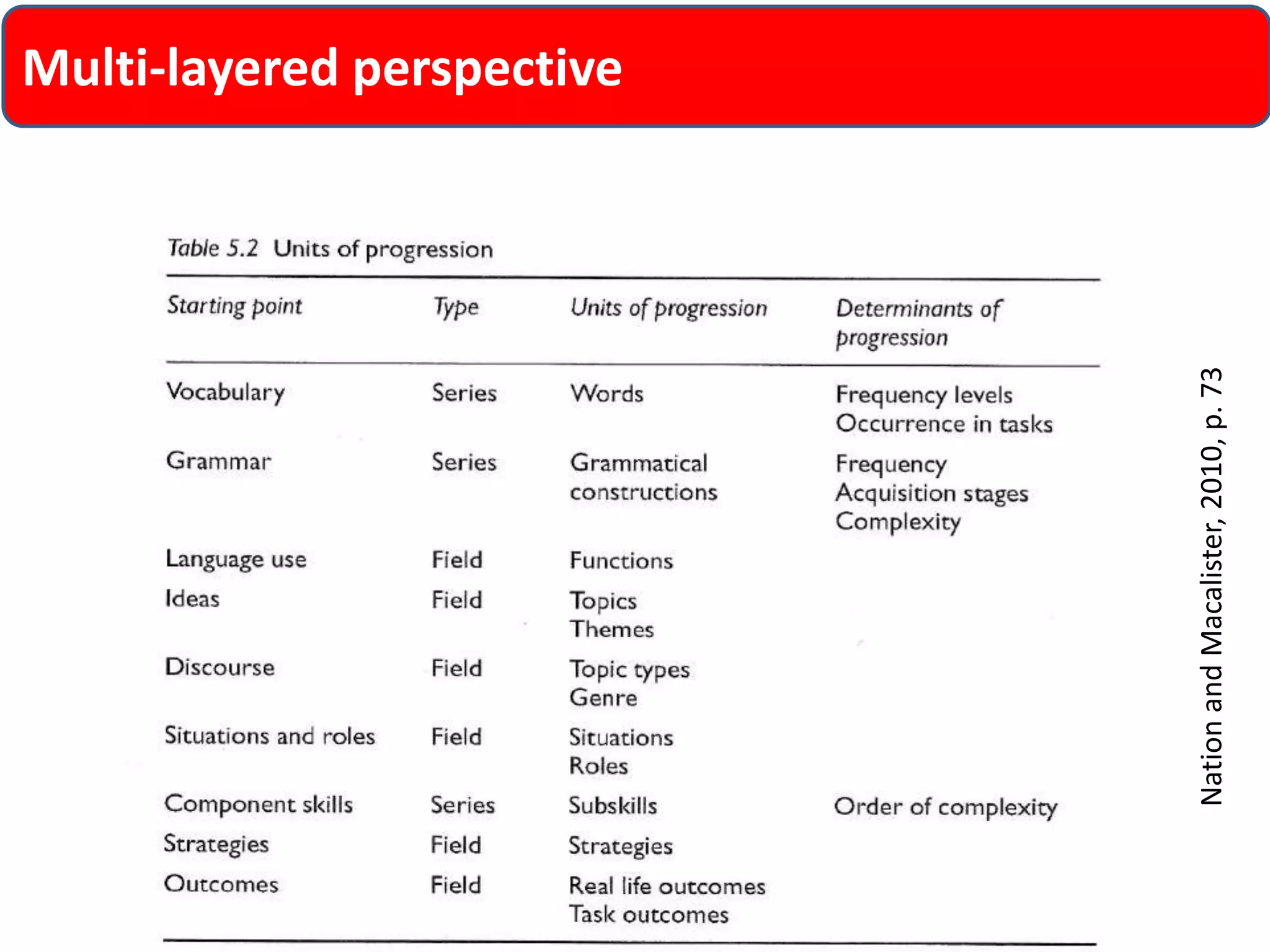
Nation and Macalister, 2010, p. 73 
Multi-layered perspective
Multi-layered perspective: Suggested grading 
criteria 
Language areas Research based suggested criteria 
Vocabulary West’s General Sevice List, 
Coxhead’s Academic list 
Grammar Georges’ Verb form frequency 
counts 
Functions Van Ek notional syllabus 
Council of Europe’s list of functions
Multi-layered perspective: Suggested grading 
criteria 
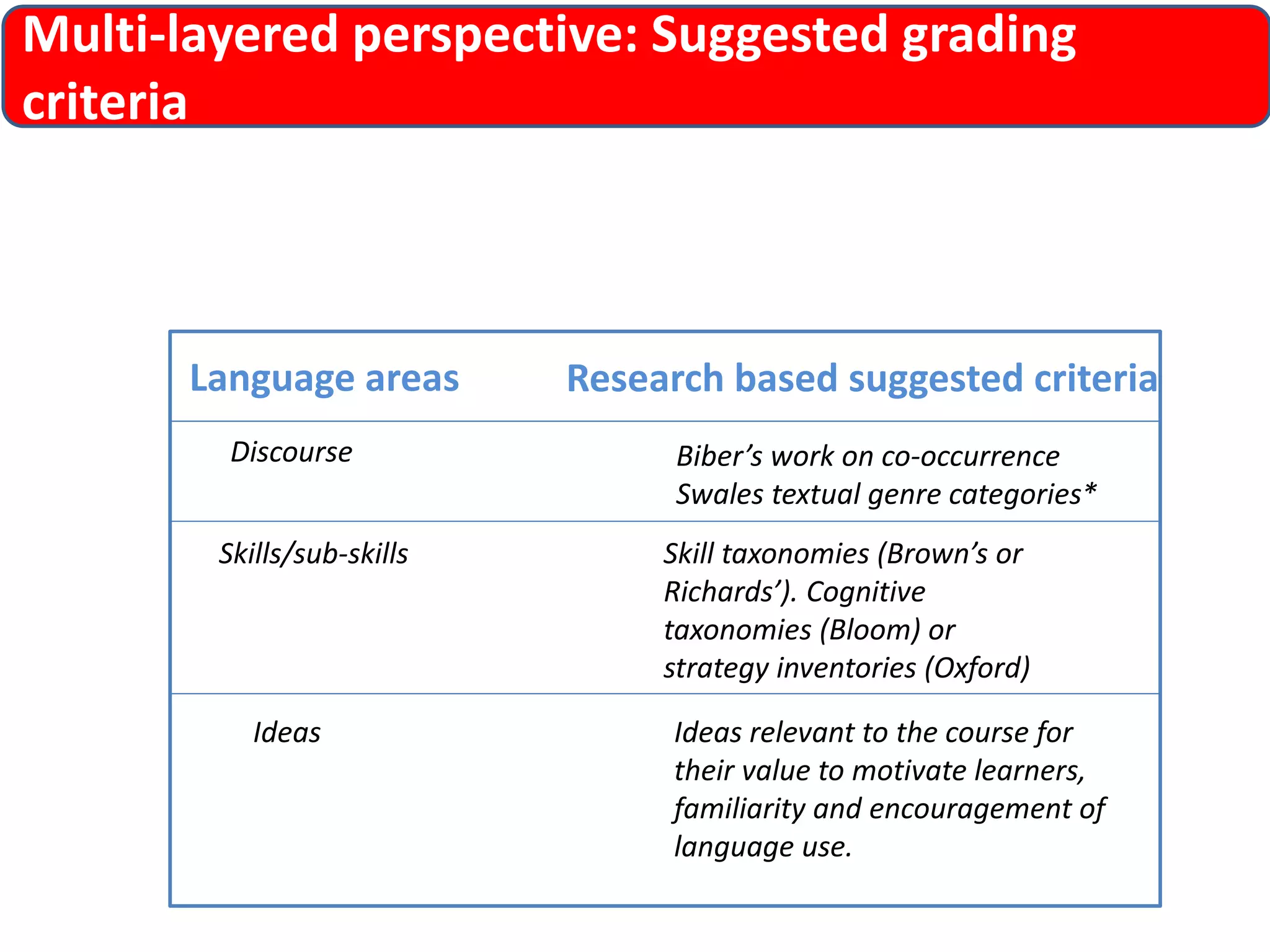
Language areas Research based suggested criteria 
Discourse Biber’s work on co-occurrence 
Swales textual genre categories* 
Skills/sub-skills Skill taxonomies (Brown’s or 
Richards’). Cognitive 
taxonomies (Bloom) or 
strategy inventories (Oxford) 
Ideas Ideas relevant to the course for 
their value to motivate learners, 
familiarity and encouragement of 
language use.
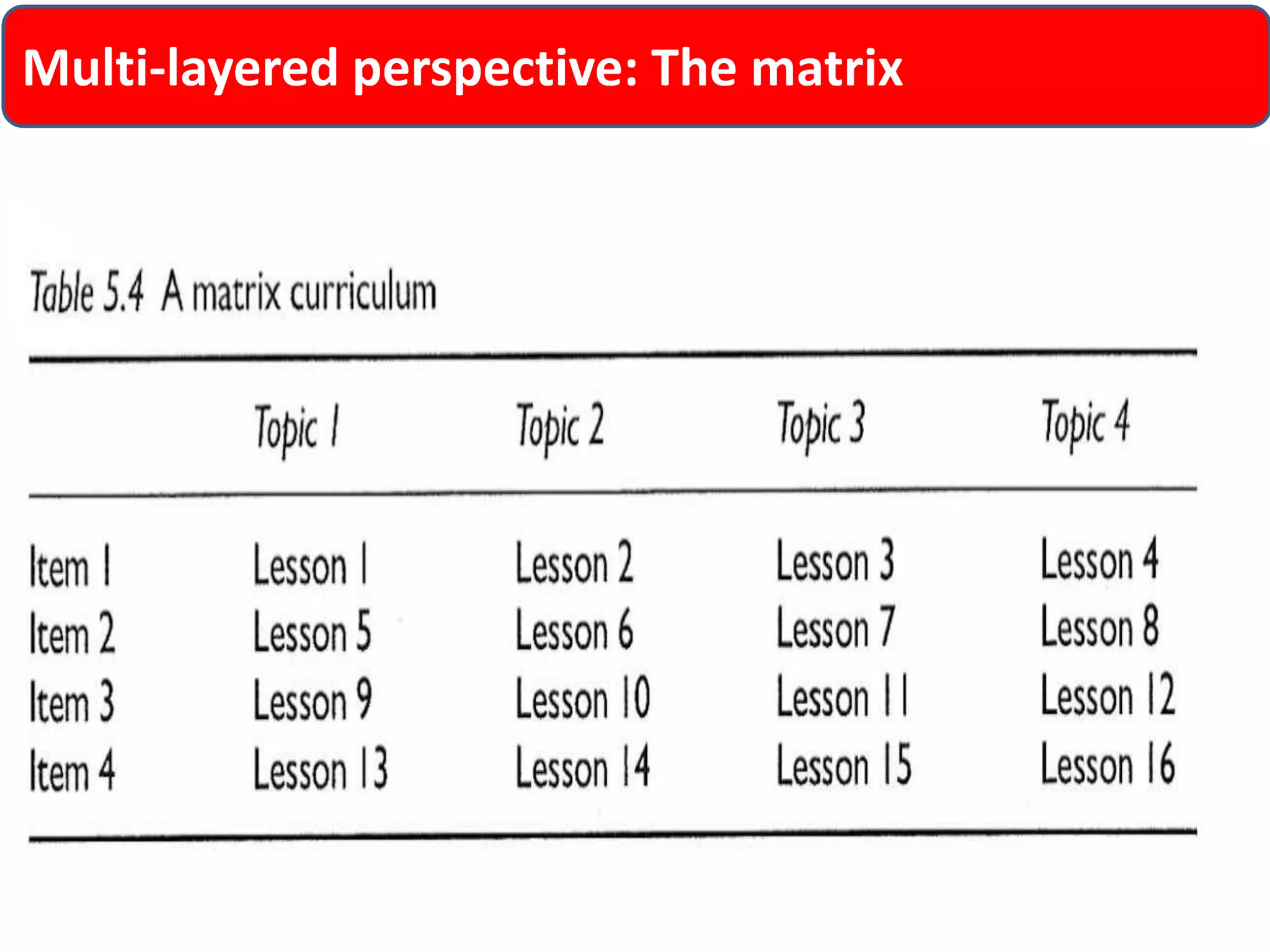
Multi-layered perspective: The matrix
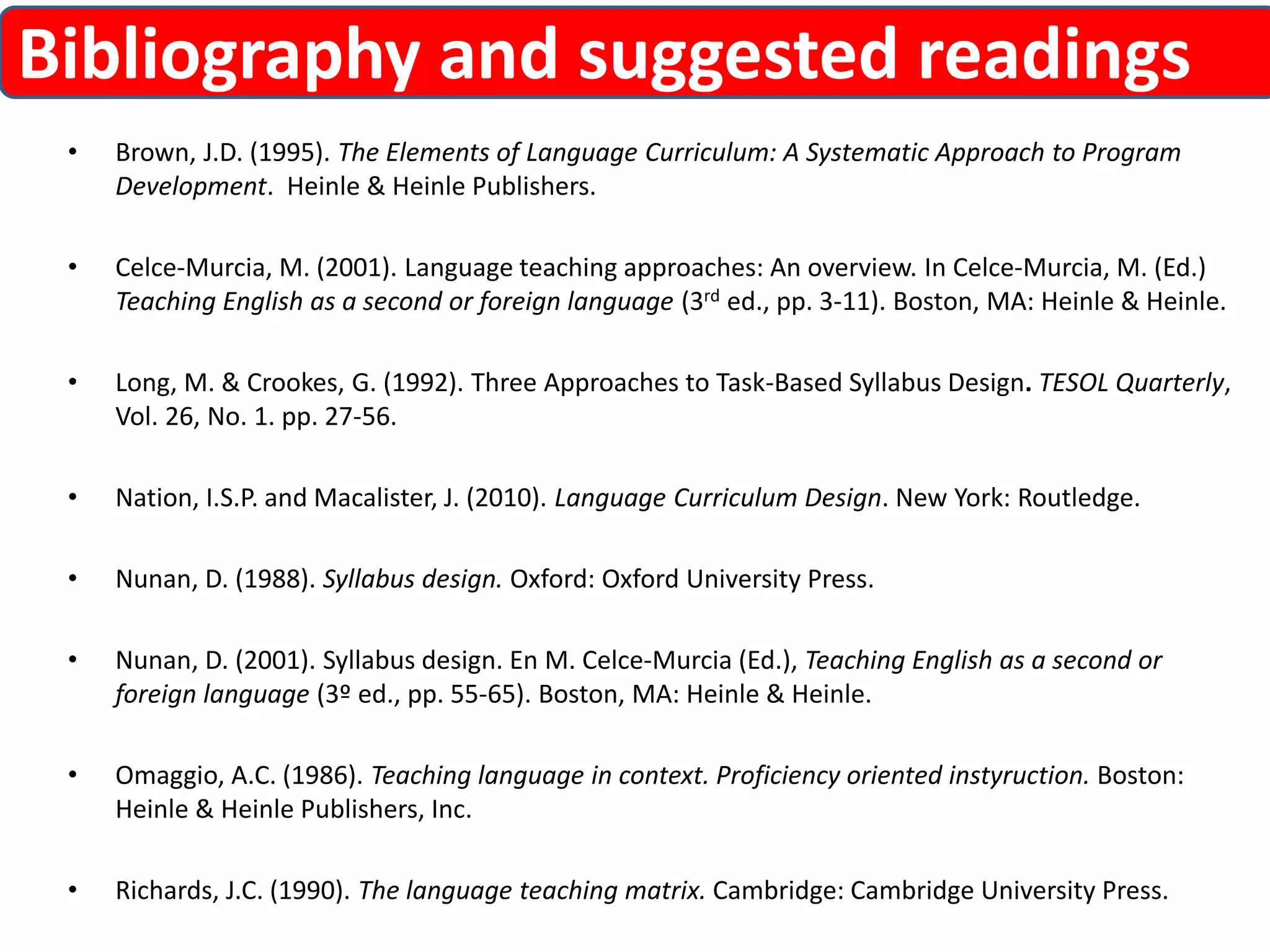
Bibliography and suggested readings 
• Brown, J.D. (1995). The Elements of Language Curriculum: A Systematic Approach to Program 
Development. Heinle & Heinle Publishers. 
• Celce-Murcia, M. (2001). Language teaching approaches: An overview. In Celce-Murcia, M. (Ed.) 
Teaching English as a second or foreign language (3rd ed., pp. 3-11). Boston, MA: Heinle & Heinle. 
• Long, M. & Crookes, G. (1992). Three Approaches to Task-Based Syllabus Design. TESOL Quarterly, 
Vol. 26, No. 1. pp. 27-56. 
• Nation, I.S.P. and Macalister, J. (2010). Language Curriculum Design. New York: Routledge. 
• Nunan, D. (1988). Syllabus design. Oxford: Oxford University Press. 
• Nunan, D. (2001). Syllabus design. En M. Celce-Murcia (Ed.), Teaching English as a second or 
foreign language (3º ed., pp. 55-65). Boston, MA: Heinle & Heinle. 
• Omaggio, A.C. (1986). Teaching language in context. Proficiency oriented instyruction. Boston: 
Heinle & Heinle Publishers, Inc. 
• Richards, J.C. (1990). The language teaching matrix. Cambridge: Cambridge University Press.

Syllabus desing

  • 1.
    Facultad de Humanidades Escuela de Ciencias del Lenguaje Seminario de Lingüística Aplicada Curricular Elements Prof. Carlos Mayora November 2014
  • 2.
    Warm-up Beyond thedesign of methods, the design of instruction is a typical activity of applied linguistics. In this class, we will look at some of the tasks of course design and specially at curricular elements.
  • 3.
    Course design defined Process Designing/creating Instructional system Development of L2 knowledge and skills
  • 4.
    Extending the definition Process Systematic Steps/phases/ stages Goal-oriented Developmental
  • 5.
    Extending the definition Goal(s) Learners Instructional System Instructional materials Procedures Activities Teacher(s) Assessment
  • 6.
    Grammar Vocabulary Pronunciation L2 Knowledge/ skills Speaking Reading Writing Listening General interest Special purpose Extending the definition
  • 7.
    Extending the definition In that definition, we see that the process is a. systematic; b. practical; and c. it tackles a real-world language related problem. We could also add that the foundations of the process are interdisciplinary in nature since it deals with both the nature of language, the nature of learning and it needs to address a number of resources. Thus, it is applied linguistics in action.
  • 8.
    • Curriculum andmaterials design. • Resources available, both material and human. • The linguistic system • Mental processes involved in learning Psychology Linguistics L2 curriculum design Management Education Interdisciplinarity
  • 9.
    Central elements ApproachSyllabus Techniques Exercises Brown’s categories (1995)
  • 10.
    Central elements Theory/beliefsabout language Theory/beliefs about learning Instructional material Approach Syllabus Techniques Exercises Selection and grading of content Teaching Assessment
  • 11.
    Curriculum CURRICULA areconcerned with making general statements about language learning, learning purpose and experience, evaluation and the relationships between teachers and learners… [ they also include] banks of learning items and suggestions about how these might be used in class Nunan, 1988, p. 3 CURRICULUMis a very general concept which involves considerations of the whole complex of philosophical, social and administrative factors which contribute to the planning of an educational programme. Allen, 1984, p. 6
  • 12.
    Syllabus provides directionand guidance in the scope, sequence and pacing of classroom activities. Omaggio, 1986, p. 410 Syllabus Syllabus is …an inventory of objectives the learner should master… in a recommended sequence. Celce-Murcia, 2001, p. 9
  • 13.
    Stages in educationalplanning National ministeries/offices Regional administrative unit The department The classroom Curriculum Syllabus Lesson The Institution
  • 14.
  • 15.
    Types of Syllabi A type or kind of syllabus is defined by… • its focus (grammar, meaning, lexis, etc.); • its units of progression; and • its grading criteria,
  • 16.
    Grammar, formal languagestructures Communication Specific language skills (i.e. listening) Difficulty or complexity (intuition) Discrete structural items (i.e. rules, tenses, sounds) Situations (i.e. at the airport) Notions (i.e. time, quantity) Usefulness for student or chronology. Usefulness (based on intuitions) Topics or themes (i.e. The government) Usefulness or chronology. Interest Social functions of language (apologizing) Frequency, usefulness or chronology Hierarchy (sub skill A is necessary for sub-skill B) Sub-skills or micro skills (i.e. listening for the gist) Usefulness or frequency or hierarchy. Tasks, either pedagogical or metacommunicative. Tasks or cognitive processes Learners’ interests or needs (negotiation) Types of Syllabi
  • 17.
    Three perspectives onselecting and grading content 1. Identify the general contexts and situations in which the learners will communicate. 2. Specify the communicative events the learners will engage in. 3. Make a list of the functional goals that the learner will need in order to take part in the communicative events. 4. List the key linguistic elements needed to achieve functional goals. 5. Sequence and integrate 3 and 4. Nunan, 2001, p. 63
  • 18.
    1. contexts andsituations 2. communicative events 3. functional goals 4. linguistic elements 5 First perspective: CLT
  • 19.
  • 20.
    Second perspective: Taskbased Long and Crookes, 1992
  • 21.
  • 22.
  • 23.
  • 24.
    Third perspective: Multi-layeredperspective • The units of progression may vary from course to course. • Whatever unit of progression chosen, course designers need to check other units are also covered and dealt with within the appropriate level for the student. Nation and Macalister, 2010
  • 25.
    Nation and Macalister,2010, p. 73 Multi-layered perspective
  • 26.
    Multi-layered perspective: Suggestedgrading criteria Language areas Research based suggested criteria Vocabulary West’s General Sevice List, Coxhead’s Academic list Grammar Georges’ Verb form frequency counts Functions Van Ek notional syllabus Council of Europe’s list of functions
  • 27.
    Multi-layered perspective: Suggestedgrading criteria Language areas Research based suggested criteria Discourse Biber’s work on co-occurrence Swales textual genre categories* Skills/sub-skills Skill taxonomies (Brown’s or Richards’). Cognitive taxonomies (Bloom) or strategy inventories (Oxford) Ideas Ideas relevant to the course for their value to motivate learners, familiarity and encouragement of language use.
  • 28.
  • 29.
    Bibliography and suggestedreadings • Brown, J.D. (1995). The Elements of Language Curriculum: A Systematic Approach to Program Development. Heinle & Heinle Publishers. • Celce-Murcia, M. (2001). Language teaching approaches: An overview. In Celce-Murcia, M. (Ed.) Teaching English as a second or foreign language (3rd ed., pp. 3-11). Boston, MA: Heinle & Heinle. • Long, M. & Crookes, G. (1992). Three Approaches to Task-Based Syllabus Design. TESOL Quarterly, Vol. 26, No. 1. pp. 27-56. • Nation, I.S.P. and Macalister, J. (2010). Language Curriculum Design. New York: Routledge. • Nunan, D. (1988). Syllabus design. Oxford: Oxford University Press. • Nunan, D. (2001). Syllabus design. En M. Celce-Murcia (Ed.), Teaching English as a second or foreign language (3º ed., pp. 55-65). Boston, MA: Heinle & Heinle. • Omaggio, A.C. (1986). Teaching language in context. Proficiency oriented instyruction. Boston: Heinle & Heinle Publishers, Inc. • Richards, J.C. (1990). The language teaching matrix. Cambridge: Cambridge University Press.