S
Sociocultural
Perspectives on SLA
Fariba Chamani, 2015
Content
S Introduction
S Sociocultural theory (SCT)
S Key constructs in SCT
S SCT view of language
S SCT view of language learning
S Methodology of SCT research
S SLA studies based on SCT
S Key issues in SLA: an SCT perspective
Introduction
S Sociocultural SLA draws on the work of Vygotsky (1987),
Leont’ev(1978) and Wertsch (1985).
S Relevance of SCT to SLA has been advocated by Lantolf
and his associates.
S Lantolf and Thorne (2006) have provided the most
substantial theoretical overview of applications of SCT
concepts to SLA.
Sociocultural theory (SCT)
SCT is a constructivist theory that stresses the
interaction of interpersonal (social), cultural–historical,
and individual factors as the key to human
development (Tudge &Scrimsher, 2003). Interactions
with persons in the environment stimulate
developmental processes and foster cognitive growth.
Key points in SCT (Meece, 2002)
S Social interactions are critical; knowledge is constructed
between two or more people.
S Self-regulation is developed through internalization (developing
an internal representation) of actions and mental operations
that occur in social interactions.
S Human development occurs through the cultural transmission
of tools (language, symbols).
S Language is the most critical tool that develops from social
speech, to private speech, to covert (inner) speech.
Key constructs in sociocultural SLA
S Mediated learning
S ZPD
S Internalization
S Activity theory
Mediated learning
S Mediation = The process through which humans deploy
culturally constructed artefacts, concepts, and activities to
regulate (i.e. gain control over and and transform) the
material world or their own and each other’s social and
mental activity (Lantolf & Thorne, 2006).
S SCT emphasizes the centrality of language as an artefact
for mediating thought. L2 also serves as both the object
of attention and also as a tool for mediating its
acquisition.
Different types of artifacts
S Concrete: Physical (Example: dictionary or hammer)
S Symbolic: Signs (Example: language)
S Internal: planned to be used
S External: employed without forethought
Mediation through social interaction
S In SCT, language learning is dialogic, acquisition occurs in
rather than as a result of interaction.
S Scaffolding = The dialogic process by which one speaker
assists another in performing a function that he or she cannot
perform alone.
S Collaborative dialogue= dialogue in which speakers are
engaged in problem solving and knowledge building.
S Instructional conversation= pedagogic interaction that is
teacher -led and curricular-goal oriented but is conversational.
Mediation by means of private speech
S Private speech (audible speech not adopted to an
addressee) is used for the purpose of self-mediating or
language learning/practicing.
S Private speech may be in the forms of imitation,
vicarious response, and mental rehearsal.
S Private talk is intended for speaker not the listener so it is
not constrained by the same norms that affect social
speech.
S Research shows that private speech is able to mediate or
assist language learning.
ZPD ( Zone of Proximal Development)
S Classic Vygotskian perspective: views ZPD as the
difference between the learner’s actual developmental
level and the higher level of potential development
(Krashen’s i+I).
S Neo-Vygotskian perspective: does not view ZPD as an
attribute of the learner with relatively fixed dimensions but
rather as task –specific, reciprocal and open-ended, and
thus emergent.
S ZPD is not a place at all; it is an activity.
ZPD explains the following questions about learning:
S Why there are some structures that learners fail to perform no matter
if external mediation is provided (unable to construct ZPD)?
S Why learners are able to perform some structures with others’ help?
S How learners internalize new structures (via appropriating the
structure for which they construct the ZPD with the help of external
mediation)?
ZPD & language learning
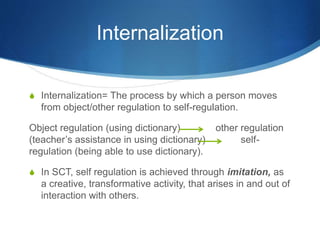
Internalization
S Internalization= The process by which a person moves
from object/other regulation to self-regulation.
Object regulation (using dictionary) other regulation
(teacher’s assistance in using dictionary) self-
regulation (being able to use dictionary).
S In SCT, self regulation is achieved through imitation, as
a creative, transformative activity, that arises in and out of
interaction with others.
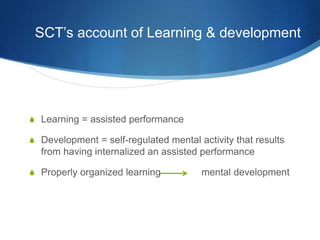
SCT’s account of Learning & development
S Learning = assisted performance
S Development = self-regulated mental activity that results
from having internalized an assisted performance
S Properly organized learning mental development
Activity Theory
S Activity theory, developed by Leont’ev (1981), suggests
that human development and behavior result from
engagement in activities which are considered to be the
result of the integration of biological and sociocultural
motives.
S Motives stem from an activity system (subjects, objects of
learning, and artifacts) which is influenced by many other
activity systems in the wider sociocultural context.
SCT view of language
S Vygotsky views language as a cultural tool for mediating
higher levels of thinking (voluntary attention, intentional
memory, logical thought, planning and problem solving),
which has been developed and refined in the service of
social action and interaction.
S SCT focuses on semantic properties of language rather
than its formal properties. It claims that a given form does
not have a stable meaning but multiple personal
meanings that are constructed through interaction in
accordance with the social events they occur.
Mr. Smith pushing a machine across his
lawn
S In reply to a friend’s enquiry regarding what her lazy husband is doing:
Mrs. Smith may respond:
“Mr. Smith is working, he’s mowing the lawn.”
S In reply to Mr. Smith’s friend as to whether Mr. Smith is working that
day
Mrs. Smith may respond:
“Mr. Smith is not working, he’s mowing the
lawn.”
SCT view of language learning
S In SCT, learning is viewed as a socially mediated process taking
place as a result of interaction between the learner and the
sociocultural environment.
S In SCT, language learning involves how to use language to
mediate language learning. This is primarily achieved by means of
verbal interaction which can be monologic or dialogic (Swain,
2000).
S According to SCT, learners are thought to be active meaning-
makers and problem-solvers in their learning process.
Methodology of sociocultural research
Genetic Method
S This method was first used by Vygotsky then by other
sociocultural researchers.
S It examines language in the context rather than in
isolation.
S It focuses on the process of language learning rather its
products.
Different types of genetic method
1. Phylogenesis: Evolution of human species
2. Sociocultural history: Evolution of a particular culture
3. Ontogenesis: Development of an individual over the
course of his/her life (Vygotsky’s & sociocultural SLA)
4. Microgenesis: Development over the course of a
particular interaction in a specific sociocultural setting
(Sociocultural SLA)
Microgenetic method
S Microgenetic method seeks to uncover the stages through
which a learner passes to achieve self regulation (the ability to
control the use of a particular L2 feature).
S Identifying microgenetic growth involves looking for the
evidence of a shift from other-regulated behavior on the part of
the learner to self-regulated behavior.
Key characteristics of Microgenetic
method
S Individuals are observed through a period of change.
S Observations are conducted before, during and after the
period of change.
S Observations during the period of transition are
conducted regularly.
S Observed behaviors are analyzed intensively in order to
identify the processes arise in the developmental change.
SLA studies based on SCT
S Corrective feedback
S Collaborative dialoguing
S Private speech
S Metatalk
S Task versus activity
Key issues in SLA: an SCT
perspective
S Errors
S Acquisitional orders and sequences
S L1 transfer
S Implicit and explicit L2 knowledge
S Motivation
Errors
S Error in mainstream SLA: are indicators of interlanguage
development and also of mental processes involved.
S Errors in SCT: may reflect the forms of private speech
which are different from those of social speech, or they
may reflect the learner’s struggle to self-regulate when
performing a demanding task. So the errors may not
reflect the lack of knowledge but rather the nature of the
specific activity they are engaging with.
Acquisitional orders and sequences
S According to Krashen, we acquire language, as a formal
system of rules, in a predictable or natural order, and
acquisition goes on exclusively inside the learner’s head,
driven by LAD, triggered by exposure to input, however:
S According to Vygotsky, learning originates in social interaction,
and development is revolutionary and thus unpredictable.
language is also not viewed as a formal system with a priori
grammar but as an emergent system comprised of fragments
that emerge and are shaped in interaction, thus:
S SCT challenges the universality of the order and sequence of
acquisition, as individuals’ experiences will vary.
L1 transfer
S Mainstream SLA: approaches L1 in terms of how the L1
influences interlanguage development.
S SCT: is more concerned with whether learners are able
to make use of the L2 to mediate thinking, and focuses
more on the meaning rather than the form.
Implicit and explicit L2 knowledge
S From an SCT perspective explicit L2 knowledge is
viewed as central.
S L2 learning, at least by adults, involves gradual
internalization of explicit grammatical concepts that
subsequently become automatized.
S Yet, It is not clear whether young children’s L2
development follows a similar pattern.
Motivation
S SCT does not treat motivation as a stable force that
can predict achievement because the learner’s goals are
formed and reformed under specific circumstances.
S SCT views motivation as a socially constructed and
reconstructed tool that mediates learning. Thus it is
both the product of learning and a powerful support for
learning.
References
S Brown, H. D. (2014). Principles of language learning and teaching. New
York: Pearson Education, Inc.
S Fahim, M., & Haghani, M. (2012). Sociocultural perspectives on
foreign language learning. Journal of Language Teaching and
Research, 3(4). 693-699.
S Ellis, R. (2008). The study of second language acquisition. Oxford:
Oxford University Press.
S Mitchell, R., Myles, F., Marsden, E. (2013). Second language learning
theories. London: Routledge.
S Ortega, L. (2009). Understanding second language acquisition. London:
Hodder Education.
Sociocultural perspectives on SLA

Sociocultural perspectives on SLA

  • 1.
  • 2.
    Content S Introduction S Socioculturaltheory (SCT) S Key constructs in SCT S SCT view of language S SCT view of language learning S Methodology of SCT research S SLA studies based on SCT S Key issues in SLA: an SCT perspective
  • 3.
    Introduction S Sociocultural SLAdraws on the work of Vygotsky (1987), Leont’ev(1978) and Wertsch (1985). S Relevance of SCT to SLA has been advocated by Lantolf and his associates. S Lantolf and Thorne (2006) have provided the most substantial theoretical overview of applications of SCT concepts to SLA.
  • 4.
    Sociocultural theory (SCT) SCTis a constructivist theory that stresses the interaction of interpersonal (social), cultural–historical, and individual factors as the key to human development (Tudge &Scrimsher, 2003). Interactions with persons in the environment stimulate developmental processes and foster cognitive growth.
  • 5.
    Key points inSCT (Meece, 2002) S Social interactions are critical; knowledge is constructed between two or more people. S Self-regulation is developed through internalization (developing an internal representation) of actions and mental operations that occur in social interactions. S Human development occurs through the cultural transmission of tools (language, symbols). S Language is the most critical tool that develops from social speech, to private speech, to covert (inner) speech.
  • 6.
    Key constructs insociocultural SLA S Mediated learning S ZPD S Internalization S Activity theory
  • 7.
    Mediated learning S Mediation= The process through which humans deploy culturally constructed artefacts, concepts, and activities to regulate (i.e. gain control over and and transform) the material world or their own and each other’s social and mental activity (Lantolf & Thorne, 2006). S SCT emphasizes the centrality of language as an artefact for mediating thought. L2 also serves as both the object of attention and also as a tool for mediating its acquisition.
  • 8.
    Different types ofartifacts S Concrete: Physical (Example: dictionary or hammer) S Symbolic: Signs (Example: language) S Internal: planned to be used S External: employed without forethought
  • 9.
    Mediation through socialinteraction S In SCT, language learning is dialogic, acquisition occurs in rather than as a result of interaction. S Scaffolding = The dialogic process by which one speaker assists another in performing a function that he or she cannot perform alone. S Collaborative dialogue= dialogue in which speakers are engaged in problem solving and knowledge building. S Instructional conversation= pedagogic interaction that is teacher -led and curricular-goal oriented but is conversational.
  • 10.
    Mediation by meansof private speech S Private speech (audible speech not adopted to an addressee) is used for the purpose of self-mediating or language learning/practicing. S Private speech may be in the forms of imitation, vicarious response, and mental rehearsal. S Private talk is intended for speaker not the listener so it is not constrained by the same norms that affect social speech. S Research shows that private speech is able to mediate or assist language learning.
  • 11.
    ZPD ( Zoneof Proximal Development) S Classic Vygotskian perspective: views ZPD as the difference between the learner’s actual developmental level and the higher level of potential development (Krashen’s i+I). S Neo-Vygotskian perspective: does not view ZPD as an attribute of the learner with relatively fixed dimensions but rather as task –specific, reciprocal and open-ended, and thus emergent. S ZPD is not a place at all; it is an activity.
  • 12.
    ZPD explains thefollowing questions about learning: S Why there are some structures that learners fail to perform no matter if external mediation is provided (unable to construct ZPD)? S Why learners are able to perform some structures with others’ help? S How learners internalize new structures (via appropriating the structure for which they construct the ZPD with the help of external mediation)? ZPD & language learning
  • 13.
    Internalization S Internalization= Theprocess by which a person moves from object/other regulation to self-regulation. Object regulation (using dictionary) other regulation (teacher’s assistance in using dictionary) self- regulation (being able to use dictionary). S In SCT, self regulation is achieved through imitation, as a creative, transformative activity, that arises in and out of interaction with others.
  • 14.
    SCT’s account ofLearning & development S Learning = assisted performance S Development = self-regulated mental activity that results from having internalized an assisted performance S Properly organized learning mental development
  • 15.
    Activity Theory S Activitytheory, developed by Leont’ev (1981), suggests that human development and behavior result from engagement in activities which are considered to be the result of the integration of biological and sociocultural motives. S Motives stem from an activity system (subjects, objects of learning, and artifacts) which is influenced by many other activity systems in the wider sociocultural context.
  • 16.
    SCT view oflanguage S Vygotsky views language as a cultural tool for mediating higher levels of thinking (voluntary attention, intentional memory, logical thought, planning and problem solving), which has been developed and refined in the service of social action and interaction. S SCT focuses on semantic properties of language rather than its formal properties. It claims that a given form does not have a stable meaning but multiple personal meanings that are constructed through interaction in accordance with the social events they occur.
  • 17.
    Mr. Smith pushinga machine across his lawn S In reply to a friend’s enquiry regarding what her lazy husband is doing: Mrs. Smith may respond: “Mr. Smith is working, he’s mowing the lawn.” S In reply to Mr. Smith’s friend as to whether Mr. Smith is working that day Mrs. Smith may respond: “Mr. Smith is not working, he’s mowing the lawn.”
  • 18.
    SCT view oflanguage learning S In SCT, learning is viewed as a socially mediated process taking place as a result of interaction between the learner and the sociocultural environment. S In SCT, language learning involves how to use language to mediate language learning. This is primarily achieved by means of verbal interaction which can be monologic or dialogic (Swain, 2000). S According to SCT, learners are thought to be active meaning- makers and problem-solvers in their learning process.
  • 19.
    Methodology of socioculturalresearch Genetic Method S This method was first used by Vygotsky then by other sociocultural researchers. S It examines language in the context rather than in isolation. S It focuses on the process of language learning rather its products.
  • 20.
    Different types ofgenetic method 1. Phylogenesis: Evolution of human species 2. Sociocultural history: Evolution of a particular culture 3. Ontogenesis: Development of an individual over the course of his/her life (Vygotsky’s & sociocultural SLA) 4. Microgenesis: Development over the course of a particular interaction in a specific sociocultural setting (Sociocultural SLA)
  • 21.
    Microgenetic method S Microgeneticmethod seeks to uncover the stages through which a learner passes to achieve self regulation (the ability to control the use of a particular L2 feature). S Identifying microgenetic growth involves looking for the evidence of a shift from other-regulated behavior on the part of the learner to self-regulated behavior.
  • 22.
    Key characteristics ofMicrogenetic method S Individuals are observed through a period of change. S Observations are conducted before, during and after the period of change. S Observations during the period of transition are conducted regularly. S Observed behaviors are analyzed intensively in order to identify the processes arise in the developmental change.
  • 23.
    SLA studies basedon SCT S Corrective feedback S Collaborative dialoguing S Private speech S Metatalk S Task versus activity
  • 24.
    Key issues inSLA: an SCT perspective S Errors S Acquisitional orders and sequences S L1 transfer S Implicit and explicit L2 knowledge S Motivation
  • 25.
    Errors S Error inmainstream SLA: are indicators of interlanguage development and also of mental processes involved. S Errors in SCT: may reflect the forms of private speech which are different from those of social speech, or they may reflect the learner’s struggle to self-regulate when performing a demanding task. So the errors may not reflect the lack of knowledge but rather the nature of the specific activity they are engaging with.
  • 26.
    Acquisitional orders andsequences S According to Krashen, we acquire language, as a formal system of rules, in a predictable or natural order, and acquisition goes on exclusively inside the learner’s head, driven by LAD, triggered by exposure to input, however: S According to Vygotsky, learning originates in social interaction, and development is revolutionary and thus unpredictable. language is also not viewed as a formal system with a priori grammar but as an emergent system comprised of fragments that emerge and are shaped in interaction, thus: S SCT challenges the universality of the order and sequence of acquisition, as individuals’ experiences will vary.
  • 27.
    L1 transfer S MainstreamSLA: approaches L1 in terms of how the L1 influences interlanguage development. S SCT: is more concerned with whether learners are able to make use of the L2 to mediate thinking, and focuses more on the meaning rather than the form.
  • 28.
    Implicit and explicitL2 knowledge S From an SCT perspective explicit L2 knowledge is viewed as central. S L2 learning, at least by adults, involves gradual internalization of explicit grammatical concepts that subsequently become automatized. S Yet, It is not clear whether young children’s L2 development follows a similar pattern.
  • 29.
    Motivation S SCT doesnot treat motivation as a stable force that can predict achievement because the learner’s goals are formed and reformed under specific circumstances. S SCT views motivation as a socially constructed and reconstructed tool that mediates learning. Thus it is both the product of learning and a powerful support for learning.
  • 30.
    References S Brown, H.D. (2014). Principles of language learning and teaching. New York: Pearson Education, Inc. S Fahim, M., & Haghani, M. (2012). Sociocultural perspectives on foreign language learning. Journal of Language Teaching and Research, 3(4). 693-699. S Ellis, R. (2008). The study of second language acquisition. Oxford: Oxford University Press. S Mitchell, R., Myles, F., Marsden, E. (2013). Second language learning theories. London: Routledge. S Ortega, L. (2009). Understanding second language acquisition. London: Hodder Education.

Editor's Notes

  • #11 vicarious response: responding the questions addressed to a classmate