




SLA THEORIES
Part 1
Eda Nur ÖZCAN
What is the main of
purpose of theories
of SLA?
The main purpose of theories of
second-language acquisition (SLA) is
to shed light on how people who
already know one language learn a
second language
The field of second-
language acquisition
involves various
contributions
● Linguistics
● Sociolinguistics
● Psychology
● Cognitive science
● Neuroscience
● Education
● Linguistic dimensions of SLA
● Cognitive dimensions of SLA
● Socio-cultural dimensions of SLA
● Instructional dimensions of SLA
A HISTORICAL PERSPECTIVE
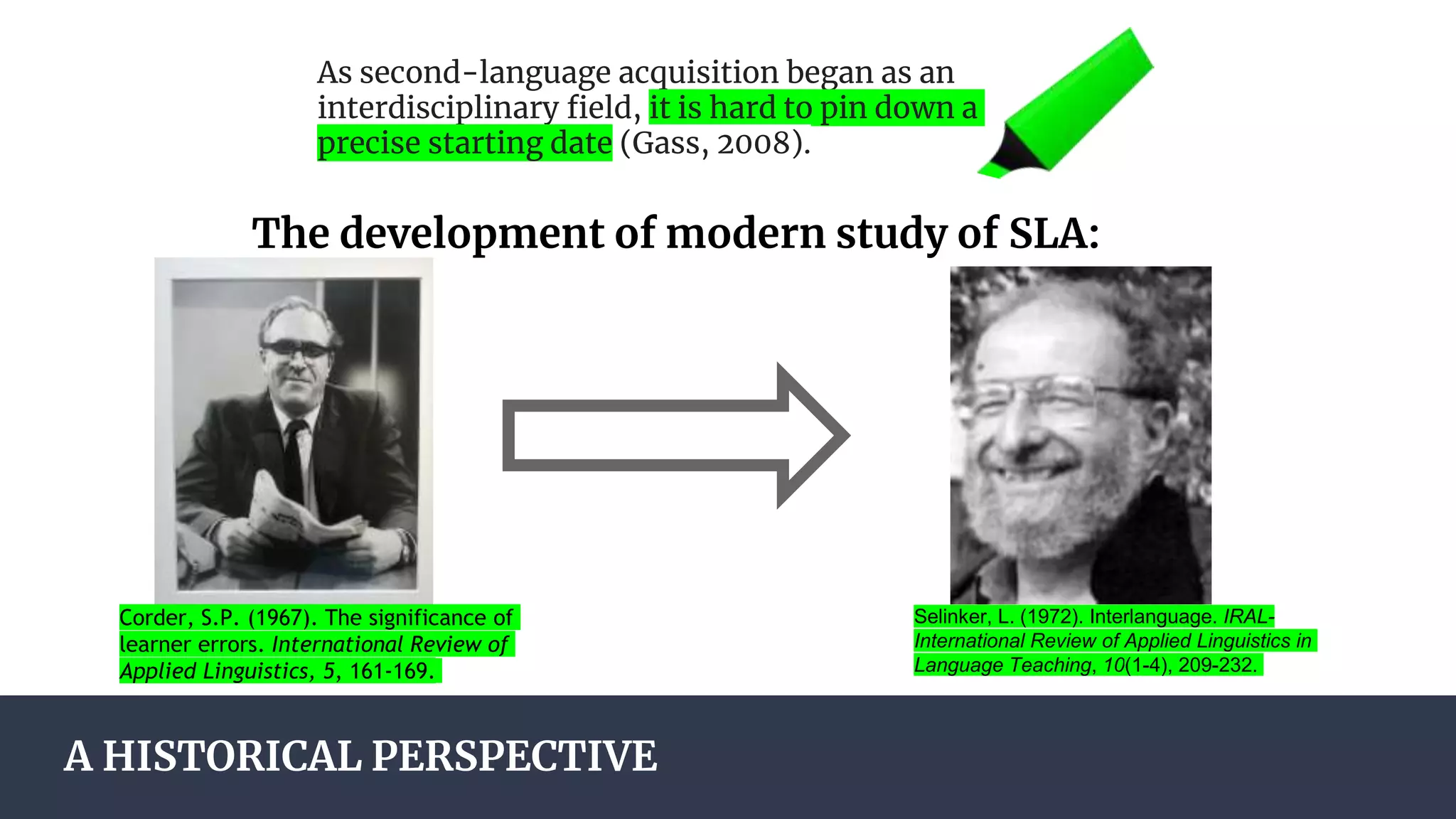
As second-language acquisition began as an
interdisciplinary field, it is hard to pin down a
precise starting date (Gass, 2008).
The development of modern study of SLA:
Corder, S.P. (1967). The significance of
learner errors. International Review of
Applied Linguistics, 5, 161-169.
Selinker, L. (1972). Interlanguage. IRAL-
International Review of Applied Linguistics in
Language Teaching, 10(1-4), 209-232.
A HISTORICAL PERSPECTIVE
● Error analysis
● Transitional
stages of SLA
● Morpheme
studies
● Input hypothesis
● Comprehensible
Input
● Lexical functional
grammar
● Connectivism
● Interaction
hypothesis
● Output hypothesis
● Noticing hypothesis
● Universal Grammar
● Skill-acquisition
theory
● Processability
● Input Processing
● Sociocultural
Theory
● Research split into
two main camps of
linguistic and
psychological
approaches
1970s 1980s 1990s 2000s
HOW DOES SLA EVOLVE IN TIME?
VanPatten, B., & Benati, A. G. (2015)
Behavioral Psychology
Pavlov’s Classical Conditioning
Skinner’s Operant Conditioning
For language, what matters is verbal behaviors
How was behaviorism reflected on Second Language Learning/Teaching?
● Powerful influence on
second language teaching,
especially in the North
America, from the 1940s to
the 1970s.
● The influence of
behaviorism on ALM
teaching materials.
● The Army Method
Behaviorist Perspective in SLA
● Emphasizes mimicry
● Memorization is important
● Habit formation
● Habits of L1 interferes L2
acquisition
● New habits are necessary for L2
acquisition
● Errors should be directly corrected
to help students develop correct
habits. Larsen-Freeman, D. (2000)
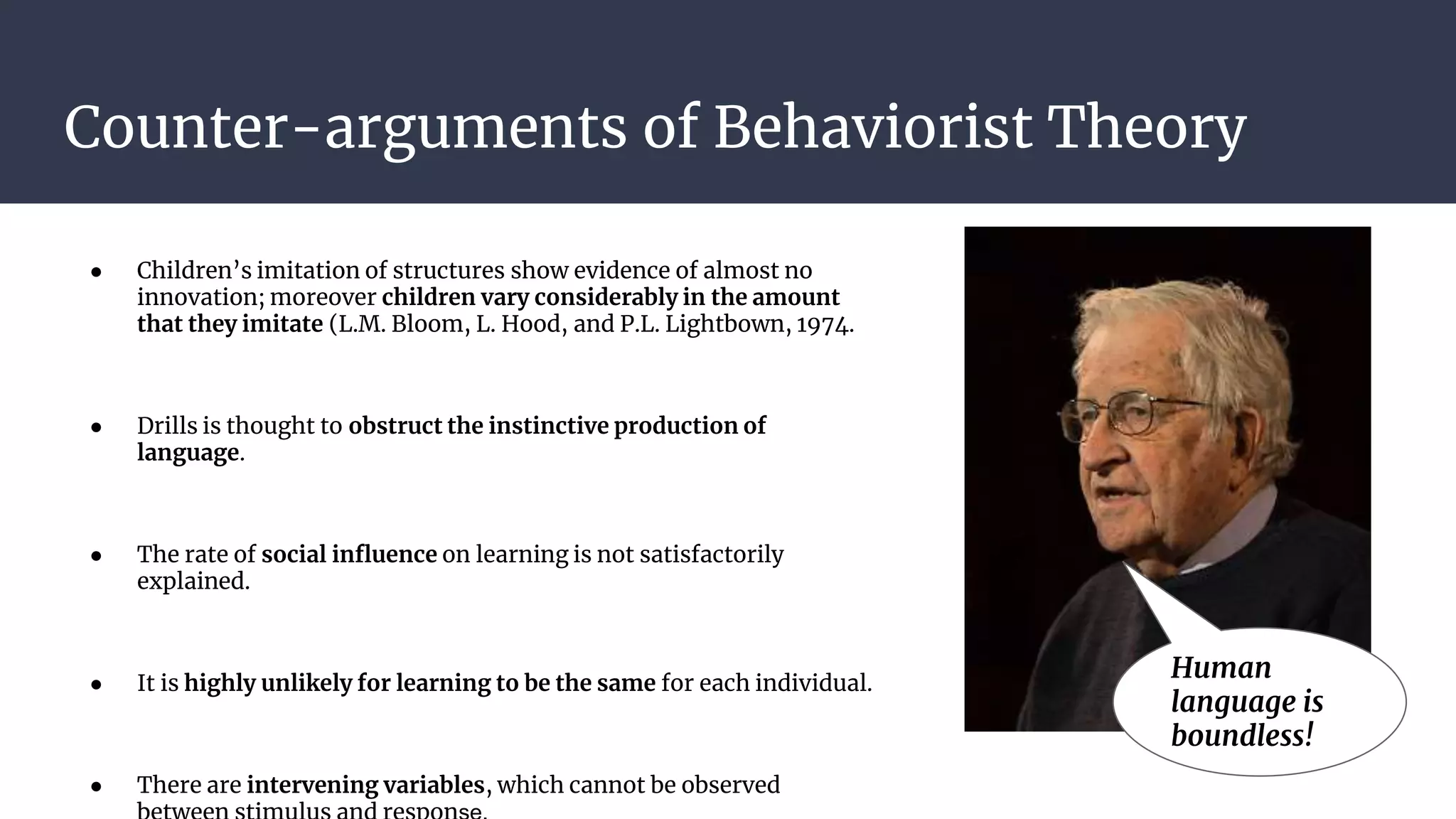
Counter-arguments of Behaviorist Theory
● Children’s imitation of structures show evidence of almost no
innovation; moreover children vary considerably in the amount
that they imitate (L.M. Bloom, L. Hood, and P.L. Lightbown, 1974.
● Drills is thought to obstruct the instinctive production of
language.
● The rate of social influence on learning is not satisfactorily
explained.
● It is highly unlikely for learning to be the same for each individual.
● There are intervening variables, which cannot be observed
Human
language is
boundless!
Skinner never gave a
formal response to
Chomsky and allowed a
"Chomskyan revolution"
to occur in the field of
linguistics in the 1960s.
Chomsky's main
argument against
behaviorist views of
language acquisition
can perhaps be
summarized by his
quote "if in fact our
minds were a blank
slate we would be
very impoverished
creatures, indeed"
Debate of the Century
"Skinner is nothing
but a stimulus
response
psychologist" or that
Skinner thinks
"people are nothing
more than pigeons"
Contrastive Analysis Hypothesis
● A prevalent hypothesis prior to 1980s that
predicted acquisition difficulties.
● Developed by Robert Lado who was researching the
best teaching method for military purposes during
WW2.
● There were similarities between an L1 and an L2,
acquisition would be easier compared with
situations in which there were differences between
the L1 and the L2. VanPatten, B., & Benati, A. G. (2015)
Contrastive Error Hypothesis was intimately
tied to a theory of learning called
behaviorism that emphasized learning as
habit formation.
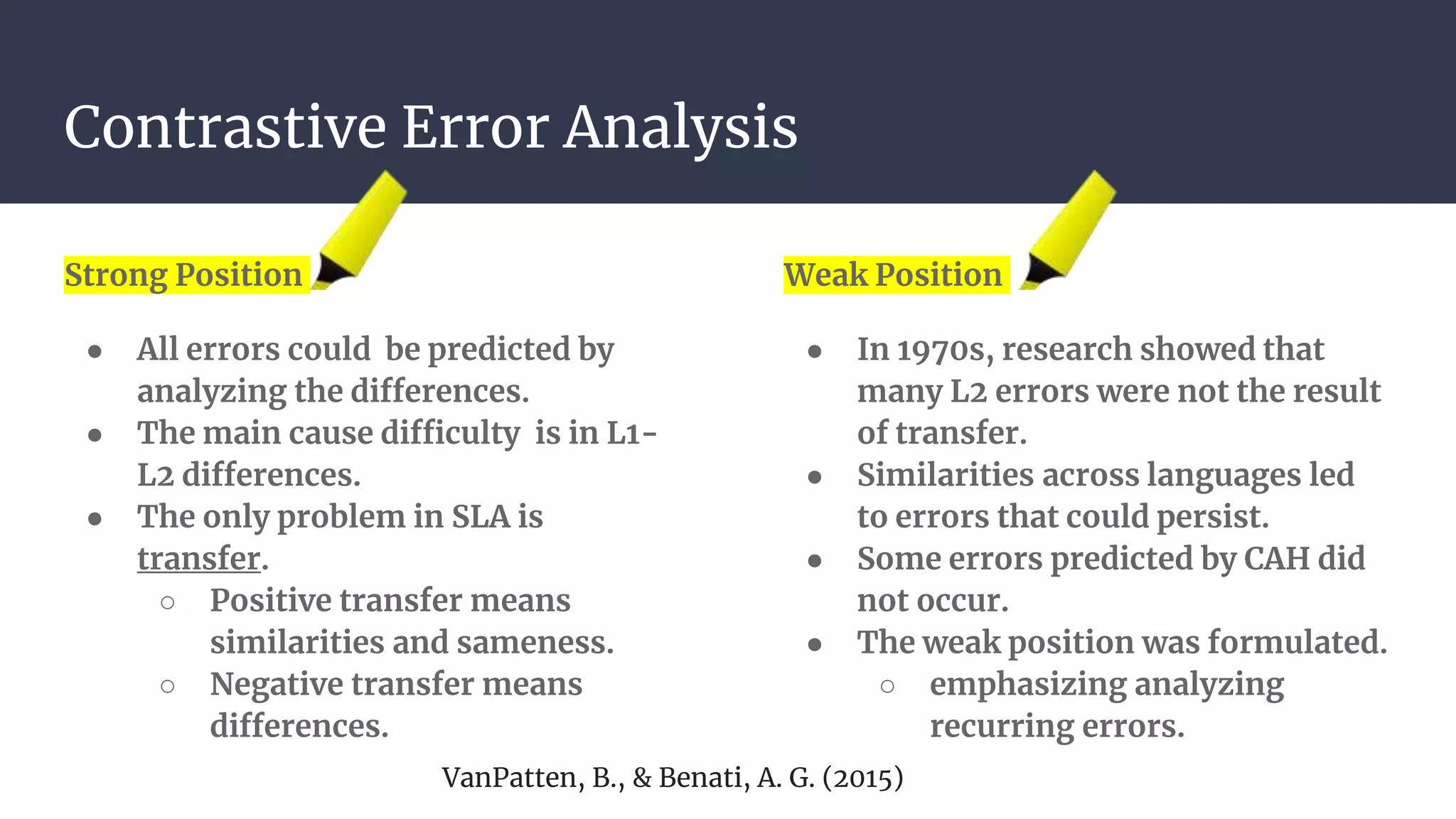
Contrastive Error Analysis
Strong Position
● All errors could be predicted by
analyzing the differences.
● The main cause difficulty is in L1-
L2 differences.
● The only problem in SLA is
transfer.
○ Positive transfer means
similarities and sameness.
○ Negative transfer means
differences.
Weak Position
● In 1970s, research showed that
many L2 errors were not the result
of transfer.
● Similarities across languages led
to errors that could persist.
● Some errors predicted by CAH did
not occur.
● The weak position was formulated.
○ emphasizing analyzing
recurring errors.
VanPatten, B., & Benati, A. G. (2015)
Creative
Construction
Hypothesis as a
criticism towards
Behaviorism & CAH
● SLA is considered to be very
much like L1 acquisition in that
SLA is a process in which
learners make unconscious
hypotheses on the basis of the
input they get from the
environment.
VanPatten, B., & Benati, A. G. (2015)
Error Analysis (EA)
as a reaction to
Behaviorism & CAH
● Error analysis is a research tool
characterized by a set of procedures
for identifying, describing, and
explaining L2 learners’ errors.
● What early EA showed was that not
all errors could be attributed to L1
influence and that L2 learners were
active creators of linguistic system.
● The first scholar was S. Pit Corder
back in the late 1960s.
EA or CAH?
● Pedagogical orientation
● Focus on input, practice,
inductive teaching
● Errors of transfer
● Scientific orientation
● Focus on linguistic and
cognitive processes
● Multiple types of errors
KRASHEN’S 5
HYPOTHESES ON
SECOND LANGUAGE
ACQUISITION
Acquisition versus Learning
Acquisition is a general term in SLA research used to mean the internalization of a linguistic system.
Acquisition
● Acquisition refers to processes by
which learners internalize language
from exposure to input.
Learning
● Learning refers to conscious effort at
learning rules from books and
teachers.
“You need to add an -s to verbs
that refer to someone else. This is
called third-person -s.” and then
practice this rule.”
To acquire third-person -s, learners
would need to hear lots of third-person
verbs in context, as part of the
communication of information. In a
certain sense, Krashen likens acquisition
for L2 learners to acquisition for L1
learners; namely, acquisition happens
● Learning results in _____
system of knowledge while
Acquisition results in ____
system of knowledge.
Implicit
Explicit
Krashen’s distinction of Learning vs. Acquisition caused considerable debate...
Today, regardless of the processes involved (learning vs. acquisition), scholars
accept that learners develop an implicit mental representation of language,
which subsumes Krashen’s acquired system At the same time, they accept that
learners may also have explicit knowledge, which subsumes Krashen’s learned
knowledge about language.
VanPatten, B., & Benati, A. G. (2015)
Monitor Hypothesis / Monitor Model
● The Monitor is a component of an L2 learner's language processing device that uses
knowledge gained from language learning to observe and regulate the learner's own L2
production, checking for accuracy and adjusting language production when necessary
(Krashen, 1982)
● There are certain circumstances to monitor one’s input:
○ The learner has to know the rule to apply.
○ The learner must have time to apply the conscious rule
VanPatten, B., & Benati, A. G. (2015)
THE MONITOR IS VERY LIMITED IN ITS USEFULNESS
Input? Intake? Output?
Input Hypothesis
● A component of Monitor Theory
● Learners acquire language in only one way: by exposure to input
● Language input should be at the "i+1" level, just beyond what the
learner can fully understand; this input is comprehensible, but
contains structures that are not yet fully understood.
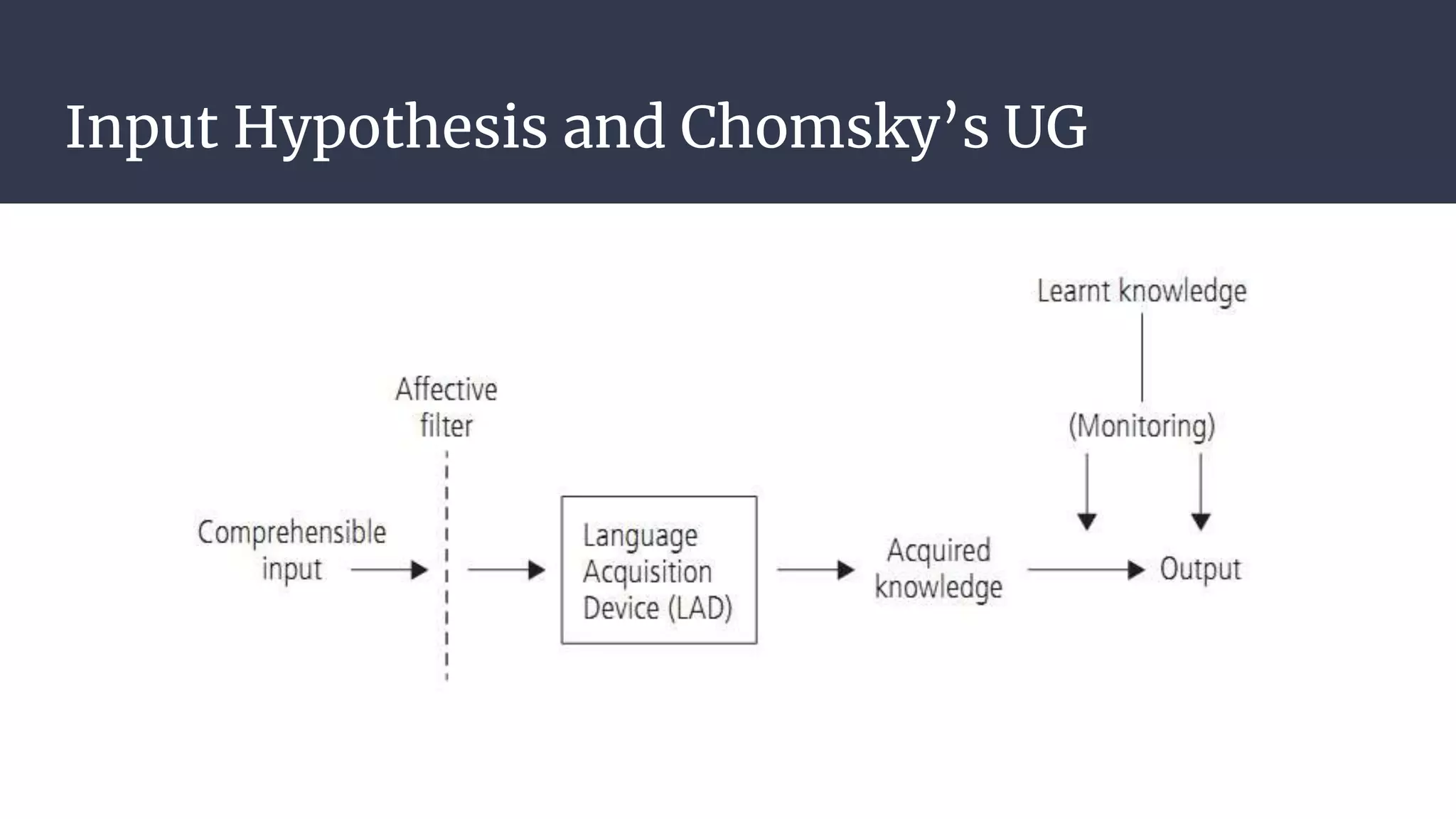
Input Hypothesis and Chomsky’s UG
Strong Version vs Weak Version of Input Hypothesis
Strong Version
● Rejects any significant role for
formal instruction and negative
evidence
● Claiming that only exposure to
input can cause acquisition to
happen.
Weak Version
● Formal instruction and negative
evidence can be beneficial, but not
necessary.
VanPatten, B., & Benati, A. G. (2015)
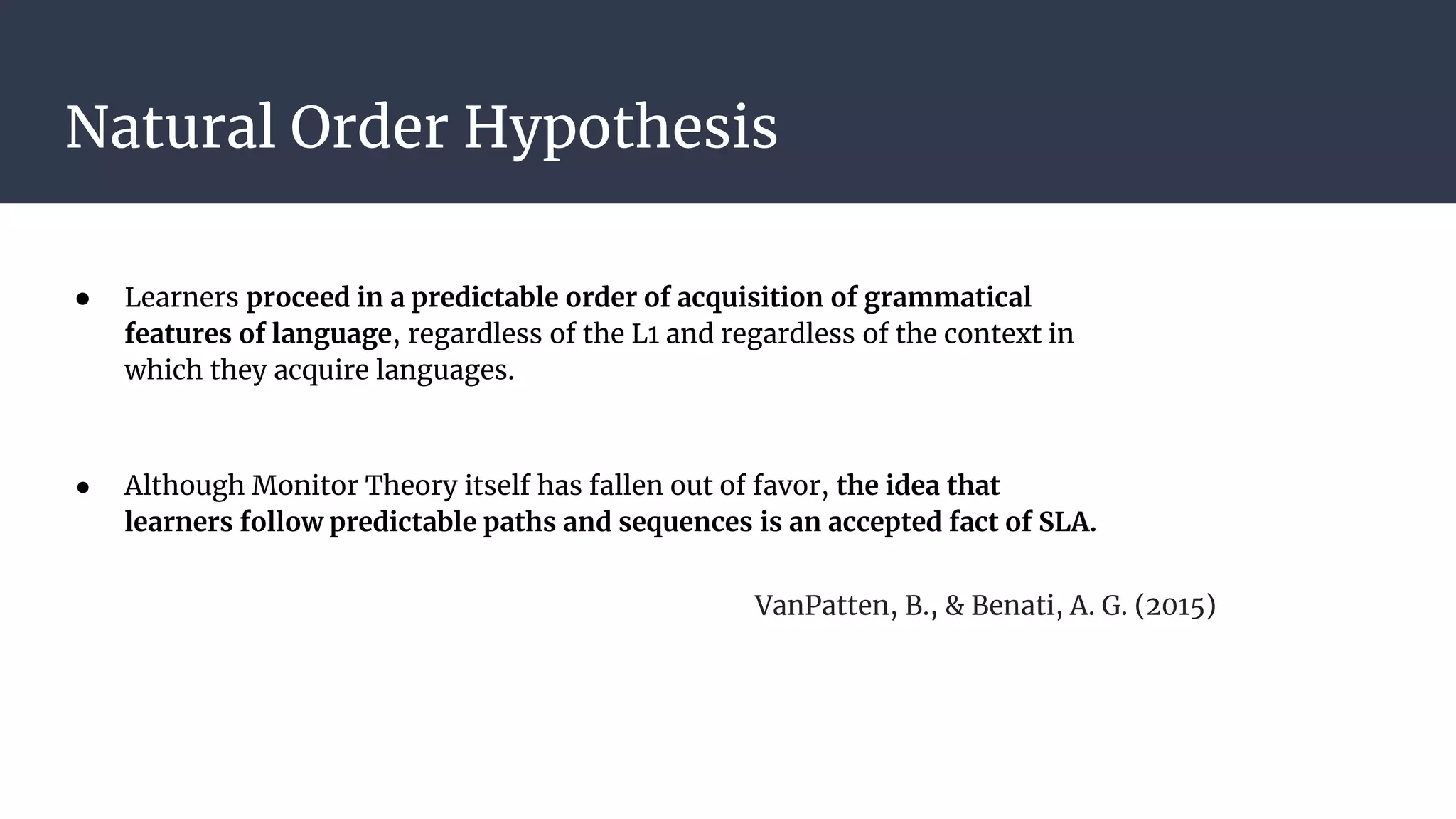
Natural Order Hypothesis
● Learners proceed in a predictable order of acquisition of grammatical
features of language, regardless of the L1 and regardless of the context in
which they acquire languages.
● Although Monitor Theory itself has fallen out of favor, the idea that
learners follow predictable paths and sequences is an accepted fact of SLA.
VanPatten, B., & Benati, A. G. (2015)
Natural Order Hypothesis
Affective Filter Hypothesis
● Affective/Affect refers to moods, personal
states of being, attitudes, feelings,
opinions and so on.
● The affective filter is a metaphor that
concerns why input enters or doesn’t
ender the head of the learner.
● High affective filter blocks out language
while low affective filter does not!
● Self-esteem, motivation, inhibition,
anxiety etc.
Swain’s Comprehensible Output Hypothesis
● Developed by Merill Swain
● Learning takes place when learners encounter a gap in their linguistic knowledge of L2. By
noticing this gap, learners become aware of it and may be able to modify their input so that
they learn something new about the language.
● Closely related to Noticing Hypothesis
● Swain defines three functions of output
(Swain, M. and Lapkin, 1995)
○ Noticing function
○ Hypothesis-testing function
○ Metalinguistic function
Noticing Hypothesis
● Attributed largely to Richard Schmidt
● The input that learners can acquire are those elements that they notice
● There is some level of awareness in learning
● As a reaction to Krashen’s idea of acquisition
● Not universally accepted, remain controversial
● Criticism: the noticing hypothesis should be limited to describing metalinguistic
knowledge and not overall language competence.
VanPatten, B., & Benati, A. G. (2015)
(Truscott, 1998)
Interaction Hypothesis
● The development of language proficiency is promoted by F2F
interaction and communication (Johnson & Johnson, 1999)
● The idea existed in the 1980s, but usually credited to Michael
Long
Long, Michael (1996). "The role of
the linguistic environment in
second language acquisition". In
Ritchie, William; Bhatia, Tej (eds.).
Handbook of second language
acquisition. San Diego: Academic
Press. pp. 413–468.
Interaction Hypothesis
● According to the Interaction Hypothesis, learners may be led to
notice things they wouldn’t notice otherwise, and this noticing can
affect acquisition.
● Input Modifications: the other speaker adjusts his or her speech
due to perceived difficulties in learner comprehension.
● Feedback: the other speaker indicates in some way that the
learner has produced something non-native-like.
Interaction Hypothesis
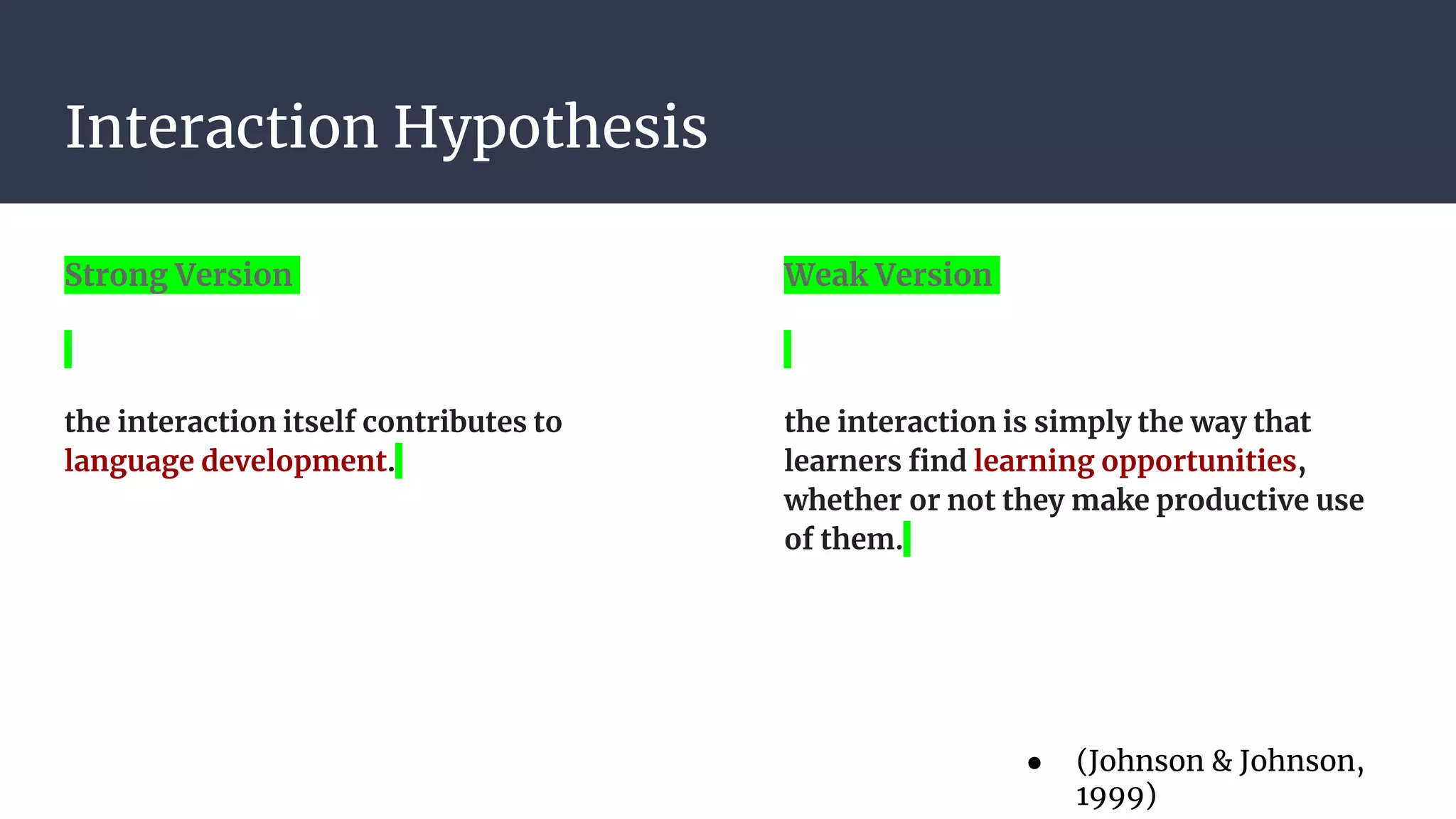
Strong Version
the interaction itself contributes to
language development.
Weak Version
the interaction is simply the way that
learners find learning opportunities,
whether or not they make productive use
of them.
● (Johnson & Johnson,
1999)
Sociocultural Theory
Sociocultural theory
focuses not only how
adults and peers
influence individual
learning, but also on
how cultural beliefs
and attitudes affect
how learning takes
place.
Sociocultural Theory
● Parents, caregivers, peers, and the culture at large were
responsible for developing higher-order functions.
● Learning has its basis in interacting with other people.
● The most important cognitive activities in which people
engage are shaped by the environment.
● All learning is context-bound.
● The major construct is mediation (cultural tools, such as
language, literacy, numeracy etc.)
Sociocultural Theory
To assist a person to move through the zone of proximal development, educators are
encouraged to focus on three important components which aid the learning process:
● The presence of someone with knowledge and skills beyond that of the learner
(a more knowledgeable other).
● Social interactions with a skillful tutor that allow the learner to observe and
practice their skills.
● Scaffolding, or supportive activities provided by the educator, or more
competent peer, to support the student as he or she is led through the ZPD.
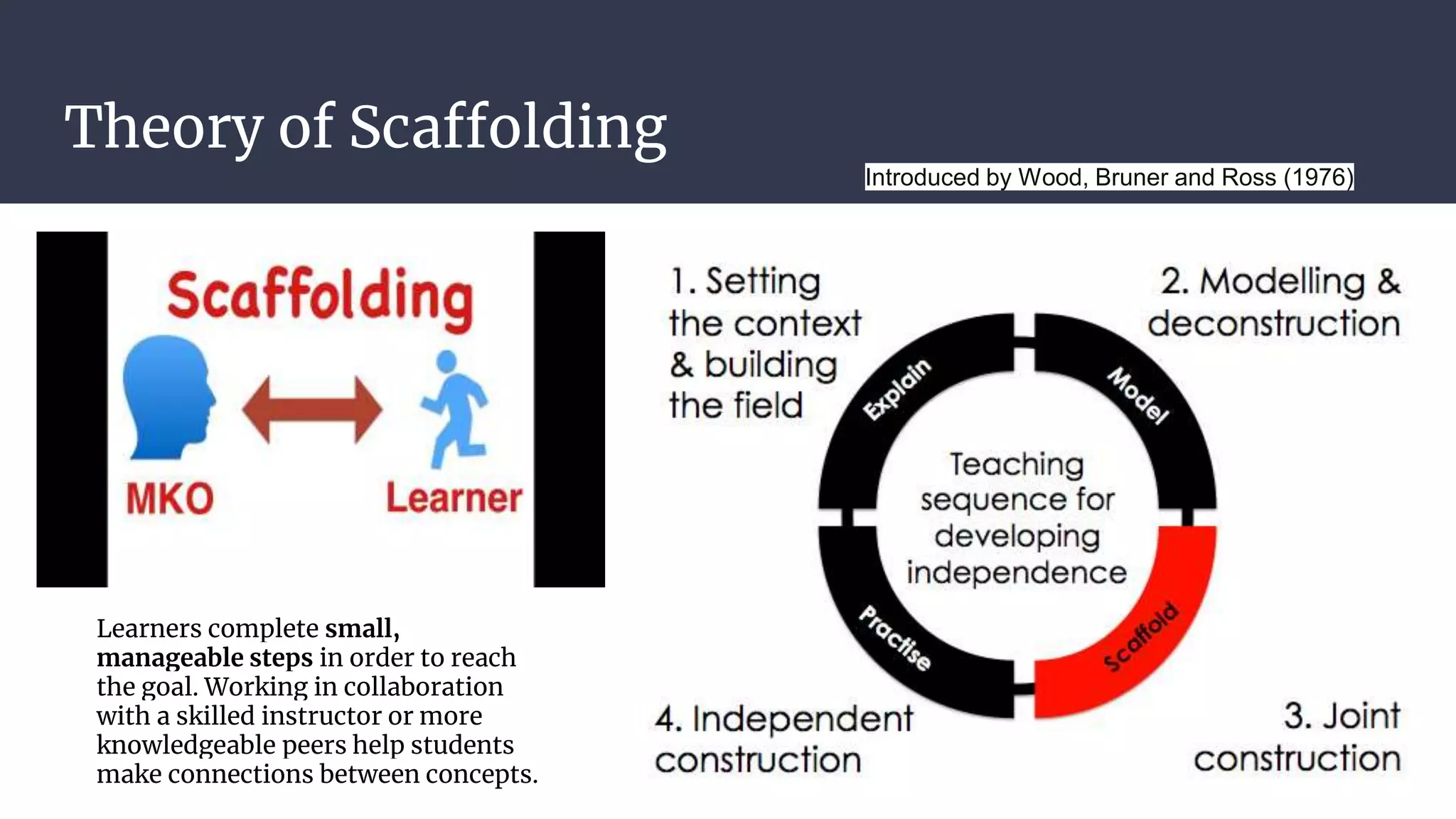
Theory of Scaffolding
Introduced by Wood, Bruner and Ross (1976)
Learners complete small,
manageable steps in order to reach
the goal. Working in collaboration
with a skilled instructor or more
knowledgeable peers help students
make connections between concepts.
What scaffolding
strategies are used
in a foreign
language class?
Functional Approach
● From the purely formal approaches of syntactic theory in that functional
approaches view language as a means to communicate.
● Attempt to relate function to from and form to function.
● Meaning and function influence both language structure and language
acquisition.
● Language is not so much a system of rules as posed by Chomsky, but a
means of performing particular socially communicative functions.
VanPatten, B., & Benati, A. G. (2015)
The functionalist theory is based on the work of Michael Halliday
language is a matter of
learning the kinds of
meanings that can be
shared in particular
situations, and that
children learn grammar
based on meaningful
choices rather than formal
rules.
Observed his son for his
functionalist theory
The Functionalist Theory
Halliday's functionalist theory are are of the "seven functions of
language," which were designed to reflect the various conversational
interactions that children develop during language acquisition. They
are listed below:
1. Instrumental - "I want"
2. Regulatory - "Do as I tell you"
3. Interactional - "Me and you"
4. Personal - "Here I come"
5. Heuristic - "Tell me why"
6. Imaginative - "Let’s pretend"
7. Representational - "I've got something for you"
(Halliday, 1973)
What strategies are
used in a foreign
language class to
foster the
functional theory?
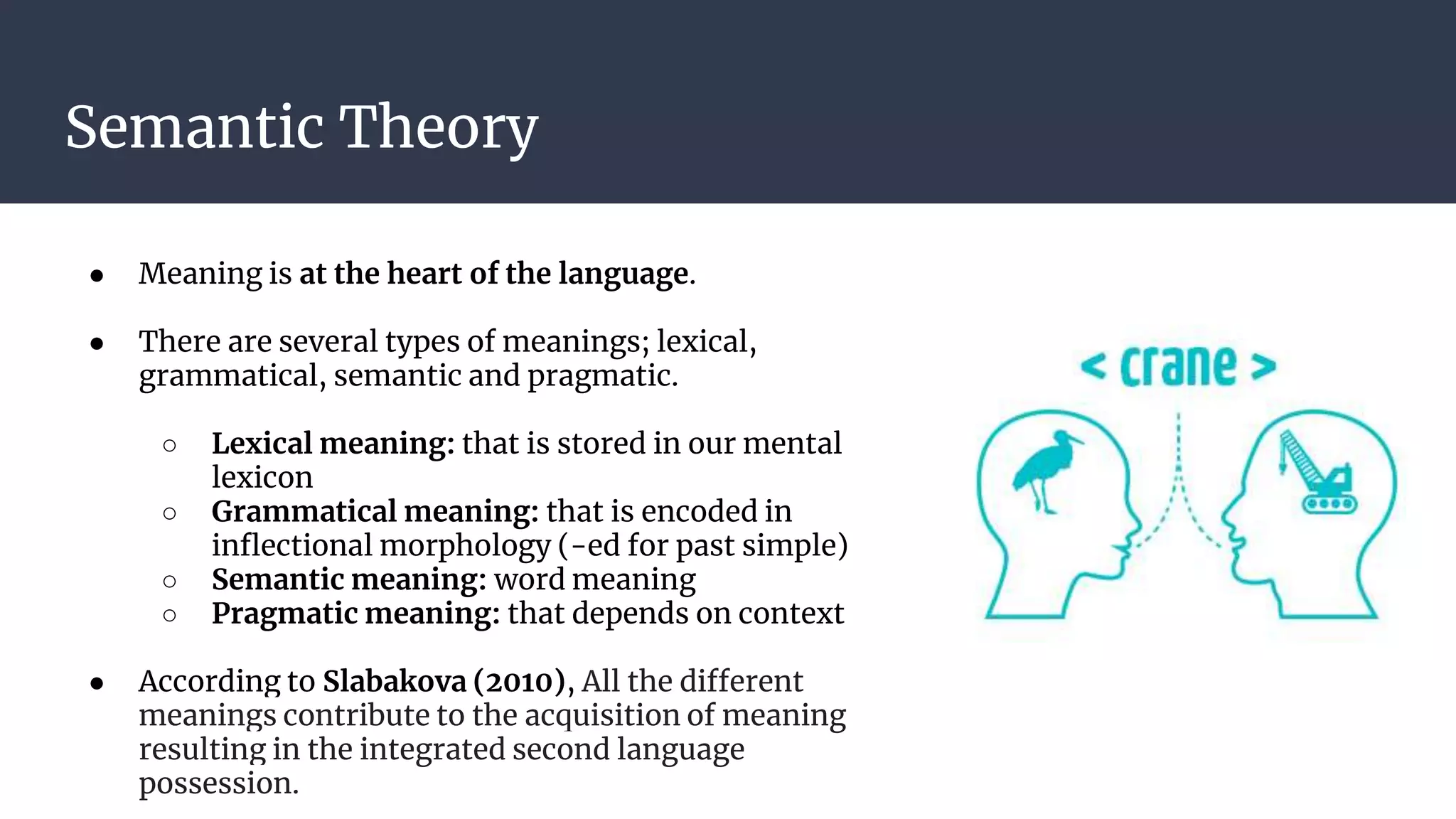
Semantic Theory
● Meaning is at the heart of the language.
● There are several types of meanings; lexical,
grammatical, semantic and pragmatic.
○ Lexical meaning: that is stored in our mental
lexicon
○ Grammatical meaning: that is encoded in
inflectional morphology (-ed for past simple)
○ Semantic meaning: word meaning
○ Pragmatic meaning: that depends on context
● According to Slabakova (2010), All the different
meanings contribute to the acquisition of meaning
resulting in the integrated second language
possession.
Complex Dynamic Systems Theory
1. Larsen-Freeman (1997) claimed that second language acquisition should
be viewed as a developmental process which includes language attrition as
well as language acquisition.
1. Language is considered to be a system which includes many subsystems
such as linguistic system, phonetic system. Dynamic systems are
interconnected, nonlinear, adaptive, open, sensitive to initial conditions.
Variability is seen as an inherent property of development and it is not
viewed as measurement error, therefore from a dynamic systems
perspective variability in the data is analysed and considered valuable
information.
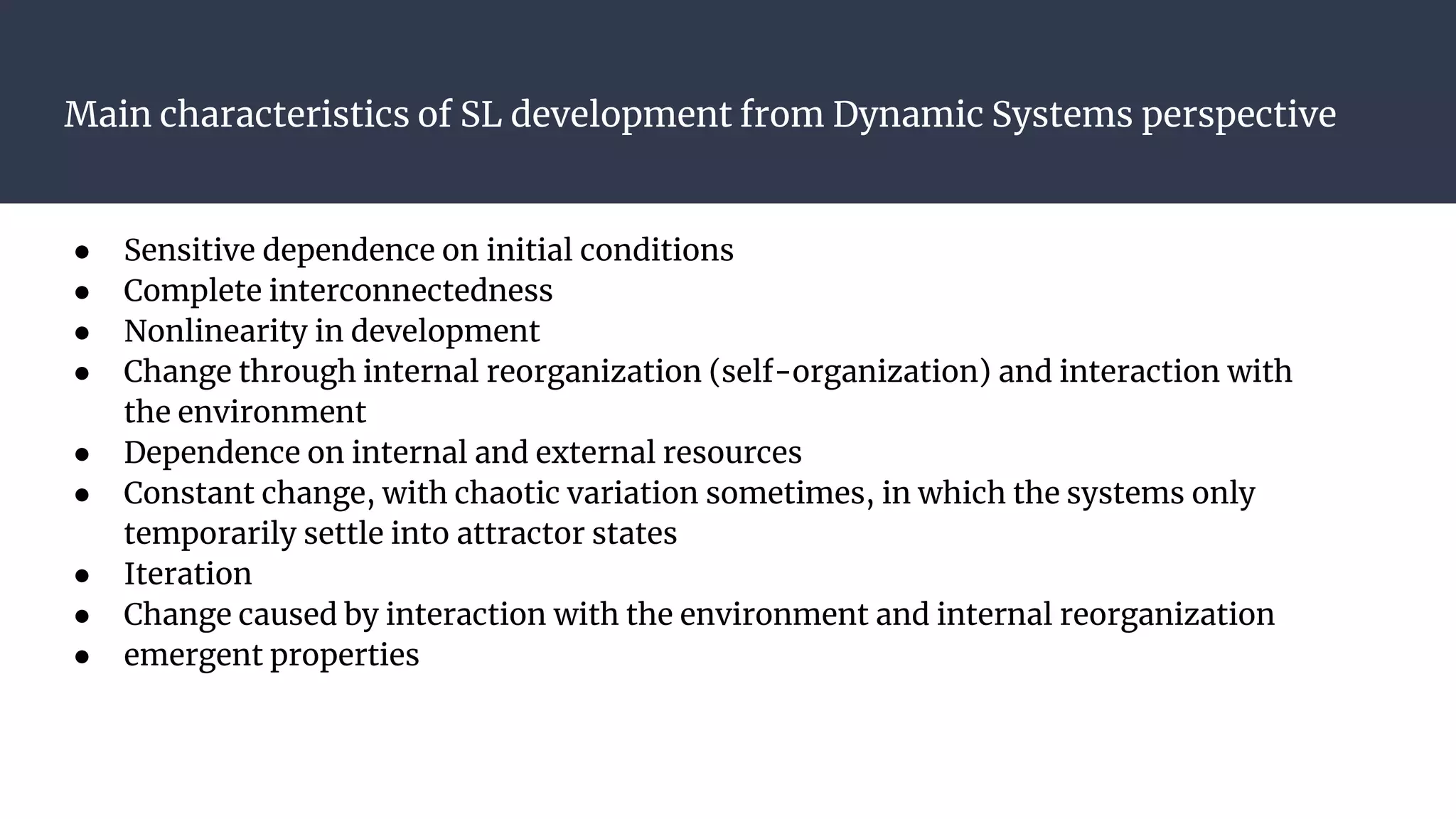
Main characteristics of SL development from Dynamic Systems perspective
● Sensitive dependence on initial conditions
● Complete interconnectedness
● Nonlinearity in development
● Change through internal reorganization (self-organization) and interaction with
the environment
● Dependence on internal and external resources
● Constant change, with chaotic variation sometimes, in which the systems only
temporarily settle into attractor states
● Iteration
● Change caused by interaction with the environment and internal reorganization
● emergent properties
According to CDS Theory
SLA can be best captured by applying longitudinal case
study research design rather than cross-sectional
designs.
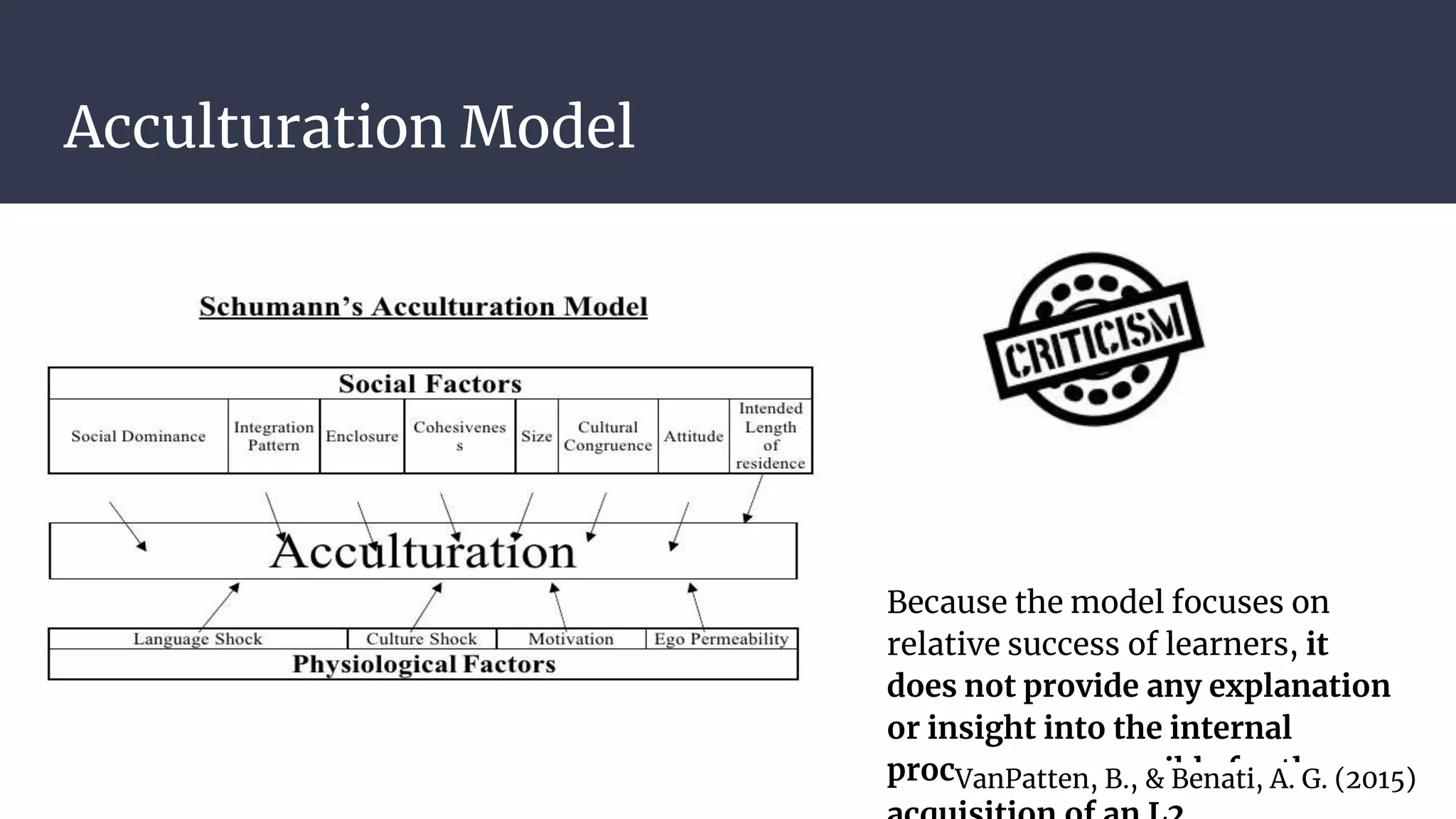
Acculturation Model
Because the model focuses on
relative success of learners, it
does not provide any explanation
or insight into the internal
processes responsible for the
VanPatten, B., & Benati, A. G. (2015)
Communication Accommodation Theory
● Developed by Howard Gills
● Communication accommodation theory elaborates the human tendency to
adjust their behaviour while interacting. The reason behind this behaviour is
explained as to control the social differences between the interactants.
● There are two types of accommodation process:
○ Convergence: a process where people tend to adapt the other person’s communication
characteristics to reduce the social differences
○ Divergence: the individual emphasis is on the social difference and nonverbal
differences between the interactants
An example of CAT
Mike was a new employee in a
certain organisation. While
understanding about the
environment, he came to know
about his senior officer who
apparently had an interest in
painting from his co-workers.
When mike got an opportunity to
interact with him, he glorified the
beauty of a painting the officer has
been displayed in his office which
pleased the officer. In this situation
mike accommodated his behaviour
according to the situation and thus
could create an impression on his
senior officer.
Thank you for listening...
References
Corder, S.P. (1967). The significance of learner errors. International Review of Applied Linguistics, 5, 161-169.
Gass, S. M. (2013). Second language acquisition: An introductory course. Routledge.
Halliday, M. A. K. (1973). Explorations in the functions of language.
Krashen, S. (1982). Principles and practice in second language acquisition. Pergamon Press. ISBN 978-0-08-028628-0. Archived from the original on 2011-07-
16. Retrieved 2010-11-25.
Johnson, Keith; Johnson, Helen, eds. (1999). "Interaction Hypothesis". Encyclopedic Dictionary of Applied Linguistics: A Handbook for Language Teaching.
Oxford: Blackwell Publishers. p. 174.
Larsen-Freeman, D. (2000). Techniques and principles in language teaching. Oxford University.
Larsen-Freeman, D (1997). "Chaos/complexity science and second language acquisition". Applied Linguistics. 18 (2): 141–165.
Selinker, L. (1972). Interlanguage. IRAL-International Review of Applied Linguistics in Language Teaching, 10(1-4), 209-232.
Long, Michael (1996). "The role of the linguistic environment in second language acquisition". In Ritchie, William; Bhatia, Tej (eds.). Handbook of second
language acquisition. San Diego: Academic Press. pp. 413–468.
Slabakova, R. (2010). "Semantic theory and second language acquisition". Annual Review of Applied Linguistics. 30: 231–247.
Swain, M. and Lapkin, S. (1995). Problems in output and the cognitive processes they generate: A step towards second language learning. Applied Linguistics
16: 371-391, p. 372.
Truscott, John (1998). "Noticing in second language acquisition: a critical review" (PDF). Second Language Research. 14 (2): 103–135. Retrieved 29 October
2012.
VanPatten, B., & Benati, A. G. (2015). Key terms in second language acquisition. Bloomsbury Publishing.
Wood, D., Bruner, J. S., & Ross, G. (1976). The role of tutoring in problem solving. Journal of child psychology and psychiatry, 17(2), 89-100.

Sla theories part 1

  • 1.
  • 2.
    What is themain of purpose of theories of SLA? The main purpose of theories of second-language acquisition (SLA) is to shed light on how people who already know one language learn a second language
  • 3.
    The field ofsecond- language acquisition involves various contributions ● Linguistics ● Sociolinguistics ● Psychology ● Cognitive science ● Neuroscience ● Education ● Linguistic dimensions of SLA ● Cognitive dimensions of SLA ● Socio-cultural dimensions of SLA ● Instructional dimensions of SLA
  • 5.
    A HISTORICAL PERSPECTIVE Assecond-language acquisition began as an interdisciplinary field, it is hard to pin down a precise starting date (Gass, 2008). The development of modern study of SLA: Corder, S.P. (1967). The significance of learner errors. International Review of Applied Linguistics, 5, 161-169. Selinker, L. (1972). Interlanguage. IRAL- International Review of Applied Linguistics in Language Teaching, 10(1-4), 209-232.
  • 6.
    A HISTORICAL PERSPECTIVE ●Error analysis ● Transitional stages of SLA ● Morpheme studies ● Input hypothesis ● Comprehensible Input ● Lexical functional grammar ● Connectivism ● Interaction hypothesis ● Output hypothesis ● Noticing hypothesis ● Universal Grammar ● Skill-acquisition theory ● Processability ● Input Processing ● Sociocultural Theory ● Research split into two main camps of linguistic and psychological approaches 1970s 1980s 1990s 2000s HOW DOES SLA EVOLVE IN TIME? VanPatten, B., & Benati, A. G. (2015)
  • 7.
  • 8.
  • 9.
  • 10.
    For language, whatmatters is verbal behaviors
  • 11.
    How was behaviorismreflected on Second Language Learning/Teaching? ● Powerful influence on second language teaching, especially in the North America, from the 1940s to the 1970s. ● The influence of behaviorism on ALM teaching materials. ● The Army Method
  • 12.
    Behaviorist Perspective inSLA ● Emphasizes mimicry ● Memorization is important ● Habit formation ● Habits of L1 interferes L2 acquisition ● New habits are necessary for L2 acquisition ● Errors should be directly corrected to help students develop correct habits. Larsen-Freeman, D. (2000)
  • 13.
    Counter-arguments of BehavioristTheory ● Children’s imitation of structures show evidence of almost no innovation; moreover children vary considerably in the amount that they imitate (L.M. Bloom, L. Hood, and P.L. Lightbown, 1974. ● Drills is thought to obstruct the instinctive production of language. ● The rate of social influence on learning is not satisfactorily explained. ● It is highly unlikely for learning to be the same for each individual. ● There are intervening variables, which cannot be observed Human language is boundless!
  • 14.
    Skinner never gavea formal response to Chomsky and allowed a "Chomskyan revolution" to occur in the field of linguistics in the 1960s. Chomsky's main argument against behaviorist views of language acquisition can perhaps be summarized by his quote "if in fact our minds were a blank slate we would be very impoverished creatures, indeed" Debate of the Century "Skinner is nothing but a stimulus response psychologist" or that Skinner thinks "people are nothing more than pigeons"
  • 15.
    Contrastive Analysis Hypothesis ●A prevalent hypothesis prior to 1980s that predicted acquisition difficulties. ● Developed by Robert Lado who was researching the best teaching method for military purposes during WW2. ● There were similarities between an L1 and an L2, acquisition would be easier compared with situations in which there were differences between the L1 and the L2. VanPatten, B., & Benati, A. G. (2015)
  • 16.
    Contrastive Error Hypothesiswas intimately tied to a theory of learning called behaviorism that emphasized learning as habit formation.
  • 17.
    Contrastive Error Analysis StrongPosition ● All errors could be predicted by analyzing the differences. ● The main cause difficulty is in L1- L2 differences. ● The only problem in SLA is transfer. ○ Positive transfer means similarities and sameness. ○ Negative transfer means differences. Weak Position ● In 1970s, research showed that many L2 errors were not the result of transfer. ● Similarities across languages led to errors that could persist. ● Some errors predicted by CAH did not occur. ● The weak position was formulated. ○ emphasizing analyzing recurring errors. VanPatten, B., & Benati, A. G. (2015)
  • 18.
    Creative Construction Hypothesis as a criticismtowards Behaviorism & CAH ● SLA is considered to be very much like L1 acquisition in that SLA is a process in which learners make unconscious hypotheses on the basis of the input they get from the environment. VanPatten, B., & Benati, A. G. (2015)
  • 19.
    Error Analysis (EA) asa reaction to Behaviorism & CAH ● Error analysis is a research tool characterized by a set of procedures for identifying, describing, and explaining L2 learners’ errors. ● What early EA showed was that not all errors could be attributed to L1 influence and that L2 learners were active creators of linguistic system. ● The first scholar was S. Pit Corder back in the late 1960s.
  • 20.
    EA or CAH? ●Pedagogical orientation ● Focus on input, practice, inductive teaching ● Errors of transfer ● Scientific orientation ● Focus on linguistic and cognitive processes ● Multiple types of errors
  • 21.
  • 23.
    Acquisition versus Learning Acquisitionis a general term in SLA research used to mean the internalization of a linguistic system. Acquisition ● Acquisition refers to processes by which learners internalize language from exposure to input. Learning ● Learning refers to conscious effort at learning rules from books and teachers. “You need to add an -s to verbs that refer to someone else. This is called third-person -s.” and then practice this rule.” To acquire third-person -s, learners would need to hear lots of third-person verbs in context, as part of the communication of information. In a certain sense, Krashen likens acquisition for L2 learners to acquisition for L1 learners; namely, acquisition happens
  • 24.
    ● Learning resultsin _____ system of knowledge while Acquisition results in ____ system of knowledge. Implicit Explicit
  • 25.
    Krashen’s distinction ofLearning vs. Acquisition caused considerable debate... Today, regardless of the processes involved (learning vs. acquisition), scholars accept that learners develop an implicit mental representation of language, which subsumes Krashen’s acquired system At the same time, they accept that learners may also have explicit knowledge, which subsumes Krashen’s learned knowledge about language. VanPatten, B., & Benati, A. G. (2015)
  • 26.
    Monitor Hypothesis /Monitor Model ● The Monitor is a component of an L2 learner's language processing device that uses knowledge gained from language learning to observe and regulate the learner's own L2 production, checking for accuracy and adjusting language production when necessary (Krashen, 1982) ● There are certain circumstances to monitor one’s input: ○ The learner has to know the rule to apply. ○ The learner must have time to apply the conscious rule VanPatten, B., & Benati, A. G. (2015)
  • 27.
    THE MONITOR ISVERY LIMITED IN ITS USEFULNESS
  • 28.
  • 29.
    Input Hypothesis ● Acomponent of Monitor Theory ● Learners acquire language in only one way: by exposure to input ● Language input should be at the "i+1" level, just beyond what the learner can fully understand; this input is comprehensible, but contains structures that are not yet fully understood.
  • 30.
    Input Hypothesis andChomsky’s UG
  • 31.
    Strong Version vsWeak Version of Input Hypothesis Strong Version ● Rejects any significant role for formal instruction and negative evidence ● Claiming that only exposure to input can cause acquisition to happen. Weak Version ● Formal instruction and negative evidence can be beneficial, but not necessary. VanPatten, B., & Benati, A. G. (2015)
  • 32.
    Natural Order Hypothesis ●Learners proceed in a predictable order of acquisition of grammatical features of language, regardless of the L1 and regardless of the context in which they acquire languages. ● Although Monitor Theory itself has fallen out of favor, the idea that learners follow predictable paths and sequences is an accepted fact of SLA. VanPatten, B., & Benati, A. G. (2015)
  • 33.
  • 34.
    Affective Filter Hypothesis ●Affective/Affect refers to moods, personal states of being, attitudes, feelings, opinions and so on. ● The affective filter is a metaphor that concerns why input enters or doesn’t ender the head of the learner. ● High affective filter blocks out language while low affective filter does not! ● Self-esteem, motivation, inhibition, anxiety etc.
  • 35.
    Swain’s Comprehensible OutputHypothesis ● Developed by Merill Swain ● Learning takes place when learners encounter a gap in their linguistic knowledge of L2. By noticing this gap, learners become aware of it and may be able to modify their input so that they learn something new about the language. ● Closely related to Noticing Hypothesis ● Swain defines three functions of output (Swain, M. and Lapkin, 1995) ○ Noticing function ○ Hypothesis-testing function ○ Metalinguistic function
  • 36.
    Noticing Hypothesis ● Attributedlargely to Richard Schmidt ● The input that learners can acquire are those elements that they notice ● There is some level of awareness in learning ● As a reaction to Krashen’s idea of acquisition ● Not universally accepted, remain controversial ● Criticism: the noticing hypothesis should be limited to describing metalinguistic knowledge and not overall language competence. VanPatten, B., & Benati, A. G. (2015) (Truscott, 1998)
  • 37.
    Interaction Hypothesis ● Thedevelopment of language proficiency is promoted by F2F interaction and communication (Johnson & Johnson, 1999) ● The idea existed in the 1980s, but usually credited to Michael Long Long, Michael (1996). "The role of the linguistic environment in second language acquisition". In Ritchie, William; Bhatia, Tej (eds.). Handbook of second language acquisition. San Diego: Academic Press. pp. 413–468.
  • 38.
    Interaction Hypothesis ● Accordingto the Interaction Hypothesis, learners may be led to notice things they wouldn’t notice otherwise, and this noticing can affect acquisition. ● Input Modifications: the other speaker adjusts his or her speech due to perceived difficulties in learner comprehension. ● Feedback: the other speaker indicates in some way that the learner has produced something non-native-like.
  • 39.
    Interaction Hypothesis Strong Version theinteraction itself contributes to language development. Weak Version the interaction is simply the way that learners find learning opportunities, whether or not they make productive use of them. ● (Johnson & Johnson, 1999)
  • 40.
    Sociocultural Theory Sociocultural theory focusesnot only how adults and peers influence individual learning, but also on how cultural beliefs and attitudes affect how learning takes place.
  • 41.
    Sociocultural Theory ● Parents,caregivers, peers, and the culture at large were responsible for developing higher-order functions. ● Learning has its basis in interacting with other people. ● The most important cognitive activities in which people engage are shaped by the environment. ● All learning is context-bound. ● The major construct is mediation (cultural tools, such as language, literacy, numeracy etc.)
  • 42.
  • 43.
    Sociocultural Theory To assista person to move through the zone of proximal development, educators are encouraged to focus on three important components which aid the learning process: ● The presence of someone with knowledge and skills beyond that of the learner (a more knowledgeable other). ● Social interactions with a skillful tutor that allow the learner to observe and practice their skills. ● Scaffolding, or supportive activities provided by the educator, or more competent peer, to support the student as he or she is led through the ZPD.
  • 44.
    Theory of Scaffolding Introducedby Wood, Bruner and Ross (1976) Learners complete small, manageable steps in order to reach the goal. Working in collaboration with a skilled instructor or more knowledgeable peers help students make connections between concepts.
  • 45.
    What scaffolding strategies areused in a foreign language class?
  • 46.
    Functional Approach ● Fromthe purely formal approaches of syntactic theory in that functional approaches view language as a means to communicate. ● Attempt to relate function to from and form to function. ● Meaning and function influence both language structure and language acquisition. ● Language is not so much a system of rules as posed by Chomsky, but a means of performing particular socially communicative functions. VanPatten, B., & Benati, A. G. (2015)
  • 47.
    The functionalist theoryis based on the work of Michael Halliday language is a matter of learning the kinds of meanings that can be shared in particular situations, and that children learn grammar based on meaningful choices rather than formal rules. Observed his son for his functionalist theory
  • 48.
    The Functionalist Theory Halliday'sfunctionalist theory are are of the "seven functions of language," which were designed to reflect the various conversational interactions that children develop during language acquisition. They are listed below: 1. Instrumental - "I want" 2. Regulatory - "Do as I tell you" 3. Interactional - "Me and you" 4. Personal - "Here I come" 5. Heuristic - "Tell me why" 6. Imaginative - "Let’s pretend" 7. Representational - "I've got something for you" (Halliday, 1973)
  • 49.
    What strategies are usedin a foreign language class to foster the functional theory?
  • 50.
    Semantic Theory ● Meaningis at the heart of the language. ● There are several types of meanings; lexical, grammatical, semantic and pragmatic. ○ Lexical meaning: that is stored in our mental lexicon ○ Grammatical meaning: that is encoded in inflectional morphology (-ed for past simple) ○ Semantic meaning: word meaning ○ Pragmatic meaning: that depends on context ● According to Slabakova (2010), All the different meanings contribute to the acquisition of meaning resulting in the integrated second language possession.
  • 51.
    Complex Dynamic SystemsTheory 1. Larsen-Freeman (1997) claimed that second language acquisition should be viewed as a developmental process which includes language attrition as well as language acquisition. 1. Language is considered to be a system which includes many subsystems such as linguistic system, phonetic system. Dynamic systems are interconnected, nonlinear, adaptive, open, sensitive to initial conditions. Variability is seen as an inherent property of development and it is not viewed as measurement error, therefore from a dynamic systems perspective variability in the data is analysed and considered valuable information.
  • 52.
    Main characteristics ofSL development from Dynamic Systems perspective ● Sensitive dependence on initial conditions ● Complete interconnectedness ● Nonlinearity in development ● Change through internal reorganization (self-organization) and interaction with the environment ● Dependence on internal and external resources ● Constant change, with chaotic variation sometimes, in which the systems only temporarily settle into attractor states ● Iteration ● Change caused by interaction with the environment and internal reorganization ● emergent properties
  • 53.
    According to CDSTheory SLA can be best captured by applying longitudinal case study research design rather than cross-sectional designs.
  • 54.
    Acculturation Model Because themodel focuses on relative success of learners, it does not provide any explanation or insight into the internal processes responsible for the VanPatten, B., & Benati, A. G. (2015)
  • 55.
    Communication Accommodation Theory ●Developed by Howard Gills ● Communication accommodation theory elaborates the human tendency to adjust their behaviour while interacting. The reason behind this behaviour is explained as to control the social differences between the interactants. ● There are two types of accommodation process: ○ Convergence: a process where people tend to adapt the other person’s communication characteristics to reduce the social differences ○ Divergence: the individual emphasis is on the social difference and nonverbal differences between the interactants
  • 56.
    An example ofCAT Mike was a new employee in a certain organisation. While understanding about the environment, he came to know about his senior officer who apparently had an interest in painting from his co-workers. When mike got an opportunity to interact with him, he glorified the beauty of a painting the officer has been displayed in his office which pleased the officer. In this situation mike accommodated his behaviour according to the situation and thus could create an impression on his senior officer.
  • 57.
    Thank you forlistening...
  • 58.
    References Corder, S.P. (1967).The significance of learner errors. International Review of Applied Linguistics, 5, 161-169. Gass, S. M. (2013). Second language acquisition: An introductory course. Routledge. Halliday, M. A. K. (1973). Explorations in the functions of language. Krashen, S. (1982). Principles and practice in second language acquisition. Pergamon Press. ISBN 978-0-08-028628-0. Archived from the original on 2011-07- 16. Retrieved 2010-11-25. Johnson, Keith; Johnson, Helen, eds. (1999). "Interaction Hypothesis". Encyclopedic Dictionary of Applied Linguistics: A Handbook for Language Teaching. Oxford: Blackwell Publishers. p. 174. Larsen-Freeman, D. (2000). Techniques and principles in language teaching. Oxford University. Larsen-Freeman, D (1997). "Chaos/complexity science and second language acquisition". Applied Linguistics. 18 (2): 141–165. Selinker, L. (1972). Interlanguage. IRAL-International Review of Applied Linguistics in Language Teaching, 10(1-4), 209-232. Long, Michael (1996). "The role of the linguistic environment in second language acquisition". In Ritchie, William; Bhatia, Tej (eds.). Handbook of second language acquisition. San Diego: Academic Press. pp. 413–468. Slabakova, R. (2010). "Semantic theory and second language acquisition". Annual Review of Applied Linguistics. 30: 231–247. Swain, M. and Lapkin, S. (1995). Problems in output and the cognitive processes they generate: A step towards second language learning. Applied Linguistics 16: 371-391, p. 372. Truscott, John (1998). "Noticing in second language acquisition: a critical review" (PDF). Second Language Research. 14 (2): 103–135. Retrieved 29 October 2012. VanPatten, B., & Benati, A. G. (2015). Key terms in second language acquisition. Bloomsbury Publishing. Wood, D., Bruner, J. S., & Ross, G. (1976). The role of tutoring in problem solving. Journal of child psychology and psychiatry, 17(2), 89-100.

Editor's Notes

  • #28 The important thing is to put across the meaning in a conversation. Monitor comes out especially in writing tasks. Fell out of favor, test allows monitors does not offer accurate picture of learners’ implicit system. But the theory is important because it leads researcher to question how we can stay away from monitoring..
  • #32 Theories of SLA in use today assume some version of the Input Hypothesis; that is, these theories assume that input contains the data necessary for acquisition and that acquisition is partially a by-product of comprehension.
  • #46 Use of L1, MODELS, graphic organizers, visuals, realia, verbal prompts, activating knowledge, pairing with an advanced peer ..
  • #50 Conversation and discussion sessions Dialogues and role play Debates Sharing of personal experiences or describing of events Playing and working in groups to complete tasks Students explain rules of games
  • #55 hat is, it does not attempt to explain why there are developmental sequences or acquisition orders, for example, and what causes them.
  • #57 Bu convergence örneği, divergence örneği: In a meeting, the boss stands, subordinates sit.