


Second Language
Learning
Instructor: Bibi Halima
Bibi.Halima@uow.edu.pk
MAJOR DISTINCTIONS
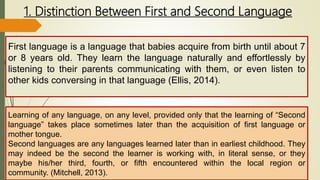
1. Distinction Between First and Second Language
First language is a language that babies acquire from birth until about 7
or 8 years old. They learn the language naturally and effortlessly by
listening to their parents communicating with them, or even listen to
other kids conversing in that language (Ellis, 2014).
Learning of any language, on any level, provided only that the learning of “Second
language” takes place sometimes later than the acquisition of first language or
mother tongue.
Second languages are any languages learned later than in earliest childhood. They
may indeed be the second the learner is working with, in literal sense, or they
maybe his/her third, fourth, or fifth encountered within the local region or
community. (Mitchell, 2013).
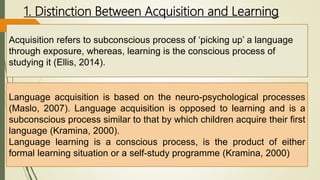
1. Distinction Between Acquisition and Learning
Acquisition refers to subconscious process of ‘picking up’ a language
through exposure, whereas, learning is the conscious process of
studying it (Ellis, 2014).
Language acquisition is based on the neuro-psychological processes
(Maslo, 2007). Language acquisition is opposed to learning and is a
subconscious process similar to that by which children acquire their first
language (Kramina, 2000).
Language learning is a conscious process, is the product of either
formal learning situation or a self-study programme (Kramina, 2000)
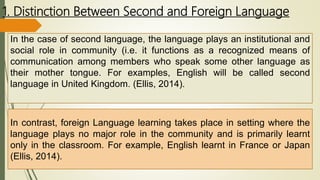
1. Distinction Between Second and Foreign Language
In the case of second language, the language plays an institutional and
social role in community (i.e. it functions as a recognized means of
communication among members who speak some other language as
their mother tongue. For examples, English will be called second
language in United Kingdom. (Ellis, 2014).
In contrast, foreign Language learning takes place in setting where the
language plays no major role in the community and is primarily learnt
only in the classroom. For example, English learnt in France or Japan
(Ellis, 2014).
1. Distinction Between Naturalistic and Instructed Second
Language Learning
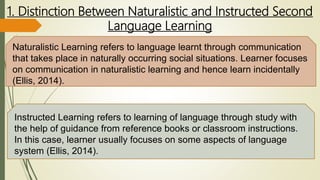
Naturalistic Learning refers to language learnt through communication
that takes place in naturally occurring social situations. Learner focuses
on communication in naturalistic learning and hence learn incidentally
(Ellis, 2014).
Instructed Learning refers to learning of language through study with
the help of guidance from reference books or classroom instructions.
In this case, learner usually focuses on some aspects of language
system (Ellis, 2014).
1. Distinction Between Explicit and Implicit Learning
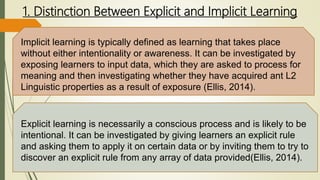
Implicit learning is typically defined as learning that takes place
without either intentionality or awareness. It can be investigated by
exposing learners to input data, which they are asked to process for
meaning and then investigating whether they have acquired ant L2
Linguistic properties as a result of exposure (Ellis, 2014).
Explicit learning is necessarily a conscious process and is likely to be
intentional. It can be investigated by giving learners an explicit rule
and asking them to apply it on certain data or by inviting them to try to
discover an explicit rule from any array of data provided(Ellis, 2014).
Concerns of Second Language learning
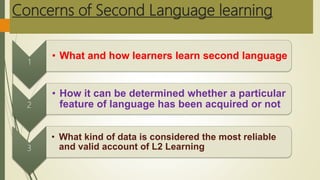
1
• What and how learners learn second language
2
• How it can be determined whether a particular
feature of language has been acquired or not
3
• What kind of data is considered the most reliable
and valid account of L2 Learning
Theories of Second Language learning
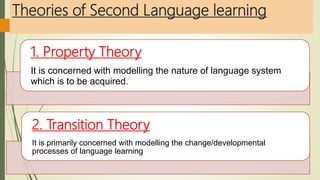
1. Property Theory
It is concerned with modelling the nature of language system
which is to be acquired.
2. Transition Theory
It is primarily concerned with modelling the change/developmental
processes of language learning
Second Language
Learning and Spolsky’s
General Model of L2
Learning
Spolsky’s Model of Second Language Learning
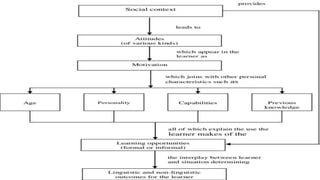
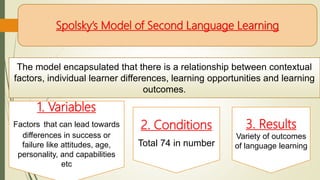
The model encapsulated that there is a relationship between contextual
factors, individual learner differences, learning opportunities and learning
outcomes.
1. Variables
Factors that can lead towards
differences in success or
failure like attitudes, age,
personality, and capabilities
etc
2. Conditions
Total 74 in number
3. Results
Variety of outcomes
of language learning
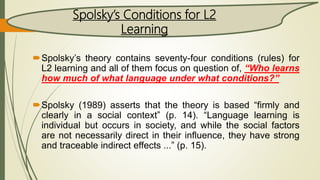
Spolsky’s theory contains seventy-four conditions (rules) for
L2 learning and all of them focus on question of, “Who learns
how much of what language under what conditions?”
Spolsky (1989) asserts that the theory is based “firmly and
clearly in a social context” (p. 14). “Language learning is
individual but occurs in society, and while the social factors
are not necessarily direct in their influence, they have strong
and traceable indirect effects ...” (p. 15).
Spolsky’s Conditions for L2
Learning
Spolsky’s Conditions for L2
Learning (Cont…)
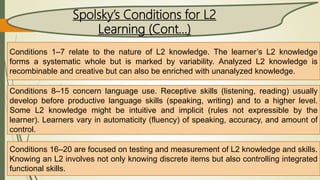
Conditions 1–7 relate to the nature of L2 knowledge. The learner’s L2 knowledge
forms a systematic whole but is marked by variability. Analyzed L2 knowledge is
recombinable and creative but can also be enriched with unanalyzed knowledge.
Conditions 8–15 concern language use. Receptive skills (listening, reading) usually
develop before productive language skills (speaking, writing) and to a higher level.
Some L2 knowledge might be intuitive and implicit (rules not expressible by the
learner). Learners vary in automaticity (fluency) of speaking, accuracy, and amount of
control.
Conditions 16–20 are focused on testing and measurement of L2 knowledge and skills.
Knowing an L2 involves not only knowing discrete items but also controlling integrated
functional skills.
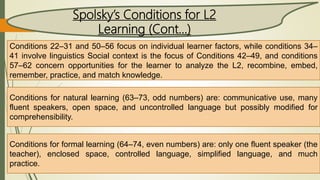
Conditions 22–31 and 50–56 focus on individual learner factors, while conditions 34–
41 involve linguistics Social context is the focus of Conditions 42–49, and conditions
57–62 concern opportunities for the learner to analyze the L2, recombine, embed,
remember, practice, and match knowledge.
Conditions for natural learning (63–73, odd numbers) are: communicative use, many
fluent speakers, open space, and uncontrolled language but possibly modified for
comprehensibility.
Conditions for formal learning (64–74, even numbers) are: only one fluent speaker (the
teacher), enclosed space, controlled language, simplified language, and much
practice.
Spolsky’s Conditions for L2
Learning (Cont…)
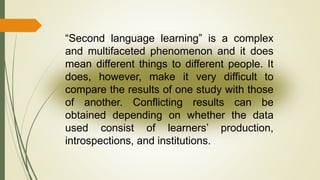
“Second language learning” is a complex
and multifaceted phenomenon and it does
mean different things to different people. It
does, however, make it very difficult to
compare the results of one study with those
of another. Conflicting results can be
obtained depending on whether the data
used consist of learners’ production,
introspections, and institutions.
STUDY QUESTIONS
 What role “contextual factors” play in Spolsky’s model of second language learning?
 Decide whether “Grammatical rule presented” in the classroom by instructor is an
example of explicit or implicit learning.
 If English is taught in non-English speaking country, what kind of learning a learner will
make in this context? Decide whether it is Naturalistic or Instructed.

Second Language Learning

  • 1.
    Second Language Learning Instructor: BibiHalima Bibi.Halima@uow.edu.pk
  • 2.
  • 3.
    1. Distinction BetweenFirst and Second Language First language is a language that babies acquire from birth until about 7 or 8 years old. They learn the language naturally and effortlessly by listening to their parents communicating with them, or even listen to other kids conversing in that language (Ellis, 2014). Learning of any language, on any level, provided only that the learning of “Second language” takes place sometimes later than the acquisition of first language or mother tongue. Second languages are any languages learned later than in earliest childhood. They may indeed be the second the learner is working with, in literal sense, or they maybe his/her third, fourth, or fifth encountered within the local region or community. (Mitchell, 2013).
  • 4.
    1. Distinction BetweenAcquisition and Learning Acquisition refers to subconscious process of ‘picking up’ a language through exposure, whereas, learning is the conscious process of studying it (Ellis, 2014). Language acquisition is based on the neuro-psychological processes (Maslo, 2007). Language acquisition is opposed to learning and is a subconscious process similar to that by which children acquire their first language (Kramina, 2000). Language learning is a conscious process, is the product of either formal learning situation or a self-study programme (Kramina, 2000)
  • 5.
    1. Distinction BetweenSecond and Foreign Language In the case of second language, the language plays an institutional and social role in community (i.e. it functions as a recognized means of communication among members who speak some other language as their mother tongue. For examples, English will be called second language in United Kingdom. (Ellis, 2014). In contrast, foreign Language learning takes place in setting where the language plays no major role in the community and is primarily learnt only in the classroom. For example, English learnt in France or Japan (Ellis, 2014).
  • 6.
    1. Distinction BetweenNaturalistic and Instructed Second Language Learning Naturalistic Learning refers to language learnt through communication that takes place in naturally occurring social situations. Learner focuses on communication in naturalistic learning and hence learn incidentally (Ellis, 2014). Instructed Learning refers to learning of language through study with the help of guidance from reference books or classroom instructions. In this case, learner usually focuses on some aspects of language system (Ellis, 2014).
  • 7.
    1. Distinction BetweenExplicit and Implicit Learning Implicit learning is typically defined as learning that takes place without either intentionality or awareness. It can be investigated by exposing learners to input data, which they are asked to process for meaning and then investigating whether they have acquired ant L2 Linguistic properties as a result of exposure (Ellis, 2014). Explicit learning is necessarily a conscious process and is likely to be intentional. It can be investigated by giving learners an explicit rule and asking them to apply it on certain data or by inviting them to try to discover an explicit rule from any array of data provided(Ellis, 2014).
  • 8.
    Concerns of SecondLanguage learning 1 • What and how learners learn second language 2 • How it can be determined whether a particular feature of language has been acquired or not 3 • What kind of data is considered the most reliable and valid account of L2 Learning
  • 9.
    Theories of SecondLanguage learning 1. Property Theory It is concerned with modelling the nature of language system which is to be acquired. 2. Transition Theory It is primarily concerned with modelling the change/developmental processes of language learning
  • 10.
    Second Language Learning andSpolsky’s General Model of L2 Learning
  • 12.
    Spolsky’s Model ofSecond Language Learning The model encapsulated that there is a relationship between contextual factors, individual learner differences, learning opportunities and learning outcomes. 1. Variables Factors that can lead towards differences in success or failure like attitudes, age, personality, and capabilities etc 2. Conditions Total 74 in number 3. Results Variety of outcomes of language learning
  • 13.
    Spolsky’s theory containsseventy-four conditions (rules) for L2 learning and all of them focus on question of, “Who learns how much of what language under what conditions?” Spolsky (1989) asserts that the theory is based “firmly and clearly in a social context” (p. 14). “Language learning is individual but occurs in society, and while the social factors are not necessarily direct in their influence, they have strong and traceable indirect effects ...” (p. 15). Spolsky’s Conditions for L2 Learning
  • 14.
    Spolsky’s Conditions forL2 Learning (Cont…) Conditions 1–7 relate to the nature of L2 knowledge. The learner’s L2 knowledge forms a systematic whole but is marked by variability. Analyzed L2 knowledge is recombinable and creative but can also be enriched with unanalyzed knowledge. Conditions 8–15 concern language use. Receptive skills (listening, reading) usually develop before productive language skills (speaking, writing) and to a higher level. Some L2 knowledge might be intuitive and implicit (rules not expressible by the learner). Learners vary in automaticity (fluency) of speaking, accuracy, and amount of control. Conditions 16–20 are focused on testing and measurement of L2 knowledge and skills. Knowing an L2 involves not only knowing discrete items but also controlling integrated functional skills.
  • 15.
    Conditions 22–31 and50–56 focus on individual learner factors, while conditions 34– 41 involve linguistics Social context is the focus of Conditions 42–49, and conditions 57–62 concern opportunities for the learner to analyze the L2, recombine, embed, remember, practice, and match knowledge. Conditions for natural learning (63–73, odd numbers) are: communicative use, many fluent speakers, open space, and uncontrolled language but possibly modified for comprehensibility. Conditions for formal learning (64–74, even numbers) are: only one fluent speaker (the teacher), enclosed space, controlled language, simplified language, and much practice. Spolsky’s Conditions for L2 Learning (Cont…)
  • 16.
    “Second language learning”is a complex and multifaceted phenomenon and it does mean different things to different people. It does, however, make it very difficult to compare the results of one study with those of another. Conflicting results can be obtained depending on whether the data used consist of learners’ production, introspections, and institutions.
  • 17.
    STUDY QUESTIONS  Whatrole “contextual factors” play in Spolsky’s model of second language learning?  Decide whether “Grammatical rule presented” in the classroom by instructor is an example of explicit or implicit learning.  If English is taught in non-English speaking country, what kind of learning a learner will make in this context? Decide whether it is Naturalistic or Instructed.