Facultad de Humanidades 
Escuela de Ciencias del Lenguaje 
Seminario de Lingüística Aplicada 
Communicative Language 
Teaching 
Prof. Carlos Mayora 
November 2014
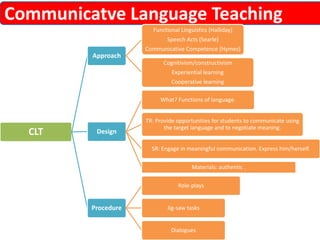
Communicatve Language Teaching 
CLT 
Approach 
Functional Linguistics (Halliday) 
Speech Acts (Searle) 
Communicative Competence (Hymes) 
Cognitivism/constructivism 
Experiential learning 
Cooperative learning 
Design 
What? Functions of language. 
TR: Provide opportunities for students to communicate using 
the target language and to negotiate meaning. 
SR: Engage in meaningful communication. Express him/herself. 
Materials: authentic . 
Procedure 
Role-plays 
Jig-saw tasks 
Dialogues
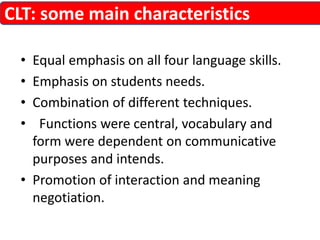
CLT: some main characteristics 
• Equal emphasis on all four language skills. 
• Emphasis on students needs. 
• Combination of different techniques. 
• Functions were central, vocabulary and 
form were dependent on communicative 
purposes and intends. 
• Promotion of interaction and meaning 
negotiation.
CLT: some main characteristics 
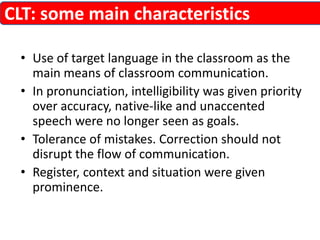
• Use of target language in the classroom as the 
main means of classroom communication. 
• In pronunciation, intelligibility was given priority 
over accuracy, native-like and unaccented 
speech were no longer seen as goals. 
• Tolerance of mistakes. Correction should not 
disrupt the flow of communication. 
• Register, context and situation were given 
prominence.
CLT: criticism 
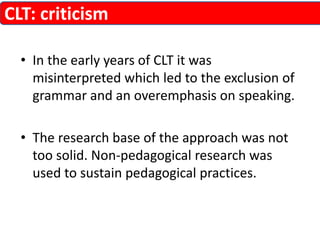
• In the early years of CLT it was 
misinterpreted which led to the exclusion of 
grammar and an overemphasis on speaking. 
• The research base of the approach was not 
too solid. Non-pedagogical research was 
used to sustain pedagogical practices.
CLT: criticism 
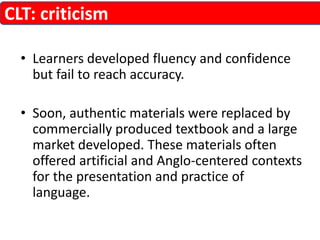
• Learners developed fluency and confidence 
but fail to reach accuracy. 
• Soon, authentic materials were replaced by 
commercially produced textbook and a large 
market developed. These materials often 
offered artificial and Anglo-centered contexts 
for the presentation and practice of 
language.
CLT: criticism 
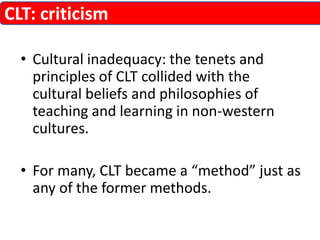
• Cultural inadequacy: the tenets and 
principles of CLT collided with the 
cultural beliefs and philosophies of 
teaching and learning in non-western 
cultures. 
• For many, CLT became a “method” just as 
any of the former methods.
Communicative approach 
A development (evolution) of CLT in 
which the centrality of meaning and 
the functional view of language are 
kept as principles, but in which 
different designs and procedures are 
used in the classroom.
Communicative approaches 
• Competency-based teaching 
• Content-based instruction 
• Task-based language teaching 
• Strategic teaching 
• Critical pedagogy
Bibliography and suggested readings 
• Celce-Murcia, M. (2001). Language teaching approaches: An overview. 
In Celce-Murcia, M. (Ed.) Teaching English as a second or foreign 
language (3rd ed., pp. 3-11). Boston, MA: Heinle & Heinle. 
• Kumaravadivelu, B. (2006) Understanding language teaching. From 
method to postmethod. London: Lawrence Earlbaum Associates Inc. 
• Richards, J.C. (2006) Communicative language teaching today. 
Cambridge: Cambridge University Press. 
• Richards, J.C. and Rodgers, T. (2001). Approaches and methods in 
language teaching (2nd edition). Cambridge: Cambridge University 
Press. 
• Savignon, S. (1991). Communicative language teaching: State of the 
art. TESOL Quarterly, 25(2): 261-267.

Communicative Language Teaching

  • 1.
    Facultad de Humanidades Escuela de Ciencias del Lenguaje Seminario de Lingüística Aplicada Communicative Language Teaching Prof. Carlos Mayora November 2014
  • 2.
    Communicatve Language Teaching CLT Approach Functional Linguistics (Halliday) Speech Acts (Searle) Communicative Competence (Hymes) Cognitivism/constructivism Experiential learning Cooperative learning Design What? Functions of language. TR: Provide opportunities for students to communicate using the target language and to negotiate meaning. SR: Engage in meaningful communication. Express him/herself. Materials: authentic . Procedure Role-plays Jig-saw tasks Dialogues
  • 3.
    CLT: some maincharacteristics • Equal emphasis on all four language skills. • Emphasis on students needs. • Combination of different techniques. • Functions were central, vocabulary and form were dependent on communicative purposes and intends. • Promotion of interaction and meaning negotiation.
  • 4.
    CLT: some maincharacteristics • Use of target language in the classroom as the main means of classroom communication. • In pronunciation, intelligibility was given priority over accuracy, native-like and unaccented speech were no longer seen as goals. • Tolerance of mistakes. Correction should not disrupt the flow of communication. • Register, context and situation were given prominence.
  • 5.
    CLT: criticism •In the early years of CLT it was misinterpreted which led to the exclusion of grammar and an overemphasis on speaking. • The research base of the approach was not too solid. Non-pedagogical research was used to sustain pedagogical practices.
  • 6.
    CLT: criticism •Learners developed fluency and confidence but fail to reach accuracy. • Soon, authentic materials were replaced by commercially produced textbook and a large market developed. These materials often offered artificial and Anglo-centered contexts for the presentation and practice of language.
  • 7.
    CLT: criticism •Cultural inadequacy: the tenets and principles of CLT collided with the cultural beliefs and philosophies of teaching and learning in non-western cultures. • For many, CLT became a “method” just as any of the former methods.
  • 8.
    Communicative approach Adevelopment (evolution) of CLT in which the centrality of meaning and the functional view of language are kept as principles, but in which different designs and procedures are used in the classroom.
  • 9.
    Communicative approaches •Competency-based teaching • Content-based instruction • Task-based language teaching • Strategic teaching • Critical pedagogy
  • 10.
    Bibliography and suggestedreadings • Celce-Murcia, M. (2001). Language teaching approaches: An overview. In Celce-Murcia, M. (Ed.) Teaching English as a second or foreign language (3rd ed., pp. 3-11). Boston, MA: Heinle & Heinle. • Kumaravadivelu, B. (2006) Understanding language teaching. From method to postmethod. London: Lawrence Earlbaum Associates Inc. • Richards, J.C. (2006) Communicative language teaching today. Cambridge: Cambridge University Press. • Richards, J.C. and Rodgers, T. (2001). Approaches and methods in language teaching (2nd edition). Cambridge: Cambridge University Press. • Savignon, S. (1991). Communicative language teaching: State of the art. TESOL Quarterly, 25(2): 261-267.