ENGL 625: Introduction to TESOLSession # 4
Introduction of the MA TESOL Organization.Lily Savova’s Proposal Writing Workshop, This Thursday!Teacher-Scholar Symposium, This Friday! As part of The People’s G20 Summit: A Symposium On Globalization and its Impact on Northern Appalachia by our Center for Northern Appalachian Studies and running all this week--at 7 p.m. in Pratt Auditorium tomorrow (Tu.) evening,Morning Group:Antony’s discussion on Kumar1 and 2Soo-ok’s discussion on Norton’s article and the TQ DialoguesSbu’s discussion on Hall 1 and 2Afternoon group:Carmella’s discussion on Kumar 2Ashley B.’s discussion on Norton’s Investment articleAshley R.’s Hall discussion Agenda and Announcements
When I read this article (B. Norton), I found myself can’t stop reading through the whole article. No matter the story of Ivan ,Wong, or Mary, each of them reminds me of teaching English in my home country, Taiwan. Wong’s story interests me the most. Wong never talked to people at work because he was afraid that he would make mistakes. I have taught English in an English learning institution for two years. Most of the kids were tried to talk as more as possible when they came to the English learning institution. However, a boy, Shawn, never looked happy and enjoyed in the class. He never said a word or answered my question. He even lies on the desk when other kids come to talk to him in English. Finally, I know the main reason behind Shawn after talking to his parents. Chia-Chen says…
I resonate with the writer’s(Norton) conceptualization the relationship between the language learner and the social environment. A great many language learners were very excited when they first arrived in an English speaking countries, for they were exposed to an ideal English speaking environment. Some people survived and acquired the necessary skills, some people failed as the writers explained in the article: it is the social identities which block them from conversing with the native speakers.Yuhua says…
Every person, regardless of age, wants to know that someone believes in them. I want my students to know that I believe in the; that I care about who they are as a person. Sure, they might not always get the concept I am trying to teach, but I believe that as long as they know that I believe in them and care about them, that they will try their hardest to work and understand what I am teaching. Many students do not have a strong home life where they are encouraged by their parents, but as a teacher, I have the influence to help them know that they can achieve something, and Norton's article helped me to realize my fullest potential as a teacher.Molly says…
I have been an enthusiastic English learner for many years and cherish every opportunity I have when talking with native speakers, but after I arrive in the US, sometimes I cannot catch up with the local people and feel embarrassed to repeat over and over, or some people may not want to talk with me, I gave up my opportunity to practice English. Even though I understand”(P.14) the more exposure and practice, the more proficient learner will become” I believe most of the international students here have gone through this period of depression and anxiety.Yuhua continues…
After reading B. Peirce’s article and several responses to it, I know why. I’m another Wong. I’m afraid of my errors when I speak English to native speakers(NS). And worse than ever, I felt I’m so deficient and stupid when I meet non-native speakers(NNS) who speak English fluently. Whenever it happens, mostly I keep silent and just speak a little. Why do I feel like that? My questions go on and on.Seonmin says…
I am a just a student in IUP, but when I go back to Japan, I have to teach English in senior high school. I have a strong desire to speak English fluently. However, unlikely Martina, I don’t force myself to the situation like her. I have to read and think in English every day, but either can do only by myself. I am not connected with society or native speakers very much. I hesitate to speak to a native speaker, because my English is not good. Then, I was impressed with her change on the phone and at work. It is also important to have the ability to claim the right to speak so as to develop the language competence.Hiromi says…
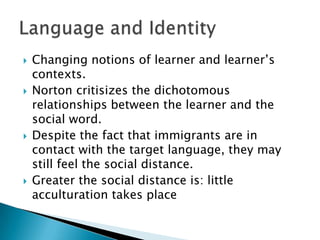
Changing notions of learner and learner’s contexts.Norton critisizes the dichotomous relationships between the learner and the social word.Despite the fact that immigrants are in contact with the target language, they may still feel the social distance.Greater the social distance is: little acculturation takes placeLanguage and Identity
Power relationships play a significant role in social interactions.Eva’s humiliation, her feeling of “strange woman”How do power relationships are implicated in learning and teaching?Language learners as having complex, changing, dynamic and multiple social identities.Social identity is multiple and contradictory: a site for struggleNorton’s poststructural social identity theory in TESOL
Problemitizing the notion of motivation, advocating for the notion of investment.We cannot quantify the learners’ commitment to learning the target language Instrumental vs integrative motivationWhen learners INVEST in a second language, they do so with the understanding that they will gain symbolic and material sources.Investment: the relationship of the language learner to the changing social world.From Motivation to Investment
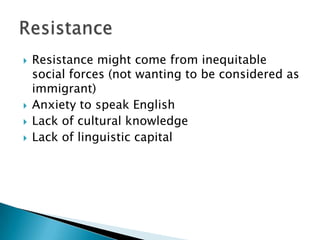
Resistance might come from inequitable social forces (not wanting to be considered as immigrant)Anxiety to speak EnglishLack of cultural knowledgeLack of linguistic capitalResistance
SaphirWorf HypothesisCriticisms to  the language and culture connectionLanguage and culture are NOT inextricablePut the Whorfian theory into good useThe benefits of linguistic pluralism Constantly think about the language culture connection as it applies to language educationLanguage and Culture
Cultural understanding is not a by-product of learningThe discussion of culture in language education became important due to globalization, international commerce etc.Moving away from dichotomizing cultures“If we develop a notion of culture in TESOL that takes into account the cultural in the individual, and individual in the culture, then we will have a conceptualization that will stand us in good stead in the 21st century” (Atkinson, 1999 p. 648-49)Culture
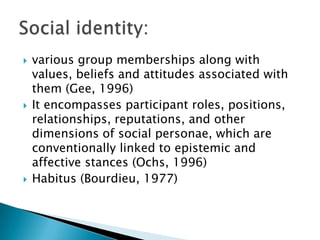
various group memberships along with values, beliefs and attitudes associated with them (Gee, 1996)It encompasses participant roles, positions, relationships, reputations, and other dimensions of social personae, which are conventionally linked to epistemic and affective stances (Ochs, 1996)Habitus (Bourdieu, 1977)Social identity:
How we enact any particular identity is responsive to contextual conditions.Individuals are neither free agents, nor completely socially determined productsRecursive process of identity production
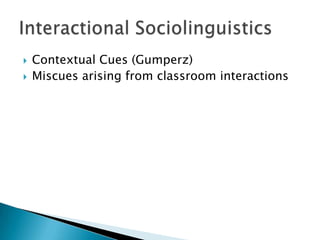
Contextual Cues (Gumperz)Miscues arising from classroom interactionsInteractional Sociolinguistics
What we learn is shaped by our history of lived experiences in our communicative environmentsLanguage learning= culture learningCultural knowledge is learnt though languageLearning happens both inside and outside the classroom communitySociocultural Theory of Language Learning
The reconceptualization of individual in SLAArgues for the conception of investment rather than motivation---- Language learner is viewed as someone who has complex sociohistory, multiple aims, desires and dynamic cultureNorton’s Investment vs motivation
Make sure that you blog at least 2 hours before the class.Presenters: send your materials a day before your presentations, that is ANYTIME on Sunday.ReadingsAssignments

Intro To Tesol 4

  • 1.
    ENGL 625: Introductionto TESOLSession # 4
  • 2.
    Introduction of theMA TESOL Organization.Lily Savova’s Proposal Writing Workshop, This Thursday!Teacher-Scholar Symposium, This Friday! As part of The People’s G20 Summit: A Symposium On Globalization and its Impact on Northern Appalachia by our Center for Northern Appalachian Studies and running all this week--at 7 p.m. in Pratt Auditorium tomorrow (Tu.) evening,Morning Group:Antony’s discussion on Kumar1 and 2Soo-ok’s discussion on Norton’s article and the TQ DialoguesSbu’s discussion on Hall 1 and 2Afternoon group:Carmella’s discussion on Kumar 2Ashley B.’s discussion on Norton’s Investment articleAshley R.’s Hall discussion Agenda and Announcements
  • 3.
    When I readthis article (B. Norton), I found myself can’t stop reading through the whole article. No matter the story of Ivan ,Wong, or Mary, each of them reminds me of teaching English in my home country, Taiwan. Wong’s story interests me the most. Wong never talked to people at work because he was afraid that he would make mistakes. I have taught English in an English learning institution for two years. Most of the kids were tried to talk as more as possible when they came to the English learning institution. However, a boy, Shawn, never looked happy and enjoyed in the class. He never said a word or answered my question. He even lies on the desk when other kids come to talk to him in English. Finally, I know the main reason behind Shawn after talking to his parents. Chia-Chen says…
  • 4.
    I resonate withthe writer’s(Norton) conceptualization the relationship between the language learner and the social environment. A great many language learners were very excited when they first arrived in an English speaking countries, for they were exposed to an ideal English speaking environment. Some people survived and acquired the necessary skills, some people failed as the writers explained in the article: it is the social identities which block them from conversing with the native speakers.Yuhua says…
  • 5.
    Every person, regardlessof age, wants to know that someone believes in them. I want my students to know that I believe in the; that I care about who they are as a person. Sure, they might not always get the concept I am trying to teach, but I believe that as long as they know that I believe in them and care about them, that they will try their hardest to work and understand what I am teaching. Many students do not have a strong home life where they are encouraged by their parents, but as a teacher, I have the influence to help them know that they can achieve something, and Norton's article helped me to realize my fullest potential as a teacher.Molly says…
  • 6.
    I have beenan enthusiastic English learner for many years and cherish every opportunity I have when talking with native speakers, but after I arrive in the US, sometimes I cannot catch up with the local people and feel embarrassed to repeat over and over, or some people may not want to talk with me, I gave up my opportunity to practice English. Even though I understand”(P.14) the more exposure and practice, the more proficient learner will become” I believe most of the international students here have gone through this period of depression and anxiety.Yuhua continues…
  • 7.
    After reading B.Peirce’s article and several responses to it, I know why. I’m another Wong. I’m afraid of my errors when I speak English to native speakers(NS). And worse than ever, I felt I’m so deficient and stupid when I meet non-native speakers(NNS) who speak English fluently. Whenever it happens, mostly I keep silent and just speak a little. Why do I feel like that? My questions go on and on.Seonmin says…
  • 8.
    I am ajust a student in IUP, but when I go back to Japan, I have to teach English in senior high school. I have a strong desire to speak English fluently. However, unlikely Martina, I don’t force myself to the situation like her. I have to read and think in English every day, but either can do only by myself. I am not connected with society or native speakers very much. I hesitate to speak to a native speaker, because my English is not good. Then, I was impressed with her change on the phone and at work. It is also important to have the ability to claim the right to speak so as to develop the language competence.Hiromi says…
  • 9.
    Changing notions oflearner and learner’s contexts.Norton critisizes the dichotomous relationships between the learner and the social word.Despite the fact that immigrants are in contact with the target language, they may still feel the social distance.Greater the social distance is: little acculturation takes placeLanguage and Identity
  • 10.
    Power relationships playa significant role in social interactions.Eva’s humiliation, her feeling of “strange woman”How do power relationships are implicated in learning and teaching?Language learners as having complex, changing, dynamic and multiple social identities.Social identity is multiple and contradictory: a site for struggleNorton’s poststructural social identity theory in TESOL
  • 11.
    Problemitizing the notionof motivation, advocating for the notion of investment.We cannot quantify the learners’ commitment to learning the target language Instrumental vs integrative motivationWhen learners INVEST in a second language, they do so with the understanding that they will gain symbolic and material sources.Investment: the relationship of the language learner to the changing social world.From Motivation to Investment
  • 12.
    Resistance might comefrom inequitable social forces (not wanting to be considered as immigrant)Anxiety to speak EnglishLack of cultural knowledgeLack of linguistic capitalResistance
  • 13.
    SaphirWorf HypothesisCriticisms to the language and culture connectionLanguage and culture are NOT inextricablePut the Whorfian theory into good useThe benefits of linguistic pluralism Constantly think about the language culture connection as it applies to language educationLanguage and Culture
  • 14.
    Cultural understanding isnot a by-product of learningThe discussion of culture in language education became important due to globalization, international commerce etc.Moving away from dichotomizing cultures“If we develop a notion of culture in TESOL that takes into account the cultural in the individual, and individual in the culture, then we will have a conceptualization that will stand us in good stead in the 21st century” (Atkinson, 1999 p. 648-49)Culture
  • 15.
    various group membershipsalong with values, beliefs and attitudes associated with them (Gee, 1996)It encompasses participant roles, positions, relationships, reputations, and other dimensions of social personae, which are conventionally linked to epistemic and affective stances (Ochs, 1996)Habitus (Bourdieu, 1977)Social identity:
  • 16.
    How we enactany particular identity is responsive to contextual conditions.Individuals are neither free agents, nor completely socially determined productsRecursive process of identity production
  • 17.
    Contextual Cues (Gumperz)Miscuesarising from classroom interactionsInteractional Sociolinguistics
  • 18.
    What we learnis shaped by our history of lived experiences in our communicative environmentsLanguage learning= culture learningCultural knowledge is learnt though languageLearning happens both inside and outside the classroom communitySociocultural Theory of Language Learning
  • 19.
    The reconceptualization ofindividual in SLAArgues for the conception of investment rather than motivation---- Language learner is viewed as someone who has complex sociohistory, multiple aims, desires and dynamic cultureNorton’s Investment vs motivation
  • 20.
    Make sure thatyou blog at least 2 hours before the class.Presenters: send your materials a day before your presentations, that is ANYTIME on Sunday.ReadingsAssignments