SYSTEM
ANALYSIS PRESENTATION
Course Instructor- RETHWAN
FAIZ
NAME ID
1. Alam iftekhar ul 12-22225-3
2. Hasan,Md.Nazmul Anas Bin 13-24437-2
3. Shiblu Nazmul Huda 12-22183-3
4.Rahman,MD.Sadiqur 13-24415-2
5.Delowar,Chowdhury Salahuddin 13-23737-1
SMART CARD TECHNOLOGY.
Aim of our presentation is to just
give you a brief idea about the
smart card technology being one of
the best steps towards the
advancement of science and
technology , making our life faster
and obviously easier.
CONTENTS.
 What is smart card?
 The dimensions.
 Types.
 What is ISO 7816,and ISO 14443.
 Why use smart card ?
 Uses of smart card.
 Advantages.
 Disadvantages.
 Use of smart Card.
 Future.
 Conclusion.
1. What is a smart card?
 The standard definition of a a smart card, or
integrated circuit card (ICC), is any pocket
sized card with embedded integrated circuits.
OR
 A smart card is a plastic card with a
small, built in microcomputer chip and
integrated circuit that can store and
process a lot of data
Dimensions of smart card.
85.6mm x 53.98mm x 0.76mm(defined by ISO 7816
Chips being used:-
Vcc
RST
CLK
AUX1
GND
SWP
I/O
AUX2
 Vcc - gives the biasing voltage to the smart card.
 RST- resets the data stored in the smart card.
 CLK- provides the clock signals for the
operations.
 GND – provides ground as usual.
 Vpp –provides the programming voltage to the
EEPROM.But now it is not used,because the
modern cards are capable of generating
programmin voltage by itself when comes in
contact with a reader.
 I/P,O/P- is the input output port.
 AUX1/2- are auxilliary contacts,used by USB
Types of smart card.
 Contact smart cards.
 Contactless smart cards.
 Dual interface smart cards.
 Hybrid smart cards.
 Integrated circuit microprocessor smart
card.
1. Contact smart card.
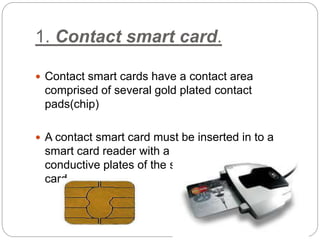
 Contact smart cards have a contact area
comprised of several gold plated contact
pads(chip)
 A contact smart card must be inserted in to a
smart card reader with a direct connection to the
conductive plates of the surface of the smart
card.
2. Contactless smart card.
 Uses an inbuilt internal antenna for communication with
the card reader.
 It just requires a close proximity (10 cm.)to the
reader.The readers also have an inbuilt internal antenna
to identify the smart card and communicate with it.
 The antenna used in these use radio frequency to
communicate.
Contactless smart card:-
3.Dual interface smart cards.
 Also called Combi card.
 Has a single chip over it.
 Has both contact as well as contactless
interfaces.
 We can use the same chip using either
contact or contactless interface with a
Dual interface smart card.
4.Hybrid smart card.
 Two chips.
 One with contact interface.
 Other with contactless interface.
 No connection between the two
chips.
Hybrid smart cards.
5.Integrated circuit (ic) microprocessor
card.
 Microprocessor cards , also called as
chip cards offer greater range of
memory storage of data than a
traditional smart card.
 Chips used are also called as
microprocessors with internal memory.
What is iso 7816, iso 14443 .
 1. ISO-7810.
 Internationally accepted standard for smart cards.
 Deals with different aspects of smart card. Like:-
a. Dimensions.
b. Radio frequency range.
c. Mechanical stress.
d. Location of IC in the card.
e. Location of magnetic strip in the card.
Etc…
ISO-7816.
 Has 14 divisions.
 Part 1,2,3- deal with contact smart card.(defines
its physical aspects).
 Part 4,5…..9;11,12…..15- deal with both contact
as well as contactless cards.
Define-
a. Card logical structure.
b. Programming.
c. Biometric verification.
 Part 10 defines the chip for memory cards for
applications like telephone or electricity billing.
ISO 14443.
 International standard.
 Deals – only contactless smart cards.
 Defines:-
a. Interface.
b. Radio frequency interface.
c. Electrical interface.
d. Operating distance.
Etc…..
How it works
Uses:-
 Net surfing.
 Electronic purse(debit/credit card).
 Banking(ATM card).
 Employee attendance.
 Medical identification.
 Identity card.
 Driving licence.
 Pan card.
 Passport.
 Payphones.
And many more apps..
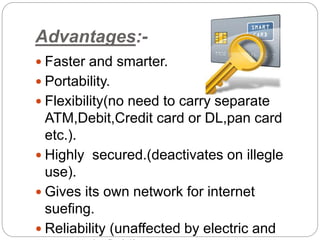
Advantages:-
 Faster and smarter.
 Portability.
 Flexibility(no need to carry separate
ATM,Debit,Credit card or DL,pan card
etc.).
 Highly secured.(deactivates on illegle
use).
 Gives its own network for internet
suefing.
 Reliability (unaffected by electric and
Disadvantages:-
COST AND AVAILABILITY
 Expensive.
 All readers can not read all types of
smart card(depends upon the smart
card brand).
Why Smart Cards
 Improve the convenience and security of any
transaction.
 Provide tamper-proof storage of user and account
identity.
 Provide vital components of system security.
 Protect against a full range of security threats
Future
• Health Services
• Education
• Transportation
• Tele-communications
Conclusio
n.
Thank
You

Psa final

  • 1.
  • 2.
    NAME ID 1. Alamiftekhar ul 12-22225-3 2. Hasan,Md.Nazmul Anas Bin 13-24437-2 3. Shiblu Nazmul Huda 12-22183-3 4.Rahman,MD.Sadiqur 13-24415-2 5.Delowar,Chowdhury Salahuddin 13-23737-1
  • 3.
  • 4.
    Aim of ourpresentation is to just give you a brief idea about the smart card technology being one of the best steps towards the advancement of science and technology , making our life faster and obviously easier.
  • 5.
    CONTENTS.  What issmart card?  The dimensions.  Types.  What is ISO 7816,and ISO 14443.  Why use smart card ?  Uses of smart card.  Advantages.  Disadvantages.  Use of smart Card.  Future.  Conclusion.
  • 6.
    1. What isa smart card?  The standard definition of a a smart card, or integrated circuit card (ICC), is any pocket sized card with embedded integrated circuits. OR  A smart card is a plastic card with a small, built in microcomputer chip and integrated circuit that can store and process a lot of data
  • 7.
    Dimensions of smartcard. 85.6mm x 53.98mm x 0.76mm(defined by ISO 7816
  • 8.
  • 9.
     Vcc -gives the biasing voltage to the smart card.  RST- resets the data stored in the smart card.  CLK- provides the clock signals for the operations.  GND – provides ground as usual.  Vpp –provides the programming voltage to the EEPROM.But now it is not used,because the modern cards are capable of generating programmin voltage by itself when comes in contact with a reader.  I/P,O/P- is the input output port.  AUX1/2- are auxilliary contacts,used by USB
  • 10.
    Types of smartcard.  Contact smart cards.  Contactless smart cards.  Dual interface smart cards.  Hybrid smart cards.  Integrated circuit microprocessor smart card.
  • 11.
    1. Contact smartcard.  Contact smart cards have a contact area comprised of several gold plated contact pads(chip)  A contact smart card must be inserted in to a smart card reader with a direct connection to the conductive plates of the surface of the smart card.
  • 12.
    2. Contactless smartcard.  Uses an inbuilt internal antenna for communication with the card reader.  It just requires a close proximity (10 cm.)to the reader.The readers also have an inbuilt internal antenna to identify the smart card and communicate with it.  The antenna used in these use radio frequency to communicate.
  • 13.
  • 14.
    3.Dual interface smartcards.  Also called Combi card.  Has a single chip over it.  Has both contact as well as contactless interfaces.  We can use the same chip using either contact or contactless interface with a
  • 15.
  • 16.
    4.Hybrid smart card. Two chips.  One with contact interface.  Other with contactless interface.  No connection between the two chips.
  • 17.
  • 18.
    5.Integrated circuit (ic)microprocessor card.  Microprocessor cards , also called as chip cards offer greater range of memory storage of data than a traditional smart card.  Chips used are also called as microprocessors with internal memory.
  • 19.
    What is iso7816, iso 14443 .  1. ISO-7810.  Internationally accepted standard for smart cards.  Deals with different aspects of smart card. Like:- a. Dimensions. b. Radio frequency range. c. Mechanical stress. d. Location of IC in the card. e. Location of magnetic strip in the card. Etc…
  • 20.
    ISO-7816.  Has 14divisions.  Part 1,2,3- deal with contact smart card.(defines its physical aspects).  Part 4,5…..9;11,12…..15- deal with both contact as well as contactless cards. Define- a. Card logical structure. b. Programming. c. Biometric verification.  Part 10 defines the chip for memory cards for applications like telephone or electricity billing.
  • 21.
    ISO 14443.  Internationalstandard.  Deals – only contactless smart cards.  Defines:- a. Interface. b. Radio frequency interface. c. Electrical interface. d. Operating distance. Etc…..
  • 22.
  • 23.
    Uses:-  Net surfing. Electronic purse(debit/credit card).  Banking(ATM card).  Employee attendance.  Medical identification.  Identity card.  Driving licence.  Pan card.  Passport.  Payphones. And many more apps..
  • 24.
    Advantages:-  Faster andsmarter.  Portability.  Flexibility(no need to carry separate ATM,Debit,Credit card or DL,pan card etc.).  Highly secured.(deactivates on illegle use).  Gives its own network for internet suefing.  Reliability (unaffected by electric and
  • 25.
    Disadvantages:- COST AND AVAILABILITY Expensive.  All readers can not read all types of smart card(depends upon the smart card brand).
  • 26.
    Why Smart Cards Improve the convenience and security of any transaction.  Provide tamper-proof storage of user and account identity.  Provide vital components of system security.  Protect against a full range of security threats
  • 27.
    Future • Health Services •Education • Transportation • Tele-communications
  • 28.
  • 30.

Editor's Notes

  • #5 Aim of my ppt is to just give you a brief idea about the smart card technology being one of the best steps towards the advancement of science and technology,making our life faster and obviously easier.