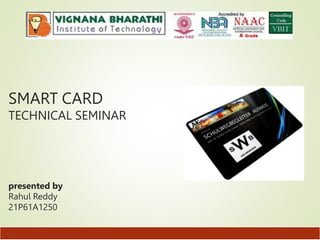
SMART CARD
TECHNICAL SEMINAR
presented by
Rahul Reddy
21P61A1250
Overview
❖What is Smart Card?
❖Design
❖Types of smart cards
❖Applications
❖Security with smart cards
❖Benefits
❖Problems
❖References
What is Smart Card?
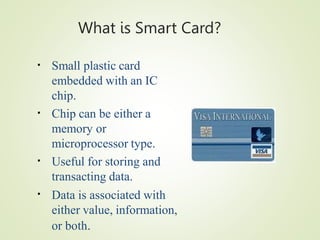
▪ Small plastic card
embedded with an IC
chip.
Chip can be either a
memory or
microprocessor type.
Useful for storing and
transacting data.
Data is associated with
either value, information,
or both.
▪
▪
▪
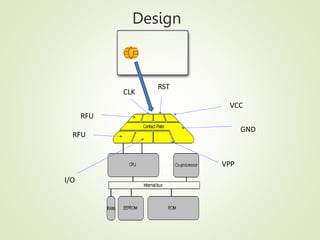
Design
VCC
VPP
GND
I/O
RFU
RFU
CLK
RST
Types of Smart Cards
Based on the way the smart card interacts with
the Card Reader, smart cards are of three types:
➢Contact Smart Cards
➢Contactless Smart Cards
➢Hybrid Cards
Contact Smart Card
Defined in ISO 7810
standard.
Have contact area of
approx. 1 cm2
This area comprises of
several gold-plated
contact pads.
Pads provides electrical
conductivity.
Power is supplied by
card reader.
Contactless smart cards
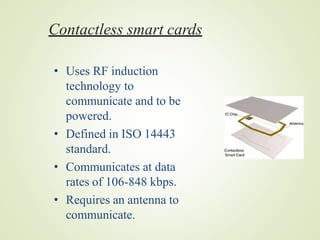
• Uses RF induction
technology to
communicate and to be
powered.
• Defined in ISO 14443
standard.
• Communicates at data
rates of 106-848 kbps.
• Requires an antenna to
communicate.
Hybrids
• Implements former two
interfaces on a single
card.
•
•
On developing stage.
Example is Andante,
Porto’s multi-application
transport card.
Applications
• Financial
> As ATM cards, Fuel cards, SIMs.
> As electronic wallet.
• Identification
• Public Transit.
• Educational Institutes.
> Tracking Student attendance.
>As an electronic purse to pay various
bills.
> Access control of some buildings.
Security with smart cards
The standard security goals like
▪ Authentication
▪ Confidentiality
▪ Integrity
▪ Non-repudiation
can easily be provided by using smart cards..
Benefits
• Easy to use.
• Individuals gain increased
convenience.
• Multiple tasks can be done by a
single card.
• An important key in E-
governance.
• Enhanced security.
• A handsome way to deal with
the things.
Problems
• High probability for damage of
card.
• Malware can break smart card
security model.
• Lack of standards for
functionality & security.
smartcard-1250-SAIPATIL.pptx

smartcard-1250-SAIPATIL.pptx

  • 1.
    SMART CARD TECHNICAL SEMINAR presentedby Rahul Reddy 21P61A1250
  • 2.
    Overview ❖What is SmartCard? ❖Design ❖Types of smart cards ❖Applications ❖Security with smart cards ❖Benefits ❖Problems ❖References
  • 3.
    What is SmartCard? ▪ Small plastic card embedded with an IC chip. Chip can be either a memory or microprocessor type. Useful for storing and transacting data. Data is associated with either value, information, or both. ▪ ▪ ▪
  • 4.
  • 5.
    Types of SmartCards Based on the way the smart card interacts with the Card Reader, smart cards are of three types: ➢Contact Smart Cards ➢Contactless Smart Cards ➢Hybrid Cards
  • 6.
    Contact Smart Card Definedin ISO 7810 standard. Have contact area of approx. 1 cm2 This area comprises of several gold-plated contact pads. Pads provides electrical conductivity. Power is supplied by card reader.
  • 7.
    Contactless smart cards •Uses RF induction technology to communicate and to be powered. • Defined in ISO 14443 standard. • Communicates at data rates of 106-848 kbps. • Requires an antenna to communicate.
  • 8.
    Hybrids • Implements formertwo interfaces on a single card. • • On developing stage. Example is Andante, Porto’s multi-application transport card.
  • 9.
    Applications • Financial > AsATM cards, Fuel cards, SIMs. > As electronic wallet. • Identification • Public Transit. • Educational Institutes. > Tracking Student attendance. >As an electronic purse to pay various bills. > Access control of some buildings.
  • 10.
    Security with smartcards The standard security goals like ▪ Authentication ▪ Confidentiality ▪ Integrity ▪ Non-repudiation can easily be provided by using smart cards..
  • 11.
    Benefits • Easy touse. • Individuals gain increased convenience. • Multiple tasks can be done by a single card. • An important key in E- governance. • Enhanced security. • A handsome way to deal with the things.
  • 12.
    Problems • High probabilityfor damage of card. • Malware can break smart card security model. • Lack of standards for functionality & security.