CHAPTER 2
LAND & WATER FORMS
• Produce the infinite local
variations in the surface of
the earth.
LAND FORMS
TWO KINDS OF FORCES
• 1. Forces that wash, that wear down the
earth surface.
• 2. Forces that move, push & raise the
earth’s surface.
GERMOPHOLOGY
•  is a branch of geology that
studies the origin,
characteristics & development
of land forms.
GERMOPHOLOGISTS
•  these are persons that
studies the land forms.
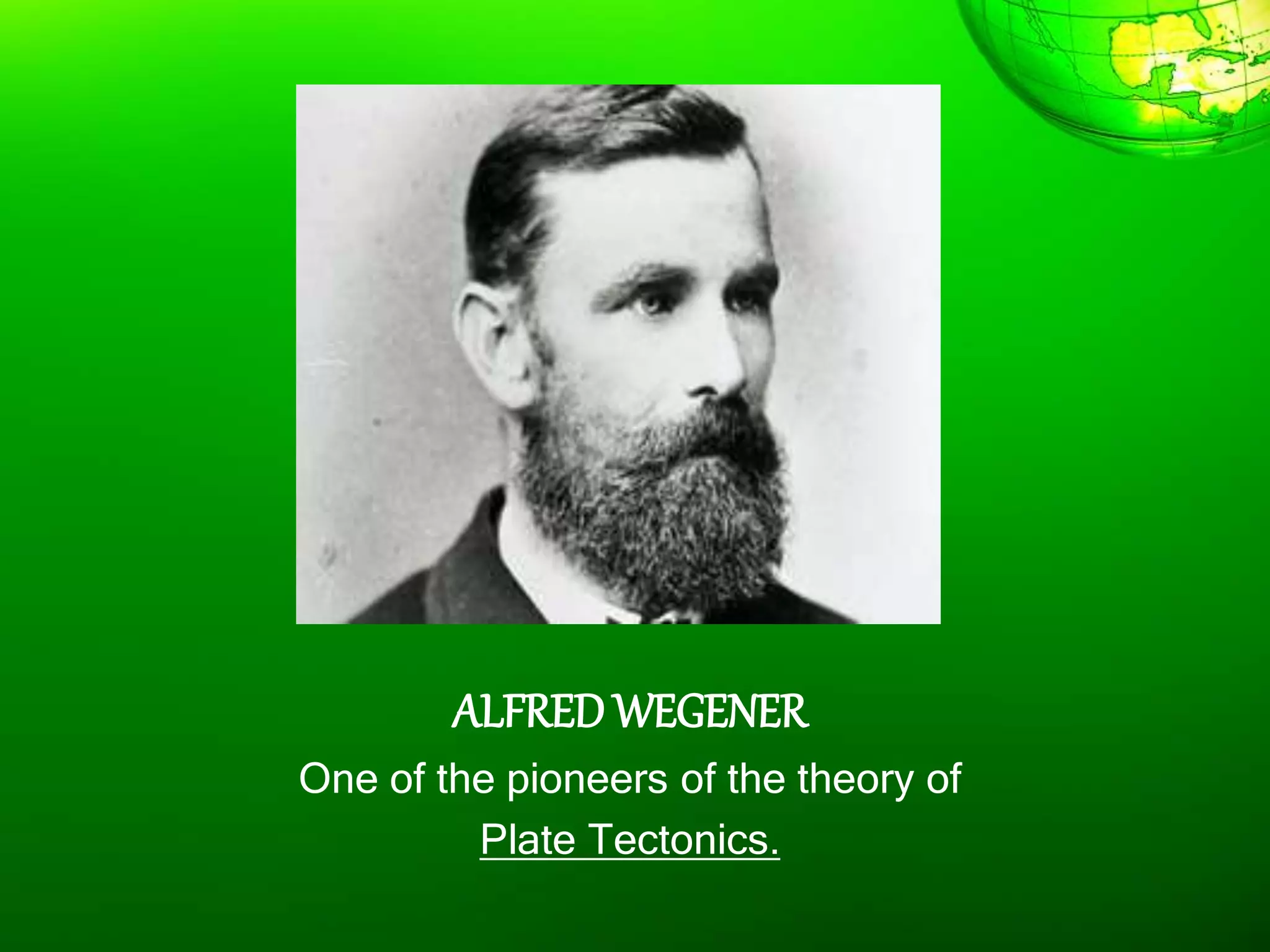
ALFRED WEGENER
One of the pioneers of the theory of
Plate Tectonics.
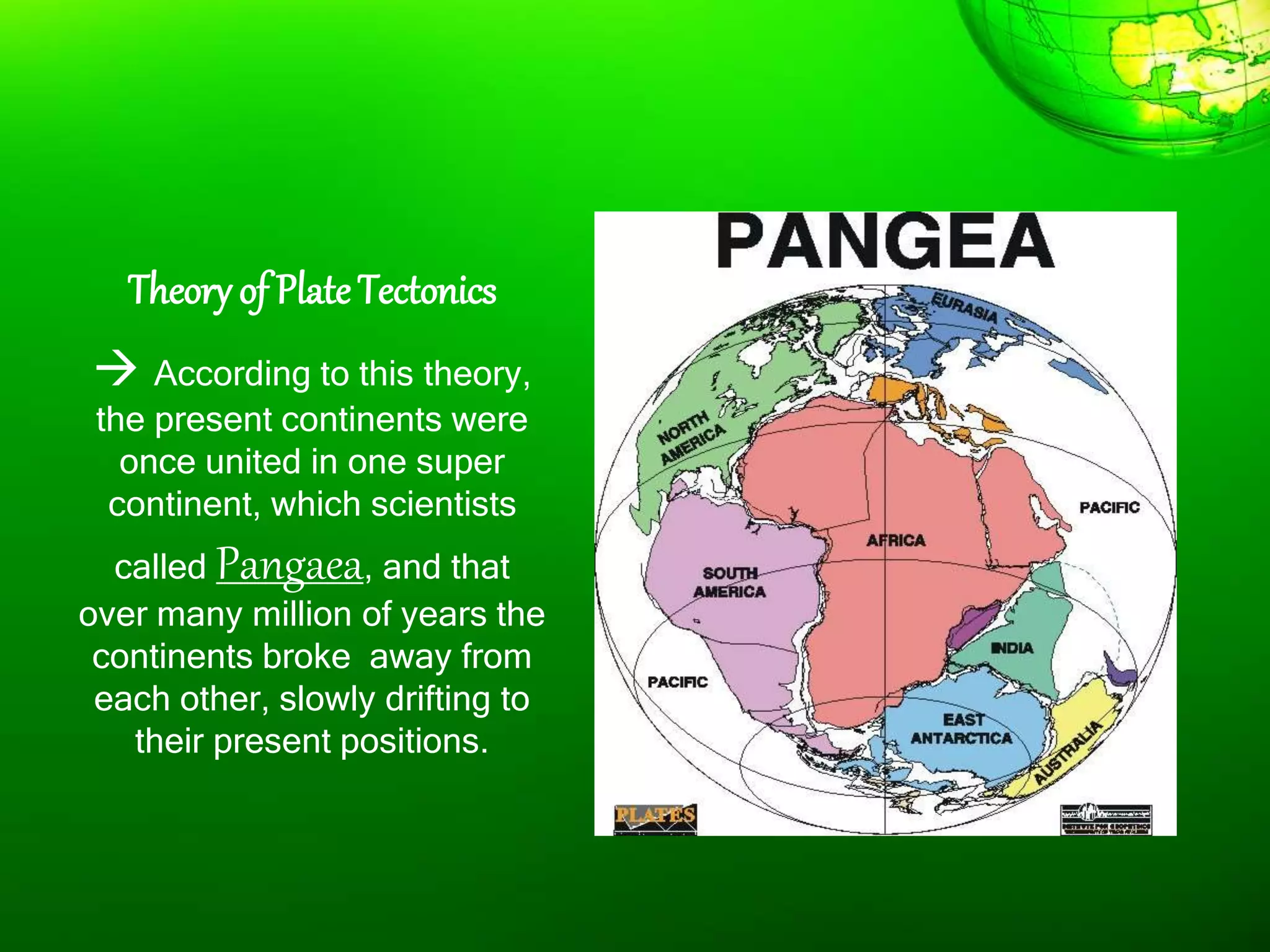
Theory of PlateTectonics
 According to this theory,
the present continents were
once united in one super
continent, which scientists
called Pangaea, and that
over many million of years the
continents broke away from
each other, slowly drifting to
their present positions.
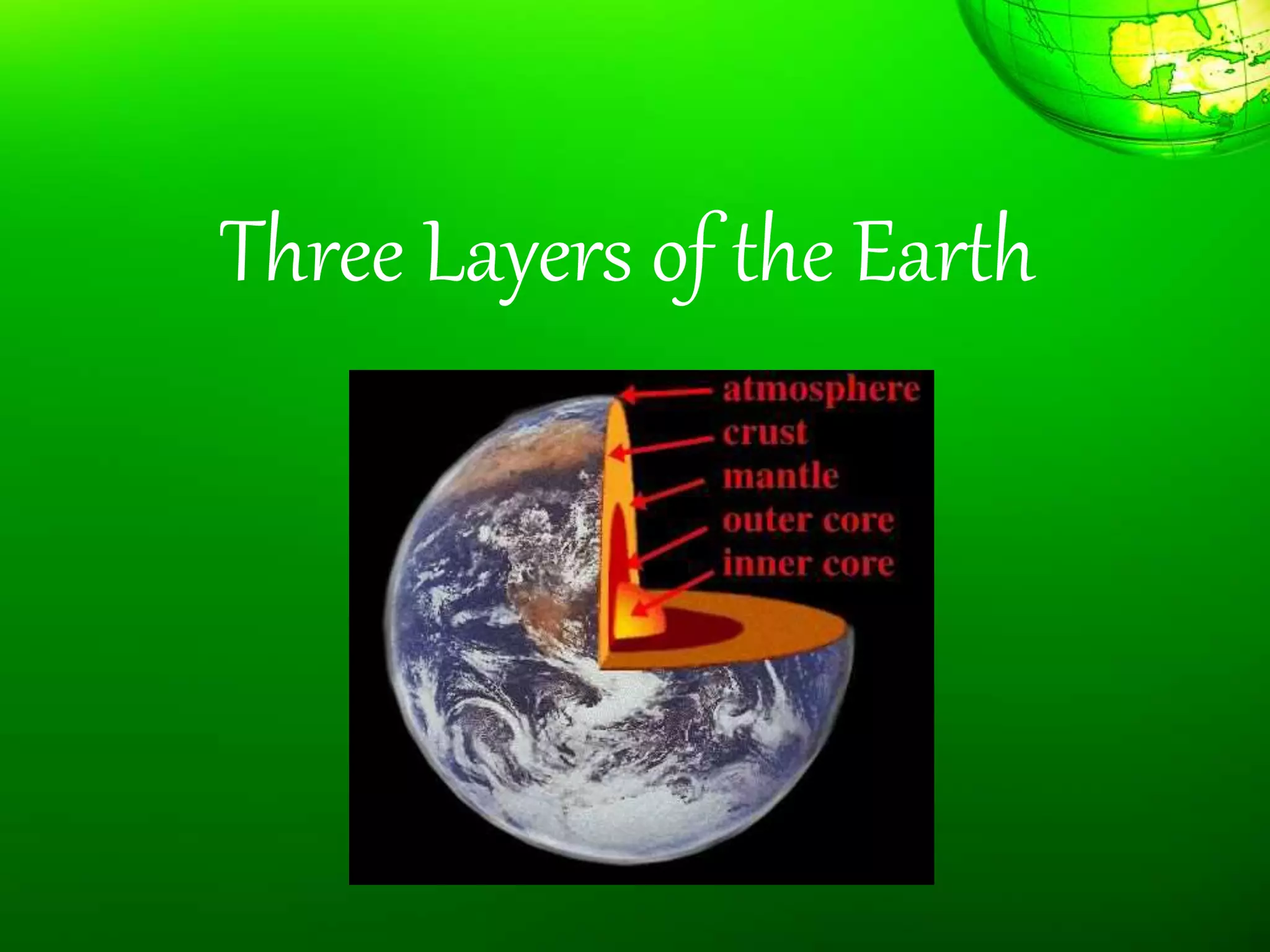
Three Layers of the Earth
1. Crust
•  is the outer part of the
earth.
•  it varies in thickness from 5
to 20 miles.
2. Mantle
•  it is found beneath the
earth’s crust.
•  it is composed of rock and
metal.
3. Core
• Inner Core
 it is made of
very hot solid
metal.
• Outer Core
•  it is
composed of
liquid metal.
Tectonic Activity
•  a movement wherein
plates drift, pull apart or
sometimes collide.
Rift
•  formed when two plates
separate.
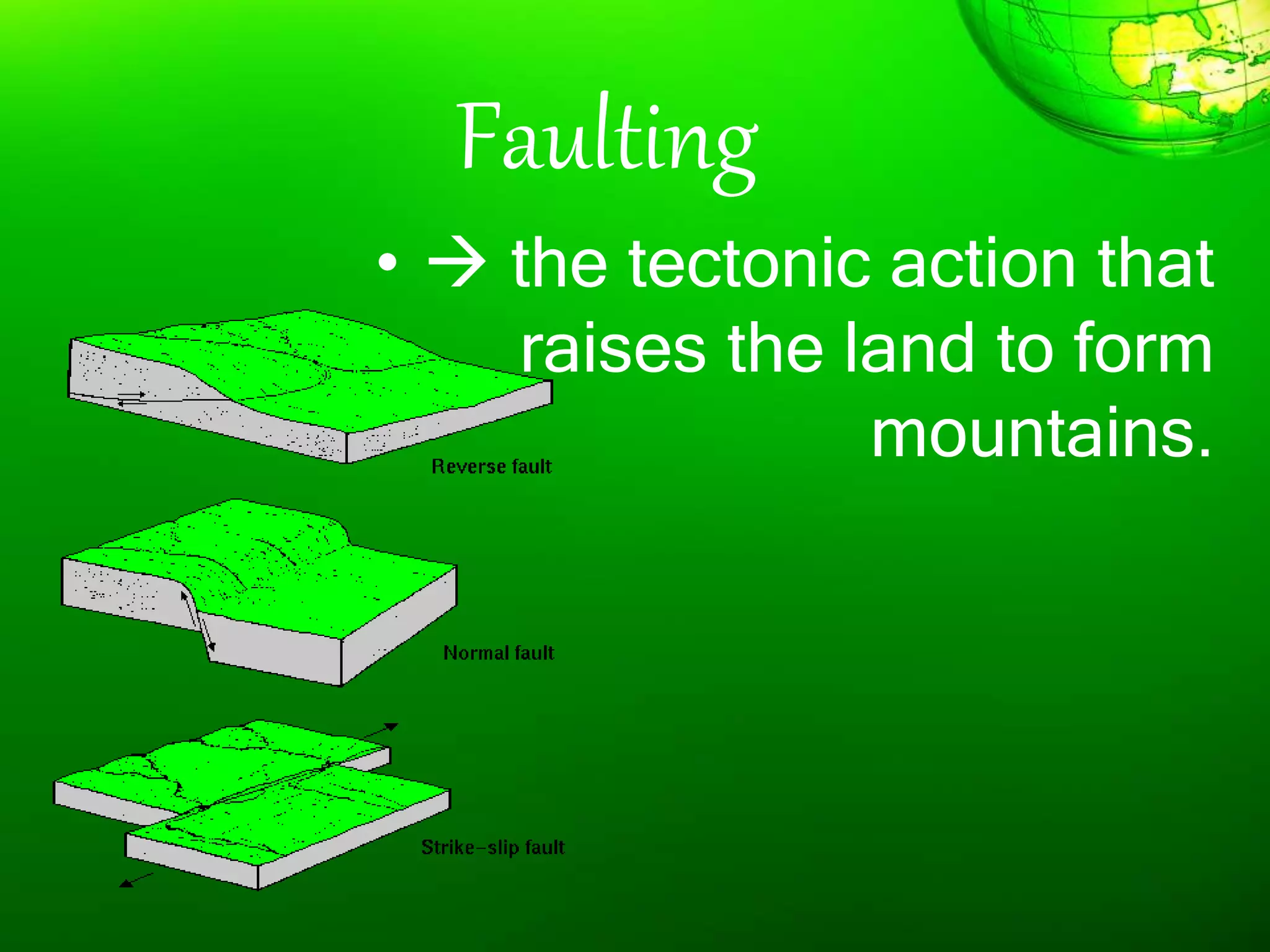
Faulting
•  the tectonic action that
raises the land to form
mountains.
TSUNAMIS
Gigantic waves caused by earthquakes
in the ocean floor.
LAND SHAPES
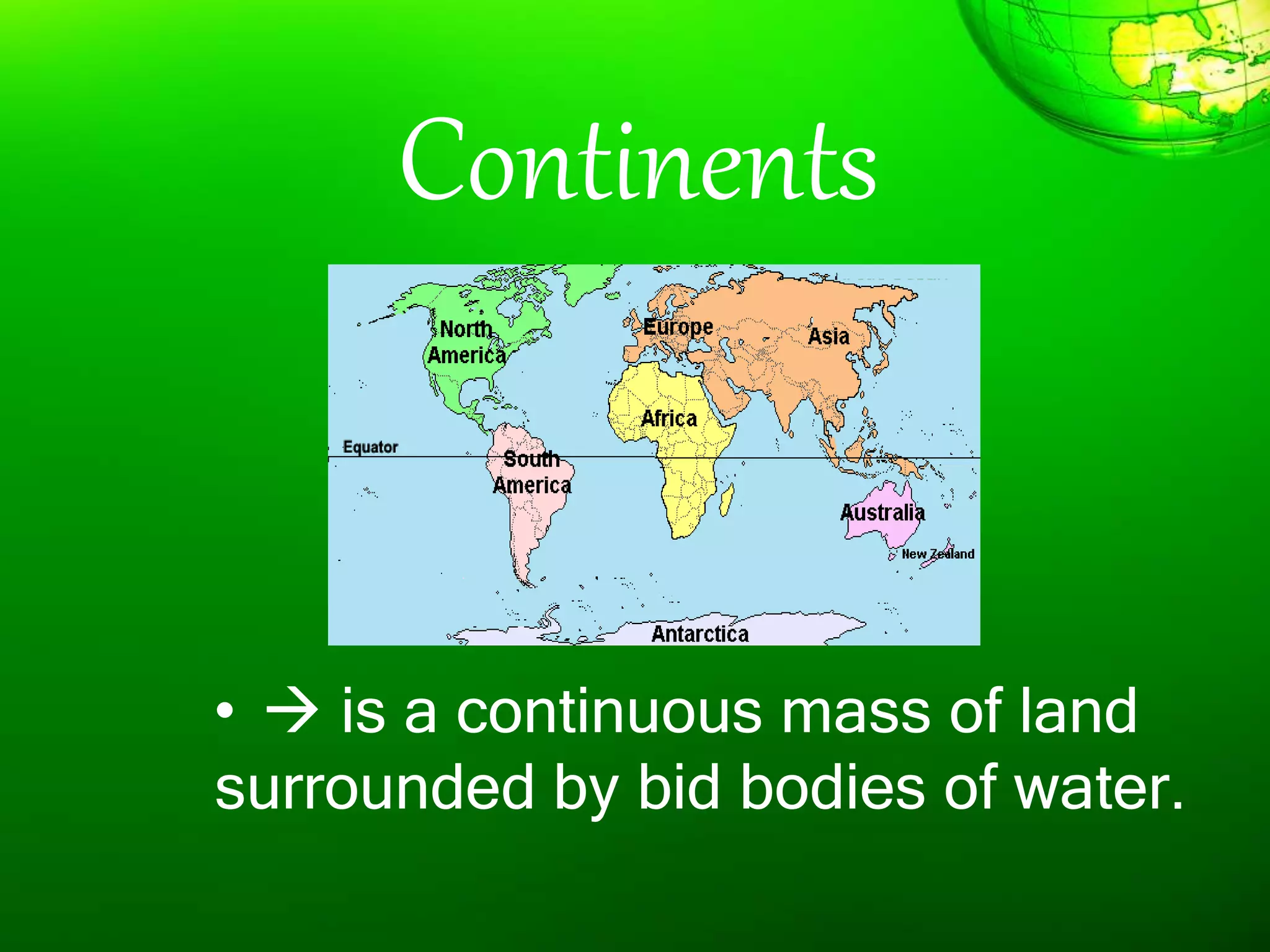
Continents
•  is a continuous mass of land
surrounded by bid bodies of water.
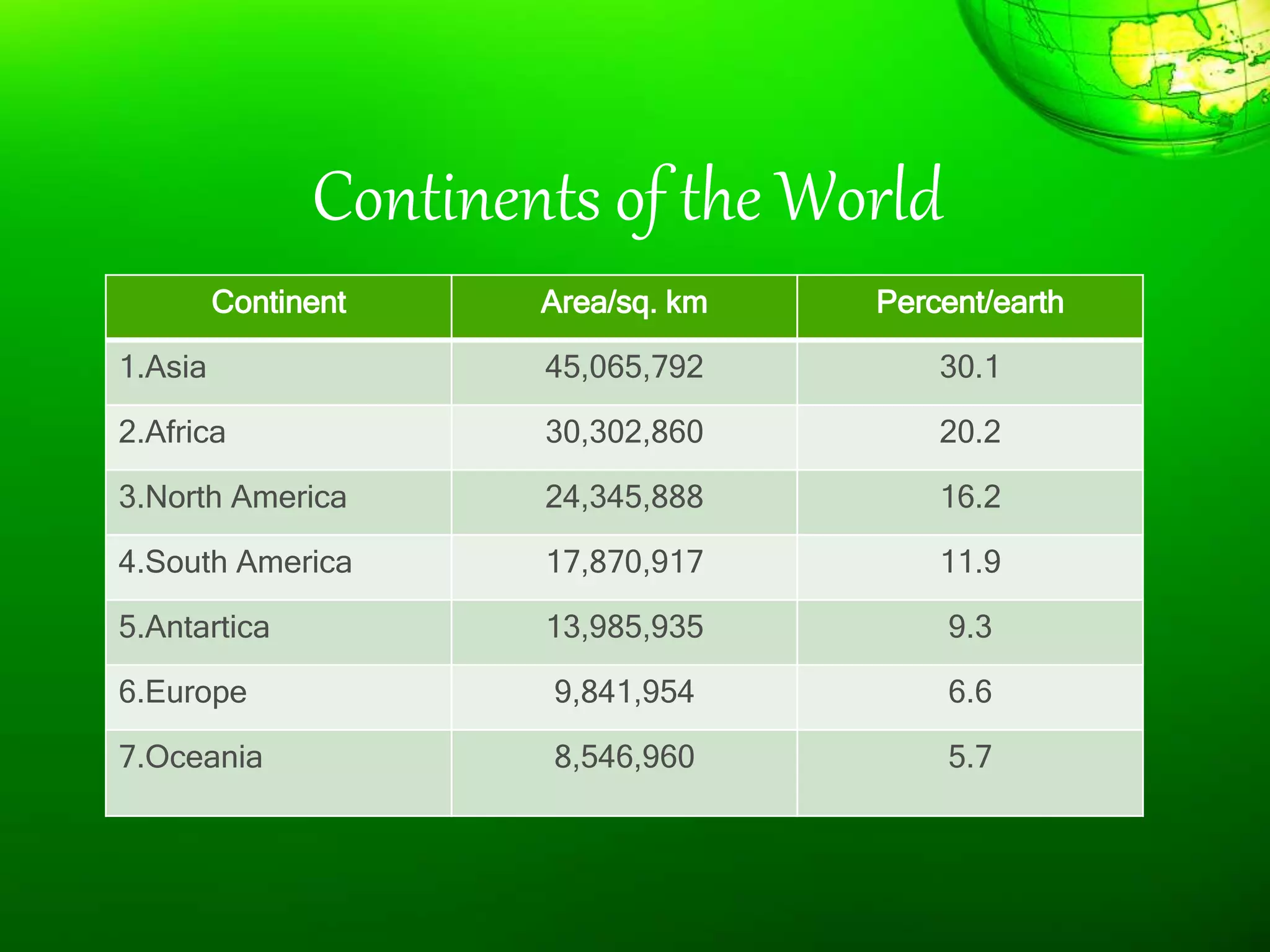
Continents of the World
Continent Area/sq. km Percent/earth
1.Asia 45,065,792 30.1
2.Africa 30,302,860 20.2
3.North America 24,345,888 16.2
4.South America 17,870,917 11.9
5.Antartica 13,985,935 9.3
6.Europe 9,841,954 6.6
7.Oceania 8,546,960 5.7
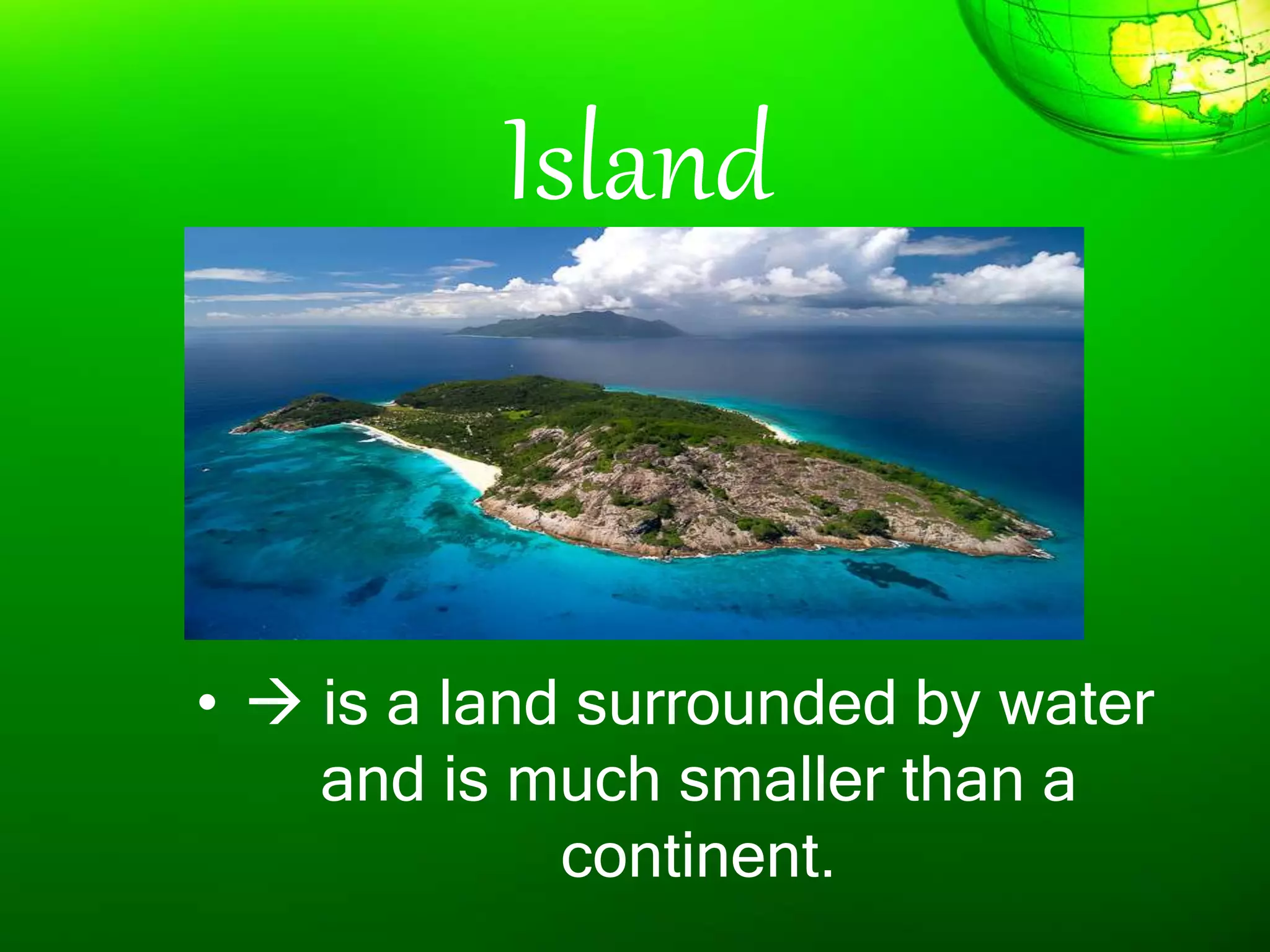
Island
•  is a land surrounded by water
and is much smaller than a
continent.
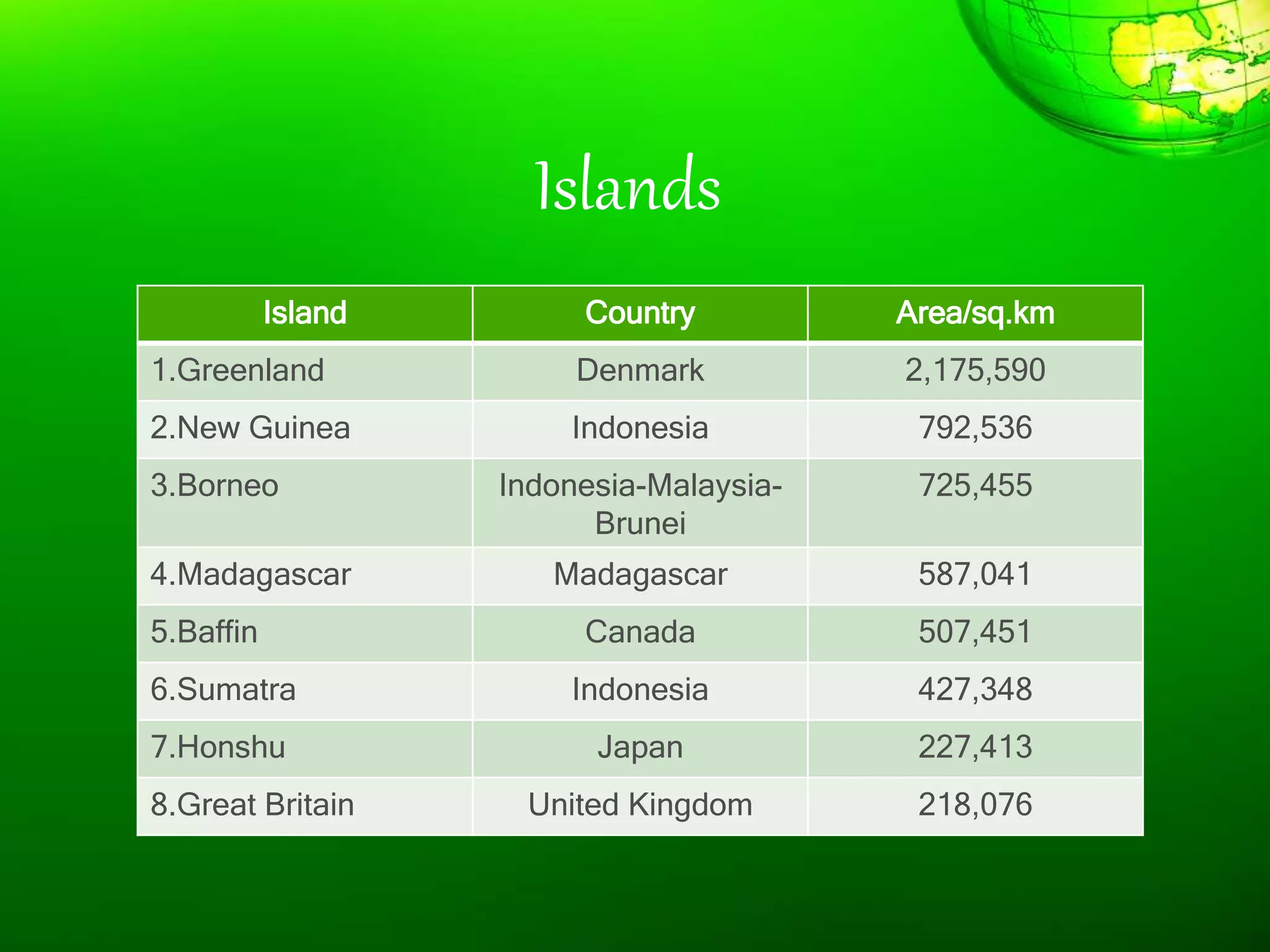
Islands
Island Country Area/sq.km
1.Greenland Denmark 2,175,590
2.New Guinea Indonesia 792,536
3.Borneo Indonesia-Malaysia-
Brunei
725,455
4.Madagascar Madagascar 587,041
5.Baffin Canada 507,451
6.Sumatra Indonesia 427,348
7.Honshu Japan 227,413
8.Great Britain United Kingdom 218,076
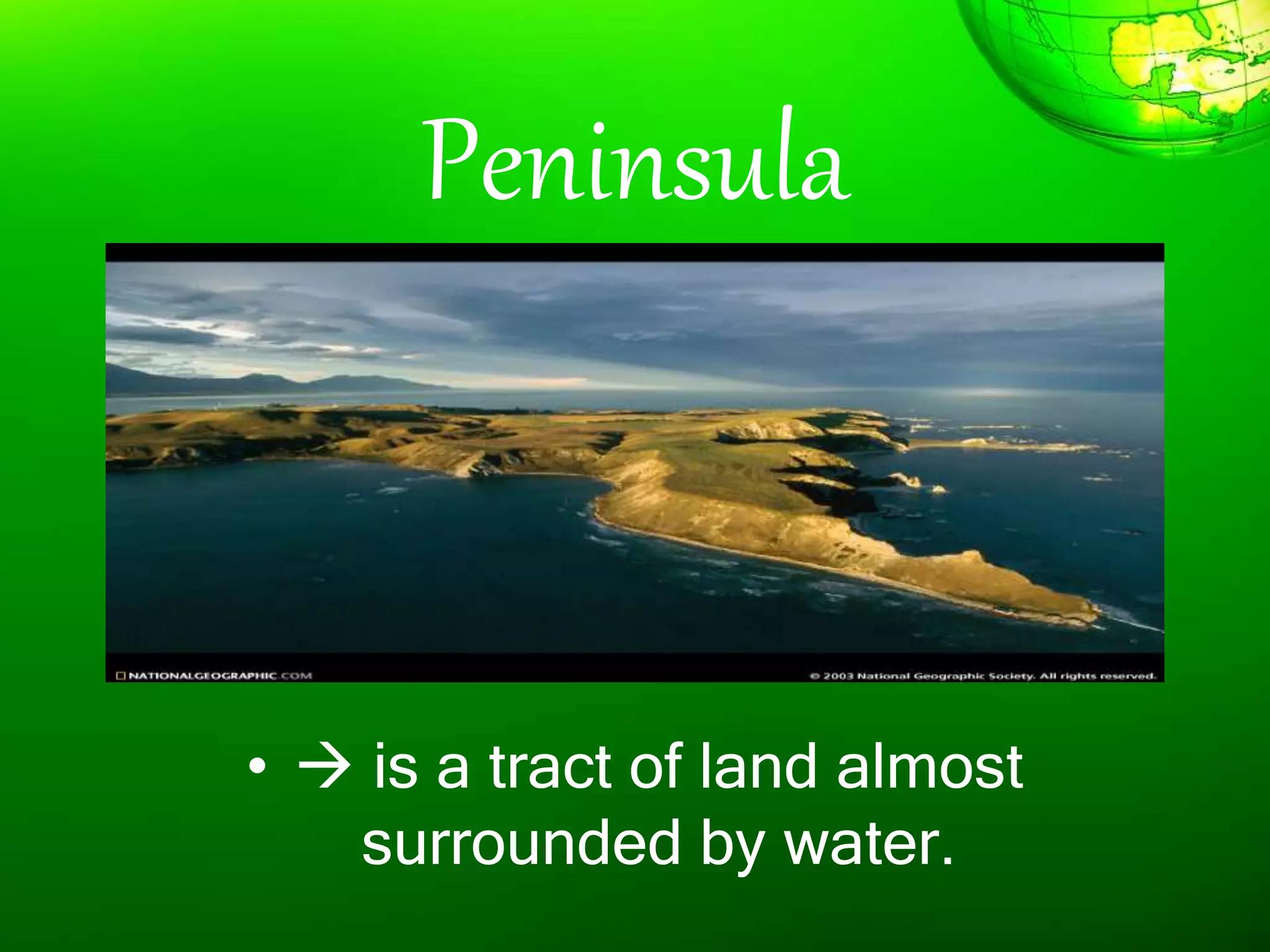
Peninsula
•  is a tract of land almost
surrounded by water.
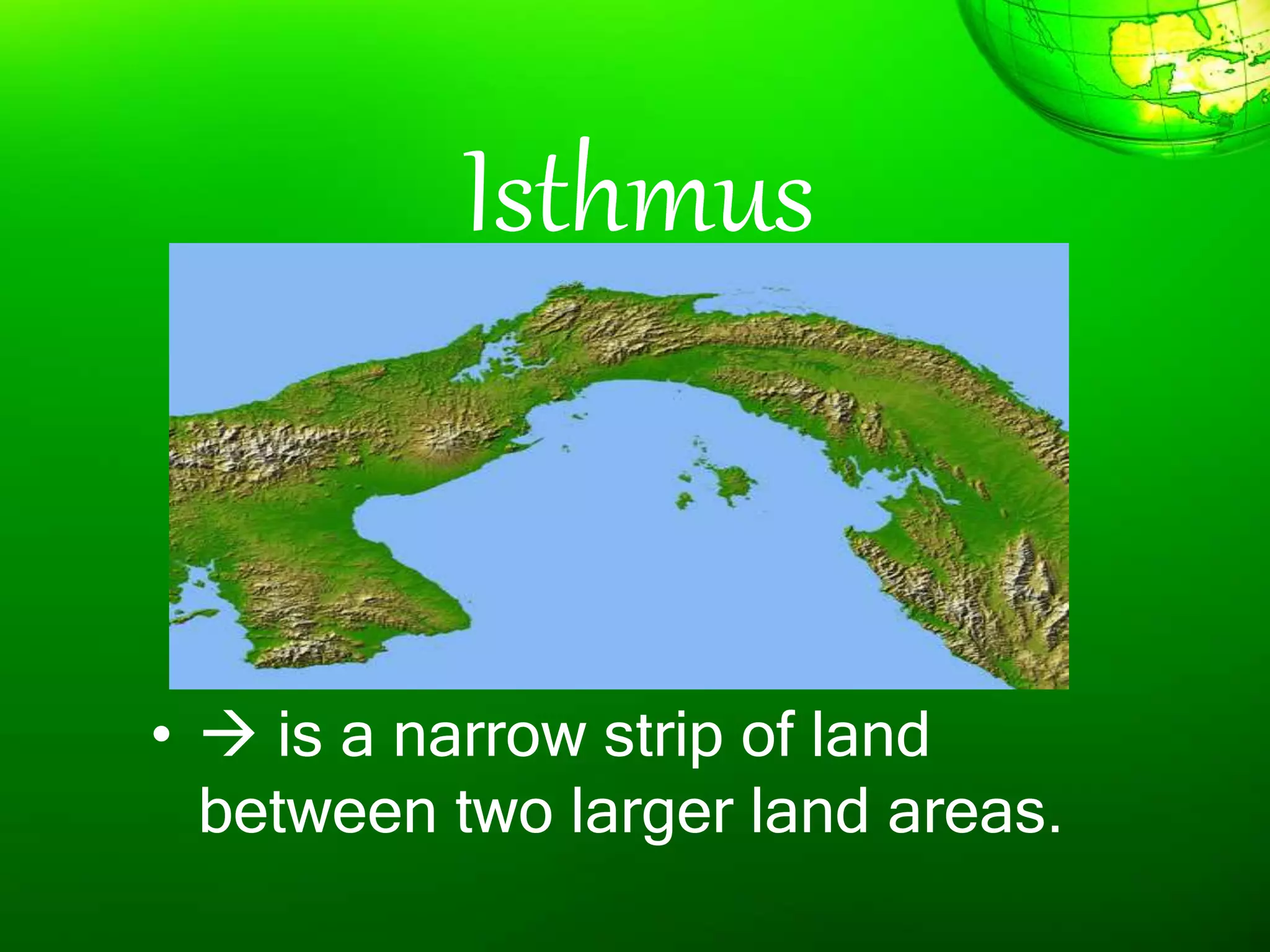
Isthmus
•  is a narrow strip of land
between two larger land areas.
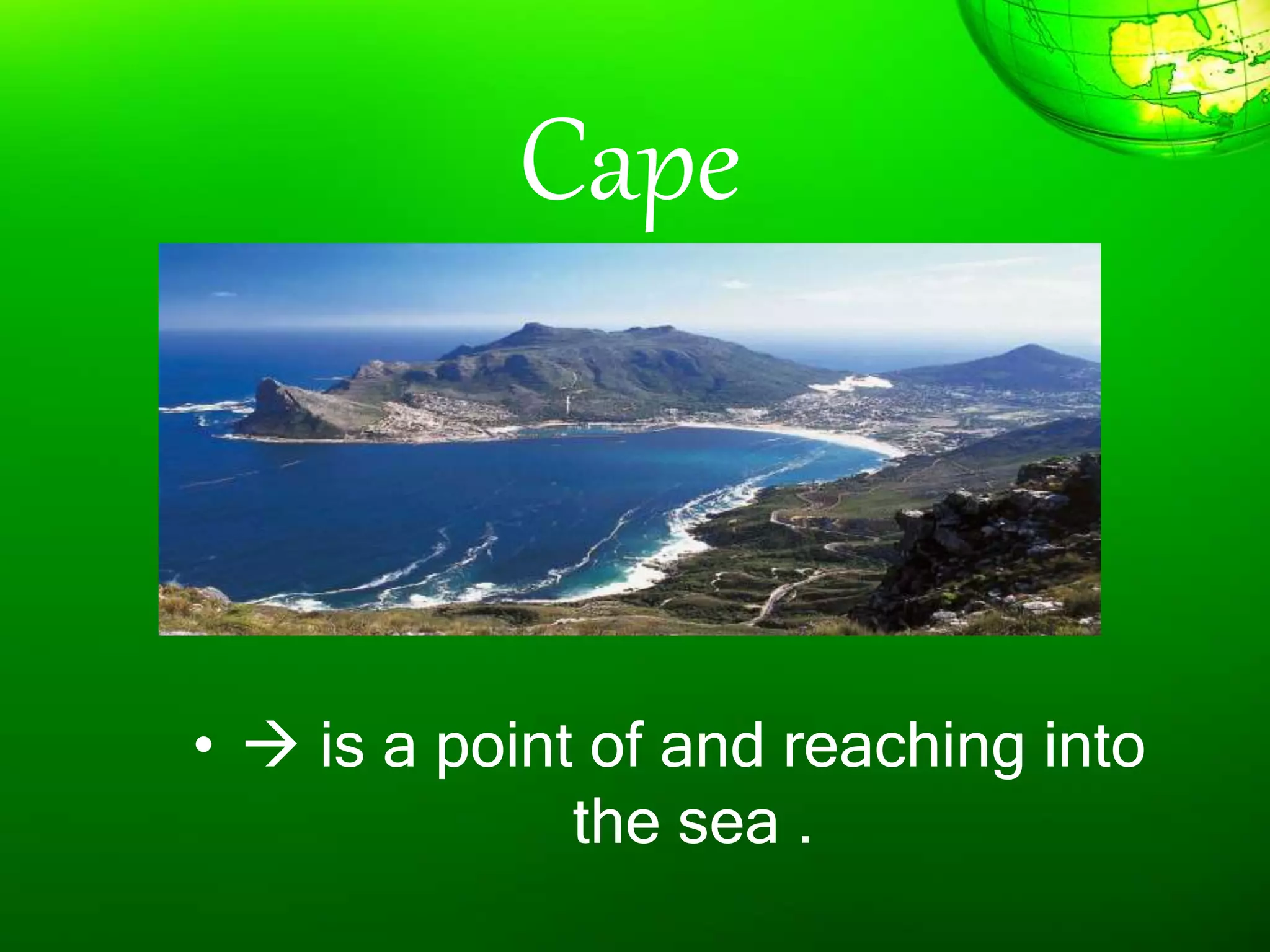
Cape
•  is a point of and reaching into
the sea .
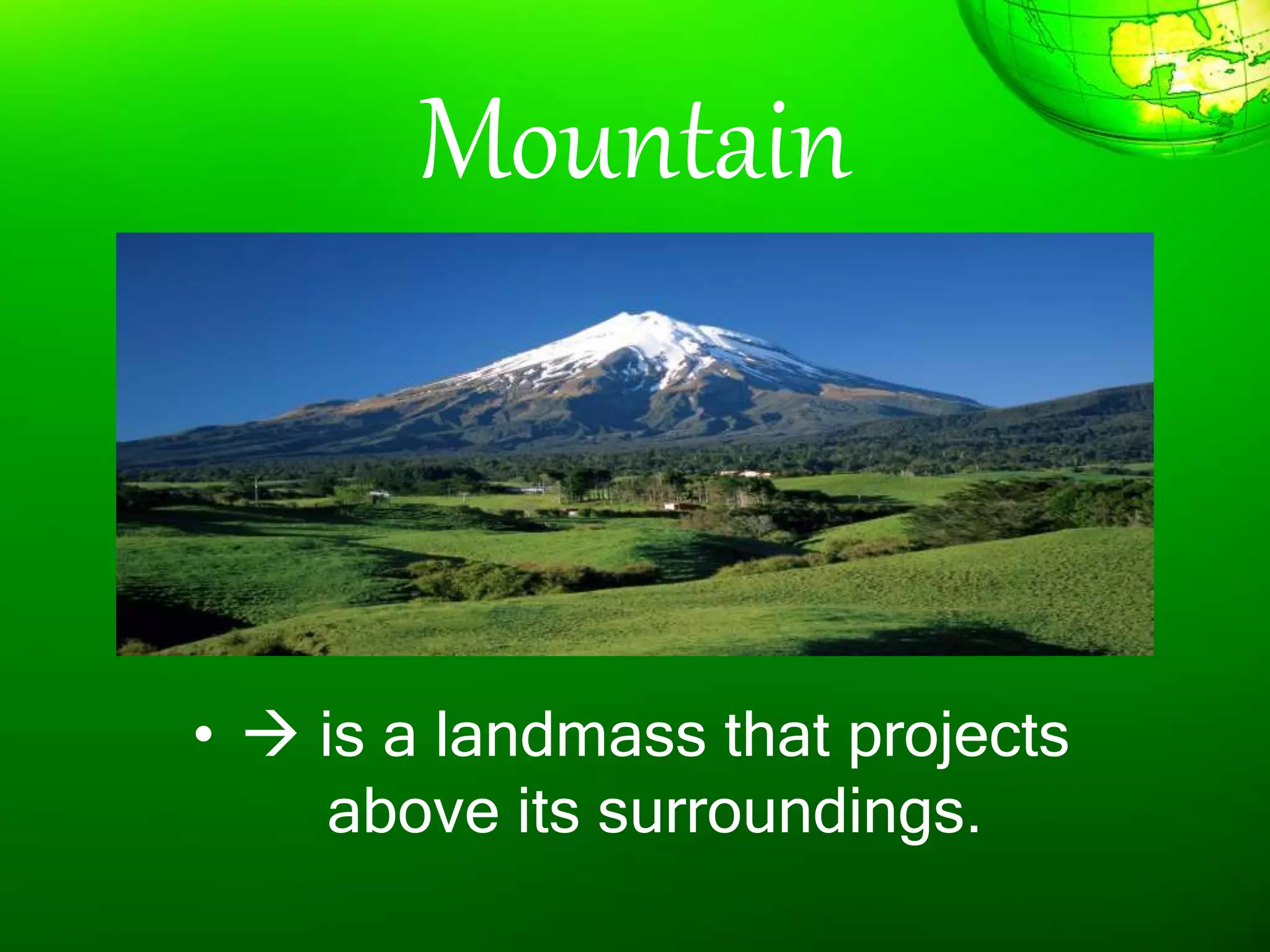
Mountain
•  is a landmass that projects
above its surroundings.
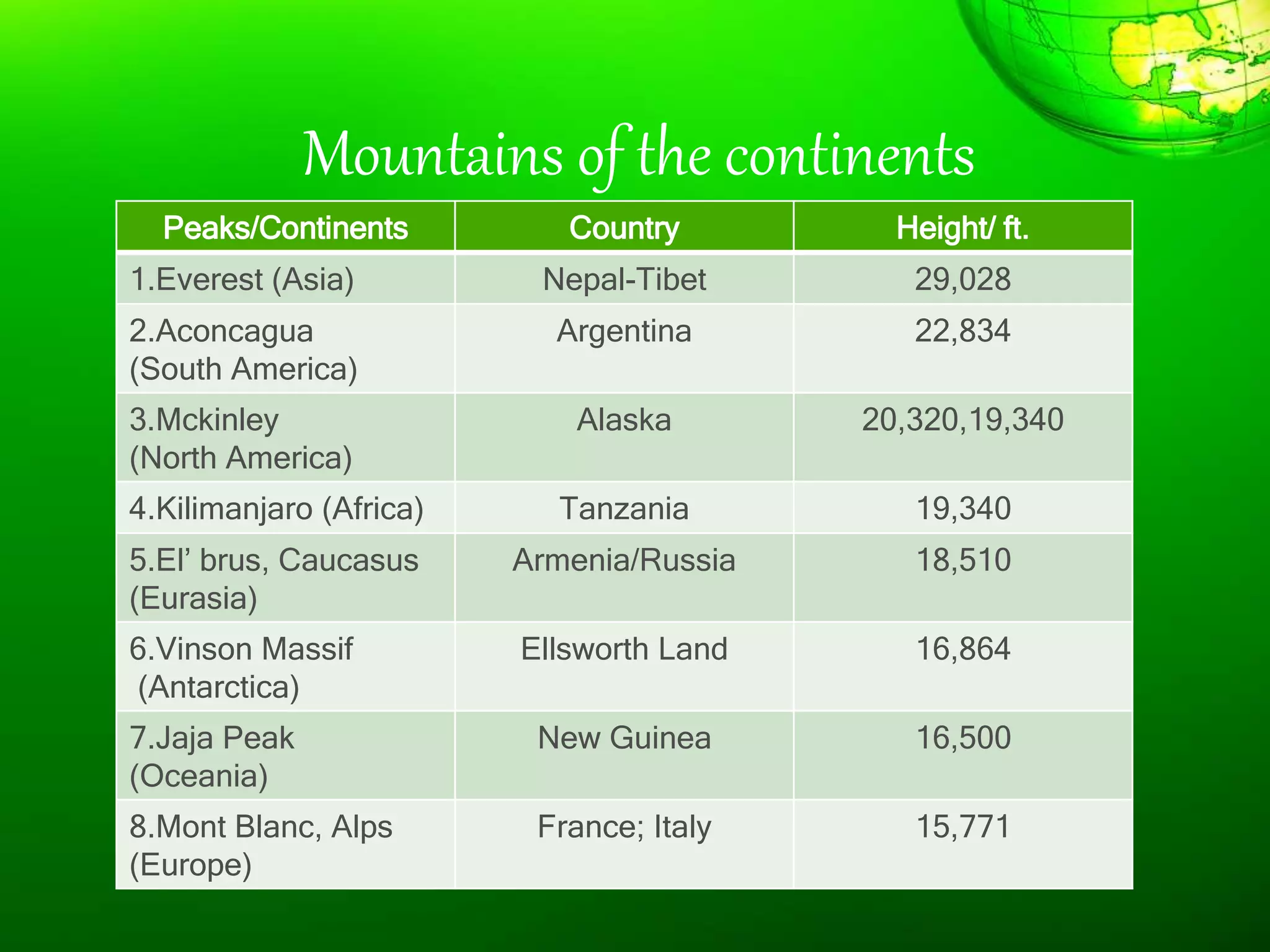
Mountains of the continents
Peaks/Continents Country Height/ ft.
1.Everest (Asia) Nepal-Tibet 29,028
2.Aconcagua
(South America)
Argentina 22,834
3.Mckinley
(North America)
Alaska 20,320,19,340
4.Kilimanjaro (Africa) Tanzania 19,340
5.El’ brus, Caucasus
(Eurasia)
Armenia/Russia 18,510
6.Vinson Massif
(Antarctica)
Ellsworth Land 16,864
7.Jaja Peak
(Oceania)
New Guinea 16,500
8.Mont Blanc, Alps
(Europe)
France; Italy 15,771
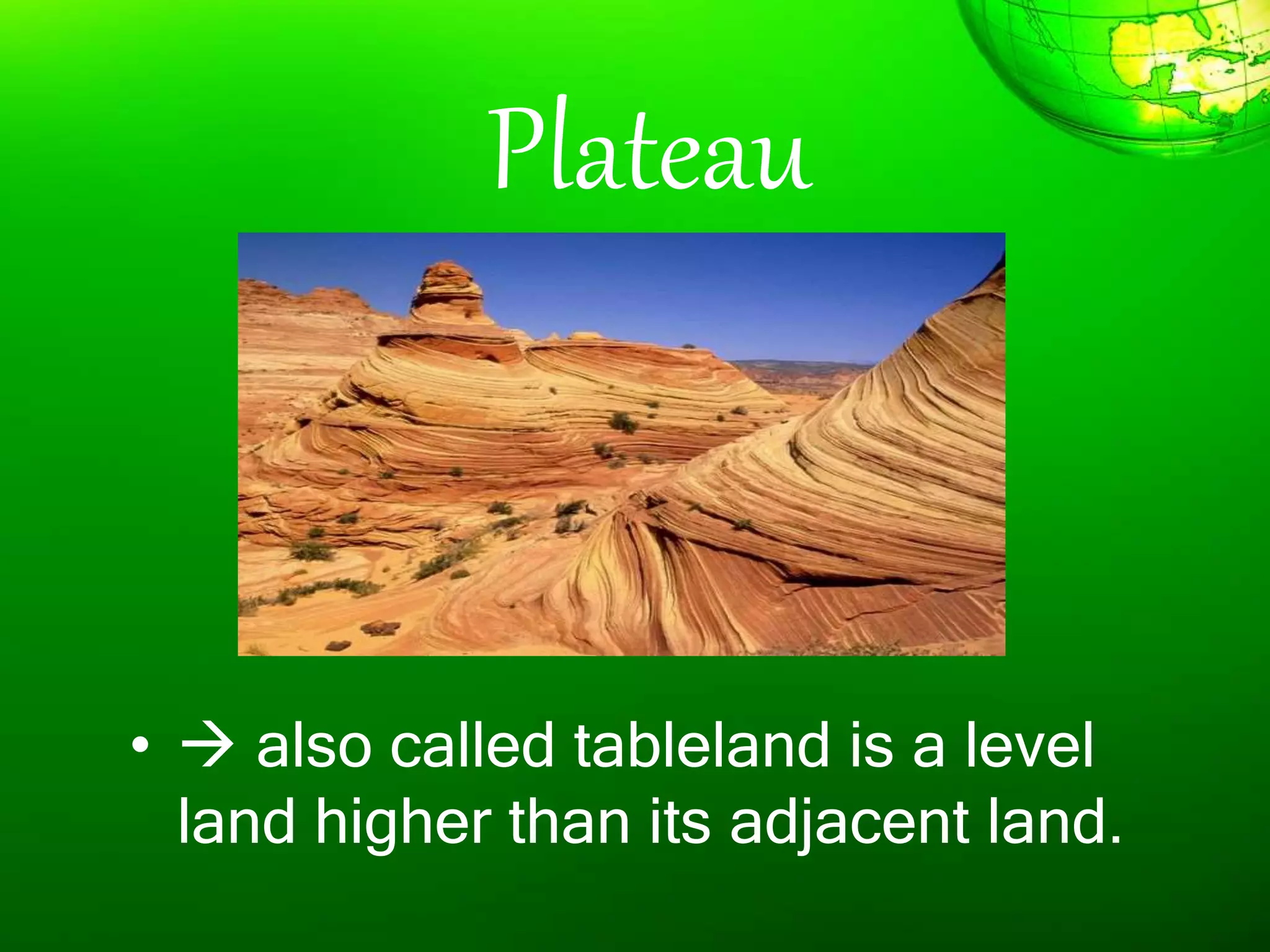
Plateau
•  also called tableland is a level
land higher than its adjacent land.
Types
of
Plains
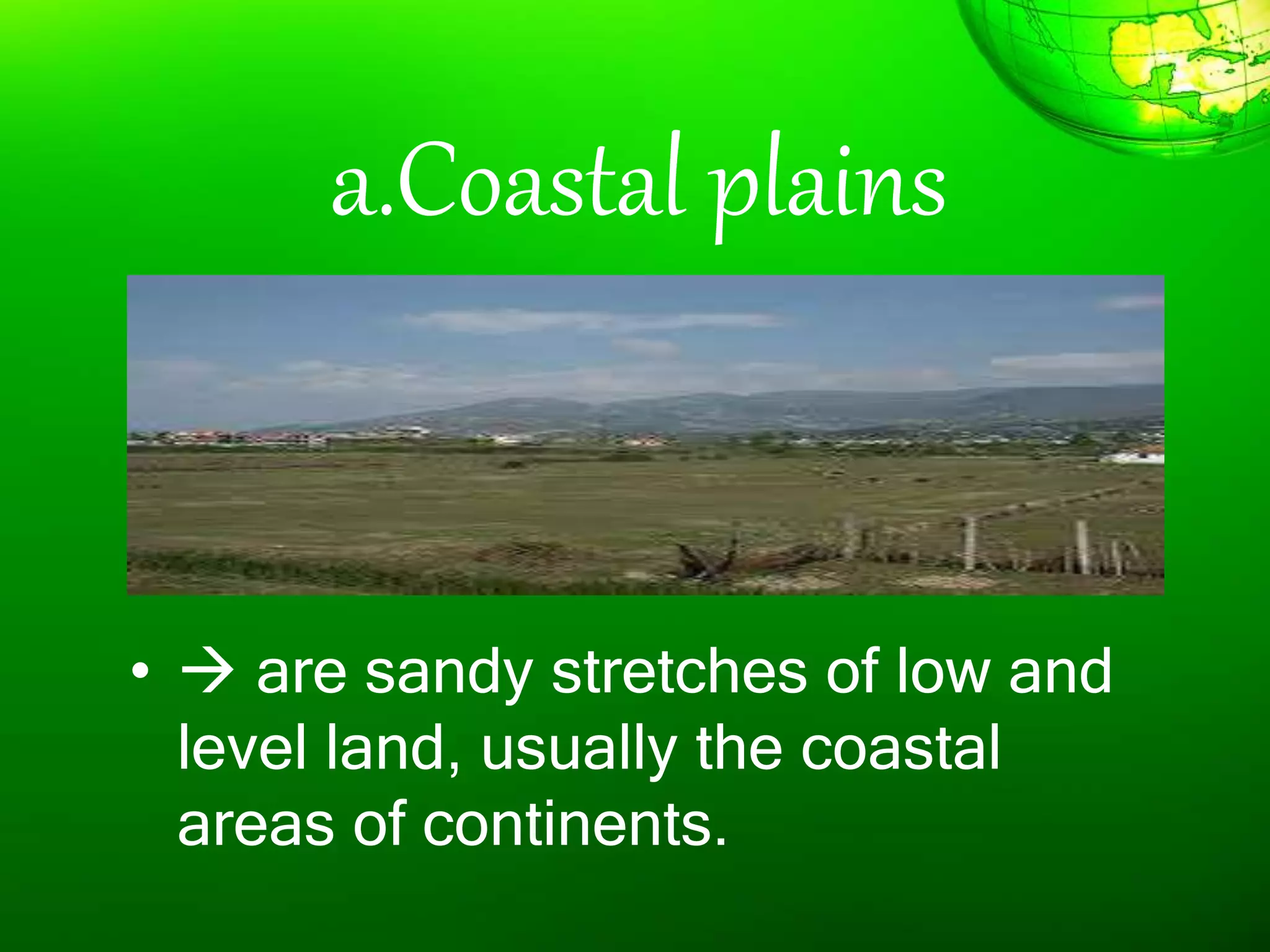
a.Coastal plains
•  are sandy stretches of low and
level land, usually the coastal
areas of continents.
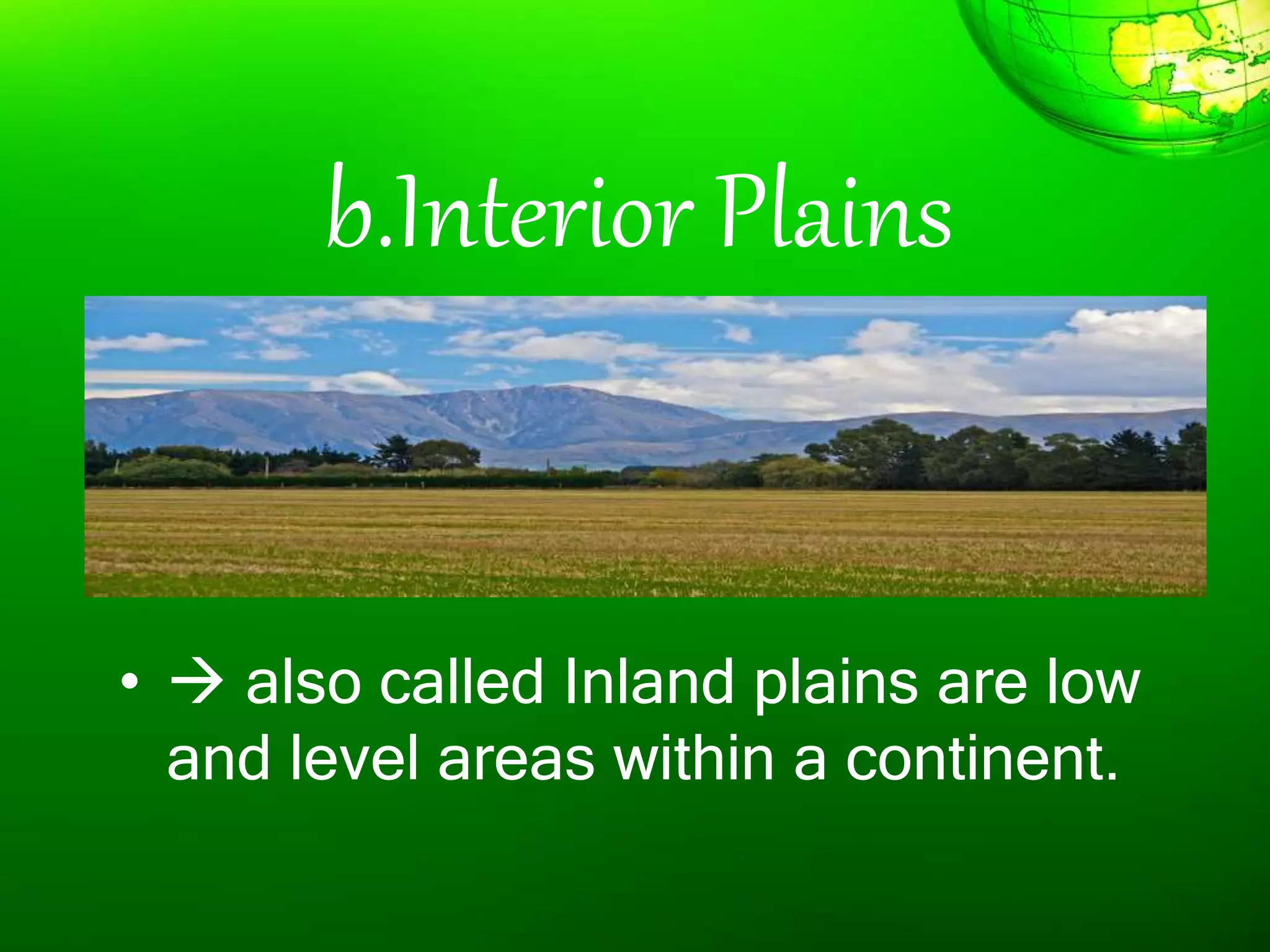
b.Interior Plains
•  also called Inland plains are low
and level areas within a continent.
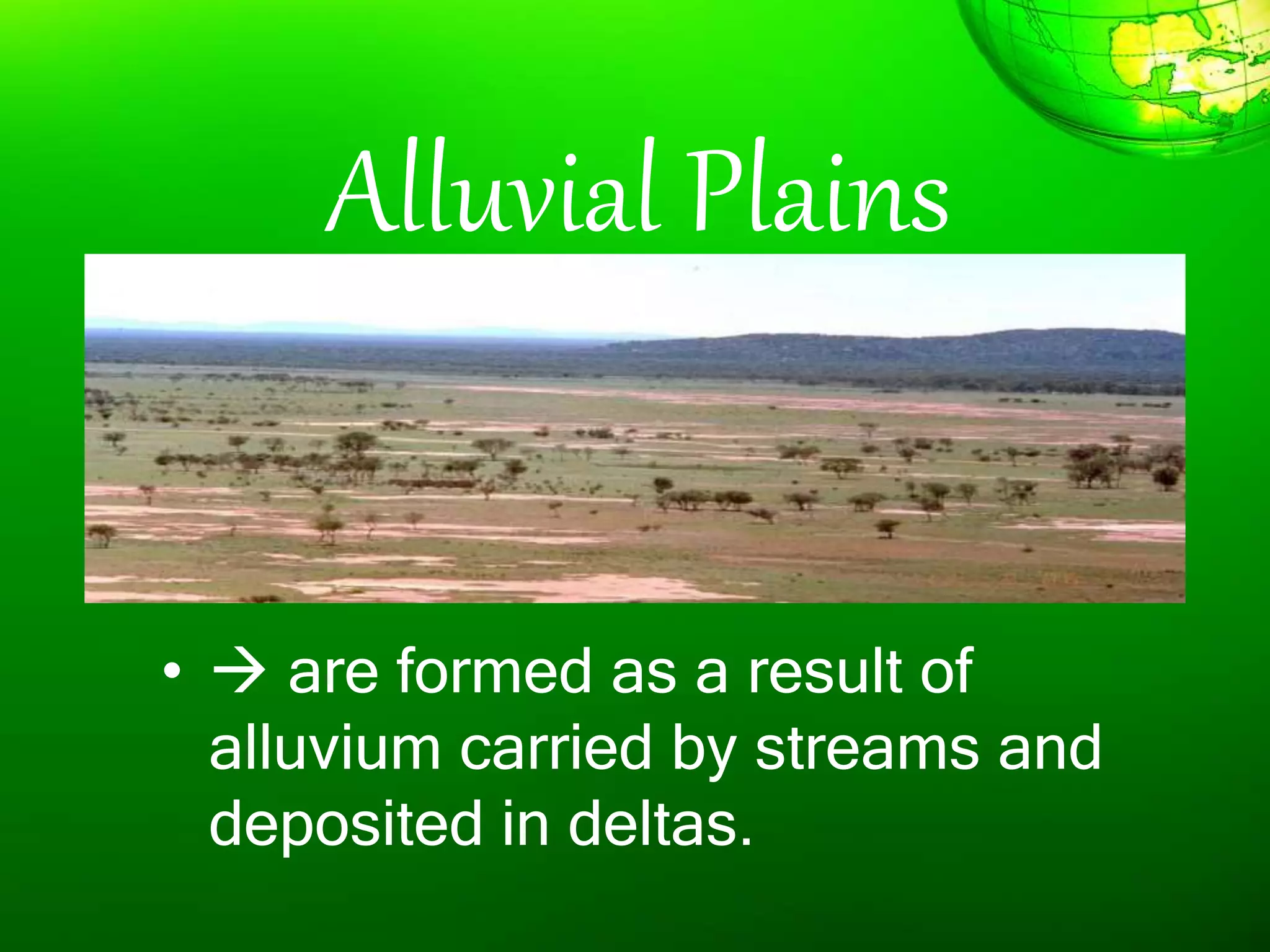
Alluvial Plains
•  are formed as a result of
alluvium carried by streams and
deposited in deltas.
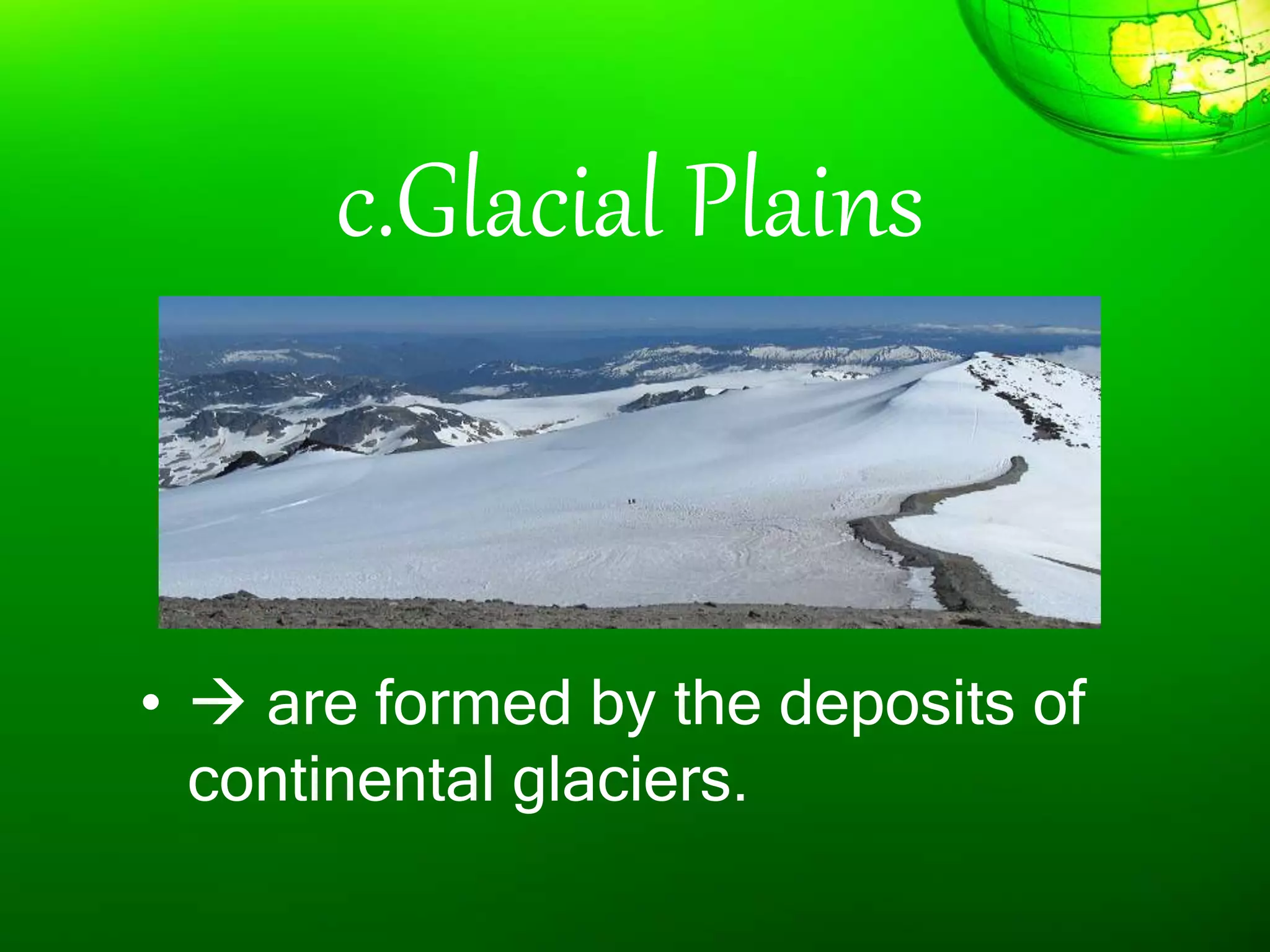
c.Glacial Plains
•  are formed by the deposits of
continental glaciers.
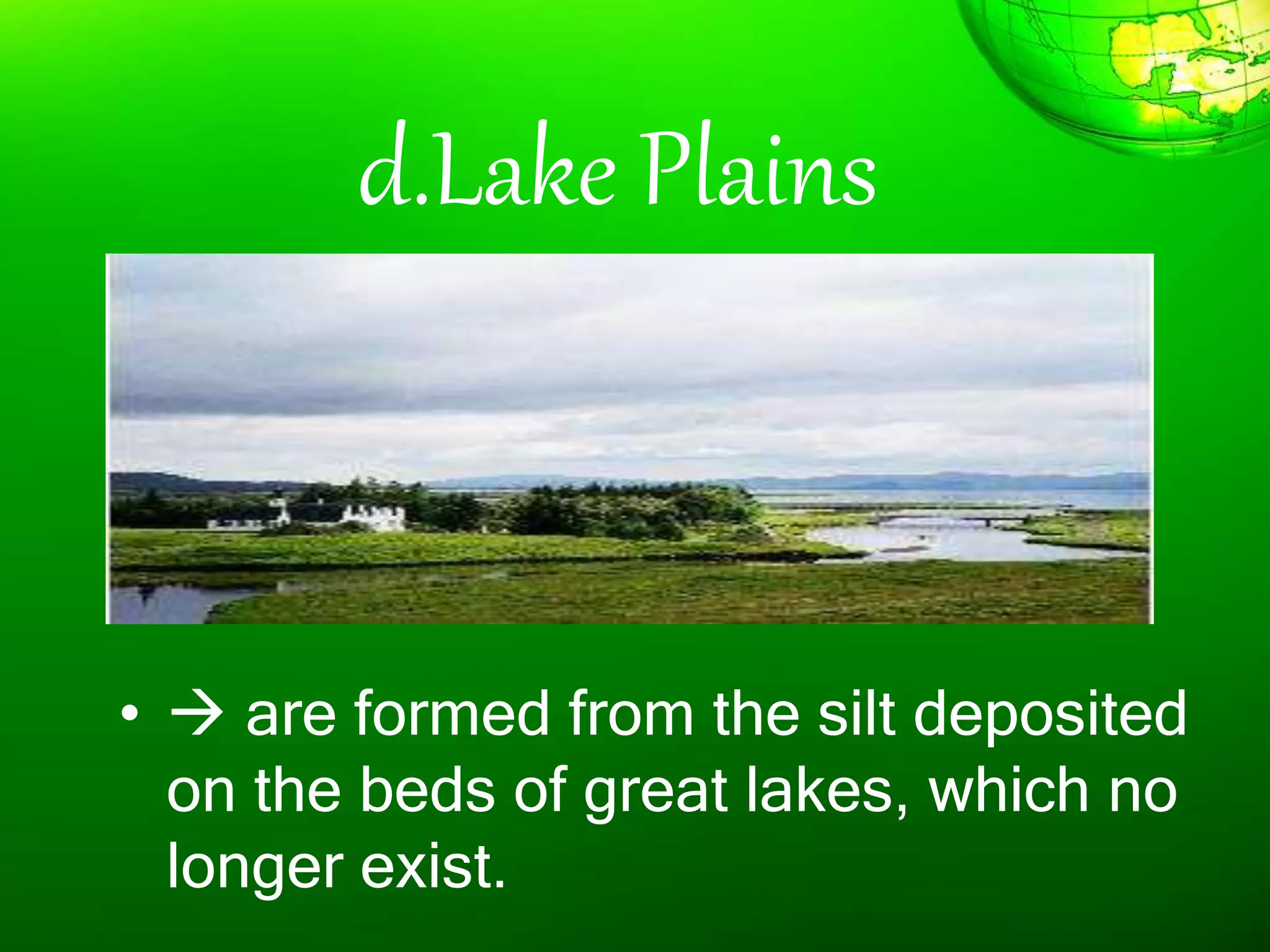
d.Lake Plains
•  are formed from the silt deposited
on the beds of great lakes, which no
longer exist.
Prairies
•  are grass-covered plains.
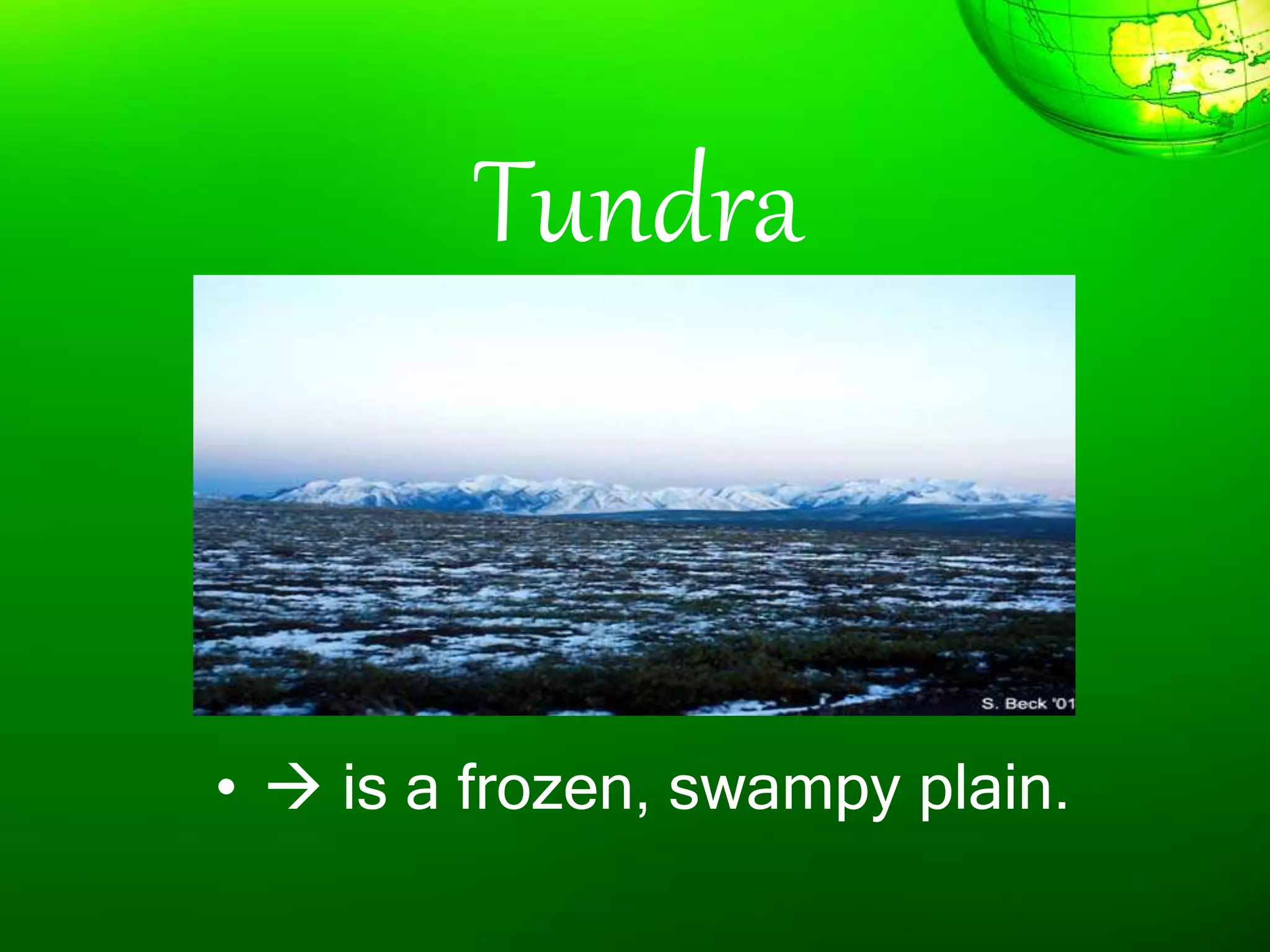
Tundra
•  is a frozen, swampy plain.
Steppes
•  are plains usually found in
semiarid climate.
WATER
AREAS
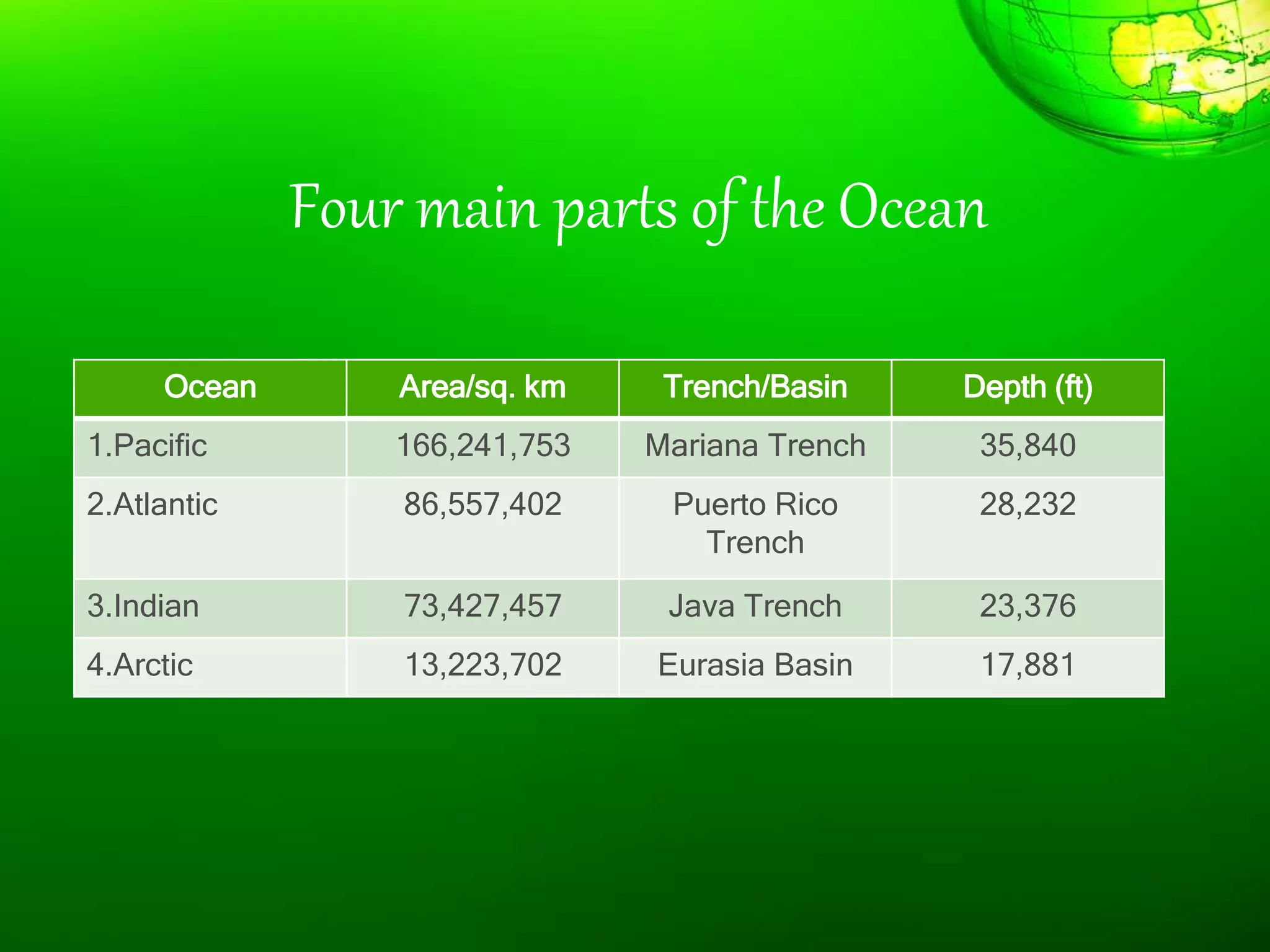
Four main parts of the Ocean
Ocean Area/sq. km Trench/Basin Depth (ft)
1.Pacific 166,241,753 Mariana Trench 35,840
2.Atlantic 86,557,402 Puerto Rico
Trench
28,232
3.Indian 73,427,457 Java Trench 23,376
4.Arctic 13,223,702 Eurasia Basin 17,881
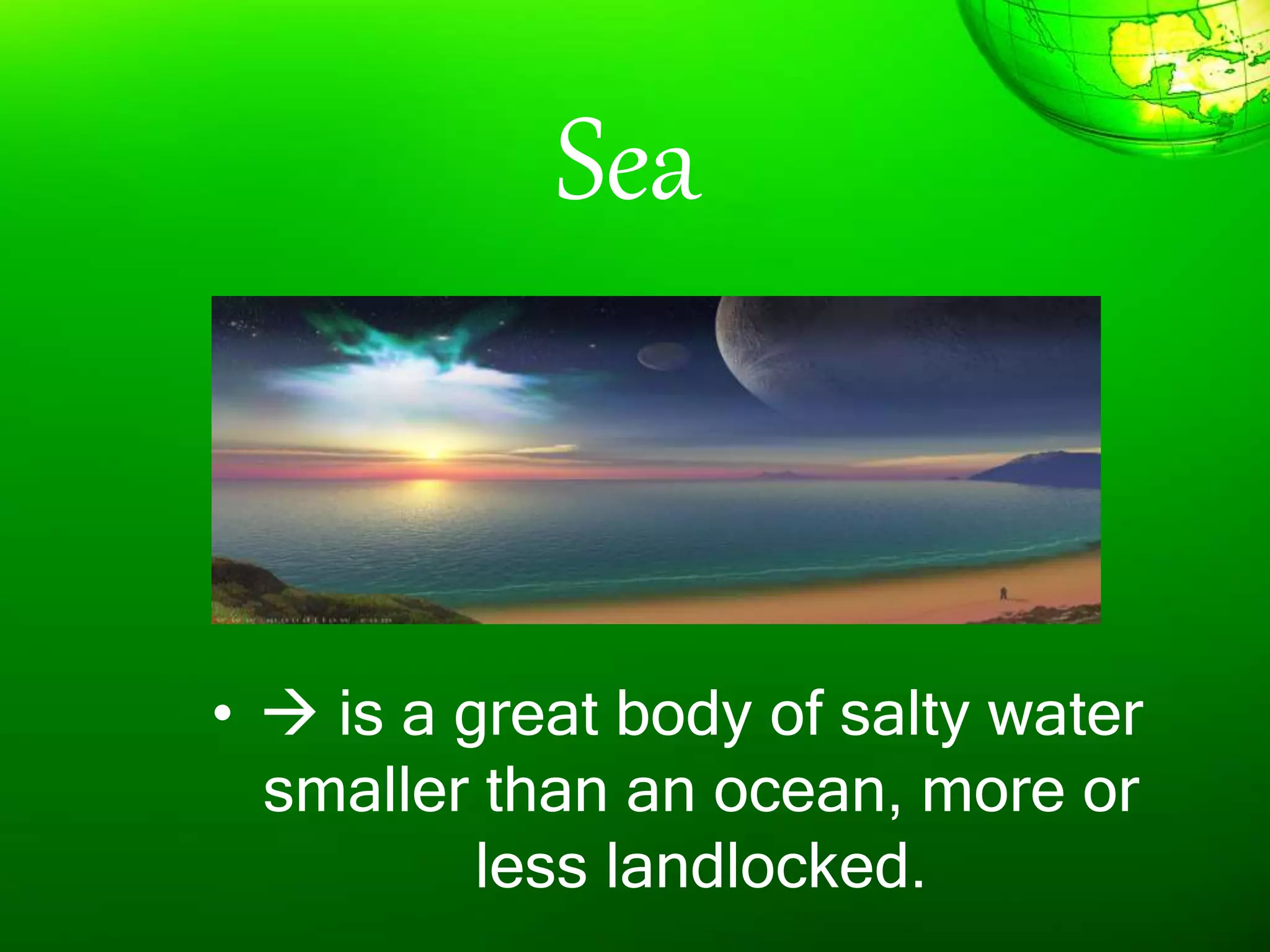
Sea
•  is a great body of salty water
smaller than an ocean, more or
less landlocked.
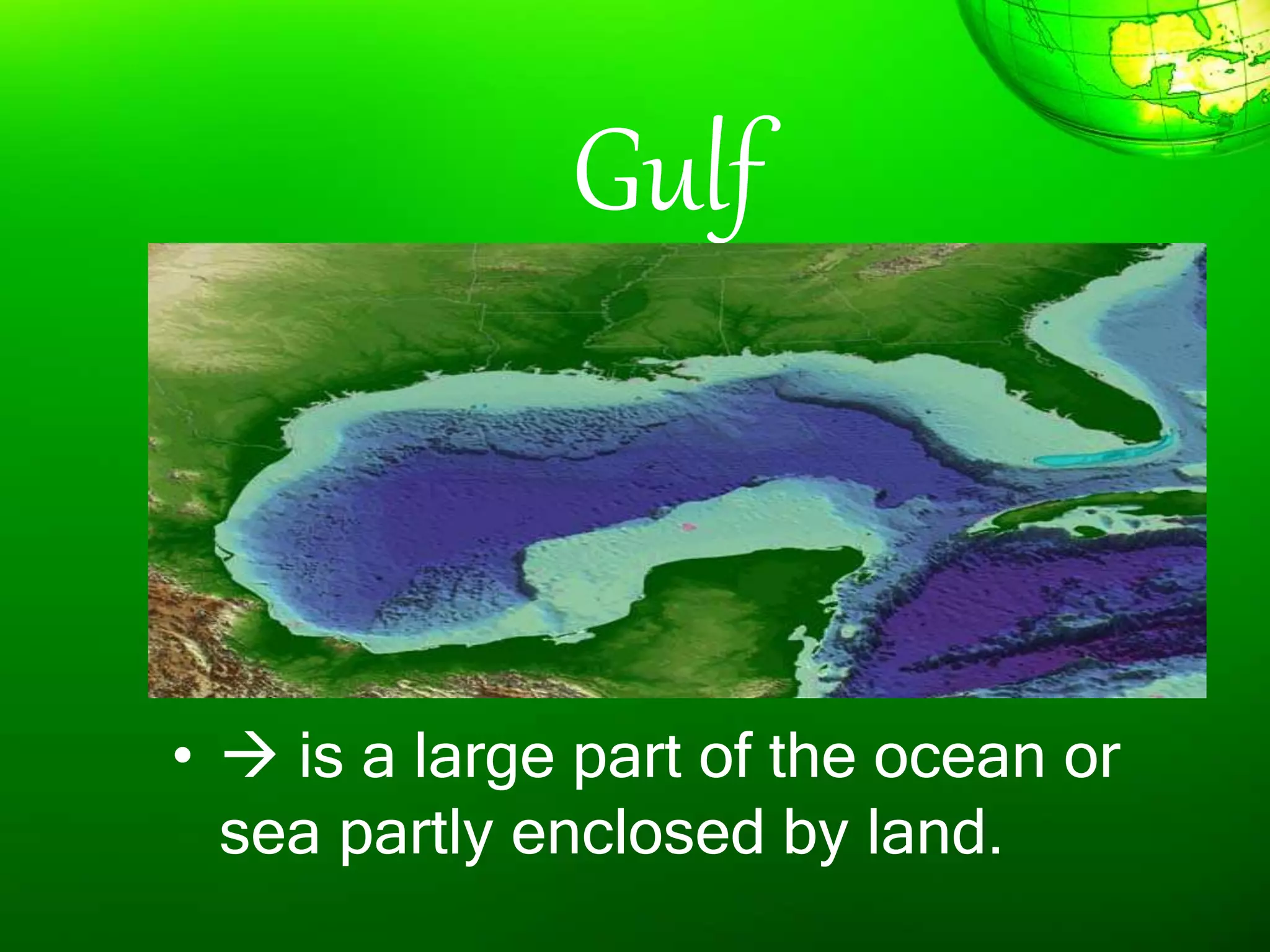
Gulf
•  is a large part of the ocean or
sea partly enclosed by land.
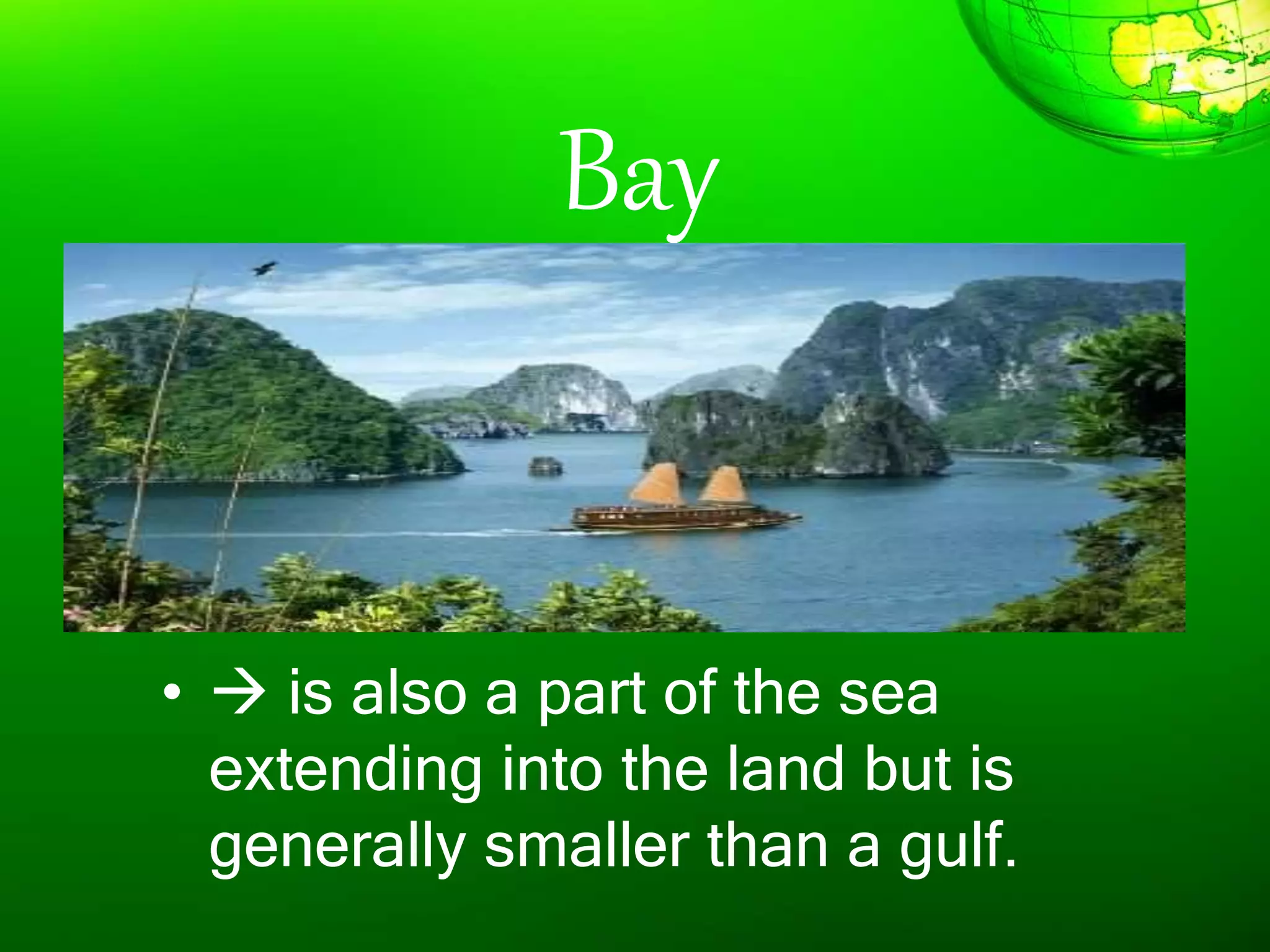
Bay
•  is also a part of the sea
extending into the land but is
generally smaller than a gulf.
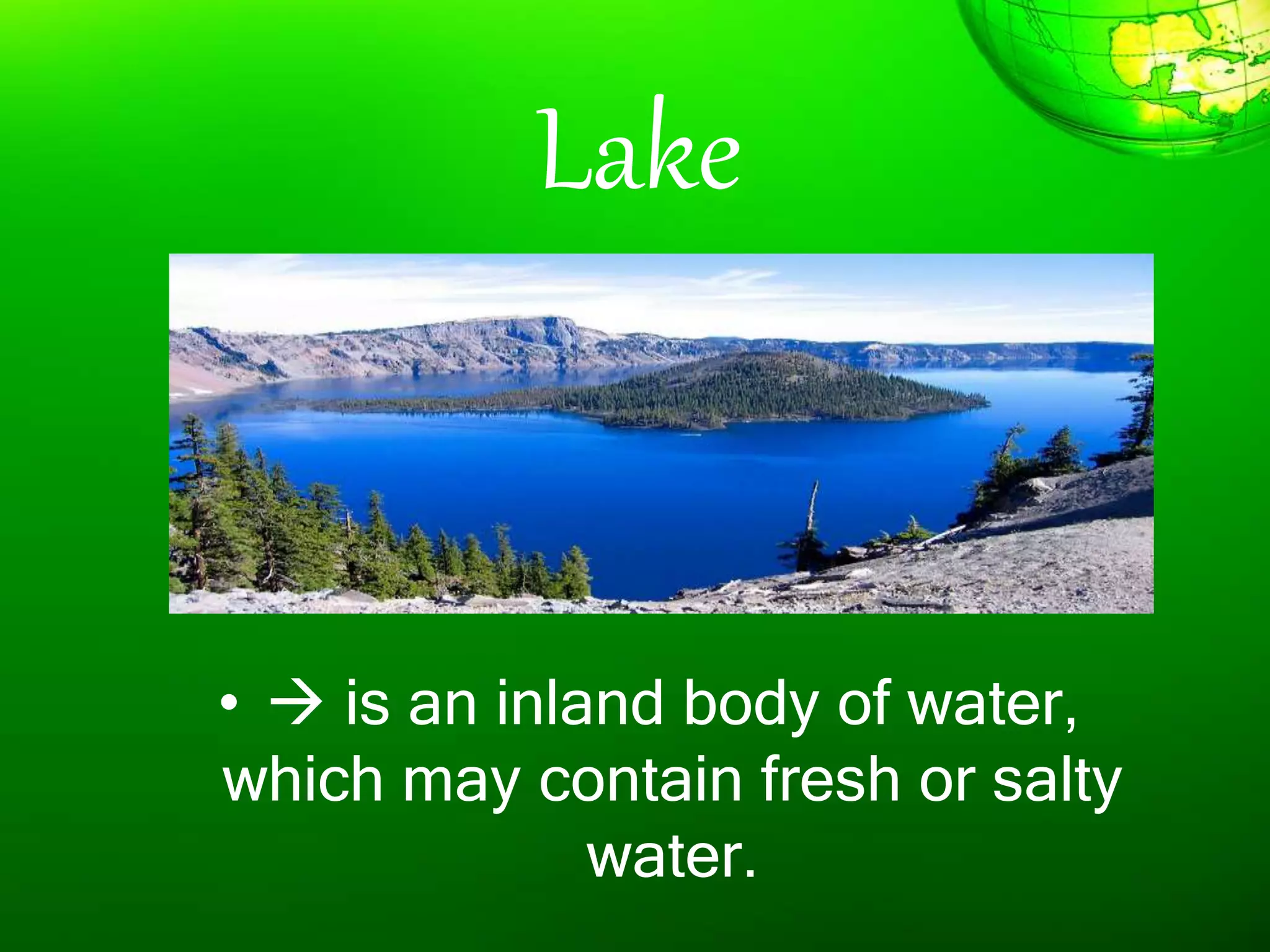
Lake
•  is an inland body of water,
which may contain fresh or salty
water.
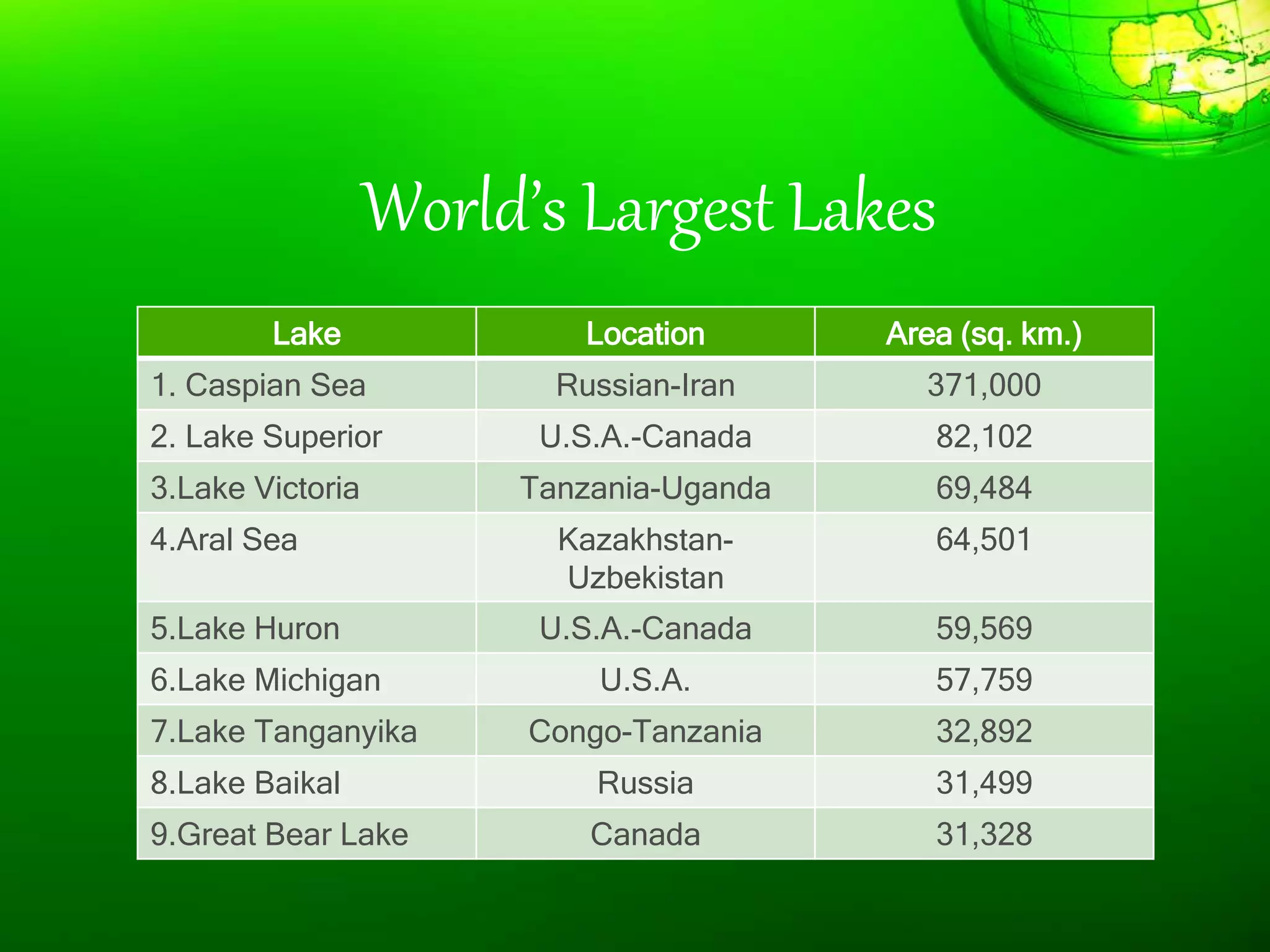
World’s Largest Lakes
Lake Location Area (sq. km.)
1. Caspian Sea Russian-Iran 371,000
2. Lake Superior U.S.A.-Canada 82,102
3.Lake Victoria Tanzania-Uganda 69,484
4.Aral Sea Kazakhstan-
Uzbekistan
64,501
5.Lake Huron U.S.A.-Canada 59,569
6.Lake Michigan U.S.A. 57,759
7.Lake Tanganyika Congo-Tanzania 32,892
8.Lake Baikal Russia 31,499
9.Great Bear Lake Canada 31,328
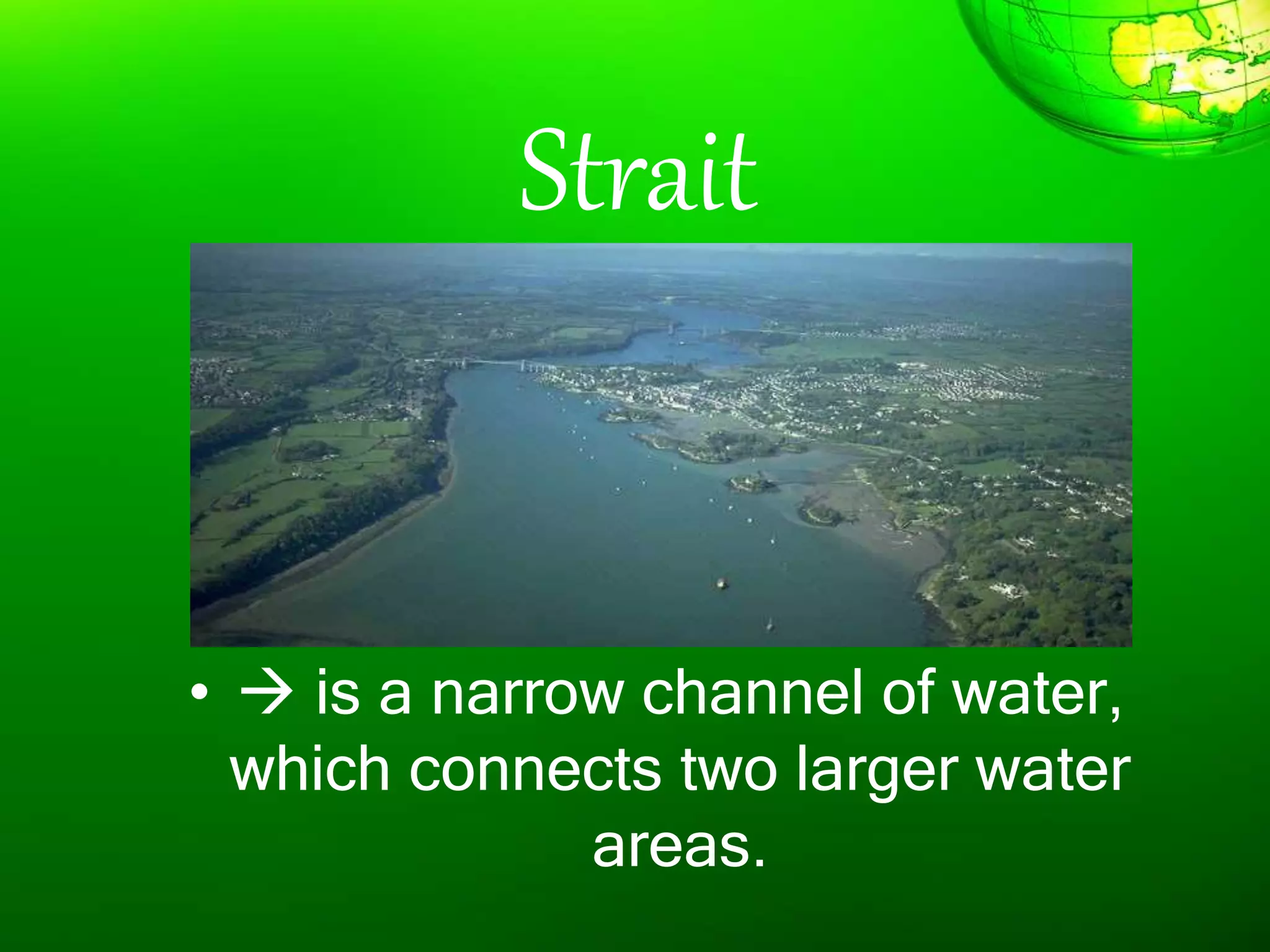
Strait
•  is a narrow channel of water,
which connects two larger water
areas.
Canal
•  is a man-made channel
intended for navigation.
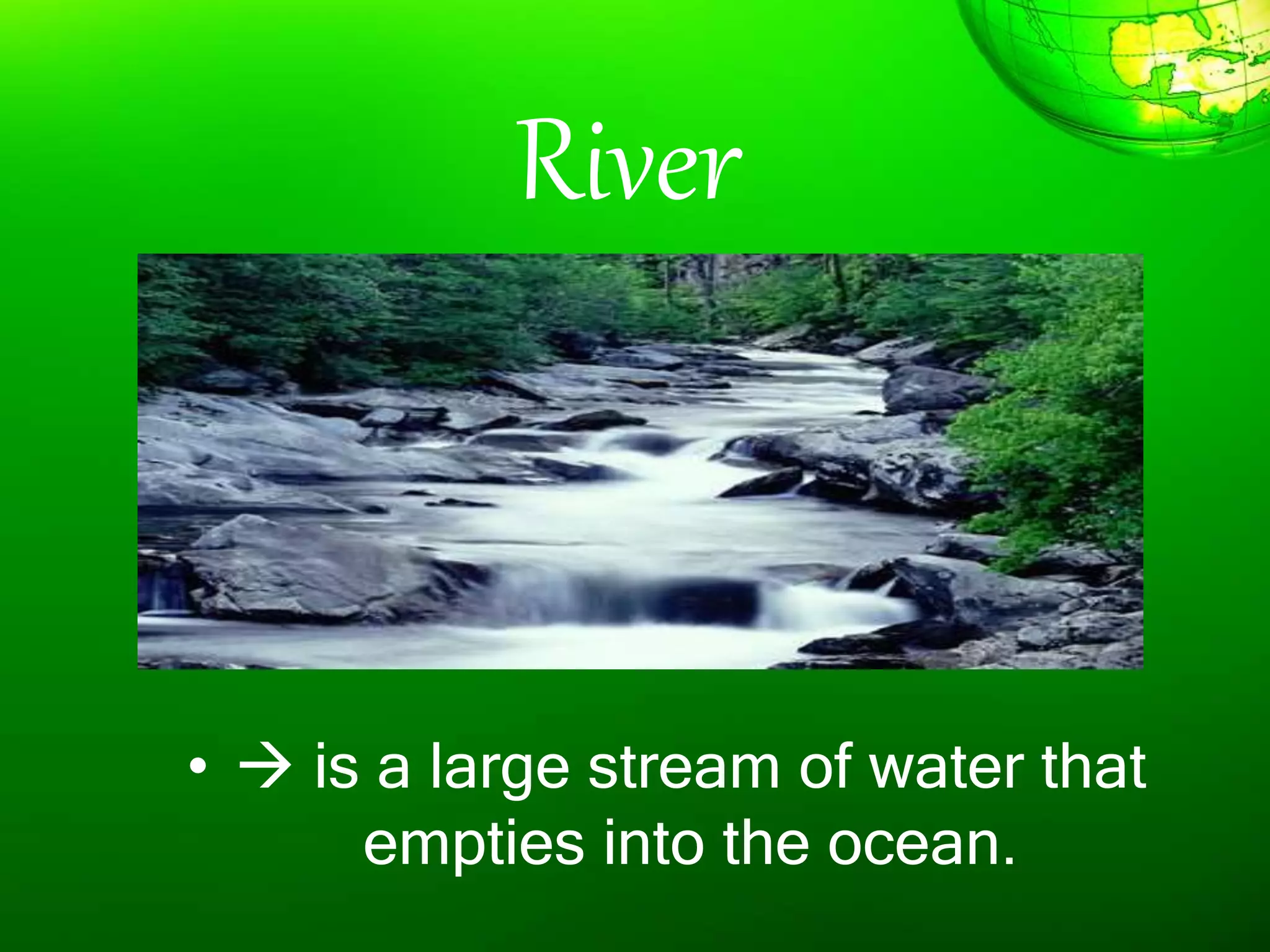
River
•  is a large stream of water that
empties into the ocean.
The Changing Earth:
Forces from without
•Erosion
 Is the process by which soil and
rock are washed or worn away
from the earth’s surface and
moved to another site.
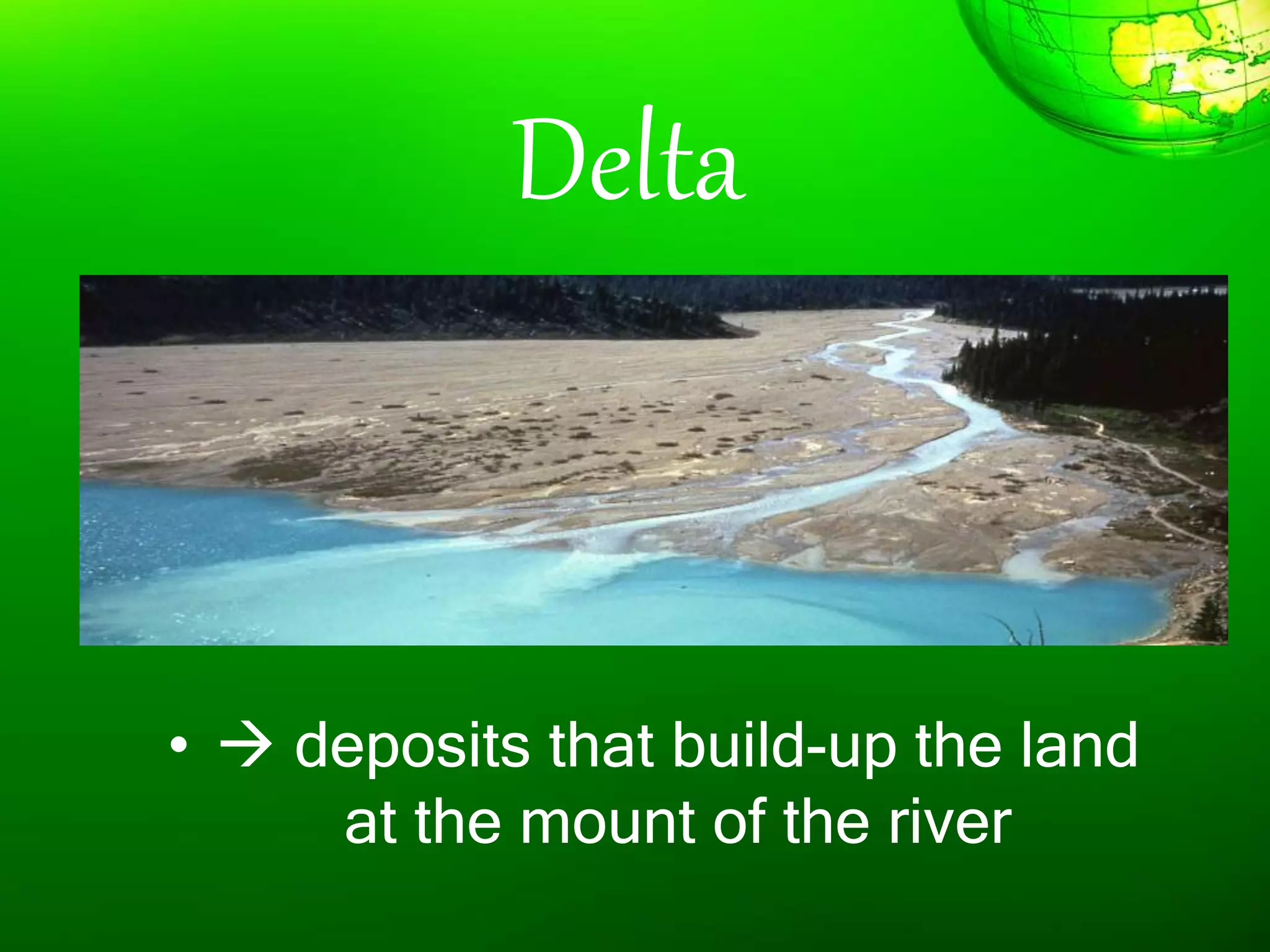
Delta
•  deposits that build-up the land
at the mount of the river
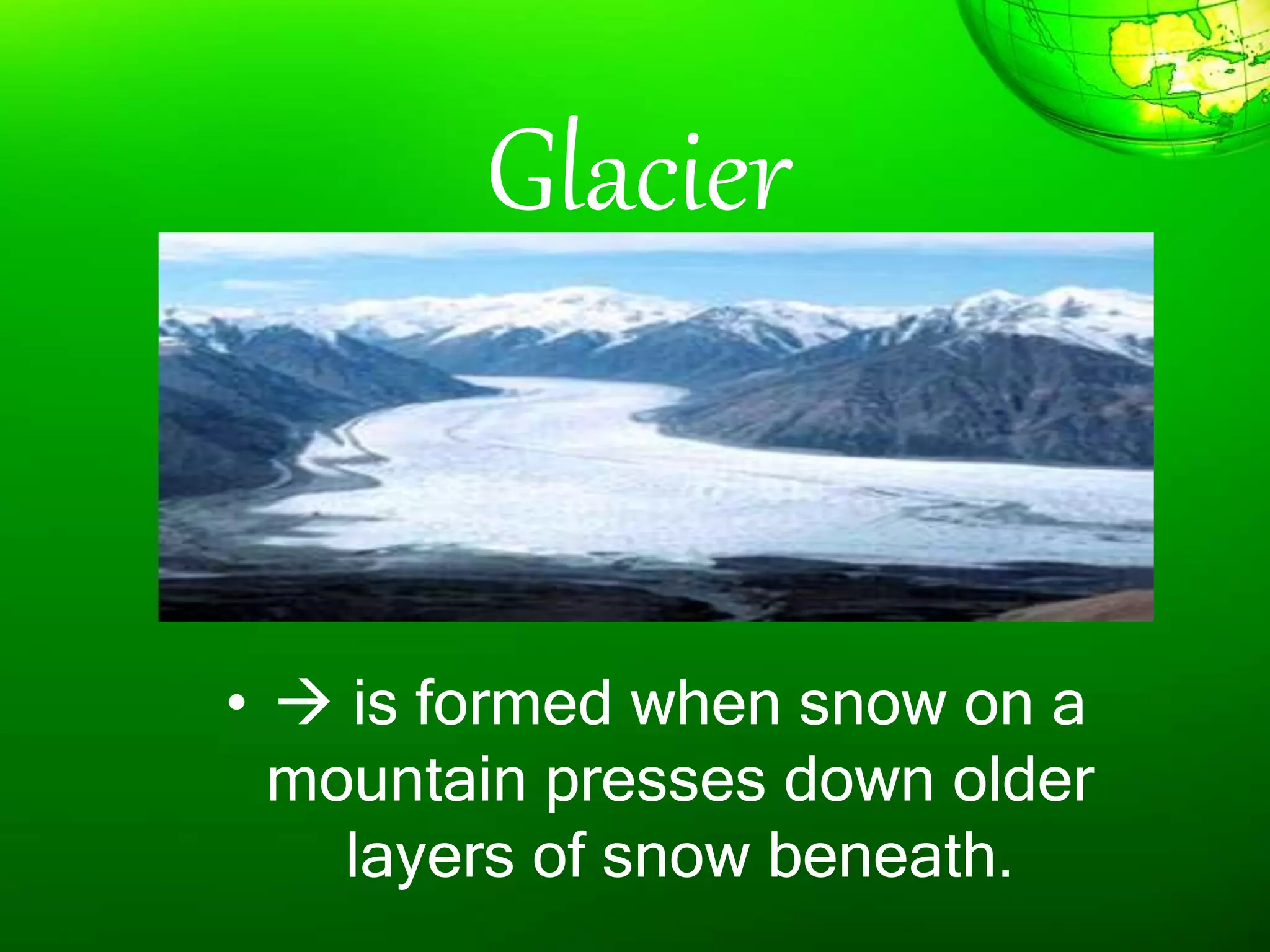
Glacier
•  is formed when snow on a
mountain presses down older
layers of snow beneath.
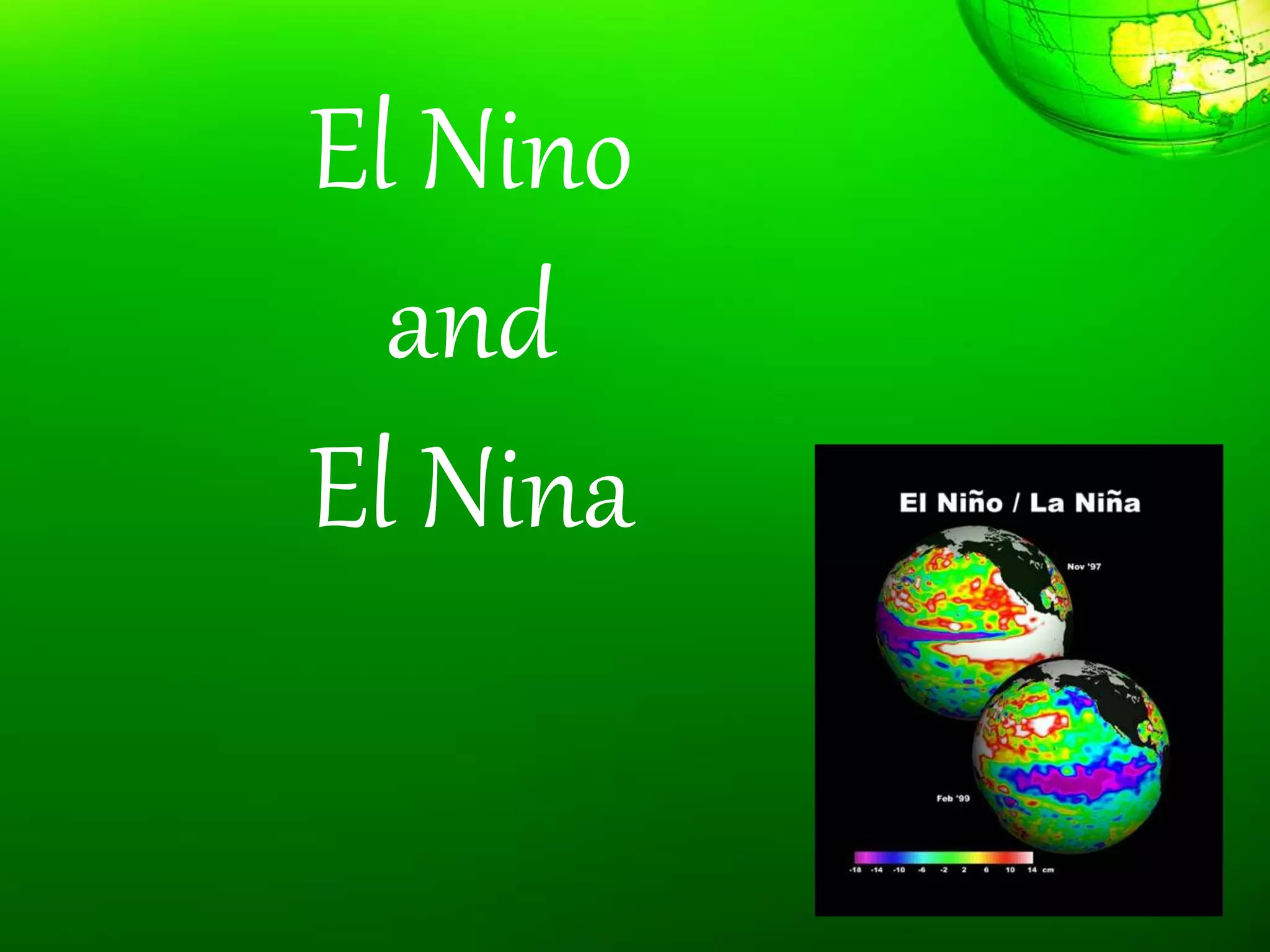
El Nino
and
El Nina
• El Nino •
this current is more
intense.
is exceptionally
warm.
accompanied by
heavy rainfall.
• El Nina •
is a condition when
sea surface
temperatures in the
central & eastern
Pacific are usually
low and trade winds
are very strong.

Land & Water Forms

  • 1.
    CHAPTER 2 LAND &WATER FORMS
  • 2.
    • Produce theinfinite local variations in the surface of the earth. LAND FORMS
  • 3.
    TWO KINDS OFFORCES • 1. Forces that wash, that wear down the earth surface. • 2. Forces that move, push & raise the earth’s surface.
  • 4.
    GERMOPHOLOGY •  isa branch of geology that studies the origin, characteristics & development of land forms.
  • 5.
    GERMOPHOLOGISTS •  theseare persons that studies the land forms.
  • 6.
    ALFRED WEGENER One ofthe pioneers of the theory of Plate Tectonics.
  • 7.
    Theory of PlateTectonics According to this theory, the present continents were once united in one super continent, which scientists called Pangaea, and that over many million of years the continents broke away from each other, slowly drifting to their present positions.
  • 8.
    Three Layers ofthe Earth
  • 9.
    1. Crust • is the outer part of the earth. •  it varies in thickness from 5 to 20 miles.
  • 10.
    2. Mantle • it is found beneath the earth’s crust. •  it is composed of rock and metal.
  • 11.
    3. Core • InnerCore  it is made of very hot solid metal. • Outer Core •  it is composed of liquid metal.
  • 12.
    Tectonic Activity • a movement wherein plates drift, pull apart or sometimes collide.
  • 13.
    Rift •  formedwhen two plates separate.
  • 14.
    Faulting •  thetectonic action that raises the land to form mountains.
  • 15.
    TSUNAMIS Gigantic waves causedby earthquakes in the ocean floor.
  • 16.
  • 17.
    Continents •  isa continuous mass of land surrounded by bid bodies of water.
  • 18.
    Continents of theWorld Continent Area/sq. km Percent/earth 1.Asia 45,065,792 30.1 2.Africa 30,302,860 20.2 3.North America 24,345,888 16.2 4.South America 17,870,917 11.9 5.Antartica 13,985,935 9.3 6.Europe 9,841,954 6.6 7.Oceania 8,546,960 5.7
  • 19.
    Island •  isa land surrounded by water and is much smaller than a continent.
  • 20.
    Islands Island Country Area/sq.km 1.GreenlandDenmark 2,175,590 2.New Guinea Indonesia 792,536 3.Borneo Indonesia-Malaysia- Brunei 725,455 4.Madagascar Madagascar 587,041 5.Baffin Canada 507,451 6.Sumatra Indonesia 427,348 7.Honshu Japan 227,413 8.Great Britain United Kingdom 218,076
  • 21.
    Peninsula •  isa tract of land almost surrounded by water.
  • 22.
    Isthmus •  isa narrow strip of land between two larger land areas.
  • 23.
    Cape •  isa point of and reaching into the sea .
  • 24.
    Mountain •  isa landmass that projects above its surroundings.
  • 25.
    Mountains of thecontinents Peaks/Continents Country Height/ ft. 1.Everest (Asia) Nepal-Tibet 29,028 2.Aconcagua (South America) Argentina 22,834 3.Mckinley (North America) Alaska 20,320,19,340 4.Kilimanjaro (Africa) Tanzania 19,340 5.El’ brus, Caucasus (Eurasia) Armenia/Russia 18,510 6.Vinson Massif (Antarctica) Ellsworth Land 16,864 7.Jaja Peak (Oceania) New Guinea 16,500 8.Mont Blanc, Alps (Europe) France; Italy 15,771
  • 26.
    Plateau •  alsocalled tableland is a level land higher than its adjacent land.
  • 27.
  • 28.
    a.Coastal plains • are sandy stretches of low and level land, usually the coastal areas of continents.
  • 29.
    b.Interior Plains • also called Inland plains are low and level areas within a continent.
  • 30.
    Alluvial Plains • are formed as a result of alluvium carried by streams and deposited in deltas.
  • 31.
    c.Glacial Plains • are formed by the deposits of continental glaciers.
  • 32.
    d.Lake Plains • are formed from the silt deposited on the beds of great lakes, which no longer exist.
  • 33.
    Prairies •  aregrass-covered plains.
  • 34.
    Tundra •  isa frozen, swampy plain.
  • 35.
    Steppes •  areplains usually found in semiarid climate.
  • 36.
  • 37.
    Four main partsof the Ocean Ocean Area/sq. km Trench/Basin Depth (ft) 1.Pacific 166,241,753 Mariana Trench 35,840 2.Atlantic 86,557,402 Puerto Rico Trench 28,232 3.Indian 73,427,457 Java Trench 23,376 4.Arctic 13,223,702 Eurasia Basin 17,881
  • 38.
    Sea •  isa great body of salty water smaller than an ocean, more or less landlocked.
  • 39.
    Gulf •  isa large part of the ocean or sea partly enclosed by land.
  • 40.
    Bay •  isalso a part of the sea extending into the land but is generally smaller than a gulf.
  • 41.
    Lake •  isan inland body of water, which may contain fresh or salty water.
  • 42.
    World’s Largest Lakes LakeLocation Area (sq. km.) 1. Caspian Sea Russian-Iran 371,000 2. Lake Superior U.S.A.-Canada 82,102 3.Lake Victoria Tanzania-Uganda 69,484 4.Aral Sea Kazakhstan- Uzbekistan 64,501 5.Lake Huron U.S.A.-Canada 59,569 6.Lake Michigan U.S.A. 57,759 7.Lake Tanganyika Congo-Tanzania 32,892 8.Lake Baikal Russia 31,499 9.Great Bear Lake Canada 31,328
  • 43.
    Strait •  isa narrow channel of water, which connects two larger water areas.
  • 44.
    Canal •  isa man-made channel intended for navigation.
  • 45.
    River •  isa large stream of water that empties into the ocean.
  • 46.
    The Changing Earth: Forcesfrom without •Erosion  Is the process by which soil and rock are washed or worn away from the earth’s surface and moved to another site.
  • 47.
    Delta •  depositsthat build-up the land at the mount of the river
  • 48.
    Glacier •  isformed when snow on a mountain presses down older layers of snow beneath.
  • 49.
  • 50.
    • El Nino• this current is more intense. is exceptionally warm. accompanied by heavy rainfall. • El Nina • is a condition when sea surface temperatures in the central & eastern Pacific are usually low and trade winds are very strong.