Prepared by:
Sheila Mae Rosali d.N. Lavapie &
Renria Joy E. Vejerano
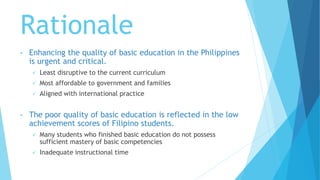
Rationale
• Enhancing the quality of basic education in the Philippines
is urgent and critical.
 Least disruptive to the current curriculum
 Most affordable to government and families
 Aligned with international practice
• The poor quality of basic education is reflected in the low
achievement scores of Filipino students.
 Many students who finished basic education do not possess
sufficient mastery of basic competencies
 Inadequate instructional time
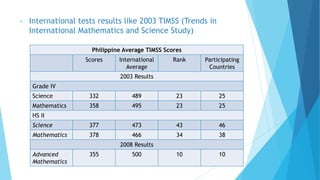
• International tests results like 2003 TIMSS (Trends in
International Mathematics and Science Study)
Philippine Average TIMSS Scores
Scores International
Average
Rank Participating
Countries
2003 Results
Grade IV
Science 332 489 23 25
Mathematics 358 495 23 25
HS II
Science 377 473 43 46
Mathematics 378 466 34 38
2008 Results
Advanced
Mathematics
355 500 10 10
• This quality of education is reflected in the inadequate
preparation of high school graduates for the world of work or
entrepreneurship or higher education.
 High school graduates do not possess the basic competencies or
emotional maturity for the world of work.
 70.9% of unemployed are at least HS graduates & 80% of the
unemployed are 15-34 y/o. (NSO, LFS 2010)
 Serious gaps in critical skills of graduates such as
 Problem-solving
 Initiative
 Creativity
 Job-specific technical skills
• Most graduates are too young to enter the labor force.
 Those who do not pursue higher education would be unproductive or
be vulnerable to exploitative labor practices.
 Those who may be interested to set up business cannot legally enter
into contracts.
• The current system also
reinforces the misperception
that basic education is just a
preparatory step for higher
education.
 Preparation for college education
 Expectation as most students
usually take remedial and high
school level classes in colleges and
universities.
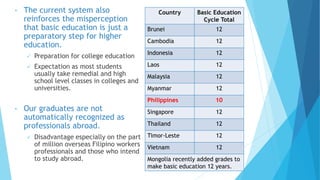
• Our graduates are not
automatically recognized as
professionals abroad.
 Disadvantage especially on the part
of million overseas Filipino workers
professionals and those who intend
to study abroad.
Country Basic Education
Cycle Total
Brunei 12
Cambodia 12
Indonesia 12
Laos 12
Malaysia 12
Myanmar 12
Philippines 10
Singapore 12
Thailand 12
Timor-Leste 12
Vietnam 12
Mongolia recently added grades to
make basic education 12 years.
• More importantly, the short basic education program
affects the human development of the Filipino children.
 Psychologists and educators say that children under 18 are
generally not emotionally prepared for entrepreneurship or
employment or higher education disciplines.
• Cognizant of this urgent and critical concern and in line
with the priorities of the Aquino Administration, the
Department of Education is taking bold steps to enhance
the basic education curriculum.
 DepEd intends to raise the quality of basic education through the
enhancement and expansion of the basic education cycle.
• K+12 Basic Education Program seeks to provide a quality 12-
year basic education program that each Filipino is entitled to.
 Article XIV, Section 2 of the 1987 Philippine Constitution which
states that “The State shall establish, maintain, and support a
complete, adequate, and integrated system of education relevant
to the needs and people of the society.”
• K+12 means Kindergarten and the 12 years of elementary and
secondary education.
 Under the K+12, the intention is not just to add another 2 yars of
schooling but more importantly to enhance the basic education
curriculum.
Historical Background
 As early as 1925 studies have observed the inadequacy of
the basic education curriculum. As one of the most
studied reforms, recommendations of either adding or
restoring 7th grade or adding an extra year to basic
education have been put forward.
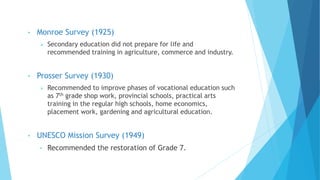
• Monroe Survey (1925)
 Secondary education did not prepare for life and
recommended training in agriculture, commerce and industry.
• Prosser Survey (1930)
 Recommended to improve phases of vocational education such
as 7th grade shop work, provincial schools, practical arts
training in the regular high schools, home economics,
placement work, gardening and agricultural education.
• UNESCO Mission Survey (1949)
• Recommended the restoration of Grade 7.
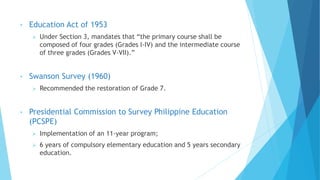
• Education Act of 1953
 Under Section 3, mandates that “the primary course shall be
composed of four grades (Grades I-IV) and the intermediate course
of three grades (Grades V-VII).”
• Swanson Survey (1960)
 Recommended the restoration of Grade 7.
• Presidential Commission to Survey Philippine Education
(PCSPE)
 Implementation of an 11-year program;
 6 years of compulsory elementary education and 5 years secondary
education.
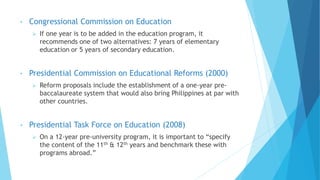
• Congressional Commission on Education
 If one year is to be added in the education program, it
recommends one of two alternatives: 7 years of elementary
education or 5 years of secondary education.
• Presidential Commission on Educational Reforms (2000)
 Reform proposals include the establishment of a one-year pre-
baccalaureate system that would also bring Philippines at par with
other countries.
• Presidential Task Force on Education (2008)
 On a 12-year pre-university program, it is important to “specify
the content of the 11th & 12th years and benchmark these with
programs abroad.”
Education Vision
• Every graduate of the Enhanced K+12 Basic Education
Program is an empowered individual who has learned ,
through a program that is rooted on sound educational
principles and geared towards excellence, the foundations
for learning throughout life, the competence to engage in
work and be productive, the ability to exist in fruitful
harmony with local and global communities, the capability
to engage in autonomous critical thinking, and the
capacity to transform others and one’s self.
• A vision Grounded on Human Development:
 The complete human development of every graduate is at the core of
the enhanced K+12 Education Program.
• Every graduate also has the courage, the drive, and relevant
skills to engage in work and have a productive life.
• Every graduate will be able to think for himself/herself and
make sound decisions on the best courses of action to take in
the different circumstances of his or her life.
• Every graduate is inculcated with the respect for human rights
and values, notably, Maka-Diyos, Maka-tao, Makabansa, and
Maka-Kalikasan.
• A Vision Achieved through an Enhanced Curriculum:
 Benefit from a reformed and updated curriculum that is focused
on enabling every child to achieve mastery of core competencies
and skills.
• A Vision that has Socio-Economic Relevance:
 Every graduate of the K+12 program is ready to take his or her
place as a productive member of the society.
• This vision is consistent with the definition of an educated
Filipino as conceived in the Philippine Constitution and
the World Declaration on Education for all.
Goals
• The goal of the Enhanced K+12 Basic Education Program is
to create a functional basic education system that will
produce productive and responsible citizens equipped
with the essential competencies and skills for both life-
long learning and employment.
Objectives:
1. To give every student an opportunity to receive quality
education based on an enhanced and decongested
curriculum that is internationally recognized and
comparable.
 Develop a curriculum that is rational and focused on excellence
 Produce a pool of highly qualified and adequately trained teachers
 Achieve high academic standards especially in Math, Science&
English at all levels
 Produce graduates who are globally competitive and whose
credentials are recognized internationally
2. To change public perception that high school education
is just a preparation for college; rather, it should
allow one to take advantage of opportunities for gainful
career or employment and/or self-employment in a
rapidly changing and increasingly globalized
environment.
 Produce graduates who possess skills and competencies that
will allow them to be productive members of the society or
pursue higher education.
 Through coordination between the academic and business
sectors, to change industry hiring practices taking into account
the enhanced skills and competencies of K+12 graduates.
Benefits of Enhanced Basic
Education Program
• The Enhanced K+12 Basic Education Program will be
instrumental in achieving the nation’s vision of a high
school graduate. The benefits of the K+12 proposal far
outweigh the additional costs that will be incurred by
both government and families.
To Individuals and
Families
1. An enhanced curriculum will decongest academic
workload.
2. Graduates will possess competencies and skills relevant
to job market.
3. Graduates will be prepared for higher education.
4. Graduates will be able to earn high wages and/or better
prepared to start their business.
5. Graduates could now be recognized abroad.
For the Society &
the Economy
1. The economy will experience accelerated growth in the
long run.
2. The Philippines education system will be at par with
international standards.
3. A better educated society provides a sound foundation
for long-term socio-economic development.
Enhanced K+12 Basic
Education Model
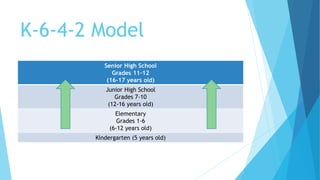
• K-6-4-2 Model
 This model involves Kindergarten, six years of elementary
education, four years of junior high school (Grades 7 to 10)
and two years of senior high school (Grades 11 to 12).
K-6-4-2 Model
Senior High School
Grades 11-12
(16-17 years old)
Junior High School
Grades 7-10
(12-16 years old)
Elementary
Grades 1-6
(6-12 years old)
Kindergarten (5 years old)
K-6-4-2
Implementation
Plan
• K+12 program will be phased.
• Starting SY 2011-12 universal kindergarten will be offered.
• By SY 2012-13 new curriculum will be offered to incoming
Grade 1 as well as to Junior High School students.
• On SY 2016-17 DepED targets to put the necessary
infrastructure and other arrangements needed to provide
the Senior High School education.
• SHS curriculum will offer areas of specialization or
electives such as science and technology, music and arts,
agriculture and fisheries, sports, business and
entrepreneurship, and subjects for advanced placement.
• DepEd will take into account the issues and concerns of
stakeholders, including the high school graduates before
2016.
• Mechanics and other details of the transition plan will be
threshed out with HEIs in coordination with CHED, TESDA
and other critical stakeholders.
Guiding Principles
• The enhancement of the curriculum is the central focus of
the Enhance K+12 Basic Education Program.
• The development of tracks based on different
competencies and/or student interest will be an integral
component of the program.
• As a part of the bigger basic education reform, the
enhancement of the basic education curriculum is being
undertaken hand I hand with the vigorous efforts to
ensure adequacy of inputs.
• Change is two-fold: curriculum enhancement and
transition management.
• An open and consultative process will be adopted in the
promotion of the Enhanced K12 Basic Education Program.
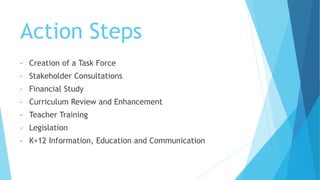
Action Steps
• Creation of a Task Force
• Stakeholder Consultations
• Financial Study
• Curriculum Review and Enhancement
• Teacher Training
• Legislation
• K+12 Information, Education and Communication

The enhanced k+12 basic education program

  • 1.
    Prepared by: Sheila MaeRosali d.N. Lavapie & Renria Joy E. Vejerano
  • 2.
    Rationale • Enhancing thequality of basic education in the Philippines is urgent and critical.  Least disruptive to the current curriculum  Most affordable to government and families  Aligned with international practice • The poor quality of basic education is reflected in the low achievement scores of Filipino students.  Many students who finished basic education do not possess sufficient mastery of basic competencies  Inadequate instructional time
  • 3.
    • International testsresults like 2003 TIMSS (Trends in International Mathematics and Science Study) Philippine Average TIMSS Scores Scores International Average Rank Participating Countries 2003 Results Grade IV Science 332 489 23 25 Mathematics 358 495 23 25 HS II Science 377 473 43 46 Mathematics 378 466 34 38 2008 Results Advanced Mathematics 355 500 10 10
  • 4.
    • This qualityof education is reflected in the inadequate preparation of high school graduates for the world of work or entrepreneurship or higher education.  High school graduates do not possess the basic competencies or emotional maturity for the world of work.  70.9% of unemployed are at least HS graduates & 80% of the unemployed are 15-34 y/o. (NSO, LFS 2010)  Serious gaps in critical skills of graduates such as  Problem-solving  Initiative  Creativity  Job-specific technical skills • Most graduates are too young to enter the labor force.  Those who do not pursue higher education would be unproductive or be vulnerable to exploitative labor practices.  Those who may be interested to set up business cannot legally enter into contracts.
  • 5.
    • The currentsystem also reinforces the misperception that basic education is just a preparatory step for higher education.  Preparation for college education  Expectation as most students usually take remedial and high school level classes in colleges and universities. • Our graduates are not automatically recognized as professionals abroad.  Disadvantage especially on the part of million overseas Filipino workers professionals and those who intend to study abroad. Country Basic Education Cycle Total Brunei 12 Cambodia 12 Indonesia 12 Laos 12 Malaysia 12 Myanmar 12 Philippines 10 Singapore 12 Thailand 12 Timor-Leste 12 Vietnam 12 Mongolia recently added grades to make basic education 12 years.
  • 6.
    • More importantly,the short basic education program affects the human development of the Filipino children.  Psychologists and educators say that children under 18 are generally not emotionally prepared for entrepreneurship or employment or higher education disciplines. • Cognizant of this urgent and critical concern and in line with the priorities of the Aquino Administration, the Department of Education is taking bold steps to enhance the basic education curriculum.  DepEd intends to raise the quality of basic education through the enhancement and expansion of the basic education cycle.
  • 7.
    • K+12 BasicEducation Program seeks to provide a quality 12- year basic education program that each Filipino is entitled to.  Article XIV, Section 2 of the 1987 Philippine Constitution which states that “The State shall establish, maintain, and support a complete, adequate, and integrated system of education relevant to the needs and people of the society.” • K+12 means Kindergarten and the 12 years of elementary and secondary education.  Under the K+12, the intention is not just to add another 2 yars of schooling but more importantly to enhance the basic education curriculum.
  • 8.
    Historical Background  Asearly as 1925 studies have observed the inadequacy of the basic education curriculum. As one of the most studied reforms, recommendations of either adding or restoring 7th grade or adding an extra year to basic education have been put forward.
  • 9.
    • Monroe Survey(1925)  Secondary education did not prepare for life and recommended training in agriculture, commerce and industry. • Prosser Survey (1930)  Recommended to improve phases of vocational education such as 7th grade shop work, provincial schools, practical arts training in the regular high schools, home economics, placement work, gardening and agricultural education. • UNESCO Mission Survey (1949) • Recommended the restoration of Grade 7.
  • 10.
    • Education Actof 1953  Under Section 3, mandates that “the primary course shall be composed of four grades (Grades I-IV) and the intermediate course of three grades (Grades V-VII).” • Swanson Survey (1960)  Recommended the restoration of Grade 7. • Presidential Commission to Survey Philippine Education (PCSPE)  Implementation of an 11-year program;  6 years of compulsory elementary education and 5 years secondary education.
  • 11.
    • Congressional Commissionon Education  If one year is to be added in the education program, it recommends one of two alternatives: 7 years of elementary education or 5 years of secondary education. • Presidential Commission on Educational Reforms (2000)  Reform proposals include the establishment of a one-year pre- baccalaureate system that would also bring Philippines at par with other countries. • Presidential Task Force on Education (2008)  On a 12-year pre-university program, it is important to “specify the content of the 11th & 12th years and benchmark these with programs abroad.”
  • 12.
    Education Vision • Everygraduate of the Enhanced K+12 Basic Education Program is an empowered individual who has learned , through a program that is rooted on sound educational principles and geared towards excellence, the foundations for learning throughout life, the competence to engage in work and be productive, the ability to exist in fruitful harmony with local and global communities, the capability to engage in autonomous critical thinking, and the capacity to transform others and one’s self.
  • 13.
    • A visionGrounded on Human Development:  The complete human development of every graduate is at the core of the enhanced K+12 Education Program. • Every graduate also has the courage, the drive, and relevant skills to engage in work and have a productive life. • Every graduate will be able to think for himself/herself and make sound decisions on the best courses of action to take in the different circumstances of his or her life. • Every graduate is inculcated with the respect for human rights and values, notably, Maka-Diyos, Maka-tao, Makabansa, and Maka-Kalikasan.
  • 14.
    • A VisionAchieved through an Enhanced Curriculum:  Benefit from a reformed and updated curriculum that is focused on enabling every child to achieve mastery of core competencies and skills. • A Vision that has Socio-Economic Relevance:  Every graduate of the K+12 program is ready to take his or her place as a productive member of the society. • This vision is consistent with the definition of an educated Filipino as conceived in the Philippine Constitution and the World Declaration on Education for all.
  • 15.
    Goals • The goalof the Enhanced K+12 Basic Education Program is to create a functional basic education system that will produce productive and responsible citizens equipped with the essential competencies and skills for both life- long learning and employment.
  • 16.
    Objectives: 1. To giveevery student an opportunity to receive quality education based on an enhanced and decongested curriculum that is internationally recognized and comparable.  Develop a curriculum that is rational and focused on excellence  Produce a pool of highly qualified and adequately trained teachers  Achieve high academic standards especially in Math, Science& English at all levels  Produce graduates who are globally competitive and whose credentials are recognized internationally
  • 17.
    2. To changepublic perception that high school education is just a preparation for college; rather, it should allow one to take advantage of opportunities for gainful career or employment and/or self-employment in a rapidly changing and increasingly globalized environment.  Produce graduates who possess skills and competencies that will allow them to be productive members of the society or pursue higher education.  Through coordination between the academic and business sectors, to change industry hiring practices taking into account the enhanced skills and competencies of K+12 graduates.
  • 18.
    Benefits of EnhancedBasic Education Program • The Enhanced K+12 Basic Education Program will be instrumental in achieving the nation’s vision of a high school graduate. The benefits of the K+12 proposal far outweigh the additional costs that will be incurred by both government and families.
  • 19.
    To Individuals and Families 1.An enhanced curriculum will decongest academic workload. 2. Graduates will possess competencies and skills relevant to job market. 3. Graduates will be prepared for higher education. 4. Graduates will be able to earn high wages and/or better prepared to start their business. 5. Graduates could now be recognized abroad.
  • 20.
    For the Society& the Economy 1. The economy will experience accelerated growth in the long run. 2. The Philippines education system will be at par with international standards. 3. A better educated society provides a sound foundation for long-term socio-economic development.
  • 21.
    Enhanced K+12 Basic EducationModel • K-6-4-2 Model  This model involves Kindergarten, six years of elementary education, four years of junior high school (Grades 7 to 10) and two years of senior high school (Grades 11 to 12).
  • 22.
    K-6-4-2 Model Senior HighSchool Grades 11-12 (16-17 years old) Junior High School Grades 7-10 (12-16 years old) Elementary Grades 1-6 (6-12 years old) Kindergarten (5 years old)
  • 23.
  • 24.
    • K+12 programwill be phased. • Starting SY 2011-12 universal kindergarten will be offered. • By SY 2012-13 new curriculum will be offered to incoming Grade 1 as well as to Junior High School students. • On SY 2016-17 DepED targets to put the necessary infrastructure and other arrangements needed to provide the Senior High School education.
  • 25.
    • SHS curriculumwill offer areas of specialization or electives such as science and technology, music and arts, agriculture and fisheries, sports, business and entrepreneurship, and subjects for advanced placement. • DepEd will take into account the issues and concerns of stakeholders, including the high school graduates before 2016. • Mechanics and other details of the transition plan will be threshed out with HEIs in coordination with CHED, TESDA and other critical stakeholders.
  • 26.
    Guiding Principles • Theenhancement of the curriculum is the central focus of the Enhance K+12 Basic Education Program. • The development of tracks based on different competencies and/or student interest will be an integral component of the program. • As a part of the bigger basic education reform, the enhancement of the basic education curriculum is being undertaken hand I hand with the vigorous efforts to ensure adequacy of inputs.
  • 27.
    • Change istwo-fold: curriculum enhancement and transition management. • An open and consultative process will be adopted in the promotion of the Enhanced K12 Basic Education Program.
  • 28.
    Action Steps • Creationof a Task Force • Stakeholder Consultations • Financial Study • Curriculum Review and Enhancement • Teacher Training • Legislation • K+12 Information, Education and Communication