The Philippine
Archipelago and it’s
People
Geographical Foundations
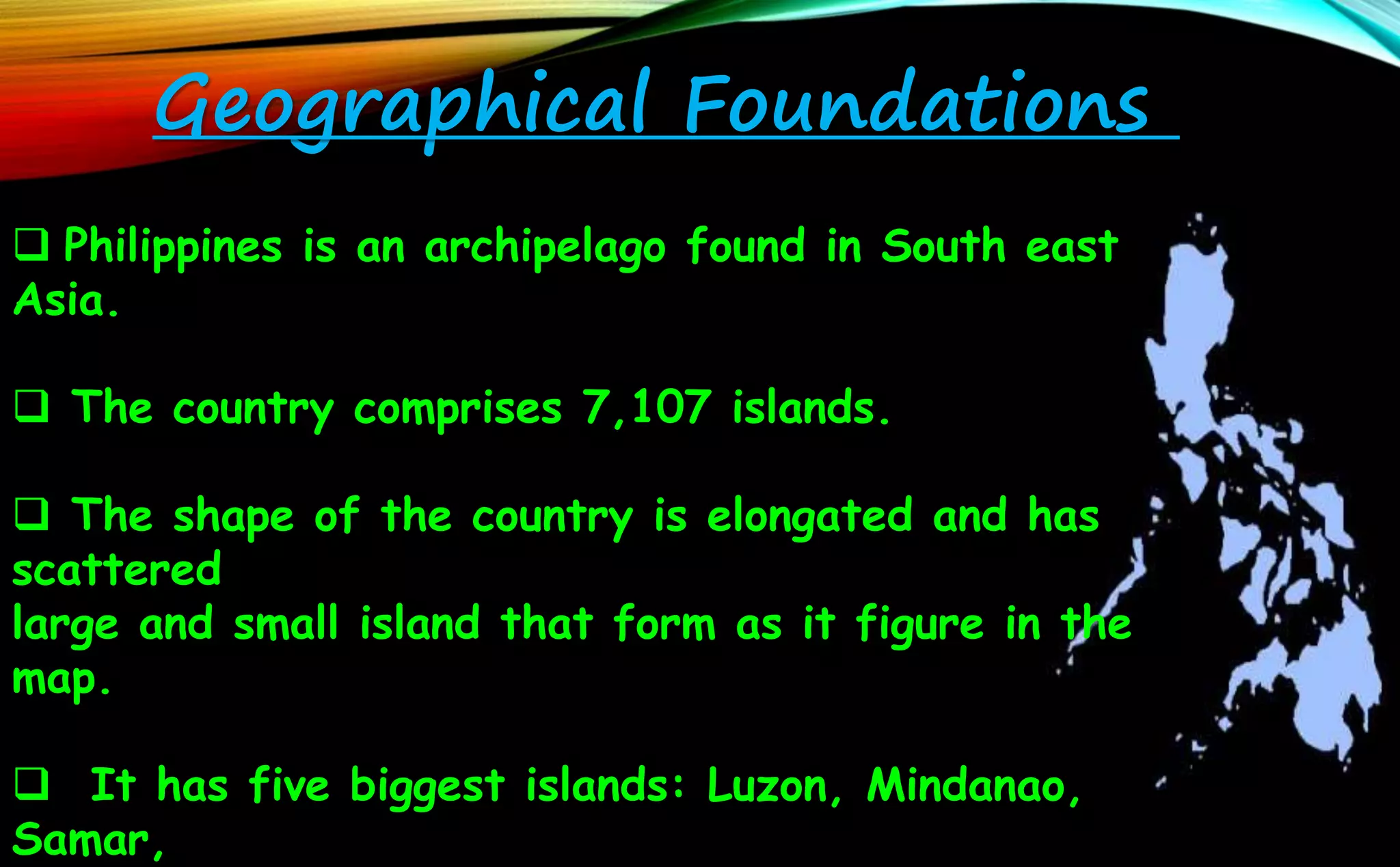
 Philippines is an archipelago found in South east
Asia.
 The country comprises 7,107 islands.
 The shape of the country is elongated and has
scattered
large and small island that form as it figure in the
map.
 It has five biggest islands: Luzon, Mindanao,
Samar,
Archipelagic Principle of the Territ
Section 1 of the Article 1 of the National
Territory states;
The national territory comprises the Philippine archipelago, with
all the islands and waters embraced therein, and all other
territories over which the Philippines has sovereignty or
jurisdiction, consisting of its terrestrial, fluvial and aerial domains,
including its territorial sea, the seabed, the subsoil, the insular
shelves, and other submarine areas. The waters around, between,
and connecting the islands of the archipelago, regardless of their
breadth and dimensions, form part of the internal waters of the
Philippines.
Mountains and
Plains
Mountains and Plains
 In Luzon, There are three large mountain ranges found:
Sierra Madre
Caraballo del Sur
Caraballo del Baler
Mountains and Plains
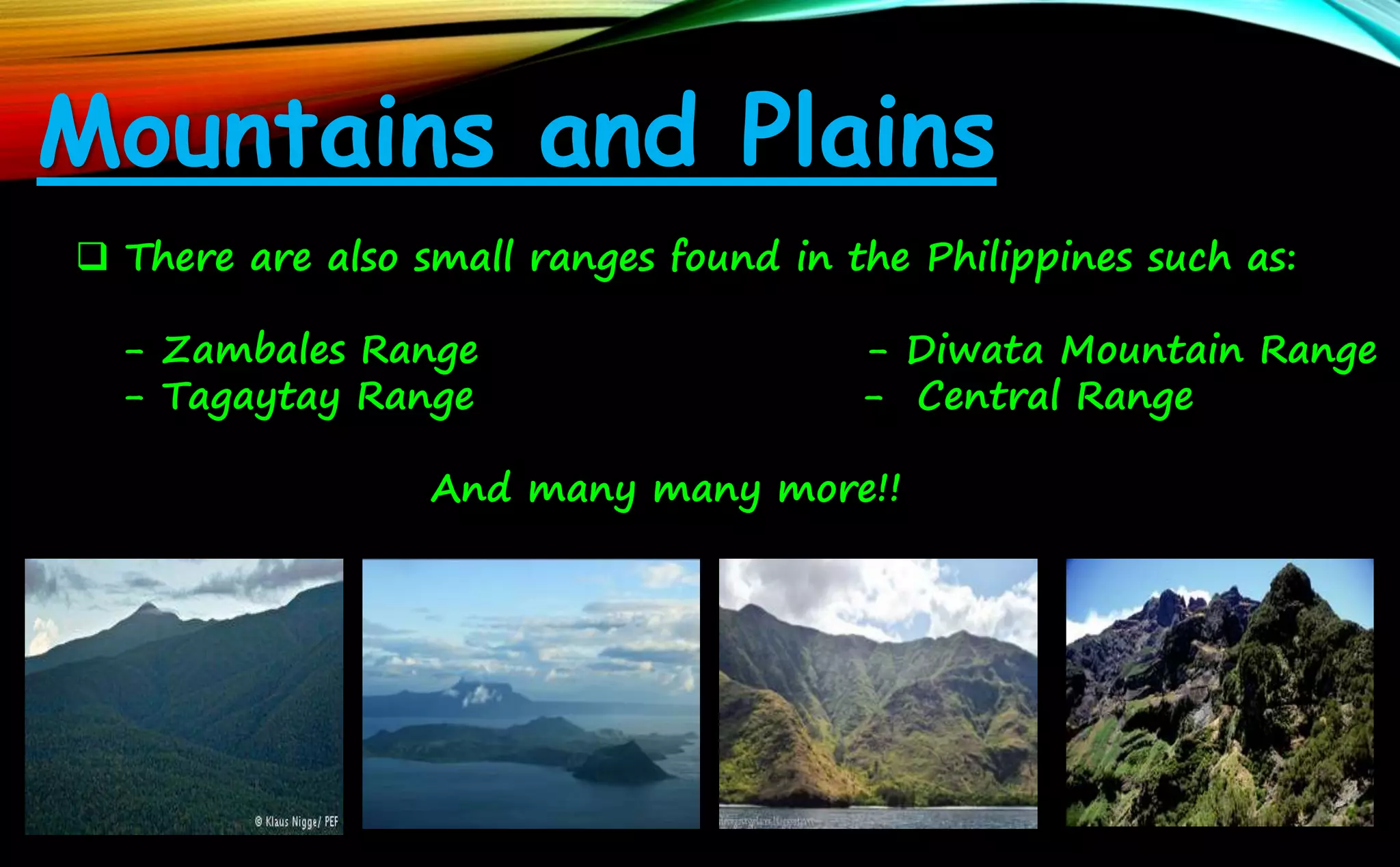
 There are also small ranges found in the Philippines such as:
- Zambales Range - Diwata Mountain Range
- Tagaytay Range - Central Range
And many many more!!
Mountains and Plains
 The highest mountain peak in the
Philippines is Mt. Apo located in
Davao del Sur in Mindanao.
 It has a high of almost 3,000
meters high which have a high
source of Geothermal Energy-(is the
heat from the Earth. It's clean and
sustainable.)
Mountains and Plains
 There are also large and fertile plains that have been
sources of staple food, fruits and vegetables for the entire
archipelago
Central Luzon Plain Cagayan Valley Plain
Volcanoes
Volcanoes
 The Philippines is known for it’s active volcanoes that are
scattered through out the archipelago. Some of the famous
active Volcanoes are Mt. Mayon, Taal Volano, Mt. Pinatubo,
Mt. Bulusan, and Mt. Kanlaon
Mt. Mayon
Taal Volcano
Mt, Pinatubo
Mt. Bulusan
Mt, kanlaon
Other Land Formations
Burol(hill)
Lambak (Valley)Talampas (Plateu)
Pulo (Island)
Tangway
(Peninsula)
Water Forms
Water Forms (Rivers)
 The largest and longest river systems in the
country are found in Luzon and Mindanao.
 Some of the famous and large rivers here in our
country are the Pampanga River, Agno River,
Agusan River and the Abra River
Pampanga River Agno River Agusan River Abra River
Water Forms (Rivers)
 The Rio Grande Rivers:
- Rio Grande de Mindanao: also
known as the Mindanao River, is the
second largest river system in
the Philippines
- Rio Grande de Cagayan: is the
longest and largest river in the Philippine
Archipelago.
Rio Grande de Mindanao
Rio Grande de Cagayan
Water Forms (Lakes)
 There are also some famous lakes found in the Philippines.
There are the Laguna de Bay, Taal Lake, and the Lake Lanao.
 Sinarapan- Smallest commercial fish. (Pandaca pyg Mea)
Water Forms (Seas)
 The seas, which are important source of fish supply and
other marine resources.
 North- Kipot ng Luzon and Celebes sea
 East- Philippine Sea, and Pacific Ocean.
 West- South China Sea
 South- Sulu Sea
Other Water Forms
Golpo (Gulf)
Karagatan (Ocean)
Look (Bay)
Talon (Falls)
Climate
General Resources of the
Country
 The Soil and it’s Products (Yamang Lupa)
 Water Resources (Yamang Tubig)
 Mineral Resources (Yamang Mineral)
The Soil and It’s Produc
 The Philippines have six qualification of soils.
Alluvial Sand
Stone
and
Shale
Lime
Stone
Volcanic Andesite
and
Basalt
Mountai
n
 Produces
agricultural
products
such as
Abaka,
Coconut,
and tabacco
 Also good
in products
but the
harvest is
lower
amounts
compared
to Alluvial
Soil.
 Produces
agricultural
products.
 Also best
for grazing
of animals
due to it’s
abundance
of grass.
 This soil
are found in
the areas
where past
eruption of
the volcano
accurs.
 Generally
used for
sugar cane
Plantations
 A kind of
soils where
trees are
found.
 Such as
soil in the
forest, and
Jungle.
Alluvial Soil
Shale and Sandstone Soil
Limestone Soil
Volcanic Soil
Andesite and basalt Stone
Mountain Soil
Water
Resource
Water Resource
 The Philippines being an archipelago has 150,000,000
hectares of water with 17,460 m. of coastlines.
 Because the Philippines has many Water forms, active
fishing is one of the source of livelihood for many Filipinos.
 There are two kinds of fishing industry in the Philippines:
The Genetic and The ExtraActive.
 Genetic Industry vs. Extractive Industry
Water Resource
Genetic Industry Extractive Industry
 Covers Fish reproduction, fish
culture and fishponds.
 This coincides with the
advancement in fish research
that is now utilized in fresh,
brackish, and salt water.
 Such as Tilapia, prawn,
milkfish(bangus), eel and catfish
reproduction.
 This covers direct fishing in
shallow, high seas, and in coral
areas.
 The fish, shells, and other
resource extracted in this areas,
take a long time before natural
replenishment occurs.
 And in some cases, threats of
extinction brought by illegal
fishing.
Mineral
Resource
Mineral Resource
 In terms of Mineral resource, the Philippines is rich in
Metallic, non metallic, and fusel minerals.
 Mining corporations extract the minerals from various
uses in industry, commerce and personal ornaments.
 Mineral fuels such as carbon and petroleum are used in
fueling industries and transportation in the country.
 In Luzon, after the eruption of Mt. Pinatubo become a
major spot for quarrying. Gravel and sand became too
abundant for the use in constructions.
Mineral Resource
 The following are mined Metallic Mineral , Non- Metallic
Minerals, and Fusel Minerals
Metallic Non-
metallic
Fusel
 gold
 Iron
 Manganese
 lead
 Ornaments
 Clay
 Cement
 pyrite
 limestone
 marbles
 sulfur
 Carbon
 Petroleum
Origins of the
Philippine
Archipelago Volcanism
 Diastrophism
 Gradation
 Land bridge
Volcanism
 The eruption of volcanoes caused by the heat released in
the mantle of the Earth thus creating a movement of molten
rocks into Earth’s Crust.
Diastrophis
m is the process of movement on the Earth’s crust that
resulted in the formations of mountains and mountain
ranges.
Gradation
 It is the formation of mountains and Volcanoes after which
erosion takes place that led to the creation of rivers, lakes,
delta, and other land formations found in the different parts
of the country.
Land Bridge
 It Explains that the Philippines was once connected to
the mainland Asia through bridges of land formed during
the Pleistocene or Ice Age 25,000,000 years ago

The Philippines (Archipelago and it's people)

  • 1.
  • 2.
    Geographical Foundations  Philippinesis an archipelago found in South east Asia.  The country comprises 7,107 islands.  The shape of the country is elongated and has scattered large and small island that form as it figure in the map.  It has five biggest islands: Luzon, Mindanao, Samar,
  • 4.
    Archipelagic Principle ofthe Territ Section 1 of the Article 1 of the National Territory states; The national territory comprises the Philippine archipelago, with all the islands and waters embraced therein, and all other territories over which the Philippines has sovereignty or jurisdiction, consisting of its terrestrial, fluvial and aerial domains, including its territorial sea, the seabed, the subsoil, the insular shelves, and other submarine areas. The waters around, between, and connecting the islands of the archipelago, regardless of their breadth and dimensions, form part of the internal waters of the Philippines.
  • 5.
  • 6.
    Mountains and Plains In Luzon, There are three large mountain ranges found: Sierra Madre Caraballo del Sur Caraballo del Baler
  • 7.
    Mountains and Plains There are also small ranges found in the Philippines such as: - Zambales Range - Diwata Mountain Range - Tagaytay Range - Central Range And many many more!!
  • 8.
    Mountains and Plains The highest mountain peak in the Philippines is Mt. Apo located in Davao del Sur in Mindanao.  It has a high of almost 3,000 meters high which have a high source of Geothermal Energy-(is the heat from the Earth. It's clean and sustainable.)
  • 9.
    Mountains and Plains There are also large and fertile plains that have been sources of staple food, fruits and vegetables for the entire archipelago Central Luzon Plain Cagayan Valley Plain
  • 10.
  • 11.
    Volcanoes  The Philippinesis known for it’s active volcanoes that are scattered through out the archipelago. Some of the famous active Volcanoes are Mt. Mayon, Taal Volano, Mt. Pinatubo, Mt. Bulusan, and Mt. Kanlaon Mt. Mayon Taal Volcano Mt, Pinatubo Mt. Bulusan Mt, kanlaon
  • 12.
    Other Land Formations Burol(hill) Lambak(Valley)Talampas (Plateu) Pulo (Island) Tangway (Peninsula)
  • 13.
  • 14.
    Water Forms (Rivers) The largest and longest river systems in the country are found in Luzon and Mindanao.  Some of the famous and large rivers here in our country are the Pampanga River, Agno River, Agusan River and the Abra River Pampanga River Agno River Agusan River Abra River
  • 15.
    Water Forms (Rivers) The Rio Grande Rivers: - Rio Grande de Mindanao: also known as the Mindanao River, is the second largest river system in the Philippines - Rio Grande de Cagayan: is the longest and largest river in the Philippine Archipelago. Rio Grande de Mindanao Rio Grande de Cagayan
  • 16.
    Water Forms (Lakes) There are also some famous lakes found in the Philippines. There are the Laguna de Bay, Taal Lake, and the Lake Lanao.  Sinarapan- Smallest commercial fish. (Pandaca pyg Mea)
  • 17.
    Water Forms (Seas) The seas, which are important source of fish supply and other marine resources.  North- Kipot ng Luzon and Celebes sea  East- Philippine Sea, and Pacific Ocean.  West- South China Sea  South- Sulu Sea
  • 18.
    Other Water Forms Golpo(Gulf) Karagatan (Ocean) Look (Bay) Talon (Falls)
  • 19.
  • 20.
    General Resources ofthe Country  The Soil and it’s Products (Yamang Lupa)  Water Resources (Yamang Tubig)  Mineral Resources (Yamang Mineral)
  • 21.
    The Soil andIt’s Produc  The Philippines have six qualification of soils. Alluvial Sand Stone and Shale Lime Stone Volcanic Andesite and Basalt Mountai n  Produces agricultural products such as Abaka, Coconut, and tabacco  Also good in products but the harvest is lower amounts compared to Alluvial Soil.  Produces agricultural products.  Also best for grazing of animals due to it’s abundance of grass.  This soil are found in the areas where past eruption of the volcano accurs.  Generally used for sugar cane Plantations  A kind of soils where trees are found.  Such as soil in the forest, and Jungle.
  • 22.
    Alluvial Soil Shale andSandstone Soil Limestone Soil Volcanic Soil Andesite and basalt Stone Mountain Soil
  • 23.
  • 24.
    Water Resource  ThePhilippines being an archipelago has 150,000,000 hectares of water with 17,460 m. of coastlines.  Because the Philippines has many Water forms, active fishing is one of the source of livelihood for many Filipinos.  There are two kinds of fishing industry in the Philippines: The Genetic and The ExtraActive.
  • 25.
     Genetic Industryvs. Extractive Industry Water Resource Genetic Industry Extractive Industry  Covers Fish reproduction, fish culture and fishponds.  This coincides with the advancement in fish research that is now utilized in fresh, brackish, and salt water.  Such as Tilapia, prawn, milkfish(bangus), eel and catfish reproduction.  This covers direct fishing in shallow, high seas, and in coral areas.  The fish, shells, and other resource extracted in this areas, take a long time before natural replenishment occurs.  And in some cases, threats of extinction brought by illegal fishing.
  • 26.
  • 27.
    Mineral Resource  Interms of Mineral resource, the Philippines is rich in Metallic, non metallic, and fusel minerals.  Mining corporations extract the minerals from various uses in industry, commerce and personal ornaments.  Mineral fuels such as carbon and petroleum are used in fueling industries and transportation in the country.  In Luzon, after the eruption of Mt. Pinatubo become a major spot for quarrying. Gravel and sand became too abundant for the use in constructions.
  • 28.
    Mineral Resource  Thefollowing are mined Metallic Mineral , Non- Metallic Minerals, and Fusel Minerals Metallic Non- metallic Fusel  gold  Iron  Manganese  lead  Ornaments  Clay  Cement  pyrite  limestone  marbles  sulfur  Carbon  Petroleum
  • 29.
    Origins of the Philippine ArchipelagoVolcanism  Diastrophism  Gradation  Land bridge
  • 30.
    Volcanism  The eruptionof volcanoes caused by the heat released in the mantle of the Earth thus creating a movement of molten rocks into Earth’s Crust. Diastrophis m is the process of movement on the Earth’s crust that resulted in the formations of mountains and mountain ranges.
  • 31.
    Gradation  It isthe formation of mountains and Volcanoes after which erosion takes place that led to the creation of rivers, lakes, delta, and other land formations found in the different parts of the country. Land Bridge  It Explains that the Philippines was once connected to the mainland Asia through bridges of land formed during the Pleistocene or Ice Age 25,000,000 years ago