Geography and
Climate
Report made by Justin Mujar.
Presented by Group 1.
Why do we
need to learn
Geography and
Climate in
Geograph
y
GEO= earth
GRAPHEIN= to write about
= “Writing aboutEarth”
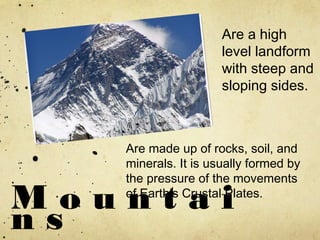
M o u n t a i
n s
Are a high
level landform
with steep and
sloping sides.
Are made up of rocks, soil, and
minerals. It is usually formed by
the pressure of the movements
of Earth’s Crustal Plates.
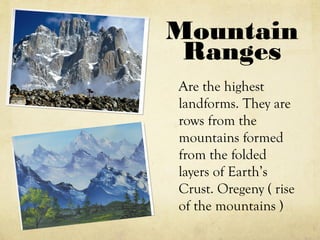
Mountain
Ranges
Are the highest
landforms. They are
rows from the
mountains formed
from the folded
layers of Earth’s
Crust. Oregeny ( rise
of the mountains )
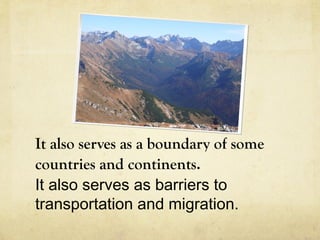
It also serves as a boundary of some
countries and continents.
It also serves as barriers to
transportation and migration.
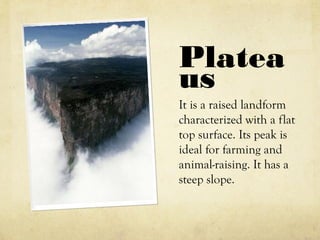
Platea
us
It is a raised landform
characterized with a flat
top surface. Its peak is
ideal for farming and
animal-raising. It has a
steep slope.
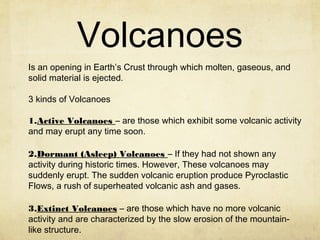
Volcanoes
Is an opening in Earth’s Crust through which molten, gaseous, and
solid material is ejected.
3 kinds of Volcanoes
1.Active Volcanoes – are those which exhibit some volcanic activity
and may erupt any time soon.
2.Dormant (Asleep) Volcanoes – If they had not shown any
activity during historic times. However, These volcanoes may
suddenly erupt. The sudden volcanic eruption produce Pyroclastic
Flows, a rush of superheated volcanic ash and gases.
3.Extinct Volcanoes – are those which have no more volcanic
activity and are characterized by the slow erosion of the mountain-
like structure.
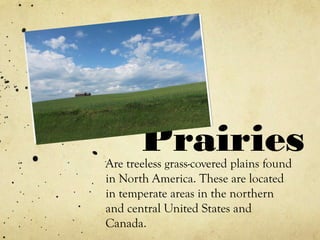
PrairiesAre treeless grass-covered plains found
in North America. These are located
in temperate areas in the northern
and central United States and
Canada.
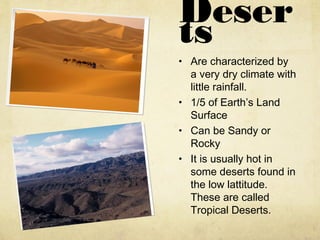
Deser
ts
• Are characterized by
a very dry climate with
little rainfall.
• 1/5 of Earth’s Land
Surface
• Can be Sandy or
Rocky
• It is usually hot in
some deserts found in
the low lattitude.
These are called
Tropical Deserts.
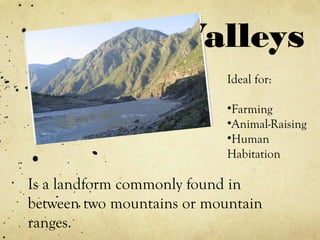
Valleys
Is a landform commonly found in
between two mountains or mountain
ranges.
Ideal for:
•Farming
•Animal-Raising
•Human
Habitation
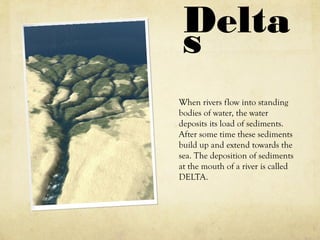
Delta
s
When rivers flow into standing
bodies of water, the water
deposits its load of sediments.
After some time these sediments
build up and extend towards the
sea. The deposition of sediments
at the mouth of a river is called
DELTA.
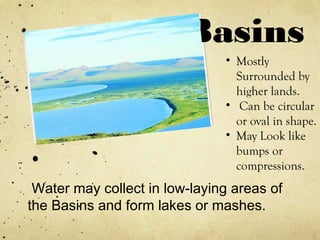
Basins
• Mostly
Surrounded by
higher lands.
• Can be circular
or oval in shape.
• May Look like
bumps or
compressions.
Water may collect in low-laying areas of
the Basins and form lakes or mashes.
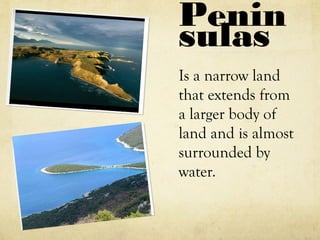
Penin
sulas
Is a narrow land
that extends from
a larger body of
land and is almost
surrounded by
water.
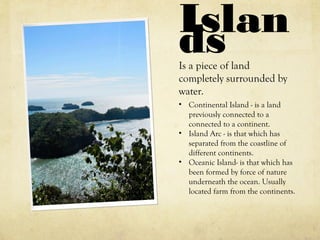
IslandsIs a piece of land
completely surrounded by
water.
• Continental Island - is a land
previously connected to a
connected to a continent.
• Island Arc - is that which has
separated from the coastline of
different continents.
• Oceanic Island- is that which has
been formed by force of nature
underneath the ocean. Usually
located farm from the continents.
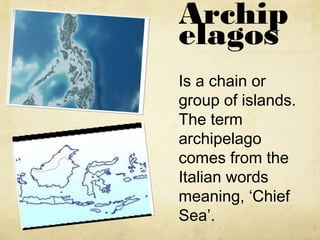
Archip
elagos
Is a chain or
group of islands.
The term
archipelago
comes from the
Italian words
meaning, ‘Chief
Sea’.
The End.
That’s All.
Justin Mujar
Resources:
Social Studies In Perspective “History of The World” Pages 14-19

Presentation1

  • 1.
    Geography and Climate Report madeby Justin Mujar. Presented by Group 1.
  • 2.
    Why do we needto learn Geography and Climate in
  • 3.
    Geograph y GEO= earth GRAPHEIN= towrite about = “Writing aboutEarth”
  • 4.
    M o un t a i n s Are a high level landform with steep and sloping sides. Are made up of rocks, soil, and minerals. It is usually formed by the pressure of the movements of Earth’s Crustal Plates.
  • 5.
    Mountain Ranges Are the highest landforms.They are rows from the mountains formed from the folded layers of Earth’s Crust. Oregeny ( rise of the mountains )
  • 6.
    It also servesas a boundary of some countries and continents. It also serves as barriers to transportation and migration.
  • 7.
    Platea us It is araised landform characterized with a flat top surface. Its peak is ideal for farming and animal-raising. It has a steep slope.
  • 8.
    Volcanoes Is an openingin Earth’s Crust through which molten, gaseous, and solid material is ejected. 3 kinds of Volcanoes 1.Active Volcanoes – are those which exhibit some volcanic activity and may erupt any time soon. 2.Dormant (Asleep) Volcanoes – If they had not shown any activity during historic times. However, These volcanoes may suddenly erupt. The sudden volcanic eruption produce Pyroclastic Flows, a rush of superheated volcanic ash and gases. 3.Extinct Volcanoes – are those which have no more volcanic activity and are characterized by the slow erosion of the mountain- like structure.
  • 9.
    PrairiesAre treeless grass-coveredplains found in North America. These are located in temperate areas in the northern and central United States and Canada.
  • 10.
    Deser ts • Are characterizedby a very dry climate with little rainfall. • 1/5 of Earth’s Land Surface • Can be Sandy or Rocky • It is usually hot in some deserts found in the low lattitude. These are called Tropical Deserts.
  • 11.
    Valleys Is a landformcommonly found in between two mountains or mountain ranges. Ideal for: •Farming •Animal-Raising •Human Habitation
  • 12.
    Delta s When rivers flowinto standing bodies of water, the water deposits its load of sediments. After some time these sediments build up and extend towards the sea. The deposition of sediments at the mouth of a river is called DELTA.
  • 13.
    Basins • Mostly Surrounded by higherlands. • Can be circular or oval in shape. • May Look like bumps or compressions. Water may collect in low-laying areas of the Basins and form lakes or mashes.
  • 14.
    Penin sulas Is a narrowland that extends from a larger body of land and is almost surrounded by water.
  • 15.
    IslandsIs a pieceof land completely surrounded by water. • Continental Island - is a land previously connected to a connected to a continent. • Island Arc - is that which has separated from the coastline of different continents. • Oceanic Island- is that which has been formed by force of nature underneath the ocean. Usually located farm from the continents.
  • 16.
    Archip elagos Is a chainor group of islands. The term archipelago comes from the Italian words meaning, ‘Chief Sea’.
  • 17.
    The End. That’s All. JustinMujar Resources: Social Studies In Perspective “History of The World” Pages 14-19