A.Very small islands such as emergent land features on
atolls can be called islets, skerries, cays or keys.
There are two main types of islands: continental
islands and oceanic islands.
The word island comes from Middle English iland, from
Old English igland (from ig, similarly meaning ‘island’
when used independently, and -land carrying its
contemporary meaning.
J.Islands are areas of land that are not
connected to a continent and are surrounded by
water. Small islands are sometimes called cays,
keys, or islets. A group of islands is often called
an archipelago.
There are two main type of islands; continental
islands and oceanic islands. Continental islands
are part of a continental shelf. One example of
this is Great Britain is an island that sits on the
continental shelf of Europe. Oceanic islands are
islands that don't sit on a continental shelf. Many
oceanic islands are formed by undersea
volcanoes like Hawaii in the Pacific Ocean.
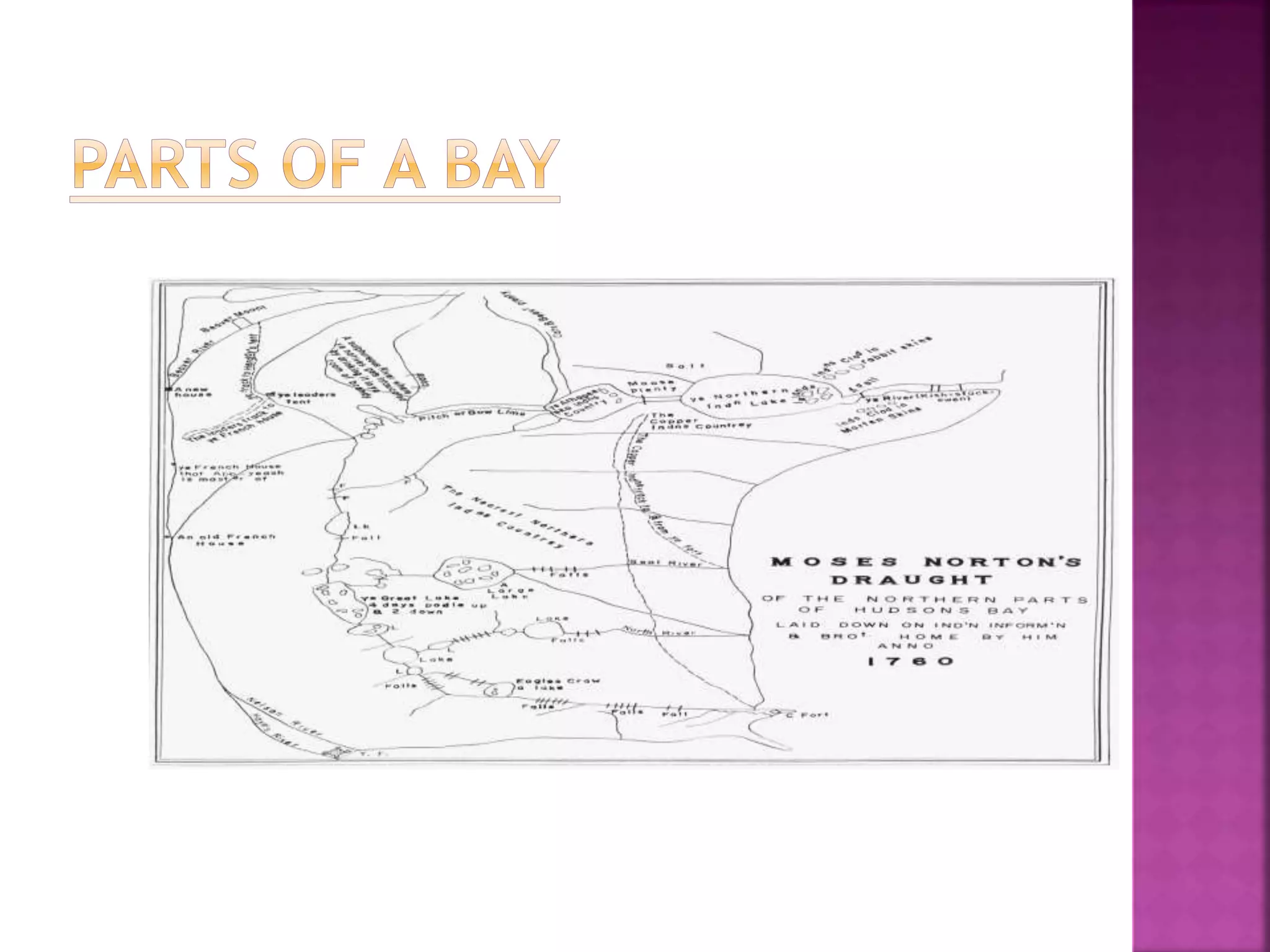
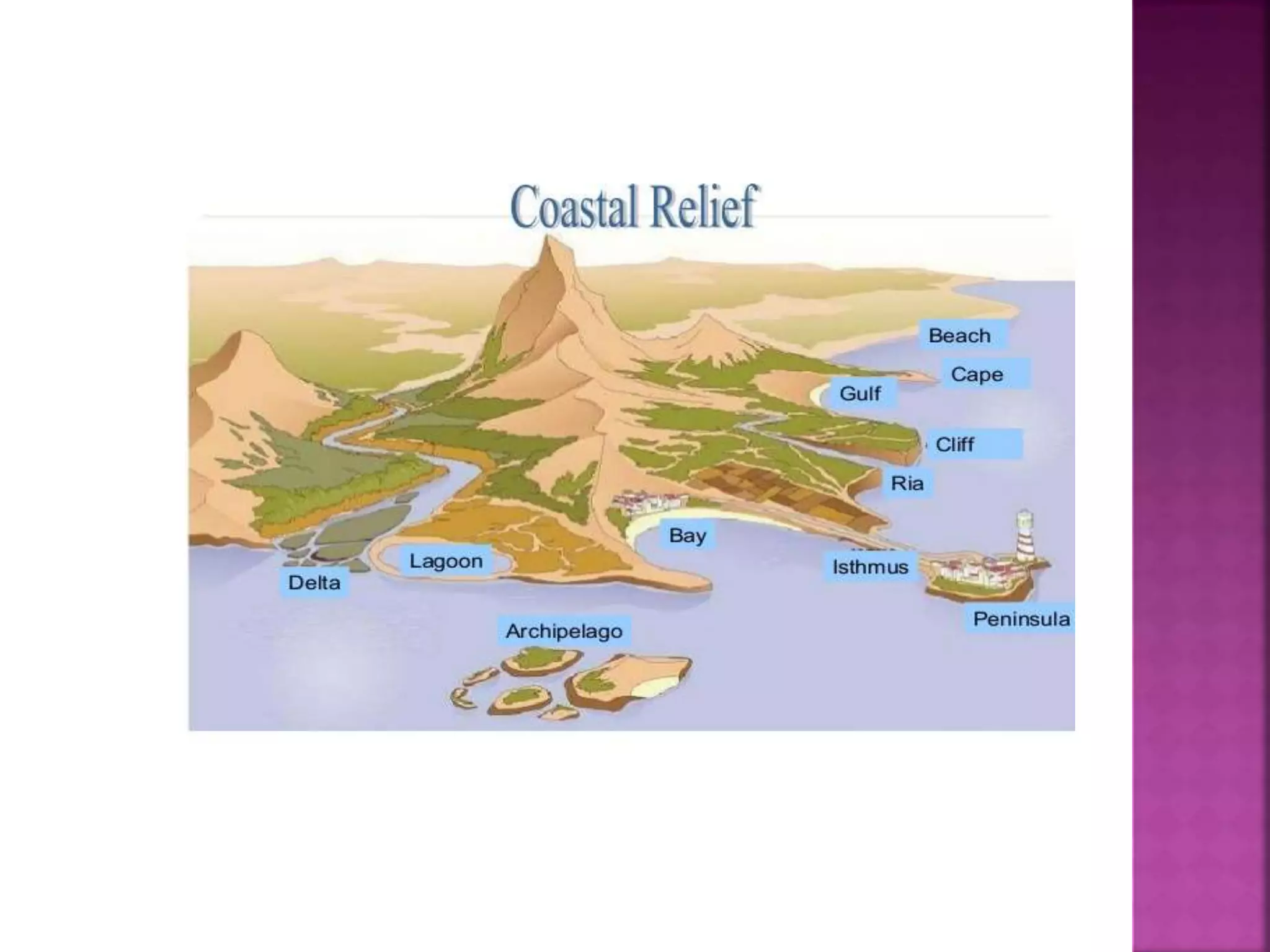
J.A bay is a body of water connected to an ocean
or lake, formed by an indentation of the
shoreline.[1] A large bay may be called a gulf, a
sea, a sound, or a bight. A cove is a smaller circular
or oval coastal inlet with a narrow entrance; some
coves may be referred to as bays. A fjord is a
particularly steep bay shaped by glacial activity.
Bays can exist as the estuary of a river, as the
estuary of the Parramatta River in Australia. Bays
may be nested in each other; for example, James
Bay is an arm of Hudson Bay. Some large bays, such
as the Bay of Bengal and the Hudson Bay, have
varied marine geology.
.
The River Channel
A.Rivers flow in channels. The bottom of the
channel is called the bed and the sides of the
channel are called the banks
An introduction to Rivers
All rivers start at the highest point in an
area. As the river flows downstream, it
gains more water from other streams,
rivers, springs, added rainfall, and other
water sources.
What is a river?
A river is freshwater flowing across the
surface of the land, usually to the sea
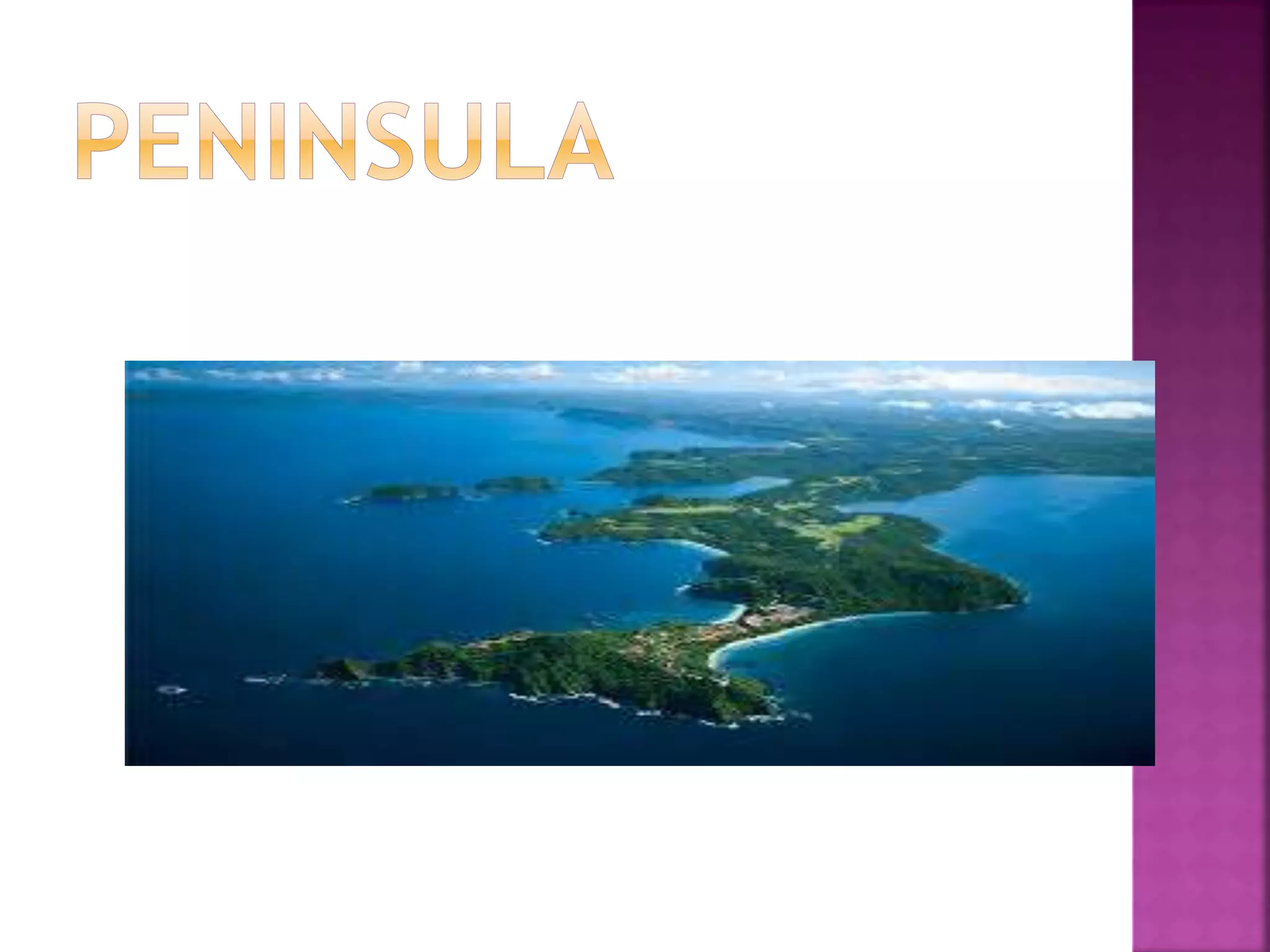
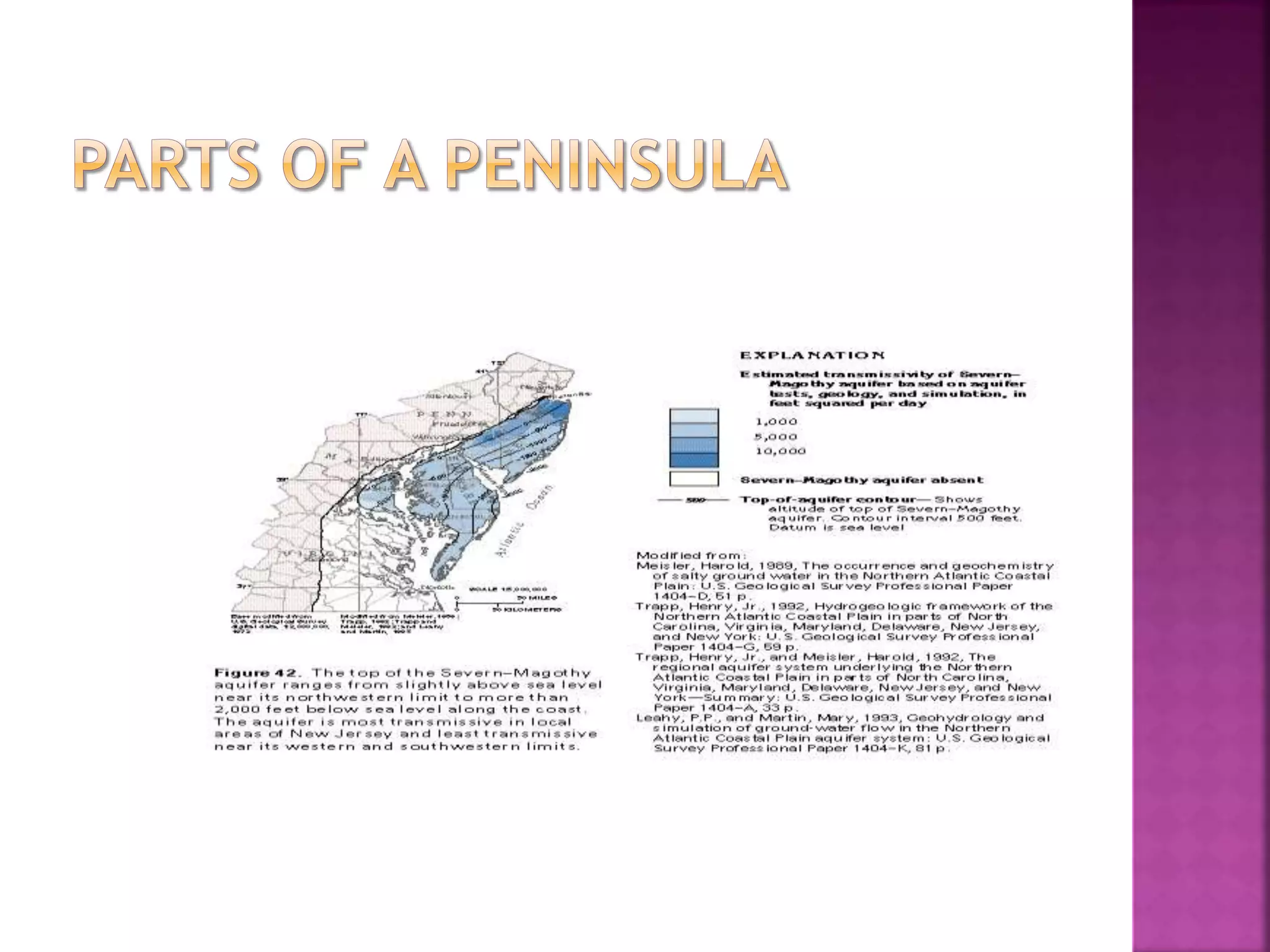
 A peninsula is a region of land that sticks out
in a body of water. It is also defined as a piece
of land with water on three sides. korea, and
most of the U.S. state of Florida, are
peninsulas. If Eurasia is considered a
continent then the continent of Europe is
technically a peninsula. The Arabian Peninsula
is the largest peninsula in the world covering
3,237,500 sq. km area.
 A body of land surrounded by water on
three sides is called a peninsula. The
word comes from the Latin paene insula,
meaning “almost an island.” In the
United States Florida is the most obvious
peninsula. Alaska also fits the definition,
though it is very large and has a number
of its own peninsulas. On the East coast
the Delmarva Peninsula (named after
Delaware, Maryland, and Virginia) lies
between Chesapeake Bay and the
Atlantic Ocean. Mexico has two notable
peninsulas: the Yucatán in the east and
Baja California in the west.
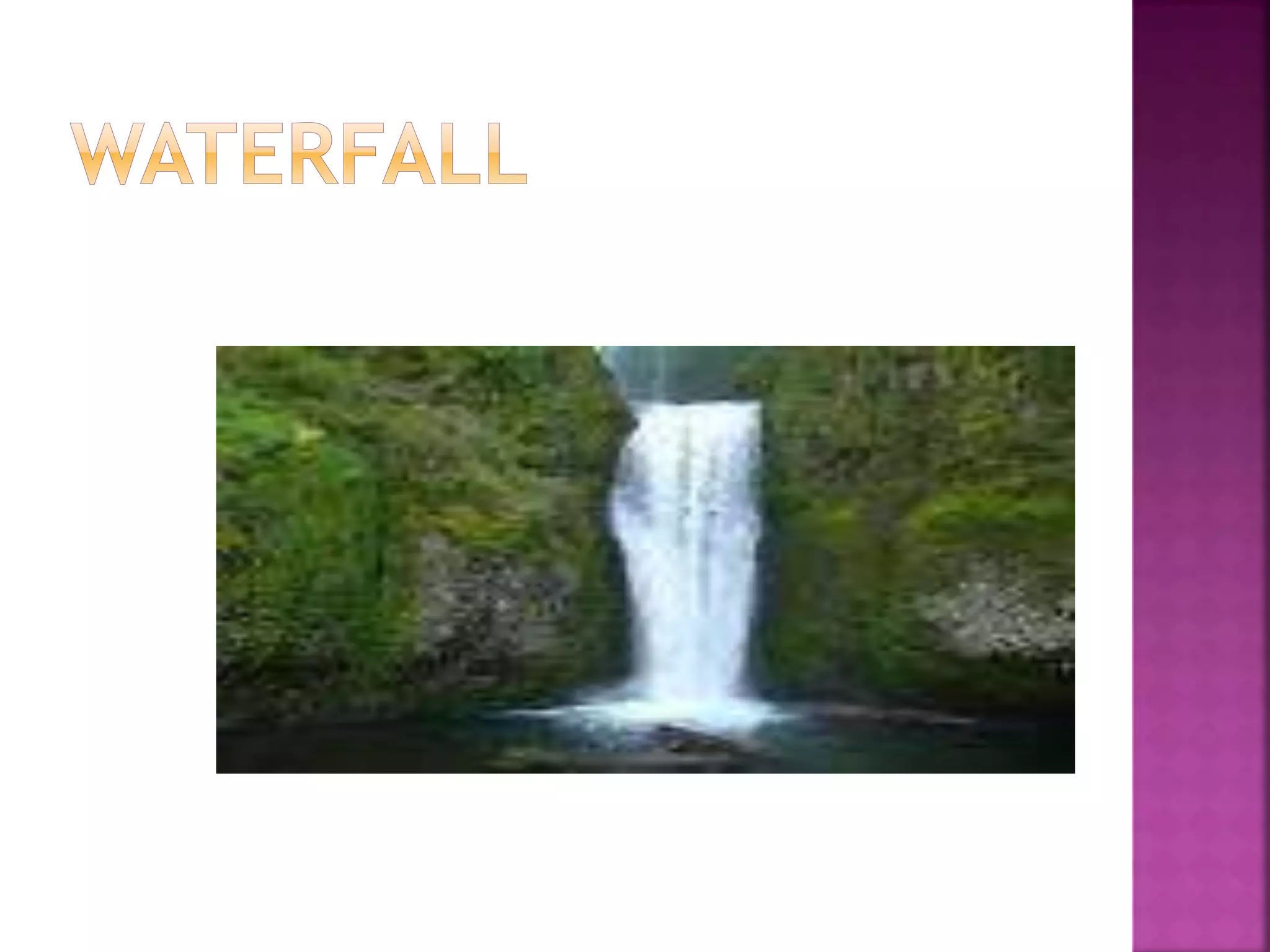
A waterfall is a part of a river
or stream where the water
flows over a steep drop, often
landing in a plunge pool below.
Some waterfalls can have a
huge drop, and these are
definitely not waterfalls to
take a jump from!
 Erosion plays an important part in how
waterfalls are made. As a stream flows, it
carries sediment that can erode the soft
bed rock, which is limestone and
sandstone underneath. Eventually this
goes deep enough so that only the
harder rock, such as granite, stays.
Waterfalls are born as the granite forms
cliffs and ledges. Wow, it takes some
doing to create a waterfall.
 Just as waterfalls are made by the
process of erosion, they cause erosion
too. How weird. The speed of the stream
gets stronger and stronger as it nears a
waterfall, increasing the amount of
erosion.
A volcano is a mountain downward to a
pool of molten rock below the surface of
the earth. When pressure builds up,
eruptions occur. Gases and rock shoot up
through the opening and spill over or fill
the air with lava fragments. Eruptions can
cause lateral blasts, lava flows, hot ash
flows, mudslides, avalanches, falling ash
and floods. Volcano eruptions have been
known to knock down entire forests. An
erupting volcano can trigger tsunamis,
flash floods, earthquakes, mudflows and
rockfalls.
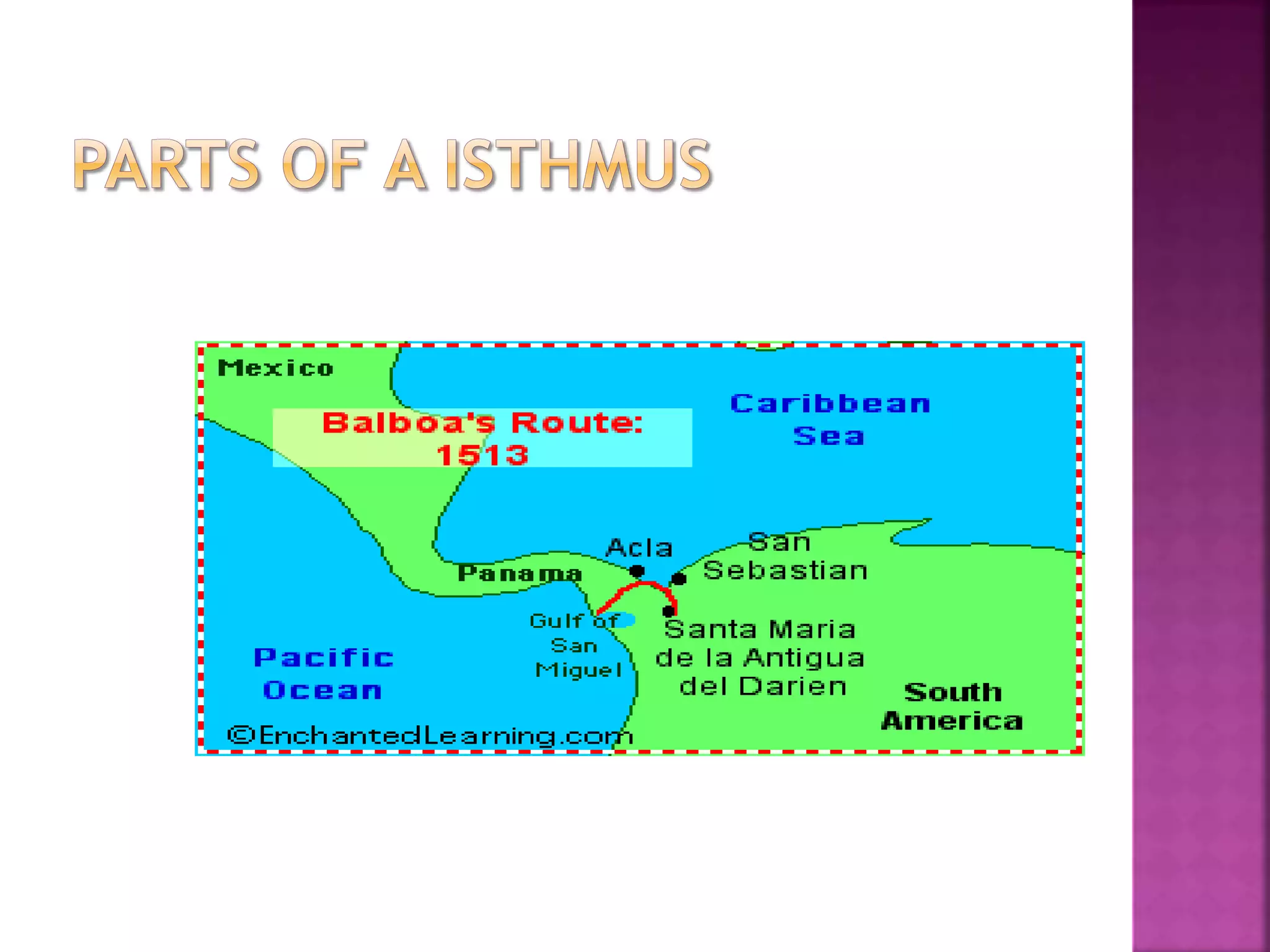
 An isthmus is a narrow strip of land that
connects two larger landmasses and
separates two bodies of water.
 Isthmuses have been strategic locations for
centuries. They are natural sites for ports
and canals linking terrestrial and aquatic
trade routes. Isthmuses are also key sites
for communications and cultural exchange,
as well as military outposts.
 What is a Mountain?
 The dictionary defines a mountain as that which
is ‘higher and steeper than a hill’.
 A mountain is a landform that rises high above
the surrounding terrain in a limited area. They
are made from rocks and earth.
 Generally, mountains are higher than 600 metres.
Those less than 600 metres are called hills.
 What do Mountains look like?
 Mountains usually have steep.
 Raised, flat-surfaced areas bounded on one
or more sides by cliffs or steep slopes are
known as plateaus. They are found on
every continent, along continental shelves,
and in most oceans. Continental plateaus,
along with their enclosed basins, account
for about 45 percent of Earth's land
surface.
 Broad and flat, plains are well named.
Some appear when glaciers and streams
erode away elevated terrain; others spread
where rising magma pushes, erupts, and
spews. Some plains spill into the oceans,
and others are bound by mountains on
several sides. They all hide a tumultuous
geologic history beneath their level
disguise.
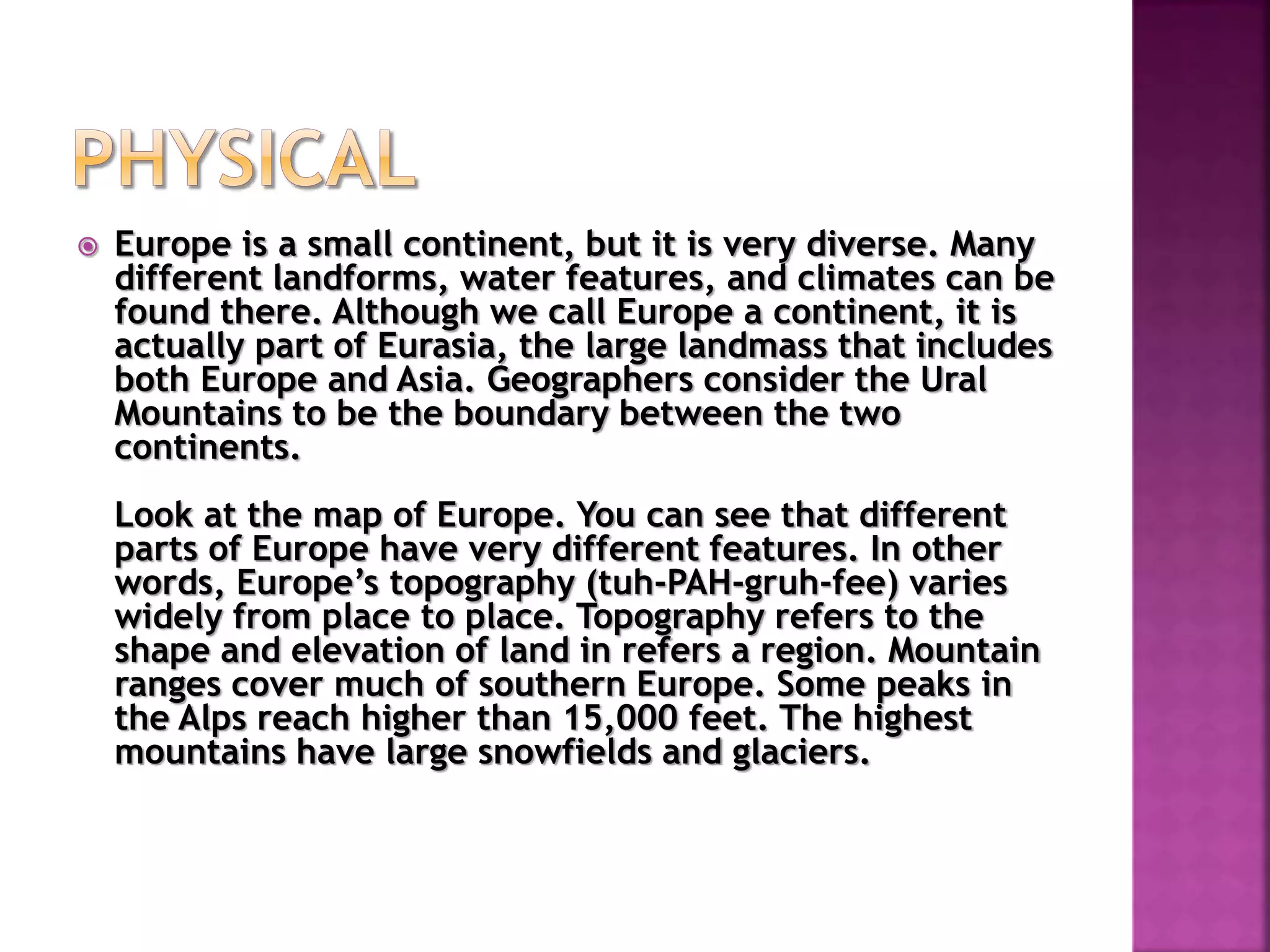
 Europe is a small continent, but it is very diverse. Many
different landforms, water features, and climates can be
found there. Although we call Europe a continent, it is
actually part of Eurasia, the large landmass that includes
both Europe and Asia. Geographers consider the Ural
Mountains to be the boundary between the two
continents.
Look at the map of Europe. You can see that different
parts of Europe have very different features. In other
words, Europe’s topography (tuh-PAH-gruh-fee) varies
widely from place to place. Topography refers to the
shape and elevation of land in refers a region. Mountain
ranges cover much of southern Europe. Some peaks in
the Alps reach higher than 15,000 feet. The highest
mountains have large snowfields and glaciers.
 1. What is the name of the world’s largest reef system?
 2. Do male or female mosquitoes bite people?
 3. True or false? Earth Day is held on June 18.
 4. What state of the USA is the Grand Canyon located in?
 5. True or false? The Dead Sea is 8.6 times more salty than the
ocean.
 6. What are the 3 R’s of recycling?
 7. True or false? The horn of a rhinoceros is made from bone.
 8. What famous islands west of Ecuador were extensively studied by
Charles Darwin?
 9. Ayers Rock in Australia is also know as what?
 10. True or false? Burning or logging naturally occurring forests is
known as deforestation.
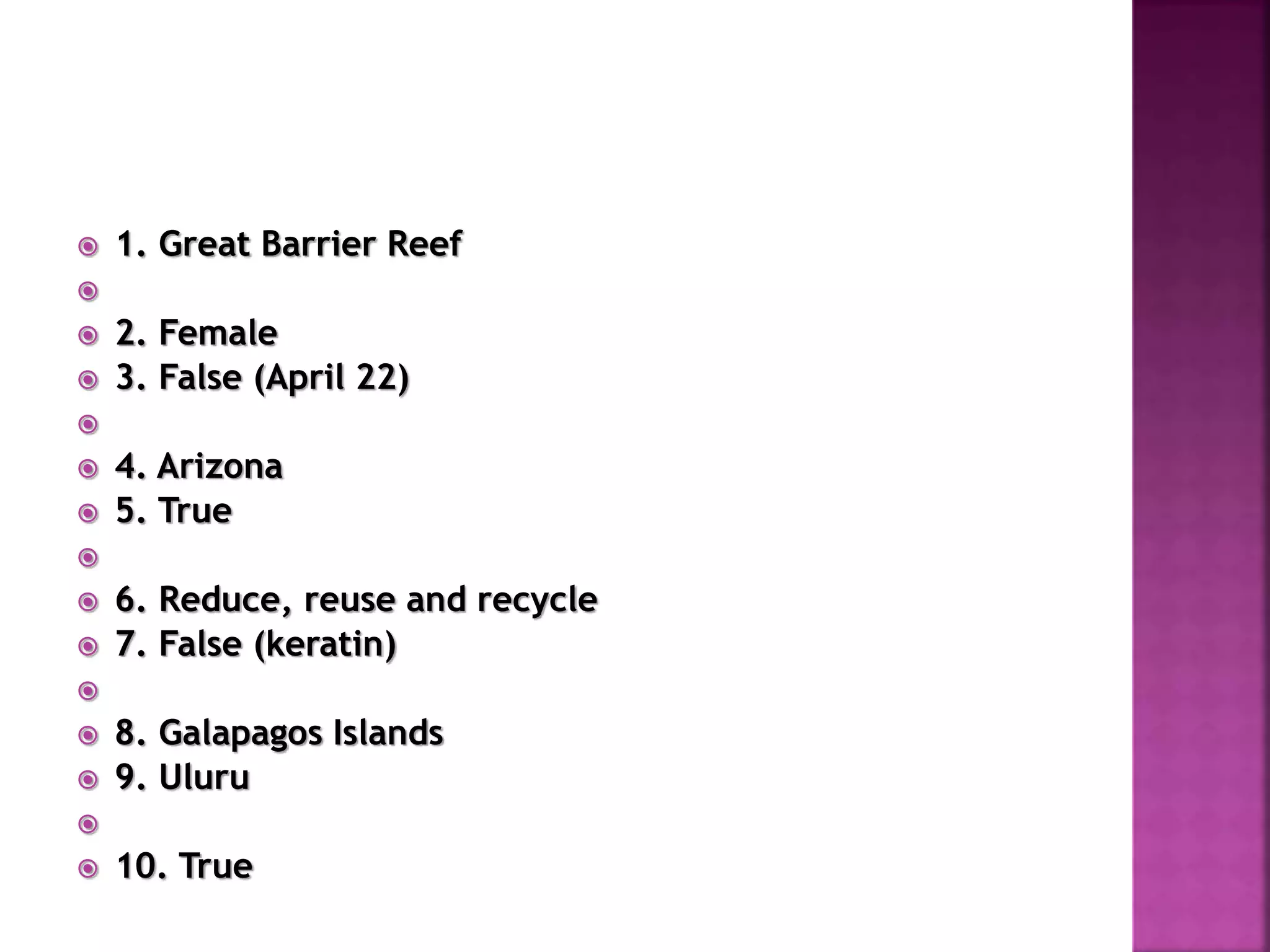
 1. Great Barrier Reef

 2. Female
 3. False (April 22)

 4. Arizona
 5. True

 6. Reduce, reuse and recycle
 7. False (keratin)

 8. Galapagos Islands
 9. Uluru

 10. True
LAndforms
LAndforms
LAndforms
LAndforms

LAndforms

  • 4.
    A.Very small islandssuch as emergent land features on atolls can be called islets, skerries, cays or keys. There are two main types of islands: continental islands and oceanic islands. The word island comes from Middle English iland, from Old English igland (from ig, similarly meaning ‘island’ when used independently, and -land carrying its contemporary meaning.
  • 5.
    J.Islands are areasof land that are not connected to a continent and are surrounded by water. Small islands are sometimes called cays, keys, or islets. A group of islands is often called an archipelago. There are two main type of islands; continental islands and oceanic islands. Continental islands are part of a continental shelf. One example of this is Great Britain is an island that sits on the continental shelf of Europe. Oceanic islands are islands that don't sit on a continental shelf. Many oceanic islands are formed by undersea volcanoes like Hawaii in the Pacific Ocean.
  • 8.
    J.A bay isa body of water connected to an ocean or lake, formed by an indentation of the shoreline.[1] A large bay may be called a gulf, a sea, a sound, or a bight. A cove is a smaller circular or oval coastal inlet with a narrow entrance; some coves may be referred to as bays. A fjord is a particularly steep bay shaped by glacial activity. Bays can exist as the estuary of a river, as the estuary of the Parramatta River in Australia. Bays may be nested in each other; for example, James Bay is an arm of Hudson Bay. Some large bays, such as the Bay of Bengal and the Hudson Bay, have varied marine geology.
  • 9.
    . The River Channel A.Riversflow in channels. The bottom of the channel is called the bed and the sides of the channel are called the banks An introduction to Rivers All rivers start at the highest point in an area. As the river flows downstream, it gains more water from other streams, rivers, springs, added rainfall, and other water sources. What is a river? A river is freshwater flowing across the surface of the land, usually to the sea
  • 12.
     A peninsulais a region of land that sticks out in a body of water. It is also defined as a piece of land with water on three sides. korea, and most of the U.S. state of Florida, are peninsulas. If Eurasia is considered a continent then the continent of Europe is technically a peninsula. The Arabian Peninsula is the largest peninsula in the world covering 3,237,500 sq. km area.
  • 13.
     A bodyof land surrounded by water on three sides is called a peninsula. The word comes from the Latin paene insula, meaning “almost an island.” In the United States Florida is the most obvious peninsula. Alaska also fits the definition, though it is very large and has a number of its own peninsulas. On the East coast the Delmarva Peninsula (named after Delaware, Maryland, and Virginia) lies between Chesapeake Bay and the Atlantic Ocean. Mexico has two notable peninsulas: the Yucatán in the east and Baja California in the west.
  • 16.
    A waterfall isa part of a river or stream where the water flows over a steep drop, often landing in a plunge pool below. Some waterfalls can have a huge drop, and these are definitely not waterfalls to take a jump from!
  • 17.
     Erosion playsan important part in how waterfalls are made. As a stream flows, it carries sediment that can erode the soft bed rock, which is limestone and sandstone underneath. Eventually this goes deep enough so that only the harder rock, such as granite, stays. Waterfalls are born as the granite forms cliffs and ledges. Wow, it takes some doing to create a waterfall.  Just as waterfalls are made by the process of erosion, they cause erosion too. How weird. The speed of the stream gets stronger and stronger as it nears a waterfall, increasing the amount of erosion.
  • 20.
    A volcano isa mountain downward to a pool of molten rock below the surface of the earth. When pressure builds up, eruptions occur. Gases and rock shoot up through the opening and spill over or fill the air with lava fragments. Eruptions can cause lateral blasts, lava flows, hot ash flows, mudslides, avalanches, falling ash and floods. Volcano eruptions have been known to knock down entire forests. An erupting volcano can trigger tsunamis, flash floods, earthquakes, mudflows and rockfalls.
  • 23.
     An isthmusis a narrow strip of land that connects two larger landmasses and separates two bodies of water.  Isthmuses have been strategic locations for centuries. They are natural sites for ports and canals linking terrestrial and aquatic trade routes. Isthmuses are also key sites for communications and cultural exchange, as well as military outposts.
  • 26.
     What isa Mountain?  The dictionary defines a mountain as that which is ‘higher and steeper than a hill’.  A mountain is a landform that rises high above the surrounding terrain in a limited area. They are made from rocks and earth.  Generally, mountains are higher than 600 metres. Those less than 600 metres are called hills.  What do Mountains look like?  Mountains usually have steep.
  • 29.
     Raised, flat-surfacedareas bounded on one or more sides by cliffs or steep slopes are known as plateaus. They are found on every continent, along continental shelves, and in most oceans. Continental plateaus, along with their enclosed basins, account for about 45 percent of Earth's land surface.
  • 32.
     Broad andflat, plains are well named. Some appear when glaciers and streams erode away elevated terrain; others spread where rising magma pushes, erupts, and spews. Some plains spill into the oceans, and others are bound by mountains on several sides. They all hide a tumultuous geologic history beneath their level disguise.
  • 39.
     Europe isa small continent, but it is very diverse. Many different landforms, water features, and climates can be found there. Although we call Europe a continent, it is actually part of Eurasia, the large landmass that includes both Europe and Asia. Geographers consider the Ural Mountains to be the boundary between the two continents. Look at the map of Europe. You can see that different parts of Europe have very different features. In other words, Europe’s topography (tuh-PAH-gruh-fee) varies widely from place to place. Topography refers to the shape and elevation of land in refers a region. Mountain ranges cover much of southern Europe. Some peaks in the Alps reach higher than 15,000 feet. The highest mountains have large snowfields and glaciers.
  • 41.
     1. Whatis the name of the world’s largest reef system?  2. Do male or female mosquitoes bite people?  3. True or false? Earth Day is held on June 18.  4. What state of the USA is the Grand Canyon located in?  5. True or false? The Dead Sea is 8.6 times more salty than the ocean.  6. What are the 3 R’s of recycling?  7. True or false? The horn of a rhinoceros is made from bone.  8. What famous islands west of Ecuador were extensively studied by Charles Darwin?  9. Ayers Rock in Australia is also know as what?  10. True or false? Burning or logging naturally occurring forests is known as deforestation.
  • 42.
     1. GreatBarrier Reef   2. Female  3. False (April 22)   4. Arizona  5. True   6. Reduce, reuse and recycle  7. False (keratin)   8. Galapagos Islands  9. Uluru   10. True