Resources of the Philippines
Review
TERMINOLOGIES
1. Latitude – an imaginary line around the Earth
parallel to the equator. Often referred to as the
parallels of latitude. This is because latitude are lines
that run parallel to the equator. They are flat line in
the globe or map. It looks like a ladder.
2. Longitude - refers to the imaginary lines that bisect
the globe through the East and West Poles.
3. Equator – located at the center of the earth and is
the line that separates the Northern hemisphere and
Southern hemisphere.
4. Prime Meridian - The prime meridian is the
planet’s line of zero degrees longitude. Slicing the
earth along the circle of the prime meridian would
divide it into the Eastern and Western hemispheres
 We used Latitude and Longitude to find places on the
map.
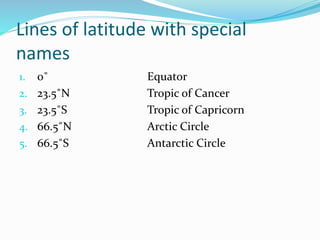
Lines of latitude with special
names
1. 0˚ Equator
2. 23.5˚N Tropic of Cancer
3. 23.5˚S Tropic of Capricorn
4. 66.5˚N Arctic Circle
5. 66.5˚S Antarctic Circle
BODIES OF WATER
 The Philippines boast of many different kinds
of natural water forms, such as bays, rivers, lakes falls,
gulfs, straits, and swamps. Because it is made up of
islands, the country's coastline, if laid end-to-end,
would measure around 17.5 thousand kilometers. The
Philippines is blessed with excellent natural harbors
for ports like Manila Bay. Other excellent harbors with
port potentials are found in Ilocos, Pangasinan,
Visayas, and Mindanao. The three largest rivers in the
country are the Cagayan River in Northern Luzon,
the Rio Grande de Mindanao, and the Agusan River,
also in Mindanao.
 Also noteworthy in terms of size are the Agno, Pasig,
Angat, Pampanga, and Bicol rivers in Luzon. Most
popular among tourist is the famous underground
river in Palawan. Aside from rivers, the country also
abounds with lakes. Easily the most famous is the
heart-shaped Laguna de Bay. Other famous lakes are
Taal in Batangas, Sampaloc in Laguna, Buhi and
Bulusan in Bicol, Naujan in Mindoro oriental, and
Lanao and Mainit in Mindanao. Generating power for
the Nation’s growth are the magnificent waterfalls that
serve as tourist attractions, as well. The biggest
waterfalls is the Maria Cristina falls, it can be found in
the North Western part of Lanao province in
Mindanao, while the most popular is Pagsanjan falls
in Laguna, where tourist came in droves.
Natural Resources
The Philippines is rich in natural resources. It has fertile,
arable lands, diverse flora and fauna, extensive coastlines, and
rich mineral deposits. About 30% of the land area of the country
was determined be geologically prospective by the Philippine
Mines and Geo-Sciences Bureau. But Only 1.5% of country's
land area is covered with mining permits. Despite the
rich natural resources of the Philippines, the government is
restricting its exploitation. A logging ban is imposed on many
areas of the country and only in select areas are "sustainable
logging" allowed. However illegal logging and small-scale illegal
mining continues is many areas. In July 2012, President Benigno
Aquino III ordered a stop to all mining activities in all (78 areas)
protected and eco-tourism sites. A positive step in the right
direction to protect the natural resources of thePhilippines.
LAND
 The Philippines’ primary source of livelihood is its
fertile land. Rich, wide plains suitable for farming are
found in the Cagayan Valley, Central Luzon, South
western Bicol, Panay, Negros, Davao, Cotabato, Agusan
and Bukidnon. The country ‘s six major crops
are rice, corn, sugarcane, coconut, abaca and tobacco.
Except for rice and corn, all
these products are exported, along with bananas and
pineapples.
FOREST
 The Philippines also boasts of wide tracts of lush,
green forests. In fact, almost half of the country’s total
land area is forested. Sixty percent of these forests are
found in Mindanao.
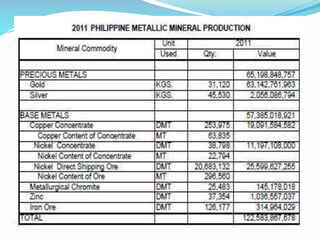
MINERAL RESOURCES
 Except for petroleum and a number of metals, mineral
resources abound in Philippine soil. The country’s
mineral deposits can be classified into metals and non-
metals. Our metal deposits are estimated at 21.5 billion
metric tons, while non-metal deposits are projected at
19.3 billion metric tons. Nickel ranks first in terms of
deposits and size, it is found in Surigao del Norte,
Davao, Palawan, Romblon and Samar. Iron is found in
Ilocos Norte, Nueva Ecija, Camarines Norte and
Cotabato. While copper in Zambales, Batangas,
Mindoro, Panay and Negros. Among non-metal deposits,
the most abundant are cement, lime, and marble. Other
non-metals include asbestos, clay, guano, asphalt,
feldspar, sulfur, talc, silicon, phosphate, and marble.
Fishery Resources With its territorial waters measuring as much as 1.67 million
square kilometers and located in the worlds fishing center,
the Philippines is definitely rich in marine resources. Of the
2,400 fish species found in the country. 65 have good
commercial value. Other
marine products include corals, pearls, crabs and seaweeds.
Some of the countries best salt water fishing area’s are found
in Sintangki Island in Sulu Estancia in Bohol, Malampaya
in Palawan, Lingayen Gulf in Pangasinan, San Miguel lake in
Camarines Norte, Bantayan Channel in Cebu, and the seas of
Quezon and Sorsogon.
 On the other hand, among our biggest fisher water fishing
areas are Laguna de Bay, Bombon Lake in Batangas, Bato Lake
in Canmarines Sur, Naujan Lake in Mindoro and Mainit lake
in Agusan del Norte.
Environmental problems in the Philippines
1. Overfishing and destructive fishing
Fishers in the Philippines are increasingly coming home with
pitiful catches. Of a number of factors which have led to this
situation, one stands out: over-fishing in many areas.
According to the Asian Development Bank (ADB), there has
been a drop of 90% in the quantity of marine organisms that
can be trawled in some traditional fishing areas of the
Philippines.
This isn’t just a question of declining fish stocks and
biodiversity, but also of social impacts and economic losses.
Mismanagement of fisheries resources is estimated to cost US$
420 million annually in lost revenues.
At the root of the overfishing problem is weak fisheries
management, ineffective policies and poor enforcement of
fishery laws.
2. Coastal infrastructure development
Coastal zone development has been particularly
damaging to the Philippines’ marine environment,
especially to coral reefs, mangroves, and seagrasses.
As populations have increased, so have their needs for
construction materials and living space. Excavation,
dredging, and coastal conversion to accommodate coastal
development have seen corals being extracted for
reclamation and construction, especially in coastal
villages.
Mangroves have particularly suffered from coastal
development, notably at the hands of the aquaculture
industry. In the Philippines, aquaculture has reduced
mangrove stands to only 36% of 1900 levels.
3. Deforestation
After decades of deforestation, which has left about 3% of
the original cover, forests continue to be under threat
from agriculture and urbanization, illegal logging and
forest fires.
Sustained forest loss in the Philippines is causing severe
soil erosion, and is threatening the country’s rich
biodiversity. This is particularly worrying as many of the
Philippines’ species, which depend on these forests, are
endemic (they cannot be found anywhere else in the
world). For example, of 180 native terrestrial mammal
species here, about 61% are endemic.
Inconsistent laws, inadequate regulations, weak
enforcement and lack of funding are making forest
conservation a major challenge.
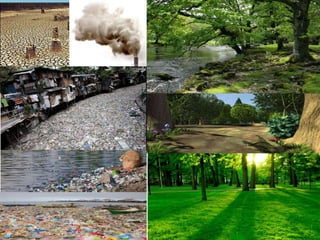
4. Pollution
Only about 10% of sewage in the Philippines is
treated or disposed of in an environmentally sound
manner. The rest goes back to nature – usually the
sea.
In this context of poor waste treatment and high
population growth, water pollution is a growing
problem for the country’s groundwater, rivers, lakes,
and coastal areas. Polluting industrial material is also
found in abandoned mining areas, with mercury
pollution affecting water bodies in these areas.
Environmental Protection and
Conservation
1. REPUBLIC ACT NO. 9147 July 30, 2001
 AN ACT PROVIDING FOR THE CONSERVATION AND
PROTECTION OF WILDLIFE RESOURCES AND THEIR
HABITATS, APPROPRIATING FUNDS THEREFOR AND FOR
OTHER PURPOSES
2. EXECUTIVE ORDER NO. 79
INSTITUTIONALIZING AND IMPLEMENTING REFORMS
IN THE PHILIPPINE MINING SECTOR PROVIDING
POLICIES AND GUIDELINES TO ENSURE
ENVIRONMENTAL PROTECTION AND RESPONSIBLE
MINING IN THE UTILIZATION OF MINERAL
RESOURCES
3. Chain Saw Act of 2002
Republic Act No. 9175
4. Philippine Plant Variety Protection Act of 2002
Republic Act No. 9168
5. Mt. Kanla-on Natural Park (MKNP) Act of 2001
Republic Act No. 9154
6. Wildlife Resources Conservation and Protection Act
Republic Act No. 9147
7. National Caves and Cave Resources Management and
Protection Act
Republic Act No. 9072
8. Ecological Solid Waste Management Act of 2000
Republic Act No. 9003
9. Philippine Clean Air Act of 1999
Republic Act No. 8749
10. Philippine Fisheries Code of 1998
Republic Act No. 8550
11. Animal Welfare Act of 1998
Republic Act No. 8485
Quiz
1. (1-5) List down some of the Natural Resources found
in the Philippines
2. (6-9) List down some of the Environmental
Problems that the Philippines is facing today
3. (10) How can you protect and conserve our Natural
Resources? 5 points
Sources
 http://www.philippine-history.org/about-
philippines.htm
 http://wwf.panda.org/who_we_are/wwf_offices/philip
pines/environmental_problems__in_philippines/
 https://www.youtube.com/watch?v=Z_Q96FgzGWg

The philippine environment

  • 1.
    Resources of thePhilippines
  • 2.
    Review TERMINOLOGIES 1. Latitude –an imaginary line around the Earth parallel to the equator. Often referred to as the parallels of latitude. This is because latitude are lines that run parallel to the equator. They are flat line in the globe or map. It looks like a ladder. 2. Longitude - refers to the imaginary lines that bisect the globe through the East and West Poles.
  • 3.
    3. Equator –located at the center of the earth and is the line that separates the Northern hemisphere and Southern hemisphere. 4. Prime Meridian - The prime meridian is the planet’s line of zero degrees longitude. Slicing the earth along the circle of the prime meridian would divide it into the Eastern and Western hemispheres  We used Latitude and Longitude to find places on the map.
  • 4.
    Lines of latitudewith special names 1. 0˚ Equator 2. 23.5˚N Tropic of Cancer 3. 23.5˚S Tropic of Capricorn 4. 66.5˚N Arctic Circle 5. 66.5˚S Antarctic Circle
  • 6.
    BODIES OF WATER The Philippines boast of many different kinds of natural water forms, such as bays, rivers, lakes falls, gulfs, straits, and swamps. Because it is made up of islands, the country's coastline, if laid end-to-end, would measure around 17.5 thousand kilometers. The Philippines is blessed with excellent natural harbors for ports like Manila Bay. Other excellent harbors with port potentials are found in Ilocos, Pangasinan, Visayas, and Mindanao. The three largest rivers in the country are the Cagayan River in Northern Luzon, the Rio Grande de Mindanao, and the Agusan River, also in Mindanao.
  • 7.
     Also noteworthyin terms of size are the Agno, Pasig, Angat, Pampanga, and Bicol rivers in Luzon. Most popular among tourist is the famous underground river in Palawan. Aside from rivers, the country also abounds with lakes. Easily the most famous is the heart-shaped Laguna de Bay. Other famous lakes are Taal in Batangas, Sampaloc in Laguna, Buhi and Bulusan in Bicol, Naujan in Mindoro oriental, and Lanao and Mainit in Mindanao. Generating power for the Nation’s growth are the magnificent waterfalls that serve as tourist attractions, as well. The biggest waterfalls is the Maria Cristina falls, it can be found in the North Western part of Lanao province in Mindanao, while the most popular is Pagsanjan falls in Laguna, where tourist came in droves.
  • 8.
    Natural Resources The Philippinesis rich in natural resources. It has fertile, arable lands, diverse flora and fauna, extensive coastlines, and rich mineral deposits. About 30% of the land area of the country was determined be geologically prospective by the Philippine Mines and Geo-Sciences Bureau. But Only 1.5% of country's land area is covered with mining permits. Despite the rich natural resources of the Philippines, the government is restricting its exploitation. A logging ban is imposed on many areas of the country and only in select areas are "sustainable logging" allowed. However illegal logging and small-scale illegal mining continues is many areas. In July 2012, President Benigno Aquino III ordered a stop to all mining activities in all (78 areas) protected and eco-tourism sites. A positive step in the right direction to protect the natural resources of thePhilippines.
  • 10.
    LAND  The Philippines’primary source of livelihood is its fertile land. Rich, wide plains suitable for farming are found in the Cagayan Valley, Central Luzon, South western Bicol, Panay, Negros, Davao, Cotabato, Agusan and Bukidnon. The country ‘s six major crops are rice, corn, sugarcane, coconut, abaca and tobacco. Except for rice and corn, all these products are exported, along with bananas and pineapples.
  • 11.
    FOREST  The Philippinesalso boasts of wide tracts of lush, green forests. In fact, almost half of the country’s total land area is forested. Sixty percent of these forests are found in Mindanao.
  • 12.
    MINERAL RESOURCES  Exceptfor petroleum and a number of metals, mineral resources abound in Philippine soil. The country’s mineral deposits can be classified into metals and non- metals. Our metal deposits are estimated at 21.5 billion metric tons, while non-metal deposits are projected at 19.3 billion metric tons. Nickel ranks first in terms of deposits and size, it is found in Surigao del Norte, Davao, Palawan, Romblon and Samar. Iron is found in Ilocos Norte, Nueva Ecija, Camarines Norte and Cotabato. While copper in Zambales, Batangas, Mindoro, Panay and Negros. Among non-metal deposits, the most abundant are cement, lime, and marble. Other non-metals include asbestos, clay, guano, asphalt, feldspar, sulfur, talc, silicon, phosphate, and marble.
  • 13.
    Fishery Resources Withits territorial waters measuring as much as 1.67 million square kilometers and located in the worlds fishing center, the Philippines is definitely rich in marine resources. Of the 2,400 fish species found in the country. 65 have good commercial value. Other marine products include corals, pearls, crabs and seaweeds. Some of the countries best salt water fishing area’s are found in Sintangki Island in Sulu Estancia in Bohol, Malampaya in Palawan, Lingayen Gulf in Pangasinan, San Miguel lake in Camarines Norte, Bantayan Channel in Cebu, and the seas of Quezon and Sorsogon.  On the other hand, among our biggest fisher water fishing areas are Laguna de Bay, Bombon Lake in Batangas, Bato Lake in Canmarines Sur, Naujan Lake in Mindoro and Mainit lake in Agusan del Norte.
  • 14.
    Environmental problems inthe Philippines 1. Overfishing and destructive fishing Fishers in the Philippines are increasingly coming home with pitiful catches. Of a number of factors which have led to this situation, one stands out: over-fishing in many areas. According to the Asian Development Bank (ADB), there has been a drop of 90% in the quantity of marine organisms that can be trawled in some traditional fishing areas of the Philippines. This isn’t just a question of declining fish stocks and biodiversity, but also of social impacts and economic losses. Mismanagement of fisheries resources is estimated to cost US$ 420 million annually in lost revenues. At the root of the overfishing problem is weak fisheries management, ineffective policies and poor enforcement of fishery laws.
  • 15.
    2. Coastal infrastructuredevelopment Coastal zone development has been particularly damaging to the Philippines’ marine environment, especially to coral reefs, mangroves, and seagrasses. As populations have increased, so have their needs for construction materials and living space. Excavation, dredging, and coastal conversion to accommodate coastal development have seen corals being extracted for reclamation and construction, especially in coastal villages. Mangroves have particularly suffered from coastal development, notably at the hands of the aquaculture industry. In the Philippines, aquaculture has reduced mangrove stands to only 36% of 1900 levels.
  • 16.
    3. Deforestation After decadesof deforestation, which has left about 3% of the original cover, forests continue to be under threat from agriculture and urbanization, illegal logging and forest fires. Sustained forest loss in the Philippines is causing severe soil erosion, and is threatening the country’s rich biodiversity. This is particularly worrying as many of the Philippines’ species, which depend on these forests, are endemic (they cannot be found anywhere else in the world). For example, of 180 native terrestrial mammal species here, about 61% are endemic. Inconsistent laws, inadequate regulations, weak enforcement and lack of funding are making forest conservation a major challenge.
  • 17.
    4. Pollution Only about10% of sewage in the Philippines is treated or disposed of in an environmentally sound manner. The rest goes back to nature – usually the sea. In this context of poor waste treatment and high population growth, water pollution is a growing problem for the country’s groundwater, rivers, lakes, and coastal areas. Polluting industrial material is also found in abandoned mining areas, with mercury pollution affecting water bodies in these areas.
  • 19.
    Environmental Protection and Conservation 1.REPUBLIC ACT NO. 9147 July 30, 2001  AN ACT PROVIDING FOR THE CONSERVATION AND PROTECTION OF WILDLIFE RESOURCES AND THEIR HABITATS, APPROPRIATING FUNDS THEREFOR AND FOR OTHER PURPOSES 2. EXECUTIVE ORDER NO. 79 INSTITUTIONALIZING AND IMPLEMENTING REFORMS IN THE PHILIPPINE MINING SECTOR PROVIDING POLICIES AND GUIDELINES TO ENSURE ENVIRONMENTAL PROTECTION AND RESPONSIBLE MINING IN THE UTILIZATION OF MINERAL RESOURCES
  • 20.
    3. Chain SawAct of 2002 Republic Act No. 9175 4. Philippine Plant Variety Protection Act of 2002 Republic Act No. 9168 5. Mt. Kanla-on Natural Park (MKNP) Act of 2001 Republic Act No. 9154 6. Wildlife Resources Conservation and Protection Act Republic Act No. 9147 7. National Caves and Cave Resources Management and Protection Act Republic Act No. 9072 8. Ecological Solid Waste Management Act of 2000 Republic Act No. 9003 9. Philippine Clean Air Act of 1999 Republic Act No. 8749 10. Philippine Fisheries Code of 1998 Republic Act No. 8550 11. Animal Welfare Act of 1998 Republic Act No. 8485
  • 21.
    Quiz 1. (1-5) Listdown some of the Natural Resources found in the Philippines 2. (6-9) List down some of the Environmental Problems that the Philippines is facing today 3. (10) How can you protect and conserve our Natural Resources? 5 points
  • 22.