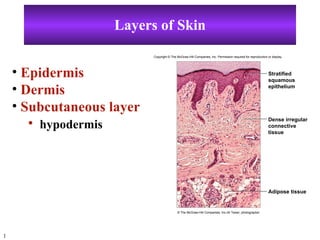
Layers of Skin Epidermis Dermis Subcutaneous layer hypodermis Stratified squamous epithelium Dense irregular connective tissue Adipose tissue Copyright © The McGraw-Hill Companies, Inc. Permission required for reproduction or display. © The McGraw-Hill Companies, Inc./Al Telser, photographer
Epidermis Lacks blood vessels Keratinized Thickest on palms and   soles (0.8-1.4mm) Melanocytes provide melanin Rests on basement membrane Stratified squamous epithelium Copyright © The McGraw-Hill Companies, Inc. Permission required for reproduction or display. b: © Victor Eroschenko (a) Hair shaft Epidermis Hair follicle (b) Sebaceous gland Dermis Sweat Epidermis Dermis Hair shaft Sweat gland pore Capillary Stratum corneum Stratum basale Dermal papilla Arrector pili muscle Lamellated (Pacinian) corpuscle Basement membrane Sebaceous gland Hair follicle Sweat gland Nerve cell process Adipose tissue Blood vessels Muscle layer Sweat gland duct Subcutaneous layer T Tactile (Meissner’s) corpuscle
Epidermis There are five (5) layers of the epidermis: Stratum corneum Stratum lucidum Stratum granulosum Stratum spinosum Stratum basale Stratum corneum Stratum lucidum Stratum granulosum Stratum spinosum Stratum basale Basement membrane Dermis Dermal papilla (a) (b) Copyright © The McGraw-Hill Companies, Inc. Permission required for reproduction or display. b: © The McGraw-Hill Companies, Inc./Al Telser, photographer
Skin and Its Tissues Skin Functions 1. Protection - Physical barrier a.  from water loss b.  from injury c.  from chemicals and microorganisms - Chemical barrier a.  pH or 5-6 b.  prevents microorganism growth - Biological barrier a.  Langerhan’s cells (epidermis) b.  Macrophages and mast cells (dermis) 2. Excretion   (minimal, most through kidneys!) - urea - uric acid 3. Regulation of body temperature -
Skin and Its Tissues Skin Functions 4. Cutaneous Sensation - Light touch detection = Meissner's Corpuscle's a.  egg-shaped; b.  located in dermal papillae; c.  populate areas in the fingertips, palms, soles,    eyelids, tip of tongue, nipples, clitoris, tip of penis. - Pressure detection =  Pacinian Corpuscle's a.  onion-shaped; b.  located in deep dermis and subcutaneous regions - Free nerve endings a.  respond to temperature changes or to factors that    can damage tissues b.  extend into epidermis
Skin and Its Tissues Skin Functions   5. Vitamin D Synthesis - UV rays in sunlight activate its synthesis; - Vitamin D is required for bone homeostasis. 6. Blood Reservoir - The dermis houses about 10% of the body's blood vessels. - Skin only requires 1-2% of the body’s blood 7.   Immunity - Langerhan’s cells (macrophages); - interact with T-helper cells in immune responses.
Skin and Its Tissues
Skin and Its Tissues Accessory structures of the skin originate from the  epidermis and include: Hair follicles Nails Skin glands
Skin and Its Tissues Hair Follicles 1. Epidermal cells that form a tube-like  structure that extends into the dermis 2. Three parts: 1.  Hair shaft 2.  Hair root 3.  Hair papilla 3. Cells that move upward and away  from the nutrient supply ( papilla )  become  keratinized  and die 3. Pigments include: eumelanin  – brownish- black pheomelanin  – reddish- yellow 4. Arrector Pili Muscle  = a bundle of  smooth muscle associated with  every hair follicle.  a.  causes hair to stand on    end ("goose bumps")    when frightened    or cold.
Skin and Its Tissues Nails   1. Epithelium undergoing  keratinization  2. Three parts: 1.  Nail plate 2.  Nail bed 3.  Lunula 3. Functions:  a. manipulation; b. protection of  digit ends.
Skin and Its Tissues Sebaceous Glands 1. holocrine gland  (simple cuboidal  epithelium) 2. associated with every hair follicle 3. Secretion =  sebum  (oil) a.  fat  b.  cellular material  4. Sebum is secreted into hair follicle 5. Function:  Sebum  keeps skin & hair  soft, pliable and virtually  waterproof. .
Skin and Its Tissues Sweat Glands  1. Two types (based on glandular secretion)     A.  Eccrine glands - Structure:  1.  coil in deep dermis 2.  duct in dermis 3.  pore at surface - Characteristics: 1.  respond to elevated temperature /    exercise 2.  no odor in secretion 3.  function throughout life 4.  not associated with hair follicles 5.  Location:  forehead neck back - Secretion (merocrine) =  water  plus  1. salts  and  2. wastes  (urea and uric acid)
Skin and Its Tissues
Skin and Its Tissues Sweat Glands or Sudoriferous Glands B.   Apocrine glands - Structure:  ducts terminate into hair follicles  - Characteristics: 1.  respond to stress / emotions 2.  odor in secretion 3.  begin to function at puberty & continue    through life 4.  associated with hair follicles 5.  Location:  axillary regions  and  groin -  Secretion (apocrine) =  water  above plus  1.  oil   and  2.  cellular debris 3. Modified Sweet Glands 1. Ceruminous glands  = external ear;  secretion = earwax; 2. Mammary glands  = breasts; milk.
Skin and Its Tissues Subcutaneous Layer (hypodermis)   1. beneath skin 2. Structure = adipose tissue & blood vessels 3. Function =  insulation
Regulation of Body Temperature Body temperature – balance between heat production and heat loss At rest, the liver, heart, brain, and endocrine organs account for most heat production During vigorous exercise, heat production from skeletal muscles can increase 30–40 times Normal body temperature is 36.2  C (98.2  F); optimal enzyme activity occurs at this temperature  Temperature spikes above this range denature proteins and depress neurons
Regulation of Body Temperature
Core and Shell Temperature Organs in the core (within the skull, thoracic, and abdominal cavities) have the highest temperature The shell, essentially the skin, has the lowest temperature Blood serves as the major agent of heat transfer between the core and shell Core temperature remains relatively constant, while shell temperature fluctuates substantially  (20  C–40  C)
Mechanisms of Heat Exchange The body uses four mechanisms of heat exchange Radiation – loss of heat in the form of infrared rays Conduction – transfer of heat by direct contact Convection – transfer of heat to the surrounding air Evaporation – heat loss due to the evaporation of water from the lungs, mouth mucosa, and skin (insensible heat loss) Evaporative heat loss becomes sensible when body temperature rises and sweating produces increased water for vaporization
Role of the Hypothalamus The main thermoregulation center is the preoptic region of the hypothalamus The heat-loss and heat-promoting centers comprise the thermoregulatory centers The hypothalamus: Receives input from thermoreceptors in the skin and core Responds by initiating appropriate heat-loss and heat-promoting activities
Heat-Promoting Mechanisms Low external temperature or low temperature of circulating blood activates heat-promoting centers of the hypothalamus to cause: Vasoconstriction of cutaneous blood vessels Increased metabolic rate Shivering Enhanced thyroxine release
Heat-Loss Mechanisms When the core temperature rises, the heat-loss center is activated to cause: Vasodilation of cutaneous blood vessels Enhanced sweating Voluntary measures commonly taken to reduce body heat include: Reducing activity and seeking a cooler environment Wearing light-colored and loose-fitting clothing
Mechanisms of Body Temperature Regulation
Hyperthermia Normal heat loss processes become ineffective and elevated body temperatures depress the hypothalamus This sets up a positive-feedback mechanism, sharply increasing body temperature and metabolic rate This condition, called heat stroke, can be fatal if not corrected
Heat Exhaustion Heat-associated collapse after vigorous exercise, evidenced by elevated body temperature, mental confusion, and fainting Due to dehydration and low blood pressure Heat-loss mechanisms are fully functional Can progress to heat stroke if the body is not cooled and rehydrated
Fever Controlled hyperthermia, often a result of infection, cancer, allergic reactions, or central nervous system injuries White blood cells, injured tissue cells, and macrophages release pyrogens that act on the hypothalamus, causing the release of prostaglandins Prostaglandins reset the hypothalamic thermostat The higher set point is maintained until the natural body defenses reverse the disease process
  Hypothermia  – low body temperature a.  very dangerous if core body temperature    drops below 94 F b.  limbs can withstand about 65 F because they    contain no vital organs

Skin and temperature

  • 1.
    Layers of SkinEpidermis Dermis Subcutaneous layer hypodermis Stratified squamous epithelium Dense irregular connective tissue Adipose tissue Copyright © The McGraw-Hill Companies, Inc. Permission required for reproduction or display. © The McGraw-Hill Companies, Inc./Al Telser, photographer
  • 2.
    Epidermis Lacks bloodvessels Keratinized Thickest on palms and soles (0.8-1.4mm) Melanocytes provide melanin Rests on basement membrane Stratified squamous epithelium Copyright © The McGraw-Hill Companies, Inc. Permission required for reproduction or display. b: © Victor Eroschenko (a) Hair shaft Epidermis Hair follicle (b) Sebaceous gland Dermis Sweat Epidermis Dermis Hair shaft Sweat gland pore Capillary Stratum corneum Stratum basale Dermal papilla Arrector pili muscle Lamellated (Pacinian) corpuscle Basement membrane Sebaceous gland Hair follicle Sweat gland Nerve cell process Adipose tissue Blood vessels Muscle layer Sweat gland duct Subcutaneous layer T Tactile (Meissner’s) corpuscle
  • 3.
    Epidermis There arefive (5) layers of the epidermis: Stratum corneum Stratum lucidum Stratum granulosum Stratum spinosum Stratum basale Stratum corneum Stratum lucidum Stratum granulosum Stratum spinosum Stratum basale Basement membrane Dermis Dermal papilla (a) (b) Copyright © The McGraw-Hill Companies, Inc. Permission required for reproduction or display. b: © The McGraw-Hill Companies, Inc./Al Telser, photographer
  • 4.
    Skin and ItsTissues Skin Functions 1. Protection - Physical barrier a. from water loss b. from injury c. from chemicals and microorganisms - Chemical barrier a. pH or 5-6 b. prevents microorganism growth - Biological barrier a. Langerhan’s cells (epidermis) b. Macrophages and mast cells (dermis) 2. Excretion (minimal, most through kidneys!) - urea - uric acid 3. Regulation of body temperature -
  • 5.
    Skin and ItsTissues Skin Functions 4. Cutaneous Sensation - Light touch detection = Meissner's Corpuscle's a. egg-shaped; b. located in dermal papillae; c. populate areas in the fingertips, palms, soles, eyelids, tip of tongue, nipples, clitoris, tip of penis. - Pressure detection = Pacinian Corpuscle's a. onion-shaped; b. located in deep dermis and subcutaneous regions - Free nerve endings a. respond to temperature changes or to factors that can damage tissues b. extend into epidermis
  • 6.
    Skin and ItsTissues Skin Functions 5. Vitamin D Synthesis - UV rays in sunlight activate its synthesis; - Vitamin D is required for bone homeostasis. 6. Blood Reservoir - The dermis houses about 10% of the body's blood vessels. - Skin only requires 1-2% of the body’s blood 7. Immunity - Langerhan’s cells (macrophages); - interact with T-helper cells in immune responses.
  • 7.
    Skin and ItsTissues
  • 8.
    Skin and ItsTissues Accessory structures of the skin originate from the epidermis and include: Hair follicles Nails Skin glands
  • 9.
    Skin and ItsTissues Hair Follicles 1. Epidermal cells that form a tube-like structure that extends into the dermis 2. Three parts: 1. Hair shaft 2. Hair root 3. Hair papilla 3. Cells that move upward and away from the nutrient supply ( papilla ) become keratinized and die 3. Pigments include: eumelanin – brownish- black pheomelanin – reddish- yellow 4. Arrector Pili Muscle = a bundle of smooth muscle associated with every hair follicle. a. causes hair to stand on end ("goose bumps") when frightened or cold.
  • 10.
    Skin and ItsTissues Nails 1. Epithelium undergoing keratinization 2. Three parts: 1. Nail plate 2. Nail bed 3. Lunula 3. Functions: a. manipulation; b. protection of digit ends.
  • 11.
    Skin and ItsTissues Sebaceous Glands 1. holocrine gland (simple cuboidal epithelium) 2. associated with every hair follicle 3. Secretion = sebum (oil) a. fat b. cellular material 4. Sebum is secreted into hair follicle 5. Function: Sebum keeps skin & hair soft, pliable and virtually waterproof. .
  • 12.
    Skin and ItsTissues Sweat Glands 1. Two types (based on glandular secretion) A. Eccrine glands - Structure: 1. coil in deep dermis 2. duct in dermis 3. pore at surface - Characteristics: 1. respond to elevated temperature / exercise 2. no odor in secretion 3. function throughout life 4. not associated with hair follicles 5. Location: forehead neck back - Secretion (merocrine) = water plus 1. salts and 2. wastes (urea and uric acid)
  • 13.
    Skin and ItsTissues
  • 14.
    Skin and ItsTissues Sweat Glands or Sudoriferous Glands B. Apocrine glands - Structure: ducts terminate into hair follicles - Characteristics: 1. respond to stress / emotions 2. odor in secretion 3. begin to function at puberty & continue through life 4. associated with hair follicles 5. Location: axillary regions and groin - Secretion (apocrine) = water above plus 1. oil and 2. cellular debris 3. Modified Sweet Glands 1. Ceruminous glands = external ear; secretion = earwax; 2. Mammary glands = breasts; milk.
  • 15.
    Skin and ItsTissues Subcutaneous Layer (hypodermis) 1. beneath skin 2. Structure = adipose tissue & blood vessels 3. Function = insulation
  • 16.
    Regulation of BodyTemperature Body temperature – balance between heat production and heat loss At rest, the liver, heart, brain, and endocrine organs account for most heat production During vigorous exercise, heat production from skeletal muscles can increase 30–40 times Normal body temperature is 36.2  C (98.2  F); optimal enzyme activity occurs at this temperature Temperature spikes above this range denature proteins and depress neurons
  • 17.
    Regulation of BodyTemperature
  • 18.
    Core and ShellTemperature Organs in the core (within the skull, thoracic, and abdominal cavities) have the highest temperature The shell, essentially the skin, has the lowest temperature Blood serves as the major agent of heat transfer between the core and shell Core temperature remains relatively constant, while shell temperature fluctuates substantially (20  C–40  C)
  • 19.
    Mechanisms of HeatExchange The body uses four mechanisms of heat exchange Radiation – loss of heat in the form of infrared rays Conduction – transfer of heat by direct contact Convection – transfer of heat to the surrounding air Evaporation – heat loss due to the evaporation of water from the lungs, mouth mucosa, and skin (insensible heat loss) Evaporative heat loss becomes sensible when body temperature rises and sweating produces increased water for vaporization
  • 20.
    Role of theHypothalamus The main thermoregulation center is the preoptic region of the hypothalamus The heat-loss and heat-promoting centers comprise the thermoregulatory centers The hypothalamus: Receives input from thermoreceptors in the skin and core Responds by initiating appropriate heat-loss and heat-promoting activities
  • 21.
    Heat-Promoting Mechanisms Lowexternal temperature or low temperature of circulating blood activates heat-promoting centers of the hypothalamus to cause: Vasoconstriction of cutaneous blood vessels Increased metabolic rate Shivering Enhanced thyroxine release
  • 22.
    Heat-Loss Mechanisms Whenthe core temperature rises, the heat-loss center is activated to cause: Vasodilation of cutaneous blood vessels Enhanced sweating Voluntary measures commonly taken to reduce body heat include: Reducing activity and seeking a cooler environment Wearing light-colored and loose-fitting clothing
  • 23.
    Mechanisms of BodyTemperature Regulation
  • 24.
    Hyperthermia Normal heatloss processes become ineffective and elevated body temperatures depress the hypothalamus This sets up a positive-feedback mechanism, sharply increasing body temperature and metabolic rate This condition, called heat stroke, can be fatal if not corrected
  • 25.
    Heat Exhaustion Heat-associatedcollapse after vigorous exercise, evidenced by elevated body temperature, mental confusion, and fainting Due to dehydration and low blood pressure Heat-loss mechanisms are fully functional Can progress to heat stroke if the body is not cooled and rehydrated
  • 26.
    Fever Controlled hyperthermia,often a result of infection, cancer, allergic reactions, or central nervous system injuries White blood cells, injured tissue cells, and macrophages release pyrogens that act on the hypothalamus, causing the release of prostaglandins Prostaglandins reset the hypothalamic thermostat The higher set point is maintained until the natural body defenses reverse the disease process
  • 27.
    Hypothermia – low body temperature a. very dangerous if core body temperature drops below 94 F b. limbs can withstand about 65 F because they contain no vital organs